
Induction of Current in a Coil A magnetic
- Slides: 44
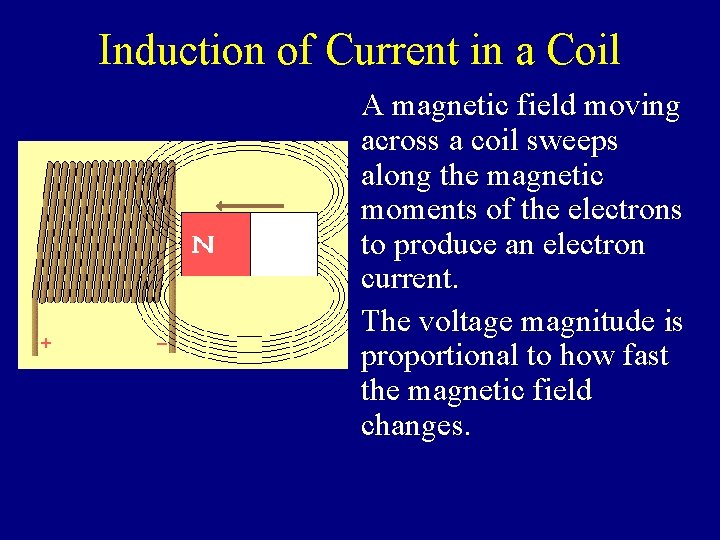
Induction of Current in a Coil A magnetic field moving across a coil sweeps along the magnetic moments of the electrons to produce an electron current. The voltage magnitude is proportional to how fast the magnetic field changes.
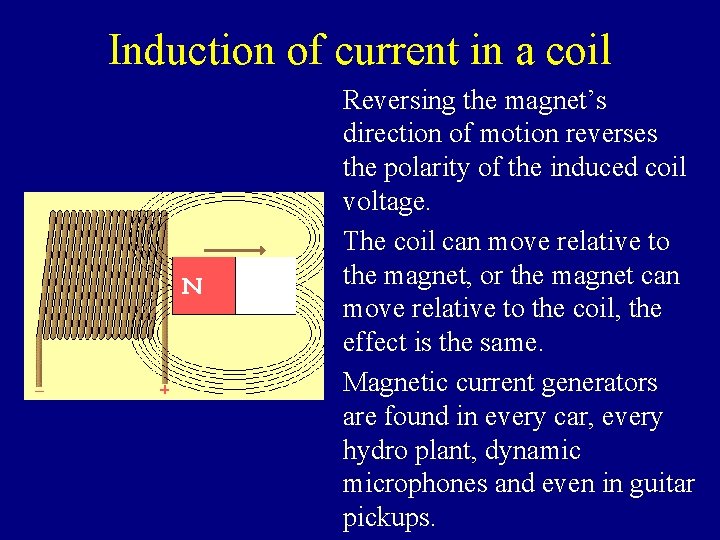
Induction of current in a coil Reversing the magnet’s direction of motion reverses the polarity of the induced coil voltage. The coil can move relative to the magnet, or the magnet can move relative to the coil, the effect is the same. Magnetic current generators are found in every car, every hydro plant, dynamic microphones and even in guitar pickups.
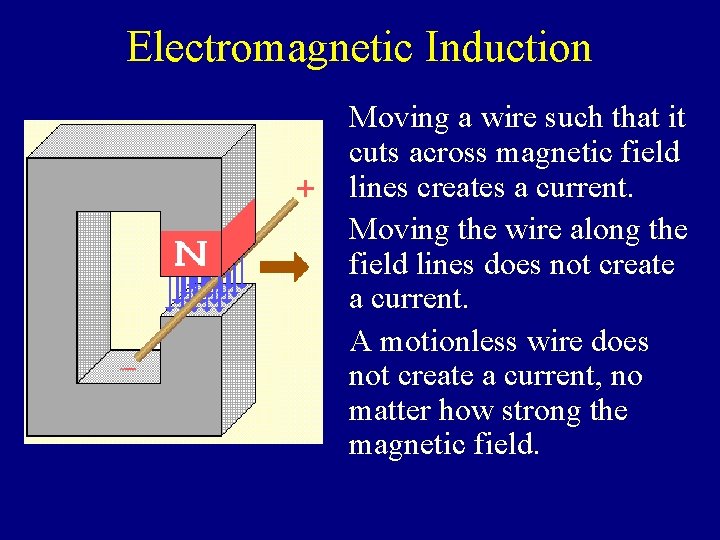
Electromagnetic Induction Moving a wire such that it cuts across magnetic field lines creates a current. Moving the wire along the field lines does not create a current. A motionless wire does not create a current, no matter how strong the magnetic field.
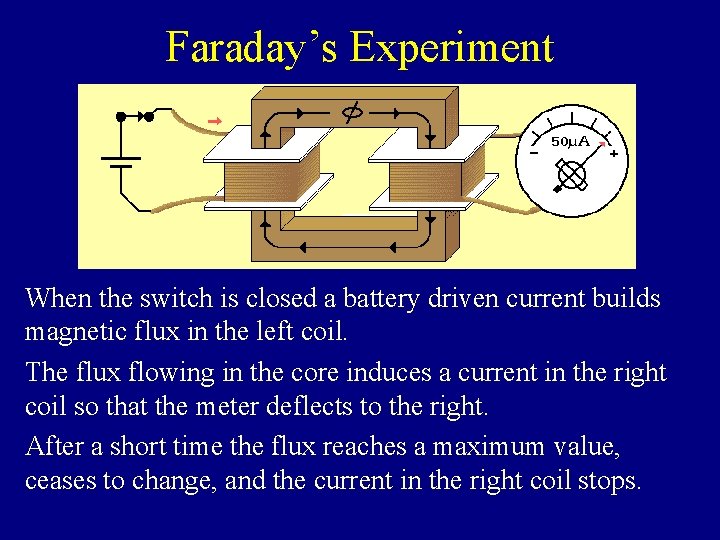
Faraday’s Experiment When the switch is closed a battery driven current builds magnetic flux in the left coil. The flux flowing in the core induces a current in the right coil so that the meter deflects to the right. After a short time the flux reaches a maximum value, ceases to change, and the current in the right coil stops.
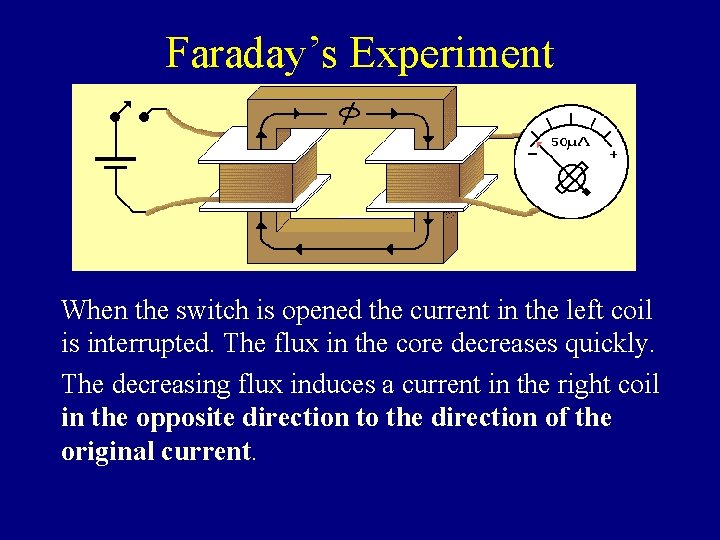
Faraday’s Experiment When the switch is opened the current in the left coil is interrupted. The flux in the core decreases quickly. The decreasing flux induces a current in the right coil in the opposite direction to the direction of the original current.
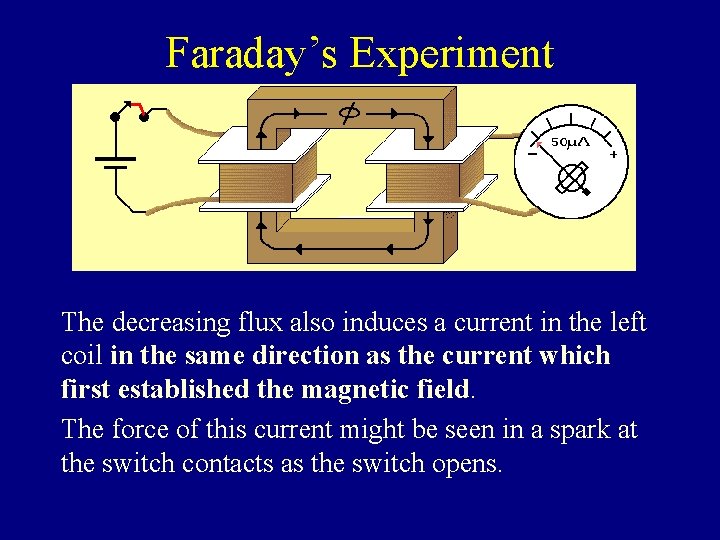
Faraday’s Experiment The decreasing flux also induces a current in the left coil in the same direction as the current which first established the magnetic field. The force of this current might be seen in a spark at the switch contacts as the switch opens.
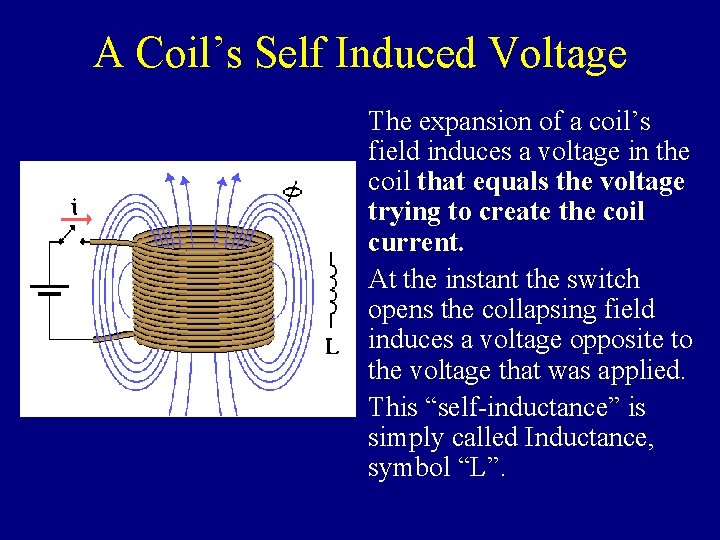
A Coil’s Self Induced Voltage The expansion of a coil’s field induces a voltage in the coil that equals the voltage trying to create the coil current. At the instant the switch opens the collapsing field induces a voltage opposite to the voltage that was applied. This “self-inductance” is simply called Inductance, symbol “L”.
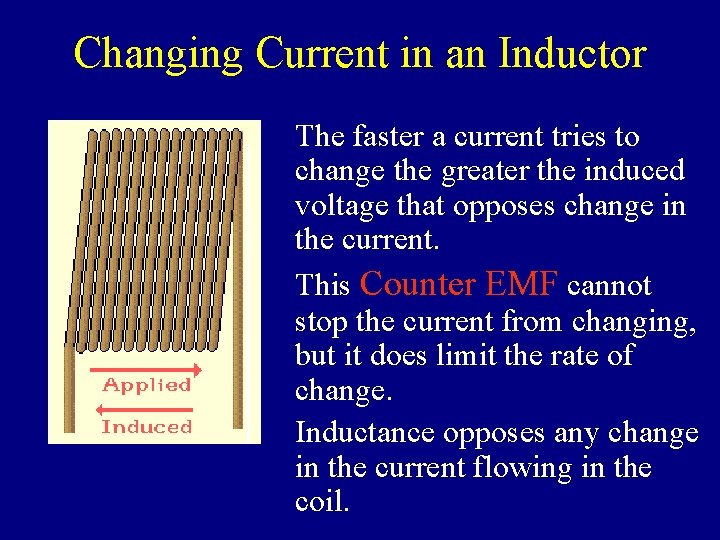
Changing Current in an Inductor The faster a current tries to change the greater the induced voltage that opposes change in the current. This Counter EMF cannot stop the current from changing, but it does limit the rate of change. Inductance opposes any change in the current flowing in the coil.
Faraday’s Law Voltage is induced in a circuit ( a wire, coil, etc) whenever the flux linking (passing through) the circuit is changing ( �) and that the magnitude of the voltage is proportional to the rate of change of the flux linkages.
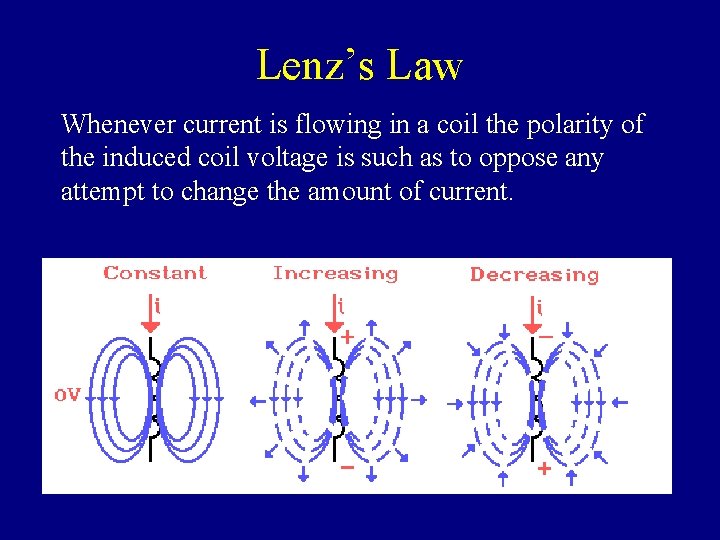
Lenz’s Law Whenever current is flowing in a coil the polarity of the induced coil voltage is such as to oppose any attempt to change the amount of current.
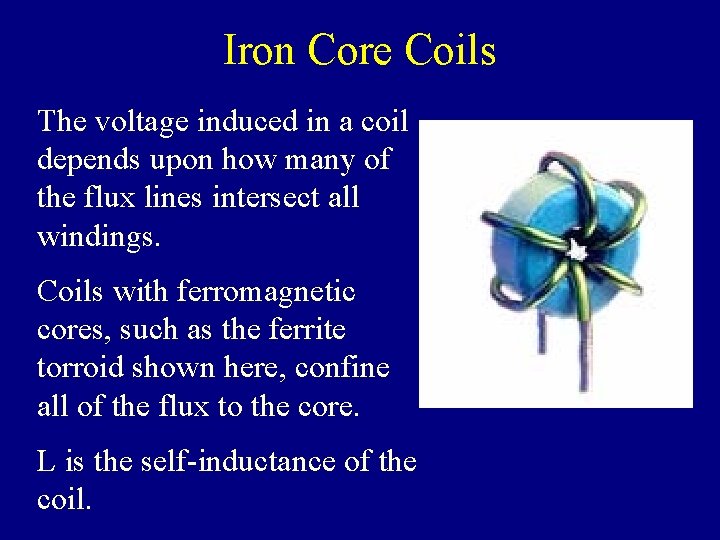
Iron Core Coils The voltage induced in a coil depends upon how many of the flux lines intersect all windings. Coils with ferromagnetic cores, such as the ferrite torroid shown here, confine all of the flux to the core. L is the self-inductance of the coil.
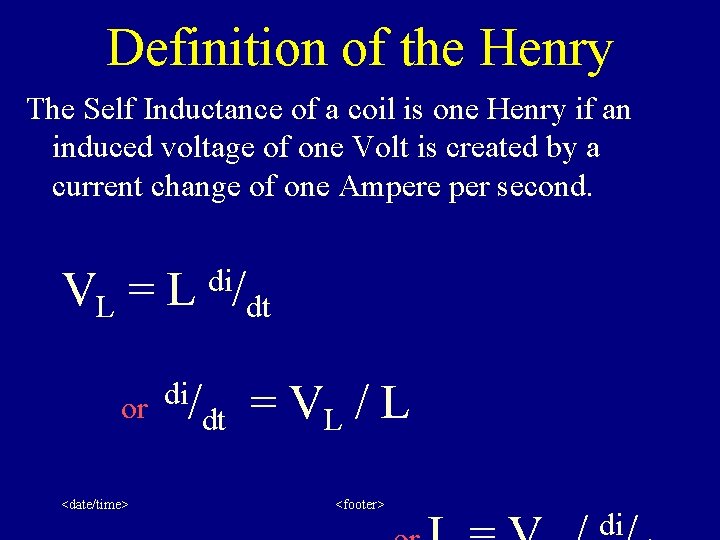
Definition of the Henry The Self Inductance of a coil is one Henry if an induced voltage of one Volt is created by a current change of one Ampere per second. VL = L di/ di or /dt <date/time> dt = VL / L <footer> di
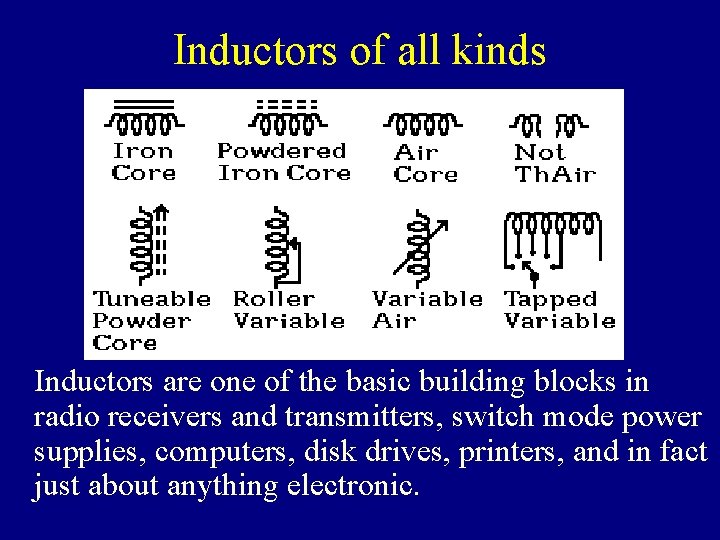
Inductors of all kinds Inductors are one of the basic building blocks in radio receivers and transmitters, switch mode power supplies, computers, disk drives, printers, and in fact just about anything electronic.
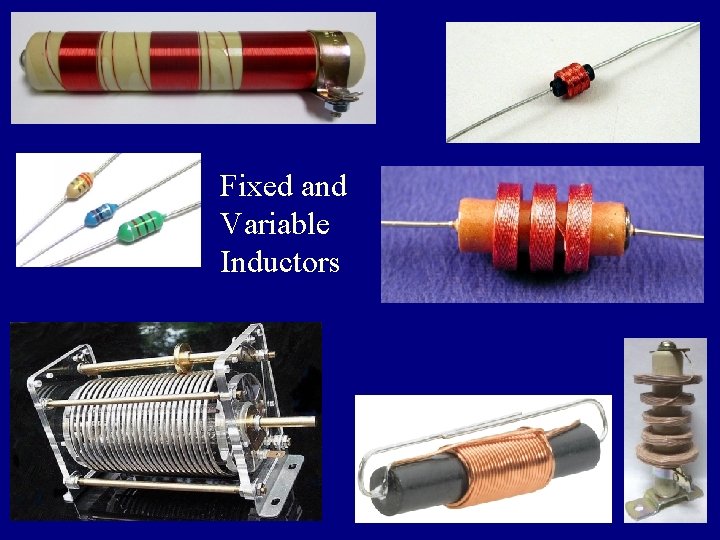
Fixed and Variable Inductors
Transformers
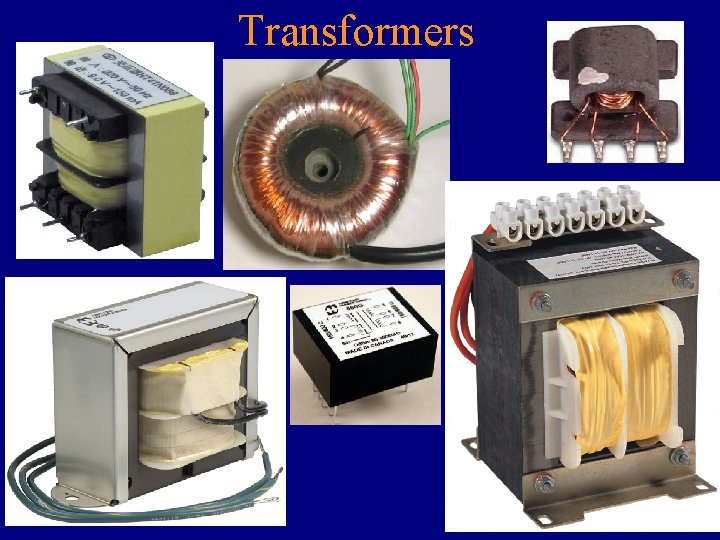
Transformers
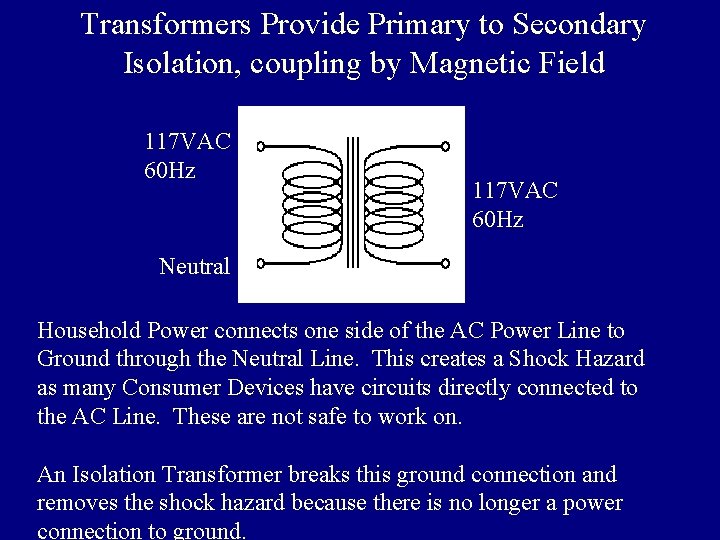
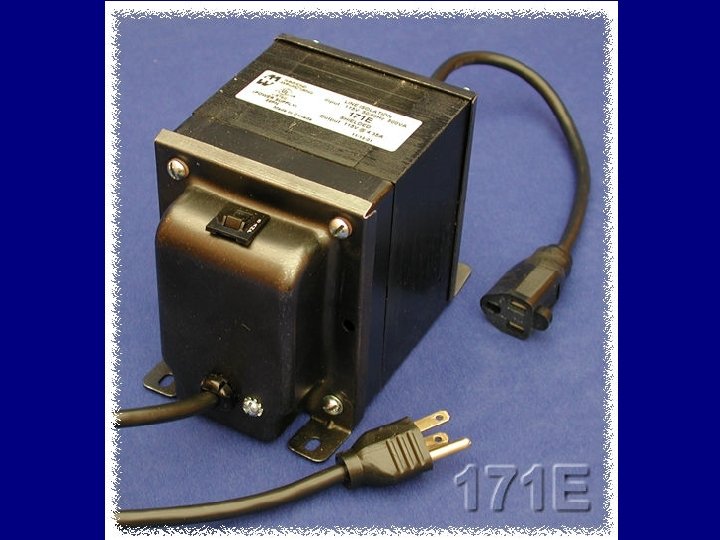
Transformers Provide Primary to Secondary Isolation, coupling by Magnetic Field 117 VAC 60 Hz Neutral Household Power connects one side of the AC Power Line to Ground through the Neutral Line. This creates a Shock Hazard as many Consumer Devices have circuits directly connected to the AC Line. These are not safe to work on. An Isolation Transformer breaks this ground connection and removes the shock hazard because there is no longer a power connection to ground.
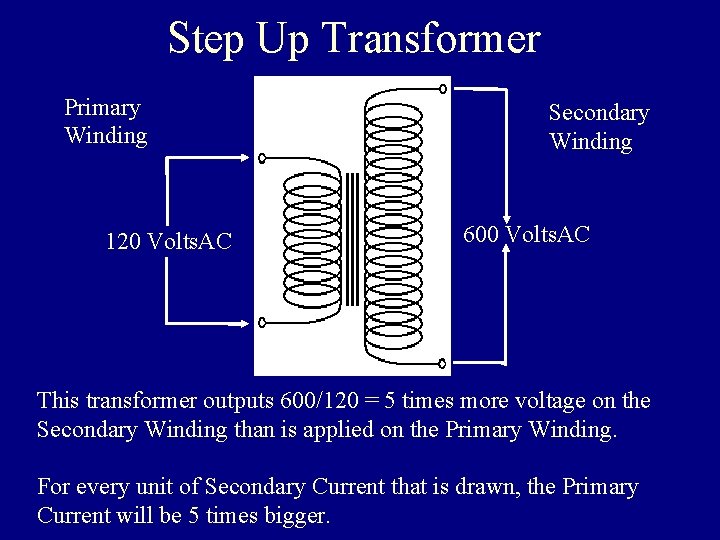
Step Up Transformer Primary Winding 120 Volts. AC Secondary Winding 600 Volts. AC This transformer outputs 600/120 = 5 times more voltage on the Secondary Winding than is applied on the Primary Winding. For every unit of Secondary Current that is drawn, the Primary Current will be 5 times bigger.
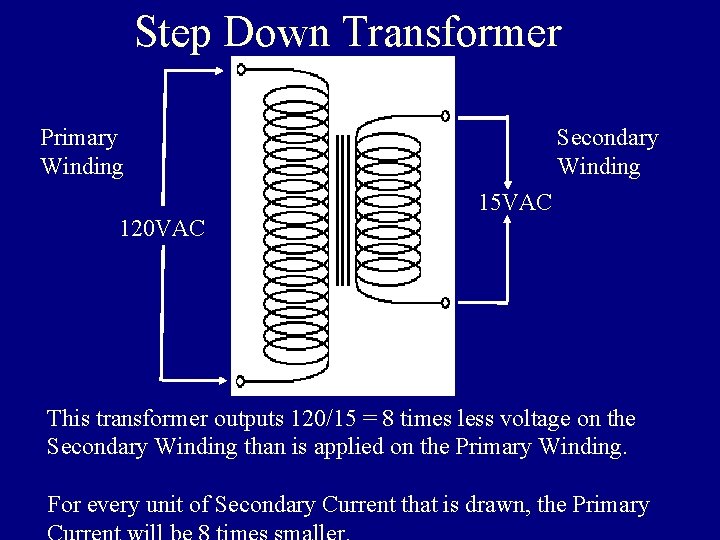
Step Down Transformer Primary Winding 120 VAC Secondary Winding 15 VAC This transformer outputs 120/15 = 8 times less voltage on the Secondary Winding than is applied on the Primary Winding. For every unit of Secondary Current that is drawn, the Primary
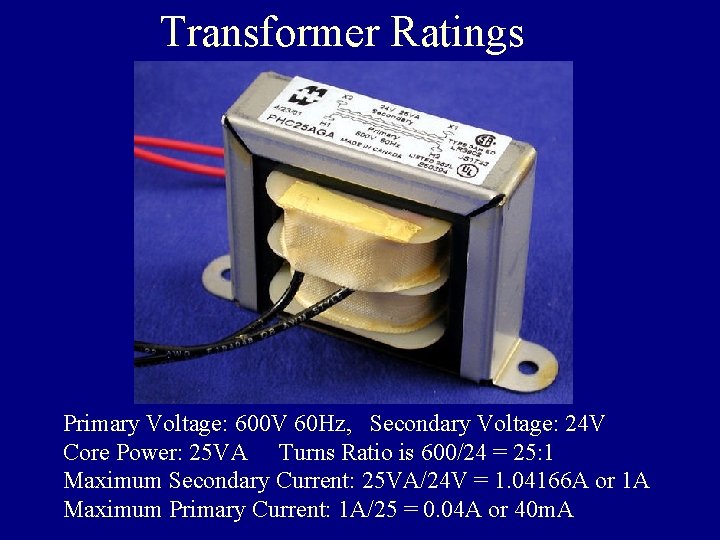
Transformer Ratings Primary Voltage: 600 V 60 Hz, Secondary Voltage: 24 V Core Power: 25 VA Turns Ratio is 600/24 = 25: 1 Maximum Secondary Current: 25 VA/24 V = 1. 04166 A or 1 A Maximum Primary Current: 1 A/25 = 0. 04 A or 40 m. A
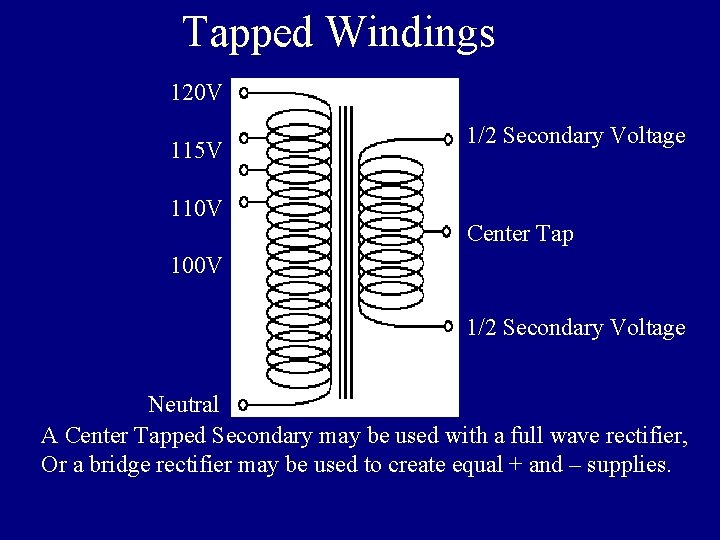
Tapped Windings 120 V 115 V 110 V 1/2 Secondary Voltage Center Tap 100 V 1/2 Secondary Voltage Neutral A Center Tapped Secondary may be used with a full wave rectifier, Or a bridge rectifier may be used to create equal + and – supplies.
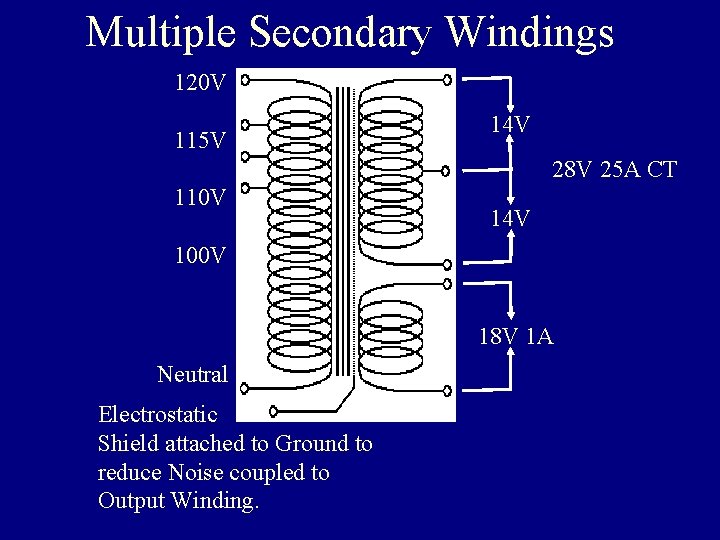
Multiple Secondary Windings 120 V 115 V 14 V 28 V 25 A CT 110 V 14 V 100 V 18 V 1 A Neutral Electrostatic Shield attached to Ground to reduce Noise coupled to Output Winding.
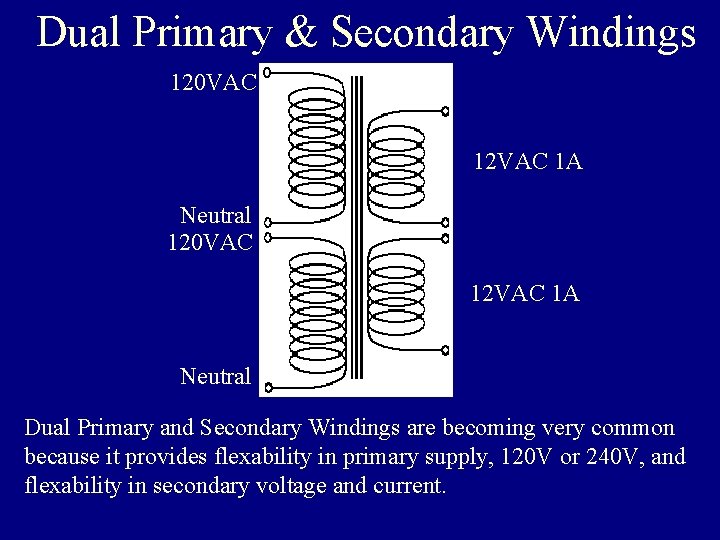
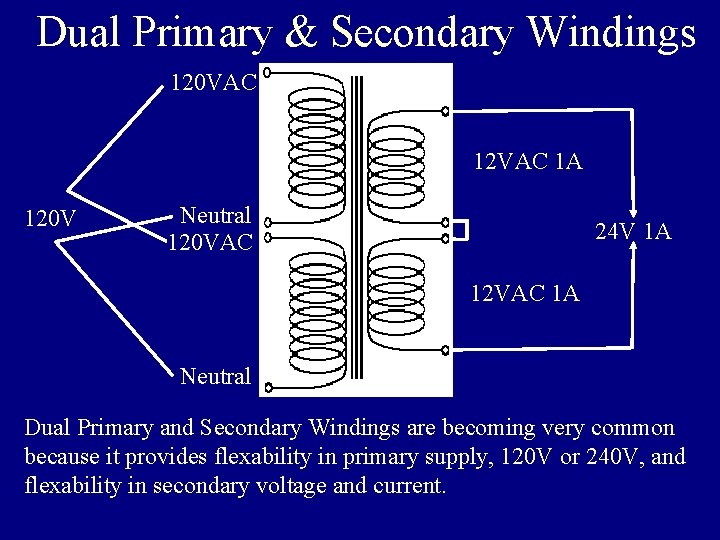
Dual Primary & Secondary Windings 120 VAC 12 VAC 1 A Neutral Dual Primary and Secondary Windings are becoming very common because it provides flexability in primary supply, 120 V or 240 V, and flexability in secondary voltage and current.
Dual Primary & Secondary Windings 120 VAC 12 VAC 1 A 120 V Neutral 120 VAC 24 V 1 A 12 VAC 1 A Neutral Dual Primary and Secondary Windings are becoming very common because it provides flexability in primary supply, 120 V or 240 V, and flexability in secondary voltage and current.
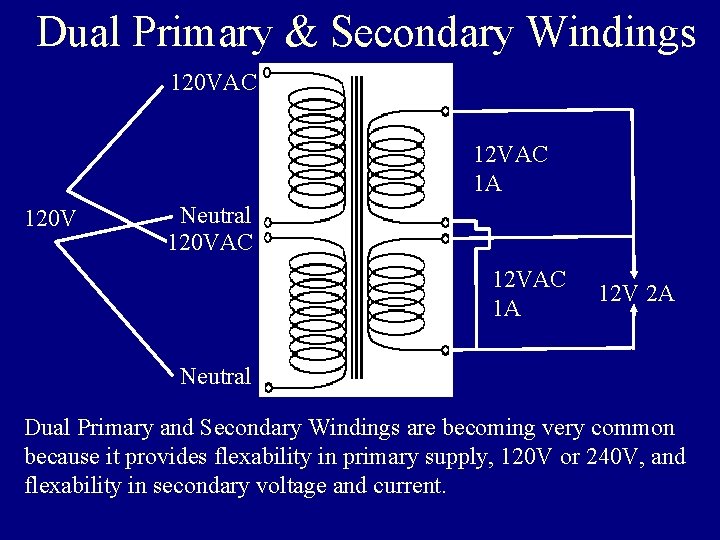
Dual Primary & Secondary Windings 120 VAC 12 VAC 1 A 120 V Neutral 120 VAC 12 VAC 1 A 12 V 2 A Neutral Dual Primary and Secondary Windings are becoming very common because it provides flexability in primary supply, 120 V or 240 V, and flexability in secondary voltage and current.
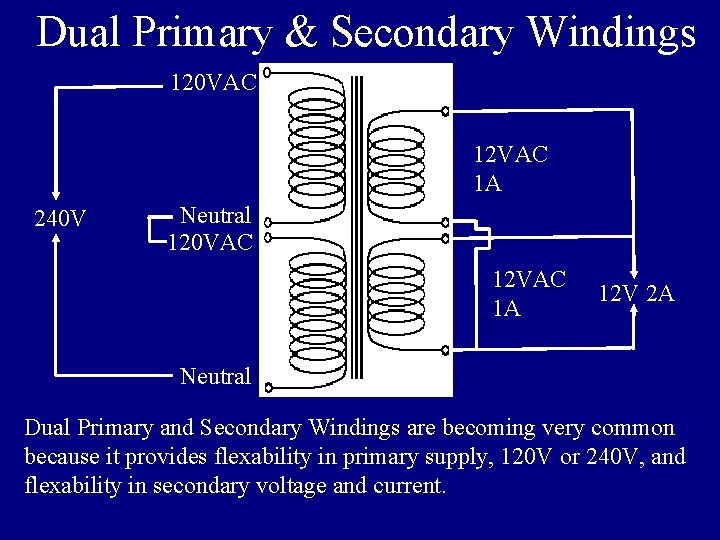
Dual Primary & Secondary Windings 120 VAC 12 VAC 1 A 240 V Neutral 120 VAC 12 VAC 1 A 12 V 2 A Neutral Dual Primary and Secondary Windings are becoming very common because it provides flexability in primary supply, 120 V or 240 V, and flexability in secondary voltage and current.
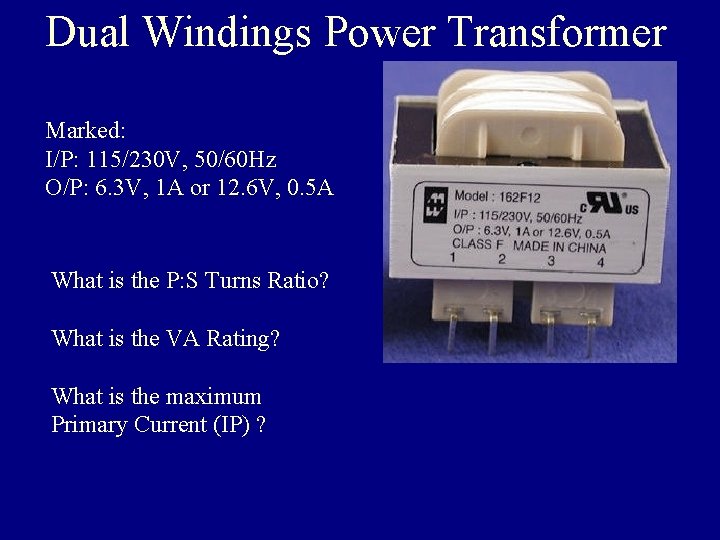
Dual Windings Power Transformer Marked: I/P: 115/230 V, 50/60 Hz O/P: 6. 3 V, 1 A or 12. 6 V, 0. 5 A What is the P: S Turns Ratio? What is the VA Rating? What is the maximum Primary Current (IP) ?
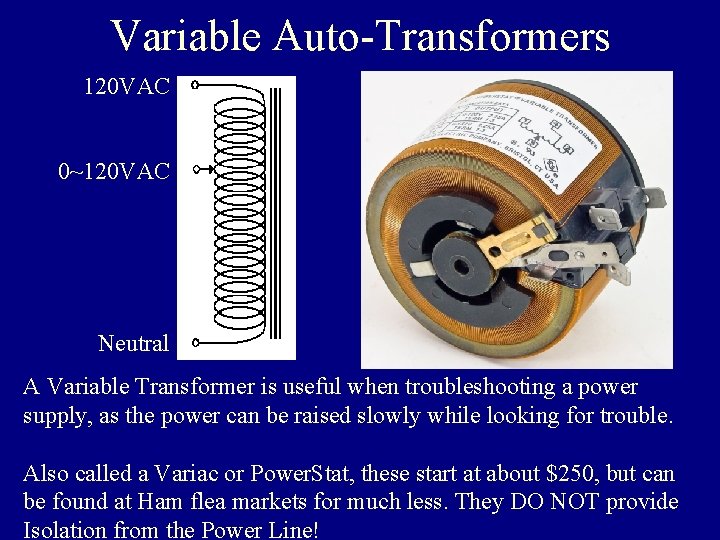
Variable Auto-Transformers 120 VAC 0~120 VAC Neutral A Variable Transformer is useful when troubleshooting a power supply, as the power can be raised slowly while looking for trouble. Also called a Variac or Power. Stat, these start at about $250, but can be found at Ham flea markets for much less. They DO NOT provide Isolation from the Power Line!
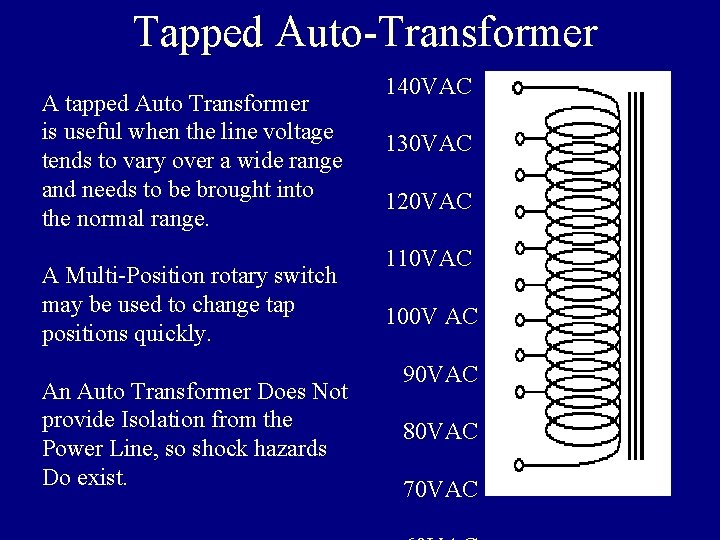
Tapped Auto-Transformer A tapped Auto Transformer is useful when the line voltage tends to vary over a wide range and needs to be brought into the normal range. A Multi-Position rotary switch may be used to change tap positions quickly. An Auto Transformer Does Not provide Isolation from the Power Line, so shock hazards Do exist. 140 VAC 130 VAC 120 VAC 110 VAC 100 V AC 90 VAC 80 VAC 70 VAC
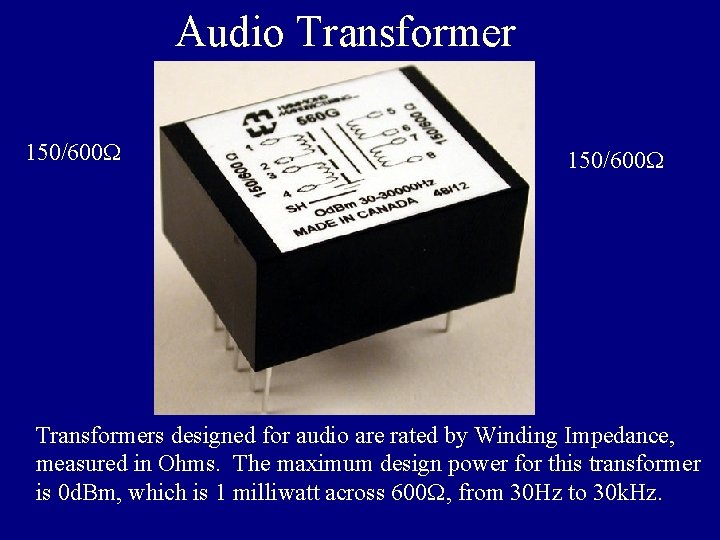
Audio Transformer 150/600 Transformers designed for audio are rated by Winding Impedance, measured in Ohms. The maximum design power for this transformer is 0 d. Bm, which is 1 milliwatt across 600 , from 30 Hz to 30 k. Hz.
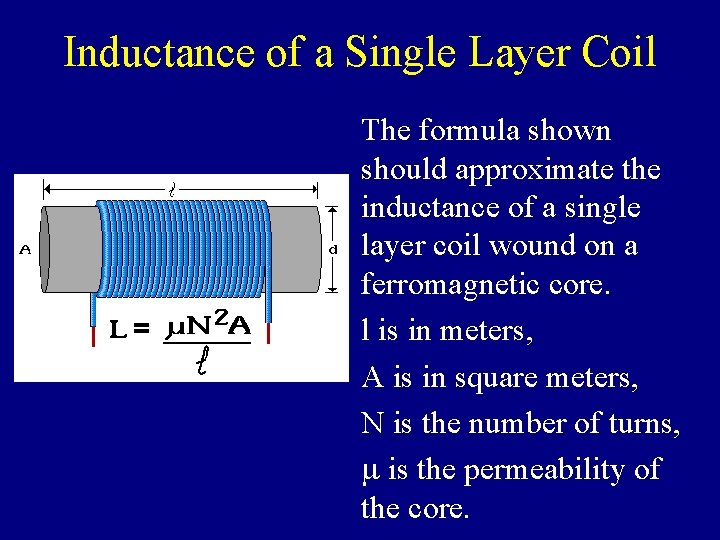
Inductance of a Single Layer Coil The formula shown should approximate the inductance of a single layer coil wound on a ferromagnetic core. l is in meters, A is in square meters, N is the number of turns, is the permeability of the core.
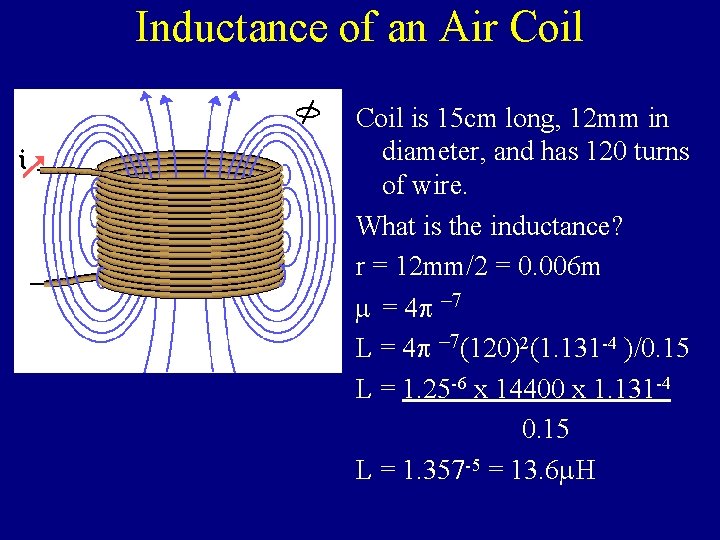
Inductance of an Air Coil is 15 cm long, 12 mm in diameter, and has 120 turns of wire. What is the inductance? r = 12 mm/2 = 0. 006 m = 4 – 7 L = 4 – 7(120)2(1. 131 -4 )/0. 15 L = 1. 25 -6 x 14400 x 1. 131 -4 0. 15 L = 1. 357 -5 = 13. 6 H
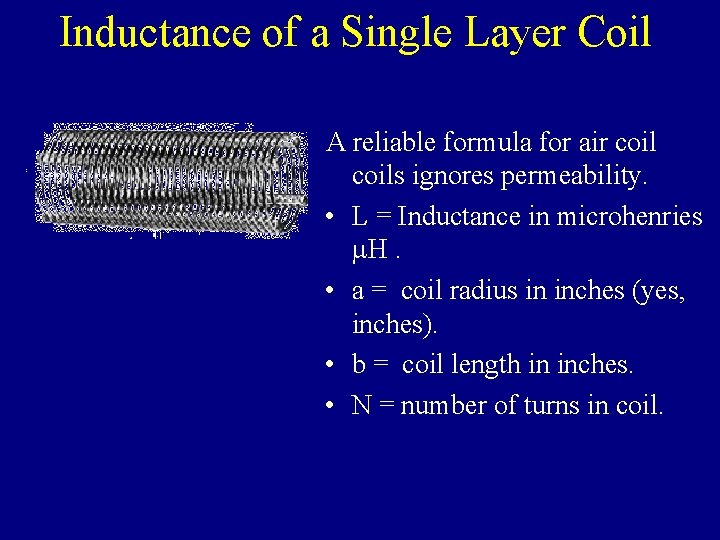
Inductance of a Single Layer Coil A reliable formula for air coils ignores permeability. • L = Inductance in microhenries H. • a = coil radius in inches (yes, inches). • b = coil length in inches. • N = number of turns in coil.
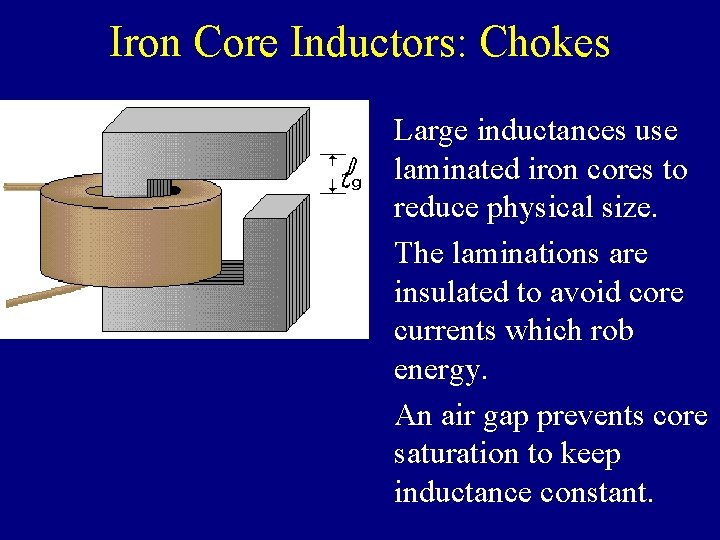
Iron Core Inductors: Chokes Large inductances use laminated iron cores to reduce physical size. The laminations are insulated to avoid core currents which rob energy. An air gap prevents core saturation to keep inductance constant.
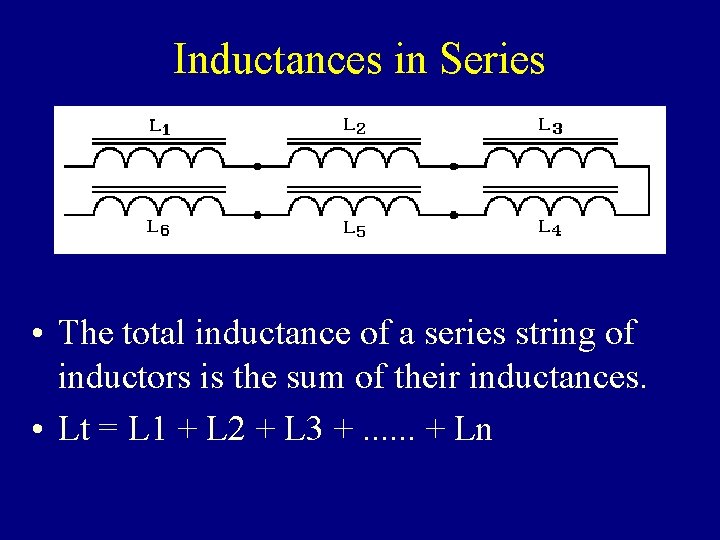
Inductors in Series and Parallel • All of the principles you learned with resistors apply to Inductors too. • Resistors will heat each other if located close together, reducing the power rating. • Inductors will change each other if placed too close together, due to magnetic coupling. Sometimes desirable, sometimes not.
Inductances in Series • The total inductance of a series string of inductors is the sum of their inductances. • Lt = L 1 + L 2 + L 3 +. . . + Ln
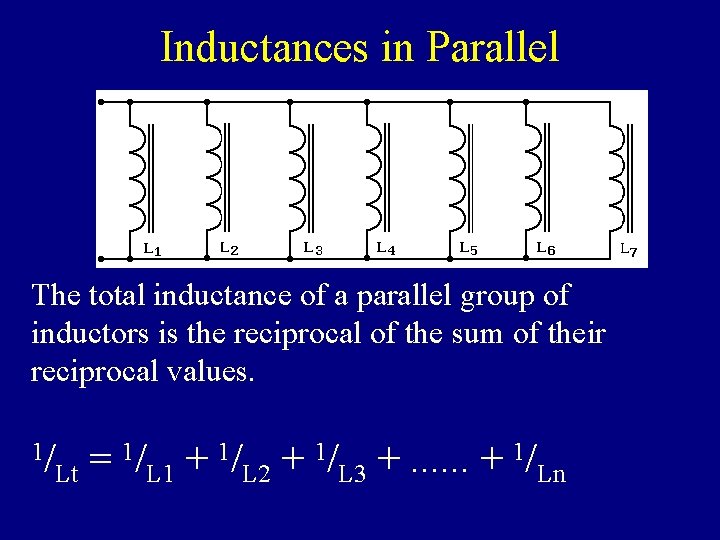
Inductances in Parallel The total inductance of a parallel group of inductors is the reciprocal of the sum of their reciprocal values. 1/ 1/ +. . . + 1/ = Lt L 1 L 2 L 3 Ln
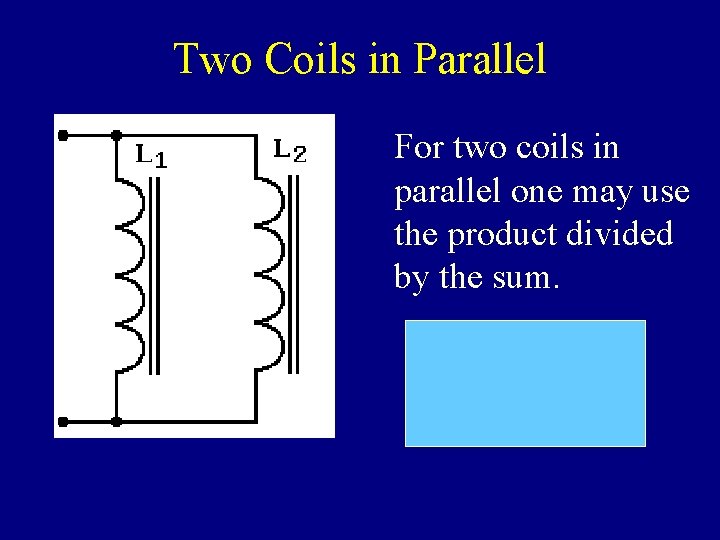
Two Coils in Parallel For two coils in parallel one may use the product divided by the sum.
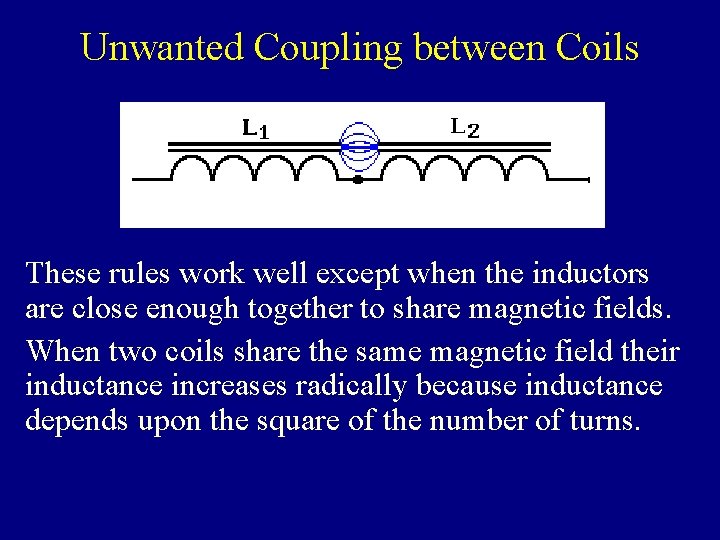
Unwanted Coupling between Coils These rules work well except when the inductors are close enough together to share magnetic fields. When two coils share the same magnetic field their inductance increases radically because inductance depends upon the square of the number of turns.
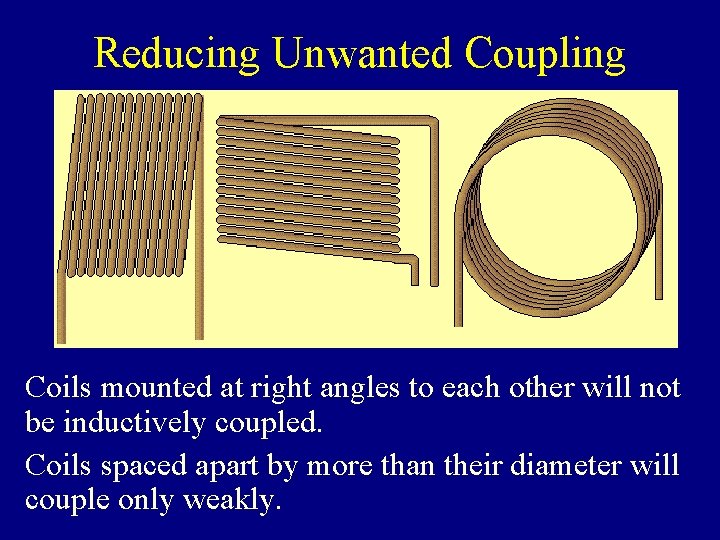
Reducing Unwanted Coupling Coils mounted at right angles to each other will not be inductively coupled. Coils spaced apart by more than their diameter will couple only weakly.
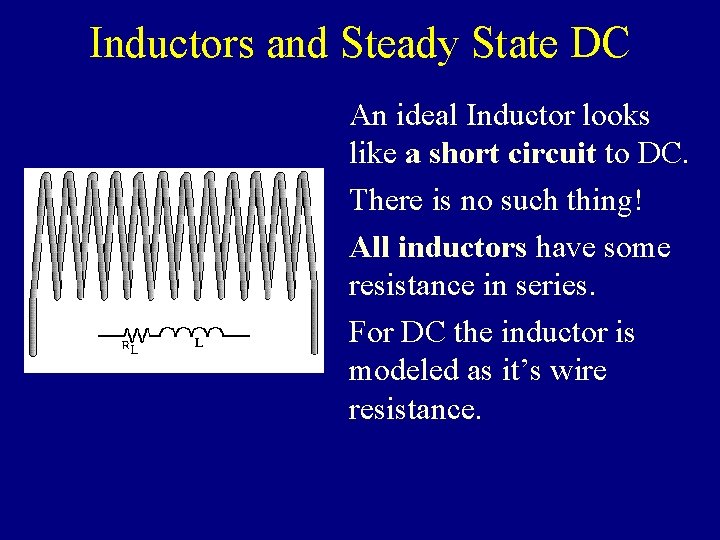
Inductors and Steady State DC An ideal Inductor looks like a short circuit to DC. There is no such thing! All inductors have some resistance in series. For DC the inductor is modeled as it’s wire resistance.
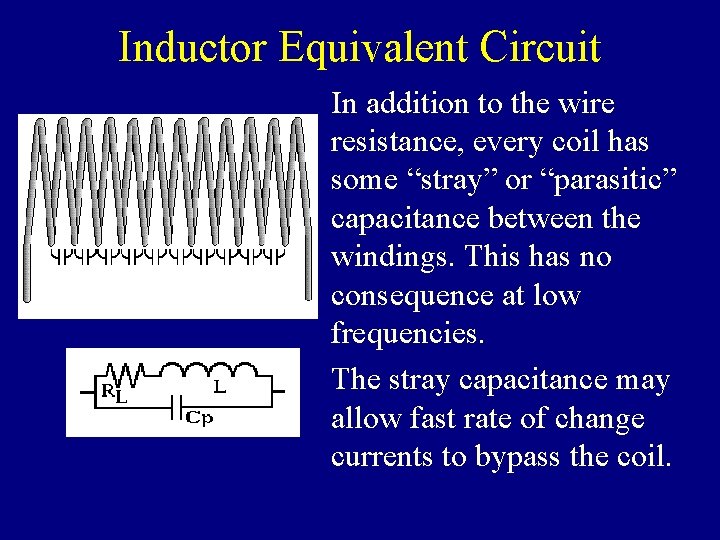
Inductor Equivalent Circuit In addition to the wire resistance, every coil has some “stray” or “parasitic” capacitance between the windings. This has no consequence at low frequencies. The stray capacitance may allow fast rate of change currents to bypass the coil.
How Do Inductors Fail? • Inductors fail open circuit: – wire failure, solder or weld failure, or thermal fuse opens. • Inductors short circuit: – Insulation fails due to heat, high voltage, or abrasion. – Wire shorts across turns. – Wire shorts to metal core. • Inductors arc intermittent: – May fail under load but test OK with VOM.