
INDUCTION MOTORS General Single phase induction motor The

- Slides: 19
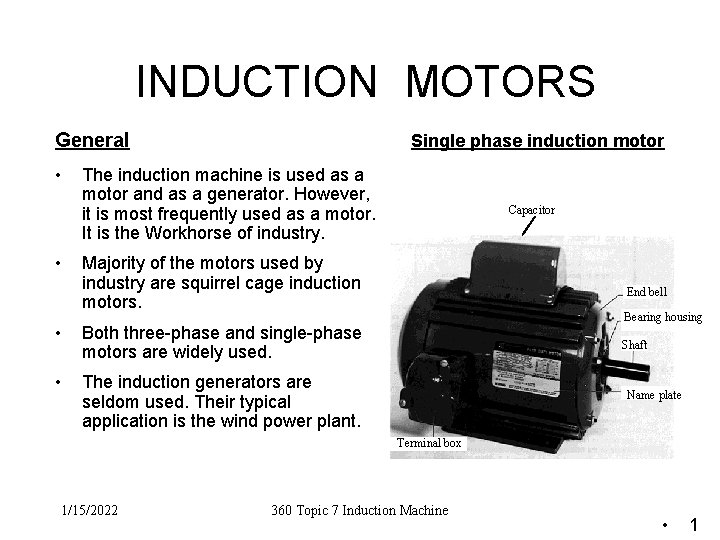
INDUCTION MOTORS General • • Single phase induction motor The induction machine is used as a motor and as a generator. However, it is most frequently used as a motor. It is the Workhorse of industry. Capacitor Majority of the motors used by industry are squirrel cage induction motors. • Both three-phase and single-phase motors are widely used. • The induction generators are seldom used. Their typical application is the wind power plant. End bell Bearing housing Shaft Name plate Terminal box 1/15/2022 360 Topic 7 Induction Machine • 1
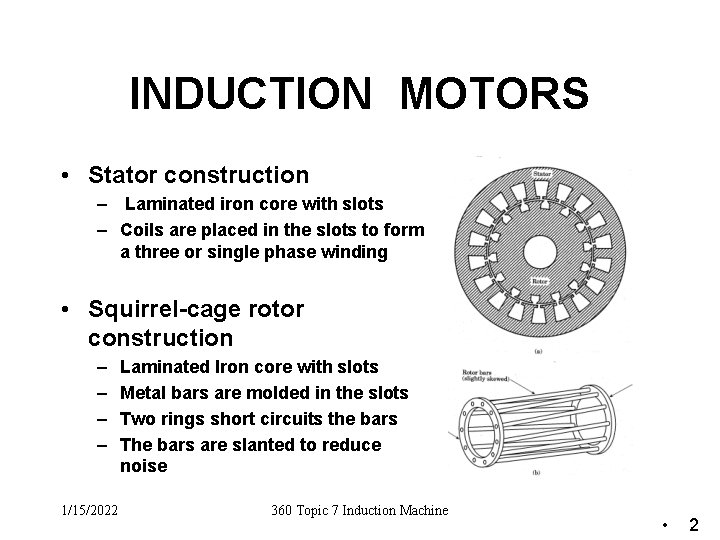
INDUCTION MOTORS • Stator construction – Laminated iron core with slots – Coils are placed in the slots to form a three or single phase winding • Squirrel-cage rotor construction – – 1/15/2022 Laminated Iron core with slots Metal bars are molded in the slots Two rings short circuits the bars The bars are slanted to reduce noise 360 Topic 7 Induction Machine • 2
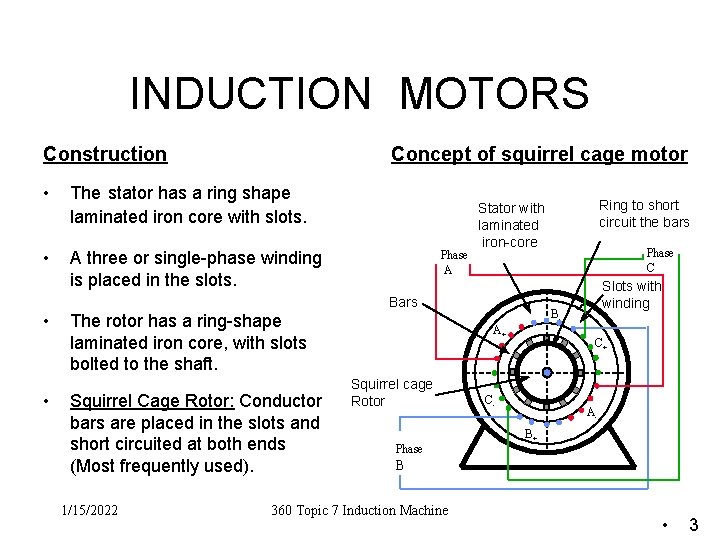
INDUCTION MOTORS Construction Concept of squirrel cage motor • The stator has a ring shape laminated iron core with slots. • A three or single-phase winding is placed in the slots. Phase A Bars • • The rotor has a ring-shape laminated iron core, with slots bolted to the shaft. Squirrel Cage Rotor: Conductor bars are placed in the slots and short circuited at both ends (Most frequently used). 1/15/2022 Phase C Slots with winding BA+ Squirrel cage Rotor Ring to short circuit the bars Stator with laminated iron-core C+ C- AB+ B 360 Topic 7 Induction Machine • 3
INDUCTION MOTORS Concept of wound-rotor motor Construction • • • Wound-rotor: Three-phase windings are placed in the slots. The winding is wye or delta connected. The ends of each phase is connected to a slip ring. Three brushes contact the three slip-rings. The rotor winding may be loaded by variable resistance's or supplied by a separate power supply. 1/15/2022 Stator with laminated Phase iron-core Laminated core with slots Phase C A Three phase winding BA+ Slip rings Phase Slots with winding C+ C- AB+ B 360 Topic 7 Induction Machine Shaft • 4
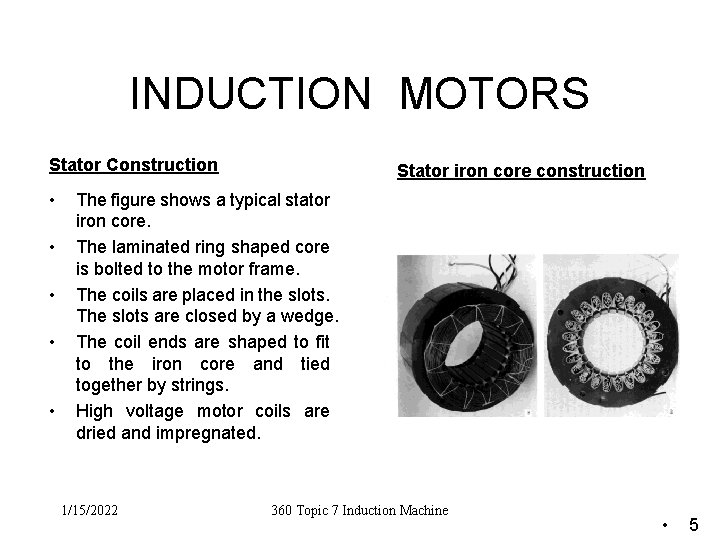
INDUCTION MOTORS Stator Construction • • • Stator iron core construction The figure shows a typical stator iron core. The laminated ring shaped core is bolted to the motor frame. The coils are placed in the slots. The slots are closed by a wedge. The coil ends are shaped to fit to the iron core and tied together by strings. High voltage motor coils are dried and impregnated. 1/15/2022 360 Topic 7 Induction Machine • 5
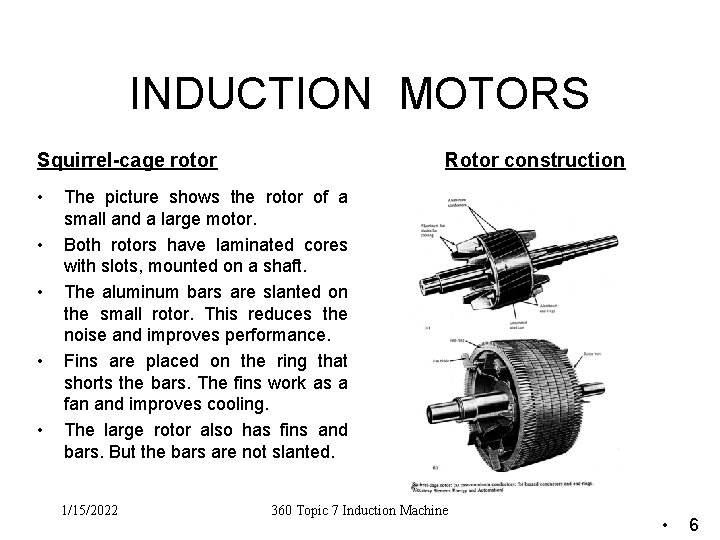
INDUCTION MOTORS Squirrel-cage rotor • • • Rotor construction The picture shows the rotor of a small and a large motor. Both rotors have laminated cores with slots, mounted on a shaft. The aluminum bars are slanted on the small rotor. This reduces the noise and improves performance. Fins are placed on the ring that shorts the bars. The fins work as a fan and improves cooling. The large rotor also has fins and bars. But the bars are not slanted. 1/15/2022 360 Topic 7 Induction Machine • 6
INDUCTION MOTORS Three-phase motors. Operation principles. • The stator is supplied by three-phase voltages that drive threephase balanced current through the windings. • The three-phase currents generate a rotating magnetic field. • The field rotates at synchronous speed. Synchronous speed is determined by the frequency of the supply voltage and the number of poles: ns = f / p/2 = 2 f / p. The unit is rpm. • The rotating field induces a voltage in the short-circuited rotor conductors. • The induced voltage generates current in the bars. 1/15/2022 360 Topic 7 Induction Machine • 7
INDUCTION MOTORS Three-phase motors. Operation principles • The interaction between the rotor current and the stator field produces a force that drives the motor: Force = B I L sin f • The induced voltage magnitude is dependent upon the speed difference between the rotating stator field and the rotor. • The speed difference is maximum during starting when the motor draws large current. The frequency of the rotor current is 60 Hz when the rotor is stationary. • As the motor starts to rotate the speed difference is reduced, which results in: – reduction on the frequency of the induced voltage in the rotor. – reduced magnitude of rotor current and induced voltage. 1/15/2022 360 Topic 7 Induction Machine • 8
INDUCTION MOTORS Three-phase motors. Operation principles. • If the rotor speed is equal to the angular speed of the stator field, the induced voltage, current and torque become zero. Therefore the motor speed must be less than the synchronous speed. • Motor operation requires speed difference between the stator generated rotating field and the actual rotor speed. The speed difference is called slip (s) and defined as: s = (ns - nr) / ns • • • where ns = 2 f / p The frequency of the rotor current is: fr = s f The slip in normal operation is between 1 and 5 % For demonstration of operation open “Squirrel Cage Rotor” animation program. 1/15/2022 360 Topic 7 Induction Machine • 9
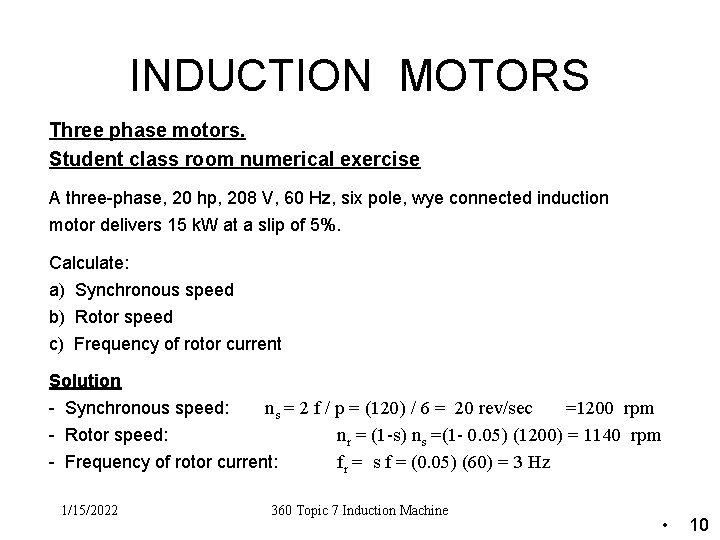
INDUCTION MOTORS Three phase motors. Student class room numerical exercise A three-phase, 20 hp, 208 V, 60 Hz, six pole, wye connected induction motor delivers 15 k. W at a slip of 5%. Calculate: a) Synchronous speed b) Rotor speed c) Frequency of rotor current Solution ns = 2 f / p = (120) / 6 = 20 rev/sec =1200 rpm - Rotor speed: nr = (1 -s) ns =(1 - 0. 05) (1200) = 1140 rpm - Frequency of rotor current: fr = s f = (0. 05) (60) = 3 Hz - Synchronous speed: 1/15/2022 360 Topic 7 Induction Machine • 10
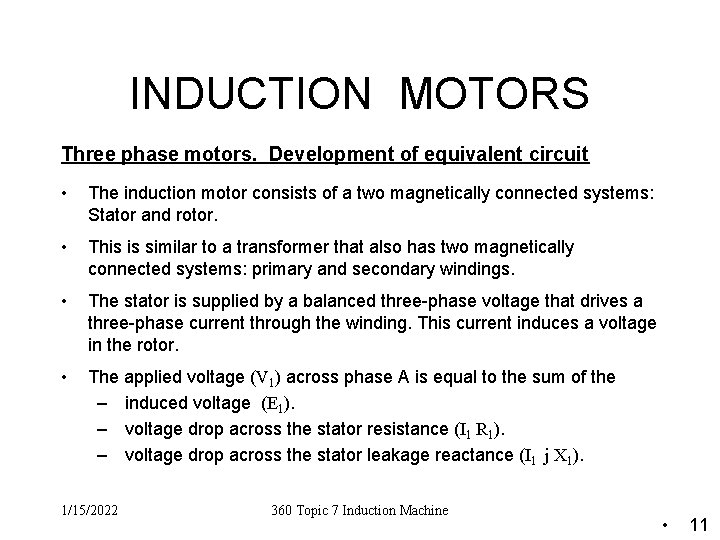
INDUCTION MOTORS Three phase motors. Development of equivalent circuit • The induction motor consists of a two magnetically connected systems: Stator and rotor. • This is similar to a transformer that also has two magnetically connected systems: primary and secondary windings. • The stator is supplied by a balanced three-phase voltage that drives a three-phase current through the winding. This current induces a voltage in the rotor. • The applied voltage (V 1) across phase A is equal to the sum of the – induced voltage (E 1). – voltage drop across the stator resistance (I 1 R 1). – voltage drop across the stator leakage reactance (I 1 j X 1). 1/15/2022 360 Topic 7 Induction Machine • 11
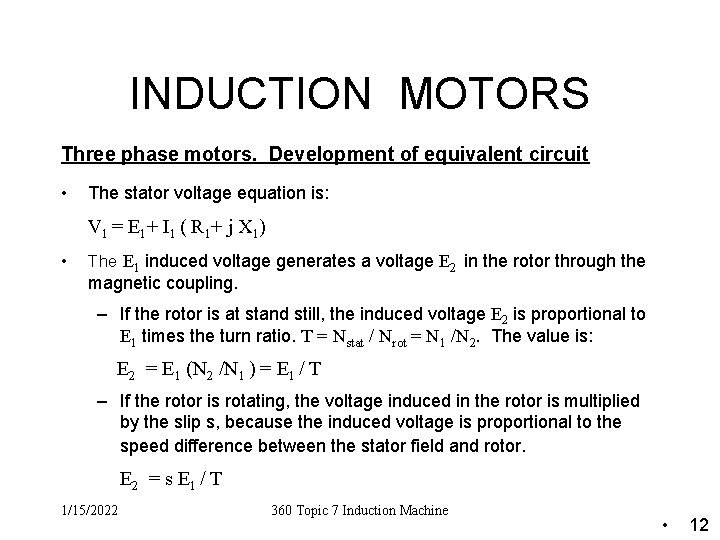
INDUCTION MOTORS Three phase motors. Development of equivalent circuit • The stator voltage equation is: V 1 = E 1 + I 1 ( R 1 + j X 1 ) • The E 1 induced voltage generates a voltage E 2 in the rotor through the magnetic coupling. – If the rotor is at stand still, the induced voltage E 2 is proportional to E 1 times the turn ratio. T = Nstat / Nrot = N 1 /N 2. The value is: E 2 = E 1 (N 2 /N 1 ) = E 1 / T – If the rotor is rotating, the voltage induced in the rotor is multiplied by the slip s, because the induced voltage is proportional to the speed difference between the stator field and rotor. E 2 = s E 1 / T 1/15/2022 360 Topic 7 Induction Machine • 12
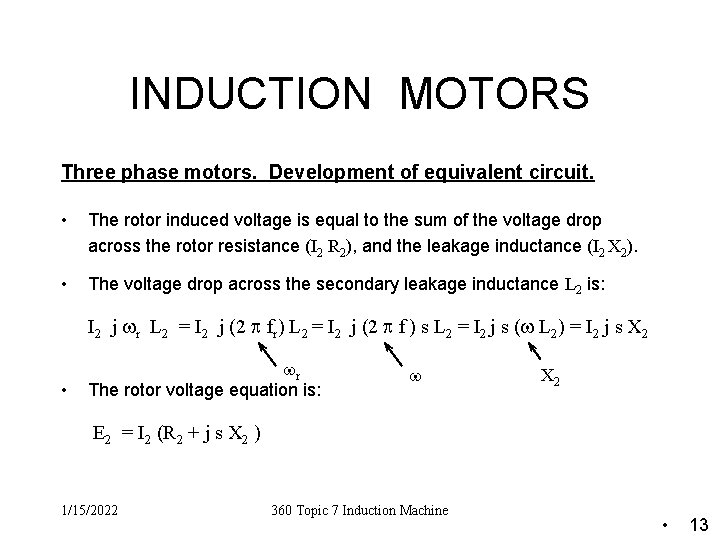
INDUCTION MOTORS Three phase motors. Development of equivalent circuit. • The rotor induced voltage is equal to the sum of the voltage drop across the rotor resistance (I 2 R 2), and the leakage inductance (I 2 X 2). • The voltage drop across the secondary leakage inductance L 2 is: I 2 j wr L 2 = I 2 j (2 p fr) L 2 = I 2 j (2 p f ) s L 2 = I 2 j s (w L 2) = I 2 j s X 2 • wr The rotor voltage equation is: w X 2 E 2 = I 2 (R 2 + j s X 2 ) 1/15/2022 360 Topic 7 Induction Machine • 13
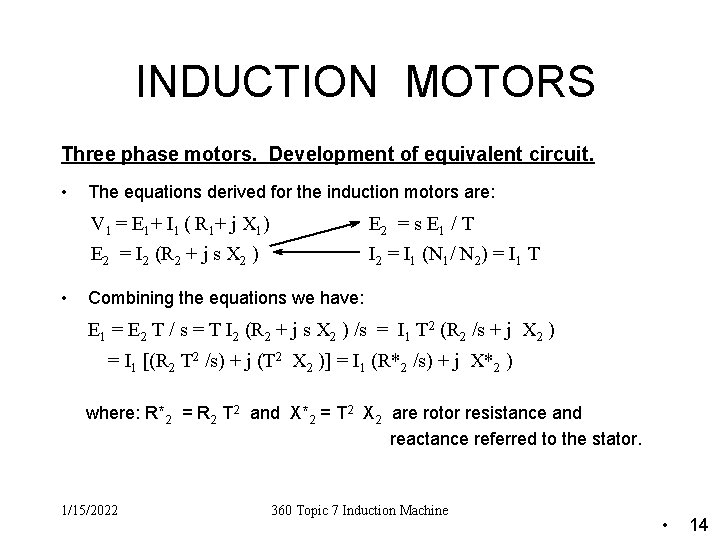
INDUCTION MOTORS Three phase motors. Development of equivalent circuit. • The equations derived for the induction motors are: V 1 = E 1 + I 1 ( R 1 + j X 1 ) E 2 = I 2 (R 2 + j s X 2 ) • E 2 = s E 1 / T I 2 = I 1 (N 1/ N 2) = I 1 T Combining the equations we have: E 1 = E 2 T / s = T I 2 (R 2 + j s X 2 ) /s = I 1 T 2 (R 2 /s + j X 2 ) = I 1 [(R 2 T 2 /s) + j (T 2 X 2 )] = I 1 (R*2 /s) + j X*2 ) where: R*2 = R 2 T 2 and X*2 = T 2 X 2 are rotor resistance and reactance referred to the stator. 1/15/2022 360 Topic 7 Induction Machine • 14
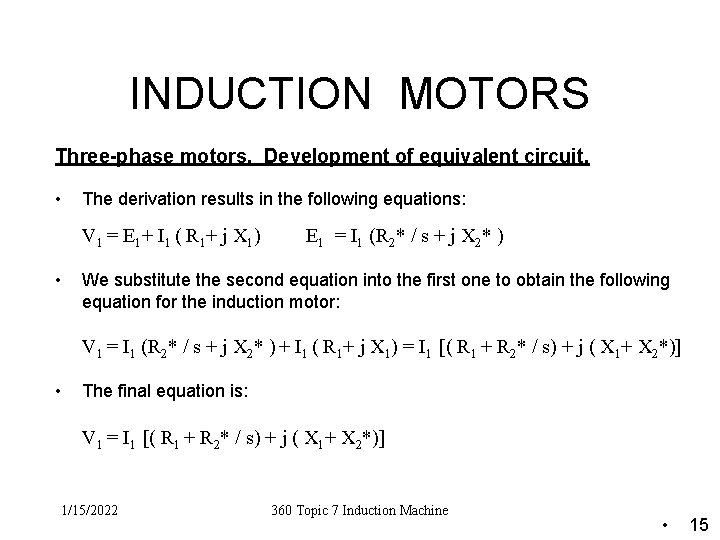
INDUCTION MOTORS Three-phase motors. Development of equivalent circuit. • The derivation results in the following equations: V 1 = E 1 + I 1 ( R 1 + j X 1 ) • E 1 = I 1 (R 2* / s + j X 2* ) We substitute the second equation into the first one to obtain the following equation for the induction motor: V 1 = I 1 (R 2* / s + j X 2* ) + I 1 ( R 1+ j X 1) = I 1 [( R 1 + R 2* / s) + j ( X 1+ X 2*)] • The final equation is: V 1 = I 1 [( R 1 + R 2* / s) + j ( X 1+ X 2*)] 1/15/2022 360 Topic 7 Induction Machine • 15
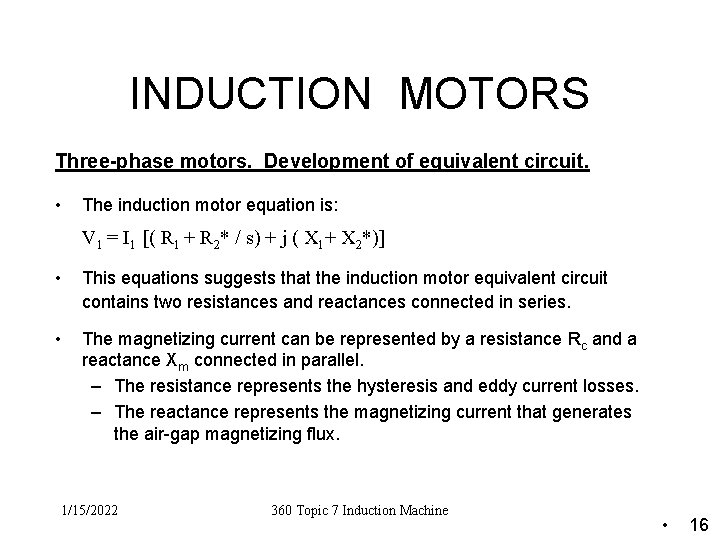
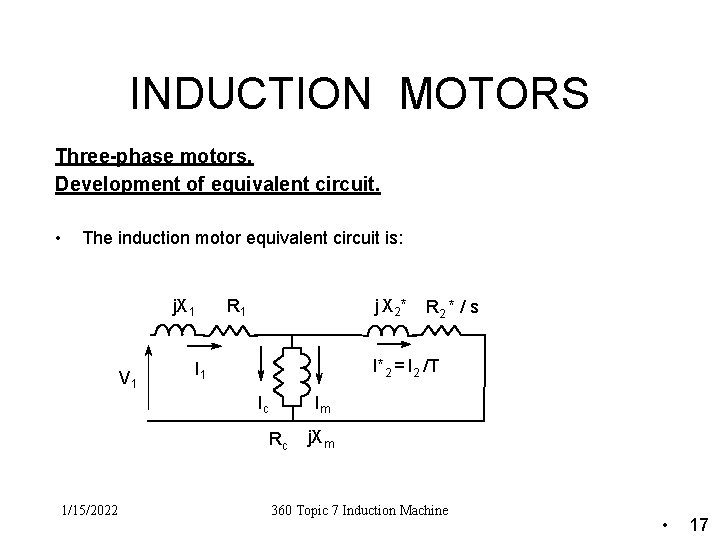
INDUCTION MOTORS Three-phase motors. Development of equivalent circuit. • The induction motor equation is: V 1 = I 1 [( R 1 + R 2* / s) + j ( X 1+ X 2*)] • This equations suggests that the induction motor equivalent circuit contains two resistances and reactances connected in series. • The magnetizing current can be represented by a resistance Rc and a reactance Xm connected in parallel. – The resistance represents the hysteresis and eddy current losses. – The reactance represents the magnetizing current that generates the air-gap magnetizing flux. 1/15/2022 360 Topic 7 Induction Machine • 16
INDUCTION MOTORS Three-phase motors. Development of equivalent circuit. • The induction motor equivalent circuit is: j. X 1 V 1 R 1 j X 2* I*2 = I 2 /T I 1 Ic Im Rc 1/15/2022 R 2 * / s j. Xm 360 Topic 7 Induction Machine • 17
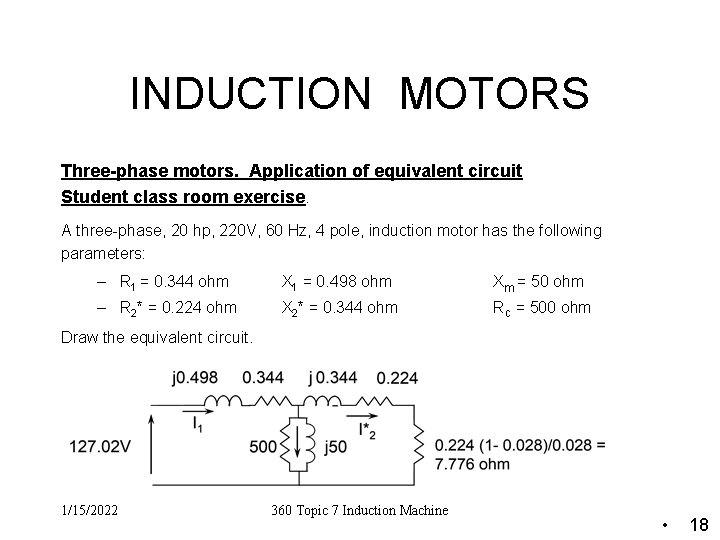
INDUCTION MOTORS Three-phase motors. Application of equivalent circuit Student class room exercise. A three-phase, 20 hp, 220 V, 60 Hz, 4 pole, induction motor has the following parameters: – R 1 = 0. 344 ohm X 1 = 0. 498 ohm Xm = 50 ohm – R 2* = 0. 224 ohm X 2* = 0. 344 ohm Rc = 500 ohm Draw the equivalent circuit. 1/15/2022 360 Topic 7 Induction Machine • 18
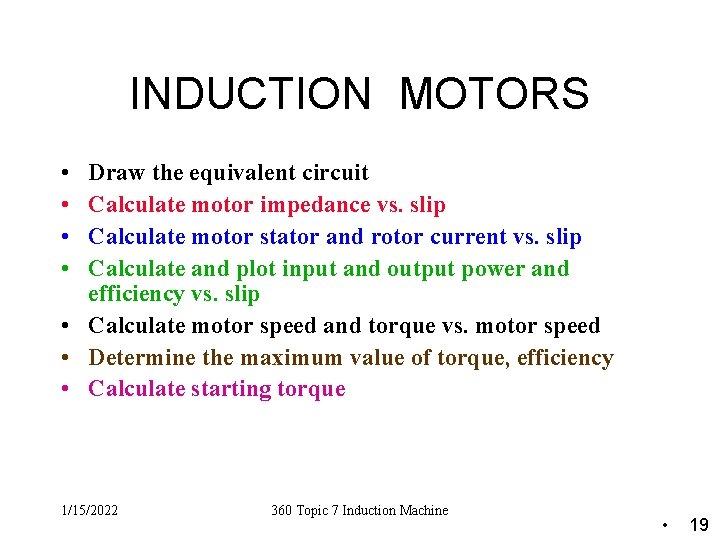
INDUCTION MOTORS • • Draw the equivalent circuit Calculate motor impedance vs. slip Calculate motor stator and rotor current vs. slip Calculate and plot input and output power and efficiency vs. slip • Calculate motor speed and torque vs. motor speed • Determine the maximum value of torque, efficiency • Calculate starting torque 1/15/2022 360 Topic 7 Induction Machine • 19