
Induced methods for complex matrix multiplication Field G





- Slides: 58
Induced methods for complex matrix multiplication Field G. Van Zee Science of High Performance Computing The University of Texas at Austin
Science of High Performance Computing (SHPC) research group • Led by Robert A. van de Geijn • Contributes to the science of DLA and instantiates research results as open source software • Long history of support from National Science Foundation • Website: http: //shpc. ices. utexas. edu/
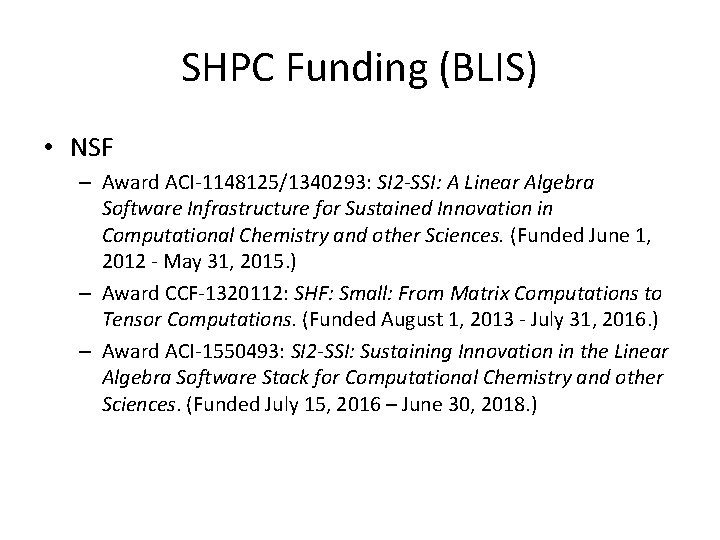
SHPC Funding (BLIS) • NSF – Award ACI-1148125/1340293: SI 2 -SSI: A Linear Algebra Software Infrastructure for Sustained Innovation in Computational Chemistry and other Sciences. (Funded June 1, 2012 - May 31, 2015. ) – Award CCF-1320112: SHF: Small: From Matrix Computations to Tensor Computations. (Funded August 1, 2013 - July 31, 2016. ) – Award ACI-1550493: SI 2 -SSI: Sustaining Innovation in the Linear Algebra Software Stack for Computational Chemistry and other Sciences. (Funded July 15, 2016 – June 30, 2018. )
SHPC Funding (BLIS) • Industry (grants and hardware) – – – Microsoft Texas Instruments Intel AMD HP Enterprise
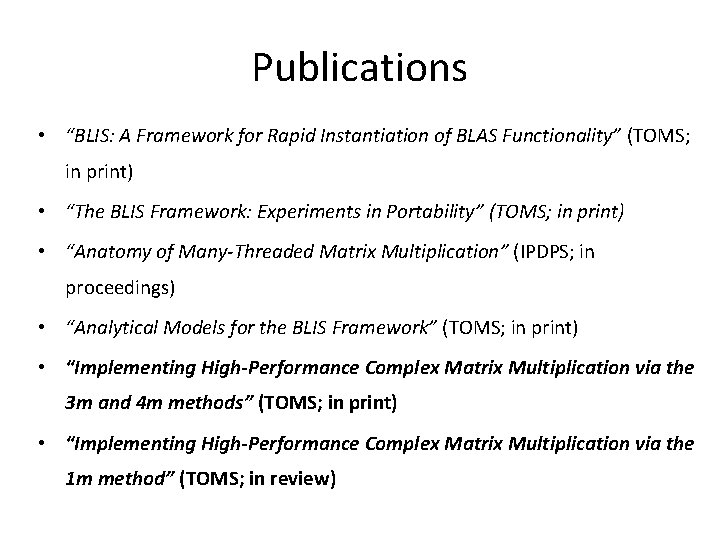
Publications • “BLIS: A Framework for Rapid Instantiation of BLAS Functionality” (TOMS; in print) • “The BLIS Framework: Experiments in Portability” (TOMS; in print) • “Anatomy of Many-Threaded Matrix Multiplication” (IPDPS; in proceedings) • “Analytical Models for the BLIS Framework” (TOMS; in print) • “Implementing High-Performance Complex Matrix Multiplication via the 3 m and 4 m methods” (TOMS; in print) • “Implementing High-Performance Complex Matrix Multiplication via the 1 m method” (TOMS; in review)
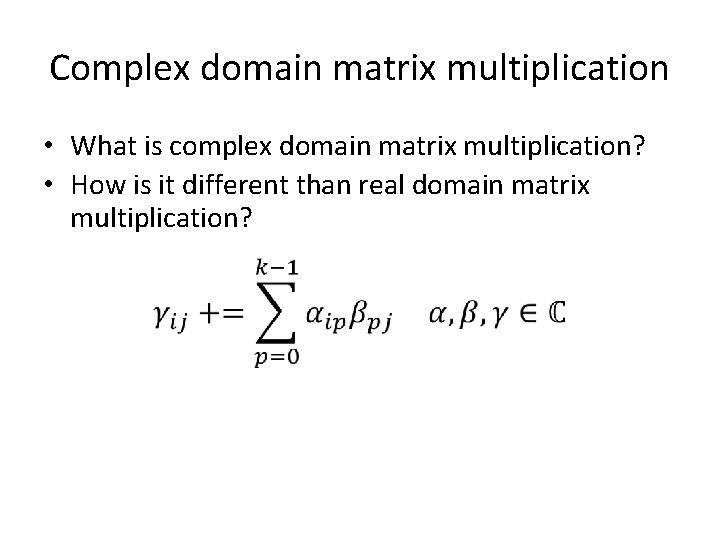
Complex domain matrix multiplication • What is complex domain matrix multiplication? • How is it different than real domain matrix multiplication?
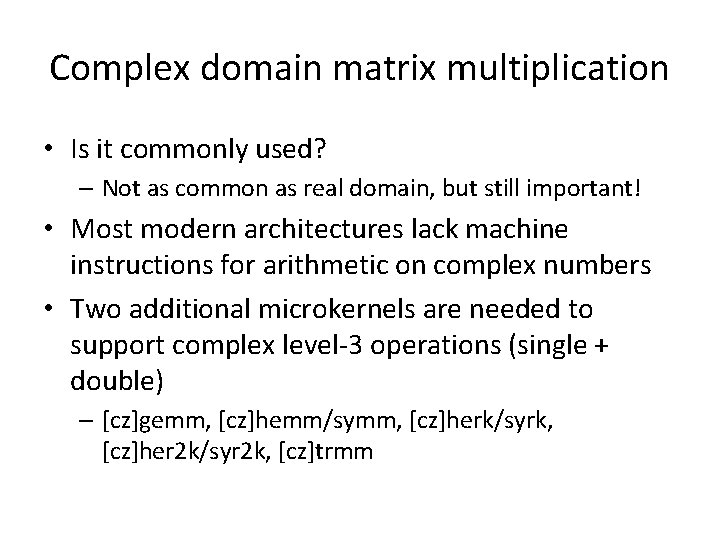
Complex domain matrix multiplication • Is it commonly used? – Not as common as real domain, but still important! • Most modern architectures lack machine instructions for arithmetic on complex numbers • Two additional microkernels are needed to support complex level-3 operations (single + double) – [cz]gemm, [cz]hemm/symm, [cz]herk/syrk, [cz]her 2 k/syr 2 k, [cz]trmm
Complex domain matrix multiplication • Life would be simpler if complex domain matrix multiplication was not necessary • Of course, complex matrix multiplication will always be necessary • But what if complex matrix multiplication kernels were found to be unnecessary?
Induced methods • Basic idea – Compute complex domain matrix multiplication using only real domain matrix multiplication primitives – The real domain primitive is defined as the fundamental unit of computation (presumably optimized) – In BLIS, it is most natural to think of the real domain gemm microkernel as the primitive (but there are others!)
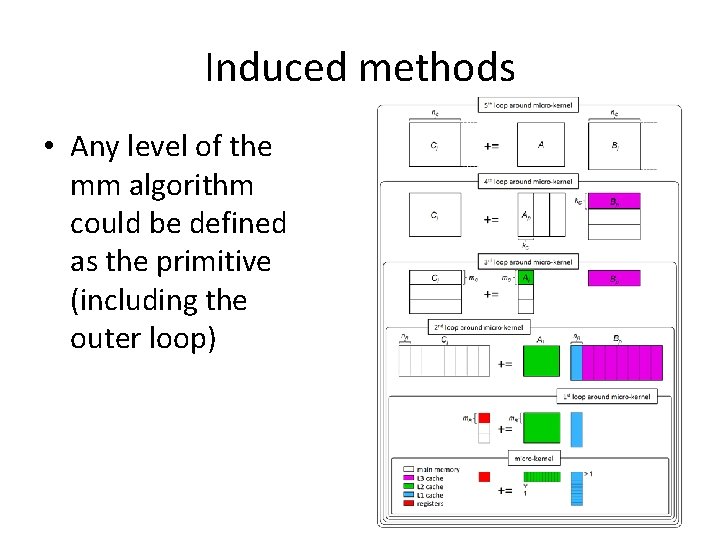
Induced methods • Any level of the mm algorithm could be defined as the primitive (including the outer loop)
Induced methods • Motivation: if complex matrix multiplication can be induced… – fewer kernels need to be written/maintained, and the remaining (real domain) kernels are simpler – complex domain support becomes portable because it is factored out of the kernel and into the framework – any performance benefits from improvements in real kernels are inherited into the complex domain (automatically and immediately)
Initial work • “Implementing High-Performance Complex Matrix Multiplication via the 3 m and 4 m Methods. ” ACM Transactions on Mathematical Software. 44(1) 7: 1— 7: 36, 2016.
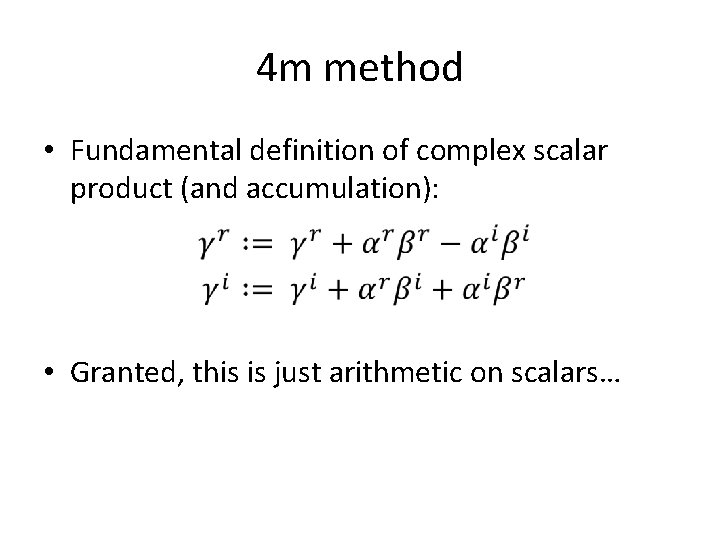
4 m method • Fundamental definition of complex scalar product (and accumulation): • Granted, this is just arithmetic on scalars…
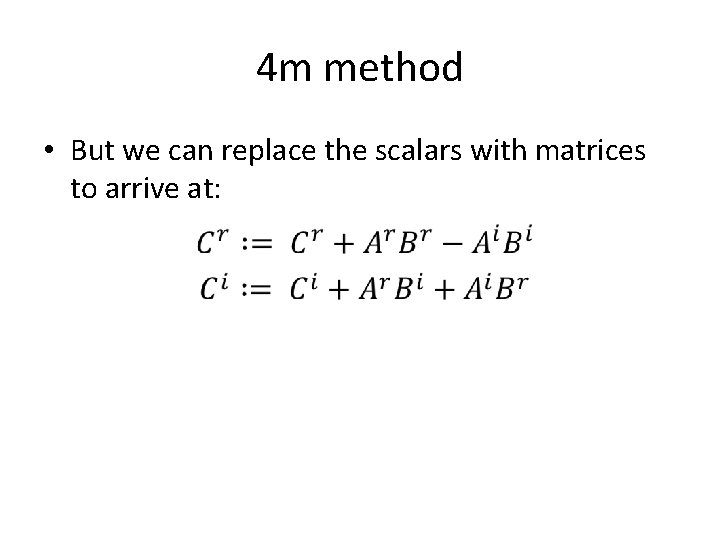
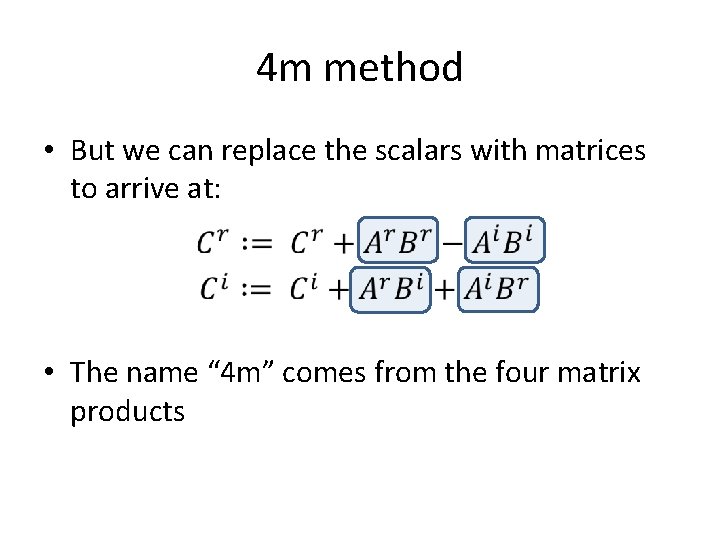
4 m method • But we can replace the scalars with matrices to arrive at:
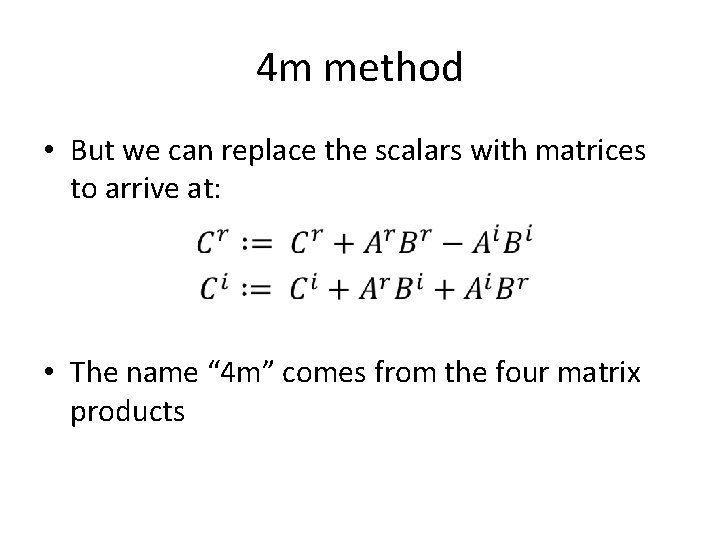
4 m method • But we can replace the scalars with matrices to arrive at: • The name “ 4 m” comes from the four matrix products
4 m method • But we can replace the scalars with matrices to arrive at: • The name “ 4 m” comes from the four matrix products
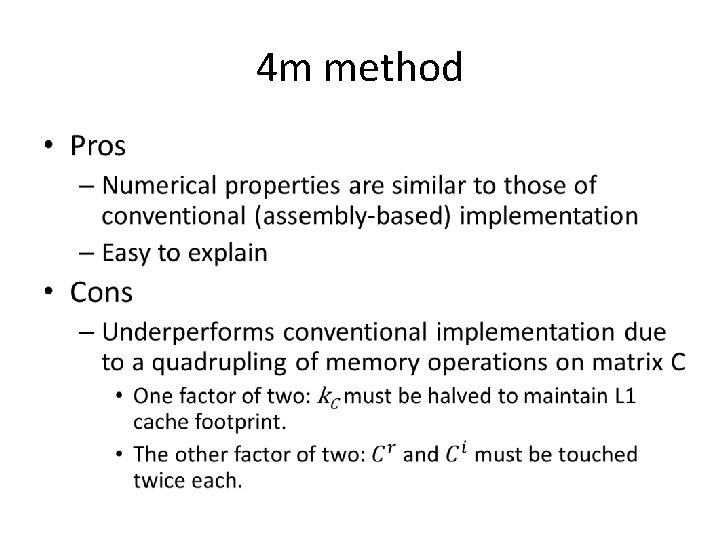
4 m method •
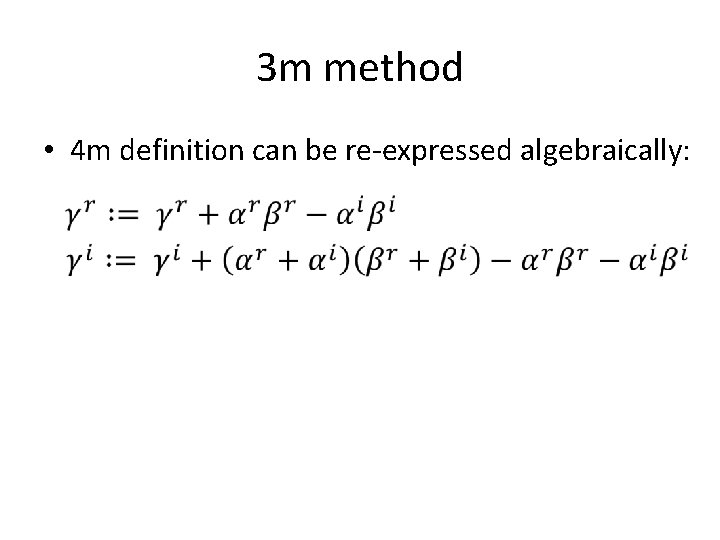
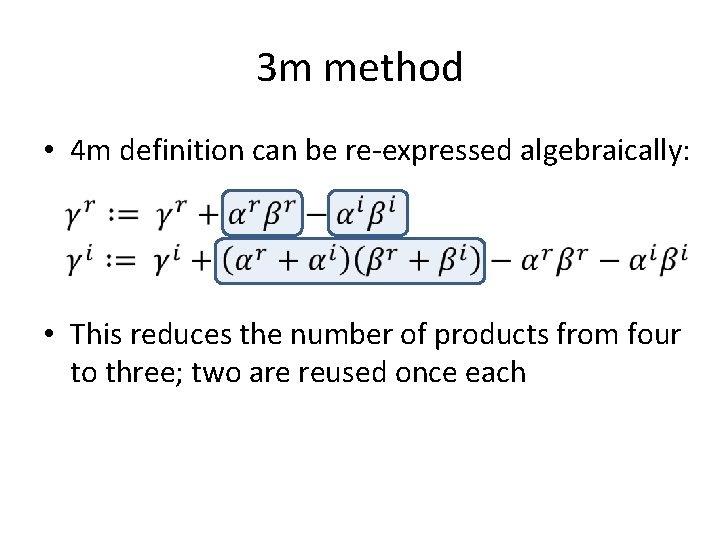
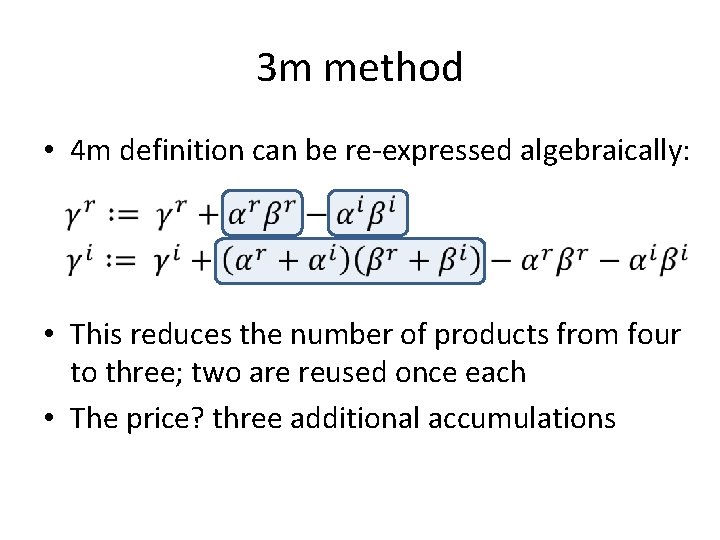
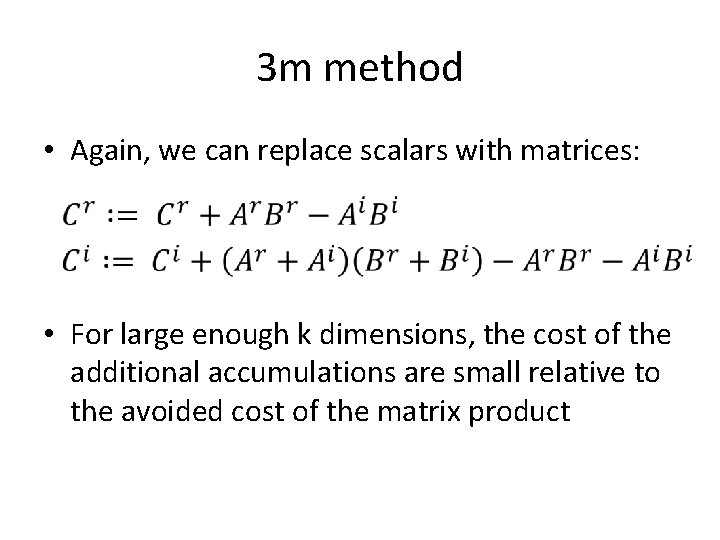
3 m method • 4 m definition can be re-expressed algebraically:
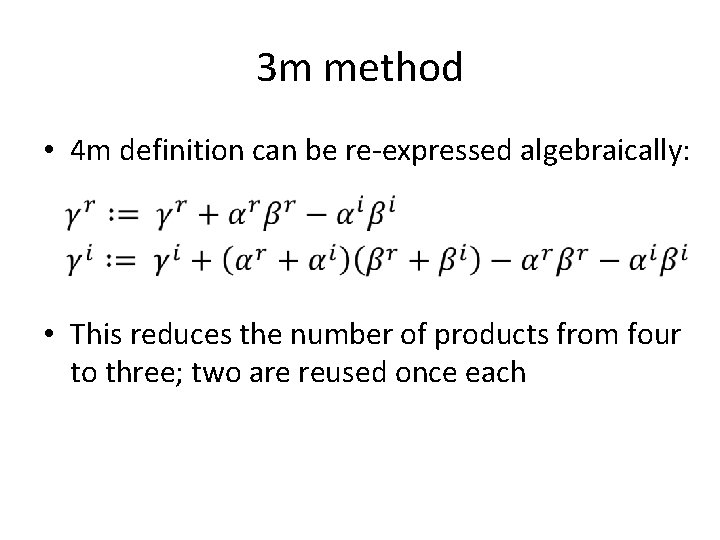
3 m method • 4 m definition can be re-expressed algebraically: • This reduces the number of products from four to three; two are reused once each
3 m method • 4 m definition can be re-expressed algebraically: • This reduces the number of products from four to three; two are reused once each
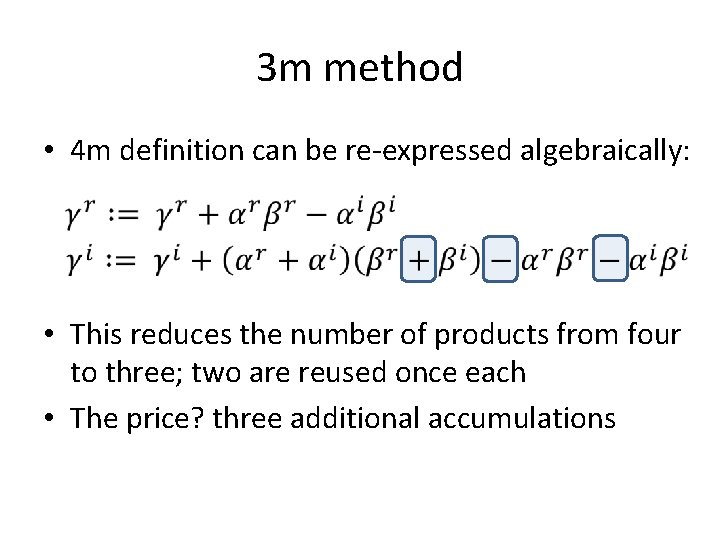
3 m method • 4 m definition can be re-expressed algebraically: • This reduces the number of products from four to three; two are reused once each • The price? three additional accumulations
3 m method • 4 m definition can be re-expressed algebraically: • This reduces the number of products from four to three; two are reused once each • The price? three additional accumulations
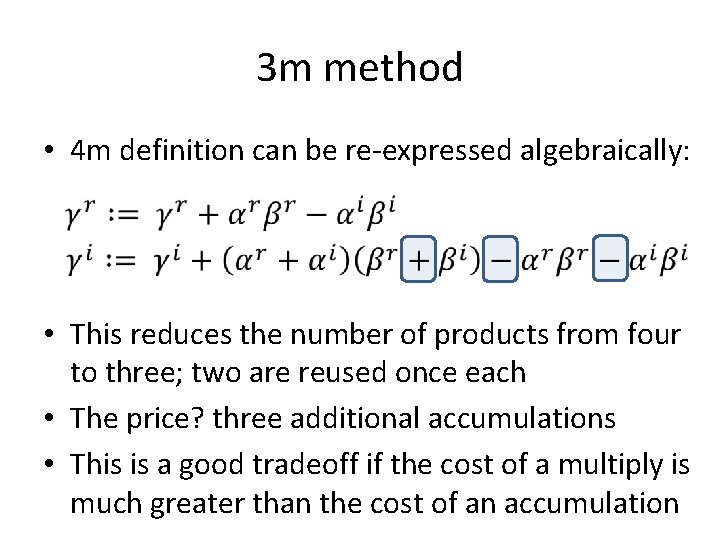
3 m method • 4 m definition can be re-expressed algebraically: • This reduces the number of products from four to three; two are reused once each • The price? three additional accumulations • This is a good tradeoff if the cost of a multiply is much greater than the cost of an accumulation
3 m method • Again, we can replace scalars with matrices: • For large enough k dimensions, the cost of the additional accumulations are small relative to the avoided cost of the matrix product
3 m method • Pros – Strassen-like potential to exceed peak performance • Cons – Requires workspace to store intermediate products – Does not make sense for small k – Slightly different (less favorable) numerical properties – Best performing algorithm (3 m_h) is somewhat mtconstrained because there are three synchronization points (can’t thread across matrix products)
Further work • “Implementing High-Performance Complex Matrix Multiplication via the 1 m Method. ” ACM Transactions on Mathematical Software. Submitted.
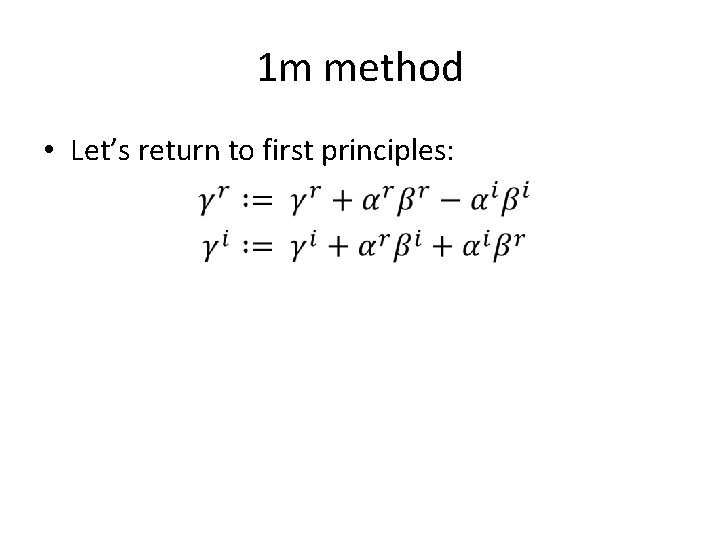
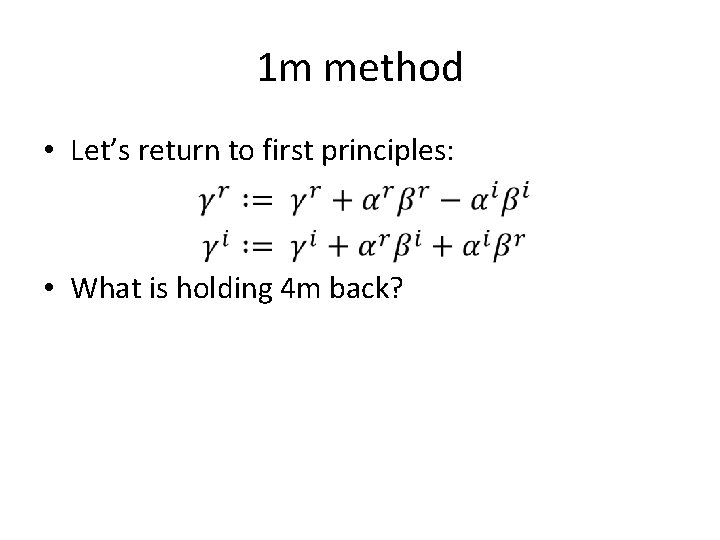
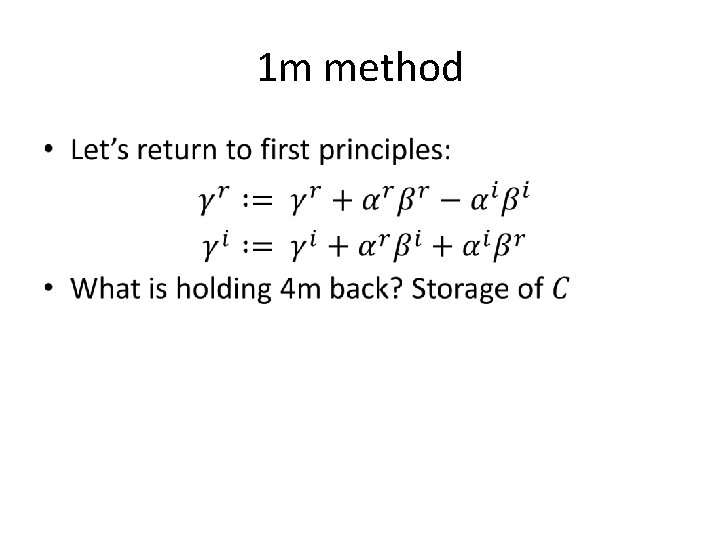
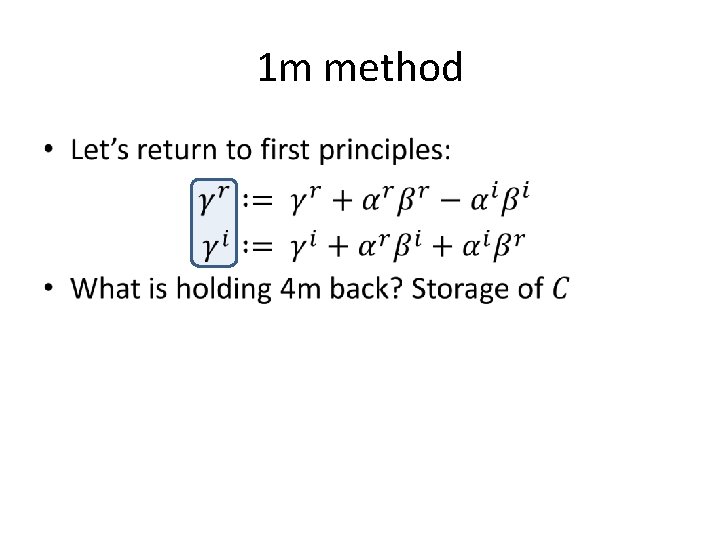
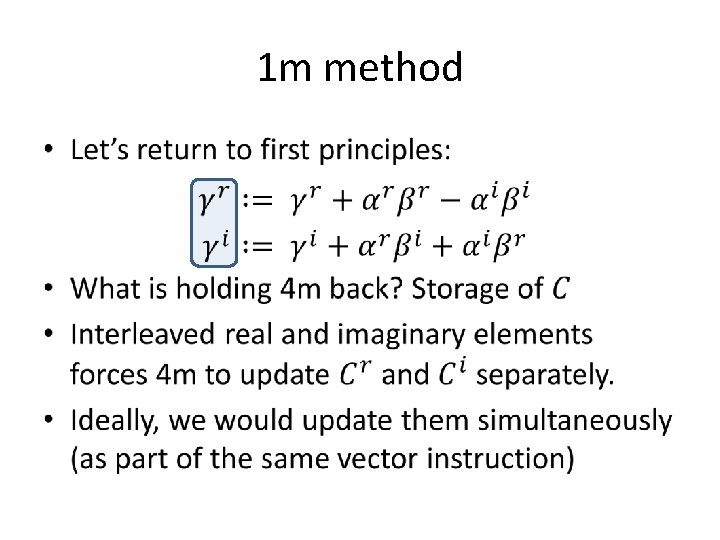
1 m method • Let’s return to first principles:
1 m method • Let’s return to first principles: • What is holding 4 m back?
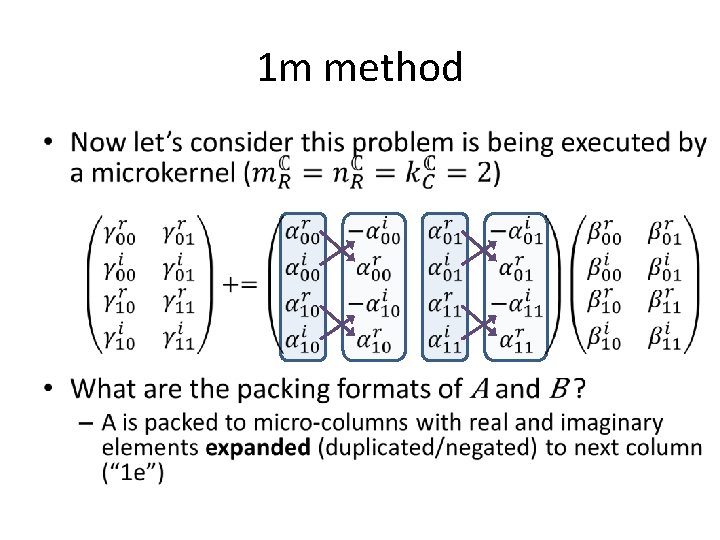
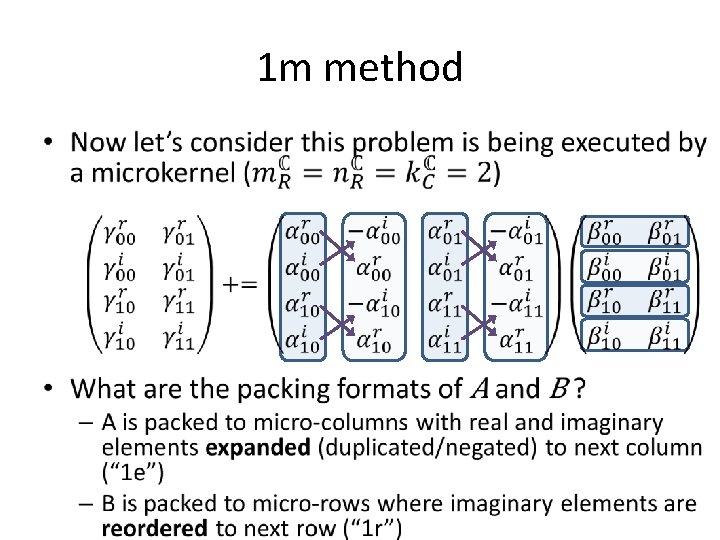
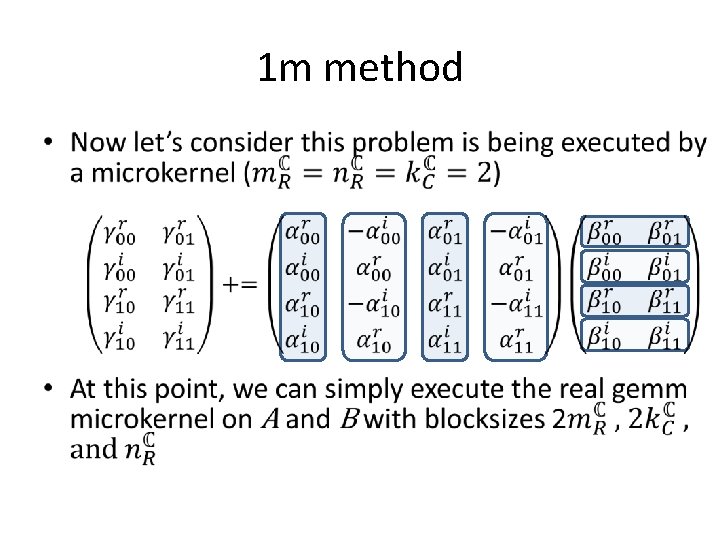
1 m method •
1 m method •
1 m method •
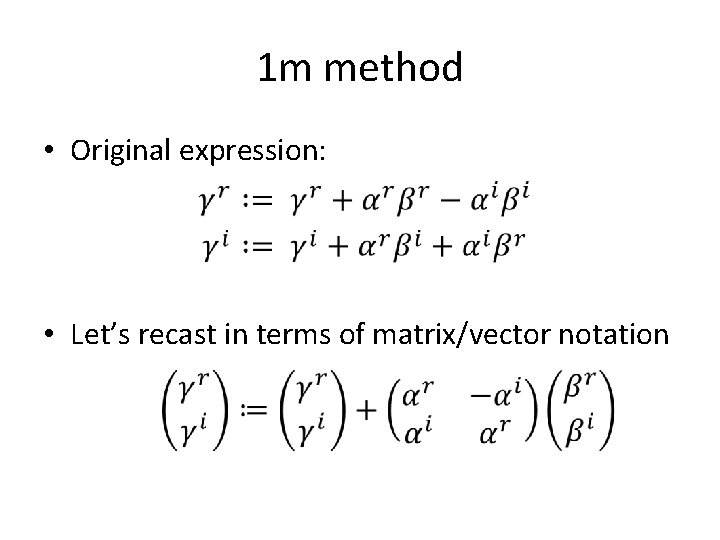
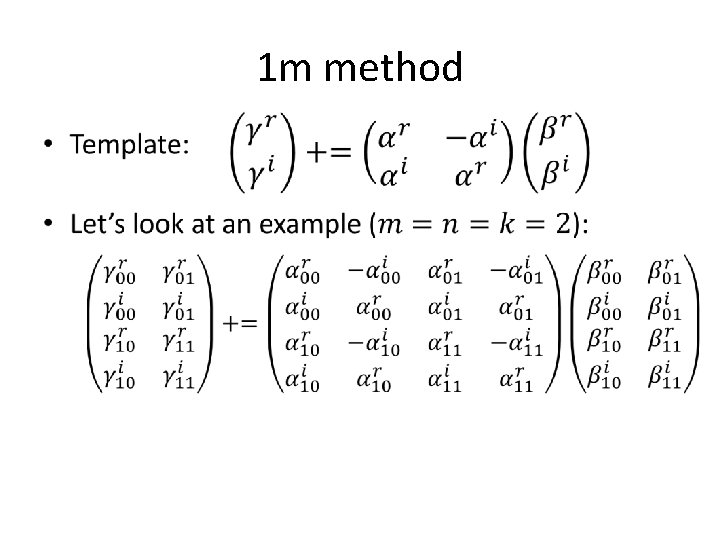
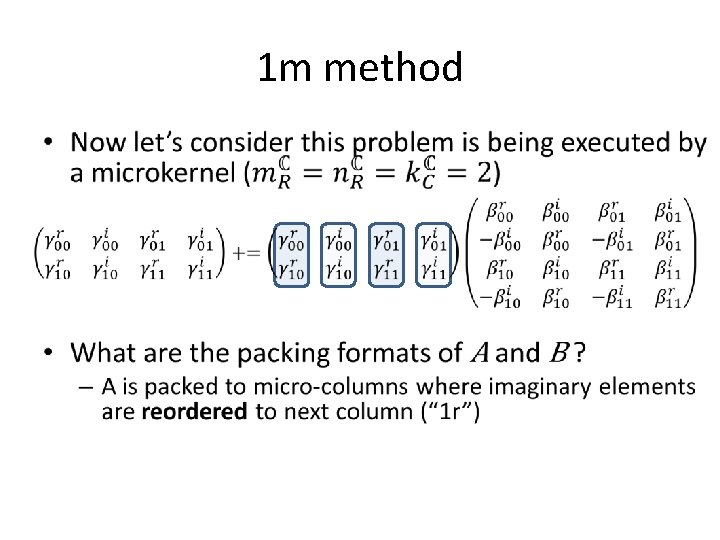
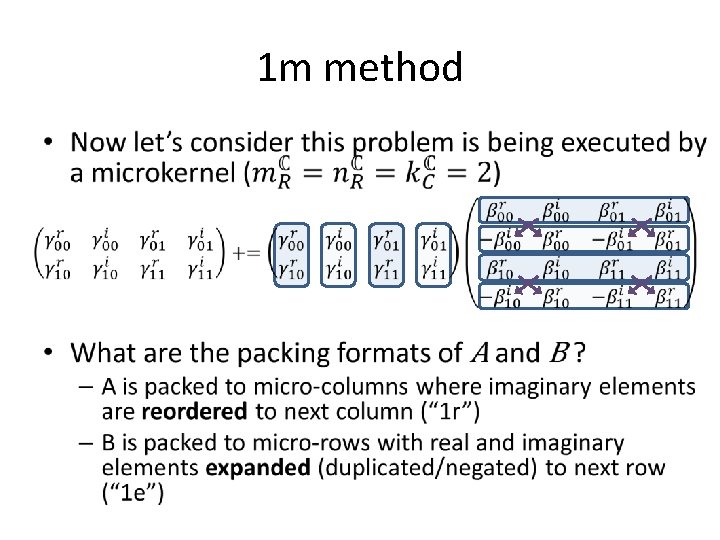
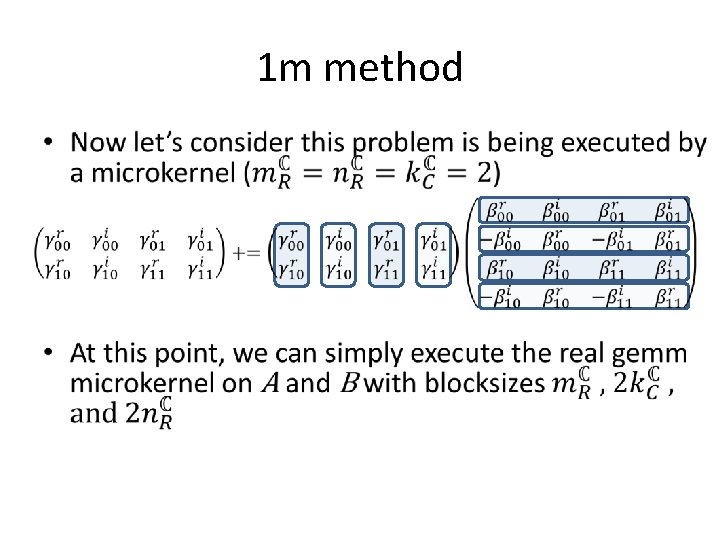
1 m method • Original expression: • Let’s recast in terms of matrix/vector notation
1 m method •
1 m method •
1 m method •
1 m method •
1 m method •
1 m method •
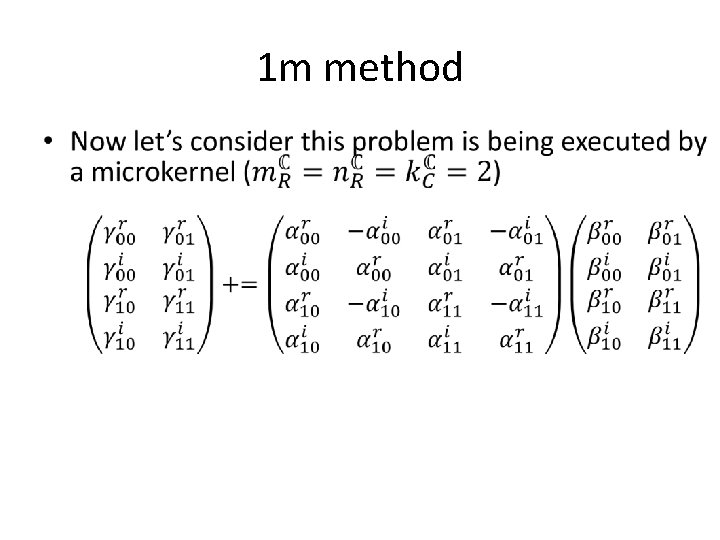
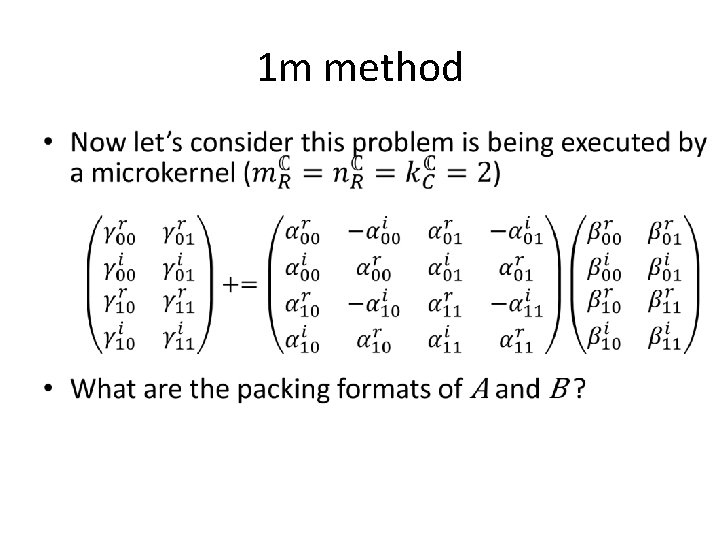
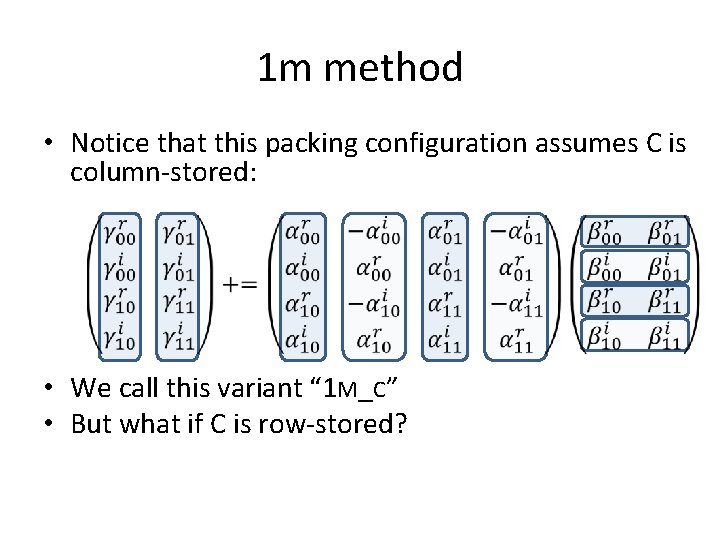
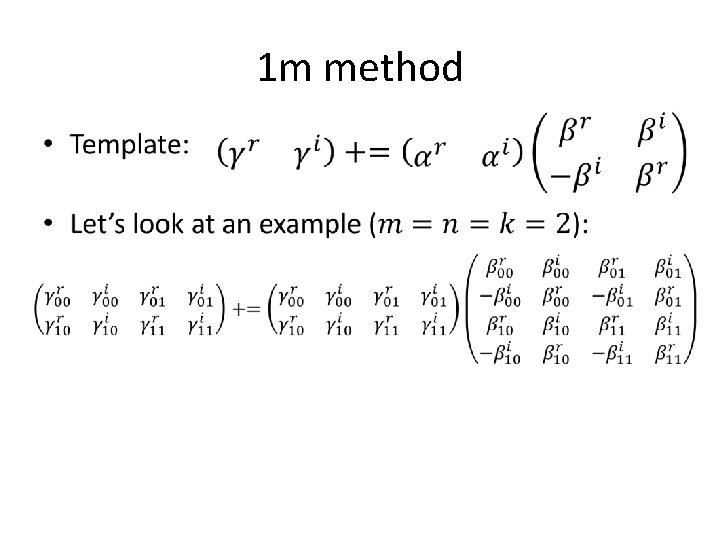
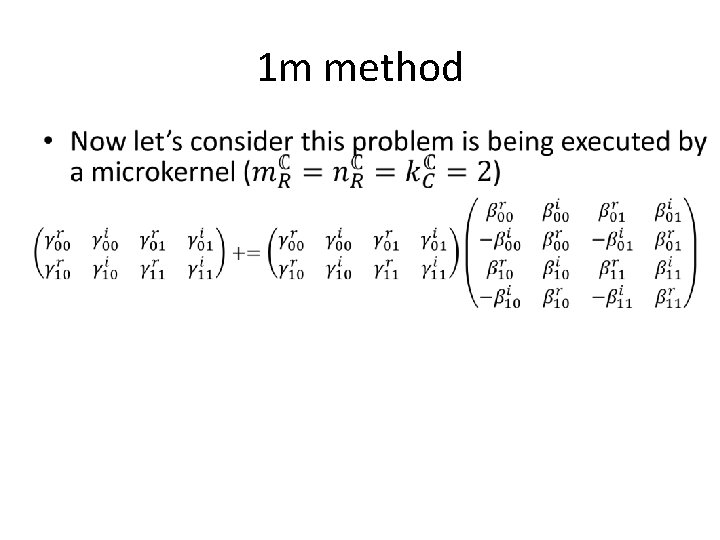
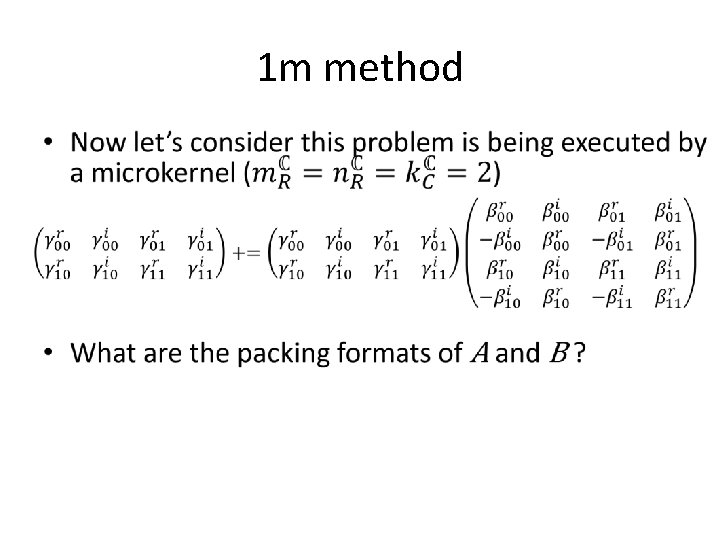
1 m method • Notice that this packing configuration assumes C is column-stored: • We call this variant “ 1 M_C” • But what if C is row-stored?
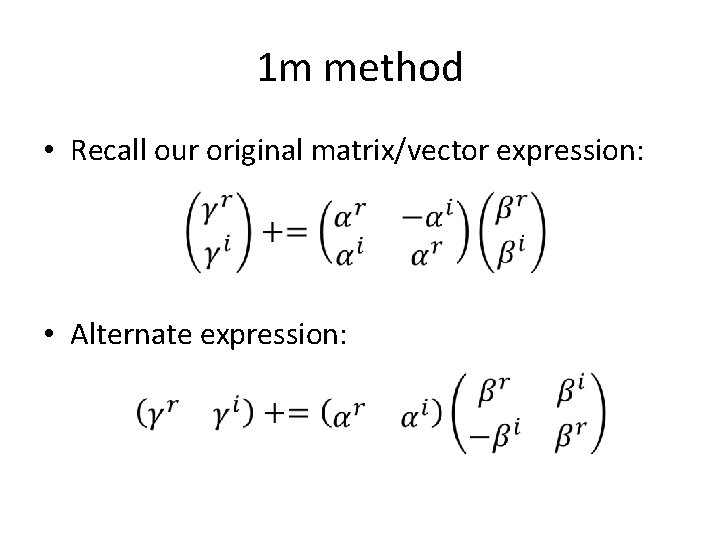
1 m method • Recall our original matrix/vector expression: • Alternate expression:
1 m method •
1 m method •
1 m method •
1 m method •
1 m method •
1 m method •
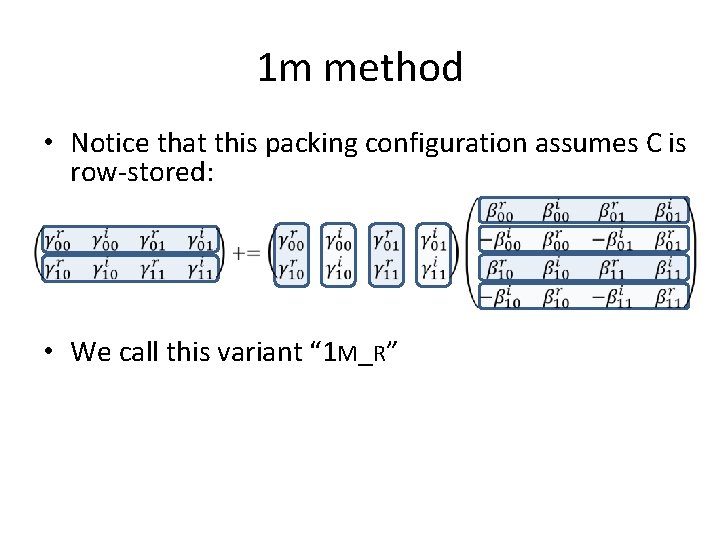
1 m method • Notice that this packing configuration assumes C is row-stored: • We call this variant “ 1 M_R”
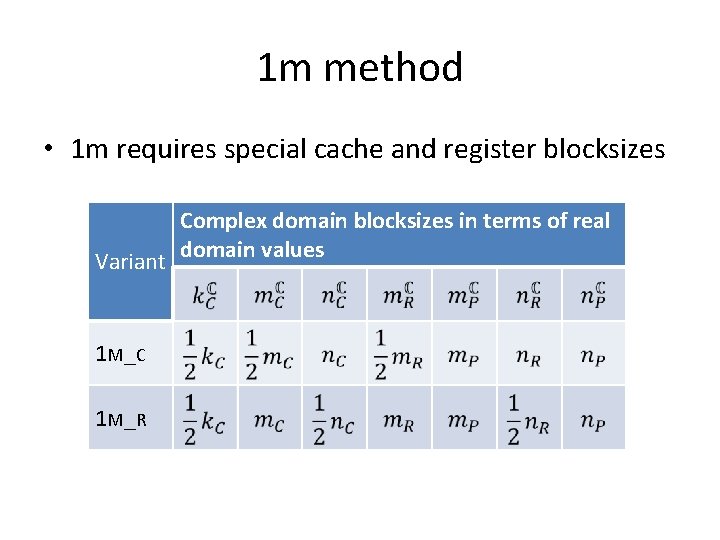
1 m method • 1 m requires special cache and register blocksizes Variant 1 M _C 1 M _R Complex domain blocksizes in terms of real domain values
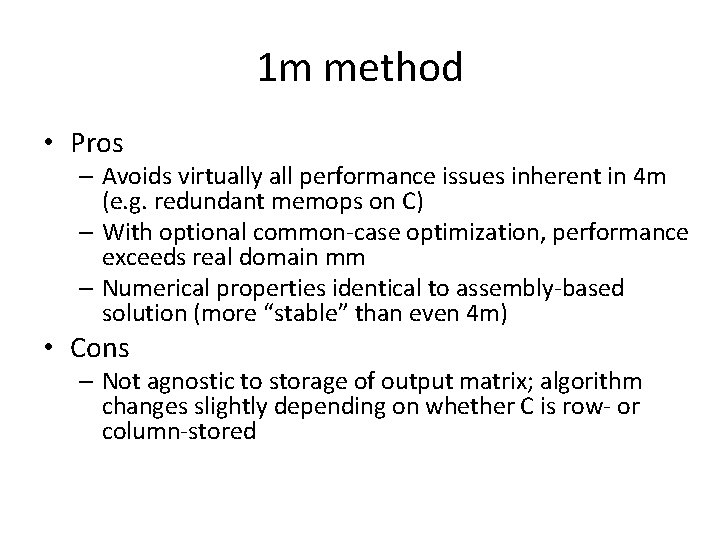
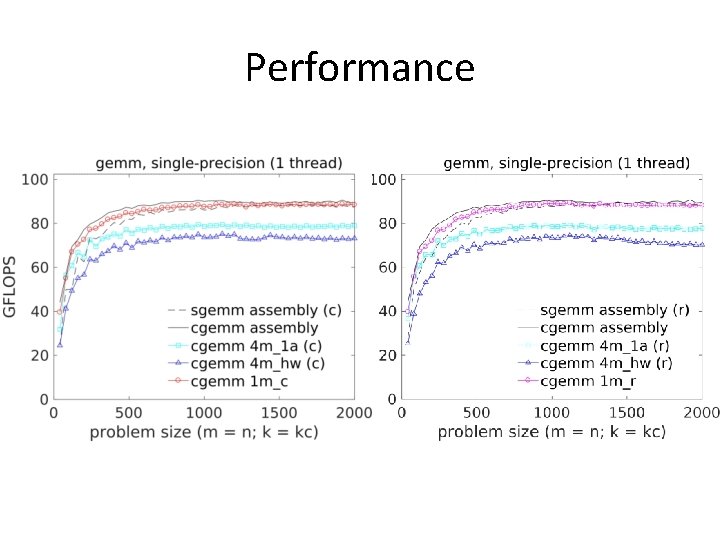
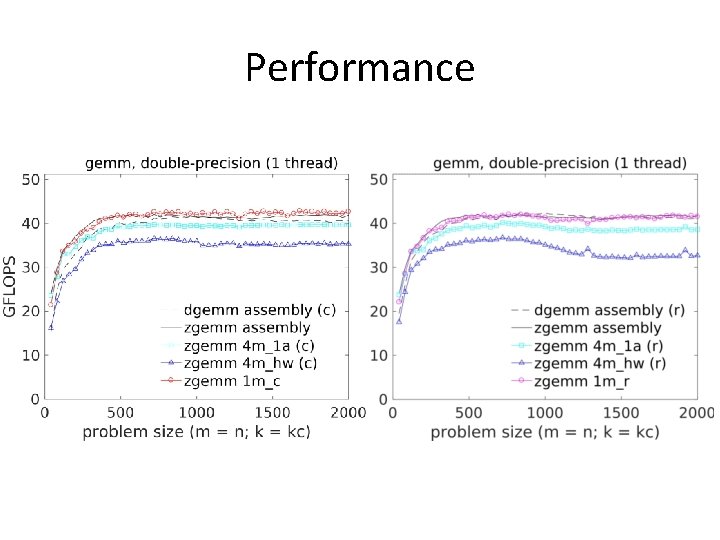
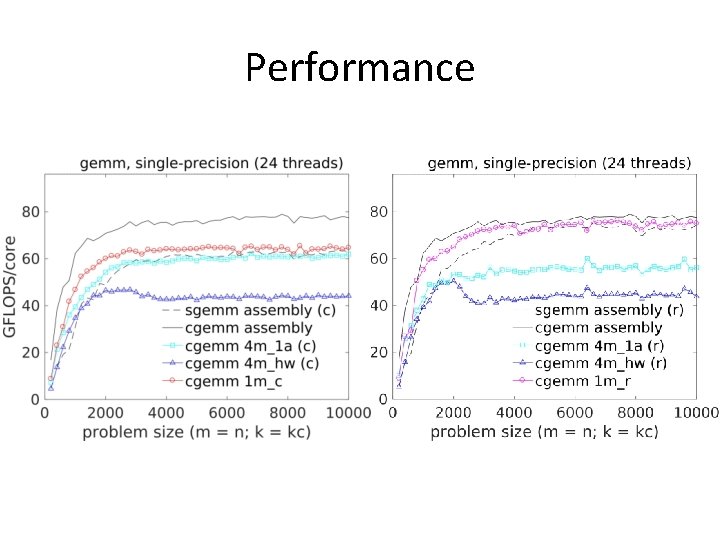
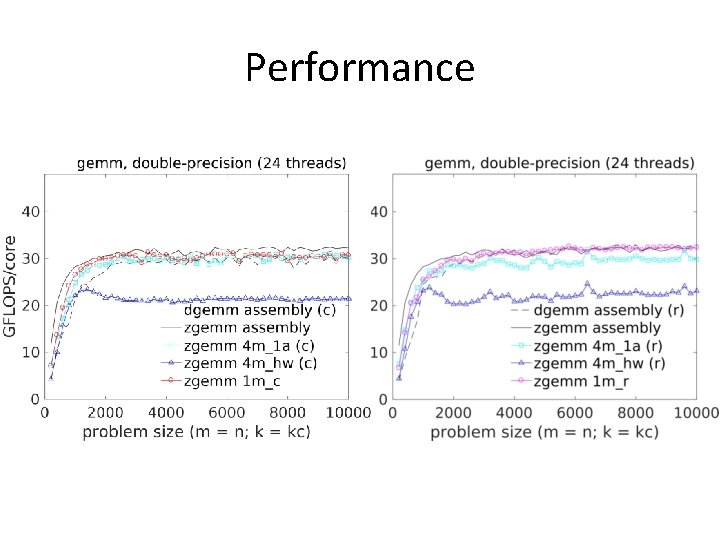
1 m method • Pros – Avoids virtually all performance issues inherent in 4 m (e. g. redundant memops on C) – With optional common-case optimization, performance exceeds real domain mm – Numerical properties identical to assembly-based solution (more “stable” than even 4 m) • Cons – Not agnostic to storage of output matrix; algorithm changes slightly depending on whether C is row- or column-stored
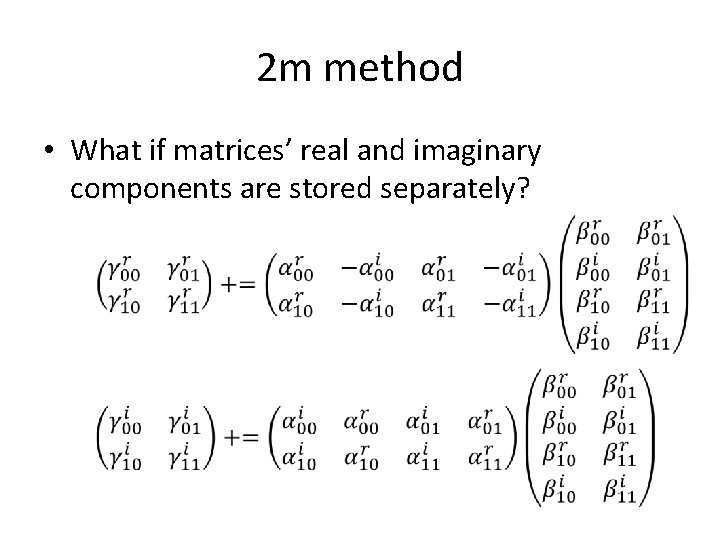
2 m method • What if matrices’ real and imaginary components are stored separately?
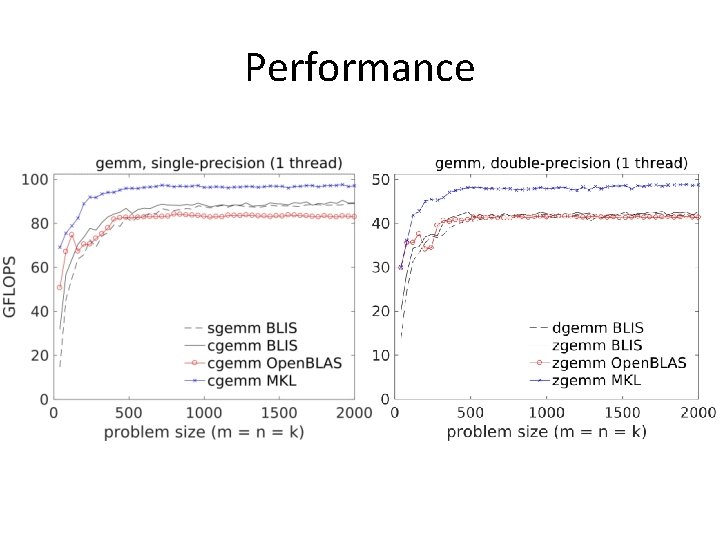
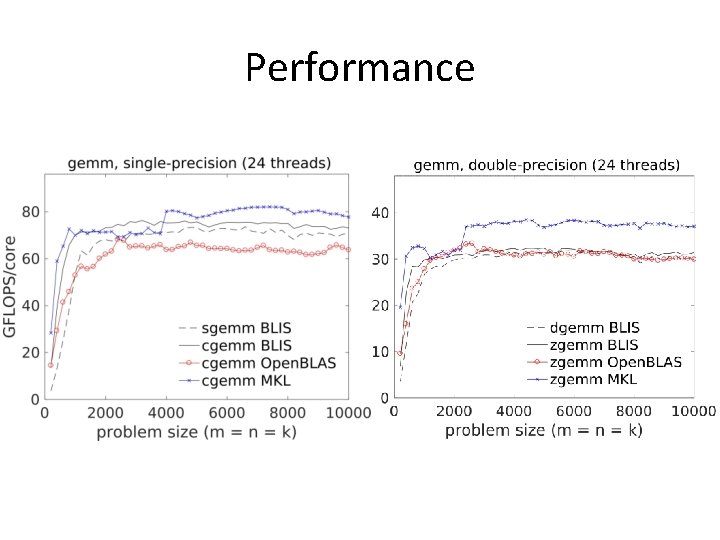
Performance
Performance
Performance
Performance
Performance
Performance
Conclusion • Key takeaway: the real and imaginary elements can always be reordered to accommodate the fundamental primitive • Family values: we now have a family of solutions, each with pros and cons – 1 m method is almost always superior if traditional numerical properties are needed – 3 m method is best when numerical behavior can be sacrificed for a faster solution – 2 m method can be used if the real and imaginary elements are stored as two separate real matrices (which is rare)
Further Information • Website: – http: //github. com/flame/blis/ • Discussion: – http: //groups. google. com/group/blis-devel – http: //groups. google. com/group/blis-discuss • Contact: – field@cs. utexas. edu 58