
Indra Nisja Figure 1 Equivalent motorload system Fundamental





- Slides: 12
Indra Nisja
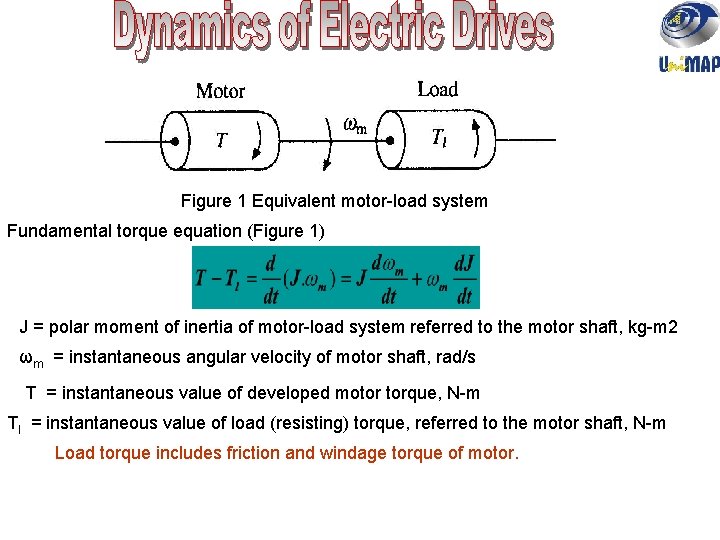
Figure 1 Equivalent motor-load system Fundamental torque equation (Figure 1) J = polar moment of inertia of motor-load system referred to the motor shaft, kg-m 2 ωm = instantaneous angular velocity of motor shaft, rad/s T = instantaneous value of developed motor torque, N-m Tl = instantaneous value of load (resisting) torque, referred to the motor shaft, N-m Load torque includes friction and windage torque of motor.
For drives with constant inertia, (d. J/dt) =0, Torque developed by motor is counter balanced by a load torque Tl and a dynamic torque J(dωm /dt). Torque component J(dωm /dt) is called the dynamic torque because it is present only during the transient operations. T > Tl T < Tl acceleration deceleration The load torque required by the load at the shaft has the following components : 1. Torque component to overcome friction and windage which accompanies mechanical motion (Tfw). 2. Torque required to accelerate the load to the desired speed (J(dωm /dt)) 3. Torque required to do prescribed (the useful) mechanical work, i. e. to run to the load at the desired speed (TL).
The load torque seen by the motor at the shaft : Tl = Tfw + J(dωm /dt) + TL The friction existing in a mechanical system may be classified as: (a) Viscous friction (Tv). In this type of friction the torque required is directly proportional to the speed of rotation where B is a constant of proportionality (viscous friction coefficient). (b) Coulomb friction (Tc) : The torque required is independent of speed in this type of friction. It acts as a load torque in either direction and is also called dry friction. Viscous friction changes to coulomb friction at very low speeds. (c) Static friction or stiction (Ts): occurs due to the sticking nature of the surfaces and present at standstill. Since Ts is present only at standstill it is not taken into account in the dynamic analysis. This is generally very small and can be neglected.
Figure 2 Types of friction in drive systems. Windage Torque (Tw) is the torque required by the load when the air surrounding the rotating parts moves T w = C ω m 2 where C is a constant for finite speeds, the load torque is Tl = TL + Bωm + Tc + C ωm 2
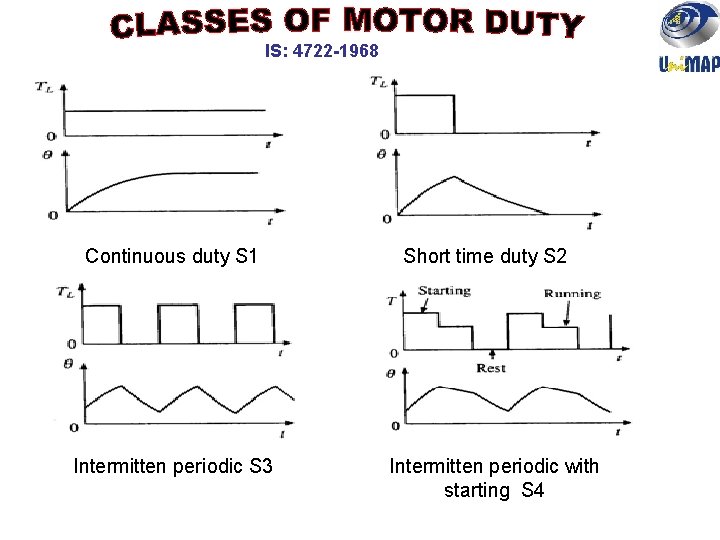
IS: 4722 -1968 Continuous duty S 1 Intermitten periodic S 3 Short time duty S 2 Intermitten periodic with starting S 4
IS: 4722 -1968 Intermitten periodic duty with starting and braking S 5
1. Continuous Duty • Maximum continuous power demand of the load is ascertained • A motor with next higher power rating from commercially available ratings is selected • Motor speed should also match load’s speed requirement • Motor can fulfil starting torque requirement and can continue to drive load in the face of normal disturbances in power supply system (transient and steady-state reserve torque capacity of the motor)
2. Equivalent Current, Torque and Power Methods for Fluctuating and Intermittent Loads [can be employed for duties (iii)-(viii)] Equivalent Current Method After Ieq is determined, a motor with next higher current rating (=Irated) from commercially available ratings is selected.
Equivalent Torque Method When torque is directly proportional to current This equation can be employed to directly ascertain the motor torque rating Equivalent Power Method When motor operates at nearly fixed speed, its power will be directly proportional to torque. Hence, for nearly constant speed operation, power rating of motor can be obtained directly from
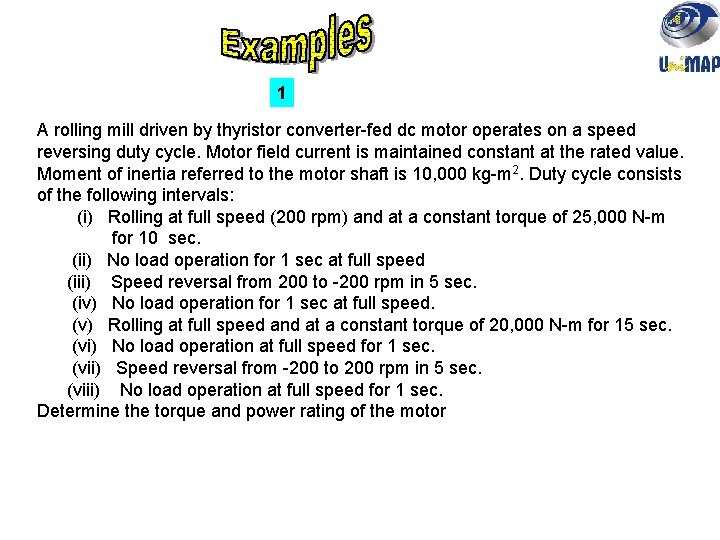
1 A rolling mill driven by thyristor converter-fed dc motor operates on a speed reversing duty cycle. Motor field current is maintained constant at the rated value. Moment of inertia referred to the motor shaft is 10, 000 kg-m 2. Duty cycle consists of the following intervals: (i) Rolling at full speed (200 rpm) and at a constant torque of 25, 000 N-m for 10 sec. (ii) No load operation for 1 sec at full speed (iii) Speed reversal from 200 to -200 rpm in 5 sec. (iv) No load operation for 1 sec at full speed. (v) Rolling at full speed and at a constant torque of 20, 000 N-m for 15 sec. (vi) No load operation at full speed for 1 sec. (vii) Speed reversal from -200 to 200 rpm in 5 sec. (viii) No load operation at full speed for 1 sec. Determine the torque and power rating of the motor
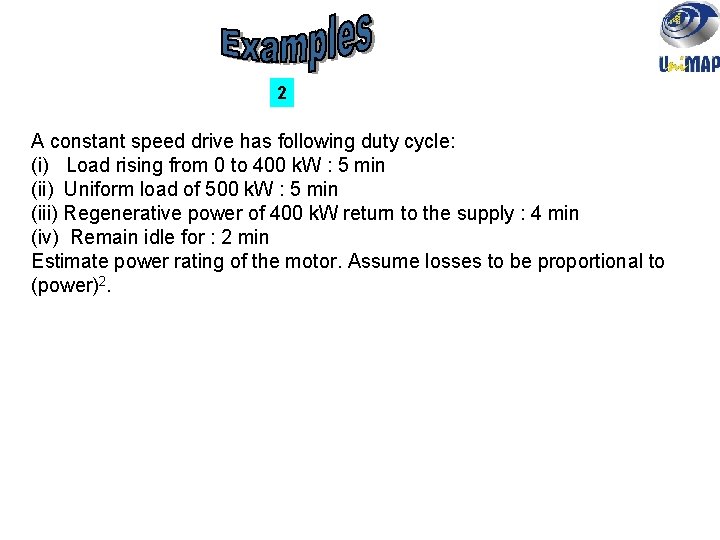
2 A constant speed drive has following duty cycle: (i) Load rising from 0 to 400 k. W : 5 min (ii) Uniform load of 500 k. W : 5 min (iii) Regenerative power of 400 k. W return to the supply : 4 min (iv) Remain idle for : 2 min Estimate power rating of the motor. Assume losses to be proportional to (power)2.