
INDOT Office of Traffic Safety Manager Mike Holowaty
- Slides: 58
INDOT Office of Traffic Safety Manager, Mike Holowaty http: //www. in. gov/dot/programs/
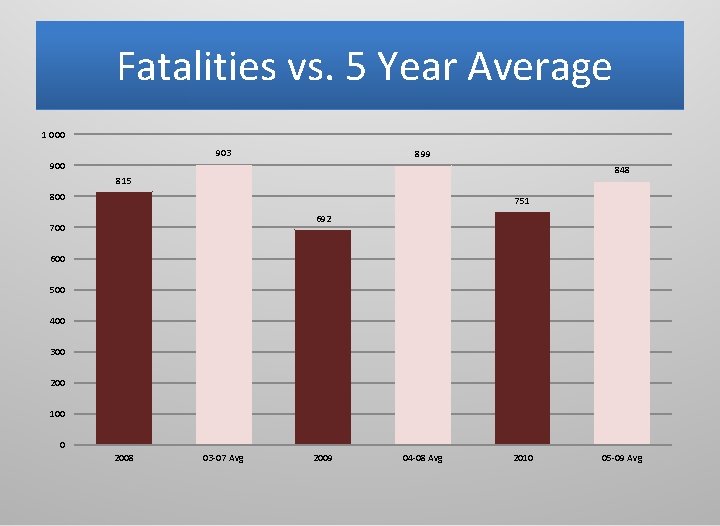
Fatalities vs. 5 Year Average 1 000 903 899 900 848 815 800 751 692 700 600 500 400 300 200 100 0 2008 03 -07 Avg 2009 04 -08 Avg 2010 05 -09 Avg
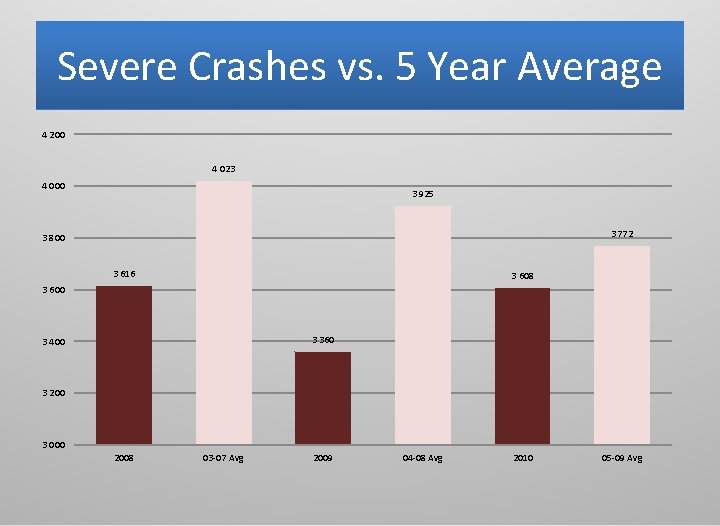
Severe Crashes vs. 5 Year Average 4 200 4 023 4 000 3 925 3 772 3 800 3 616 3 608 3 600 3 360 3 400 3 200 3 000 2008 03 -07 Avg 2009 04 -08 Avg 2010 05 -09 Avg
INDOT MISSION INDOT Will plan, build maintain and operate a superior transportation system enhancing Safety, Mobility and Economic Growth.
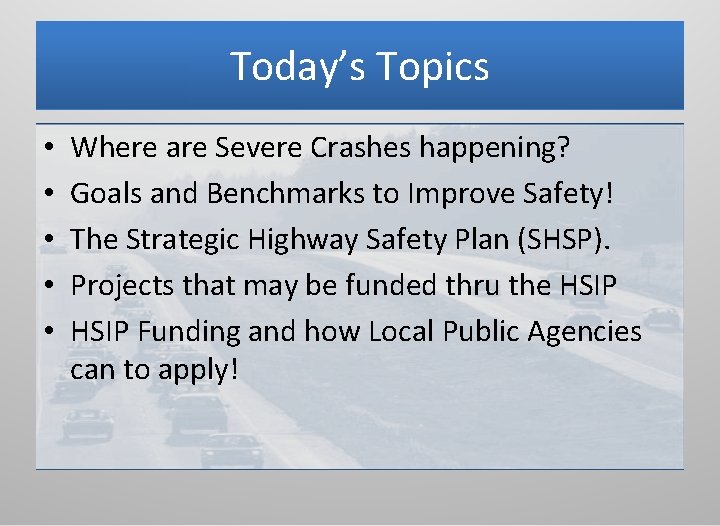
Today’s Topics • • • Where are Severe Crashes happening? Goals and Benchmarks to Improve Safety! The Strategic Highway Safety Plan (SHSP). Projects that may be funded thru the HSIP Funding and how Local Public Agencies can to apply!
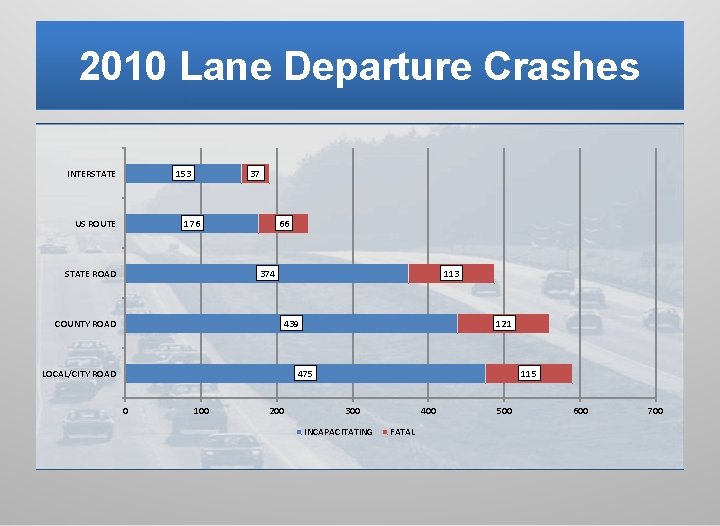
2010 Lane Departure Crashes INTERSTATE 153 US ROUTE 37 176 STATE ROAD 66 374 COUNTY ROAD 113 439 LOCAL/CITY ROAD 121 475 0 100 200 115 300 INCAPACITATING 400 FATAL 500 600 700
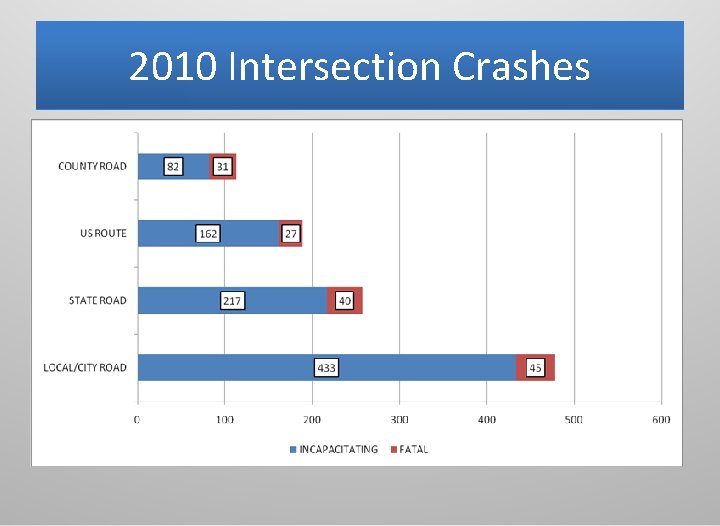
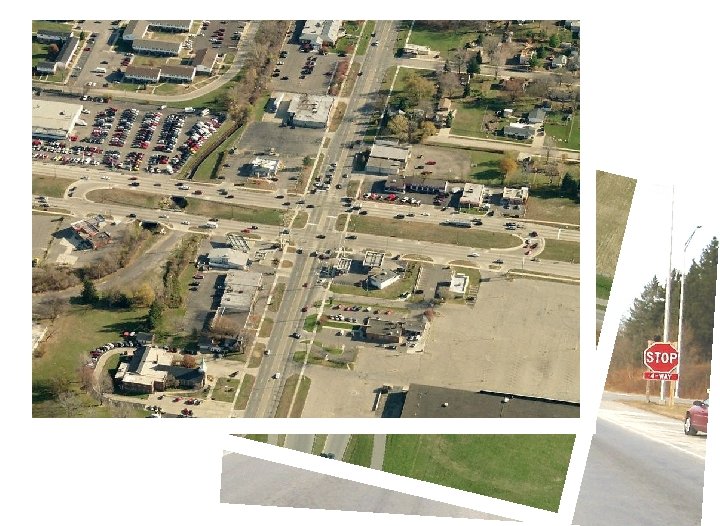
2010 Intersection Crashes
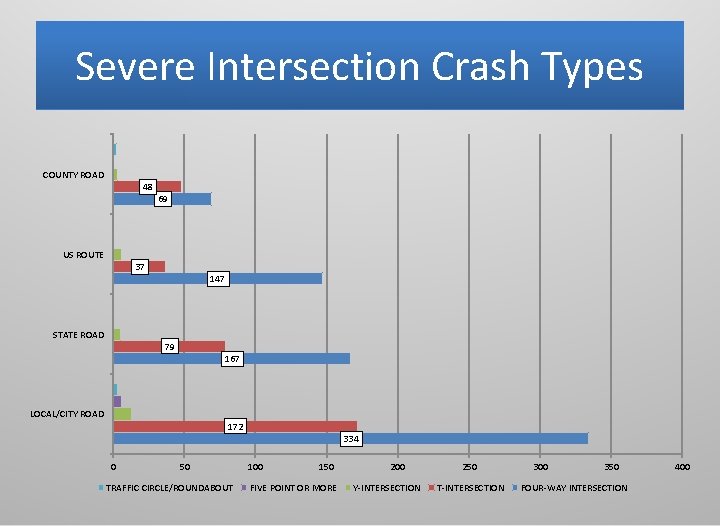
Severe Intersection Crash Types COUNTY ROAD 48 69 US ROUTE 37 147 STATE ROAD 79 167 LOCAL/CITY ROAD 172 334 0 50 TRAFFIC CIRCLE/ROUNDABOUT 100 150 FIVE POINT OR MORE 200 Y-INTERSECTION 250 T-INTERSECTION 300 350 FOUR-WAY INTERSECTION 400
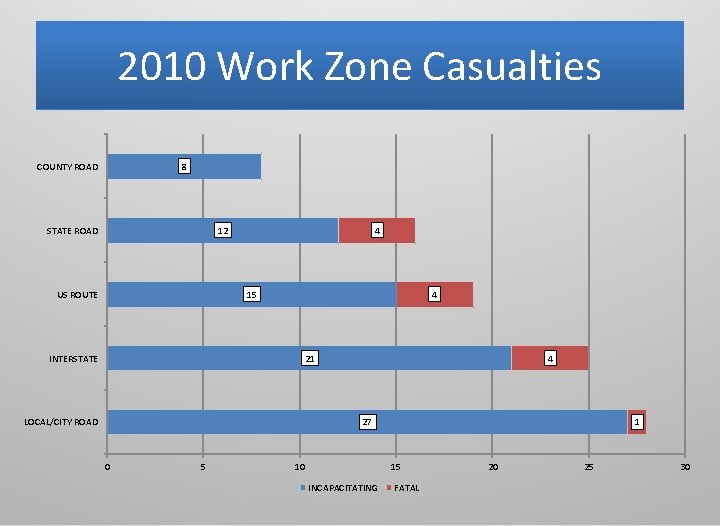
2010 Work Zone Casualties COUNTY ROAD 8 STATE ROAD 12 US ROUTE 4 15 INTERSTATE 4 21 LOCAL/CITY ROAD 4 27 0 5 10 1 15 INCAPACITATING FATAL 20 25 30
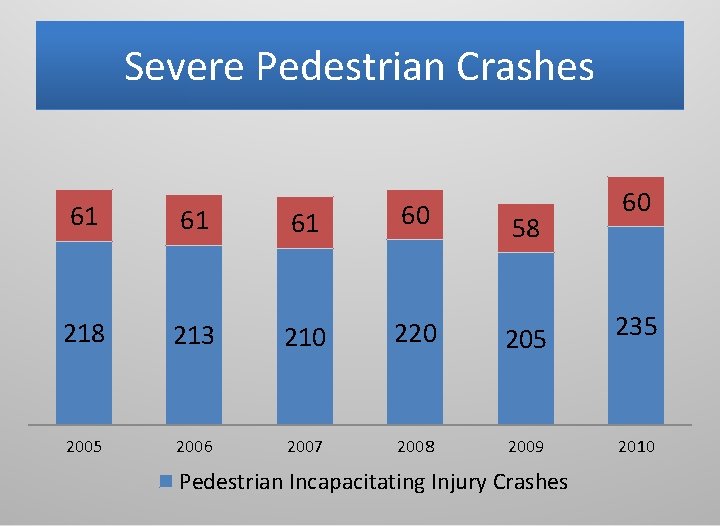
Severe Pedestrian Crashes 61 61 61 60 218 213 210 220 205 2006 2007 2008 2009 58 Pedestrian Incapacitating Injury Crashes 60 235 2010
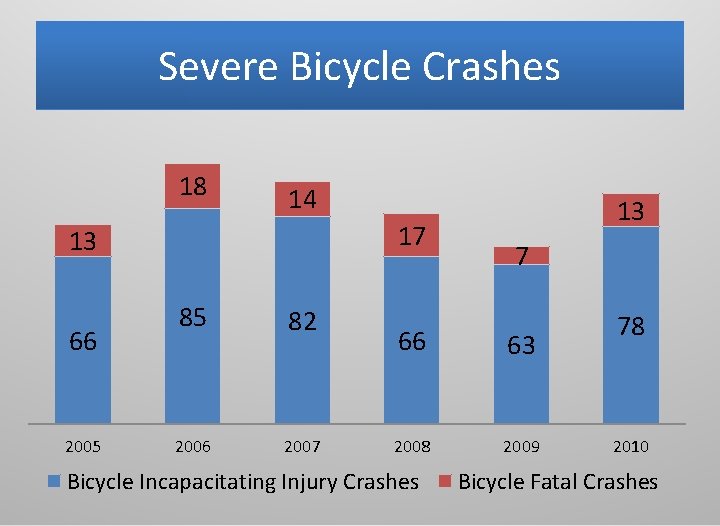
Severe Bicycle Crashes 18 14 17 13 66 2005 85 82 2006 2007 13 7 66 63 2008 2009 Bicycle Incapacitating Injury Crashes 78 2010 Bicycle Fatal Crashes
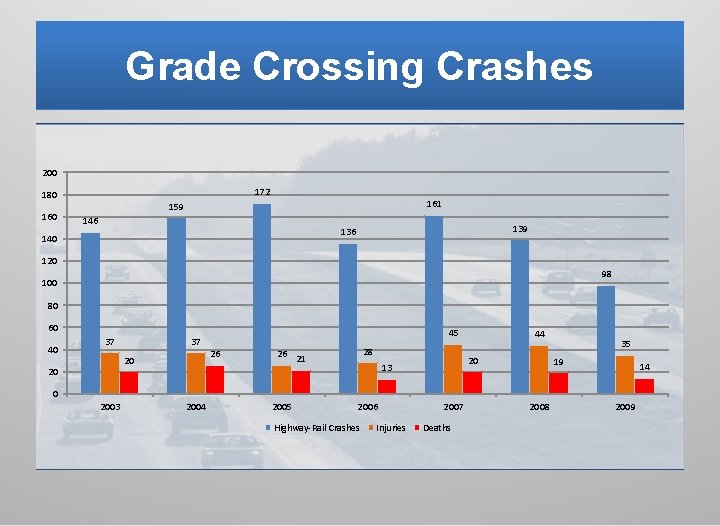
Grade Crossing Crashes 200 172 180 161 159 146 139 136 140 120 98 100 80 60 40 37 37 20 20 45 26 26 28 21 44 20 13 35 19 14 0 2003 2004 2005 2006 Highway-Rail Crashes Injuries 2007 Deaths 2008 2009
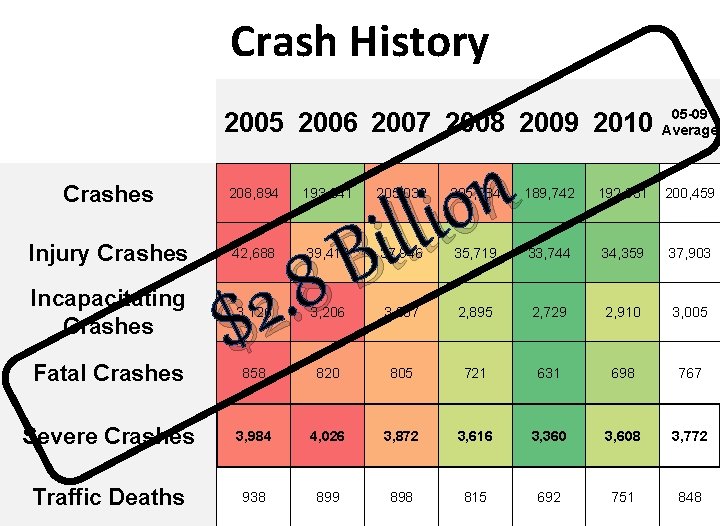
Crash History 2005 2006 2007 2008 2009 2010 Crashes Injury Crashes 208, 894 n o i l l i B 193, 341 8. 2 $ 05 -09 Average 205, 032 205, 284 189, 742 192, 931 200, 459 42, 688 39, 419 37, 946 35, 719 33, 744 34, 359 37, 903 3, 126 3, 206 3, 067 2, 895 2, 729 2, 910 3, 005 858 820 805 721 631 698 767 Severe Crashes 3, 984 4, 026 3, 872 3, 616 3, 360 3, 608 3, 772 Traffic Deaths 938 899 898 815 692 751 848 Incapacitating Crashes Fatal Crashes
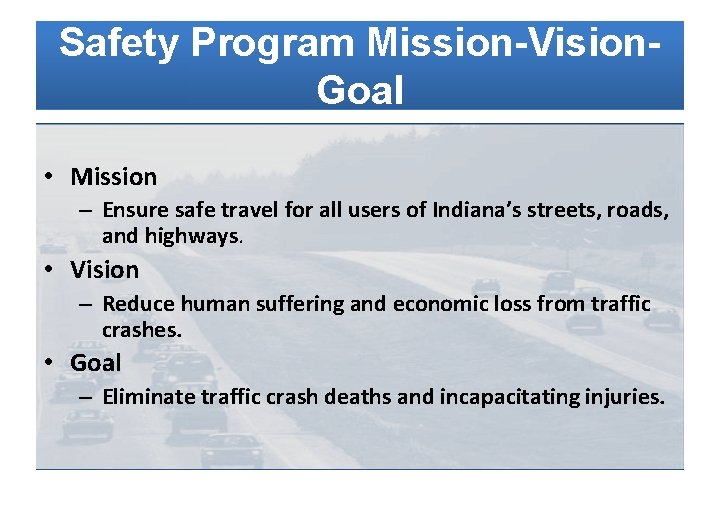
Safety Program Mission-Vision. Goal • Mission – Ensure safe travel for all users of Indiana’s streets, roads, and highways. • Vision – Reduce human suffering and economic loss from traffic crashes. • Goal – Eliminate traffic crash deaths and incapacitating injuries.
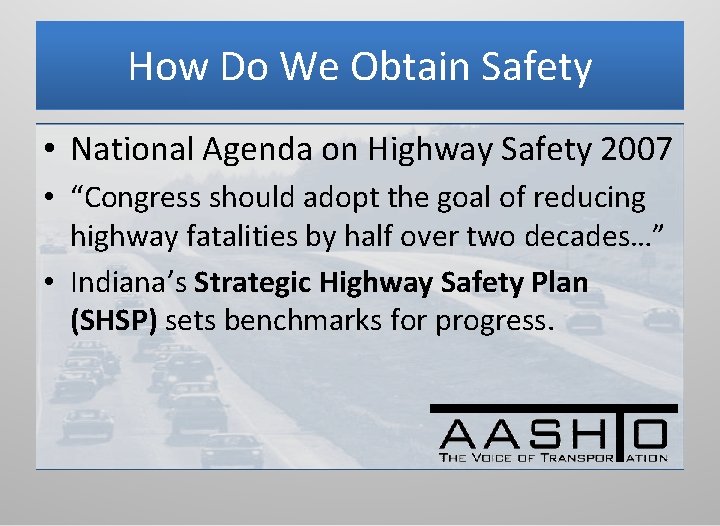
How Do We Obtain Safety • National Agenda on Highway Safety 2007 • “Congress should adopt the goal of reducing highway fatalities by half over two decades…” • Indiana’s Strategic Highway Safety Plan (SHSP) sets benchmarks for progress.
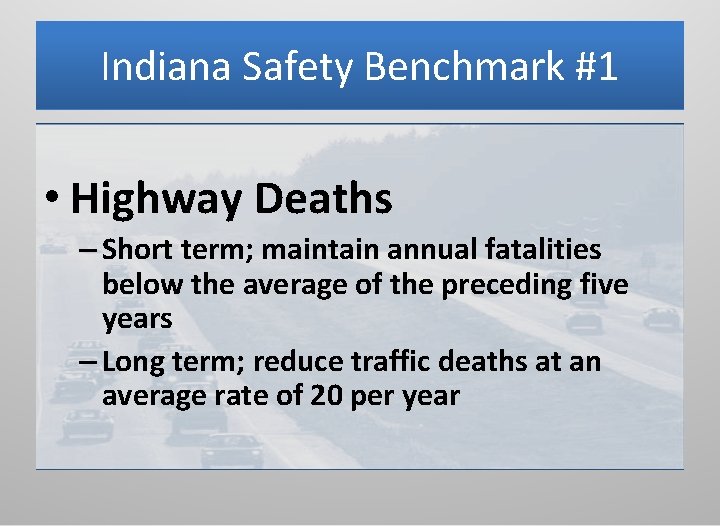
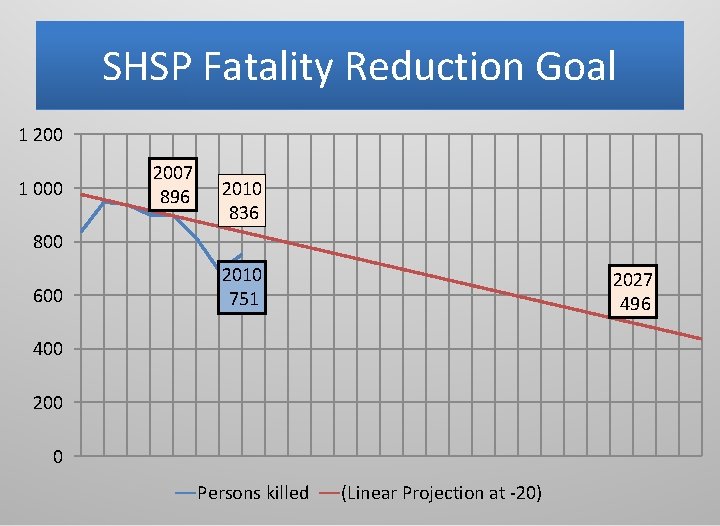
Indiana Safety Benchmark #1 • Highway Deaths – Short term; maintain annual fatalities below the average of the preceding five years – Long term; reduce traffic deaths at an average rate of 20 per year
SHSP Fatality Reduction Goal 1 200 1 000 2007 896 2010 836 800 600 2010 751 2027 496 400 200 0 Persons killed (Linear Projection at -20)
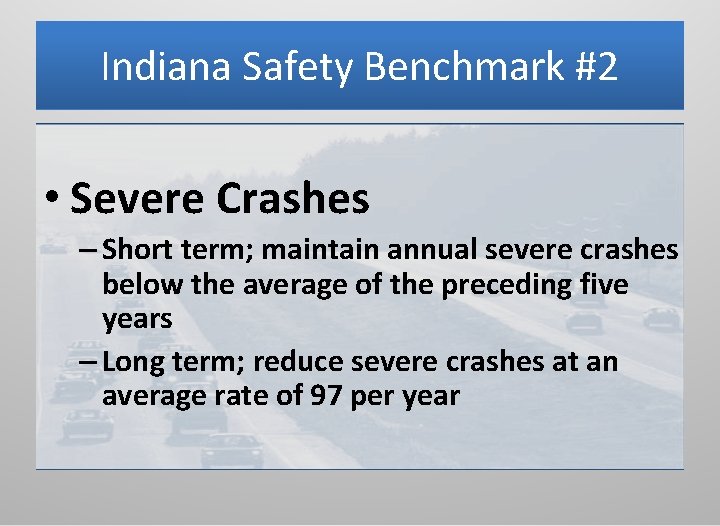
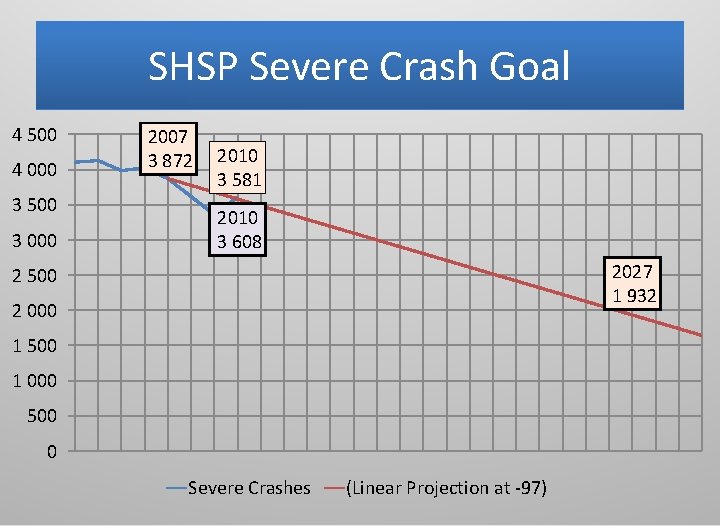
Indiana Safety Benchmark #2 • Severe Crashes – Short term; maintain annual severe crashes below the average of the preceding five years – Long term; reduce severe crashes at an average rate of 97 per year
SHSP Severe Crash Goal 4 500 4 000 3 500 3 000 2007 3 872 2010 3 581 2010 3 608 2027 1 932 2 500 2 000 1 500 1 000 500 0 Severe Crashes (Linear Projection at -97)
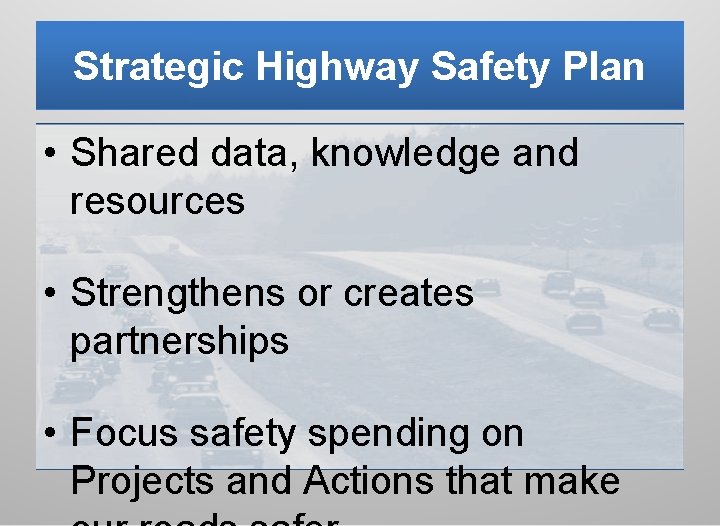
Strategic Highway Safety Plan • Shared data, knowledge and resources • Strengthens or creates partnerships • Focus safety spending on Projects and Actions that make
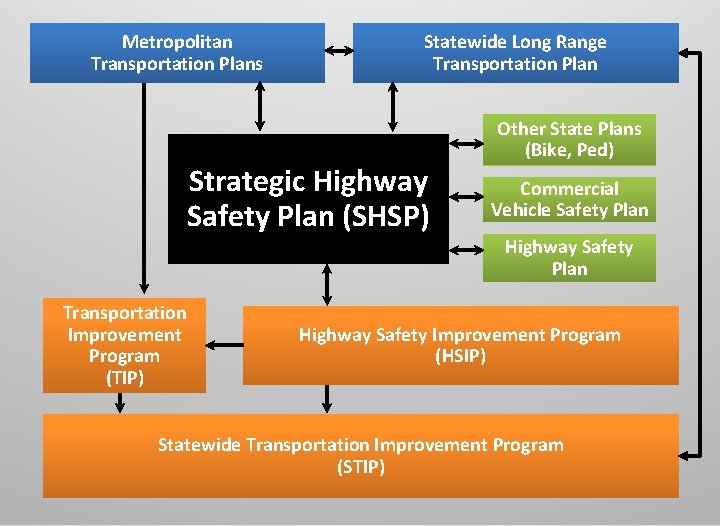
Metropolitan Transportation Plans Statewide Long Range Transportation Plan Strategic Highway Safety Plan (SHSP) Transportation Improvement Program (TIP) Other State Plans (Bike, Ped) Commercial Vehicle Safety Plan Highway Safety Improvement Program (HSIP) Statewide Transportation Improvement Program (STIP)
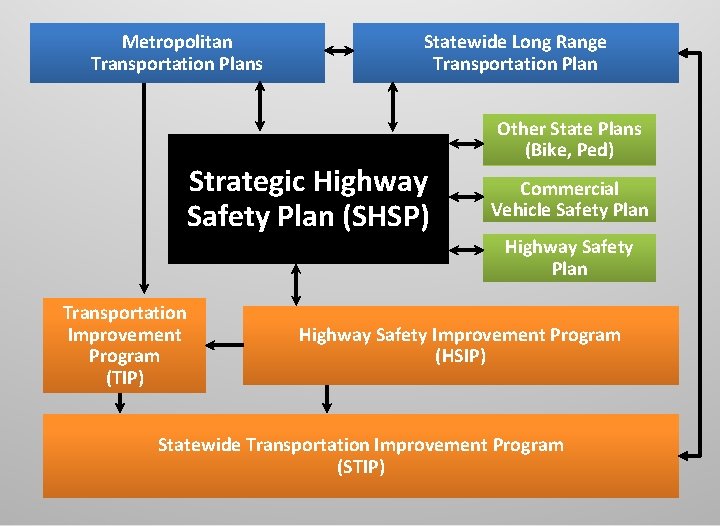
Metropolitan Transportation Plans Statewide Long Range Transportation Plan Strategic Highway Safety Plan (SHSP) Transportation Improvement Program (TIP) Other State Plans (Bike, Ped) Commercial Vehicle Safety Plan Highway Safety Improvement Program (HSIP) Statewide Transportation Improvement Program (STIP)
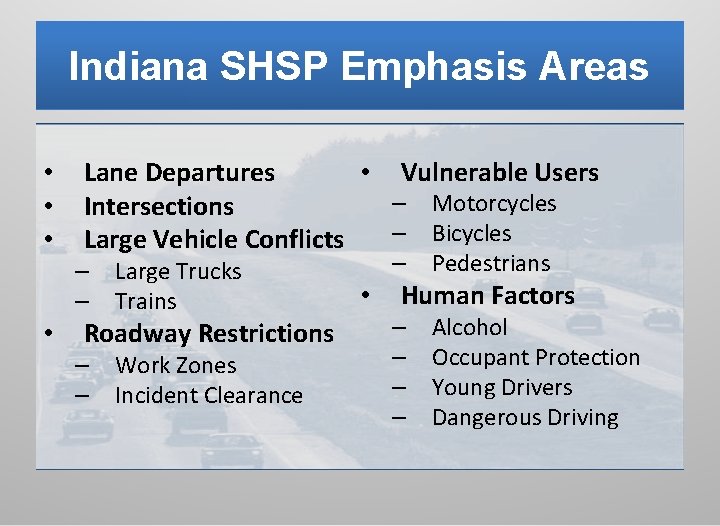
Indiana SHSP Emphasis Areas • • Vulnerable Users Lane Departures – Motorcycles Intersections – Bicycles Large Vehicle Conflicts – – • Large Trucks Trains Roadway Restrictions – – Work Zones Incident Clearance – • Pedestrians Human Factors – – Alcohol Occupant Protection Young Drivers Dangerous Driving
Highway Safety Improvement Program • 23 U. S. C. 148 • 23 CFR 924
Highway Safety Improvement Program The HSIP is a core Federal-aid funding program that requires a data-driven, strategic approach to improving highway safety that focuses on results.
Purpose of the HSIP To achieve a significant reduction in fatalities and serious injuries on all public roads through the implementation of infrastructurerelated highway safety improvements.
http: //www. in. gov/indot/files/Local. HSIPProject. Selection. Guidance. pdf
Applying for HSIP Project Eligibility There are six general requirements for HSIP project eligibility
Requesting HSIP Project Funding REQUIRED ELEMENT #1 Must Addresses an SHSP Emphasis Area!
Requesting HSIP Project Funding REQUIRED ELEMENT #2 Needs Analysis - (SAFETY) Hint: Analyze the crash history
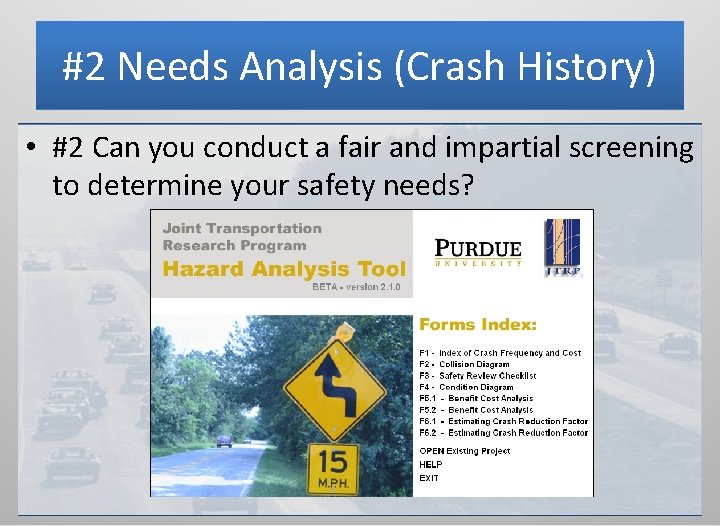
#2 Needs Analysis (Crash History) • #2 Can you conduct a fair and impartial screening to determine your safety needs?
Requesting HSIP Project Funding REQUIRED ELEMENT #3 Financial Analysis Is the project a good investment? Benefit / Cost, Net Present Value, Etc.
Requesting HSIP Project Funding REQUIRED ELEMENT #4 Agree to Maintain the New Infrastructure
Requesting HSIP Project Funding REQUIRED ELEMENT #5 Post Construction Safety Evaluation
Requesting HSIP Project Funding REQUIRED ELEMENT #6 Commitment letter signed by the LPA’s highest Elected Official & Fiscal Officer
Requesting HSIP Project Funding #6 Commitment Letter 1. Signed by the highest elected official and the highest fiscal official of the LPA. 2. The LPA intends to construct the project if it is found eligible for funding. 3. A basic project development timeline is listed. 4. An accurate project cost estimate is stated. 5. The LPA agrees to maintain the safety improvement in the future.
Finding the Worst of the Worst Agencies need to monitor safety on their roads http: //www. crashreports. in. gov/Public/Home. aspx Road Safety Audits (RSA) are a good AND REQUIRED tool to establish safety needs The RSA Report will contain Crash Analysis, Needs Analysis, Reasons that the proposed improvement is preferred, the Cost Estimate and a Financial Analysis.
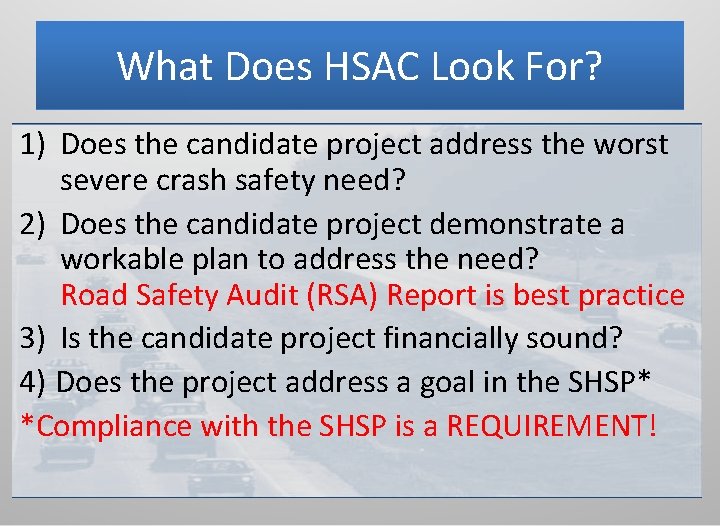
What Does HSAC Look For? 1) Does the candidate project address the worst severe crash safety need? 2) Does the candidate project demonstrate a workable plan to address the need? Road Safety Audit (RSA) Report is best practice 3) Is the candidate project financially sound? 4) Does the project address a goal in the SHSP* *Compliance with the SHSP is a REQUIREMENT!
Urban Local Traffic Safety Partners URBAN AREAS: Metropolitan Planning Agency - Groups 1 -4 • Cities and MPO’s are prime partners for Traffic Safety • MPO’s have a responsibility to guide good choices for the use of HSIP funding
Rural Local Traffic Safety Partners RURAL AREAS: Groups 3 & 4 • The prime safety partners are Cities, Towns, Counties and RPOs. • LTAP will assist local agencies in making good safety choices through the • Hazard Elimination Project for Existing Roads and Streets • The“HELPERS” Project
Who Are These HELPERS? • Assistance – Guide Rural Group 3 & 4 LPA’s in making application for federal safety funds • Advice – Provide a point of contact to get safety questions answered. • Road Safety Audits – They can facilitate Safety Investigation Teams and advise on RSA Reports • Funding Guidance - Help you determine if your proposed project could qualify for Federal Safety Funding
Gatekeepers: HSIP Projects • In Urban Metropolitan Planning Organization (MPO) Areas the MPO’s will apply the HSIP Guidance for the application and selection of projects to use locally assigned federal aid safety funds. • (Final Selection is subject to HSAC finding of Eligibility and MPO Executive Committee action. ) • In Rural Group 3 and 4 Areas the LTAP HELPERS project will receive and pass-on LPA project applications that request federal aid safety funds to the HSAC for review and approval.
Low Cost Systematic Improvement Projects Short Form Application may be used only for certain High Priority Low Cost Systematic Countermeasures
Short Form Eligible Projects Sign inventory system and or sign replacement to meet MUTCD retroreflectivity requirements
Short Form Eligible Projects Upgrade traffic signals to a minimum of one signal head per travel lane
Short Form Eligible Projects Install black backing plates on all signal heads on a traffic signal
Short Form Eligible Projects Make changes to yellow interval signal timing or interconnect to improve safety
Short Form Eligible Projects Install pedestrian push button and countdown heads on a traffic signal
Short Form Eligible Projects Install new pedestrian crosswalk warning signs, flashing beacons, special pavement markings and refuge areas
Short Form Eligible Projects Passive warning improvement at railroad crossings that lack active warning devices
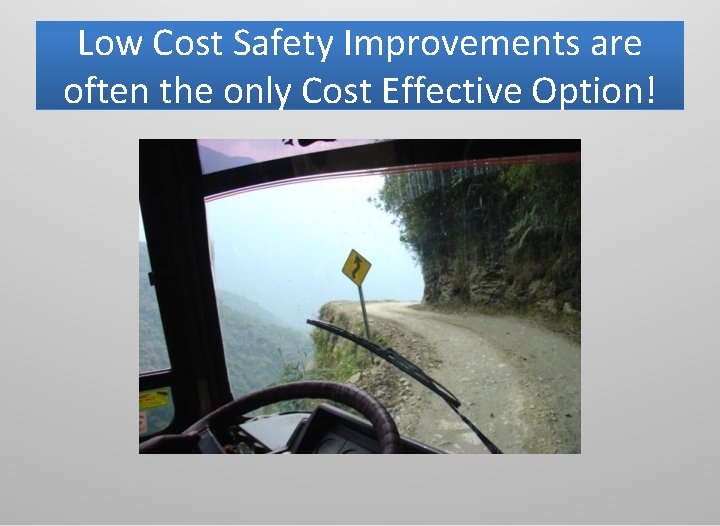
Low Cost Safety Improvements are often the only Cost Effective Option!
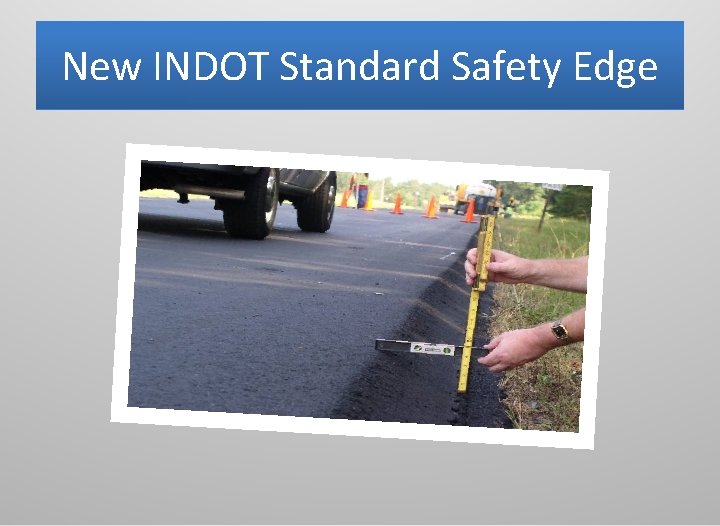
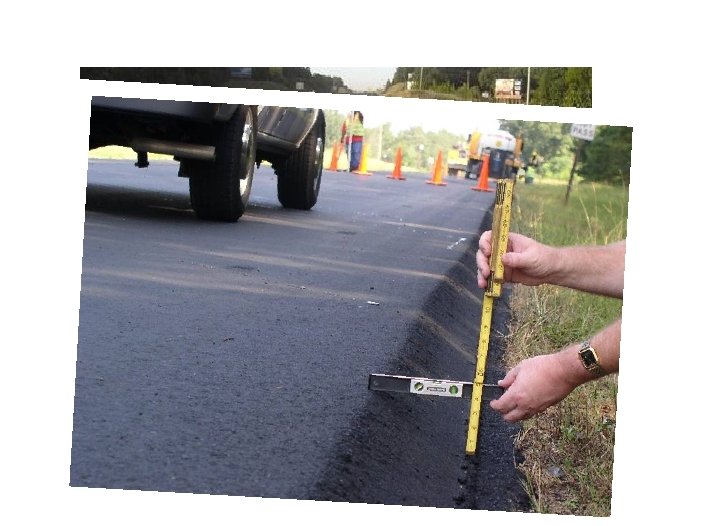
New INDOT Standard Safety Edge
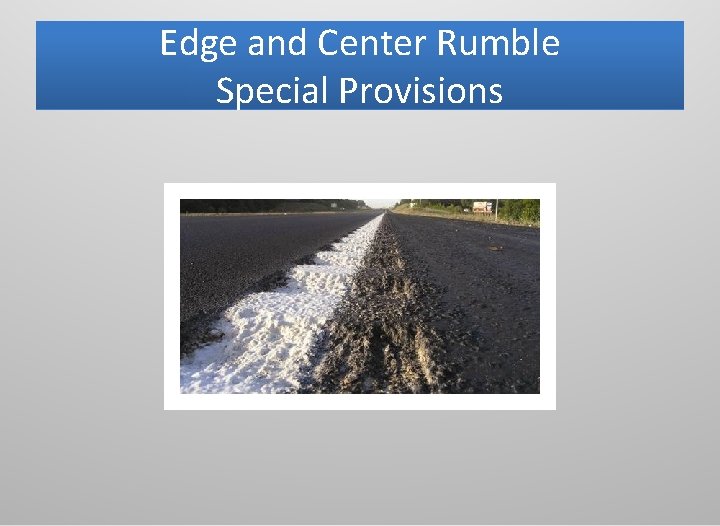
Edge and Center Rumble Special Provisions
INDOT Office of Traffic Safety http: //www. in. gov/dot/programs/ • Office Manager: Mike Holowaty – (317) 232 -5337 mholowaty@indot. in. gov • Crash Management Systems Manager: John Nagle – (317) 232 -5464 jnagle@indot. in. gov – http: //www. crashreports. in. gov/Public/Home. aspx • Strategic Highway Safety Plan Manager: Roger Manning – (317) 232 -5204 rmanning@indot. in. gov • Safe Routes to School Coordinator: Mike O’Loughlin – (317) 232 -5653 moloughlin@indot. in. gov