
INDOOR CLIMATE Copyright Catherine M Burns 1 What

INDOOR CLIMATE Copyright Catherine M. Burns 1
What does “climate” include? w air temperature w surface temperature w air humidity w air movement w air quality Copyright Catherine M. Burns 2
Human Thermoregulation w not really 37 degrees everywhere, just in interior w core temperature w also shell temperature, temperature at skin Copyright Catherine M. Burns 3
Basic Heat Transfer w heat energy flows from warm to cold w body tries to regulate heat by preventing heat loss when cold or increasing heat loss when warm w nerve cells receive external heat information w blood sweat and shivering are primary control mechanisms Copyright Catherine M. Burns 4
Role of Blood Transport w blood moves from warm tissues to cold tissues to dissipate excess heat w movement from interior to skin to release heat to environment w movement from skin to interior to increase heat w shunting blood is by dilation of veins arteries and capillaries w "vaso-dilation" Copyright Catherine M. Burns 5
Role of Sweat w removes heat by evaporation w 1 cubic cm of sweat takes 2. 4 k. J to evaporate w most people sweat 1 L per day w ability to sweat depends on air humidity and air movement Copyright Catherine M. Burns 6

Role of Shivering w raises heat production w rapid muscle action tries to generate metabolic heat Copyright Catherine M. Burns 7
Heat exchange to the environment w Conduction direct contact w Convection skin to air transfer w Evaporation (sweat) w Radiation w Depends on temperature n At 25 degrees C and above, sweating is only mechanism that works significantly Copyright Catherine M. Burns 8
Comfort and Discomfort w What is comfort? rather small range 2 -3 degrees w positive or negative heat balance is felt as discomfort w too much heat can cause tiredness w reduced performance w increased errors w too much cooling restlessness Copyright Catherine M. Burns 9
w "Comfort" depends on n n n clothing amount of physical activity food time of year body size gender age Copyright Catherine M. Burns 10
Concept of Effective Temperature w temperature alone doesn't determine rate of heat loss w also air movement, other surfaces, humidity w concept behind windchill and humidex Copyright Catherine M. Burns 11
Air Movement w seated people find anything about 0. 2 m/s unpleasant w particularly don't like movement on neck or feet w from behind more annoying that in front Copyright Catherine M. Burns 12

Air Dryness/Humidity w problem in winter due to heating systems w breathing problems w recommend 40 -50% humidity w below 30% problems Copyright Catherine M. Burns 13
General Guidelines (Offices) w temperature winter 20 -21 degrees, summer 20 -24 degrees w surface temps within 2 -3 degrees of air w relative humidity of min 30%, ideally 4060% w air speed of 0. 2 m/s Copyright Catherine M. Burns 14
Air Quality w People in a room n n release odours release water release carbon dioxide generate air pollution w Guideline is 30 cubic meters of fresh air person per hour. Copyright Catherine M. Burns 15
Physical Work w lower temperatures w down to 15 -16 degrees for severe work w Figure 12. 8 gives recommendations on work levels at various temperatures Copyright Catherine M. Burns 16
Physiological changes with heat w fatigue w increased heart rate w increased blood pressure w reduced digestive activity w increased core and shell temperature w increased blood flow w increased sweat production Copyright Catherine M. Burns 17
Heat Stroke Symptoms w w w w tiredness, loss of performance red skin increased heart rate headache giddiness shortness of breath vomiting and muscular cramps unconsciousness Copyright Catherine M. Burns 18
Signs of Heat Adaptation w increased perspiration rates w sweat with fewer salts in it w loss of weight w increased thirst w circulatory adaptation Copyright Catherine M. Burns 19
Recommendations for High Heat w 1. planning for heat adaptation of workers w 2. frequent rest and cooling breaks w 3. small amounts of fluid regularly w 4. plain water or warm drinks w 5. protection from high levels of radiant heat Copyright Catherine M. Burns 20
Sick Building Syndrome w MY STORY: I work for the County of Santa Barbara in Santa Barbara, California. I started working in the building over one year ago and it has been a year of hell. Since my employment there I have developed Fibromyalgia with Chronic Fatigue. I also have experienced heart palpitations, shortness of breath, dizziness, fainting spells, and headaches. I have had to take meds to control these symptoms. The building is very old and not well ventilated. We have old radiators that inadequately heat the building and no hvac system. There is one window on my side of the building that is about two feet by two feet and 10 -12 feet up from the ground. The screen is frequently caked with dust. The roof leaks and provides further work hazards. There are two in my building who have been removed from the building under doctors orders and several more who have the same symptoms that I do. My blood tests show that there is nothing else wrong with me. My symptoms and those of others disappear when we are away from work. I am currently looking into my legal rights. SUBMITTED: 11/21/02 http: //www. presenting. net/sbs/otherstories. html Copyright Catherine M. Burns 21
Discussion: “Sick Building” Syndrome w Diverse spectrum of complaints n n n Dizziness Headache Fatigue Nausea Skin irritation Congestion … (Niosh Indoor Environmental Quality Fact Sheet 1997) Copyright Catherine M. Burns 22
Prevalence w 1980’s made up 8% of NIOSH complaints w 1990’s made up 38% of NIOSH complaints w What are possible factors in the increase? Copyright Catherine M. Burns 23
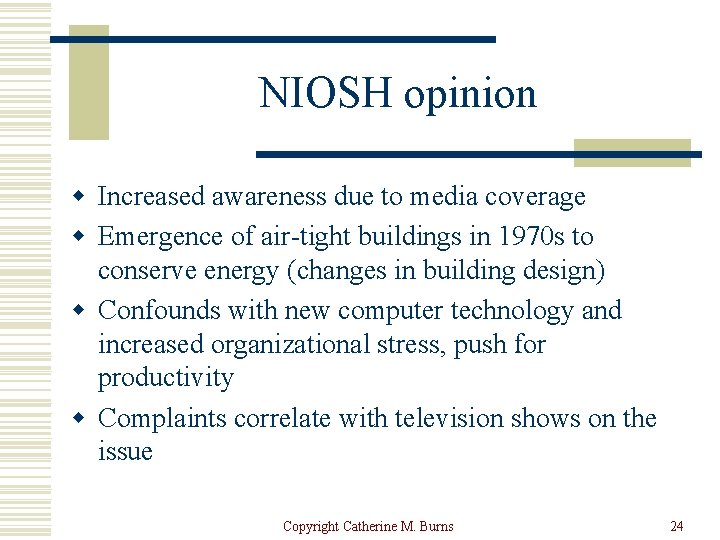
NIOSH opinion w Increased awareness due to media coverage w Emergence of air-tight buildings in 1970 s to conserve energy (changes in building design) w Confounds with new computer technology and increased organizational stress, push for productivity w Complaints correlate with television shows on the issue Copyright Catherine M. Burns 24
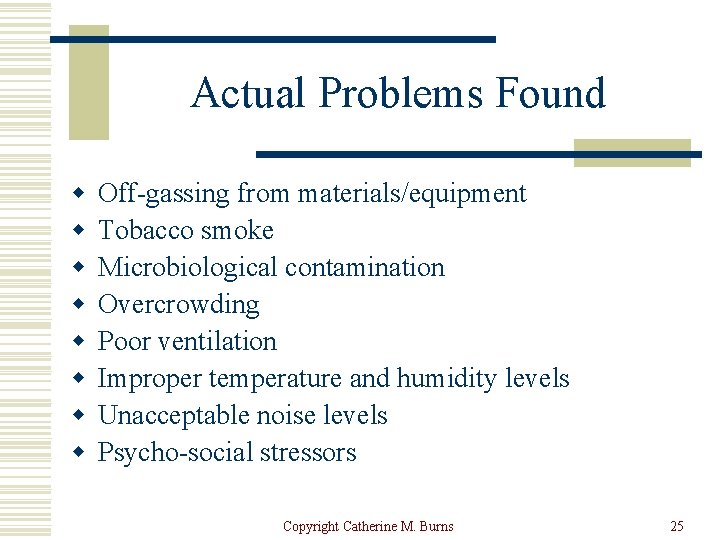
Actual Problems Found w w w w Off-gassing from materials/equipment Tobacco smoke Microbiological contamination Overcrowding Poor ventilation Improper temperature and humidity levels Unacceptable noise levels Psycho-social stressors Copyright Catherine M. Burns 25
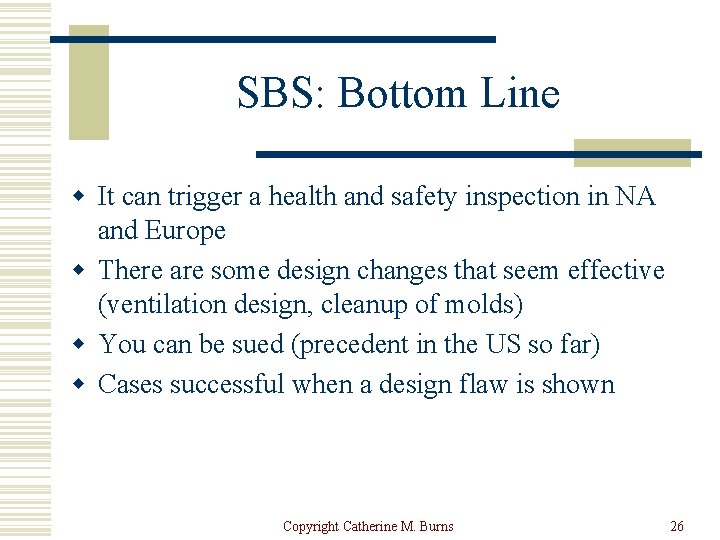
SBS: Bottom Line w It can trigger a health and safety inspection in NA and Europe w There are some design changes that seem effective (ventilation design, cleanup of molds) w You can be sued (precedent in the US so far) w Cases successful when a design flaw is shown Copyright Catherine M. Burns 26
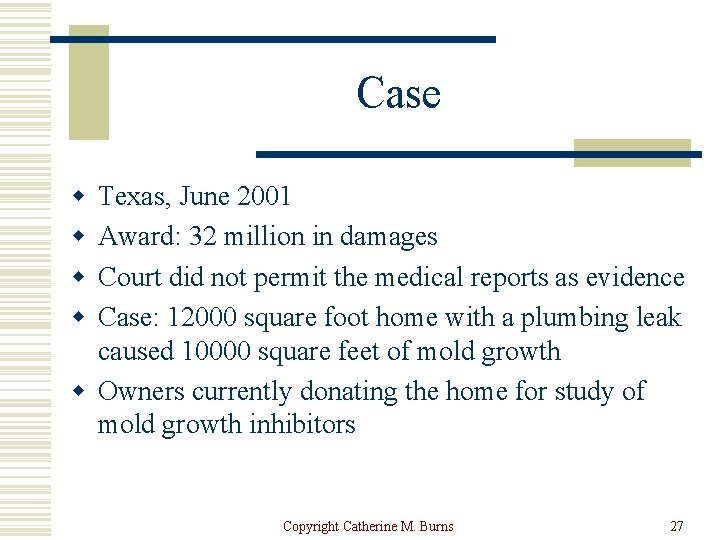
Case w w Texas, June 2001 Award: 32 million in damages Court did not permit the medical reports as evidence Case: 12000 square foot home with a plumbing leak caused 10000 square feet of mold growth w Owners currently donating the home for study of mold growth inhibitors Copyright Catherine M. Burns 27
- Slides: 27