
Indo Word Net Database Design Presented By Konkani
Indo. Word. Net Database Design Presented By: Konkani NLP Team Goa University Indo. Word. Net Database Design 1
Brief Outline • Objectives • Background • Requirements • Proposed database design – Database design details – Issues to be resolved – Tools and Scripts • API’s – Indo. Word. Net API – Layers of API – Class Diagram – Sample API code Indo. Word. Net Database Design 2
Objectives • To finalize the database design. • To finalize tools/script necessary for distributing the database. • API design. • API demonstration. Indo. Word. Net Database Design 3
Background • Indo. Word. Net is a multilingual Word. Net that links Word. Nets of different Indian languages. • A Word. Net is a crucial resource for a language which aids in NLP tasks such as Machine Translation, Information Retrieval, etc. • Databases necessary maintain the data for one or multiple Word. Nets. • Database needs to support development of online and offline applications. Indo. Word. Net Database Design 4
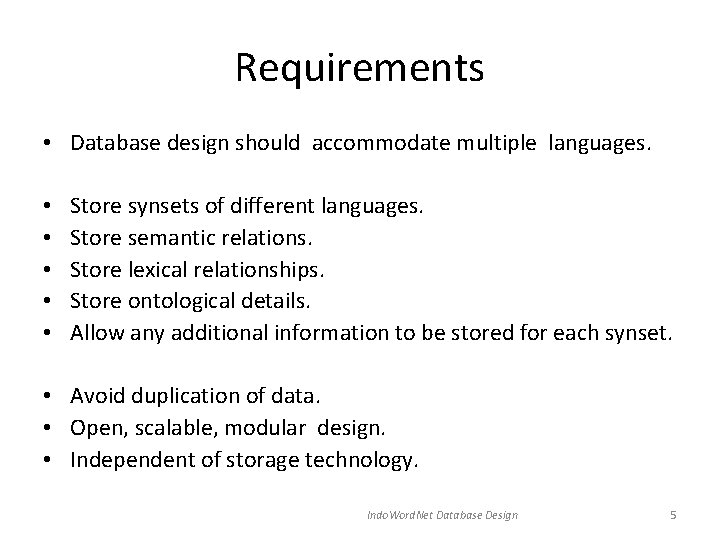
Requirements • Database design should accommodate multiple languages. • • • Store synsets of different languages. Store semantic relations. Store lexical relationships. Store ontological details. Allow any additional information to be stored for each synset. • Avoid duplication of data. • Open, scalable, modular design. • Independent of storage technology. Indo. Word. Net Database Design 5
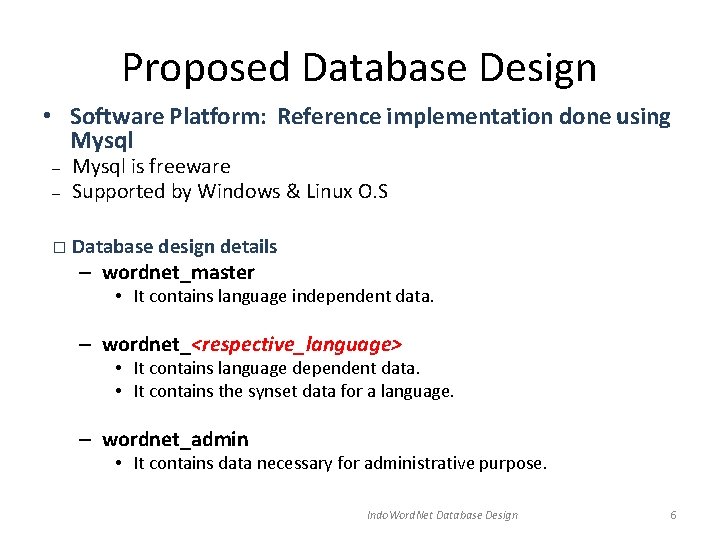
Proposed Database Design • Software Platform: Reference implementation done using Mysql – – � Mysql is freeware Supported by Windows & Linux O. S Database design details – wordnet_master • It contains language independent data. – wordnet_<respective_language> • It contains language dependent data. • It contains the synset data for a language. – wordnet_admin • It contains data necessary for administrative purpose. Indo. Word. Net Database Design 6
wordnet_master • The wordnet_master maintains the data shared by all the languages. • The wordnet_master includes tables for semantic relations. • It will include all ontology related tables in English. • The language specific data will be available in the wordnet_<respective_language> database. Indo. Word. Net Database Design 7
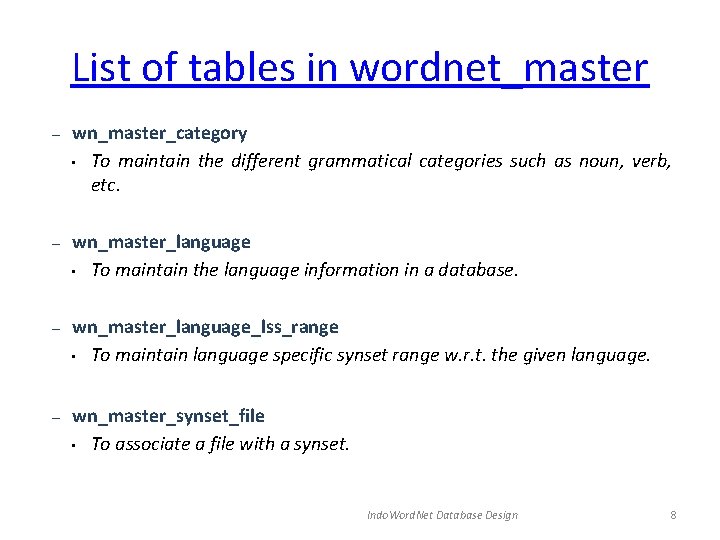
List of tables in wordnet_master – wn_master_category • To maintain the different grammatical categories such as noun, verb, etc. – wn_master_language • To maintain the language information in a database. – wn_master_language_lss_range • To maintain language specific synset range w. r. t. the given language. – wn_master_synset_file • To associate a file with a synset. Indo. Word. Net Database Design 8
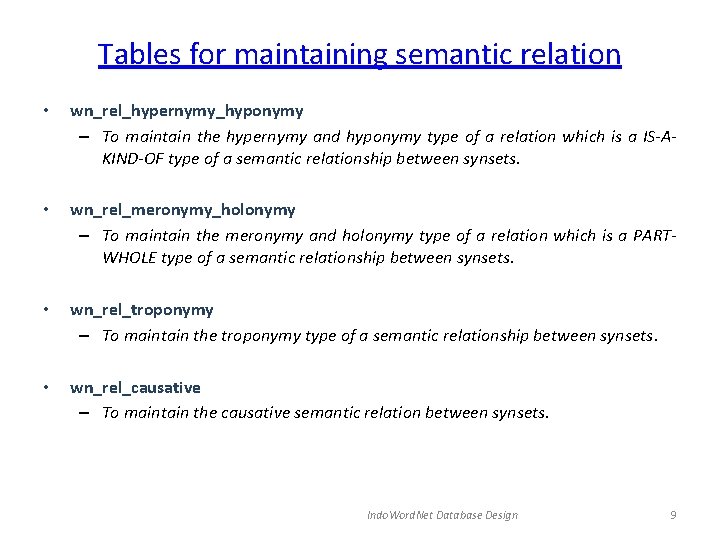
Tables for maintaining semantic relation • wn_rel_hypernymy_hyponymy – To maintain the hypernymy and hyponymy type of a relation which is a IS-AKIND-OF type of a semantic relationship between synsets. • wn_rel_meronymy_holonymy – To maintain the meronymy and holonymy type of a relation which is a PARTWHOLE type of a semantic relationship between synsets. • wn_rel_troponymy – To maintain the troponymy type of a semantic relationship between synsets. • wn_rel_causative – To maintain the causative semantic relation between synsets. Indo. Word. Net Database Design 9
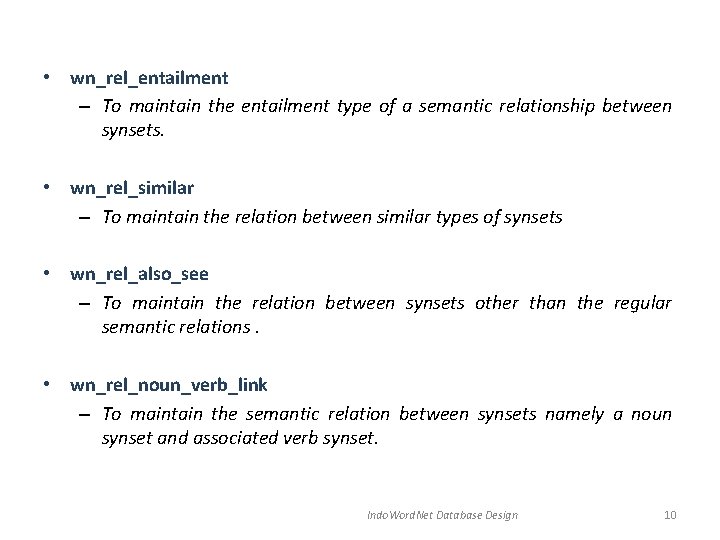
• wn_rel_entailment – To maintain the entailment type of a semantic relationship between synsets. • wn_rel_similar – To maintain the relation between similar types of synsets • wn_rel_also_see – To maintain the relation between synsets other than the regular semantic relations. • wn_rel_noun_verb_link – To maintain the semantic relation between synsets namely a noun synset and associated verb synset. Indo. Word. Net Database Design 10
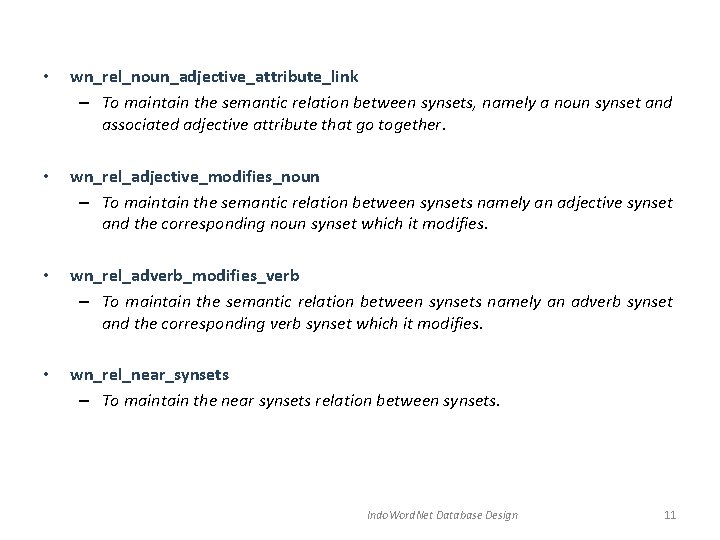
• wn_rel_noun_adjective_attribute_link – To maintain the semantic relation between synsets, namely a noun synset and associated adjective attribute that go together. • wn_rel_adjective_modifies_noun – To maintain the semantic relation between synsets namely an adjective synset and the corresponding noun synset which it modifies. • wn_rel_adverb_modifies_verb – To maintain the semantic relation between synsets namely an adverb synset and the corresponding verb synset which it modifies. • wn_rel_near_synsets – To maintain the near synsets relation between synsets. Indo. Word. Net Database Design 11
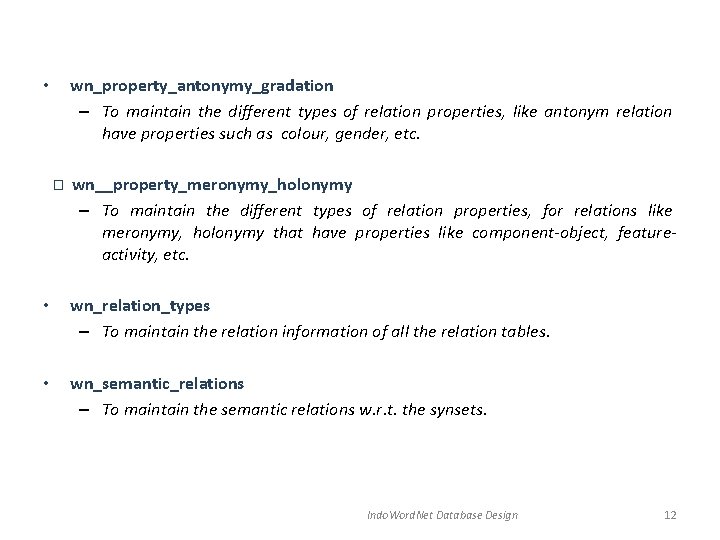
wn_property_antonymy_gradation – To maintain the different types of relation properties, like antonym relation have properties such as colour, gender, etc. • � wn__property_meronymy_holonymy – To maintain the different types of relation properties, for relations like meronymy, holonymy that have properties like component-object, featureactivity, etc. • wn_relation_types – To maintain the relation information of all the relation tables. • wn_semantic_relations – To maintain the semantic relations w. r. t. the synsets. Indo. Word. Net Database Design 12
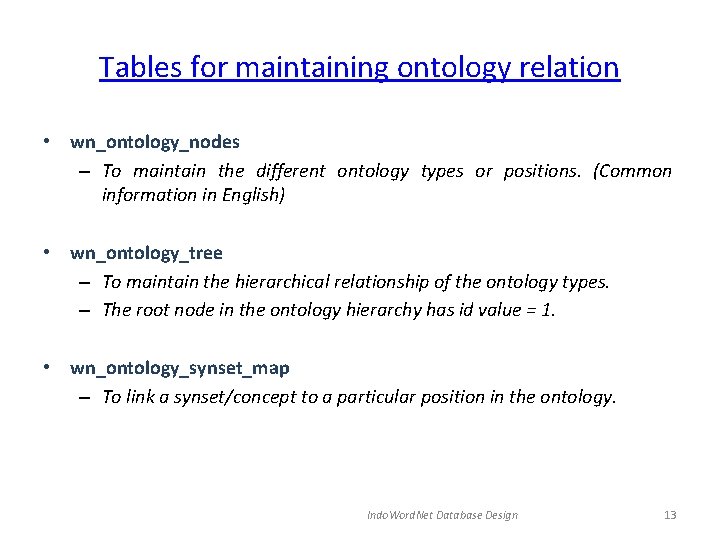
Tables for maintaining ontology relation • wn_ontology_nodes – To maintain the different ontology types or positions. (Common information in English) • wn_ontology_tree – To maintain the hierarchical relationship of the ontology types. – The root node in the ontology hierarchy has id value = 1. • wn_ontology_synset_map – To link a synset/concept to a particular position in the ontology. Indo. Word. Net Database Design 13
wordnet_<respective_language> • The wordnet_<respective_language> database will keep tables which will have information related to the particular language. • It will include tables to keep synset details, words in the language, examples, etc. • <respective_language> is to be replaced by any of the languages of the Indo. Word. Net group. viz. Assamese, Hindi, Konkani, Oriya, Punjabi, Urdu, etc as applicable. • wordnet_bodo Indo. Word. Net Database Design 14
wordnet_admin • This database is used to keep other related tables such as: – Feedback table – FAQ table – Website administration tables – User + password table –… Indo. Word. Net Database Design 15
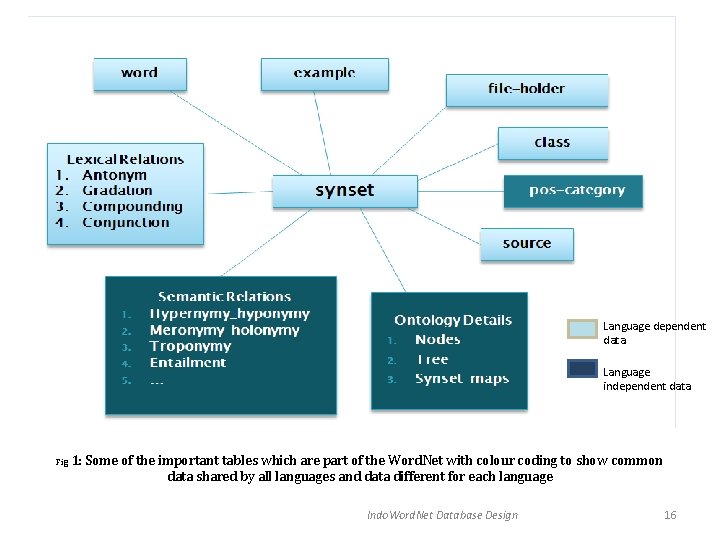
Language dependent data Language independent data Fig 1: Some of the important tables which are part of the Word. Net with colour coding to show common data shared by all languages and data different for each language Indo. Word. Net Database Design 16
Issues to be Resolved • The tables below: – wn_rel_adjective_modifies_noun – wn_rel_adverb_modifies_verb – wn_rel_noun_adjective_attribute_link – wn_rel_noun_verb_link -are to be stored as Language independent data or Language dependent data? ( in view of change in POS category reported by language groups) Indo. Word. Net Database Design 17
• In table ‘wn_ontology_nodes’ the data should be only in English and the data in other language can be kept in their respective language database. • Need to be done NOW To approve master and <respective_language> tables of each language. Indo. Word. Net Database Design 18
Tools & Scripts • Tool to populate data into the various tables of the database. • Population of data into tables such as – – wn_synset wn_word wn_synset_words wn_synset_example • Scripts to create language specific data tables. • Scripts to dump and restore data. • Scripts to manage/update incremental changes done to tables in wordnet_master Indo. Word. Net Database Design 19
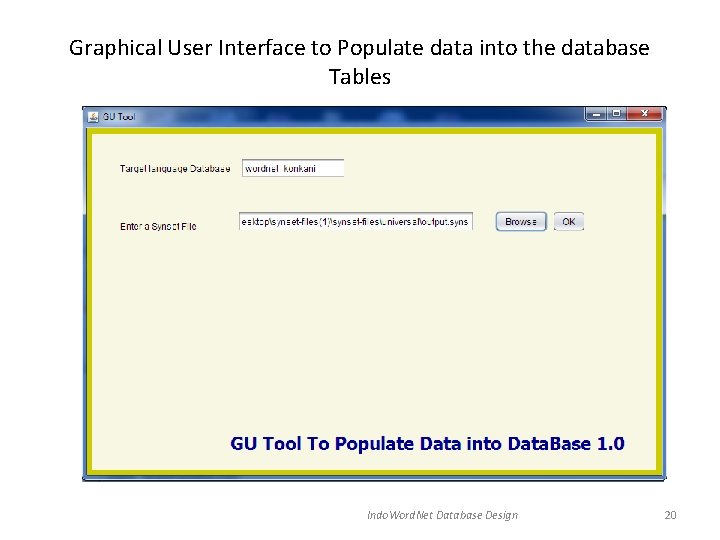
Graphical User Interface to Populate data into the database Tables Indo. Word. Net Database Design 20
Questions? Indo. Word. Net Database Design 21
API’s • An Application Programming Interface (API) is a set of commands, functions and protocols which programmers can use when building a software. • It allows the programmers to use predefined functions to interact with systems, instead of writing them from scratch. • Characteristics of good API – Easy to learn and use, Hard to misuse. – Easy to read and maintain code that uses it. – Is programming language neutral. – Sufficiently powerful to support all computational requirements. Indo. Word. Net Database Design 22
Indo. Word. Net API • It allows a user to use the API without the knowledge of the database design. • The API is object-oriented design. • The API is designed in such a way that it supports single/multiple languages. • API design consist of two layers: – Application layer – Database layer • The Database layer will change depending on the DBMS but the Application layer will mostly remain unchanged. Indo. Word. Net Database Design 23
Application layer • The Application layer incorporates the logical part of the Indo. Word. Net requirements, so as to provide classes and objects to perform all the operations to be performed on the synset, relations, ontology, other master data, etc. • Reference Implementation is being done in Java and PHP. Indo. Word. Net Database Design 24
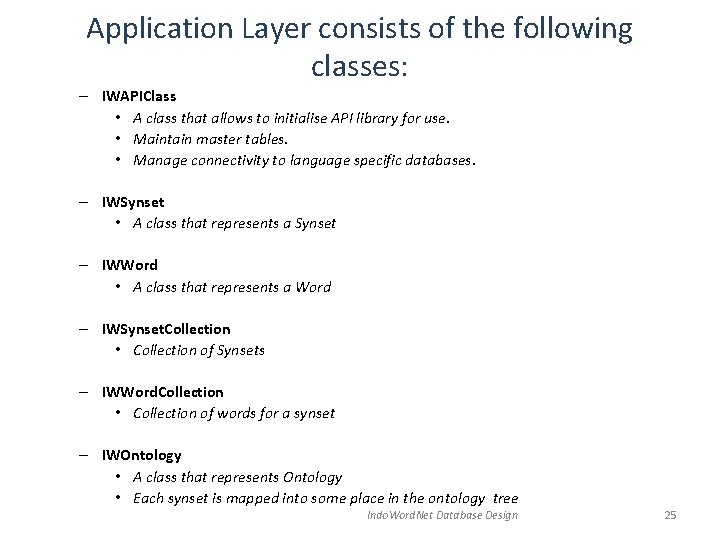
Application Layer consists of the following classes: – IWAPIClass • A class that allows to initialise API library for use. • Maintain master tables. • Manage connectivity to language specific databases. – IWSynset • A class that represents a Synset – IWWord • A class that represents a Word – IWSynset. Collection • Collection of Synsets – IWWord. Collection • Collection of words for a synset – IWOntology • A class that represents Ontology • Each synset is mapped into some place in the ontology tree Indo. Word. Net Database Design 25
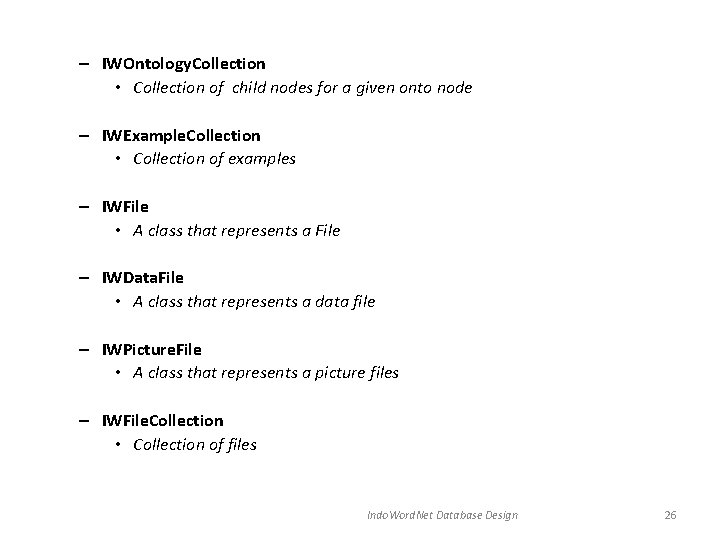
– IWOntology. Collection • Collection of child nodes for a given onto node – IWExample. Collection • Collection of examples – IWFile • A class that represents a File – IWData. File • A class that represents a data file – IWPicture. File • A class that represents a picture files – IWFile. Collection • Collection of files Indo. Word. Net Database Design 26
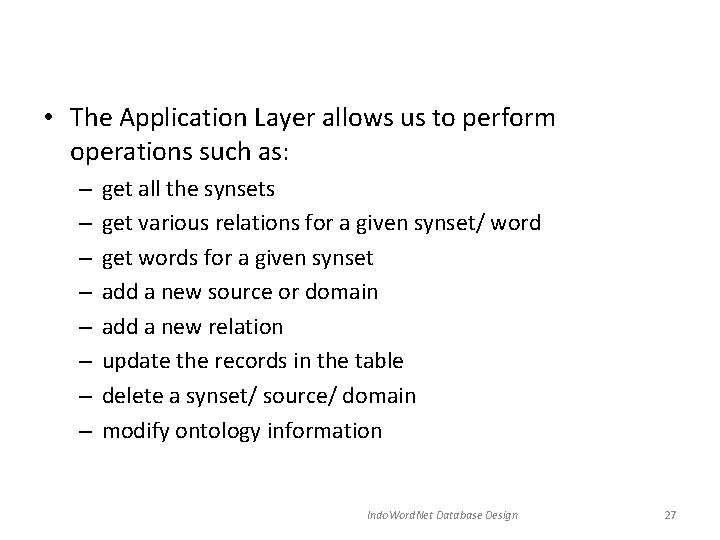
• The Application Layer allows us to perform operations such as: – – – – get all the synsets get various relations for a given synset/ word get words for a given synset add a new source or domain add a new relation update the records in the table delete a synset/ source/ domain modify ontology information Indo. Word. Net Database Design 27
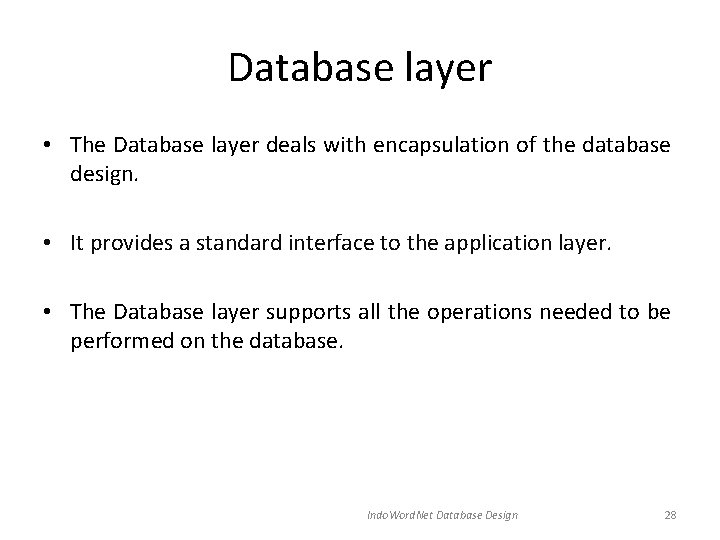
Database layer • The Database layer deals with encapsulation of the database design. • It provides a standard interface to the application layer. • The Database layer supports all the operations needed to be performed on the database. Indo. Word. Net Database Design 28
Database Layer consists of the following classes: – IWDb • A class that connects to a Language Dependent Database. – IWCon • A class that sets up a connection to a database – IWStatement • A class which contains all the queries pertaining to the application layer • Also the basic functions such as updation, deletion, insertion, selection, etc. – IWResult • A class which returns results to the application layer, the results of executed queries – IWField • A class which returns to the application, the proper data-type irrespective of the db data-type or vice versa Indo. Word. Net Database Design 29
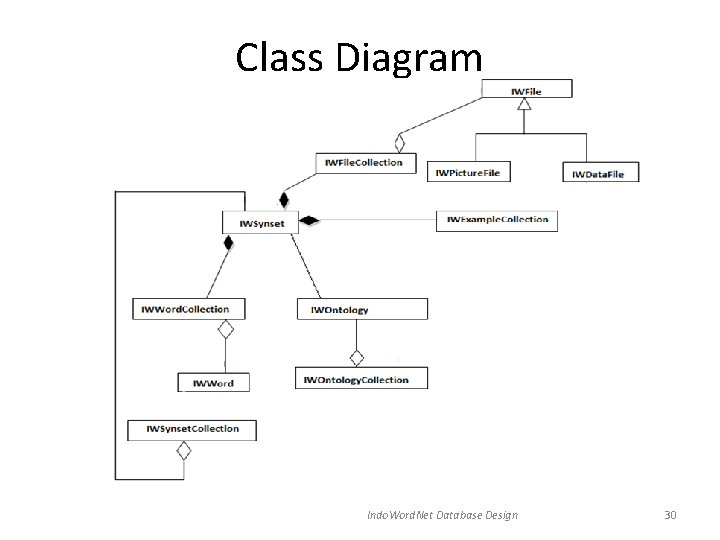
Class Diagram Indo. Word. Net Database Design 30
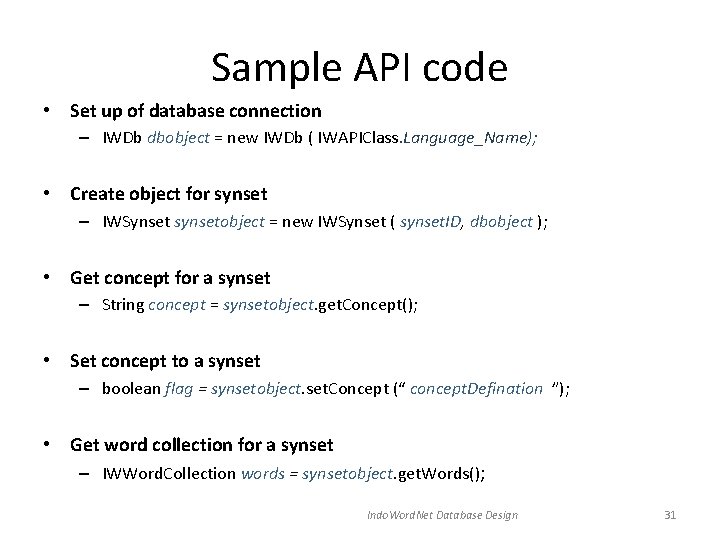
Sample API code • Set up of database connection – IWDb dbobject = new IWDb ( IWAPIClass. Language_Name); • Create object for synset – IWSynset synsetobject = new IWSynset ( synset. ID, dbobject ); • Get concept for a synset – String concept = synsetobject. get. Concept(); • Set concept to a synset – boolean flag = synsetobject. set. Concept (“ concept. Defination ”); • Get word collection for a synset – IWWord. Collection words = synsetobject. get. Words(); Indo. Word. Net Database Design 31
Questions? Indo. Word. Net Database Design 32
THANK YOU Indo. Word. Net Database Design 33
- Slides: 33