
Individualized Education Programs Module 6 Prior Written Notice





- Slides: 34
Individualized Education Programs Module #6: Prior Written Notice 1
Prior Written Notice Documenting Decisions 2
Prior Written Notice is one of the most important parental rights in Special Education. Many authorities feel it is the second most important document next to the Individualized Education Program (IEP). 3
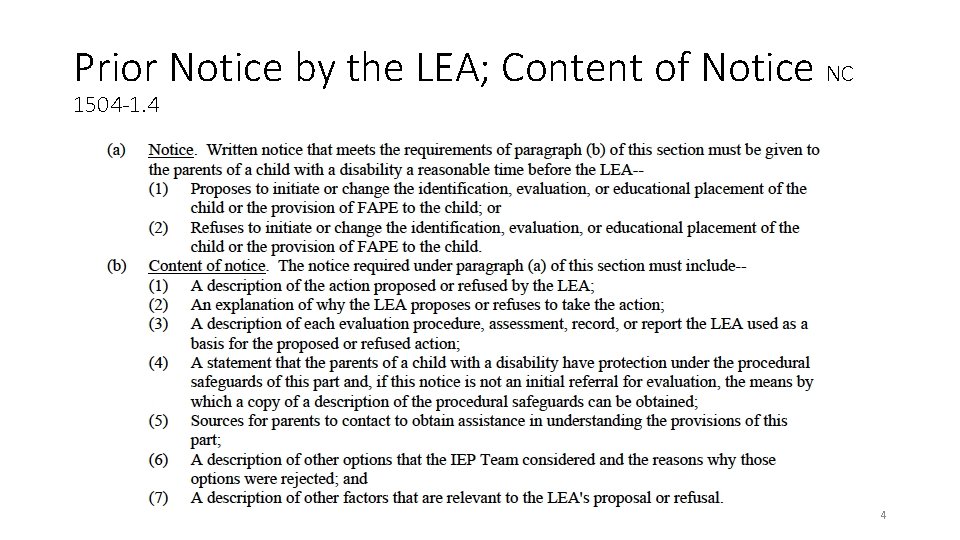
Prior Notice by the LEA; Content of Notice NC 1504 -1. 4 4
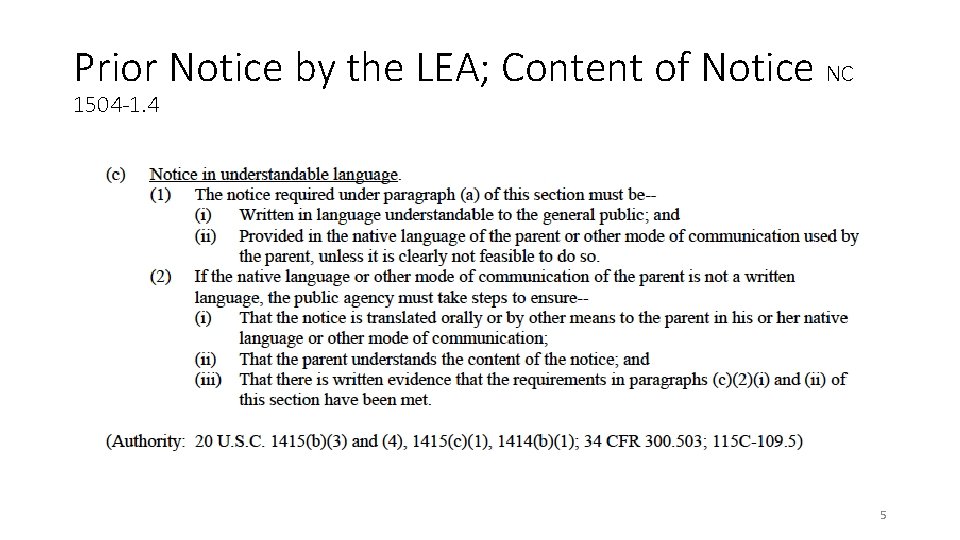
Prior Notice by the LEA; Content of Notice NC 1504 -1. 4 5
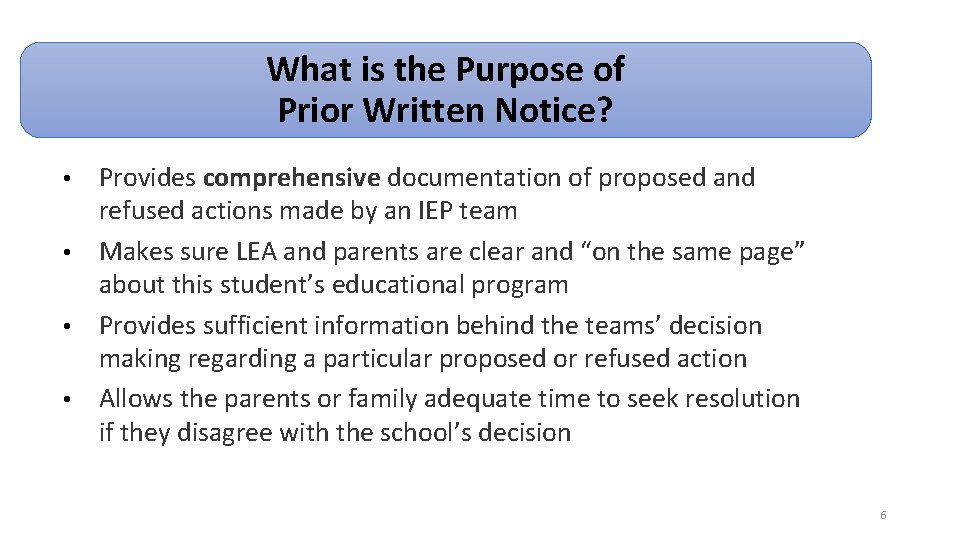
What is the Purpose of Prior Written Notice? Provides comprehensive documentation of proposed and refused actions made by an IEP team • Makes sure LEA and parents are clear and “on the same page” about this student’s educational program • Provides sufficient information behind the teams’ decision making regarding a particular proposed or refused action • Allows the parents or family adequate time to seek resolution if they disagree with the school’s decision • 6
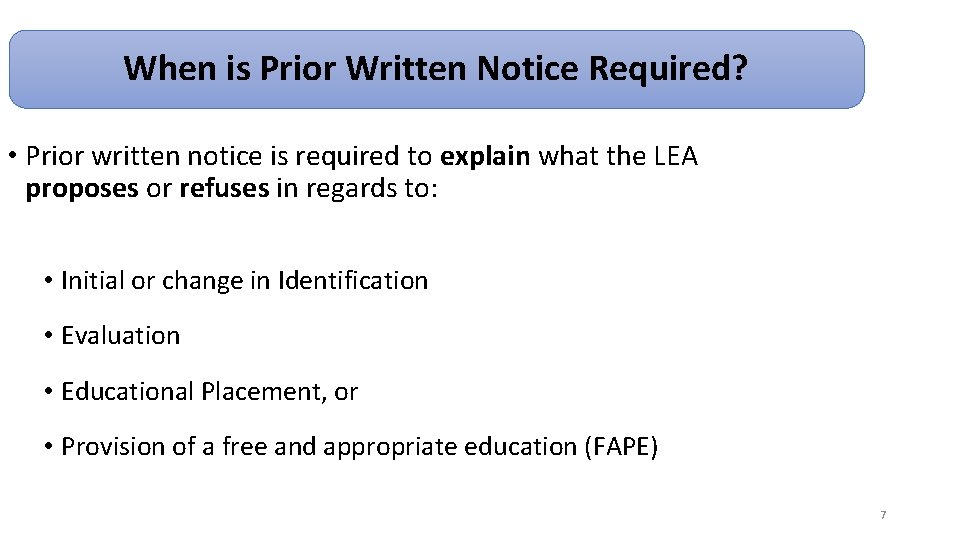
When is Prior Written Notice Required? • Prior written notice is required to explain what the LEA proposes or refuses in regards to: • Initial or change in Identification • Evaluation • Educational Placement, or • Provision of a free and appropriate education (FAPE) 7
When is Prior Written Notice Required? It is given after a decision is made, but before a decision is implemented. Think of it as “processing time” for a parent to absorb all that has been proposed or refused by the school team. 8
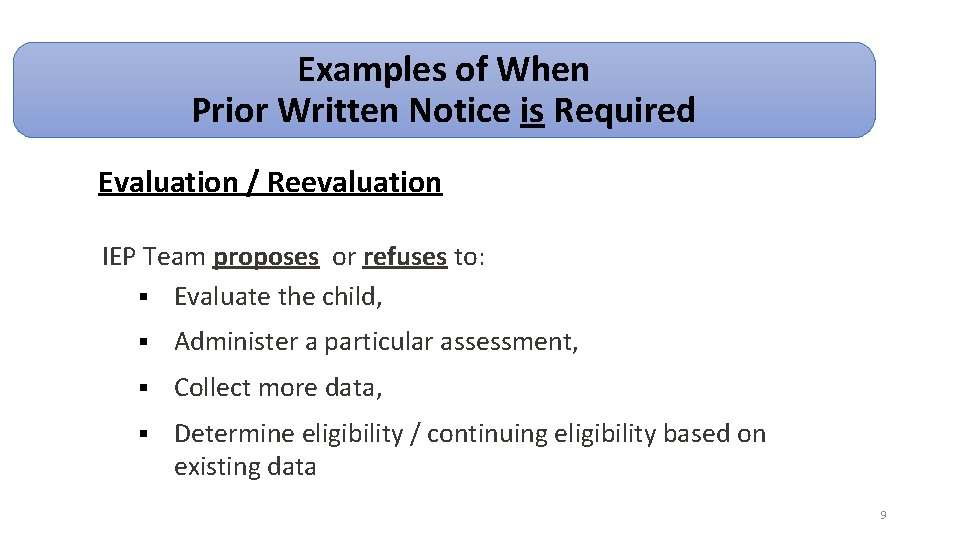
Examples of When Prior Written Notice is Required Evaluation / Reevaluation IEP Team proposes or refuses to: § Evaluate the child, § Administer a particular assessment, § Collect more data, § Determine eligibility / continuing eligibility based on existing data 9
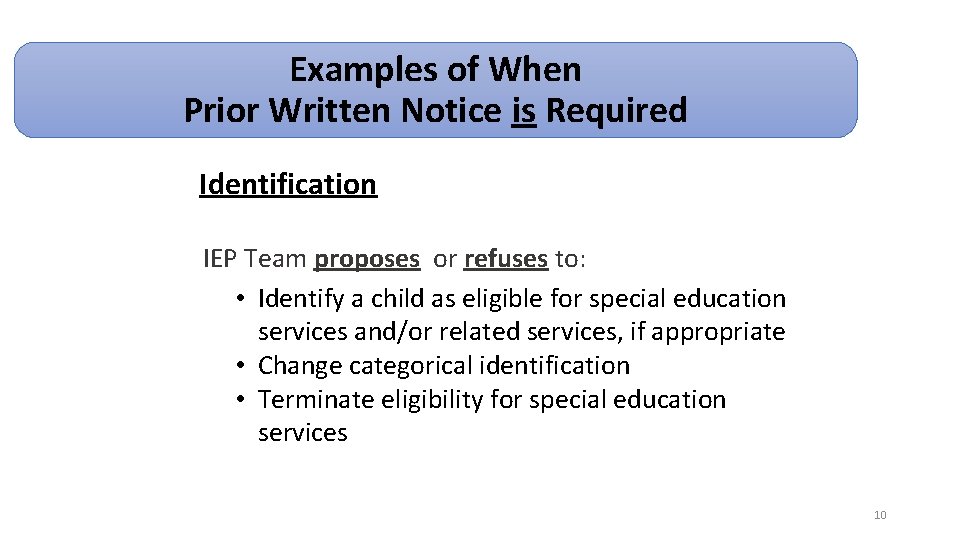
Examples of When Prior Written Notice is Required Identification IEP Team proposes or refuses to: • Identify a child as eligible for special education services and/or related services, if appropriate • Change categorical identification • Terminate eligibility for special education services 10
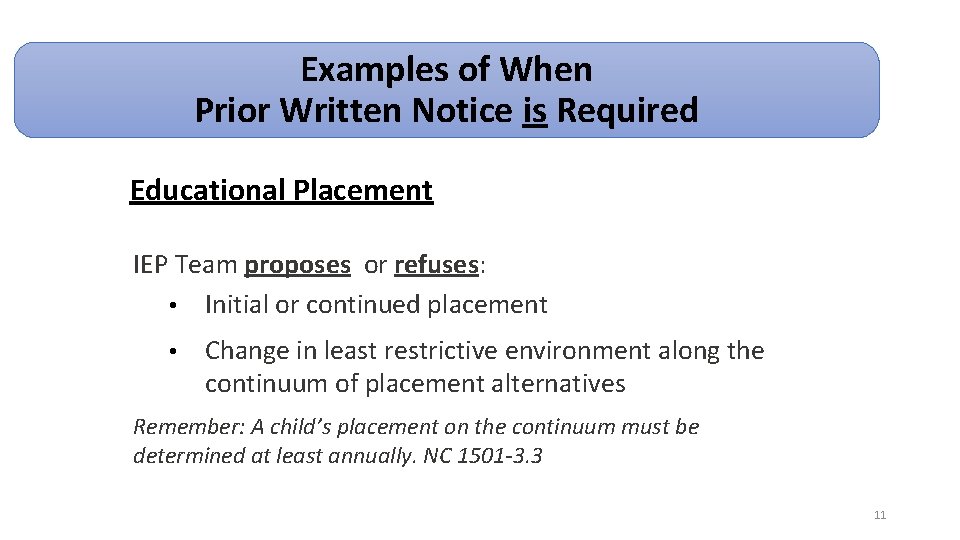
Examples of When Prior Written Notice is Required Educational Placement IEP Team proposes or refuses: • Initial or continued placement • Change in least restrictive environment along the continuum of placement alternatives Remember: A child’s placement on the continuum must be determined at least annually. NC 1501 -3. 3 11
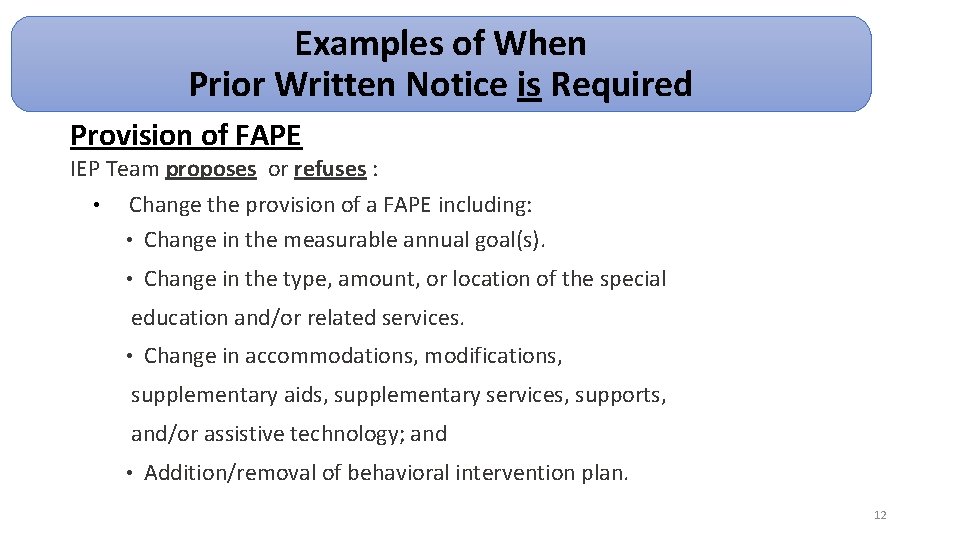
Examples of When Prior Written Notice is Required Provision of FAPE IEP Team proposes or refuses : • Change the provision of a FAPE including: • Change in the measurable annual goal(s). • Change in the type, amount, or location of the special education and/or related services. • Change in accommodations, modifications, supplementary aids, supplementary services, supports, and/or assistive technology; and • Addition/removal of behavioral intervention plan. 12
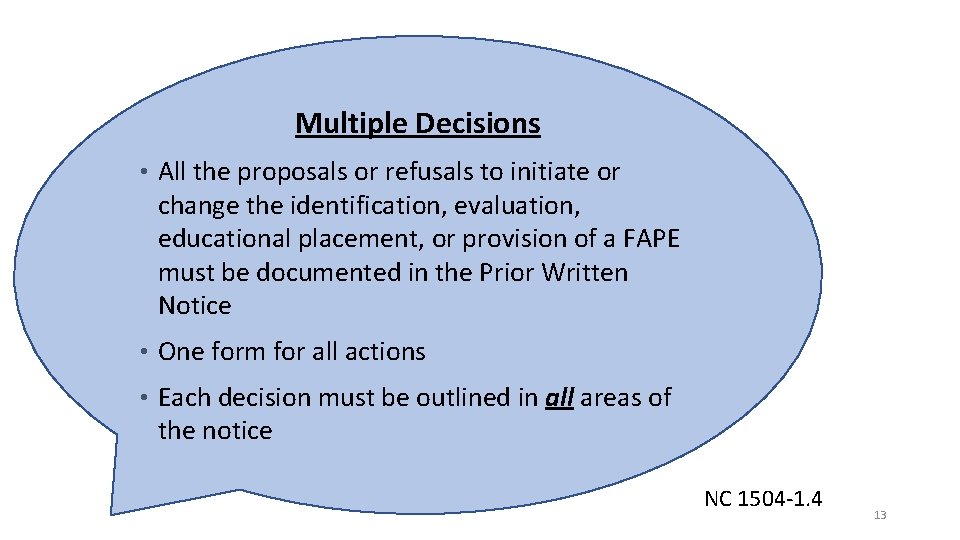
Multiple Decisions • All the proposals or refusals to initiate or change the identification, evaluation, educational placement, or provision of a FAPE must be documented in the Prior Written Notice • One form for all actions • Each decision must be outlined in all areas of the notice NC 1504 -1. 4 13
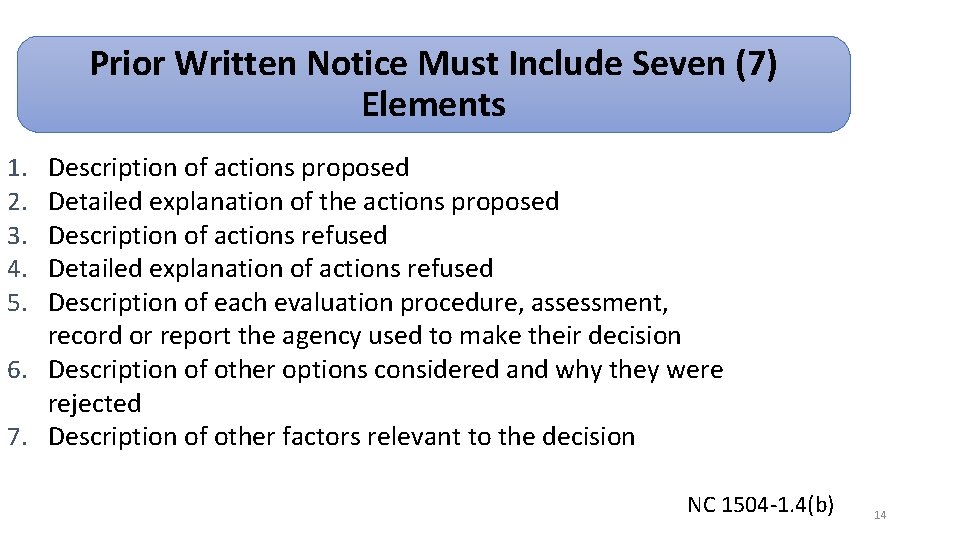
Prior Written Notice Must Include Seven (7) Elements Description of actions proposed Detailed explanation of the actions proposed Description of actions refused Detailed explanation of actions refused Description of each evaluation procedure, assessment, record or report the agency used to make their decision 6. Description of other options considered and why they were rejected 7. Description of other factors relevant to the decision 1. 2. 3. 4. 5. NC 1504 -1. 4(b) 14
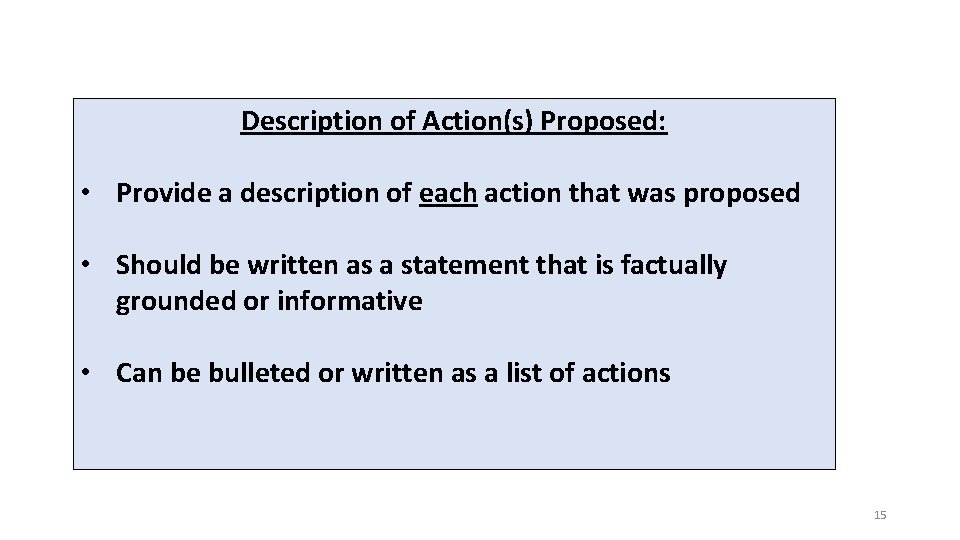
Description of Action(s) Proposed: • Provide a description of each action that was proposed • Should be written as a statement that is factually grounded or informative • Can be bulleted or written as a list of actions 15
16
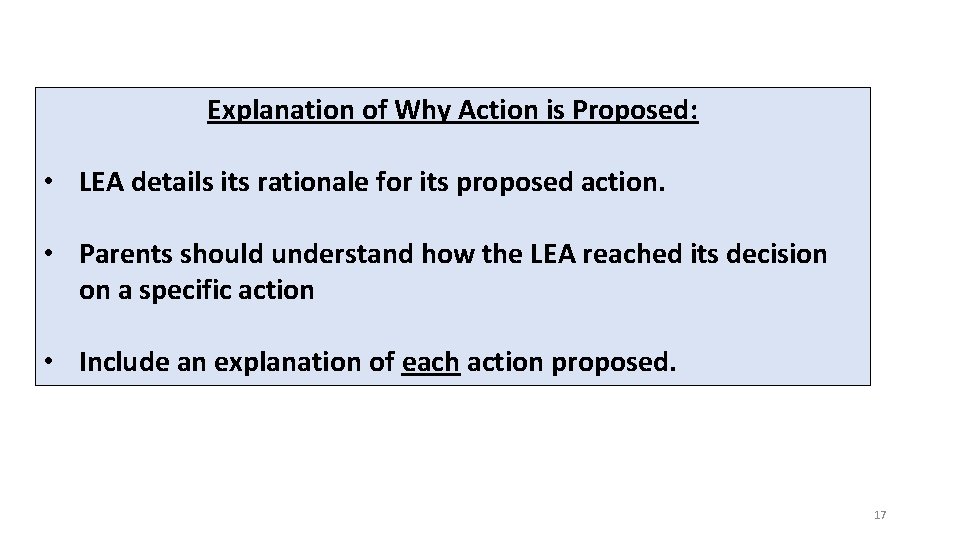
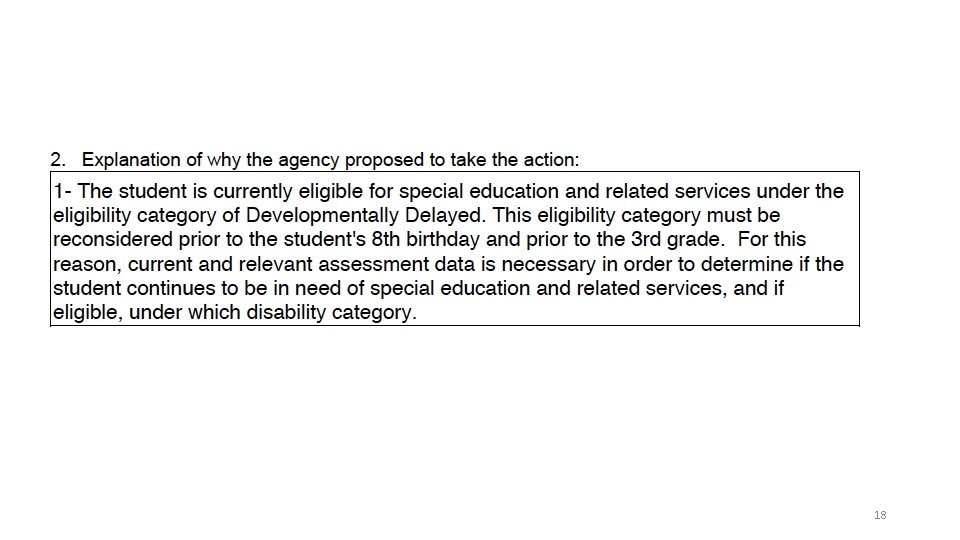
Explanation of Why Action is Proposed: • LEA details its rationale for its proposed action. • Parents should understand how the LEA reached its decision on a specific action • Include an explanation of each action proposed. 17
18
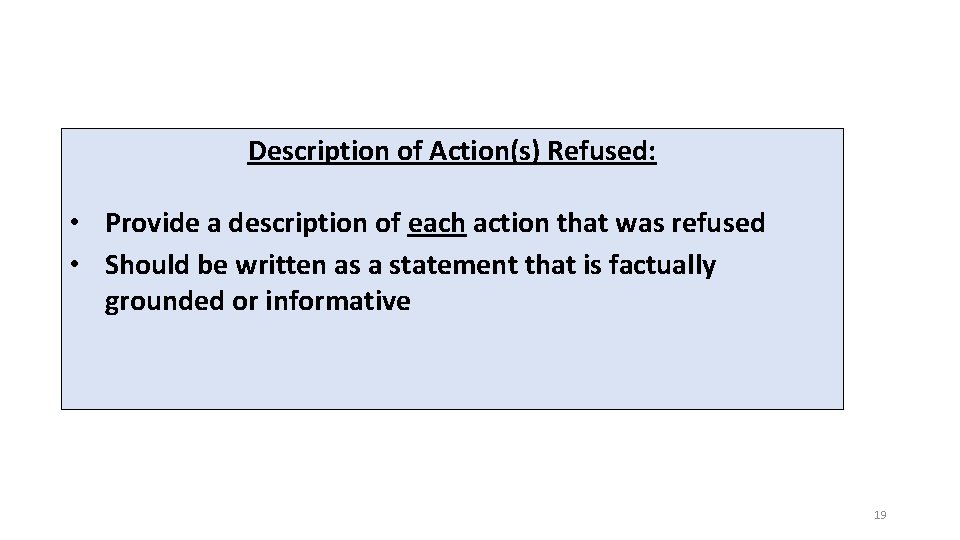
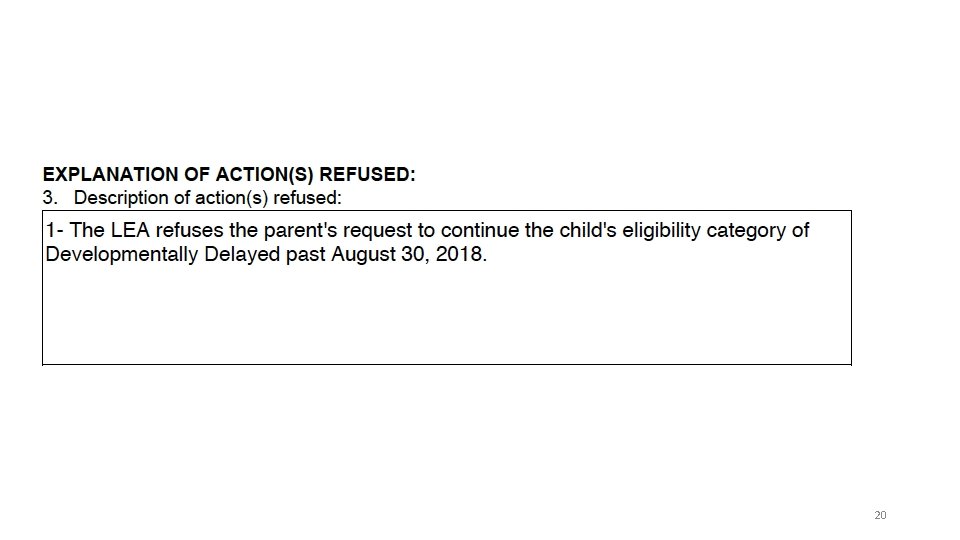
Description of Action(s) Refused: • Provide a description of each action that was refused • Should be written as a statement that is factually grounded or informative 19
20
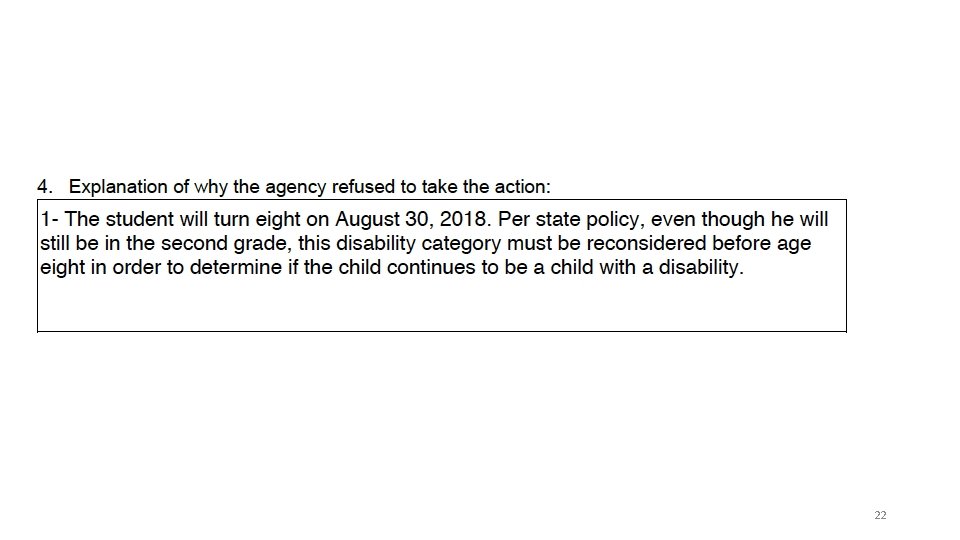
Explanation of Why Action is Refused: • Must specify the reasoning behind the school team’s decision to reject the parent’s requests 21
22
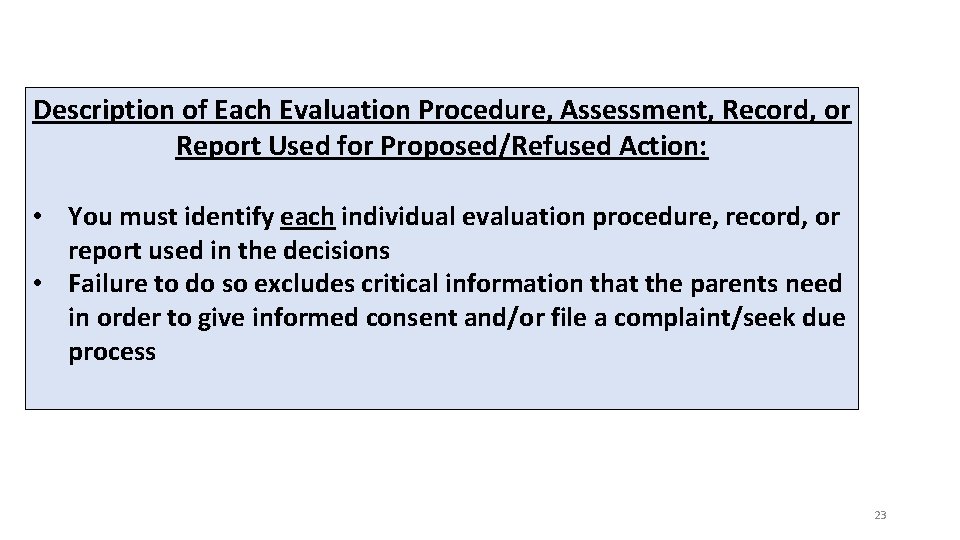
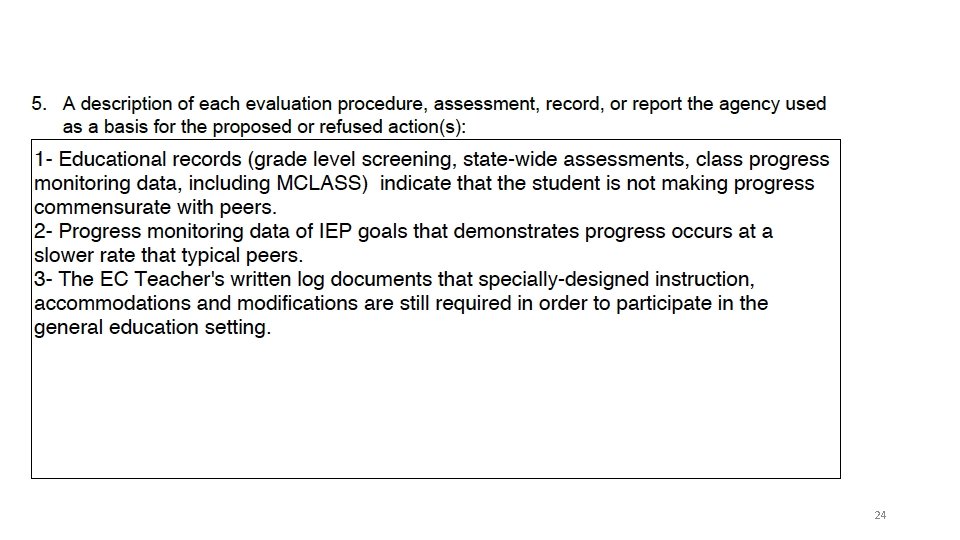
Description of Each Evaluation Procedure, Assessment, Record, or Report Used for Proposed/Refused Action: • You must identify each individual evaluation procedure, record, or report used in the decisions • Failure to do so excludes critical information that the parents need in order to give informed consent and/or file a complaint/seek due process 23
24
25
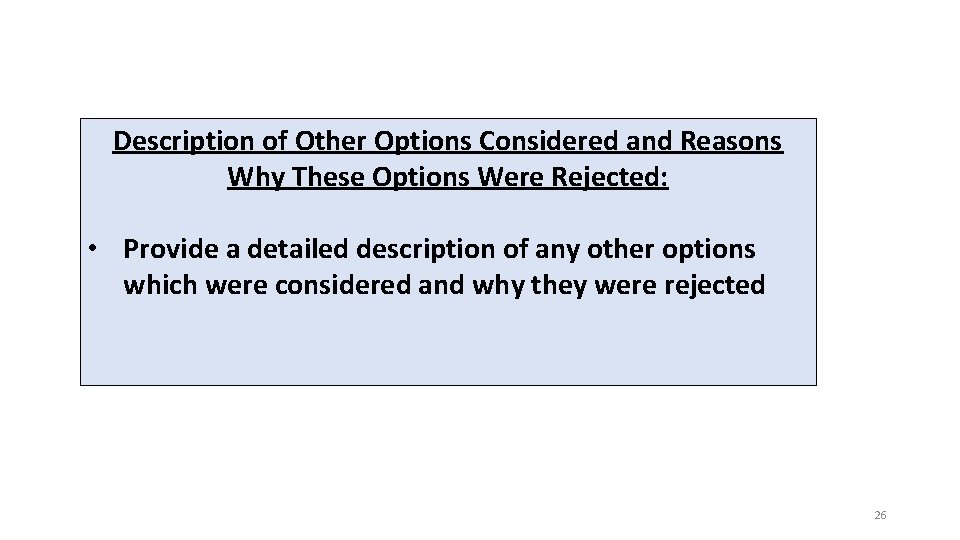
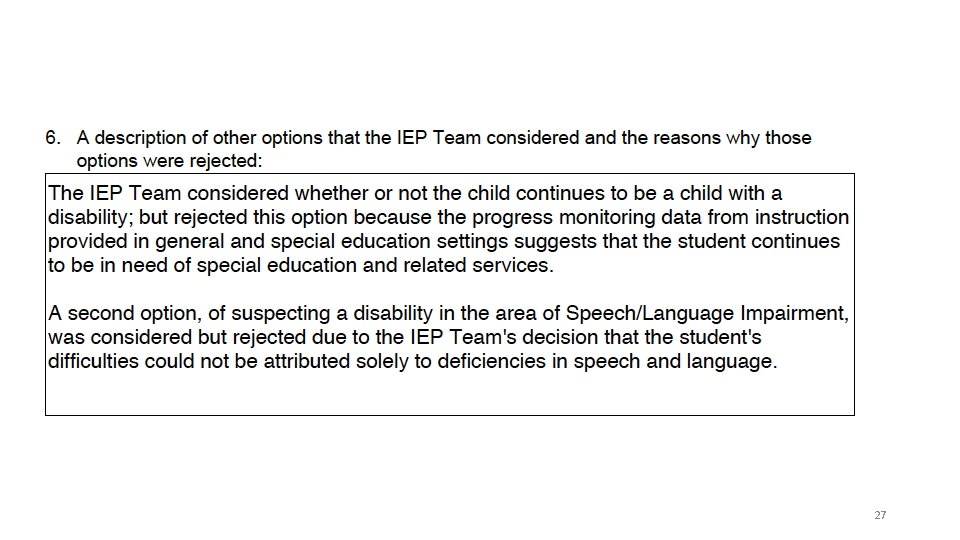
Description of Other Options Considered and Reasons Why These Options Were Rejected: • Provide a detailed description of any other options which were considered and why they were rejected 26
27
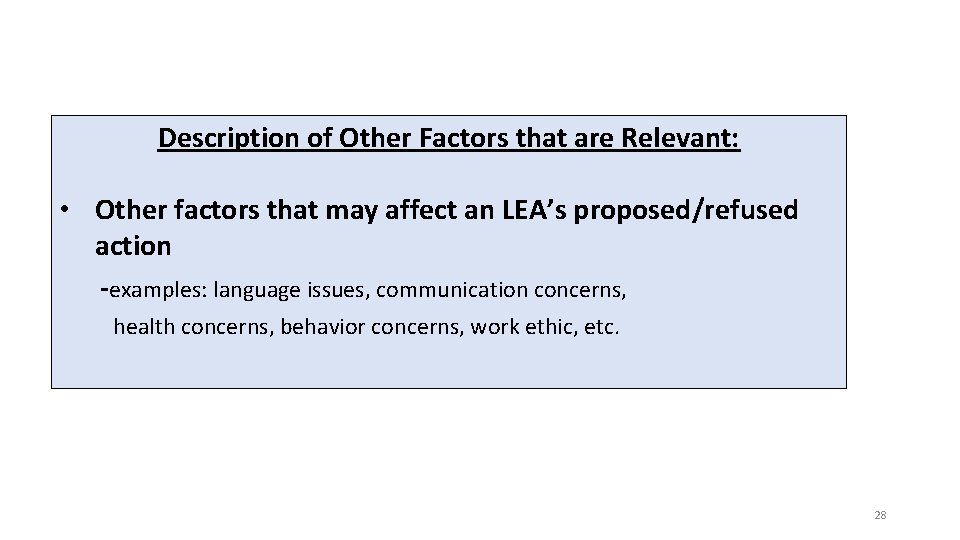
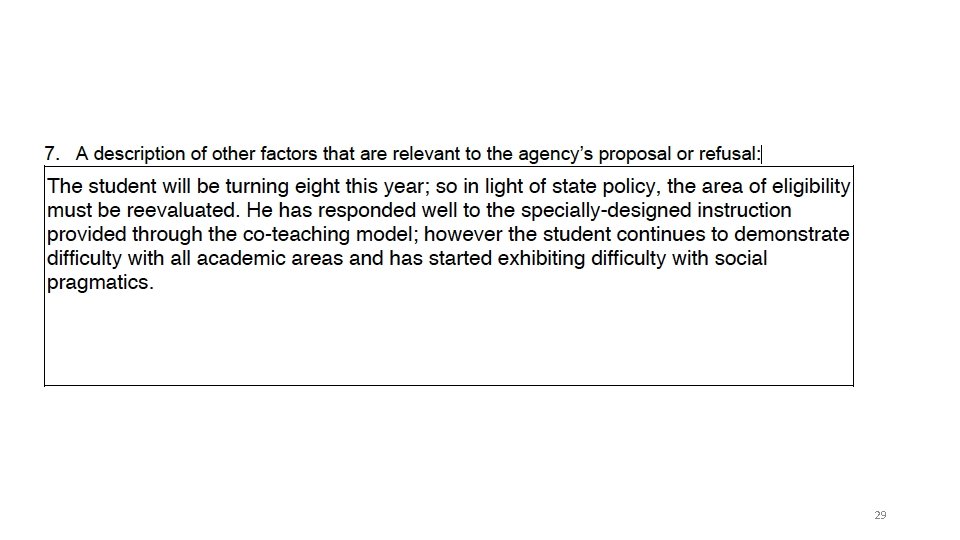
Description of Other Factors that are Relevant: • Other factors that may affect an LEA’s proposed/refused action -examples: language issues, communication concerns, health concerns, behavior concerns, work ethic, etc. 28
29
30
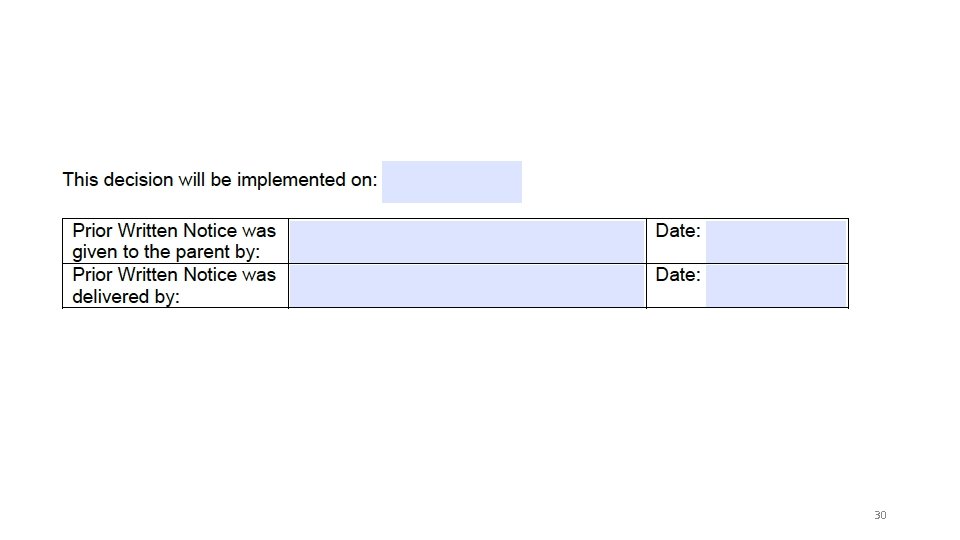
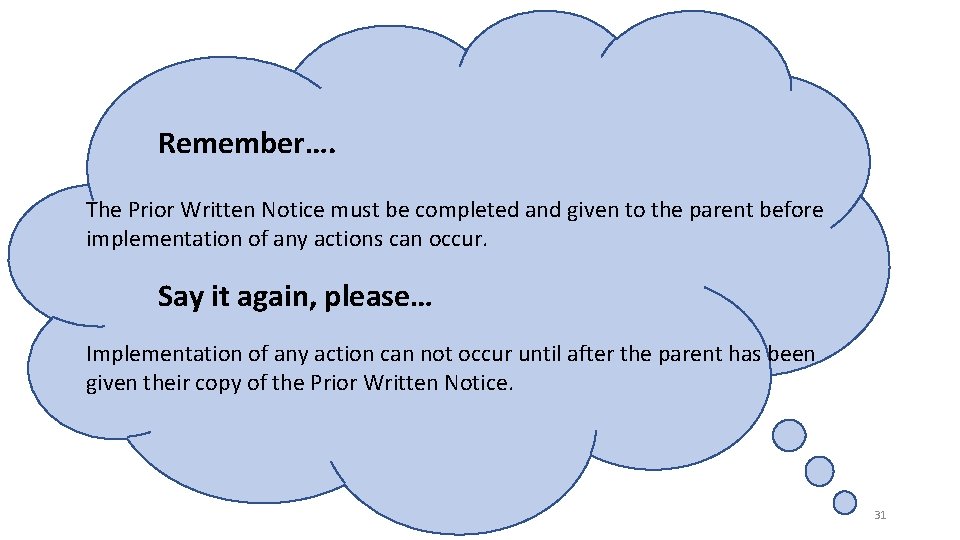
Remember…. The Prior Written Notice must be completed and given to the parent before implementation of any actions can occur. Say it again, please… Implementation of any action can not occur until after the parent has been given their copy of the Prior Written Notice. 31
Consider: 1. If the parent attends the meeting and the PWN is completed and handed to the parent at the end of the meeting, the meeting date and the given date will be the same. However, the implementation date should reflect the needed time to allow for the decisions to be fully implemented. 2. If the parent attends the meeting by phone, it would be likely that the meeting date and the given/delivered by dates would not be the same as the actual delivery of the document may not occur until the following day. Here, the implementation date should reflect time for the parent to receive the PWN along with the necessary time for the decisions to be fully implemented. 32
Cautionary Note… Parents may appear to accept certain proposed actions and/or refusals during the meeting but then change their minds after reflecting. Just because a parent does not make an issue out of a particular decision during a meeting does not necessarily mean that the decision will not be challenged in the future. 33
…Cautionary Note Therefore, it is critically important to write a comprehensive Prior Written Notice which includes: • all proposed/refused actions, • the reasons for them, and • other relevant factors A well written Prior Written Notice is good documentation that the parents were made aware of all proposals and/or refusals and the rationale behind them. 34