
INDIVIDUAL VARIATIONS Chapter 4 LEARNING GOALS 1 Intelligence

- Slides: 24
INDIVIDUAL VARIATIONS Chapter 4
LEARNING GOALS 1. Intelligence 2. Learning and Thinking Styles 3. Personality and Temperament
WHAT IS INTELLIGENCE? Intelligence: Problem-solving skills and the ability to adapt to and learn from experiences Binet Tests MA (Mental Age): an individual’s level of mental development relative to others IQ (Intelligence Quotient): a person’s mental age divided by chronological age, multiplied by 100 Normal distribution: A symmetrical distribution with a majority of scores falling in the middle of the possible range of scores and few scores appearing toward the extremes of the range Weschler Scales Group Intelligence Tests
THEORIES OF MULTIPLE INTELLIGENCES Sternberg’s Triarchic Theory: 1. Analytical 2. Creative 3. Practical Gardner’s Eight Frame of Mind: 1. 2. 3. 4. 5. 6. 7. 8. Verbal skills Mathematical skills Spatial skills Bodily-kinesthetic skills Musical skills Intrapersonal skills Interpersonal skills Naturalist skills
CONTROVERSIES AND ISSUES IN INTELLIGENCE Nature-nurture issue: Issue that involves the debate about whether development is primarily influenced by nature (an organism’s biological inheritance) or nurture (environmental experiences) Cultural bias and culture-fair tests Stereotype threat: The anxiety that one’s behavior might confirm a negative stereotype about one’s group Culture-fair test: Tests of intelligence that are intended to be free of cultural bias
CONTROVERSIES AND ISSUES IN INTELLIGENCE (CONT. ) Ability Grouping and Tracking Between-class ability grouping (tracking): Grouping students based on their ability or tracking Within-class ability grouping: Placing students in two or three groups within a class to take into account differences in students’ abilities Nongraded (cross-age) program: A variation of between-class ability grouping in which students are grouped by their ability in particular subjects regardless of their age or grade level
LEARNING AND THINKING STYLES Learning and thinking styles: Individuals’ preference in how they use their abilities Impulsive/Reflective styles (conceptual tempo): to act quickly and impulsively or to take more time to respond and reflect on the accuracy of the answer Deep/Surface style: to learn in order to understand the meaning of the materials or to learn only what needs to be learned
PERSONALITY AND TEMPERAMENT Personality: distinctive thoughts, emotions and behaviors that characterize the way an individual adapts to the word “Big Five” factors of personality: openness, conscientiousness, extraversion, agreeableness and neuroticism (emotional stability) Person-situation interaction: the view that the best way to conceptualize personality is not in terms of personal traits or characteristic alone, but also in terms of the situation involved Temperament: a person’s behavioral style and characteristic ways of responding Easy child: positive mood, regular routines and adapt to new experience Difficult child: react negatively, cries frequently, irregular routines and slow to accept new experience Slow-to-warm-up child: a low activity level, somewhat negative, a low intensity of mood Goodness of fit: a child’s temperament = the environmental demands the child must cope with
LEARNING GOALS 1. Intelligence 2. Learning and Thinking Styles 3. Personality and Temperament
SOCIOCULTURAL DIVERSITY Chapter 5
LEARNING GOALS 1. Culture and Ethnicity 2. Multicultural Education 3. Gender
CULTURE AND ETHNICITY Culture: The behavior patterns, beliefs and all other products of a particular group of people that are passed on from generation to generation Cross-cultural studies: Studies that compare what happens in one culture with what happens in one of more other cultures; they provide information about the degree to which people are similar and to what degree behaviors are specific to certain cultures Individualism: A set of values that give priority to personal rather than to group goals Collectivism: A set of values that support the group Socioeconomic status (SES): A grouping of people with similar occupational, educational, and economic characteristics
CULTURE AND ETHNICITY (CONT. ) Ethnicity: A shared pattern of characteristics such as cultural heritage, nationality, race, religion and language Prejudice: An unjustified negative attitude toward an individual because of the individual’s membership in a group English as a second language: A widely used term for bilingual education programs and classes that teach English to students whose native language is not English
MULTICULTURAL EDUCATION Multicultural education: education that values diversity and includes the perspectives of a variety of cultural groups on a regular basis Empowerment: providing people with intellectual and coping skills to succeed and make this a more just world Jigsaw classroom: a classroom in which students from a different cultural backgrounds cooperate by doing different parts of a project to reach a common goal
GENDER Gender: The characteristics of people as males and females Gender identity: the sense of being male or female, which most children acquire by the time they are 5 years old Gender role: A set of expectations that prescribes how females or males should think, act, and feel Gender typing: Acquisition of a traditional masculine or feminine role Rapport talk: The language of conversation and a way of establishing connections and negotiating relationships; more characteristic of females than males Report talk: Talk that gives information, more characteristic of males than females Androgyny: The presence of positive masculine and feminine characteristics in the same individual
GENDER (CONT. ) Quid pro quo sexual harassment: Occurs when a school employee threatens to base an educational decision (such as a grade) on a student’s submission to unwelcome sexual conduct Hostile environment sexual harassment: Occurs when students are subjected to unwelcome sexual conduct that is so severe, persistent, or pervasive that it limits the students’ ability to benefit from their education
LEARNING GOALS 1. Culture and Ethnicity 2. Multicultural Education 3. Gender
LEARNERS WHO ARE EXCEPTIONAL Chapter 6
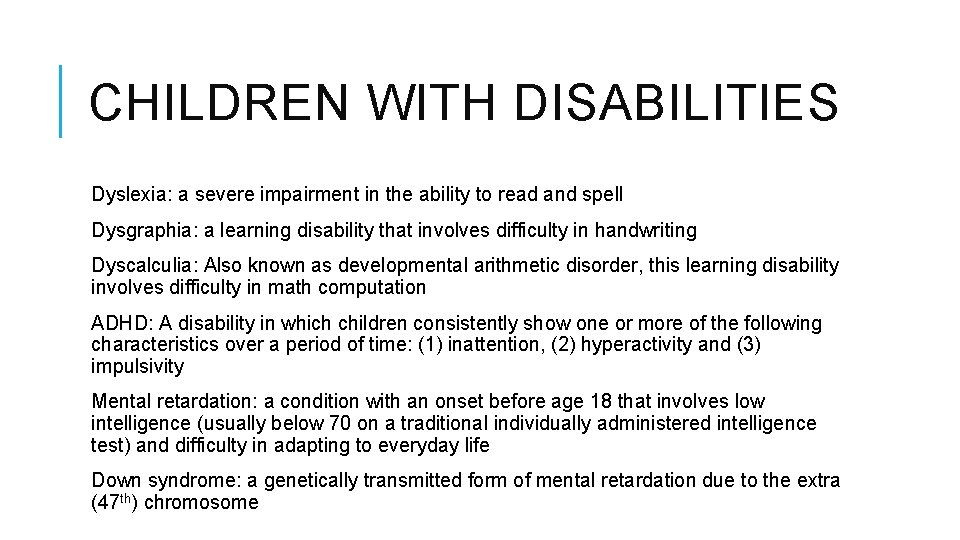
CHILDREN WITH DISABILITIES Dyslexia: a severe impairment in the ability to read and spell Dysgraphia: a learning disability that involves difficulty in handwriting Dyscalculia: Also known as developmental arithmetic disorder, this learning disability involves difficulty in math computation ADHD: A disability in which children consistently show one or more of the following characteristics over a period of time: (1) inattention, (2) hyperactivity and (3) impulsivity Mental retardation: a condition with an onset before age 18 that involves low intelligence (usually below 70 on a traditional individually administered intelligence test) and difficulty in adapting to everyday life Down syndrome: a genetically transmitted form of mental retardation due to the extra (47 th) chromosome
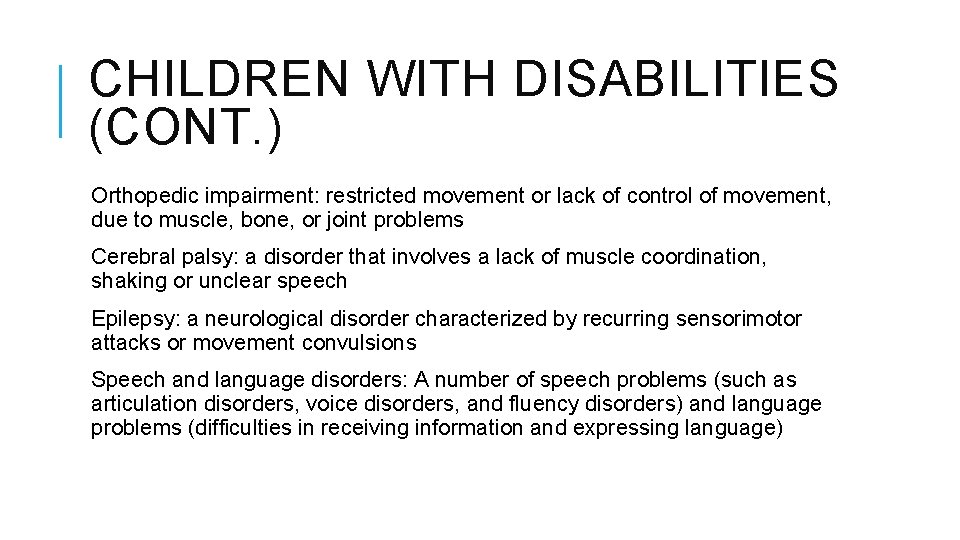
CHILDREN WITH DISABILITIES (CONT. ) Orthopedic impairment: restricted movement or lack of control of movement, due to muscle, bone, or joint problems Cerebral palsy: a disorder that involves a lack of muscle coordination, shaking or unclear speech Epilepsy: a neurological disorder characterized by recurring sensorimotor attacks or movement convulsions Speech and language disorders: A number of speech problems (such as articulation disorders, voice disorders, and fluency disorders) and language problems (difficulties in receiving information and expressing language)
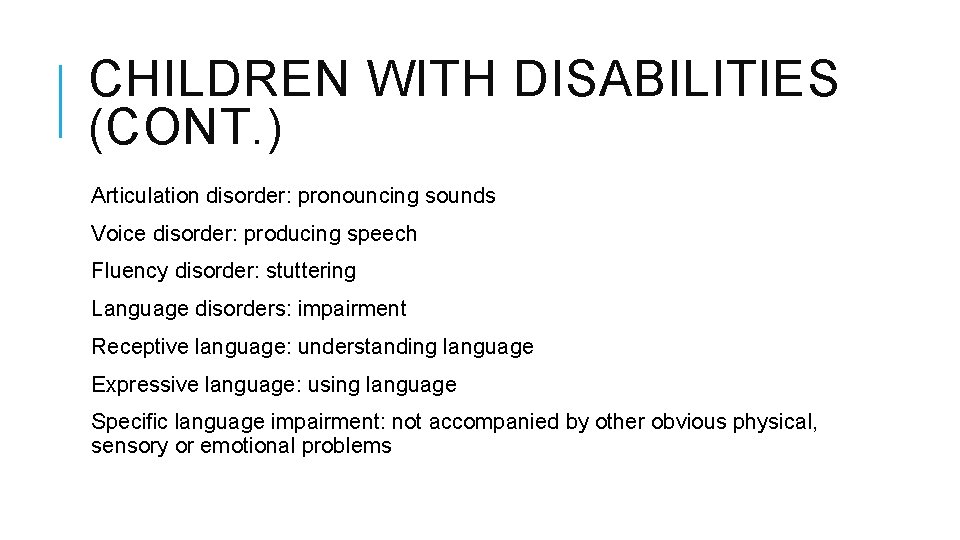
CHILDREN WITH DISABILITIES (CONT. ) Articulation disorder: pronouncing sounds Voice disorder: producing speech Fluency disorder: stuttering Language disorders: impairment Receptive language: understanding language Expressive language: using language Specific language impairment: not accompanied by other obvious physical, sensory or emotional problems
CHILDREN WITH DISABILITIES (CONT. ) Autism Spectrum Disorder: problems in social interaction, verbal and nonverbal communication and repetitive behaviors Autistic Disorder: its onset on the first three years of life and includes deficiencies in social relationships, abnormalities in communication and restricted, repetitive and stereotyped patterns of behavior Asperger Syndrome: relatively good verbal language, mild nonverbal language problems, a restricted range of interests and relationships, and frequent repetitive routines Emotional and Behavioral Disorders: Serious, persistent problems that involve relationships, aggression, depression, fears associated with personal and school matters, and other inappropriate socioemotional characteristics
QUIZ http: //bit. do/Pendidikan
URL https: //forms. office. com/Pages/Response. Page. aspx? id=j 4 ien 0 ar. Akf. Kn. P 8 p. Oz. TVe. Mn. NCbx. F 6 l. Cr. ZCV 4 C 1 Ae. Lx. UNk 81 Uk. U 1 U 1 h. GWTNGN 0 x. EM 0 1 PMUVZTj. Y 1 My 4 u