
Individual Tree Species Classification Using Low and Mid

- Slides: 29
Individual Tree Species Classification Using Low and Mid Density Airborne Li. DAR James C. G. Farrell Canadian Woodlands Forum Webinar © Her Majesty the Queen in Right of Canada, as represented by the Minister of Natural Resources, 2017 November 19, 2020
Outline • • • Introduction & Research Questions Background Methods Results Challenges Next Steps/Future Research © Her Majesty the Queen in Right of Canada, as represented by the Minister of Natural Resources, 2017
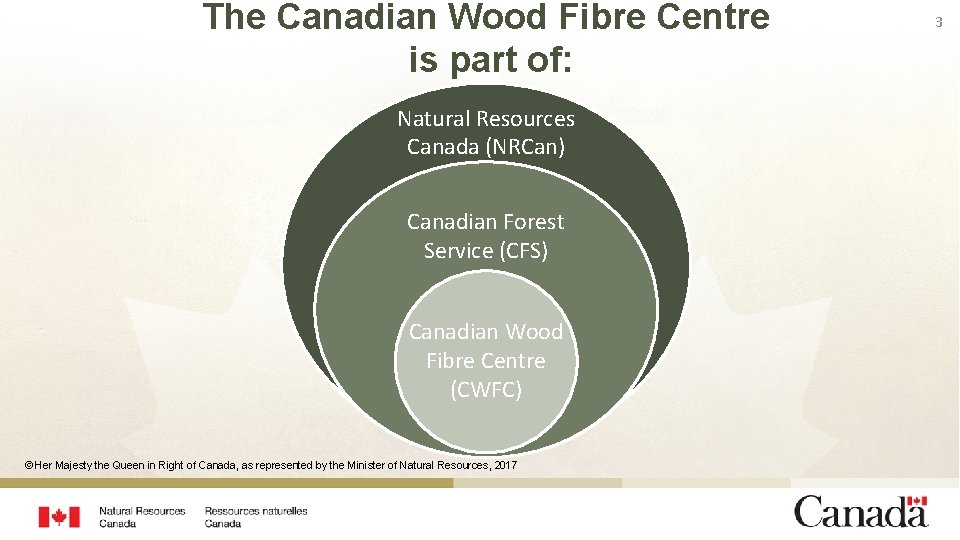
The Canadian Wood Fibre Centre is part of: Natural Resources Canada (NRCan) Canadian Forest Service (CFS) Canadian Wood Fibre Centre (CWFC) © Her Majesty the Queen in Right of Canada, as represented by the Minister of Natural Resources, 2017 3
Dispersed by Design The Canadian Wood Fibre Centre Northern Forestry Centre, Edmonton Laurentian Forestry Centre, Quebec City Atlantic Forestry Centre, Fredericton Petawawa Research Forest Pacific Forestry Centre, Victoria Great Lakes, Forestry Centre, Sault Ste Marie © Her Majesty the Queen in Right of Canada, as represented by the Minister of Natural Resources, 2017 Headquarter, Ottawa Acadia Research Forest 4
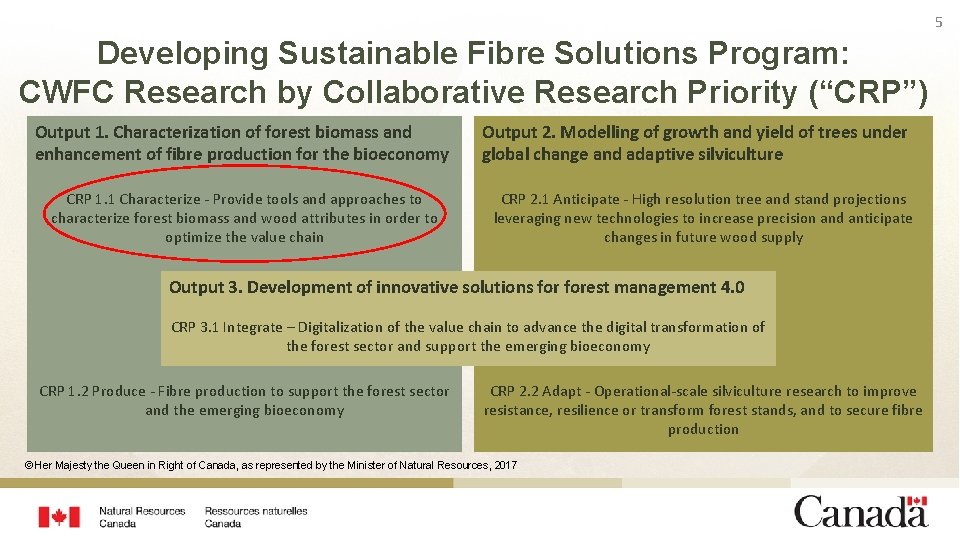
5 Developing Sustainable Fibre Solutions Program: CWFC Research by Collaborative Research Priority (“CRP”) Output 1. Characterization of forest biomass and enhancement of fibre production for the bioeconomy CRP 1. 1 Characterize - Provide tools and approaches to characterize forest biomass and wood attributes in order to optimize the value chain Output 2. Modelling of growth and yield of trees under global change and adaptive silviculture CRP 2. 1 Anticipate - High resolution tree and stand projections leveraging new technologies to increase precision and anticipate changes in future wood supply Output 3. Development of innovative solutions forest management 4. 0 CRP 3. 1 Integrate – Digitalization of the value chain to advance the digital transformation of the forest sector and support the emerging bioeconomy CRP 1. 2 Produce - Fibre production to support the forest sector and the emerging bioeconomy CRP 2. 2 Adapt - Operational-scale silviculture research to improve resistance, resilience or transform forest stands, and to secure fibre production © Her Majesty the Queen in Right of Canada, as represented by the Minister of Natural Resources, 2017
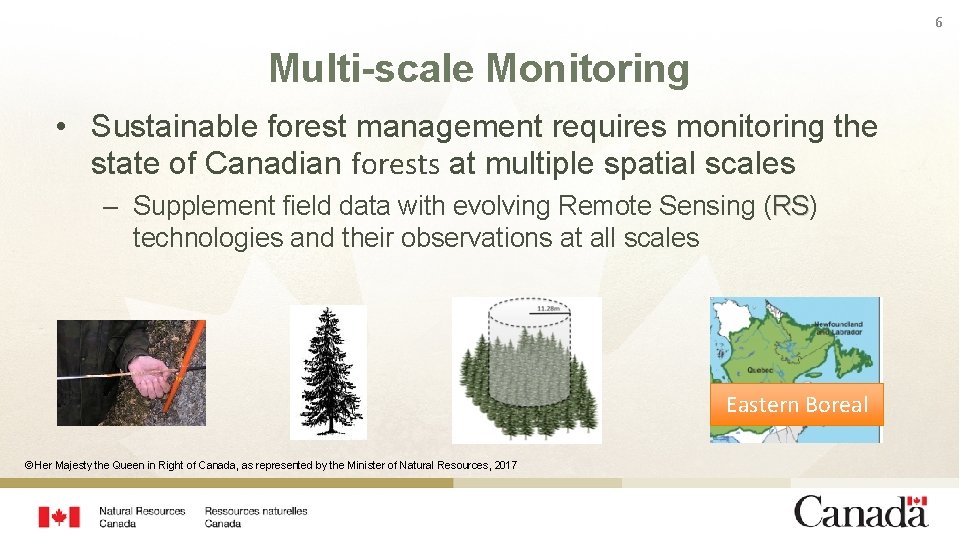
6 Multi-scale Monitoring • Sustainable forest management requires monitoring the state of Canadian forests at multiple spatial scales – Supplement field data with evolving Remote Sensing (RS) RS technologies and their observations at all scales Eastern Boreal © Her Majesty the Queen in Right of Canada, as represented by the Minister of Natural Resources, 2017
7 Remote Species Identification Using Lidar • Accurate species ID is an important part of any forest inventory, land use planning and maintaining ecological integrity. • Despite recent advances in the use of airborne lidar forest inventory and planning, remote species ID still remains a challenge. • Point cloud features and intensity is one approach that can be used to predict species at the individual tree level. • Research into lidar pulse density is an area of study that contributes to the understanding of point clouds and knowledge base for remote species ID. © Her Majesty the Queen in Right of Canada, as represented by the Minister of Natural Resources, 2017
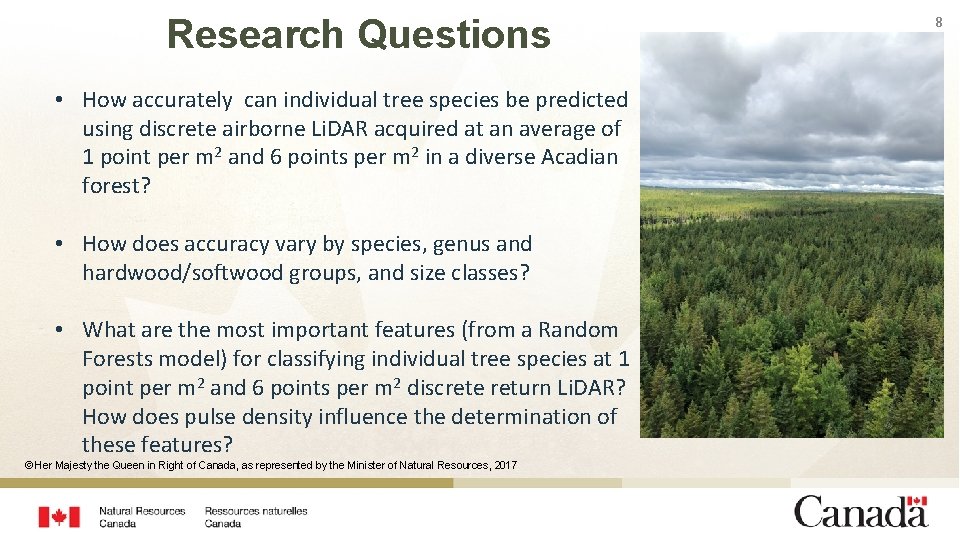
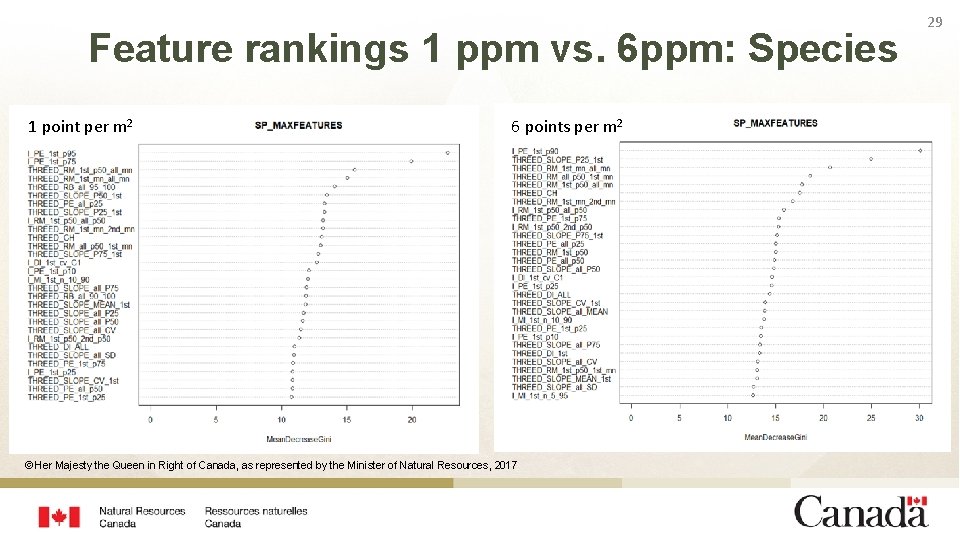
Research Questions • How accurately can individual tree species be predicted using discrete airborne Li. DAR acquired at an average of 1 point per m 2 and 6 points per m 2 in a diverse Acadian forest? • How does accuracy vary by species, genus and hardwood/softwood groups, and size classes? • What are the most important features (from a Random Forests model) for classifying individual tree species at 1 point per m 2 and 6 points per m 2 discrete return Li. DAR? How does pulse density influence the determination of these features? © Her Majesty the Queen in Right of Canada, as represented by the Minister of Natural Resources, 2017 8
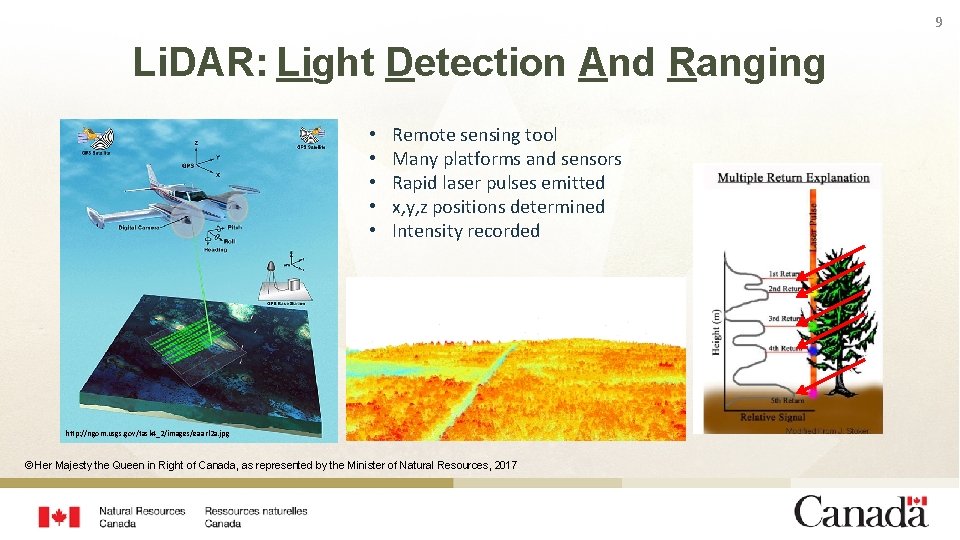
9 Li. DAR: Light Detection And Ranging • • • Remote sensing tool Many platforms and sensors Rapid laser pulses emitted x, y, z positions determined Intensity recorded http: //ngom. usgs. gov/task 4_2/images/eaarl 2 a. jpg © Her Majesty the Queen in Right of Canada, as represented by the Minister of Natural Resources, 2017
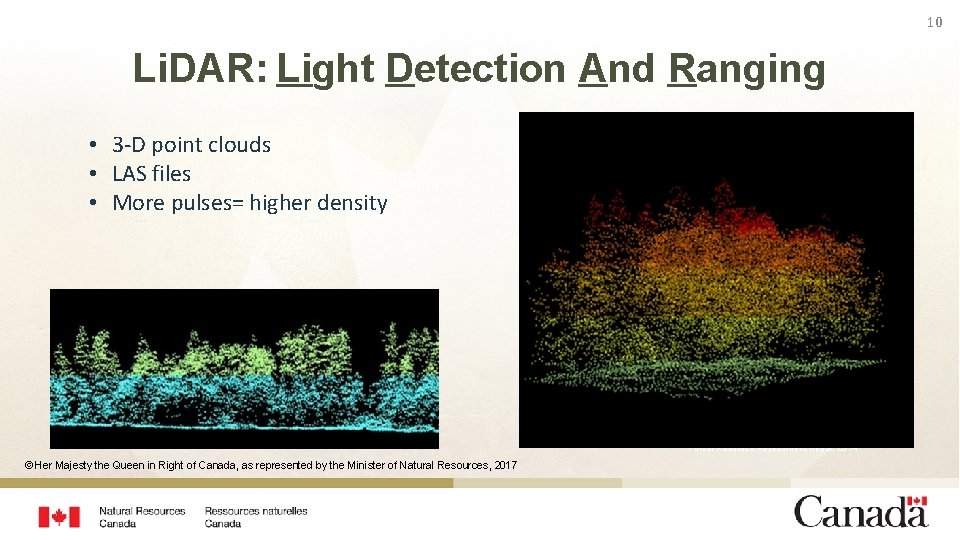
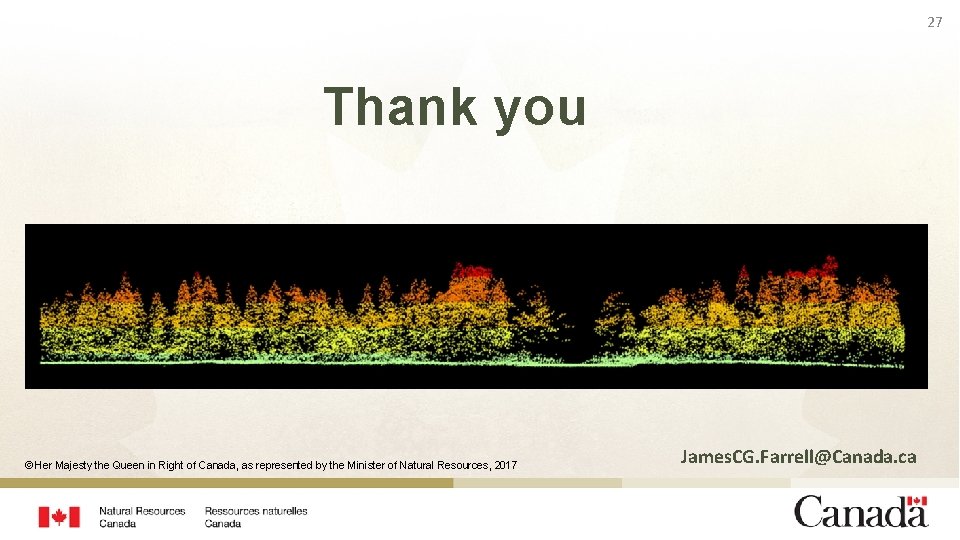
10 Li. DAR: Light Detection And Ranging • 3 -D point clouds • LAS files • More pulses= higher density Forest Resource Assessment Nepal, 2014 © Her Majesty the Queen in Right of Canada, as represented by the Minister of Natural Resources, 2017
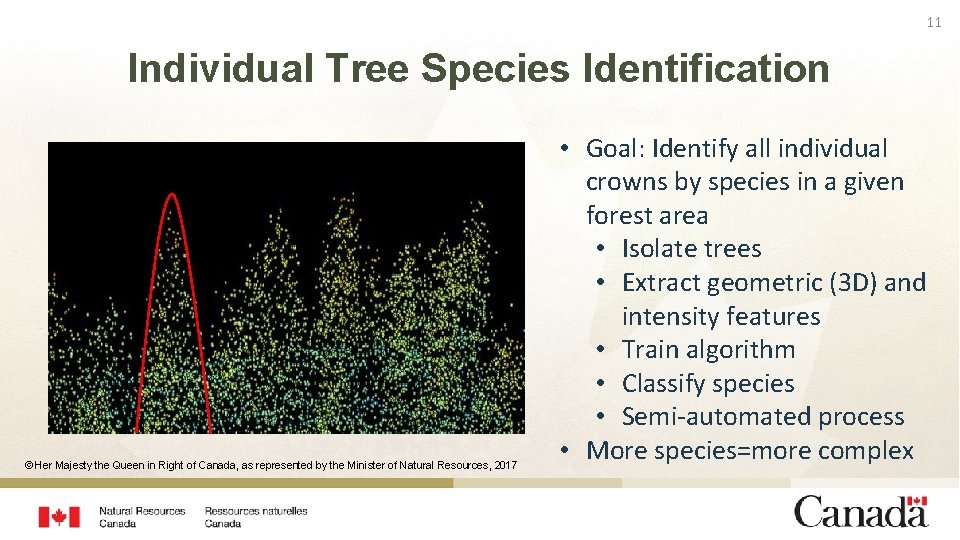
11 Individual Tree Species Identification © Her Majesty the Queen in Right of Canada, as represented by the Minister of Natural Resources, 2017 • Goal: Identify all individual crowns by species in a given forest area • Isolate trees • Extract geometric (3 D) and intensity features • Train algorithm • Classify species • Semi-automated process • More species=more complex
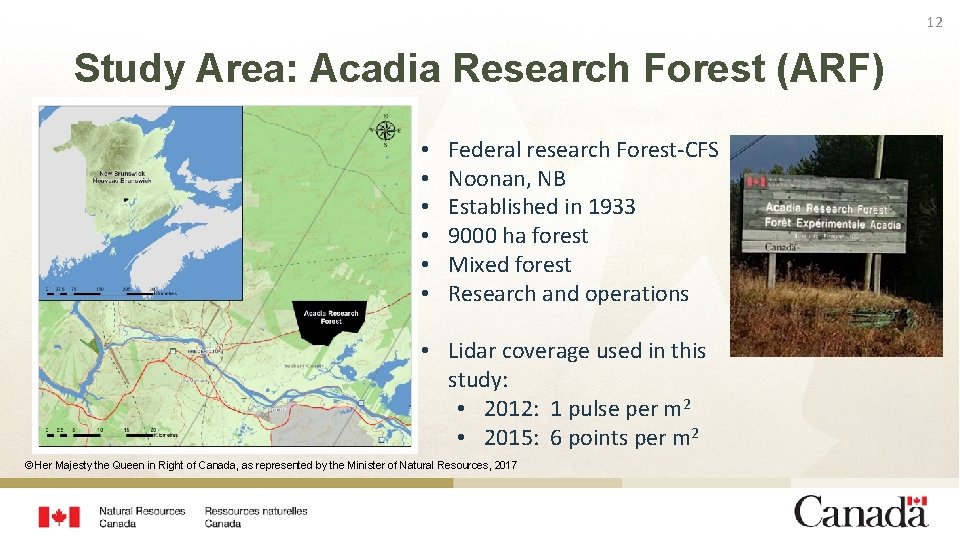
12 Study Area: Acadia Research Forest (ARF) • • • Federal research Forest-CFS Noonan, NB Established in 1933 9000 ha forest Mixed forest Research and operations • Lidar coverage used in this study: • 2012: 1 pulse per m 2 • 2015: 6 points per m 2 © Her Majesty the Queen in Right of Canada, as represented by the Minister of Natural Resources, 2017
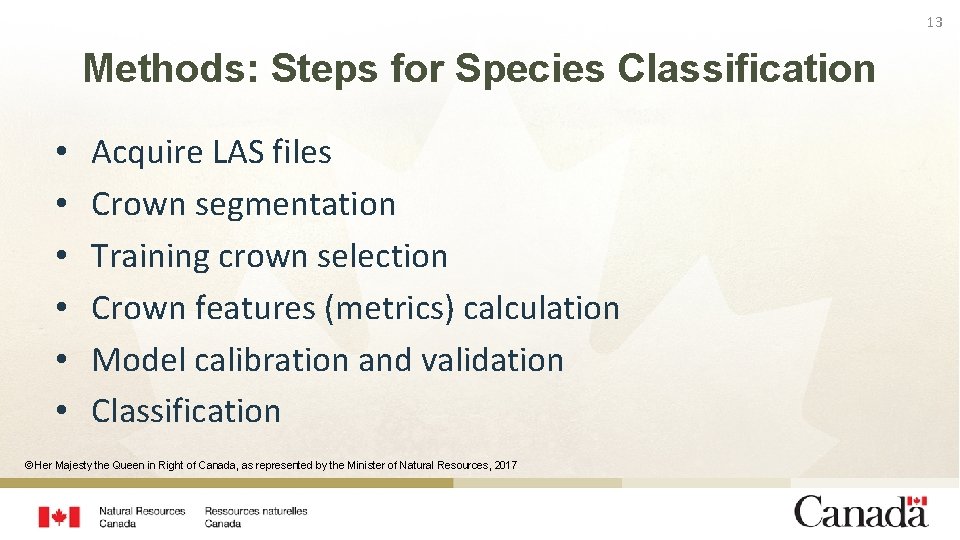
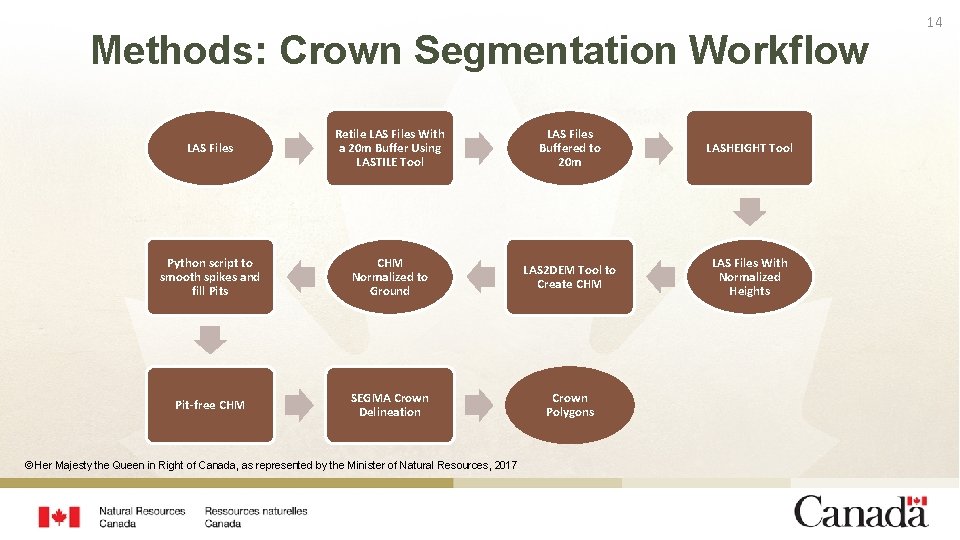
13 Methods: Steps for Species Classification • • • Acquire LAS files Crown segmentation Training crown selection Crown features (metrics) calculation Model calibration and validation Classification © Her Majesty the Queen in Right of Canada, as represented by the Minister of Natural Resources, 2017
Methods: Crown Segmentation Workflow LAS Files Retile LAS Files With a 20 m Buffer Using LASTILE Tool LAS Files Buffered to 20 m LASHEIGHT Tool Python script to smooth spikes and fill Pits CHM Normalized to Ground LAS 2 DEM Tool to Create CHM LAS Files With Normalized Heights Pit-free CHM SEGMA Crown Delineation Crown Polygons © Her Majesty the Queen in Right of Canada, as represented by the Minister of Natural Resources, 2017 14
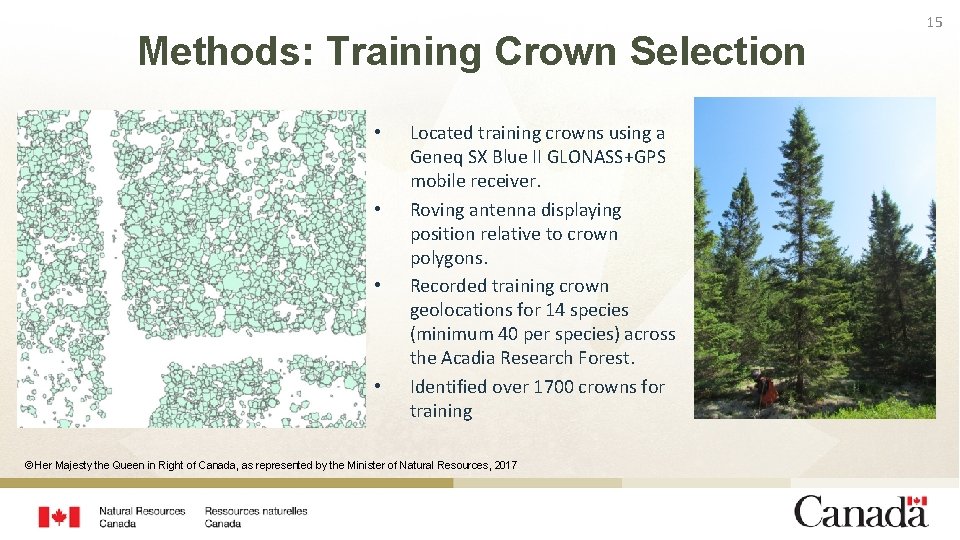
Methods: Training Crown Selection • • Located training crowns using a Geneq SX Blue II GLONASS+GPS mobile receiver. Roving antenna displaying position relative to crown polygons. Recorded training crown geolocations for 14 species (minimum 40 per species) across the Acadia Research Forest. Identified over 1700 crowns for training © Her Majesty the Queen in Right of Canada, as represented by the Minister of Natural Resources, 2017 15
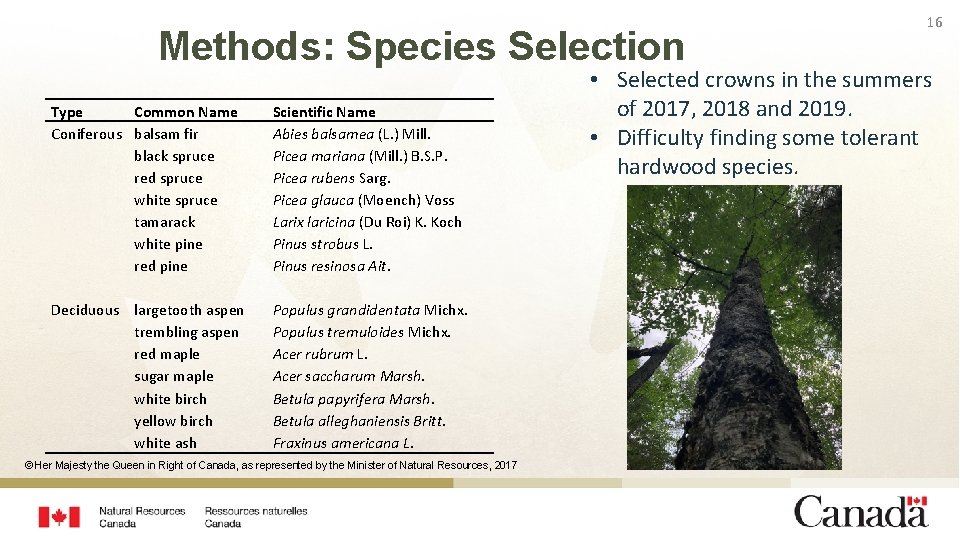
Methods: Species Selection Type Common Name Coniferous balsam fir black spruce red spruce white spruce tamarack white pine red pine Scientific Name Abies balsamea (L. ) Mill. Picea mariana (Mill. ) B. S. P. Picea rubens Sarg. Picea glauca (Moench) Voss Larix laricina (Du Roi) K. Koch Pinus strobus L. Pinus resinosa Ait. Deciduous largetooth aspen trembling aspen red maple sugar maple white birch yellow birch white ash Populus grandidentata Michx. Populus tremuloides Michx. Acer rubrum L. Acer saccharum Marsh. Betula papyrifera Marsh. Betula alleghaniensis Britt. Fraxinus americana L. © Her Majesty the Queen in Right of Canada, as represented by the Minister of Natural Resources, 2017 16 • Selected crowns in the summers of 2017, 2018 and 2019. • Difficulty finding some tolerant hardwood species.
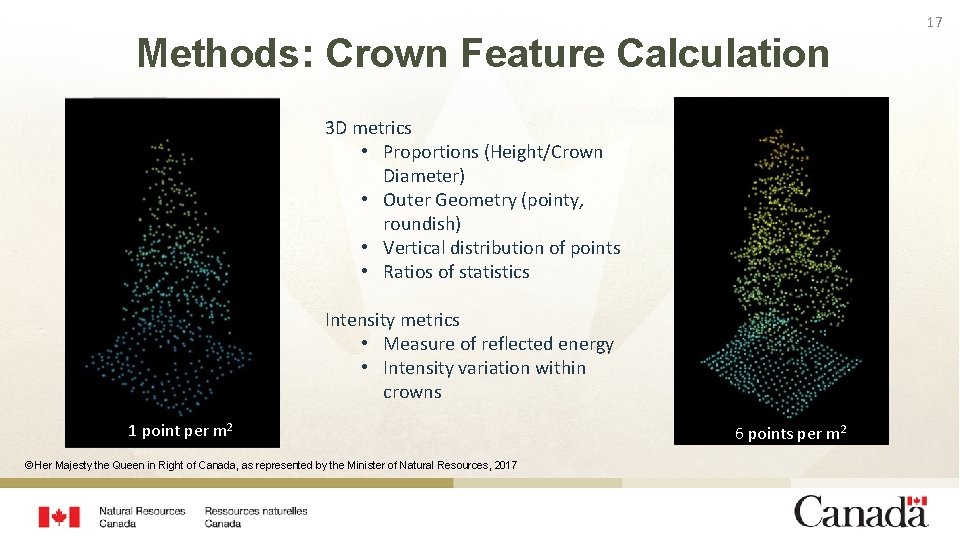
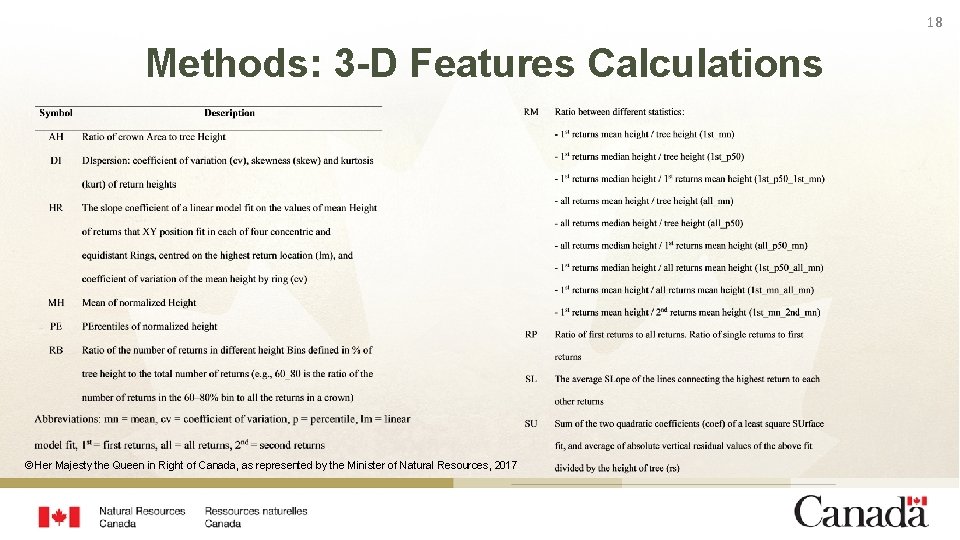
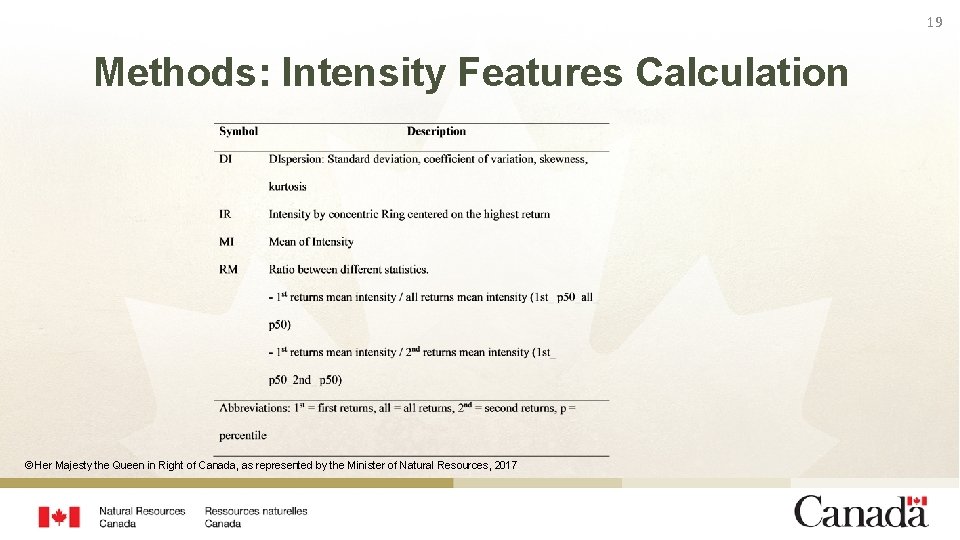
Methods: Crown Feature Calculation 3 D metrics • Proportions (Height/Crown Diameter) • Outer Geometry (pointy, roundish) • Vertical distribution of points • Ratios of statistics Intensity metrics • Measure of reflected energy • Intensity variation within crowns 1 point per m 2 © Her Majesty the Queen in Right of Canada, as represented by the Minister of Natural Resources, 2017 6 points per m 2 17
18 Methods: 3 -D Features Calculations © Her Majesty the Queen in Right of Canada, as represented by the Minister of Natural Resources, 2017
19 Methods: Intensity Features Calculation © Her Majesty the Queen in Right of Canada, as represented by the Minister of Natural Resources, 2017
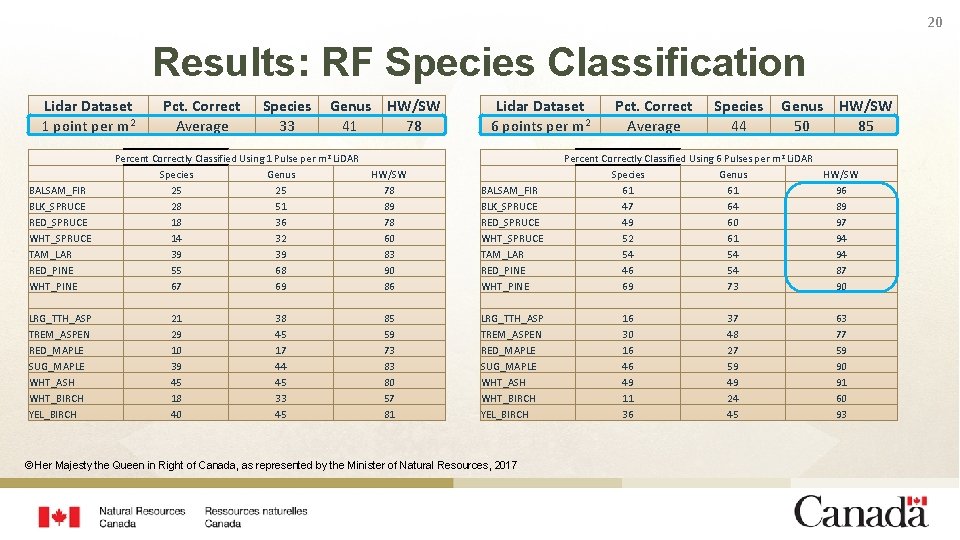
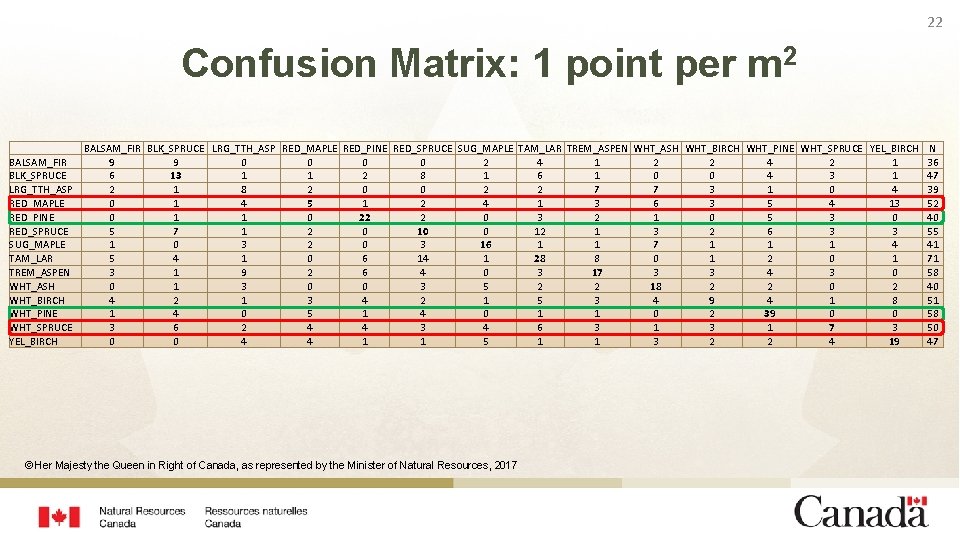
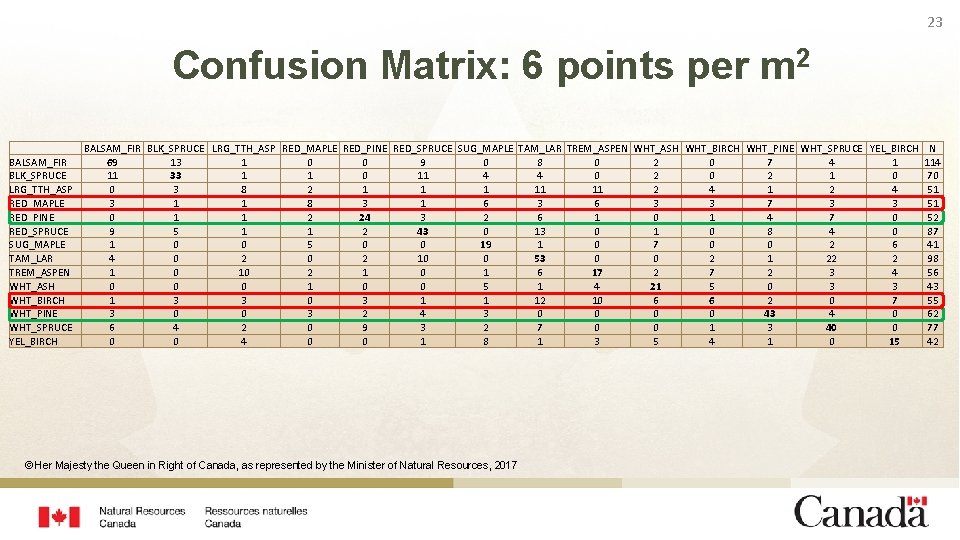
20 Results: RF Species Classification Lidar Dataset 1 point per m 2 BALSAM_FIR BLK_SPRUCE RED_SPRUCE WHT_SPRUCE TAM_LAR RED_PINE WHT_PINE LRG_TTH_ASP TREM_ASPEN RED_MAPLE SUG_MAPLE WHT_ASH WHT_BIRCH YEL_BIRCH Pct. Correct Average Species 33 Genus HW/SW 41 78 Percent Correctly Classified Using 1 Pulse per m 2 Li. DAR Species Genus 25 25 28 51 18 36 14 32 39 39 55 68 67 69 21 29 10 39 45 18 40 38 45 17 44 45 33 45 Lidar Dataset 6 points per m 2 HW/SW 78 89 78 60 83 90 86 BALSAM_FIR BLK_SPRUCE RED_SPRUCE WHT_SPRUCE TAM_LAR RED_PINE WHT_PINE 85 59 73 83 80 57 81 LRG_TTH_ASP TREM_ASPEN RED_MAPLE SUG_MAPLE WHT_ASH WHT_BIRCH YEL_BIRCH © Her Majesty the Queen in Right of Canada, as represented by the Minister of Natural Resources, 2017 Pct. Correct Average Species 44 Genus HW/SW 50 85 Percent Correctly Classified Using 6 Pulses per m 2 Li. DAR Species Genus HW/SW 61 61 96 47 64 89 49 60 97 52 61 94 54 54 94 46 54 87 69 73 90 16 30 16 46 49 11 36 37 48 27 59 49 24 45 63 77 59 90 91 60 93
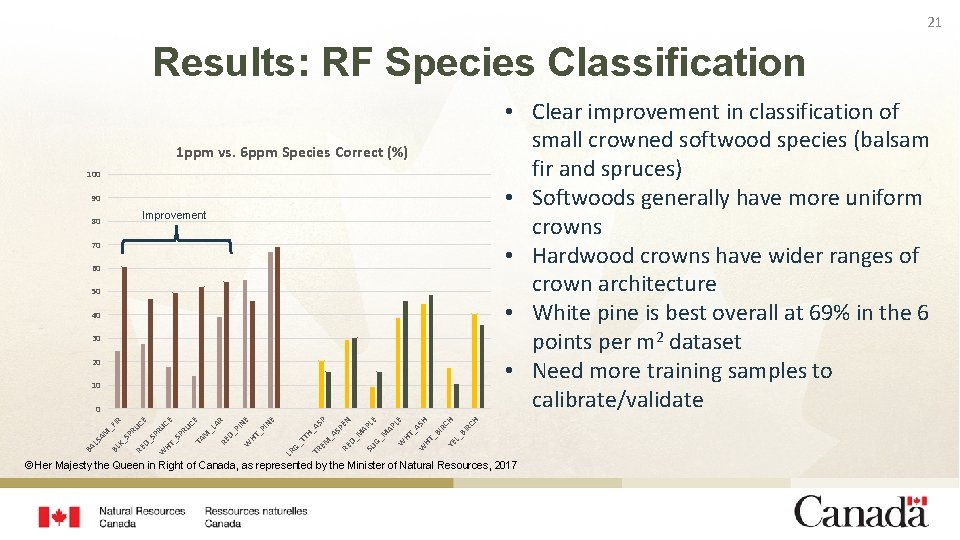
21 Results: RF Species Classification 1 ppm vs. 6 ppm Species Correct (%) 100 90 Improvement 80 70 60 50 40 30 20 10 AS P _A SP EN RE D_ M AP SU LE G_ M AP LE W HT _A SH W HT _B IR CH YE L_ BI RC H H_ EM TR TT G_ LR HT _P IN E NE PI W AR D_ _L RE M TA PR U CE CE _S W HT SP RU RU RE D_ SP K_ BL BA LS AM _F IR CE 0 • Clear improvement in classification of small crowned softwood species (balsam fir and spruces) • Softwoods generally have more uniform crowns • Hardwood crowns have wider ranges of crown architecture • White pine is best overall at 69% in the 6 points per m 2 dataset • Need more training samples to calibrate/validate © Her Majesty the Queen in Right of Canada, as represented by the Minister of Natural Resources, 2017
22 Confusion Matrix: 1 point per m 2 BALSAM_FIR BLK_SPRUCE LRG_TTH_ASP RED_MAPLE RED_PINE RED_SPRUCE SUG_MAPLE TAM_LAR TREM_ASPEN WHT_ASH WHT_BIRCH WHT_PINE WHT_SPRUCE YEL_BIRCH N 9 9 0 0 2 4 1 2 2 4 2 1 36 47 6 13 1 1 2 8 1 6 1 0 0 4 3 1 39 2 1 8 2 0 0 2 2 7 7 3 1 0 4 52 0 1 4 5 1 2 4 1 3 6 3 5 4 13 40 0 1 1 0 22 2 0 3 2 1 0 5 3 0 55 5 7 1 2 0 10 0 12 1 3 2 6 3 3 41 1 0 3 2 0 3 16 1 1 7 1 1 1 4 71 5 4 1 0 6 14 1 28 8 0 1 2 0 1 3 1 9 2 6 4 0 3 17 3 3 4 3 0 58 0 1 3 0 0 3 5 2 2 18 2 2 0 2 40 4 2 1 3 4 2 1 5 3 4 9 4 1 8 51 1 4 0 5 1 4 0 1 1 0 2 39 0 0 58 3 6 2 4 4 3 4 6 3 1 7 3 50 0 0 4 4 1 1 5 1 1 3 2 2 4 19 47 © Her Majesty the Queen in Right of Canada, as represented by the Minister of Natural Resources, 2017
23 Confusion Matrix: 6 points per m 2 BALSAM_FIR BLK_SPRUCE LRG_TTH_ASP RED_MAPLE RED_PINE RED_SPRUCE SUG_MAPLE TAM_LAR TREM_ASPEN WHT_ASH WHT_BIRCH WHT_PINE WHT_SPRUCE YEL_BIRCH N 69 13 1 0 0 9 0 8 0 2 0 7 4 1 114 11 33 1 1 0 11 4 4 0 2 1 0 70 0 3 8 2 1 11 11 2 4 51 3 1 1 8 3 1 6 3 3 7 3 3 51 0 1 1 2 24 3 2 6 1 0 1 4 7 0 52 9 5 1 1 2 43 0 1 0 8 4 0 87 1 0 0 5 0 0 19 1 0 7 0 0 2 6 41 4 0 2 10 0 53 0 0 2 1 22 2 98 1 0 10 2 1 0 1 6 17 2 3 4 56 0 0 0 1 0 0 5 1 4 21 5 0 3 3 43 1 3 3 0 3 1 1 12 10 6 6 2 0 7 55 3 0 0 3 2 4 3 0 0 43 4 0 62 6 4 2 0 9 3 2 7 0 0 1 3 40 0 77 0 0 4 0 0 1 8 1 3 5 4 1 0 15 42 © Her Majesty the Queen in Right of Canada, as represented by the Minister of Natural Resources, 2017
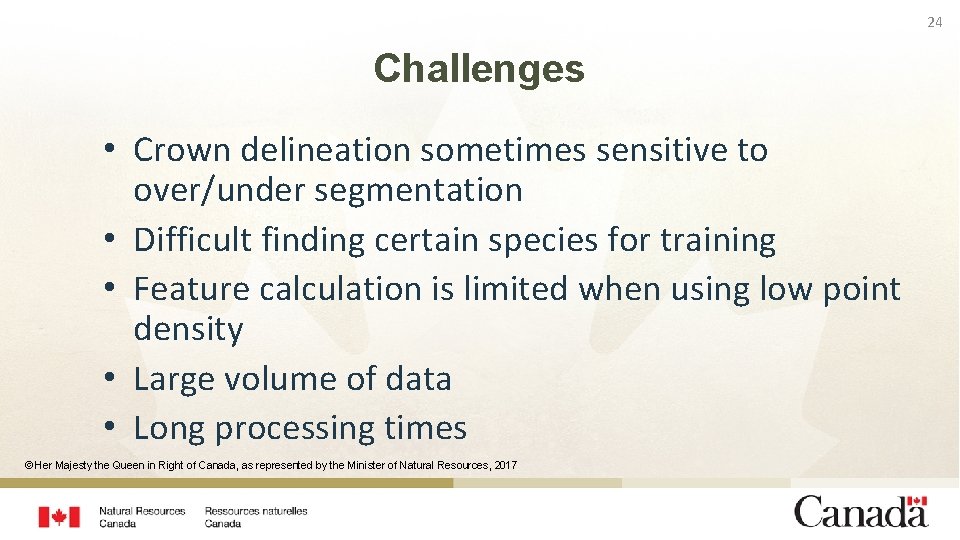
24 Challenges • Crown delineation sometimes sensitive to over/under segmentation • Difficult finding certain species for training • Feature calculation is limited when using low point density • Large volume of data • Long processing times © Her Majesty the Queen in Right of Canada, as represented by the Minister of Natural Resources, 2017
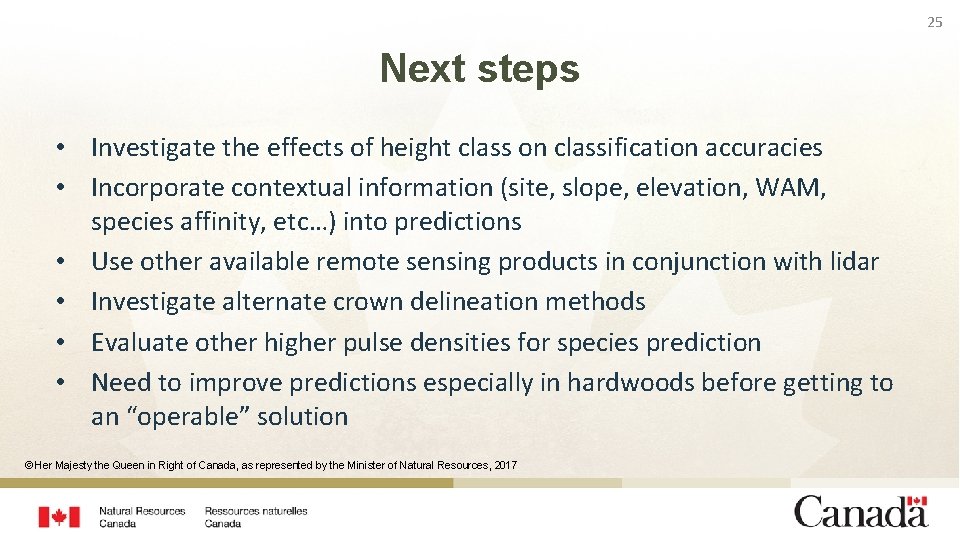
25 Next steps • Investigate the effects of height class on classification accuracies • Incorporate contextual information (site, slope, elevation, WAM, species affinity, etc…) into predictions • Use other available remote sensing products in conjunction with lidar • Investigate alternate crown delineation methods • Evaluate other higher pulse densities for species prediction • Need to improve predictions especially in hardwoods before getting to an “operable” solution © Her Majesty the Queen in Right of Canada, as represented by the Minister of Natural Resources, 2017
26 Acknowledgements UNB Masters Advisory Committee: • Dr. David Mac. Lean • Dr. Chris Hennigar • Dr. Doug Pitt Collaborators: • Jean-François Prieur CFS: • Dean Toole (Retired) • Adam Dick • Jean-François Côté • Michael Hoepting • John Mc. Mullen • Andrew Lewis CFS Summer Field Staff • John Clements • Ian Butler • Ziyi Zhao • Brent Scott • Bradley Kay • Mike Betts © Her Majesty the Queen in Right of Canada, as represented by the Minister of Natural Resources, 2017
27 Thank you © Her Majesty the Queen in Right of Canada, as represented by the Minister of Natural Resources, 2017 James. CG. Farrell@Canada. ca
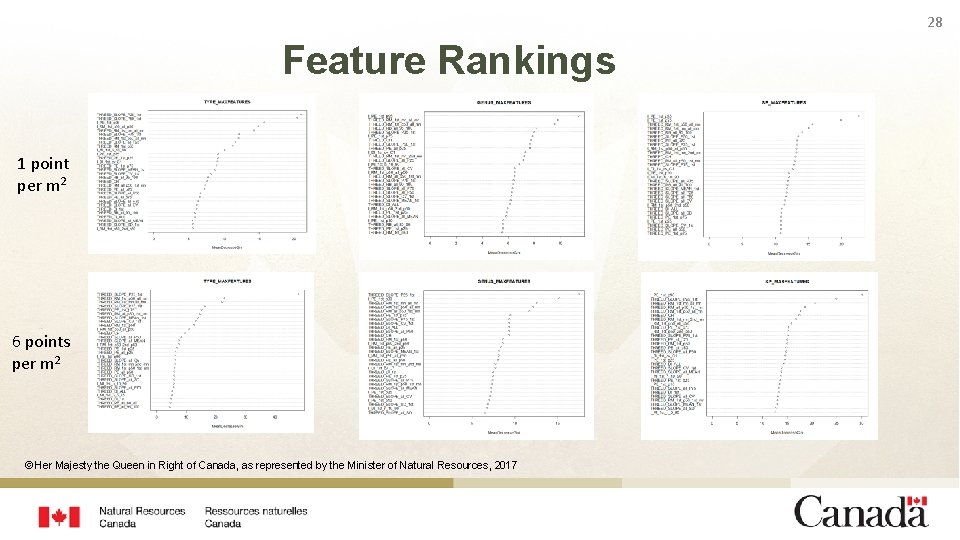
28 Feature Rankings 1 point per m 2 6 points per m 2 © Her Majesty the Queen in Right of Canada, as represented by the Minister of Natural Resources, 2017
Feature rankings 1 ppm vs. 6 ppm: Species 1 point per m 2 6 points per m 2 © Her Majesty the Queen in Right of Canada, as represented by the Minister of Natural Resources, 2017 29