
Individual Placement and Support IPS The EvidenceBased Practice
Individual Placement and Support - IPS The Evidence-Based Practice for Employment Updated 11. 2. 18
Research § Originally studied and validated with people with serious mental illness, including people with co-occurring substance use disorders
Research § IPS has been compared to traditional vocational rehabilitation approaches that typically include stepwise features such as prevocational assessment, sheltered setting, and volunteer work. In 25 randomized controlled trials, each showed a significant advantage for IPS.
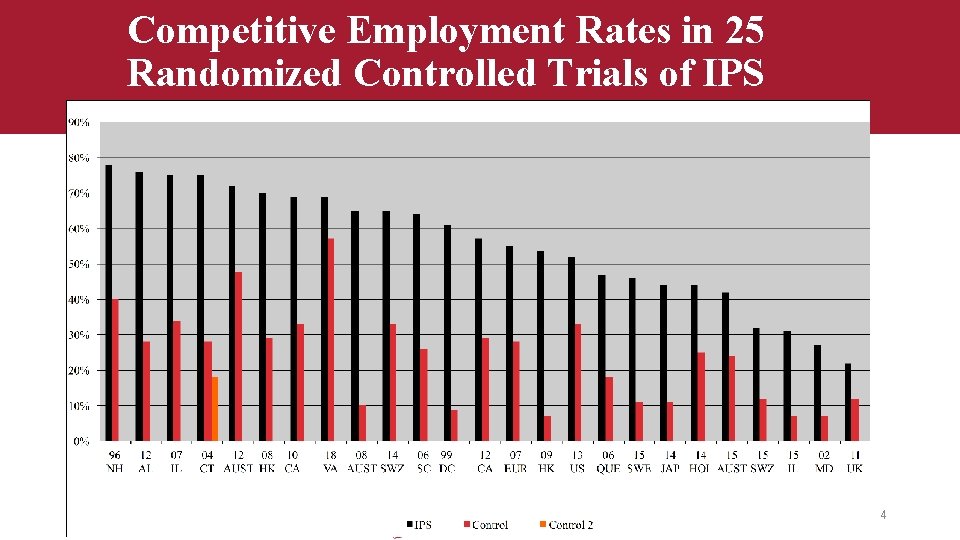
Competitive Employment Rates in 25 Randomized Controlled Trials of IPS 4
Overall Findings for 25 RCTs § Every study showed a significant advantage for IPS § Mean competitive employment rate: • 56% for IPS • 23% for controls
IPS is Effective in a Wide Variety of Target Populations § PTSD diagnosis § Mental illness + substance use § Older adults § First episode of psychosis § Homeless § Criminal justice history § Disability beneficiaries § Various racial and ethnic groups
Emerging Evidence for Other Populations § Nonpsychotic mental disorders § Substance use disorders § Musculoskeletal/neurological disorders
Why Focus on Employment and Careers? § Considered by many as an important part of recovery § Most people with serious mental illness want to work § Employment is a typical role for adults in our society § Cost-effective alternative to day treatment
Benefits of Steady Competitive Employment § Increased income § Improved self esteem § Improved social networks § Increased quality of life § Better control of symptoms § Reduced hospitalization § Reduced substance use § Reduced use of mental health services
Negative Effects of Unemployment in General Population § Increased substance abuse § Increased physical problems § Increased psychiatric disorders § Reduced self esteem § Loss of social contacts § Alienation and apathy (Warr, 1987)
What People Say “When you are working, you are part of the real world. You feel connected. Having a job gives me stability. I have something to look forward to every day. ” “In the past, people might have used labels to describe me such as ‘homeless, ’ ‘mentally ill, ’ and ‘welfare mother. ’ Now my titles are ‘financial administrator, ’ ‘college student, ’ and ‘working mom. ’”
What People Say “I was really glad that my son’s employment counselor asked me about work ideas. My son wanted me to be a part of the team. And he landed a job that I suggested. ” “I worried that if my daughter got a job, she would feel stressed. But just the opposite happened. She is doing much better than before. ”
What People Say “Andre is as good as any worker that I have. ” Automotive parts store manager “I count on Juanita. If she is feeling stressed, she sits in a room by herself for awhile. That’s okay; she gets the job done. ” Bakery supervisor “The employment counselor helped me understand why Tony paces. It’s okay in the security business. ” Security business owner
Wellness and Recovery Wellness moves the focus from thinking one needs treatment forever to capitalizing on the strengths and abilities of the individual and his/her family and community. M. Swarbrick, CSPNJ
Who Provides IPS Services? IPS specialists (sometimes called employment specialists or supported employment and education specialists) provide direct assistance with work and education/technical training. IPS specialists work closely with a team of practitioners who provide services for the same group of people.
IPS Principles § Open to anyone who wants to work § Focus on competitive employment § Rapid job search § Targeted job development § Client preferences guide decisions § Individualized long-term supports § Integrated with treatment § Benefits counseling included
Open to Anyone Who Wants to Work § Eligibility is based on consumer choice § People are not excluded because of diagnosis, recent hospitalizations, criminal justice history, or work readiness criteria
Focus on Competitive Employment § IPS specialists help people find jobs that exist in the open labor market and pay the same as others in a similar position (at least minimum wage), including part-time and full-time jobs. § People are not steered into sheltered jobs (that are set aside for people with disabilities) but work in community settings with others who do not have disabilities.
Rapid Job Search § IPS specialists help people start looking for jobs within one month of starting the program. § Pre-employment assessment, training and counseling are not required and are kept to a minimum. § IPS specialists help people explore the world of work at a pace that is right for the individual.
Targeted Job Development § Based on individuals’ interests, IPS specialists build relationships with employers to learn about the employers’ needs in order to identify qualified job candidates. § IPS specialists make multiple visits to the same employers to develop relationships and average six face-to-face contacts with hiring managers per week.
Individual Preferences Guide Decisions § The job search is based on individual preferences, strengths, and work experiences, not on a pool of jobs that are readily available. § Job seekers indicate preferences for job type, work hours, and types of job supports.
Individualized Long-Term Supports § IPS specialists provide support for as long as needed and desired, without arbitrary time limits. § Job supports are individualized based on the needs of the person and what will promote a positive work experience. § IPS specialists help people with job changes and career advancement, including additional schooling and training.
IPS is Integrated with Treatment § IPS specialists meet at least weekly with the team of providers who serve the same group of people, for example, care coordinators, therapists, medication providers, housing specialists. § The team meets together regularly to review clients’ status and plans coordinated, recovery-oriented services.
Personalized Benefits Counseling § IPS specialists refer people for comprehensive, individualized benefits planning by a trained benefits specialist so they can make informed decisions about starting or changing jobs.
Key Factors in Implementation § Build consensus § Maximize financing § Examine agency philosophy § Identify leadership § Key on organizational structure § Provide ongoing training/technical assistance § Make time commitment § Track process and outcomes
Build Consensus § Develop a steering committee to oversee implementation process § Include representatives from all stakeholder groups: Local and state mental health and vocational rehabilitation leaders Funders Providers Service recipients Family members Employers School counselors § Educate stakeholders about the practice
Maximize Funding § Determine how IPS services can be funded – Which funding sources pay for which parts of IPS? § Explore funding (in the US) from Medicaid, state vocational rehabilitation funds, state mental health contracts and grants § Approximately $5, 000 person in the first year and typically accruing limited costs thereafter (Salkever, 2013). § Reallocate resources to IPS when feasible
Examine Agency Philosophy § Determine if service agency’s philosophy, mission statement, and service paradigm are consistent with a recovery-oriented IPS approach. § Are there competing programs such as day treatment and/or stepwise vocational services that may include sheltered work, work readiness assessments, volunteer work?
Identify Leadership § Identify a committed agency IPS champion who has the authority to oversee and ensure implementation. § Leaders at all levels, including the agency director, visibly demonstrate support for IPS and consumers gaining integrated competitive employment. § Leadership from state vocational rehabilitation reinforces commitment to IPS and collaboration with IPS services. § Critical role of IPS supervisor in program success.
Organizational Structure § IPS specialists join one or two treatment teams, share office space, attend weekly treatment team meetings to discuss shared clients. § Mental health treatment team integrates IPS, benefits counseling, care management, medication management, and substance use treatment. § IPS supervisor provides weekly group outcomes-based supervision to IPS specialists.
Provide Ongoing Training/Technical Assistance § Agency staff receive initial training on IPS and the roles of different practitioners (e. g. , care managers, therapists, medication prescribers, housing specialists) in supporting people’s work efforts. § IPS trainer provides ongoing training and technical assistance to help the agency reach good IPS implementation. § IPS supervisor trains and mentors new staff on IPS services.
Make Time Commitment § Typically, 6 -12 months to build agency interest to implement IPS, organize team structure, access stable funding, and develop staff skills and confidence to implement IPS.
Track Process and Outcomes § Track integrated competitive employment outcomes on a monthly and quarterly basis. § Set realistic incremental goals. § Baseline IPS fidelity review typically occurs 6 -9 months after program start when people have obtained employment, and conducted every six months until reaching at least 100 on the 25 -item IPS Fidelity Scale, and yearly thereafter.
Summary § People with serious mental illness do want to work and can work in integrated competitive employment. § IPS is a successful employment intervention for a wide variety of populations. § IPS is an evidence-based practice that includes program manuals and an IPS Fidelity Scale to serve as roadmaps for good program implementation. § Agency leaders organize services, maximize funding, provide training and supervision, monitor implementation and track outcomes to ensure high-quality IPS services.
Resources § www. IPSworks. org § Online courses for practitioners and supervisors § IPS Supported Employment: A Practical Guide (2013) § 25 -item IPS Supported Employment Fidelity Scale
- Slides: 35