
Individual Hour Activities Picture Description Oral Written Presentation
- Slides: 13
Individual Hour Activities Picture Description Oral & Written Presentation Betty Simelmits
Social Interaction • Pupils interact effectively in English, orally and in writing, in varied social contexts with people from varied linguistic and cultural backgrounds. • Ask and answer simple questions about familiar topics and everyday situations, such as family, school, personal interests express feelings, likes and dislikes • Interact for purposes such as giving directions, making requests • Engage in short conversations • Give and receive short messages in writing, such as notes, invitations
Presentation • Pupils present information and ideas in an organized and planned manner in a variety of formats, in both spoken and written English, on a wide range of topics. • Pupils present information about personal topics, orally and in writing, using basic organizational skills. • Pupils use basic vocabulary and simple syntax
Tips for Teachers • Magazines are a rich source of pictures. No matter what the subject matter of the magazine you’re sure to find interesting pictures in advertisements or accompanying the articles • search for free clip art or other Internet resources. • Affix the pictures to construction paper and laminate. This gives pictures a nice, clean look and makes the pictures more rigid so they hold up better to frequent handling.
• Organizing picture files, sort your pictures into file folders according to life skill topic, language skill or classroom activity. • It is possible to put all the pictures is a folder of a spiral file, the picture is in front of the pupils and the other side (with guidelines) is in front of the teacher.
Getting Started. . • Pictures in multi-level instruction - When using pictures, learners at different proficiency levels can be given different tasks while working with the same sets of pictures. – Put learners together in pairs or groups at the same level of proficiency. Assign each pair a levelappropriate task. Rotate the pictures to each group.
Levels of Description • Objects, weather, nature, Places • People – physical description – cloths, parts of the body, colors, information from ID cards • Actions, prepositions • Feelings - emotions, likes and dislikes • Related to pupil’s world – describe your. .
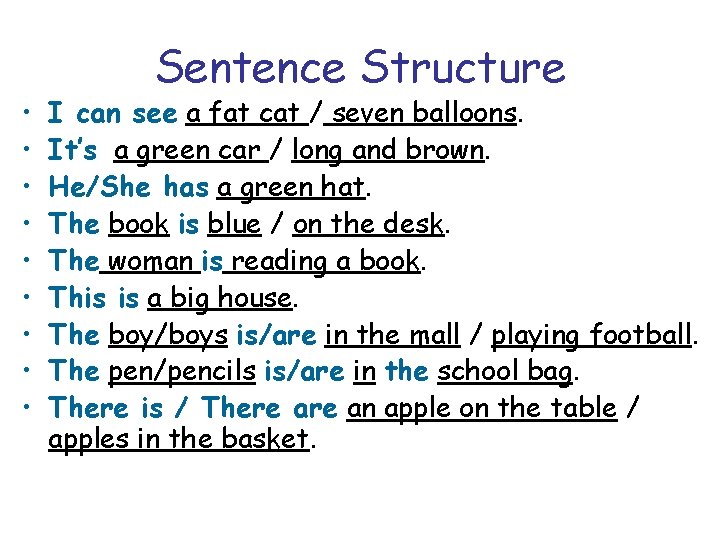
• • • Sentence Structure I can see a fat cat / seven balloons. It’s a green car / long and brown. He/She has a green hat. The book is blue / on the desk. The woman is reading a book. This is a big house. The boy/boys is/are in the mall / playing football. The pen/pencils is/are in the school bag. There is / There an apple on the table / apples in the basket.
LEVEL 1 • Show the picture to the entire group and ask general questions. • What do you see? Who is in the picture? • Where are they? • Ask them to name the people, animals, and other objects in the picture, as well as the action taking place. • Some responses will be based on direct evidence in the picture.
• Ask series of questions: – Wh-, yes/no, and “or” (choice) questions related to the picture. – Elicit responses from learners. – If any child is having difficulty, gently prompt the child using "who, what, where, why, and how" questions. For example: What is the boy doing in this picture? Why is he crying? – To encourage the children to express themselves, try to avoid questions that can be answered with yes or no. • Elicit full sentence answer.
LEVEL 2 • Encourage pupils to give their opinion, express feelings, likes and dislikes. • Ask questions such as: – Do you think …. Why? – Do you like the …. – Why does he look so unhappy?
LEVEL 3 • Encourage pupils to “talk” about the relevant topic in their lives – describe their room / house / family etc’ – Talk about things they do after school
Extension activities • Put learners in pairs. Members of the pair each have a turn being the “teacher” who asks questions about a picture and the “learner” who answers the questions. Rotate the pictures among the pairs to give additional practice. • Have learners write a description of the picture.