
Individual economic decision making Aspects of behavioural economics

Individual economic decision making Aspects of behavioural economics http: //www. bbc. co. uk/news/health-19280260
Learning outcomes • To appreciate the emergence of behavioural economics as an important contributor to economic theory • To develop and understanding of behavioural economics including bounded rationality, biases in individual decision making and the role of altruism • To be able to relate behavioural economics to government economic policy
The emergence of behavioural economics Behavioural Economics is the study of psychology as it relates to the economic decision-making processes of individuals and institutions. Behavioural economics draws on psychology and economics to explore why people sometimes make irrational decisions, and why and how their behaviour does not follow the predictions of economic models. Decisions such as how much to pay for a cup of coffee, whether to go to university, whether to pursue a healthy lifestyle, how much to contribute towards retirement, etc. are the sorts of decisions that most people make at some point in their lives. Behavioural economics seeks to explain why an individual decided to go for choice A, instead of choice B. https: //www. youtube. com/watch? v=e 0 KXh. V 6 TG 0 c
Rational economic behaviour Bounded rationality When making decisions, an individual’s rationality is limited by the information they have, the limitations of their minds, and the finite amount of time they have to make decisions. https: //www. youtube. com/watch? v=YPL 8 -7 Za. N 6 I Bounded self control Limited self control in which individuals seek to act in what they see as their self interest. https: //www. youtube. com/watch? v=k. ZLs. WXPlji. M
Bias in decision making Cognitive bias A mistake in reasoning or in some other mental process occurring as a result of. Potentially the results of preferences and beliefs regardless of contrary information. http: //www. bbc. co. uk/news/health-19280260 Availability bias When individuals make judgements about the likelihood of future events according to how easy it is to recall examples of similar events. https: //www. youtube. com/watch? v=Q 5 Ltc. YMf 4_E Anchoring A cognitive bias that sees decision making relying too heavily on the first piece of information offered. This ‘anchor’ is then used to make subsequent decisions. https: //www. youtube. com/watch? v=NFi. Ddbqu. WJY
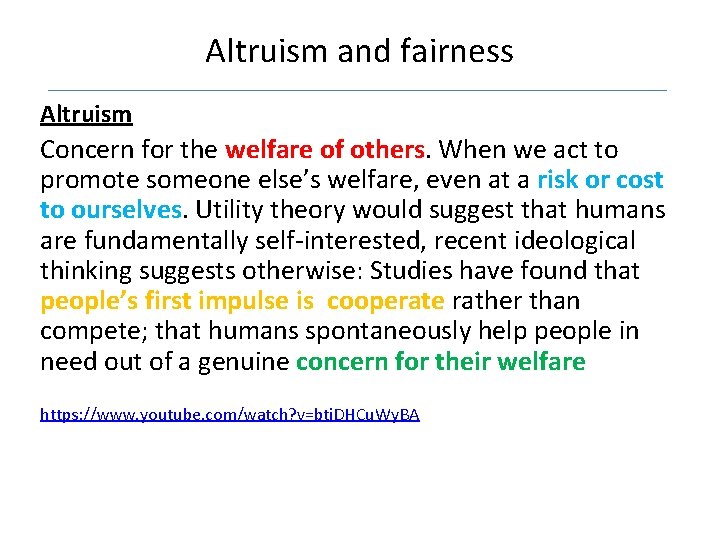
Altruism and fairness Altruism Concern for the welfare of others. When we act to promote someone else’s welfare, even at a risk or cost to ourselves. Utility theory would suggest that humans are fundamentally self-interested, recent ideological thinking suggests otherwise: Studies have found that people’s first impulse is cooperate rather than compete; that humans spontaneously help people in need out of a genuine concern for their welfare https: //www. youtube. com/watch? v=bti. DHCu. Wy. BA
Individual economic decision making Behavioural economics and economic policy
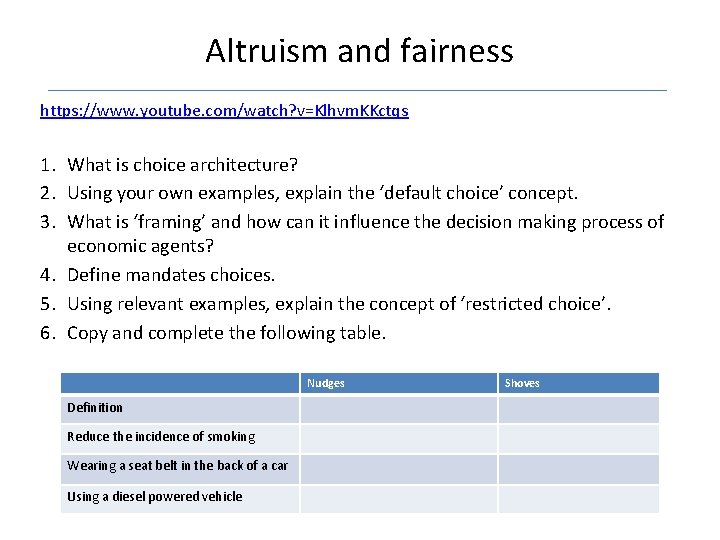
Altruism and fairness https: //www. youtube. com/watch? v=Klhvm. KKctqs 1. What is choice architecture? 2. Using your own examples, explain the ‘default choice’ concept. 3. What is ‘framing’ and how can it influence the decision making process of economic agents? 4. Define mandates choices. 5. Using relevant examples, explain the concept of ‘restricted choice’. 6. Copy and complete the following table. Nudges Definition Reduce the incidence of smoking Wearing a seat belt in the back of a car Using a diesel powered vehicle Shoves
Exam style question Economic agents are rational utility maximisers. Discuss (25 marks)
- Slides: 9