
Individual Differences Personality and Ability Understanding and Managing
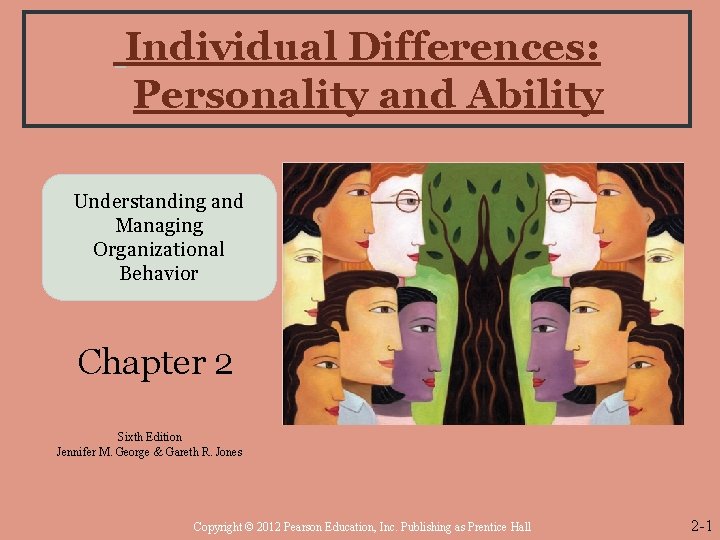
Individual Differences: Personality and Ability Understanding and Managing Organizational Behavior Chapter 2 Sixth Edition Jennifer M. George & Gareth R. Jones Copyright © 2012 Pearson Education, Inc. Publishing as Prentice Hall 2 -1
Learning Objectives • Understand the nature of personality and how it is determined by both nature and nurture • Describe the Big Five personality traits and their implication for understanding behavior in organizations • Appreciate the ways in which other personality traits, in addition to the Big Five, influence employees’ behaviors in organizations Copyright © 2012 Pearson Education, Inc. Publishing as Prentice Hall 2 -2
Learning Objectives • Describe the different kinds of abilities that employees use to perform their jobs • Appreciate how organizations manage ability through selection, placement, and training Copyright © 2012 Pearson Education, Inc. Publishing as Prentice Hall 2 -3
Determination of a Leader What does it take to lead one of the largest global companies in the snack, food, and beverage company? The conscientiousness, determination, self- discipline, sociability, and affectionate behavior of Indrawn Nooyi, CEO of Pepsi. Copyright © 2012 Pearson Education, Inc. Publishing as Prentice Hall 2 -4
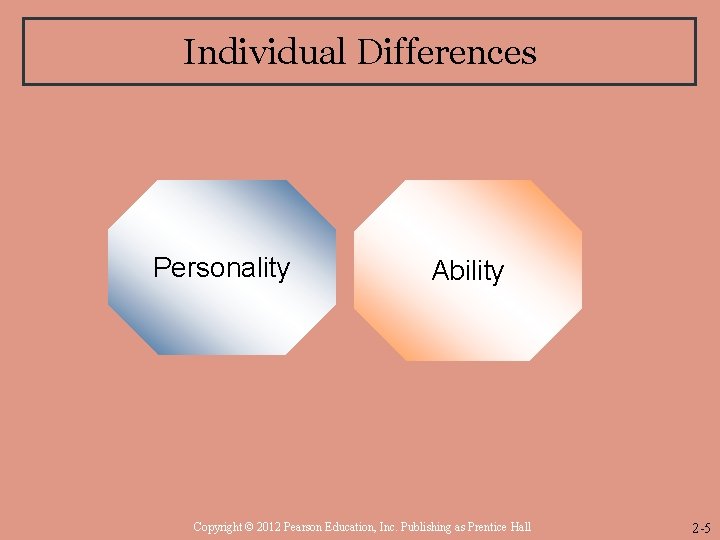
Individual Differences Personality Ability Copyright © 2012 Pearson Education, Inc. Publishing as Prentice Hall 2 -5
Personality is the pattern of relatively enduring ways that a person feels, thinks, and behaves Copyright © 2012 Pearson Education, Inc. Publishing as Prentice Hall 2 -6
The Nature of Personality Develops over a person’s lifetime Generally stable in the context of work Can influence career choice, job satisfaction, stress, leadership, and even performance Copyright © 2012 Pearson Education, Inc. Publishing as Prentice Hall 2 -7
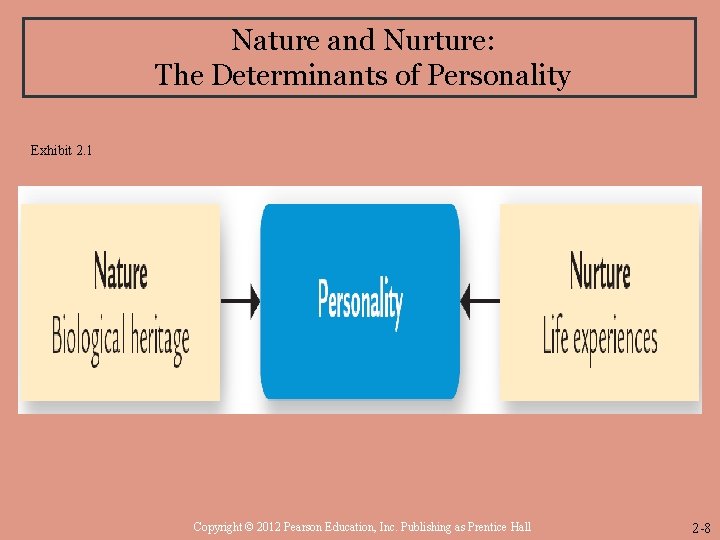
Nature and Nurture: The Determinants of Personality Exhibit 2. 1 Copyright © 2012 Pearson Education, Inc. Publishing as Prentice Hall 2 -8
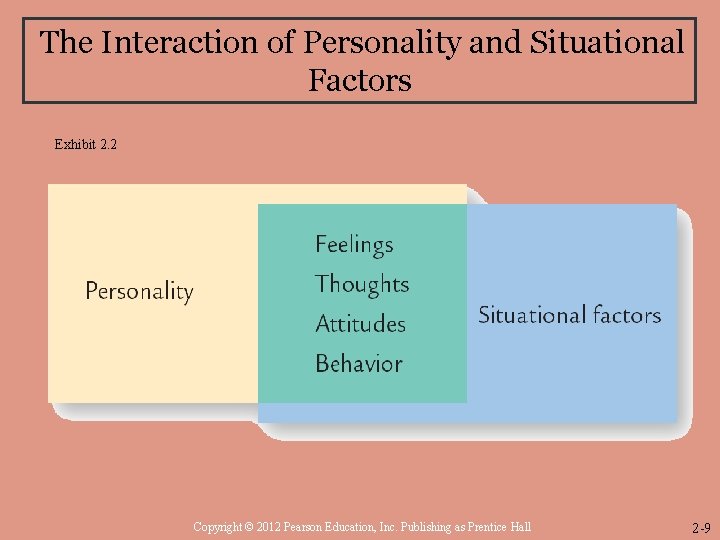
The Interaction of Personality and Situational Factors Exhibit 2. 2 Copyright © 2012 Pearson Education, Inc. Publishing as Prentice Hall 2 -9
Attraction-Selection-Attrition (ASA) Framework of employee personalities = organizational personality Individuals with similar personalities tend to be attracted to an organization (attraction) and hired by it (selection) and individuals with other types of personalities tend to leave the organization (attrition) Copyright © 2012 Pearson Education, Inc. Publishing as Prentice Hall 2 -10
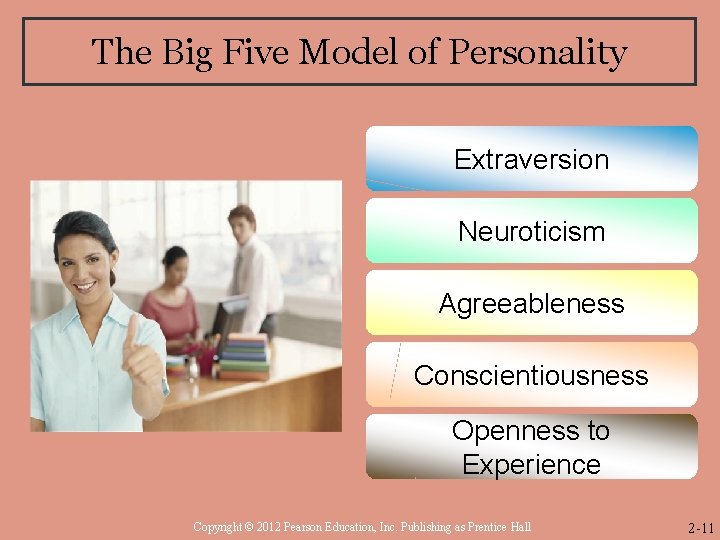
The Big Five Model of Personality Extraversion Neuroticism Agreeableness Conscientiousness Openness to Experience Copyright © 2012 Pearson Education, Inc. Publishing as Prentice Hall 2 -11
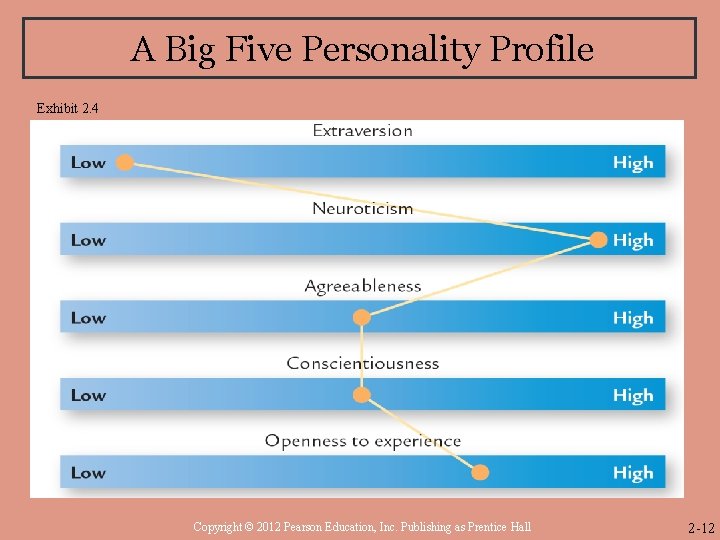
A Big Five Personality Profile Exhibit 2. 4 Copyright © 2012 Pearson Education, Inc. Publishing as Prentice Hall 2 -12
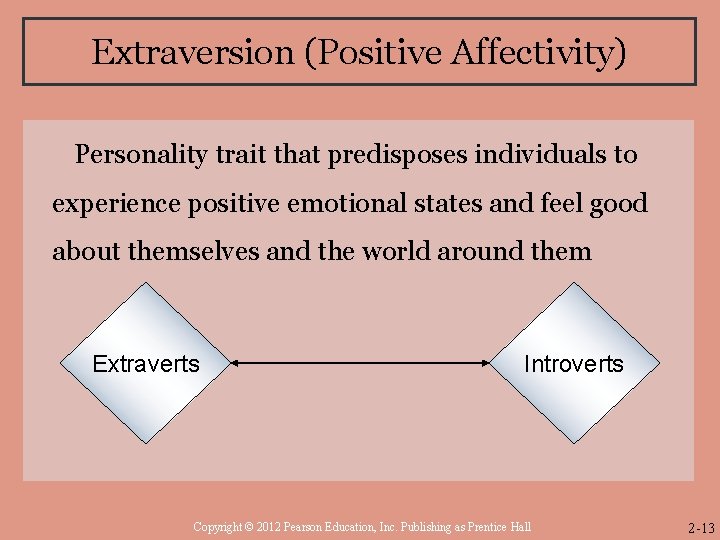
Extraversion (Positive Affectivity) Personality trait that predisposes individuals to experience positive emotional states and feel good about themselves and the world around them Extraverts Introverts Copyright © 2012 Pearson Education, Inc. Publishing as Prentice Hall 2 -13
A Measure of Extraversion Exhibit 2. 5 • How accurately does each statement describe you? • It is easy for me to become enthusiastic about things I am doing. • I often feel happy and satisfied for no particular reason. • I live a very interesting life. • Every day I do some things that are fun. • I usually find ways to liven up my day. • Most days I have moments of real fun or joy. Copyright © 2012 Pearson Education, Inc. Publishing as Prentice Hall 2 -14
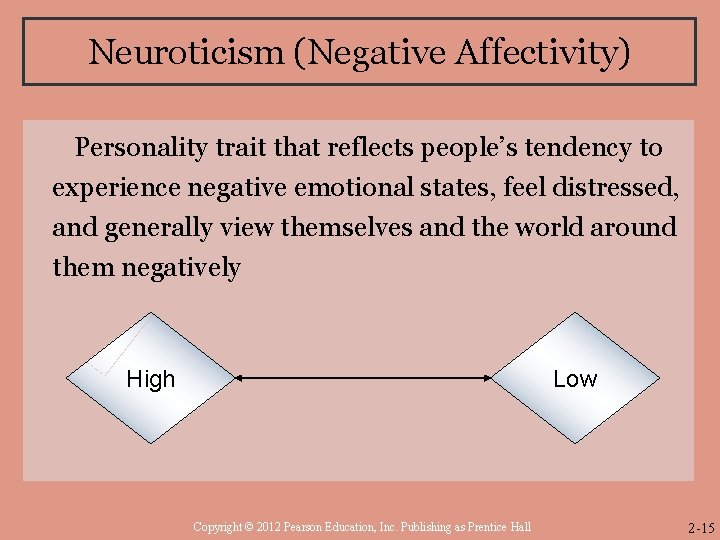
Neuroticism (Negative Affectivity) Personality trait that reflects people’s tendency to experience negative emotional states, feel distressed, and generally view themselves and the world around them negatively High Low Copyright © 2012 Pearson Education, Inc. Publishing as Prentice Hall 2 -15
A Measure of Neuroticism Exhibit 2. 6 • How accurately does each statement describe you? • I often find myself worrying about something. • My feelings are hurt rather easily. • Often I get irritated at little annoyances. • I suffer from nervousness. • My mood often goes up and down. • I sometimes feel “just miserable” for no good reason. Copyright © 2012 Pearson Education, Inc. Publishing as Prentice Hall 2 -16
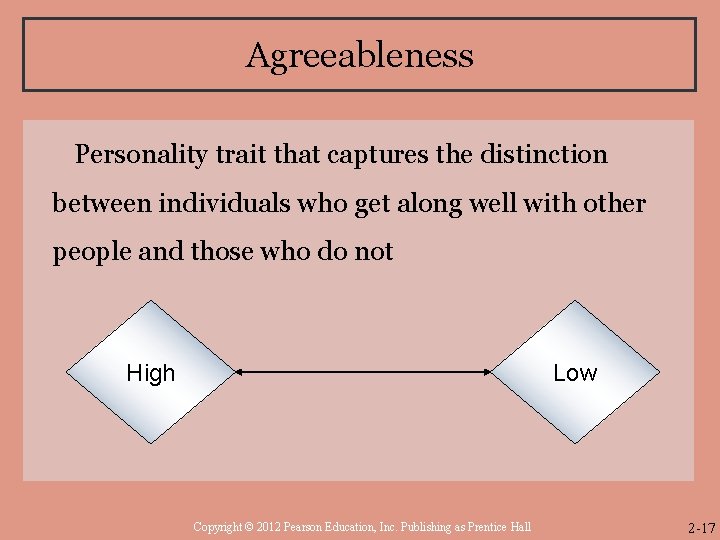
Agreeableness Personality trait that captures the distinction between individuals who get along well with other people and those who do not High Low Copyright © 2012 Pearson Education, Inc. Publishing as Prentice Hall 2 -17
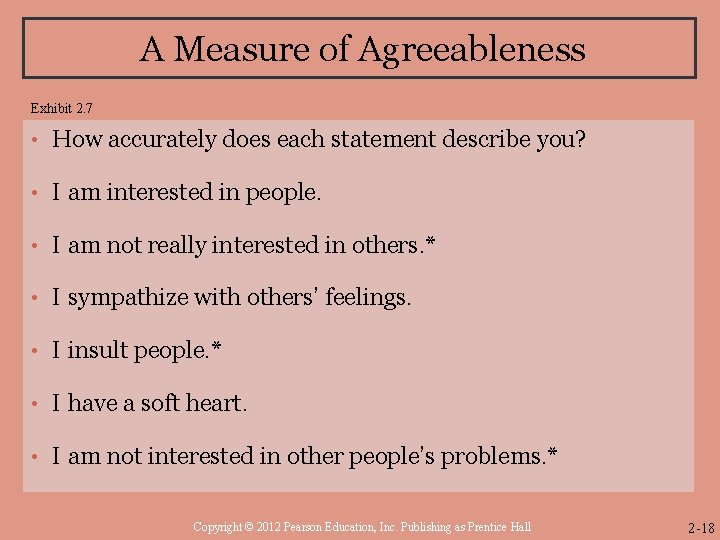
A Measure of Agreeableness Exhibit 2. 7 • How accurately does each statement describe you? • I am interested in people. • I am not really interested in others. * • I sympathize with others’ feelings. • I insult people. * • I have a soft heart. • I am not interested in other people’s problems. * Copyright © 2012 Pearson Education, Inc. Publishing as Prentice Hall 2 -18
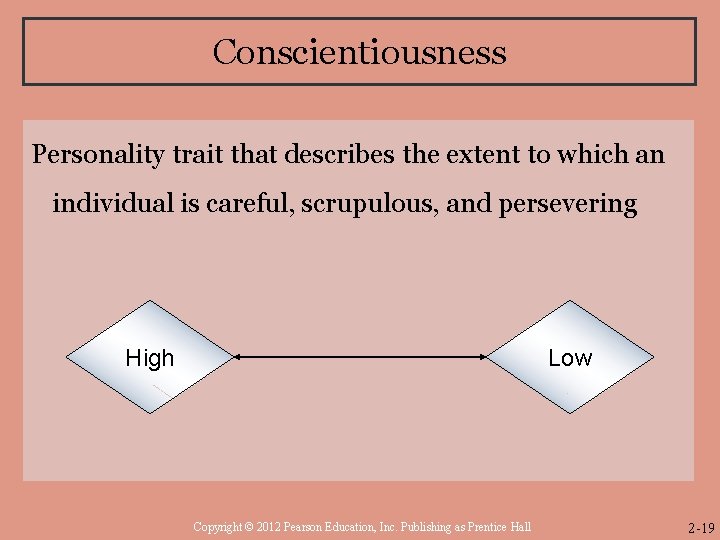
Conscientiousness Personality trait that describes the extent to which an individual is careful, scrupulous, and persevering High Low Copyright © 2012 Pearson Education, Inc. Publishing as Prentice Hall 2 -19
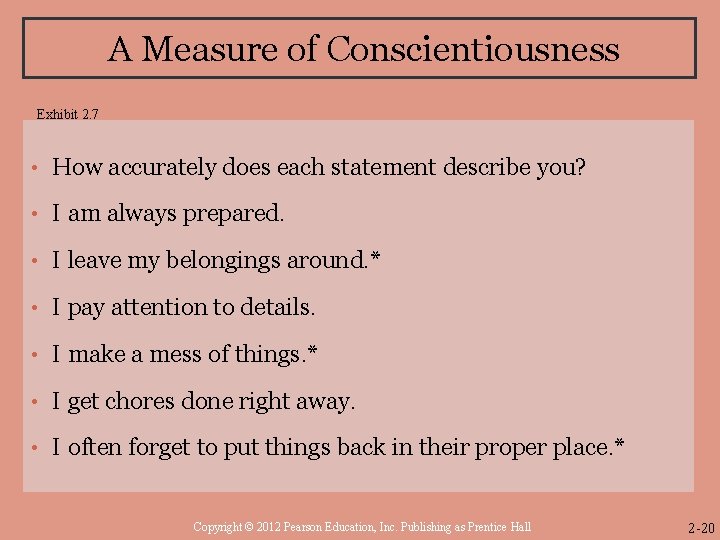
A Measure of Conscientiousness Exhibit 2. 7 • How accurately does each statement describe you? • I am always prepared. • I leave my belongings around. * • I pay attention to details. • I make a mess of things. * • I get chores done right away. • I often forget to put things back in their proper place. * Copyright © 2012 Pearson Education, Inc. Publishing as Prentice Hall 2 -20
Openness to Experience Personality trait that captures the extent to which an individual is original, open to a wide variety of stimuli, has broad interests, and is willing to take risks as opposed to being narrow-minded and cautious Copyright © 2012 Pearson Education, Inc. Publishing as Prentice Hall 2 -21
A Measure of Openness to Experience Exhibit 2. 7 • How accurately does each statement describe you? • I have a rich vocabulary. • I have difficulty understanding abstract ideas. * • I have a vivid imagination. • I am not interested in abstract ideas. * • I have excellent ideas. • I do not have a good imagination. * Copyright © 2012 Pearson Education, Inc. Publishing as Prentice Hall 2 -22
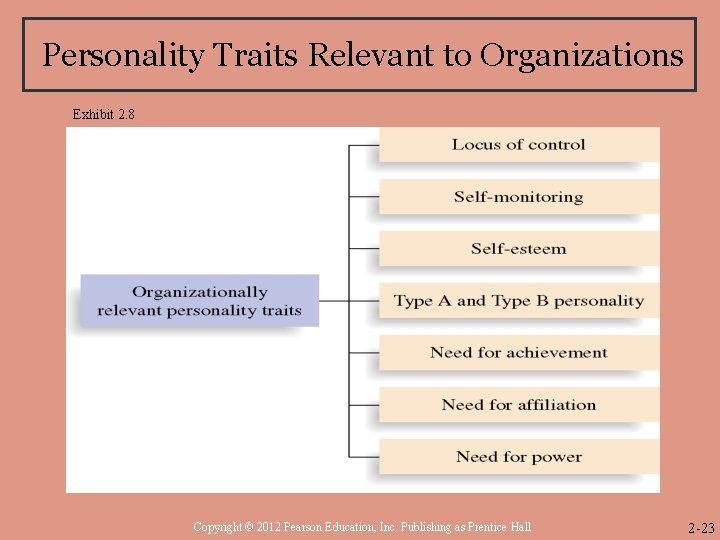
Personality Traits Relevant to Organizations Exhibit 2. 8 Copyright © 2012 Pearson Education, Inc. Publishing as Prentice Hall 2 -23
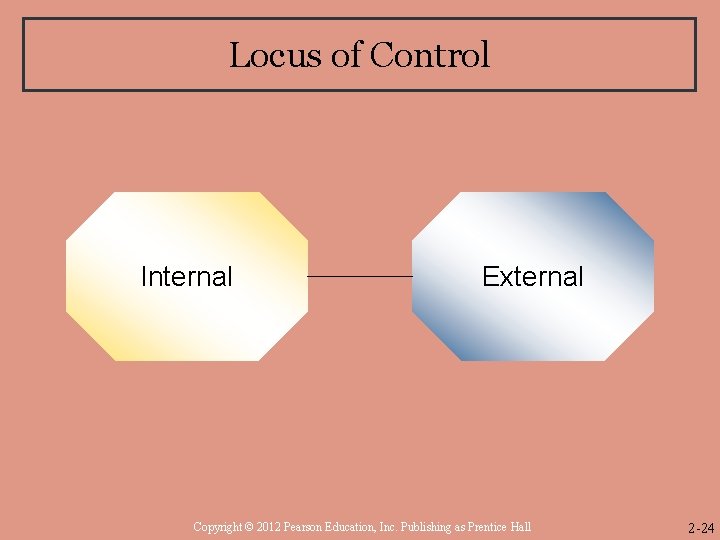
Locus of Control Internal External Copyright © 2012 Pearson Education, Inc. Publishing as Prentice Hall 2 -24
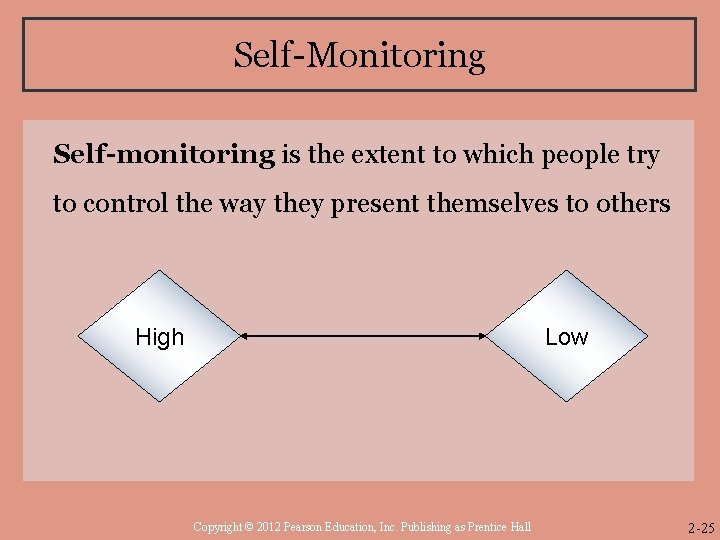
Self-Monitoring Self-monitoring is the extent to which people try to control the way they present themselves to others High Low Copyright © 2012 Pearson Education, Inc. Publishing as Prentice Hall 2 -25
A Measure of Self-Monitoring Exhibit 2. 9 • I find it hard to imitate the behavior of other people. * • At parties and social gatherings, I do not attempt to do or say things that others will like. * • I can only argue for ideas that I already believe. * • I can make impromptu speeches even on topics about which I have almost no information. • I guess I put on a show to impress or entertain others. Copyright © 2012 Pearson Education, Inc. Publishing as Prentice Hall 2 -26
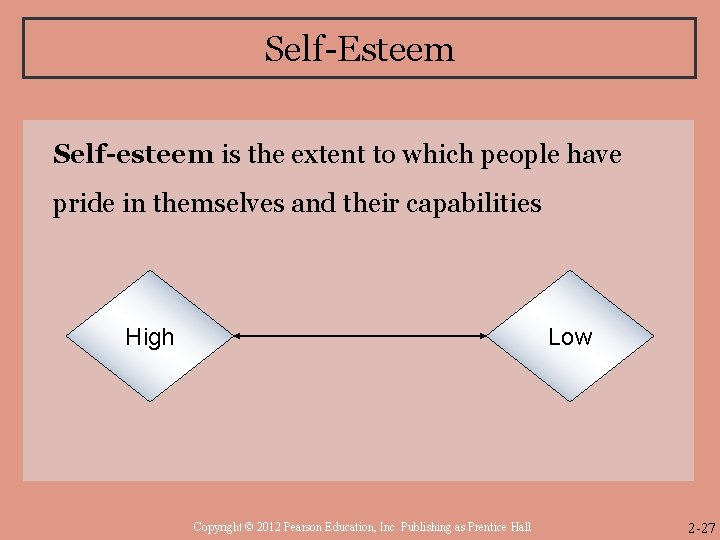
Self-Esteem Self-esteem is the extent to which people have pride in themselves and their capabilities High Low Copyright © 2012 Pearson Education, Inc. Publishing as Prentice Hall 2 -27
Type A vs. Type B Personality Type A individuals have an intense desire to achieve, are extremely competitive, have a sense of urgency, are impatient, and can be hostile Type B individuals are more relaxed and easygoing Copyright © 2012 Pearson Education, Inc. Publishing as Prentice Hall 2 -28
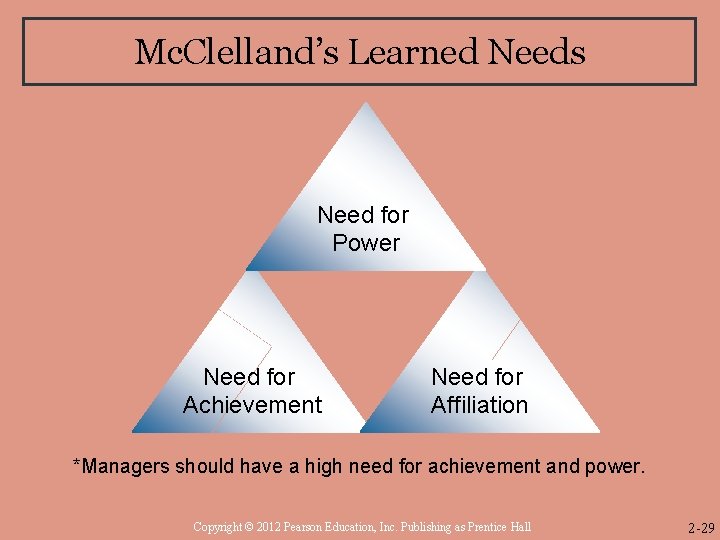
Mc. Clelland’s Learned Needs Need for Power Need for Achievement Need for Affiliation *Managers should have a high need for achievement and power. Copyright © 2012 Pearson Education, Inc. Publishing as Prentice Hall 2 -29
The Nature of Ability What a person is capable of doing Types of ability Cognitive ability Physical ability Motor skill Physical skill Emotional intelligence Copyright © 2012 Pearson Education, Inc. Publishing as Prentice Hall 2 -30
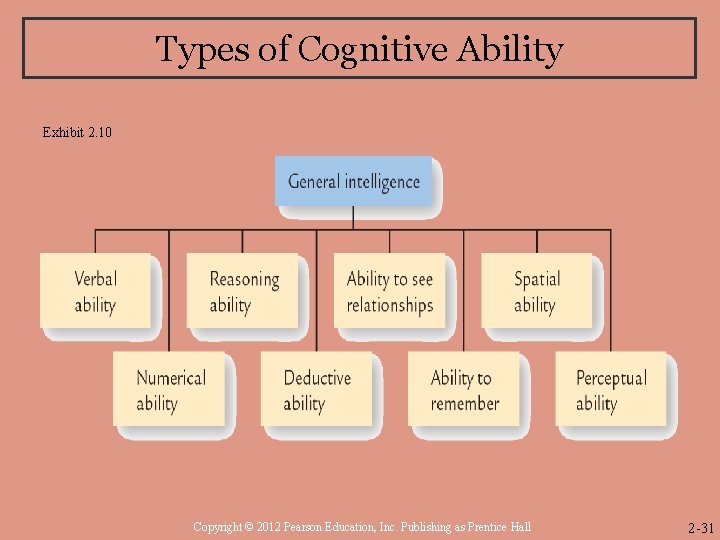
Types of Cognitive Ability Exhibit 2. 10 Copyright © 2012 Pearson Education, Inc. Publishing as Prentice Hall 2 -31
Cognitive Abilities Exhibit 2. 11 Ability to see relationships Verbal ability Numerical ability Ability to remember Reasoning ability Spatial ability Deductive ability Perceptual ability Copyright © 2012 Pearson Education, Inc. Publishing as Prentice Hall 2 -32
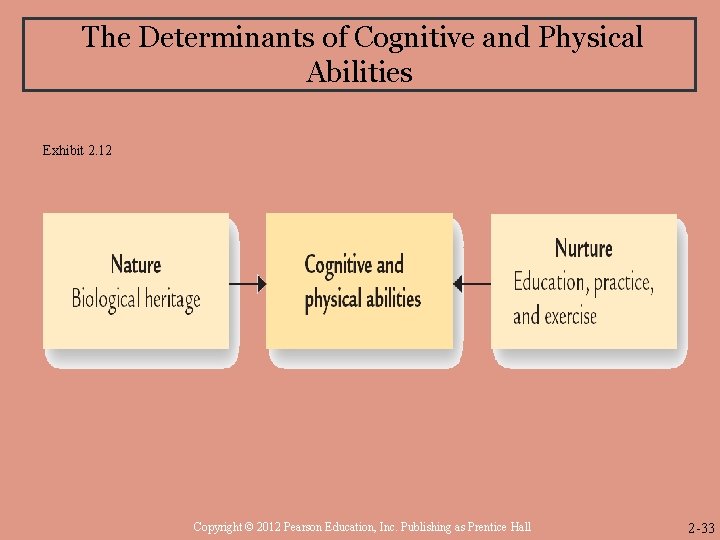
The Determinants of Cognitive and Physical Abilities Exhibit 2. 12 Copyright © 2012 Pearson Education, Inc. Publishing as Prentice Hall 2 -33
Emotional Intelligence The ability to understand manage one’s own feelings and emotions and the feelings and emotions of others A good understanding of how to use emotions to promote effective functioning and wellbeing Copyright © 2012 Pearson Education, Inc. Publishing as Prentice Hall 2 -34
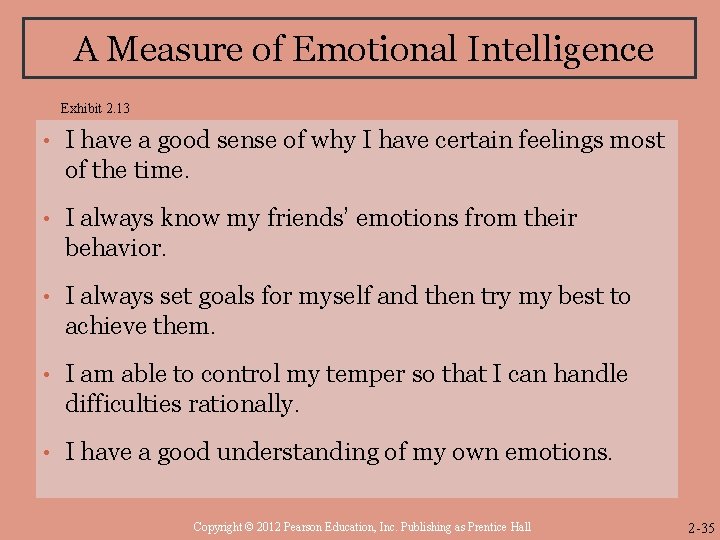
A Measure of Emotional Intelligence Exhibit 2. 13 • I have a good sense of why I have certain feelings most of the time. • I always know my friends’ emotions from their behavior. • I always set goals for myself and then try my best to achieve them. • I am able to control my temper so that I can handle difficulties rationally. • I have a good understanding of my own emotions. Copyright © 2012 Pearson Education, Inc. Publishing as Prentice Hall 2 -35
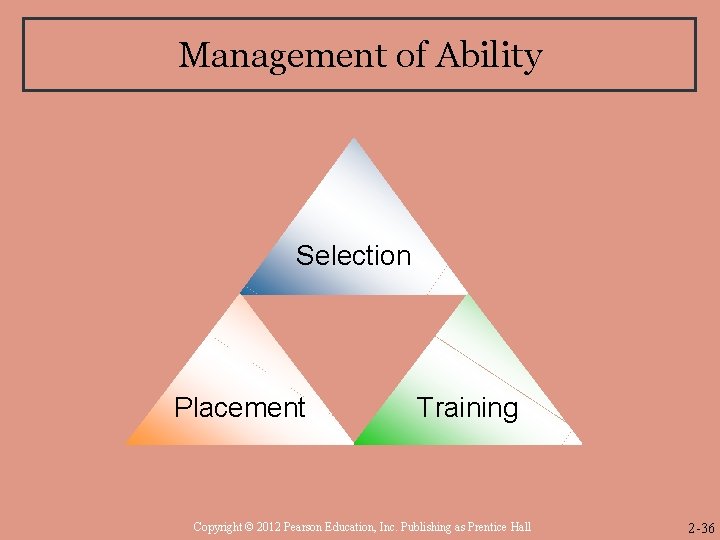
Management of Ability Selection Placement Training Copyright © 2012 Pearson Education, Inc. Publishing as Prentice Hall 2 -36
. This work is protected by United States copyright laws and is provided solely for the use of instructors in teaching their courses and assessing student learning. Dissemination or sale of any part of this work (including on the Worldwide Web) will destroy the integrity of the work and is not permitted. The work and materials from it should never be made available to students except by instructors using the accompanying text in their classes. All recipients of this work are expected to abide by these restrictions and to honor the intended pedagogical purposes and the needs of other instructors who rely on these materials. All rights reserved. No part of this publication may be reproduced, stored in a retrieval system, or transmitted, in any form or by any means, electronic, mechanical, photocopying, recording or otherwise, without the prior written permission of the publisher. Printed in the United States of America. Copyright © 2012 Pearson Education, Inc. Publishing as Prentice Hall 2 -37
- Slides: 37