
INDIVIDUAL DIFFERENCES IN L 2 ACQUISITION By Bitha
INDIVIDUAL DIFFERENCES IN L 2 ACQUISITION By: Bitha Pracandra R. S (2201410029) Andarini Handayani (2201410044) Citra Putri Utami (2201410114)
INTRODUCTION • Individual differences in L 2 acquisition • Psychological dimensions of difference
We will focus on two major dimensions; language aptitude and motivation, and also explore how differences in learning strategies can effect development.
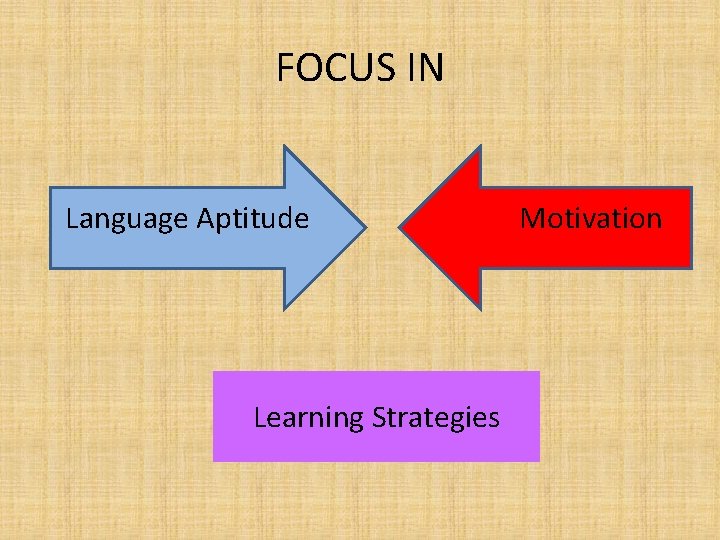
FOCUS IN Language Aptitude Learning Strategies Motivation
LANGUAGE APTITUDE Language aptitude is a natural ability for learning L 2.

COMPONENTS OF LANGUAGE APTITUDE (JOHN CARROLL) Phonemic Coding Ability Grammatical Sensitivity Inductive Language Learning Ability Rote Learning Ability
Phonemic Coding Ability The ability to identify the sounds of a foreign language so that they can be remembered later.
Grammatical Sensitivity The ability to recognize the grammatical functions of words in sentences
Inductive Language Learning Ability The ability to identify patterns of correspondence and relations between form and meaning
Rote Learning Ability The ability to form and remember association between stimuli

HOW DOES LANGUAGE APTITUDE RELATE TO THE PROCSSES OF INTERLANGUAGE DEVELOMPENT?
Motivation • Motivation involves the attitudes and affective states that influence the degree of effort that learners make to learns an L 2. • These four types of motivation should be seen as complementary rather than as distinct and oppositional. Motivation is dynamic in nature.
There are some kinds of motivation: 1. Instrumental motivation 2. Integrative motivation 3. Resultative motivation 4. Intristic motivation
1. Instrumental motivation learning for some functional reason, e. g. to get a better job 2. Integrative motivation interest in the people and culture
3. Resultative motivation is the result of learning 4. Intristic motivation interest in learning activities
Learning strategies • Learning strategies are the particular approaches or techniques that learners employ to try to learn an L 2. • They can be bahavioural and mental.
• Behavioural: repeting new words makes you remember • Mental : using the linguistic or situational context to infer the meaning of a new word.
There are different kinds of learning strategies have been identified. • Cognitive strategies • Metacognitive strategies • Social/Affective strategies
• Cognitive strategies = involved in the analysis, synthesis, or transformation of learning materials. For example: recombination. • Metacognitive strategies = involves in planning, monitoring and evaluating learning. For example: selective attention. • Social/Affective strategies = learners choose to interact with other speakers. Foe example: questioning for clarification.
• Successful language learners pay attention to both form and meaning • Good language learners are very active • Show awareness of the learning process and their personal learning styles
• There have been various attempts to discover which strategies are important for L 2 acquisition. One way is investigate how ‘good language learners’ try to learn and identify them what strategies had been used. • Different strategies are related to different aspects of L 2 learning.
• Succesful learners may also call on different strategies at different stages of their development. • If those strategies that are crucial for learning can be identified, it may prove possible to train students to use them.
Reference • Ellis, Rod 1997. Second Langauage Acquisition. Oxford: University Press.
- Slides: 23