
Individual Development Plan Plotting a Career Trajectory Jennifer

- Slides: 45
Individual Development Plan: Plotting a Career Trajectory Jennifer A. Hobin, Ph. D. Federation of American Societies for Experimental Biology Philip S. Clifford, Ph. D. Medical College of Wisconsin
You Need a Plan “Begin with the end in mind. ” Stephen Covey 7 Habits of Highly Effective People
You Don’t Need a Plan “I have always looked at life as a voyage, mostly wonderful, sometimes frightening. . . My voyage was never a well conceived plan, nor will it ever be. I have made it up as I went along. ” Jimmy Buffett
Who Needs a Plan? Nuclear plant operators Olympic athletes Investors Military strategists Academic researchers Graduate students and postdocs
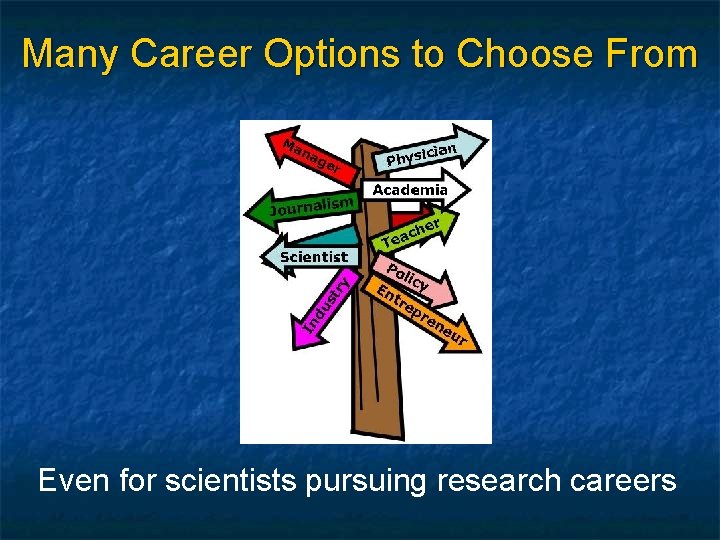
Many Career Options to Choose From Even for scientists pursuing research careers
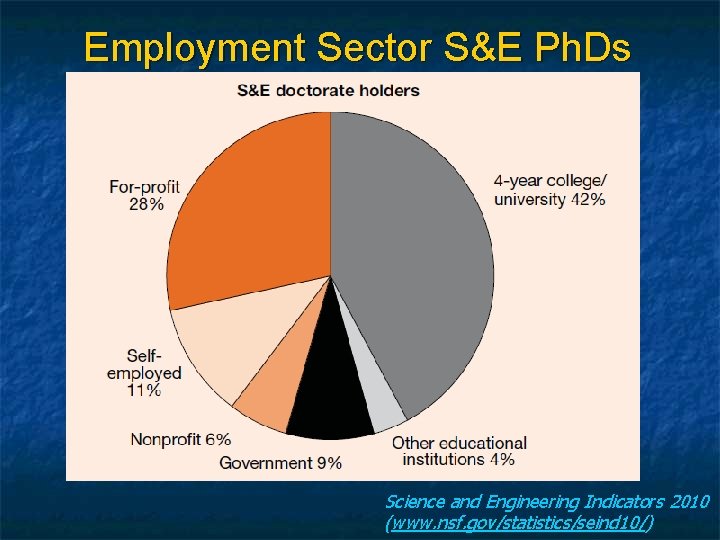
Employment Sector S&E Ph. Ds Science and Engineering Indicators 2010 (www. nsf. gov/statistics/seind 10/)
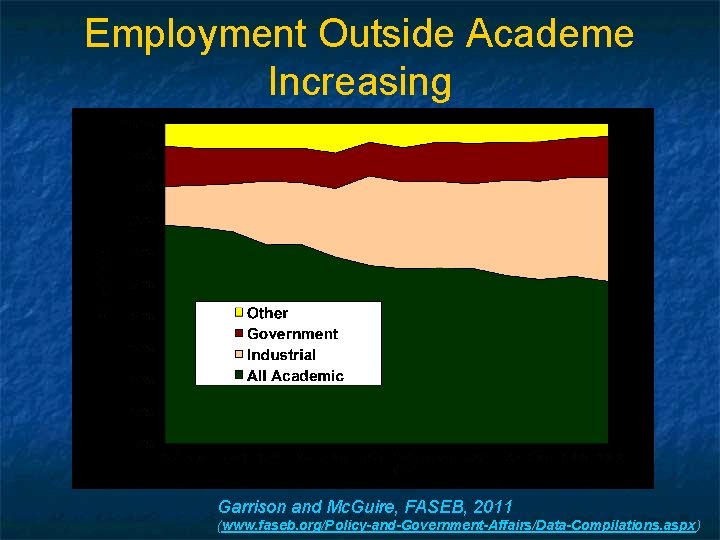
Employment Outside Academe Increasing Garrison and Mc. Guire, FASEB, 2011 (www. faseb. org/Policy-and-Government-Affairs/Data-Compilations. aspx)
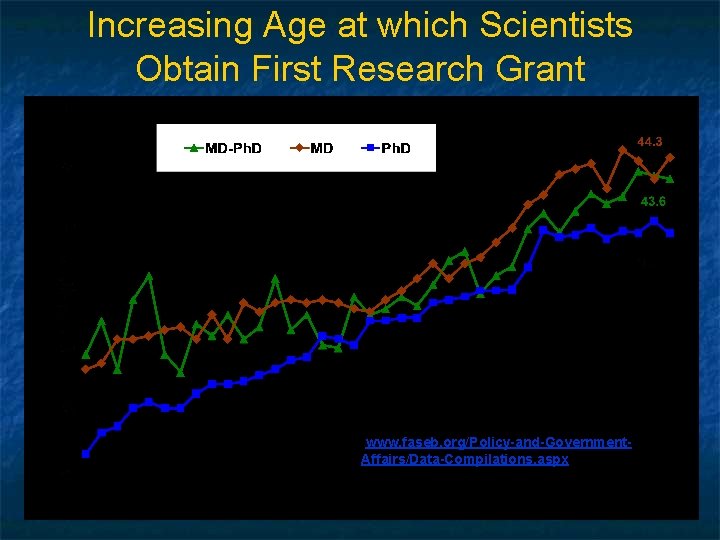
Increasing Age at which Scientists Obtain First Research Grant Garrison and Mc. Guire, FASEB, 2011 (www. faseb. org/Policy-and-Government. Affairs/Data-Compilations. aspx)
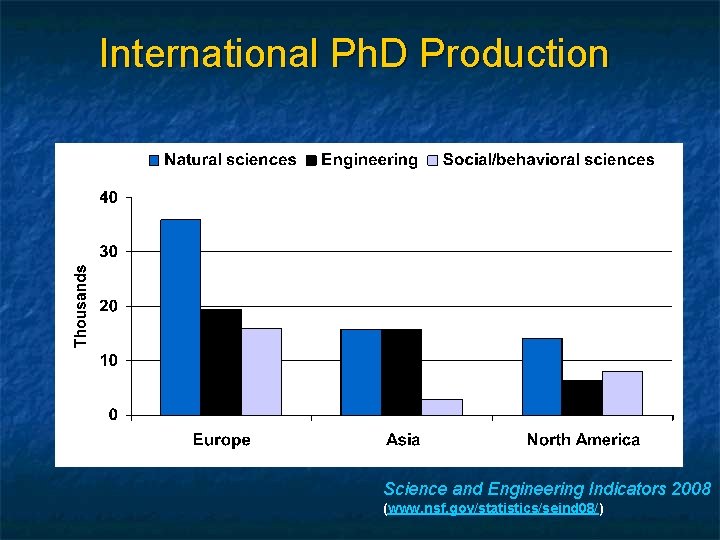
International Ph. D Production Science and Engineering Indicators 2008 (www. nsf. gov/statistics/seind 08/)
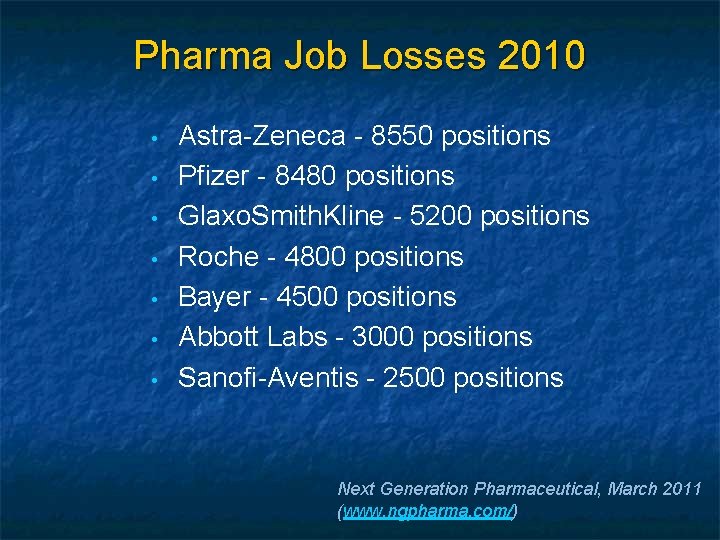
Pharma Job Losses 2010 • • Astra-Zeneca - 8550 positions Pfizer - 8480 positions Glaxo. Smith. Kline - 5200 positions Roche - 4800 positions Bayer - 4500 positions Abbott Labs - 3000 positions Sanofi-Aventis - 2500 positions Next Generation Pharmaceutical, March 2011 (www. ngpharma. com/)
Science is Evolving • Emerging tools and techniques • Increased emphasis on team and interdisciplinary science • Demand for new types of knowledge: management, regulatory issues, technology transfer…
Career Planning Can Help • Thinking about goals motivates people to pursue them • Developing specific plans helps people to reach their goals • Developing and implementing strategies to pursue career goals leads to: • • Higher salaries Promotions More responsibility Greater satisfaction
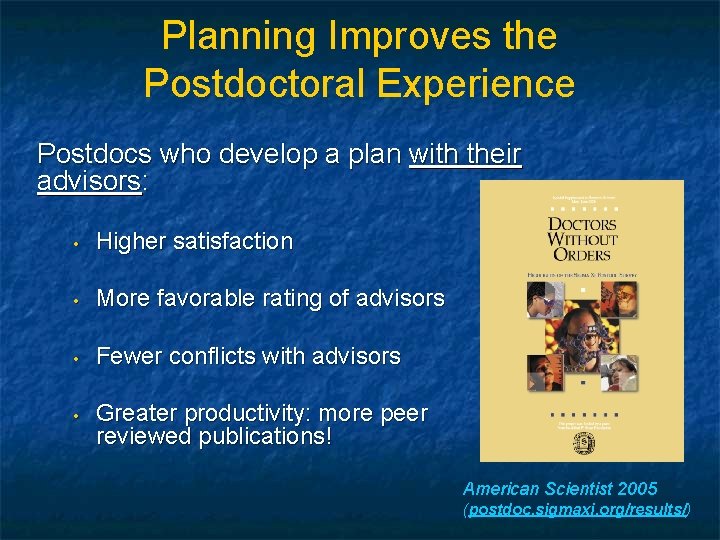
Planning Improves the Postdoctoral Experience Postdocs who develop a plan with their advisors: • Higher satisfaction • More favorable rating of advisors • Fewer conflicts with advisors • Greater productivity: more peer reviewed publications! American Scientist 2005 (postdoc. sigmaxi. org/results/)
Benefits of an Individual Development Plan FASEB survey shows that postdocs and mentors find the individual development plan (IDP) helpful for: • Enabling postdocs to assess their skills and abilities • Identifying skills and abilities postdocs need to succeed in their careers • Facilitating communication between postdocs and their mentors
What is an IDP? (www. faseb. org/) Individual: Unique training and career goals of each fellow Development: Improvement / maturation needed to achieve the individual’s goals Plan: Specific steps rather than a random walk (see file under “Resources” in upper right-hand corner of screen)
4 Steps of an IDP 1. Self-assessment 2. Career exploration 3. Write your IDP 4. Implement and evaluate
Step 1. Self-Assessment • Evaluate your skills, personal values, and interests. • Identify your strengths and areas that need improvement. • Get feedback from lab associates, friends, spouse, parents.
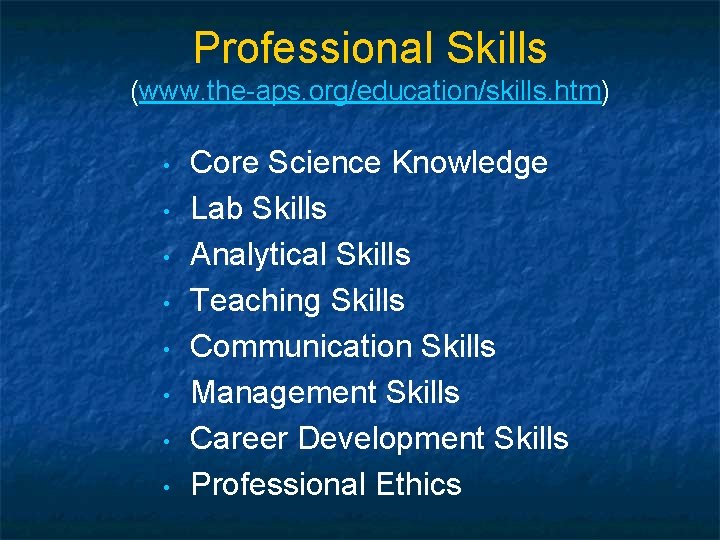
Professional Skills (www. the-aps. org/education/skills. htm) • • Core Science Knowledge Lab Skills Analytical Skills Teaching Skills Communication Skills Management Skills Career Development Skills Professional Ethics
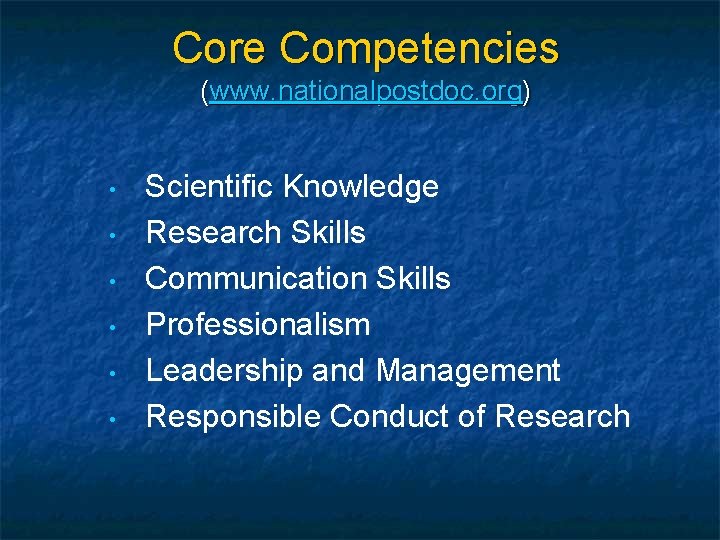
Core Competencies (www. nationalpostdoc. org) • • • Scientific Knowledge Research Skills Communication Skills Professionalism Leadership and Management Responsible Conduct of Research
Skills Assessment • Identify skills at which you are proficient and those that need work • Complete worksheet (see file under “Resources” in upper right-hand corner of the screen) • List 3 skills that you would like to work on improving
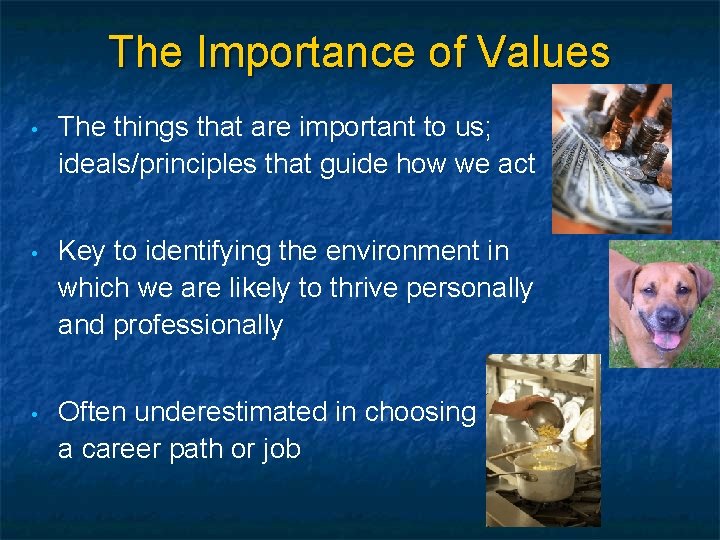
The Importance of Values • The things that are important to us; ideals/principles that guide how we act • Key to identifying the environment in which we are likely to thrive personally and professionally • Often underestimated in choosing a career path or job
Values Clarification • Complete worksheet (see file under “Resources” in upper right-hand corner of the screen) • List top 3 values • Tell partner one value
Interests Inventory • • • What do you enjoy doing? What keeps you up at night (in a good way)? Complete worksheet (see file under “Resources” in upper right-hand corner of the screen) • • List top 3 interests List 3 activities you would not like to do in the future
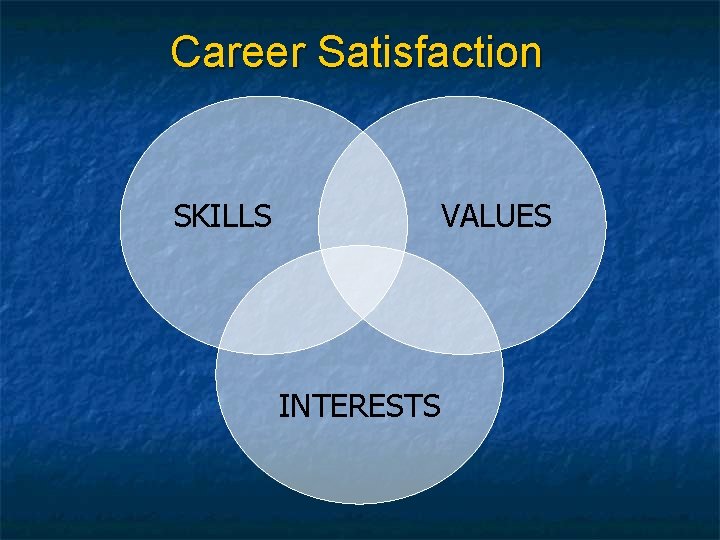
Career Satisfaction SKILLS VALUES INTERESTS
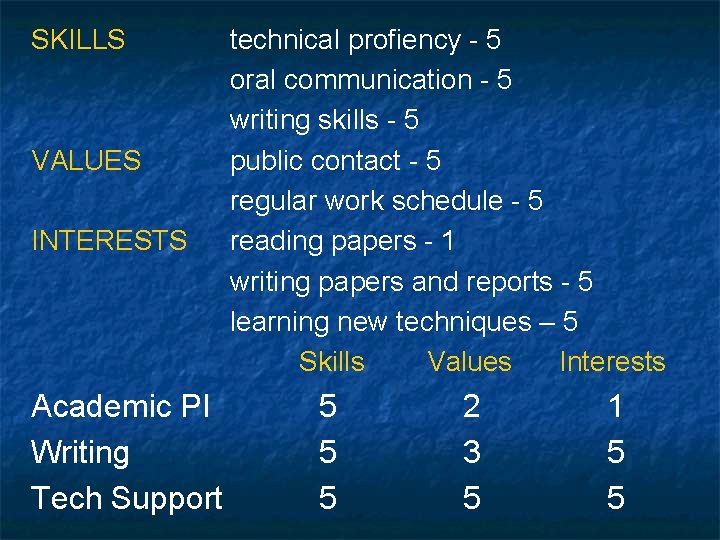
SKILLS VALUES INTERESTS Academic PI Writing Tech Support technical profiency - 5 oral communication - 5 writing skills - 5 public contact - 5 regular work schedule - 5 reading papers - 1 writing papers and reports - 5 learning new techniques – 5 Skills Values Interests 5 5 5 2 3 5 1 5 5
Step 2. Career Exploration • Identify realistic career opportunities • Determine what skills are needed for potential career choices • Compare with your skills
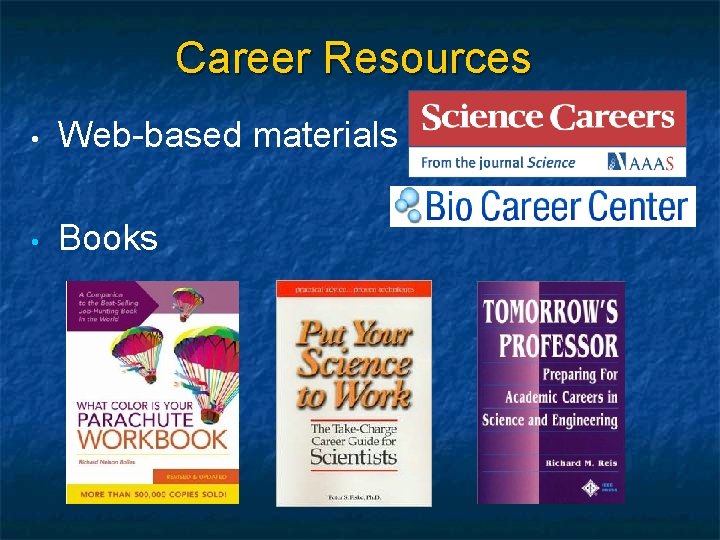
Career Resources • Web-based materials • Books
Career Resources • Professional society • Networking • Your institution • Informational interviewing • Mentors • FASEB Career Center
Strategic Networking • • • Not just Facebook Connecting to people with useful information Granovetter - Strength of Weak Ties (Am J Sociol, Vol. 78 (6): 1360 -1380, 1973) • Smaller, tighter networks less useful than lots of loose connections
Diagram of Social Networking n For a diagram of social networking, see Wikipedia (//en. wikipedia. org/wiki/Social_network)
Scientific Meetings: ideal networking opportunity! • • • Make it a goal to expand your network Read agenda and abstracts in advance Poster sessions are optimal Go to exhibits Attend special interest meetings
Informational Interview (see worksheet) • Get inside information on career choices. • Make appointment in advance. • Time is money! Be brief. • Have a list of specific questions. • Take notes. • Try to leave with an additional contact. Send thank you letter. •
Step 3. Write an IDP • Identify your career trajectory. • List specific skills and strengths that you need to develop. • Define the approaches and time frames to obtain the skills (e. g. , courses, technical skills, teaching, supervision). • Discuss draft IDP with mentor and revise.
Writing it down is important! “The discipline of writing something down is the first step toward making it happen. In conversation you can get away with all kinds of vagueness and nonsense, often without even realizing it. But there’s something about putting your thoughts on paper that forces you to get down to specifics. That way, it’s harder to deceive yourself or anybody else. ” Lee Iacocca
Setting SMART Goals • • • Specific Measurable Action-oriented Realistic Time-bound
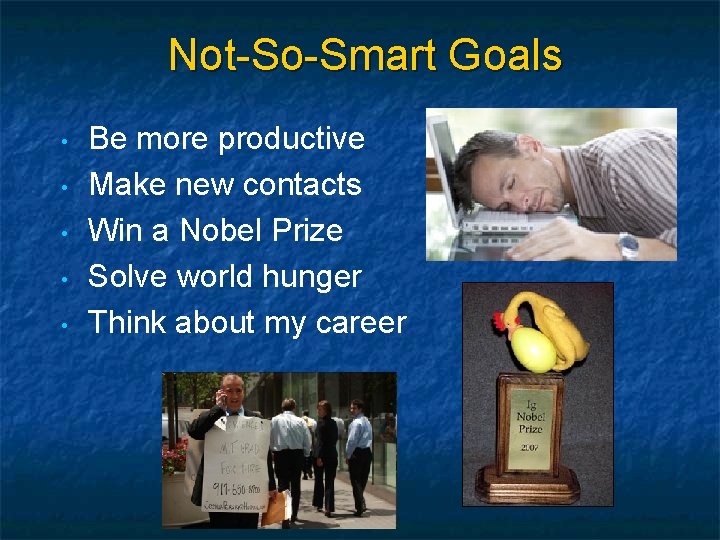
Not-So-Smart Goals • • • Be more productive Make new contacts Win a Nobel Prize Solve world hunger Think about my career
Setting Personal Goals • Refer back to your scientific skills assessment (see worksheet) • Set personal improvement goals in areas which need improvement • Specify the time when this will occur
Sharing Goals n Symposium participants sharing goals and comments about those goals meeting the SMART guidelines
Career Advancement n Set one goal for career advancement (see worksheet)
Career Preparation Goals (examples) • Visit a medical device company to learn about job opportunities in industry. • Spend weekend reading Peter Fiske’s book Put Your Science to Work • Talk to STEM faculty at a small regional college to learn about teaching careers.
Sharing Career Advancement Goals n Symposium participants sharing goals and comments about those goals meeting the SMART guidelines
Step 4. Implement Your Plan • Put your plan into action. • Revise the plan as necessary. • Review the plan and your progress with your mentor regularly. • Formal document helpful.
Step 4. Implement Your Plan • Put your plan into action. • Revise the plan as necessary. • Review the plan and your progress with your mentor regularly. • Formal document helpful. OBSTACLES?
Tips for Mentor Discussion • • • Make an appointment separate from other lab meetings An environment away from the lab will eliminate distractions Be positive - “I’ve really enjoyed my last year in the lab and I feel I’ve made progress on project X. . . ” Do not attempt to share entire IDP - prepare concise written outline for meeting Be prepared to negotiate!
Finish the Job It’s not complete until the paperwork is done.