
Indirect Taxes Lower 6 th Micro How Markets

- Slides: 11
Indirect Taxes Lower 6 th Micro How Markets Work
Intro to Indirect Taxes Mr O’Grady
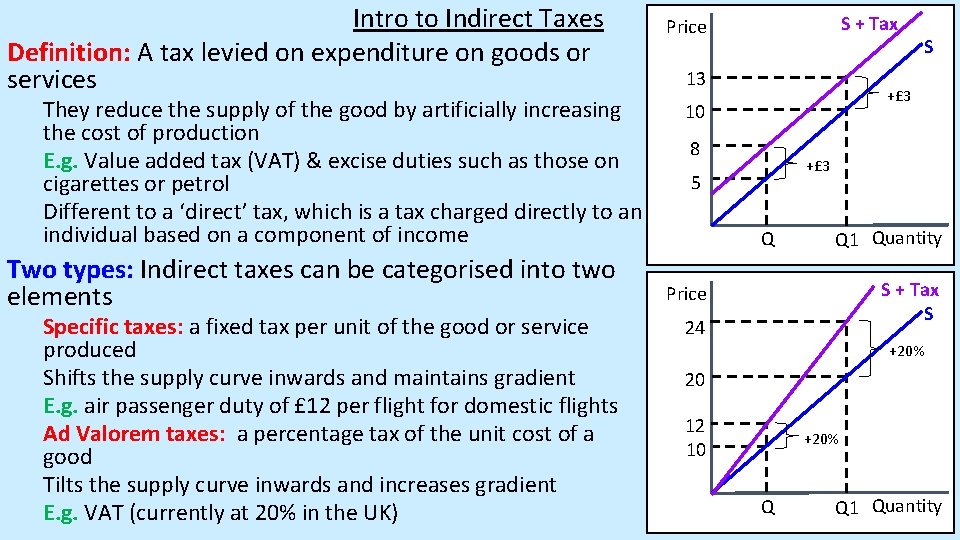
Intro to Indirect Taxes Definition: A tax levied on expenditure on goods or services They reduce the supply of the good by artificially increasing the cost of production E. g. Value added tax (VAT) & excise duties such as those on cigarettes or petrol Different to a ‘direct’ tax, which is a tax charged directly to an individual based on a component of income Two types: Indirect taxes can be categorised into two elements Specific taxes: a fixed tax per unit of the good or service produced Shifts the supply curve inwards and maintains gradient E. g. air passenger duty of £ 12 per flight for domestic flights Ad Valorem taxes: a percentage tax of the unit cost of a good Tilts the supply curve inwards and increases gradient E. g. VAT (currently at 20% in the UK) S + Tax Price 13 S +£ 3 10 8 +£ 3 5 Q Q 1 Quantity S + Tax S Price 24 +20% 20 12 10 +20% Q Q 1 Quantity
Reasons for Indirect Taxes Mr O’Grady
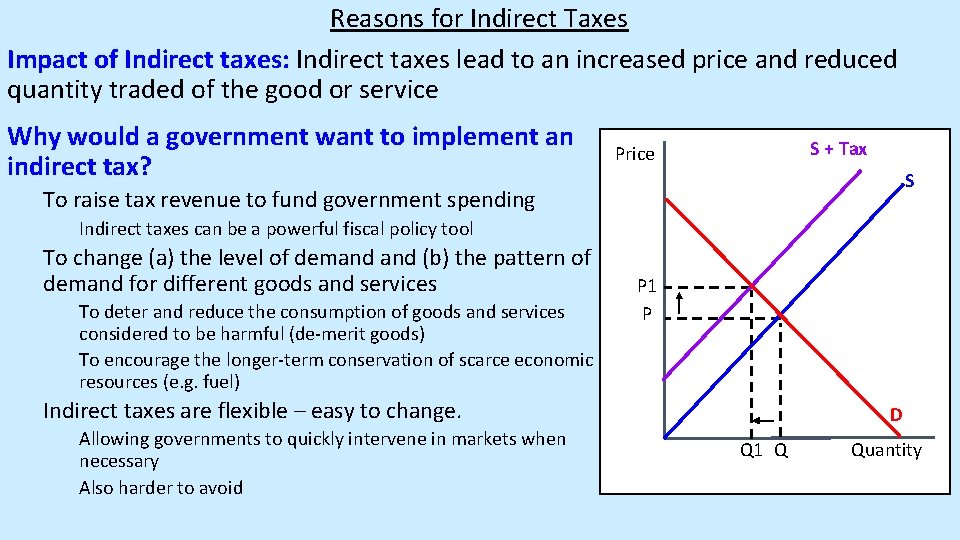
Reasons for Indirect Taxes Impact of Indirect taxes: Indirect taxes lead to an increased price and reduced quantity traded of the good or service Why would a government want to implement an indirect tax? S + Tax Price S To raise tax revenue to fund government spending Indirect taxes can be a powerful fiscal policy tool To change (a) the level of demand (b) the pattern of demand for different goods and services To deter and reduce the consumption of goods and services considered to be harmful (de-merit goods) To encourage the longer-term conservation of scarce economic resources (e. g. fuel) P 1 P Indirect taxes are flexible – easy to change. Allowing governments to quickly intervene in markets when necessary Also harder to avoid D Q 1 Q Quantity
The Incidence of a Tax: Who pays it? Indirect Taxes Mr O’Grady
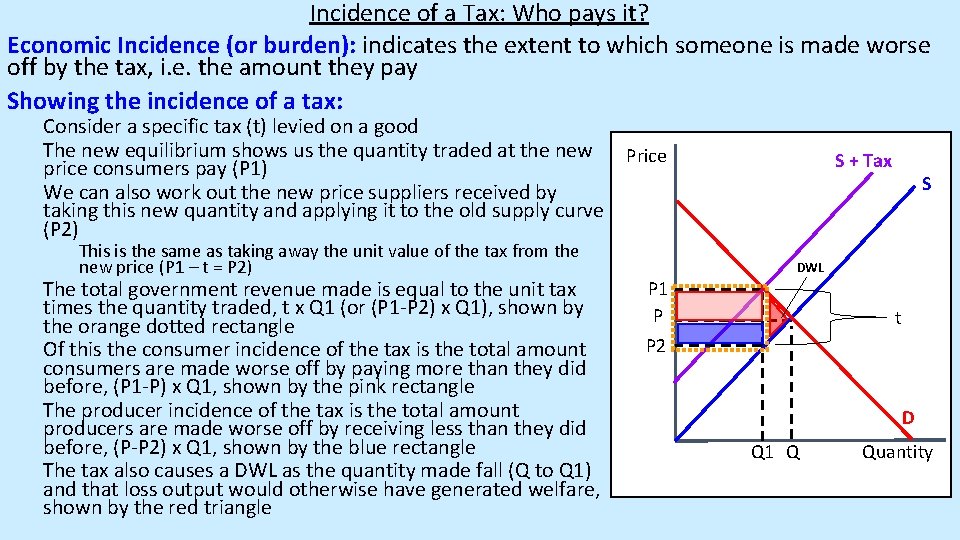
Incidence of a Tax: Who pays it? Economic Incidence (or burden): indicates the extent to which someone is made worse off by the tax, i. e. the amount they pay Showing the incidence of a tax: Consider a specific tax (t) levied on a good The new equilibrium shows us the quantity traded at the new Price price consumers pay (P 1) We can also work out the new price suppliers received by taking this new quantity and applying it to the old supply curve (P 2) This is the same as taking away the unit value of the tax from the new price (P 1 – t = P 2) The total government revenue made is equal to the unit tax times the quantity traded, t x Q 1 (or (P 1 -P 2) x Q 1), shown by the orange dotted rectangle Of this the consumer incidence of the tax is the total amount consumers are made worse off by paying more than they did before, (P 1 -P) x Q 1, shown by the pink rectangle The producer incidence of the tax is the total amount producers are made worse off by receiving less than they did before, (P-P 2) x Q 1, shown by the blue rectangle The tax also causes a DWL as the quantity made fall (Q to Q 1) and that loss output would otherwise have generated welfare, shown by the red triangle P 1 P P 2 S + Tax S DWL t D Q 1 Q Quantity
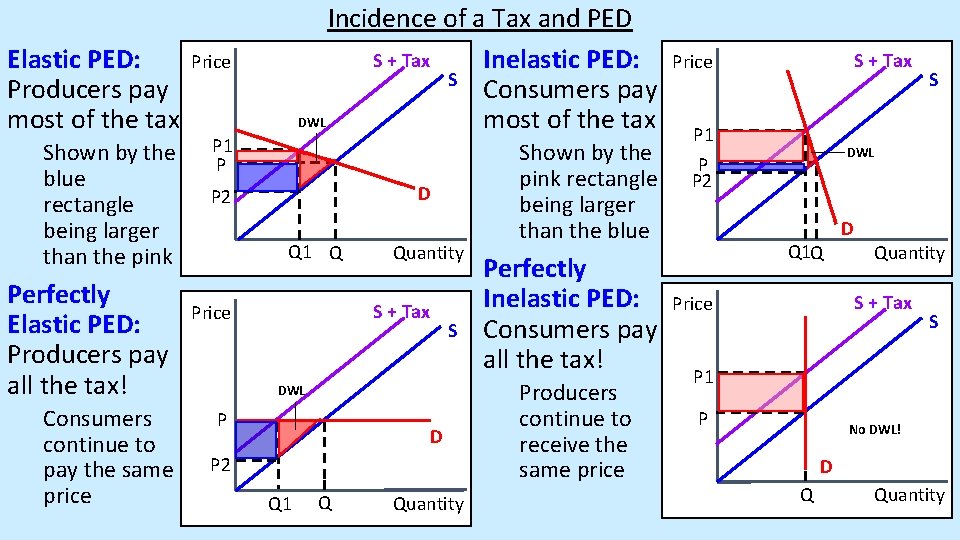
Elastic PED: Producers pay most of the tax Shown by the blue rectangle being larger than the pink Perfectly Elastic PED: Producers pay all the tax! Consumers continue to pay the same price Incidence of a Tax and PED S + Tax Inelastic PED: S Consumers pay DWL most of the tax Price P 1 P D P 2 Q 1 Q Quantity S + Tax Price S DWL P D P 2 Q 1 Q Quantity Shown by the pink rectangle being larger than the blue Perfectly Inelastic PED: Consumers pay all the tax! Producers continue to receive the same price S + Tax Price P 1 P P 2 S DWL Q 1 Q D Quantity S + Tax Price S P 1 P No DWL! D Q Quantity
Limitations of Indirect Taxes Mr O’Grady
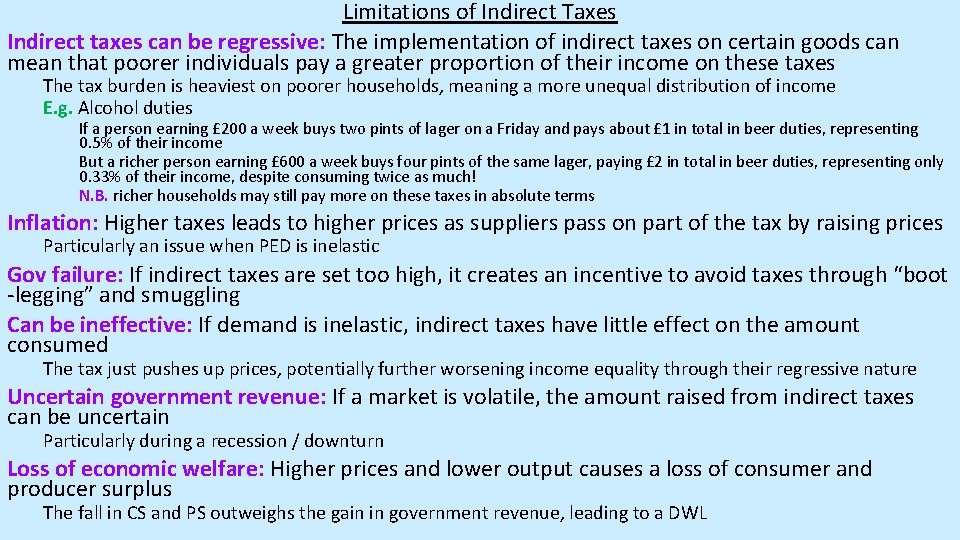
Limitations of Indirect Taxes Indirect taxes can be regressive: The implementation of indirect taxes on certain goods can mean that poorer individuals pay a greater proportion of their income on these taxes The tax burden is heaviest on poorer households, meaning a more unequal distribution of income E. g. Alcohol duties If a person earning £ 200 a week buys two pints of lager on a Friday and pays about £ 1 in total in beer duties, representing 0. 5% of their income But a richer person earning £ 600 a week buys four pints of the same lager, paying £ 2 in total in beer duties, representing only 0. 33% of their income, despite consuming twice as much! N. B. richer households may still pay more on these taxes in absolute terms Inflation: Higher taxes leads to higher prices as suppliers pass on part of the tax by raising prices Particularly an issue when PED is inelastic Gov failure: If indirect taxes are set too high, it creates an incentive to avoid taxes through “boot -legging” and smuggling Can be ineffective: If demand is inelastic, indirect taxes have little effect on the amount consumed The tax just pushes up prices, potentially further worsening income equality through their regressive nature Uncertain government revenue: If a market is volatile, the amount raised from indirect taxes can be uncertain Particularly during a recession / downturn Loss of economic welfare: Higher prices and lower output causes a loss of consumer and producer surplus The fall in CS and PS outweighs the gain in government revenue, leading to a DWL
Where next? Don’t forget to SUBSCRIBE! Visit our website: www. smootheconomics. co. uk Find more resources, extension materials, details of courses, competitions, and more! Follow our socials: Instagram: @smootheconomics Twitter: @Smooth. Economics Facebook: @Smooth. Economics