
Indirect Statement Or How to Confuse and Befuddle
Indirect Statement Or How to Confuse and Befuddle Latin Students
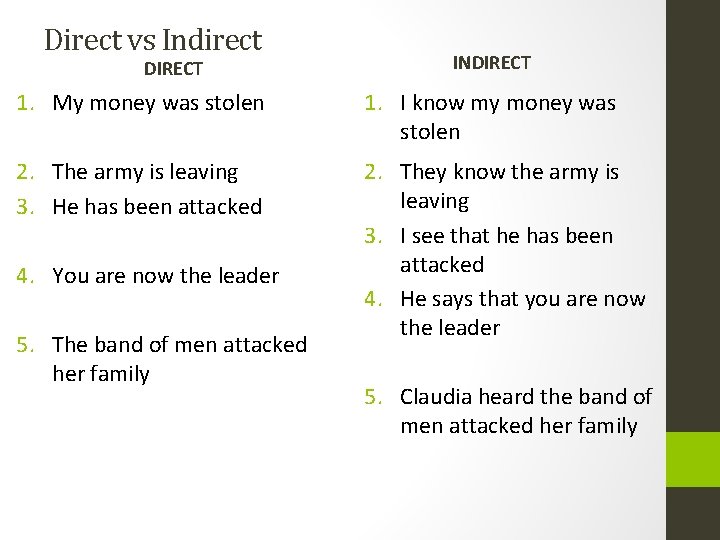
Direct vs Indirect DIRECT INDIRECT 1. My money was stolen 1. I know my money was stolen 2. The army is leaving 3. He has been attacked 2. They know the army is leaving 3. I see that he has been attacked 4. He says that you are now the leader 4. You are now the leader 5. The band of men attacked her family 5. Claudia heard the band of men attacked her family
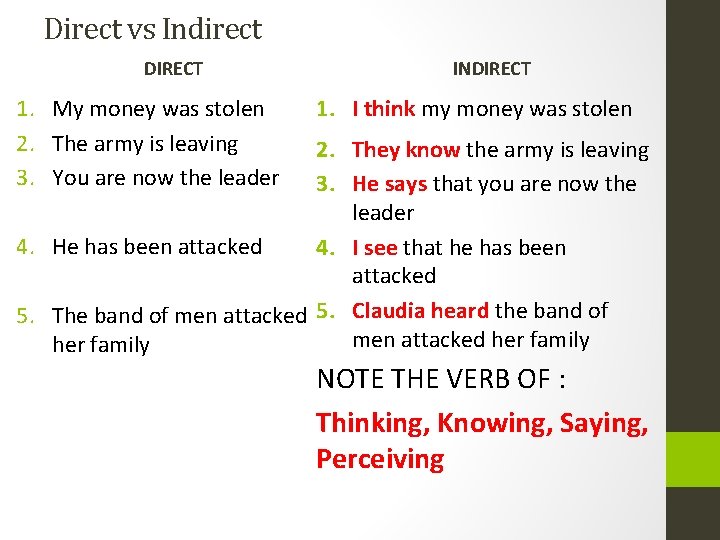
Direct vs Indirect DIRECT 1. My money was stolen 2. The army is leaving 3. You are now the leader INDIRECT 1. I think my money was stolen 2. They know the army is leaving 3. He says that you are now the leader 4. He has been attacked 4. I see that he has been attacked 5. The band of men attacked 5. Claudia heard the band of men attacked her family NOTE THE VERB OF : Thinking, Knowing, Saying, Perceiving
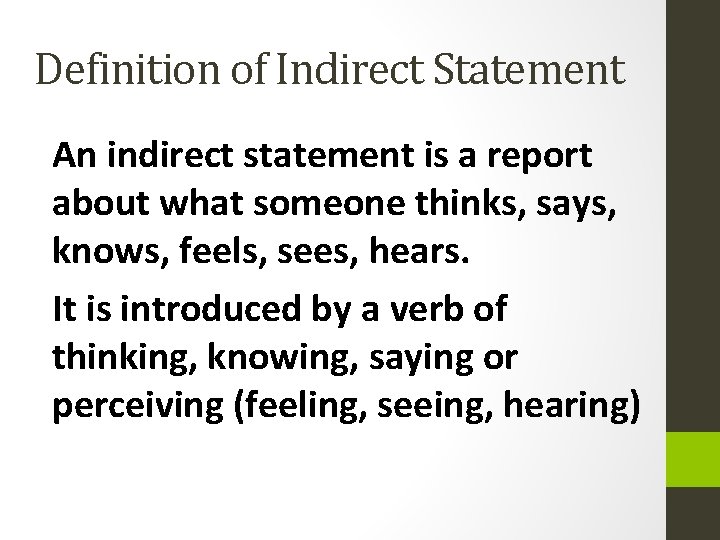
Definition of Indirect Statement An indirect statement is a report about what someone thinks, says, knows, feels, sees, hears. It is introduced by a verb of thinking, knowing, saying or perceiving (feeling, seeing, hearing)
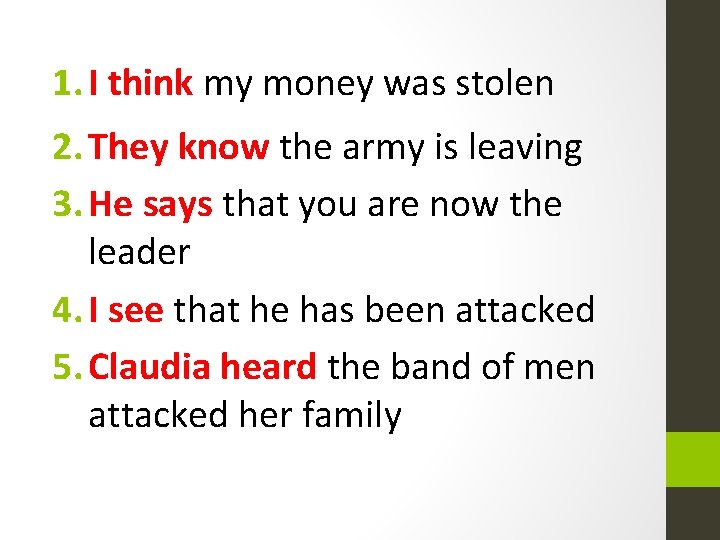
1. I think my money was stolen 2. They know the army is leaving 3. He says that you are now the leader 4. I see that he has been attacked 5. Claudia heard the band of men attacked her family
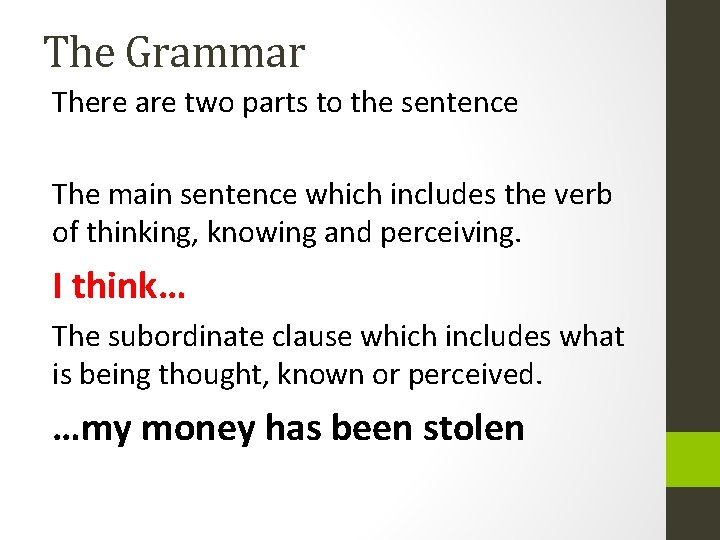
The Grammar There are two parts to the sentence The main sentence which includes the verb of thinking, knowing and perceiving. I think… The subordinate clause which includes what is being thought, known or perceived. …my money has been stolen
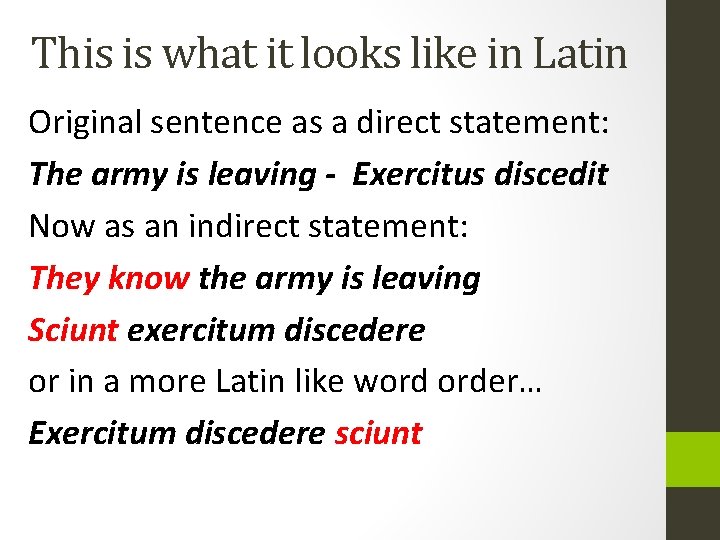
This is what it looks like in Latin Original sentence as a direct statement: The army is leaving - Exercitus discedit Now as an indirect statement: They know the army is leaving Sciunt exercitum discedere or in a more Latin like word order… Exercitum discedere sciunt
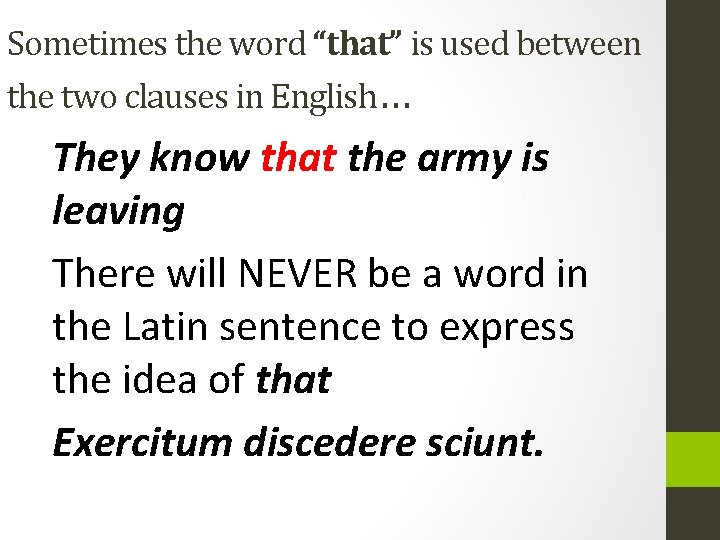
Sometimes the word “that” is used between the two clauses in English… They know that the army is leaving There will NEVER be a word in the Latin sentence to express the idea of that Exercitum discedere sciunt.
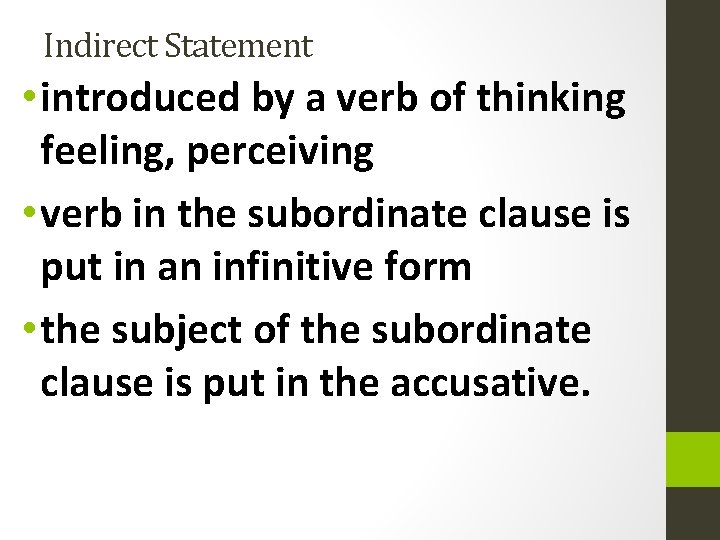
Indirect Statement • introduced by a verb of thinking feeling, perceiving • verb in the subordinate clause is put in an infinitive form • the subject of the subordinate clause is put in the accusative.
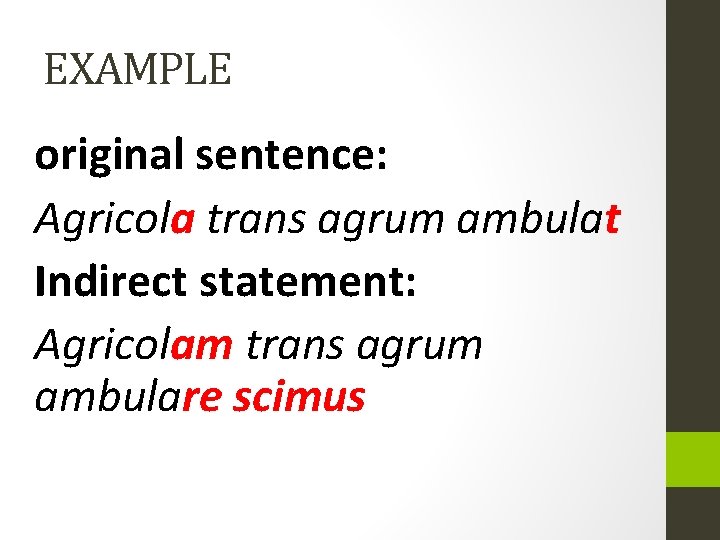
EXAMPLE original sentence: Agricola trans agrum ambulat Indirect statement: Agricolam trans agrum ambulare scimus
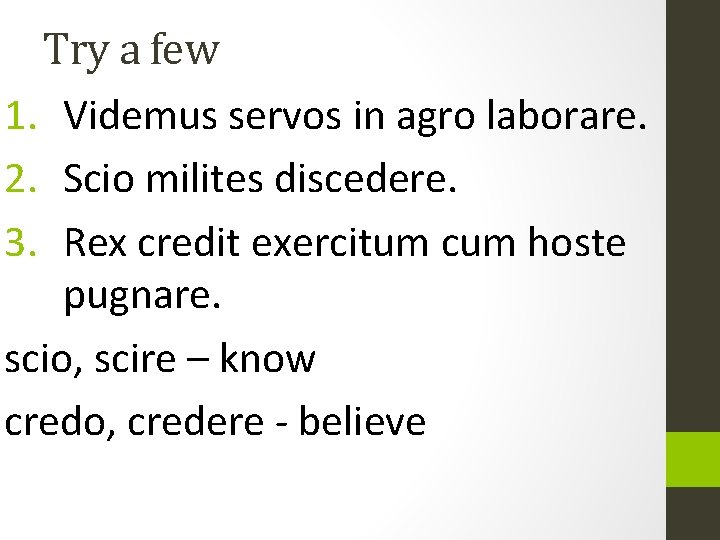
Try a few 1. Videmus servos in agro laborare. 2. Scio milites discedere. 3. Rex credit exercitum cum hoste pugnare. scio, scire – know credo, credere - believe
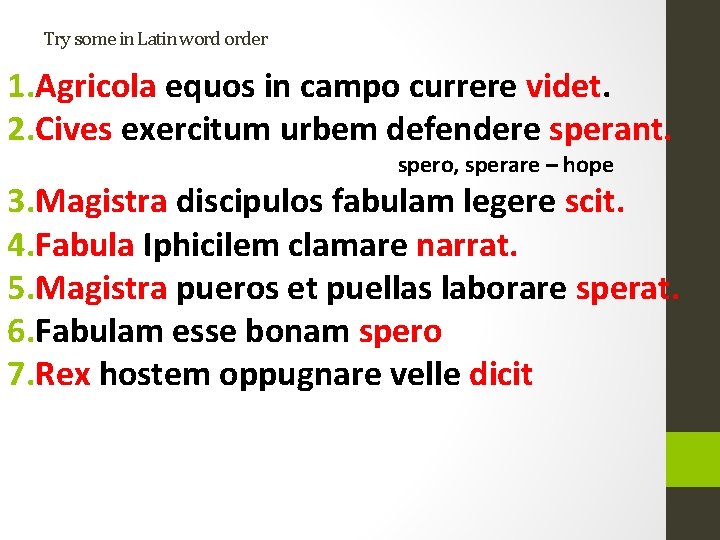
Try some in Latin word order 1. Agricola equos in campo currere videt. 2. Cives exercitum urbem defendere sperant. spero, sperare – hope 3. Magistra discipulos fabulam legere scit. 4. Fabula Iphicilem clamare narrat. 5. Magistra pueros et puellas laborare sperat. 6. Fabulam esse bonam spero 7. Rex hostem oppugnare velle dicit
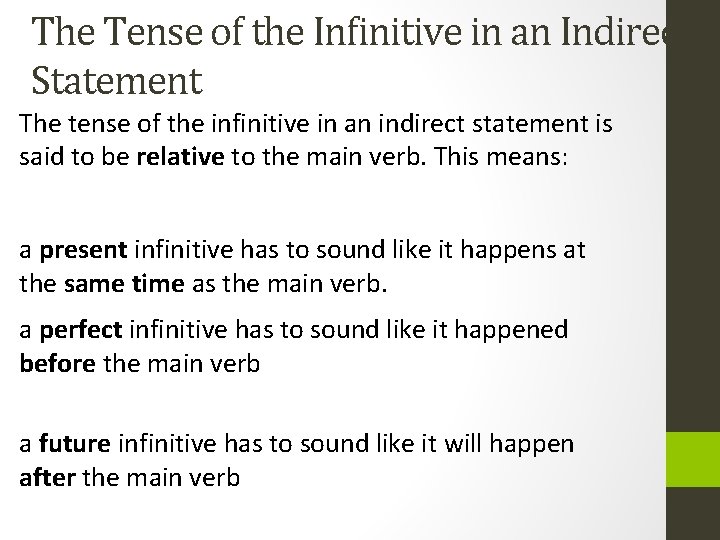
The Tense of the Infinitive in an Indirect Statement The tense of the infinitive in an indirect statement is said to be relative to the main verb. This means: a present infinitive has to sound like it happens at the same time as the main verb. a perfect infinitive has to sound like it happened before the main verb a future infinitive has to sound like it will happen after the main verb
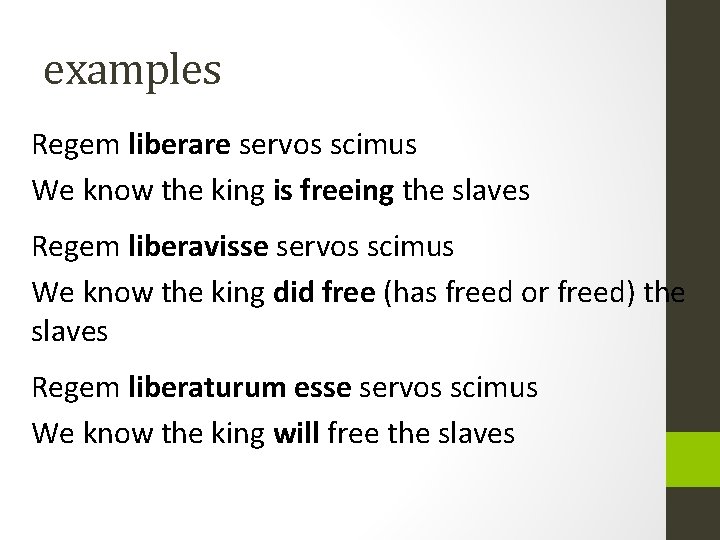
examples Regem liberare servos scimus We know the king is freeing the slaves Regem liberavisse servos scimus We know the king did free (has freed or freed) the slaves Regem liberaturum esse servos scimus We know the king will free the slaves
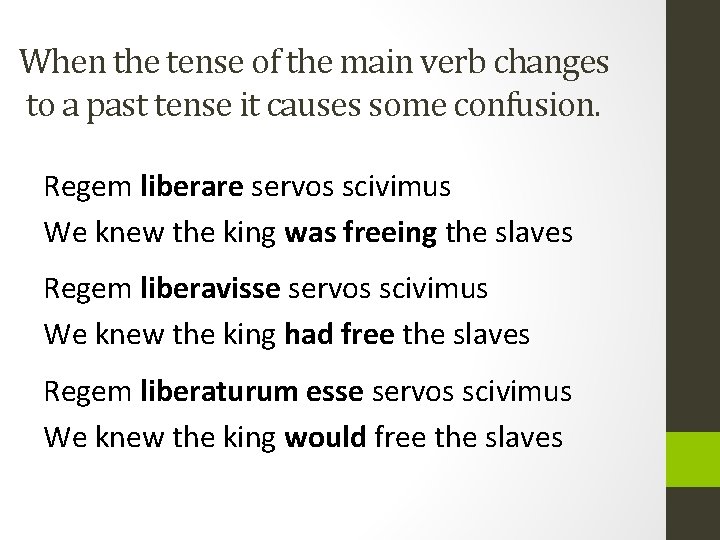
When the tense of the main verb changes to a past tense it causes some confusion. Regem liberare servos scivimus We knew the king was freeing the slaves Regem liberavisse servos scivimus We knew the king had free the slaves Regem liberaturum esse servos scivimus We knew the king would free the slaves
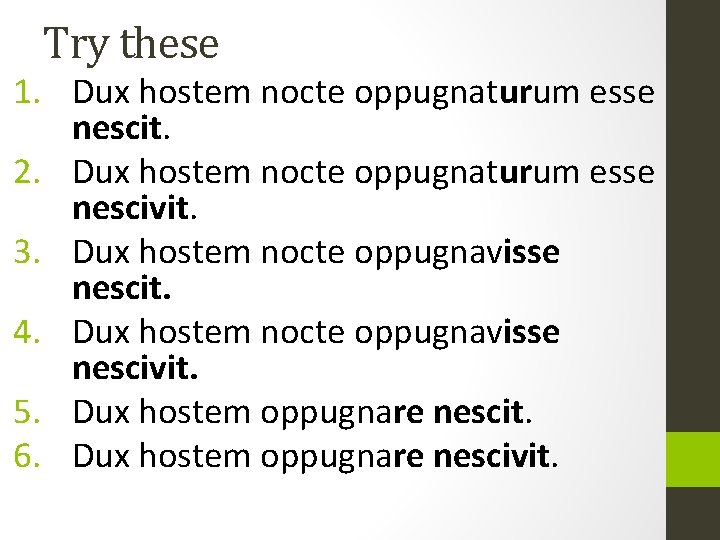
Try these 1. Dux hostem nocte oppugnaturum esse nescit. 2. Dux hostem nocte oppugnaturum esse nescivit. 3. Dux hostem nocte oppugnavisse nescit. 4. Dux hostem nocte oppugnavisse nescivit. 5. Dux hostem oppugnare nescit. 6. Dux hostem oppugnare nescivit.
- Slides: 16