
INDIRECT OBJECT PRONOUNS TELL TO WHOM THE MARKET
INDIRECT OBJECT PRONOUNS TELL “TO WHOM” THE MARKET GIFT IS GIVEN
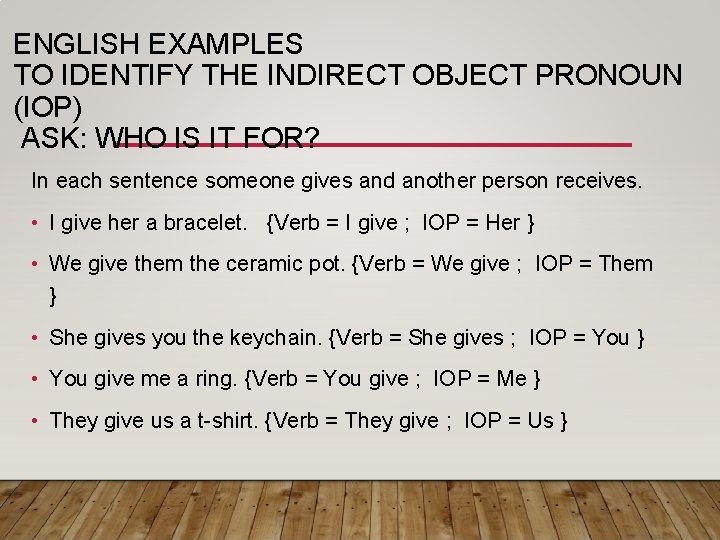
ENGLISH EXAMPLES TO IDENTIFY THE INDIRECT OBJECT PRONOUN (IOP) ASK: WHO IS IT FOR? In each sentence someone gives and another person receives. • I give her a bracelet. {Verb = I give ; IOP = Her } • We give them the ceramic pot. {Verb = We give ; IOP = Them } • She gives you the keychain. {Verb = She gives ; IOP = You } • You give me a ring. {Verb = You give ; IOP = Me } • They give us a t-shirt. {Verb = They give ; IOP = Us }
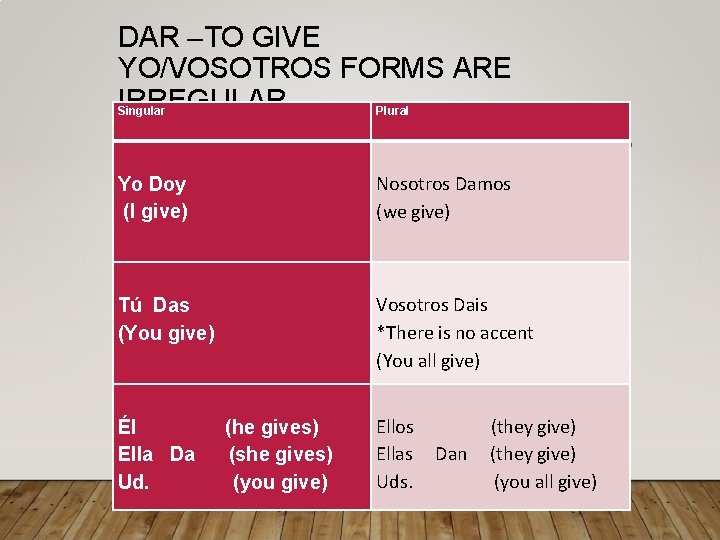
DAR –TO GIVE YO/VOSOTROS FORMS ARE IRREGULAR Singular Plural Yo Doy (I give) Nosotros Damos (we give) Tú Das (You give) Vosotros Dais *There is no accent (You all give) Él Ella Da Ud. (he gives) (she gives) (you give) Ellos Ellas Uds. Dan (they give) (you all give)
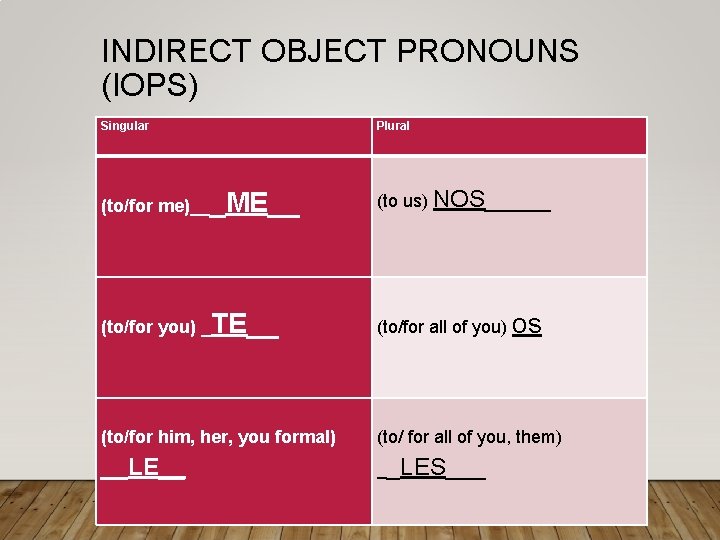
INDIRECT OBJECT PRONOUNS (IOPS) Singular Plural (to/for me)___ME__ (to us) NOS_____ (to/for you) _TE__ (to/for all of you) os (to/for him, her, you formal) (to/ for all of you, them) __LE__ __LES___

SPANISH EXAMPLES TO IDENTIFY THE INDIRECT OBJECT PRONOUN (IOP) ASK: WHO IS IT FOR? • I give her a bracelet. {Verb = I give ; IOP = Her } • Yo le doy una pulsera. <Or> Yo le doy a ella una pulsera. • We give them the ceramic pot. {Verb = We give ; IOP = Them } • Nosotros les damos la olla de cerámica. <Or> Nosotros les damos a ellos la olla de cerámica. • She gives you the keychain. {Verb = She gives ; IOP = You } • Ella te da el llavero. <Or> Ella te da a ti el llavero. • You give me a ring. {Verb = You give ; IOP = Me } • Tú me das un anillo. <Or> Tú me das a mí un anillo. • They give us a t-shirt. {Verb = They give ; IOP = Us } • Ellos nos dan una camiseta. <Or> Ellos nos dan a nosotros una camiseta.
• To accompany the indirect object: 1. Rosa le compra una pulsera a su madre. = Rosa buys a bracelet FOR HER MOTHER. The bracelet is “for her” so we use the “for her” IOP of “le” in the sentence.
• To replace the indirect object: Rosa le compra una pulsera = Rosa buys her a bracelet. (Rosa isn’t buying her, she’s buying a bracelet FOR her. So you have to use the IOP = le. )
• Sometimes the “le” can refer to different objects, so to clarify you can put “a+ name/noun/pronoun. ” • To emphasize, use a pronoun = A mí, me compro unos aretes = I’m buying myself some earrings. • Remember gusta? Te gusta bailar, a mí me gusta cantar = You like to dance, but I like to sing!
• Write the IOP you would use for the following people: 1. Mi hermano _____ 2. Sus amigos_____ 3. Tu perro_____ • Mis padres_____ • Tú/A ti_____ • Yo /A mí_____ • Los niños_____ • Las chicas_____ • Mis amigos y yo ______ • Nosotros _____
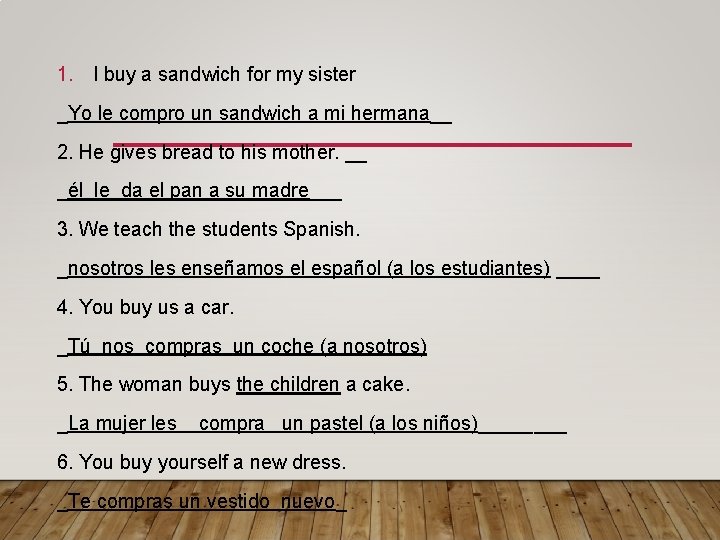
1. I buy a sandwich for my sister _Yo le compro un sandwich a mi hermana__ 2. He gives bread to his mother. __ _él le da el pan a su madre___ 3. We teach the students Spanish. _nosotros les enseñamos el español (a los estudiantes) ____ 4. You buy us a car. _Tú nos compras un coche (a nosotros) 5. The woman buys the children a cake. _La mujer les compra un pastel (a los niños)____ 6. You buy yourself a new dress. _Te compras un vestido nuevo_
- Slides: 10