
Indirect Direct object pronouns together Chapter 3 Lets
Indirect & Direct object pronouns together Chapter 3
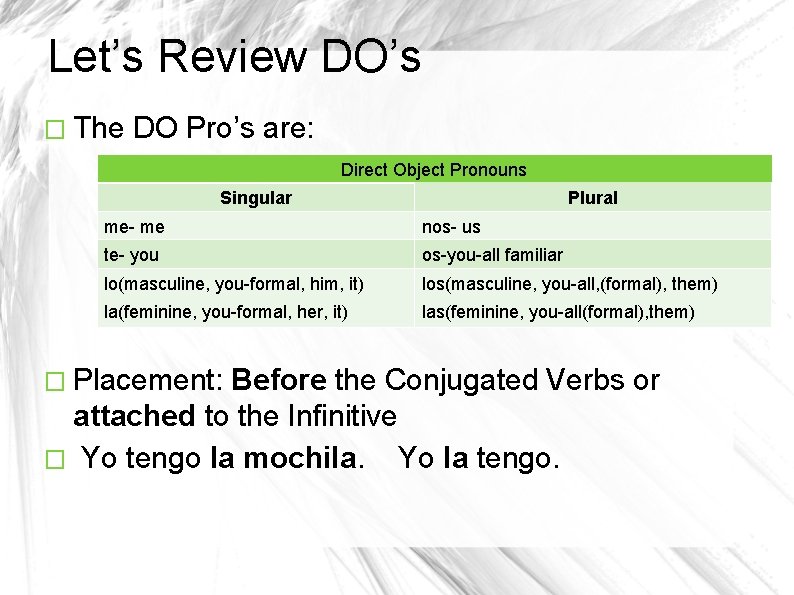
Let’s Review DO’s � The DO Pro’s are: Direct Object Pronouns Singular Plural me- me nos- us te- you os-you-all familiar lo(masculine, you-formal, him, it) los(masculine, you-all, (formal), them) la(feminine, you-formal, her, it) las(feminine, you-all(formal), them) � Placement: Before the Conjugated Verbs or attached to the Infinitive � Yo tengo la mochila. Yo la tengo.
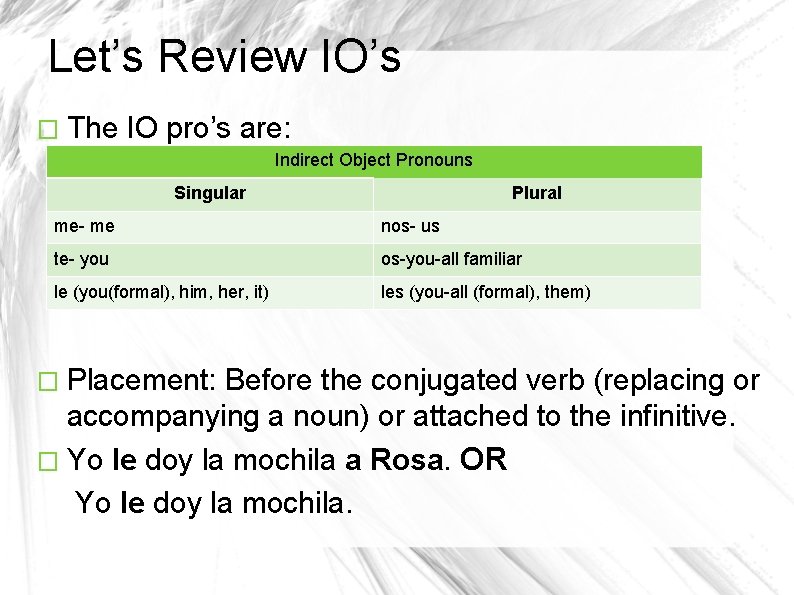
Let’s Review IO’s � The IO pro’s are: Indirect Object Pronouns Singular Plural me- me nos- us te- you os-you-all familiar le (you(formal), him, her, it) les (you-all (formal), them) � Placement: Before the conjugated verb (replacing or accompanying a noun) or attached to the infinitive. � Yo le doy la mochila a Rosa. OR Yo le doy la mochila.
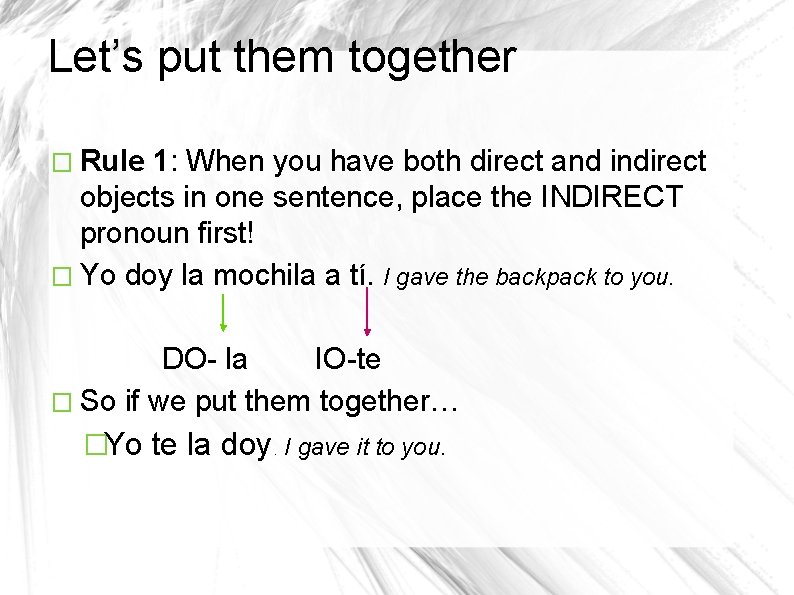
Let’s put them together � Rule 1: When you have both direct and indirect objects in one sentence, place the INDIRECT pronoun first! � Yo doy la mochila a tí. I gave the backpack to you. DO- la IO-te � So if we put them together… �Yo te la doy. I gave it to you.
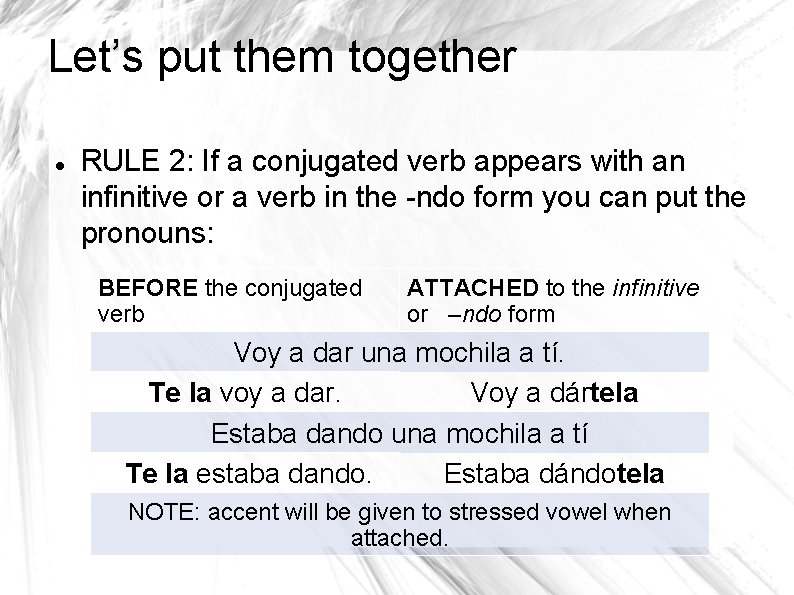
Let’s put them together RULE 2: If a conjugated verb appears with an infinitive or a verb in the -ndo form you can put the pronouns: BEFORE the conjugated verb ATTACHED to the infinitive or –ndo form Voy a dar una mochila a tí. Te la voy a dar. Voy a dártela Estaba dando una mochila a tí Te la estaba dando. Estaba dándotela NOTE: accent will be given to stressed vowel when attached.
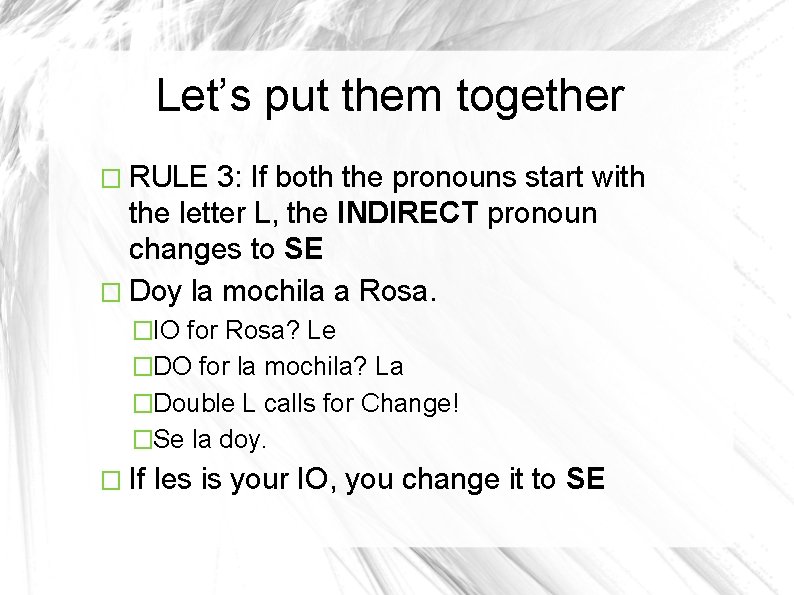
Let’s put them together � RULE 3: If both the pronouns start with the letter L, the INDIRECT pronoun changes to SE � Doy la mochila a Rosa. �IO for Rosa? Le �DO for la mochila? La �Double L calls for Change! �Se la doy. � If les is your IO, you change it to SE
- Slides: 6