
Indirect Dark Matter Search with AMS02 Stefano Di
- Slides: 50
Indirect Dark Matter Search with AMS-02 Stefano Di Falco INFN & Universita’ di Pisa for the AMS collaboration
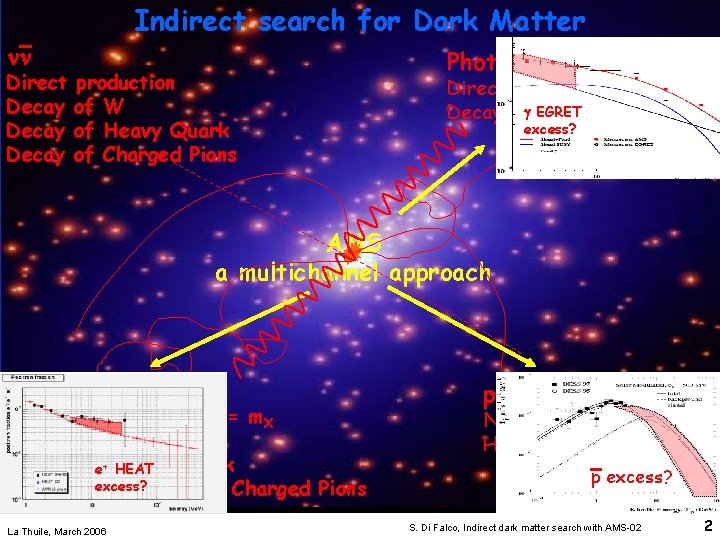
Indirect search for Dark Matter nn Direct Decay production of W of Heavy Quark of Charged Pions Photons Direct Production : E = m. X EGRET Decay ofg Neutral Pions excess? AMS a multichannel approach e+ e- Direct Decay production: Ee = m. X of W, ofe+Heavy Quark HEAT ofexcess? Leptons and Charged Pions La Thuile, March 2006 pp, (dd) No direct production Hadronization : Eh << m. X p excess? S. Di Falco, Indirect dark matter search with AMS-02 2
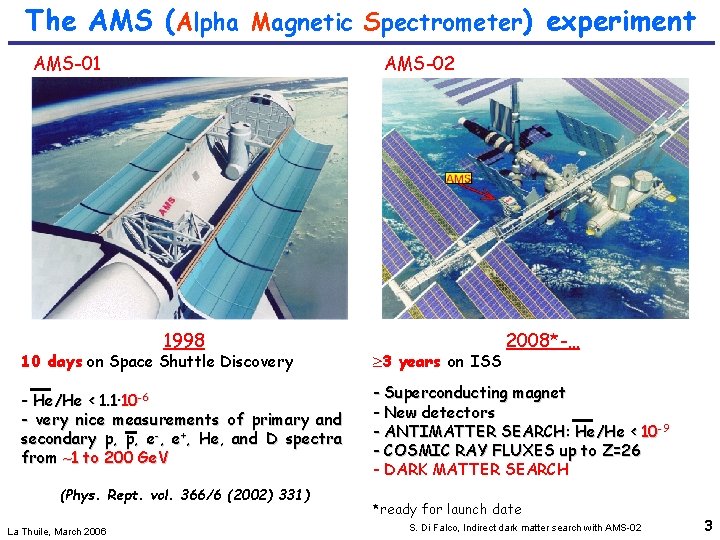
The AMS (Alpha Magnetic Spectrometer) experiment AMS-01 AMS-02 1998 2008*-… 10 days on Space Shuttle Discovery ³ 3 years on ISS - He/He < 1. 1· 10 -6 - very nice measurements of primary and secondary p, p, e-, e+, He, and D spectra from ~1 to 200 Ge. V - Superconducting magnet - New detectors - ANTIMATTER SEARCH: He/He < 10 -9 - COSMIC RAY FLUXES up to Z=26 - DARK MATTER SEARCH (Phys. Rept. vol. 366/6 (2002) 331) La Thuile, March 2006 *ready for launch date S. Di Falco, Indirect dark matter search with AMS-02 3
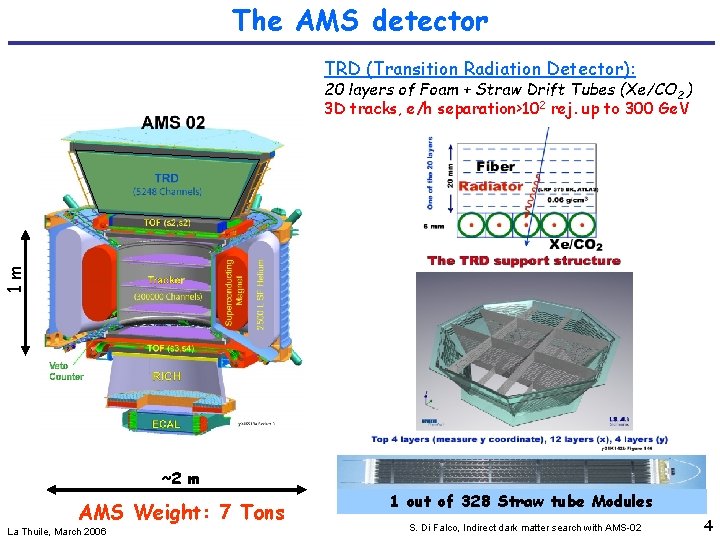
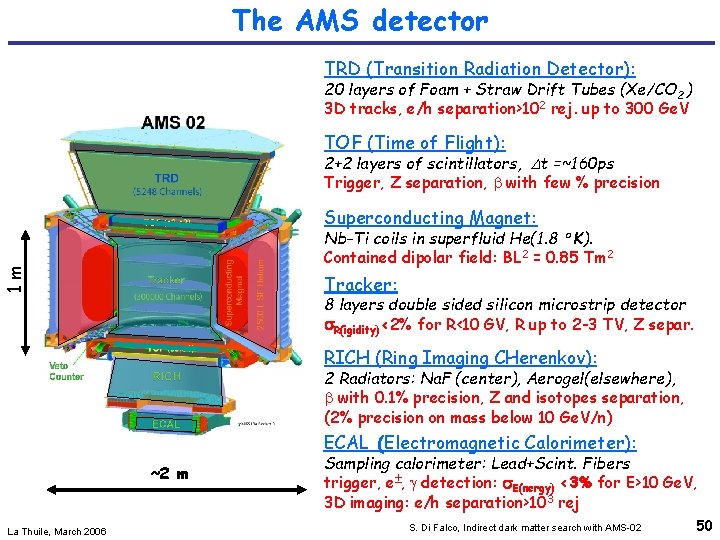
The AMS detector TRD (Transition Radiation Detector): 1 m 20 layers of Foam + Straw Drift Tubes (Xe/CO 2 ) 3 D tracks, e/h separation>102 rej. up to 300 Ge. V ~2 m AMS Weight: 7 Tons La Thuile, March 2006 1 out of 328 Straw tube Modules S. Di Falco, Indirect dark matter search with AMS-02 4
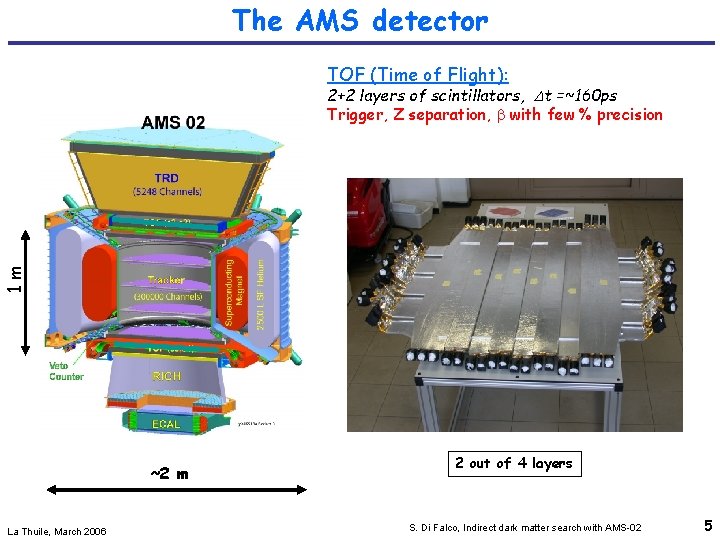
The AMS detector TOF (Time of Flight): 1 m 2+2 layers of scintillators, Dt =~160 ps Trigger, Z separation, with few % precision ~2 m La Thuile, March 2006 2 out of 4 layers S. Di Falco, Indirect dark matter search with AMS-02 5
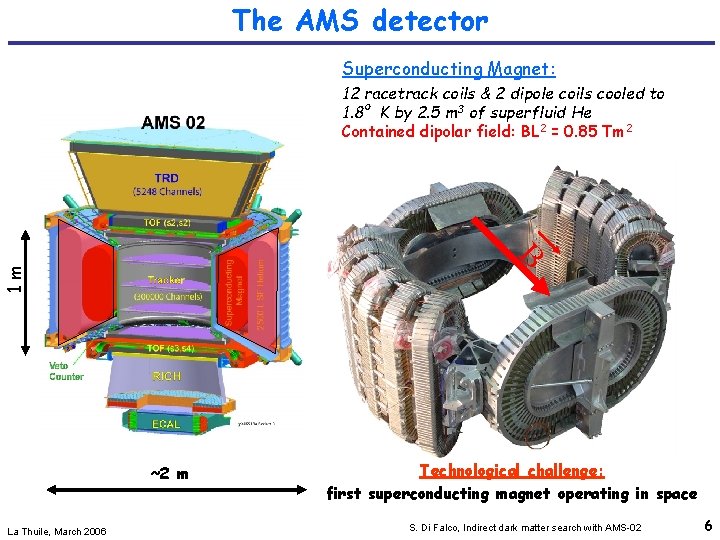
The AMS detector Superconducting Magnet: 12 racetrack coils & 2 dipole coils cooled to 1. 8° K by 2. 5 m 3 of superfluid He Contained dipolar field: BL 2 = 0. 85 Tm 2 1 m B ~2 m La Thuile, March 2006 Technological challenge: first superconducting magnet operating in space S. Di Falco, Indirect dark matter search with AMS-02 6
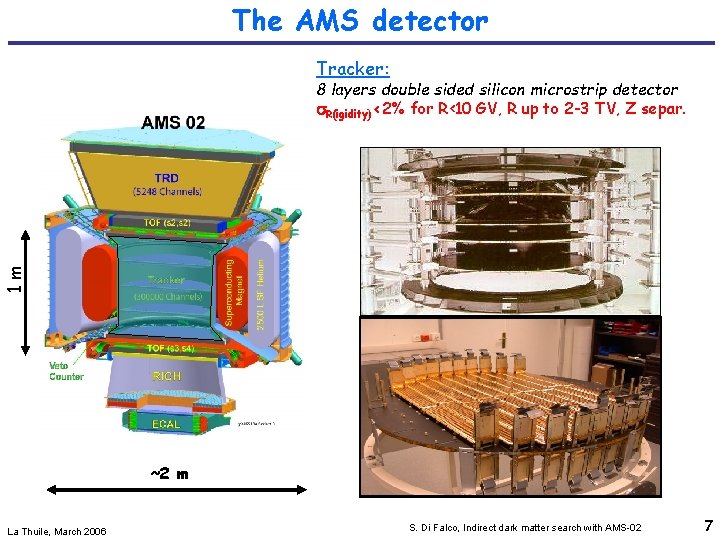
The AMS detector Tracker: 1 m 8 layers double sided silicon microstrip detector R(igidity)<2% for R<10 GV, R up to 2 -3 TV, Z separ. ~2 m La Thuile, March 2006 S. Di Falco, Indirect dark matter search with AMS-02 7
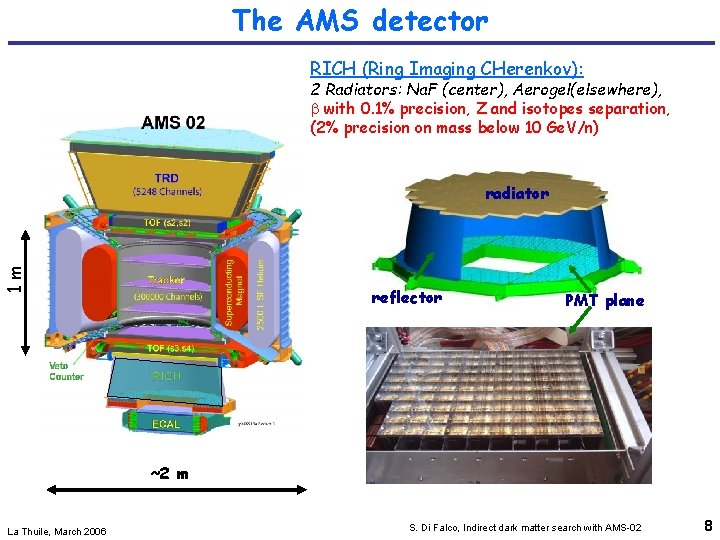
The AMS detector RICH (Ring Imaging CHerenkov): 2 Radiators: Na. F (center), Aerogel(elsewhere), with 0. 1% precision, Z and isotopes separation, (2% precision on mass below 10 Ge. V/n) 1 m radiator reflector PMT plane ~2 m La Thuile, March 2006 S. Di Falco, Indirect dark matter search with AMS-02 8
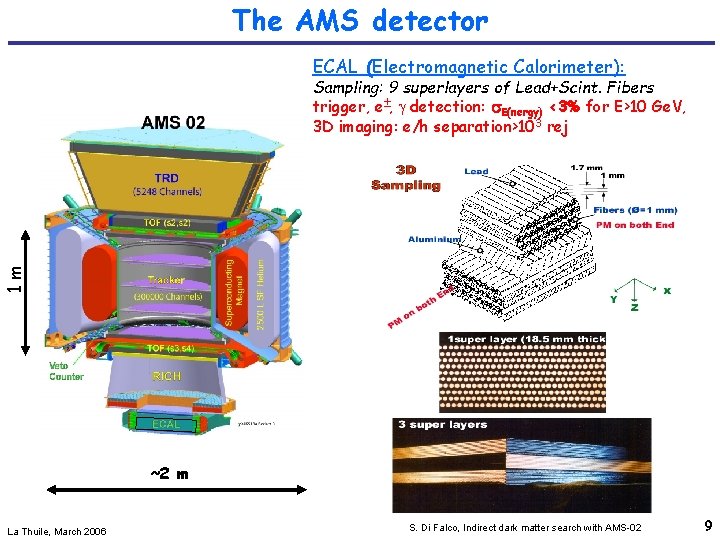
The AMS detector ECAL (Electromagnetic Calorimeter): 1 m Sampling: 9 superlayers of Lead+Scint. Fibers trigger, e , detection: E(nergy) <3% for E>10 Ge. V, 3 D imaging: e/h separation>103 rej ~2 m La Thuile, March 2006 S. Di Falco, Indirect dark matter search with AMS-02 9
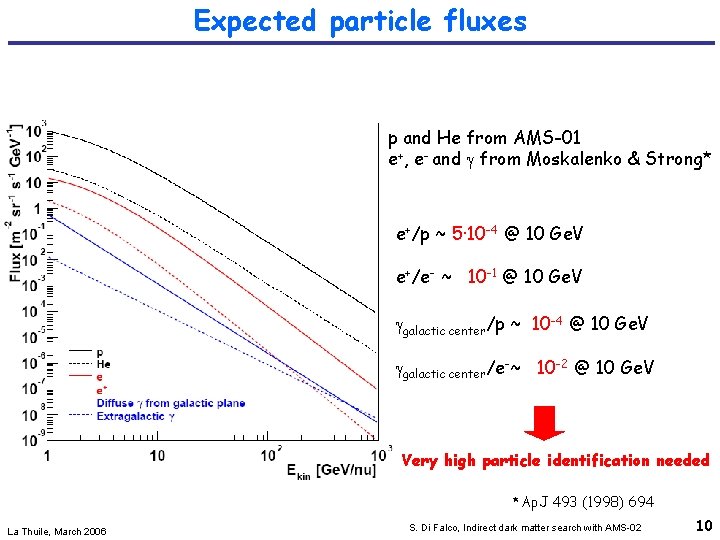
Expected particle fluxes p and He from AMS-01 e+, e- and from Moskalenko & Strong* e+/p ~ 5· 10 -4 @ 10 Ge. V e+/e- ~ 10 -1 @ 10 Ge. V galactic center/p ~ 10 -4 @ 10 Ge. V galactic center/e-~ 10 -2 @ 10 Ge. V Very high particle identification needed *Ap. J 493 (1998) 694 La Thuile, March 2006 S. Di Falco, Indirect dark matter search with AMS-02 10
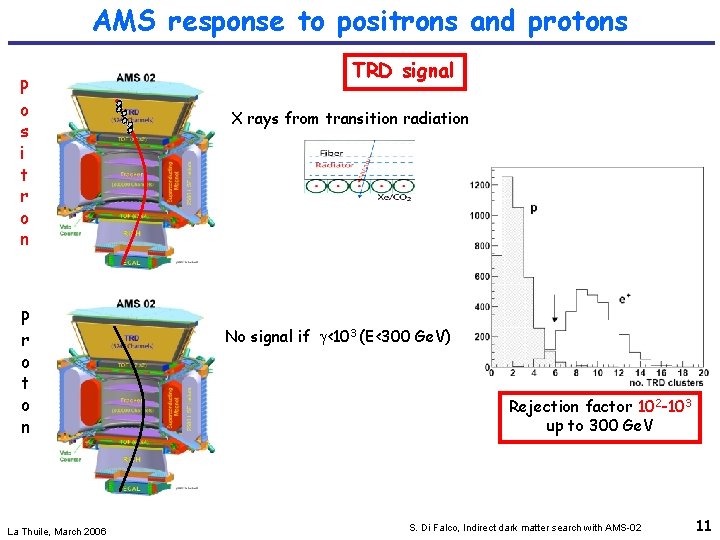
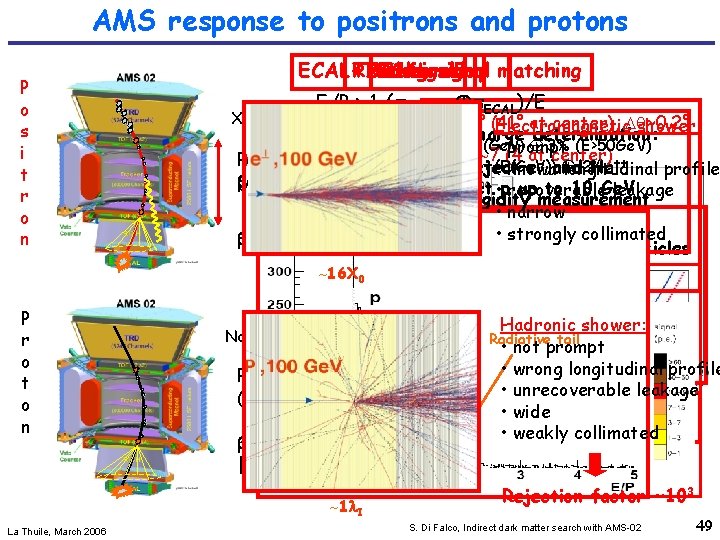
AMS response to positrons and protons P o s i t r o n P r o t o n La Thuile, March 2006 TRD signal X rays from transition radiation No signal if <103 (E<300 Ge. V) Rejection factor 102 -103 up to 300 Ge. V S. Di Falco, Indirect dark matter search with AMS-02 11
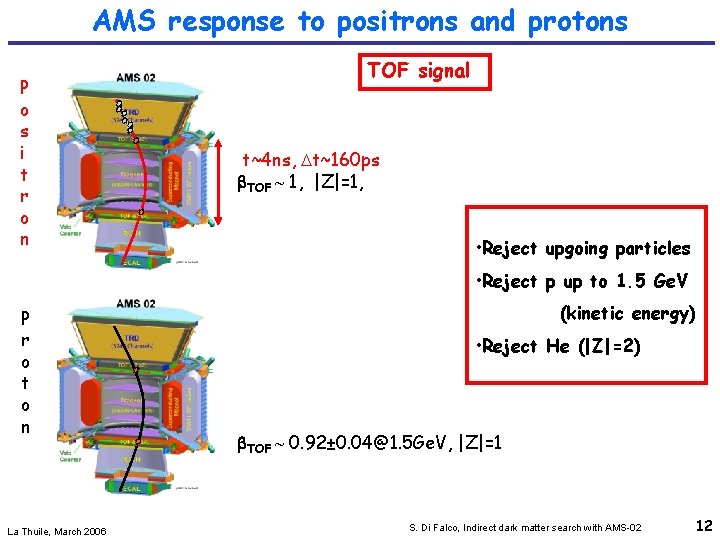
AMS response to positrons and protons P o s i t r o n TOF signal t~4 ns, Dt~160 ps b. TOF ~ 1, |Z|=1, • Reject upgoing particles • Reject p up to 1. 5 Ge. V P r o t o n La Thuile, March 2006 (kinetic energy) • Reject He (|Z|=2) b. TOF ~ 0. 92± 0. 04@1. 5 Ge. V, |Z|=1 S. Di Falco, Indirect dark matter search with AMS-02 12
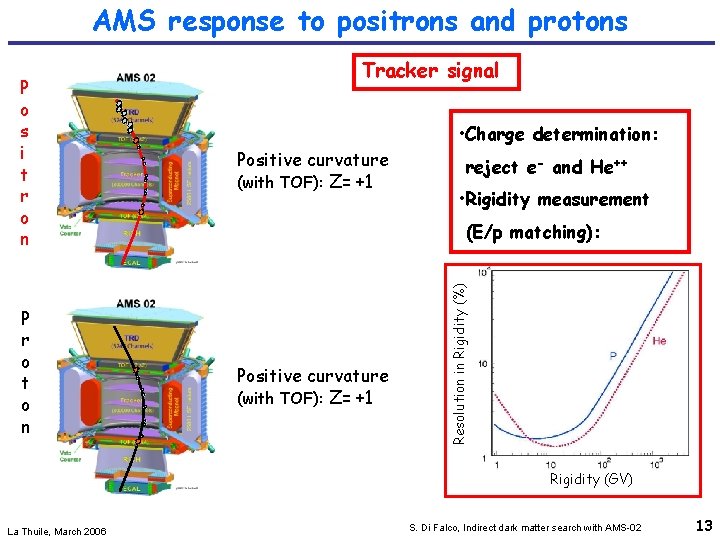
AMS response to positrons and protons P r o t o n • Charge determination: Positive curvature (with TOF): Z= +1 reject e- and He++ • Rigidity measurement (E/p matching): Positive curvature (with TOF): Z= +1 Resolution in Rigidity (%) P o s i t r o n Tracker signal Rigidity (GV) La Thuile, March 2006 S. Di Falco, Indirect dark matter search with AMS-02 13
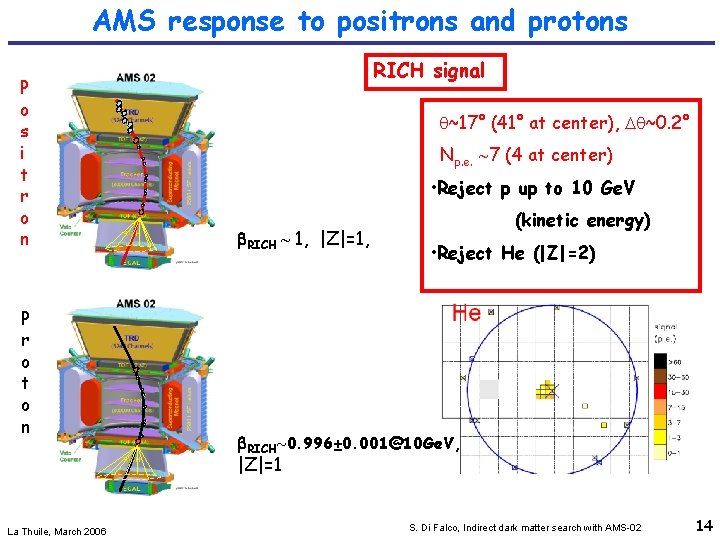
AMS response to positrons and protons P o s i t r o n P r o t o n La Thuile, March 2006 RICH signal q~17° (41° at center), Dq~0. 2° Np. e. ~7 (4 at center) • Reject p up to 10 Ge. V b. RICH ~ 1, |Z|=1, (kinetic energy) • Reject He (|Z|=2) b. RICH~0. 996± 0. 001@10 Ge. V, |Z|=1 S. Di Falco, Indirect dark matter search with AMS-02 14
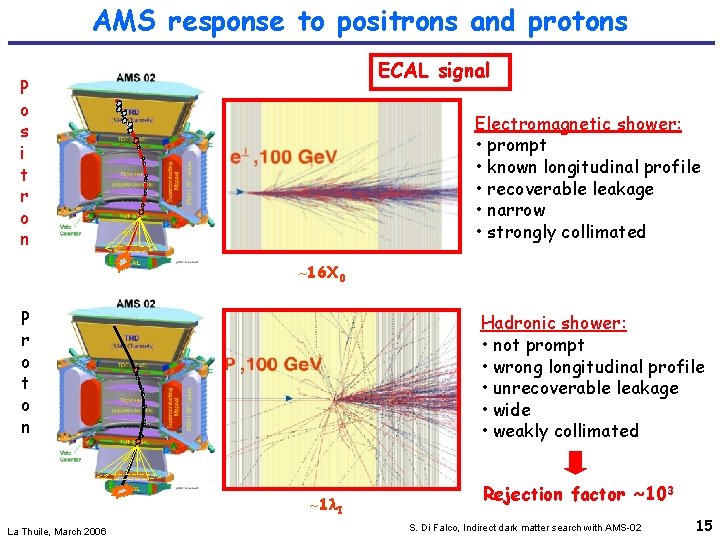
AMS response to positrons and protons ECAL signal P o s i t r o n Electromagnetic shower: • prompt • known longitudinal profile • recoverable leakage • narrow • strongly collimated ~16 X 0 P r o t o n Hadronic shower: • not prompt • wrong longitudinal profile • unrecoverable leakage • wide • weakly collimated ~1 l. I La Thuile, March 2006 Rejection factor ~103 S. Di Falco, Indirect dark matter search with AMS-02 15
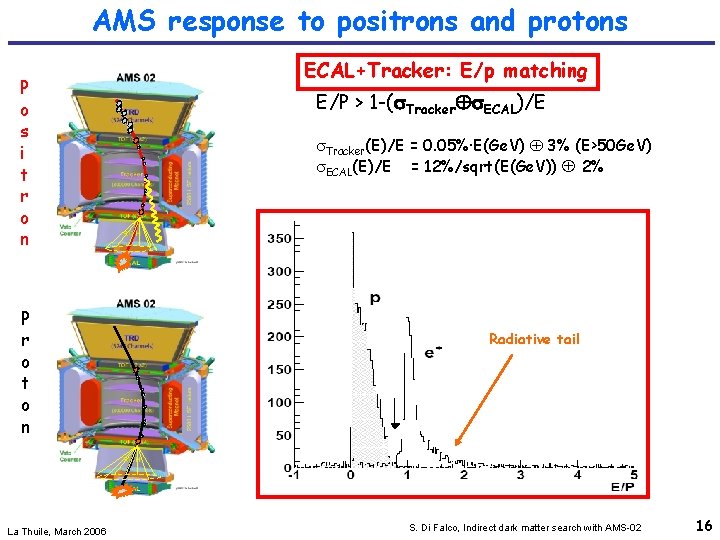
AMS response to positrons and protons P o s i t r o n P r o t o n La Thuile, March 2006 ECAL+Tracker: E/p matching E/P > 1 -( Tracker ECAL)/E s. Tracker(E)/E = 0. 05%·E(Ge. V) 3% (E>50 Ge. V) s. ECAL(E)/E = 12%/sqrt(E(Ge. V)) 2% Radiative tail S. Di Falco, Indirect dark matter search with AMS-02 16
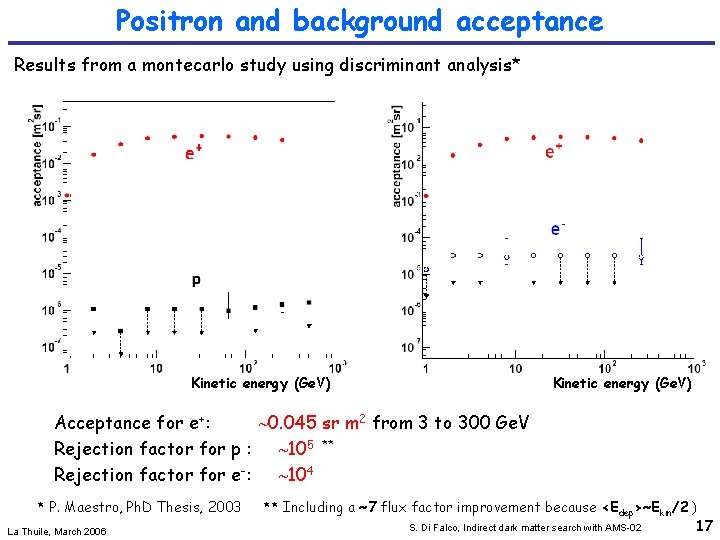
Positron and background acceptance Results from a montecarlo study using discriminant analysis* Kinetic energy (Ge. V) Acceptance for e+: ~0. 045 sr m 2 from 3 to 300 Ge. V Rejection factor for p : ~105 ** Rejection factor for e-: ~104 * P. Maestro, Ph. D Thesis, 2003 La Thuile, March 2006 ** Including a ~7 flux factor improvement because <Edep>~Ekin/2 ) 17 S. Di Falco, Indirect dark matter search with AMS-02
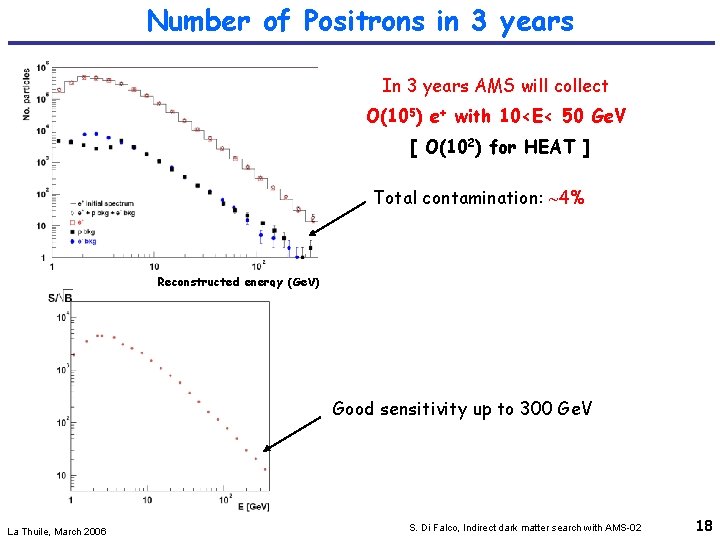
Number of Positrons in 3 years In 3 years AMS will collect O(105) e+ with 10<E< 50 Ge. V [ O(102) for HEAT ] Total contamination: ~4% Reconstructed energy (Ge. V) Good sensitivity up to 300 Ge. V La Thuile, March 2006 S. Di Falco, Indirect dark matter search with AMS-02 18
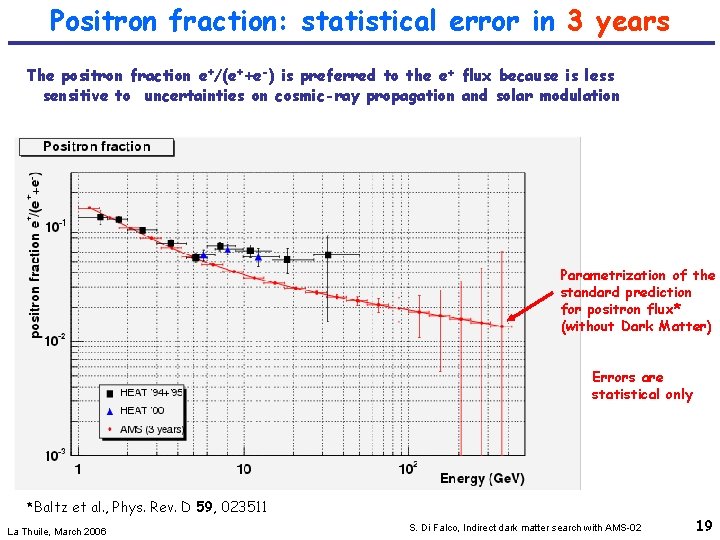
Positron fraction: statistical error in 3 years The positron fraction e+/(e++e-) is preferred to the e+ flux because is less sensitive to uncertainties on cosmic-ray propagation and solar modulation Parametrization of the standard prediction for positron flux* (without Dark Matter) Errors are statistical only *Baltz et al. , Phys. Rev. D 59, 023511 La Thuile, March 2006 S. Di Falco, Indirect dark matter search with AMS-02 19
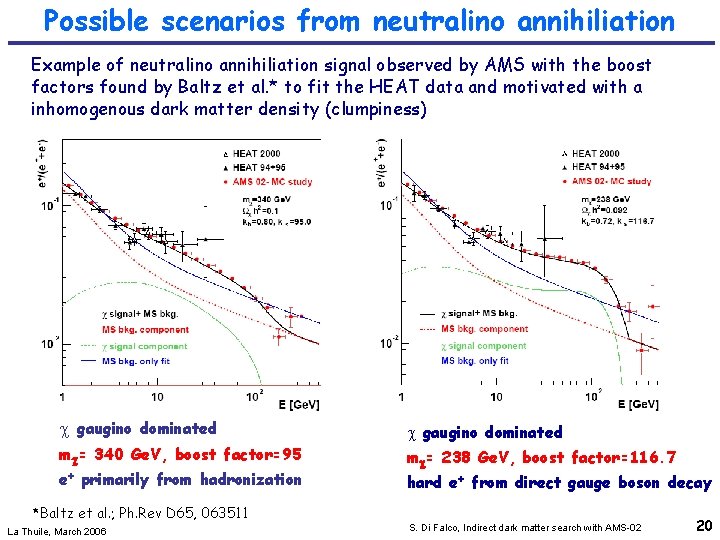
Possible scenarios from neutralino annihiliation Example of neutralino annihiliation signal observed by AMS with the boost factors found by Baltz et al. * to fit the HEAT data and motivated with a inhomogenous dark matter density (clumpiness) gaugino dominated mc= 340 Ge. V, boost factor=95 e+ primarily from hadronization *Baltz et al. ; Ph. Rev D 65, 063511 La Thuile, March 2006 gaugino dominated mc= 238 Ge. V, boost factor=116. 7 hard e+ from direct gauge boson decay S. Di Falco, Indirect dark matter search with AMS-02 20
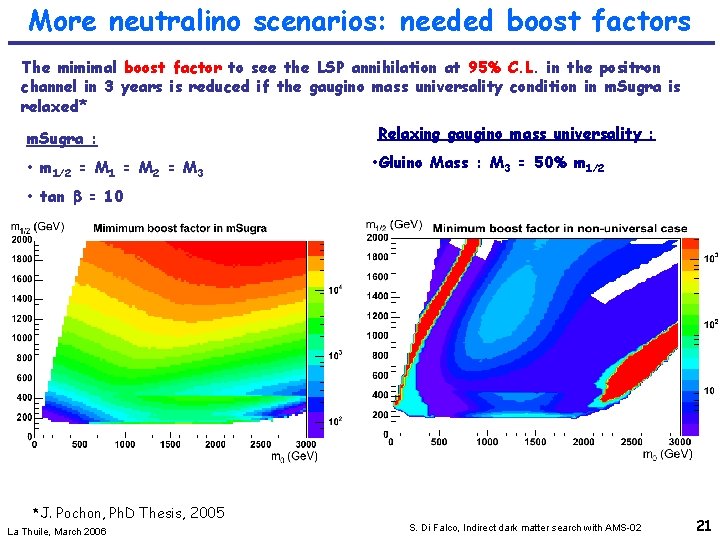
More neutralino scenarios: needed boost factors The mimimal boost factor to see the LSP annihilation at 95% C. L. in the positron channel in 3 years is reduced if the gaugino mass universality condition in m. Sugra is relaxed* m. Sugra : • m 1/2 = M 1 = M 2 = M 3 Relaxing gaugino mass universality : • Gluino Mass : M 3 = 50% m 1/2 • tan b = 10 *J. Pochon, Ph. D Thesis, 2005 La Thuile, March 2006 S. Di Falco, Indirect dark matter search with AMS-02 21
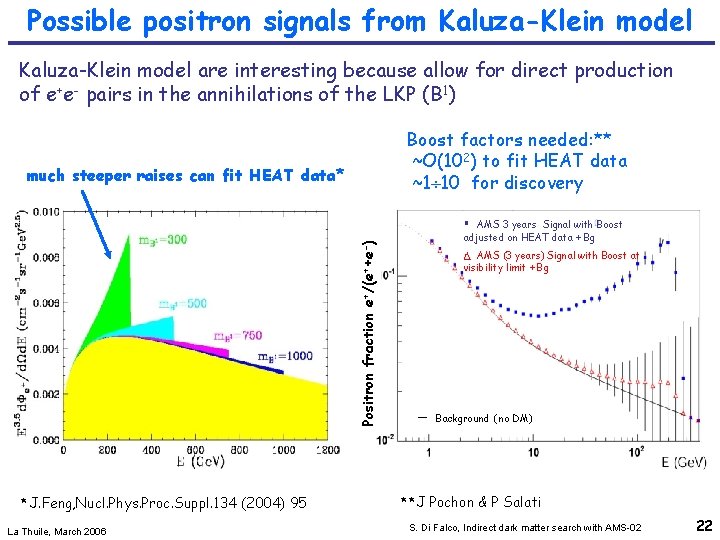
Possible positron signals from Kaluza-Klein model are interesting because allow for direct production of e+e- pairs in the annihilations of the LKP (B 1) Boost factors needed: ** ~O(102) to fit HEAT data ~1 10 for discovery much steeper raises can fit HEAT data* Positron fraction e+/(e++e-) § *J. Feng, Nucl. Phys. Proc. Suppl. 134 (2004) 95 La Thuile, March 2006 AMS 3 years Signal with Boost adjusted on HEAT data + Bg ∆ AMS (3 years) Signal with Boost at visibility limit + Bg — Background ( no DM) **J Pochon & P Salati S. Di Falco, Indirect dark matter search with AMS-02 22
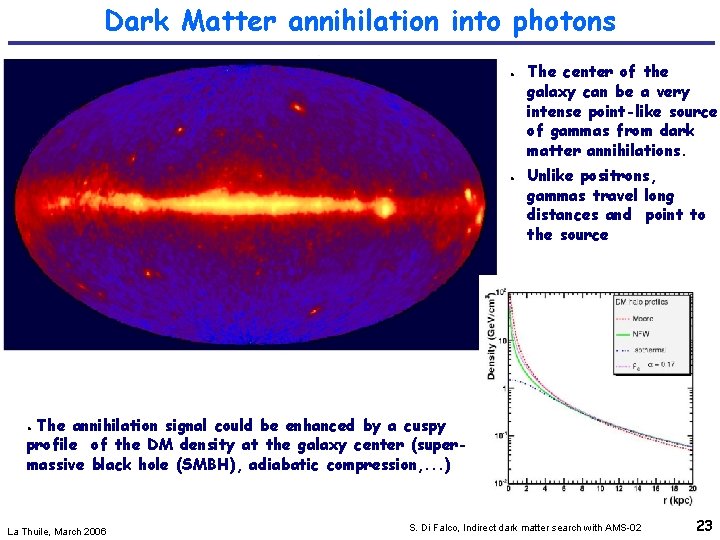
Dark Matter annihilation into photons ● ● The center of the galaxy can be a very intense point-like source of gammas from dark matter annihilations. Unlike positrons, gammas travel long distances and point to the source The annihilation signal could be enhanced by a cuspy profile of the DM density at the galaxy center (supermassive black hole (SMBH), adiabatic compression, . . . ) ● La Thuile, March 2006 S. Di Falco, Indirect dark matter search with AMS-02 23
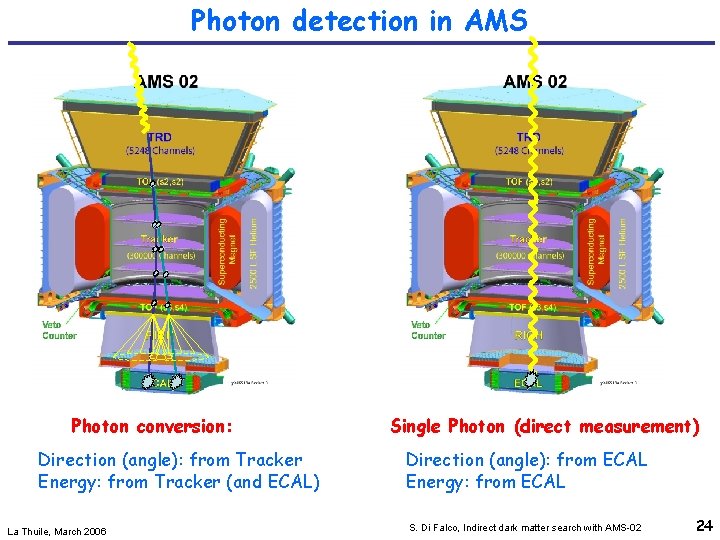
Photon detection in AMS Photon conversion: Direction (angle): from Tracker Energy: from Tracker (and ECAL) La Thuile, March 2006 Single Photon (direct measurement) Direction (angle): from ECAL Energy: from ECAL S. Di Falco, Indirect dark matter search with AMS-02 24
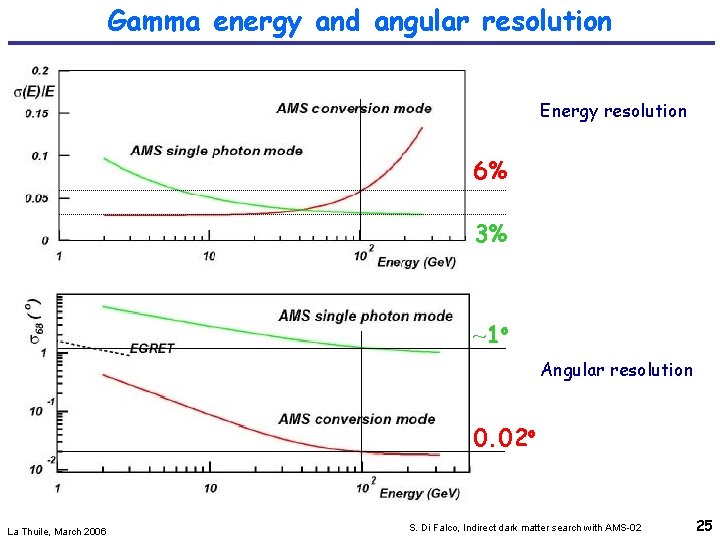
Gamma energy and angular resolution Energy resolution 6% 3% ~1 o Angular resolution 0. 02 o La Thuile, March 2006 S. Di Falco, Indirect dark matter search with AMS-02 25
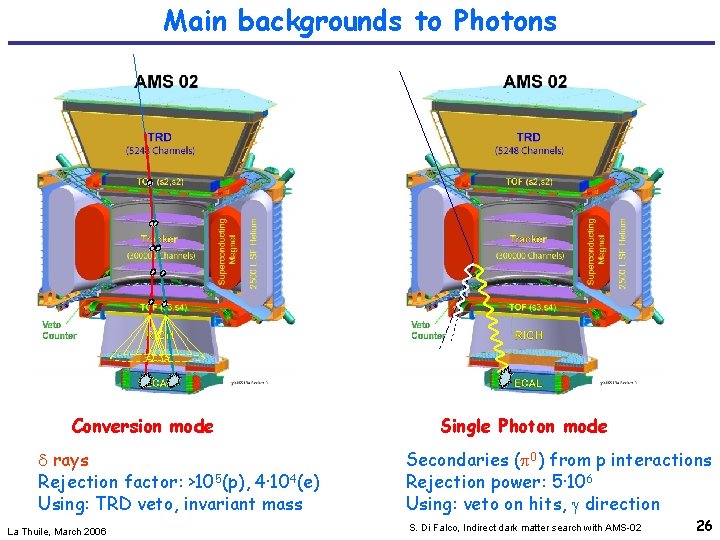
Main backgrounds to Photons Conversion mode d rays Rejection factor: >105(p), 4· 104(e) Using: TRD veto, invariant mass La Thuile, March 2006 Single Photon mode Secondaries (p 0) from p interactions Rejection power: 5· 106 Using: veto on hits, direction S. Di Falco, Indirect dark matter search with AMS-02 26
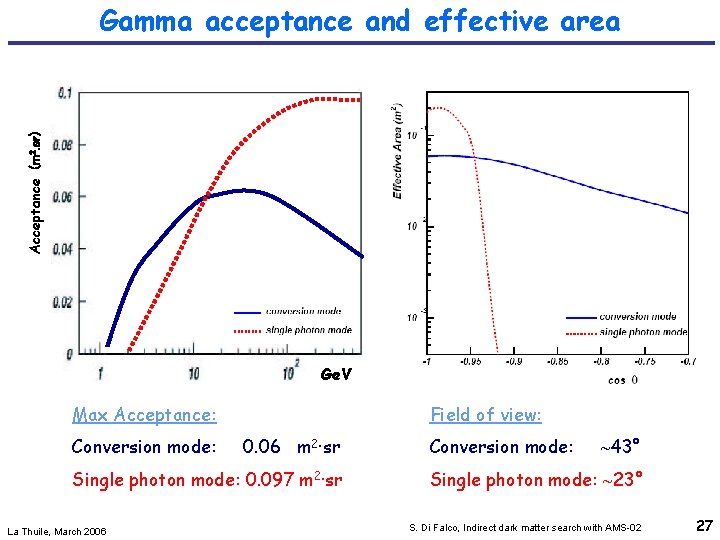
Acceptance (m 2. sr) Gamma acceptance and effective area Ge. V Max Acceptance: Conversion mode: Field of view: 0. 06 m 2·sr Single photon mode: 0. 097 m 2·sr La Thuile, March 2006 Conversion mode: ~43° Single photon mode: ~23° S. Di Falco, Indirect dark matter search with AMS-02 27
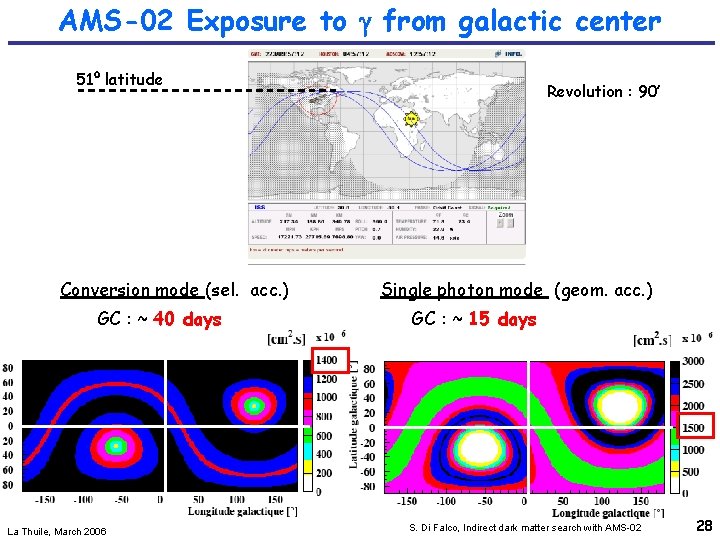
AMS-02 Exposure to g from galactic center 51º latitude Conversion mode (sel. acc. ) GC : ~ 40 days La Thuile, March 2006 Revolution : 90’ Single photon mode (geom. acc. ) GC : ~ 15 days S. Di Falco, Indirect dark matter search with AMS-02 28
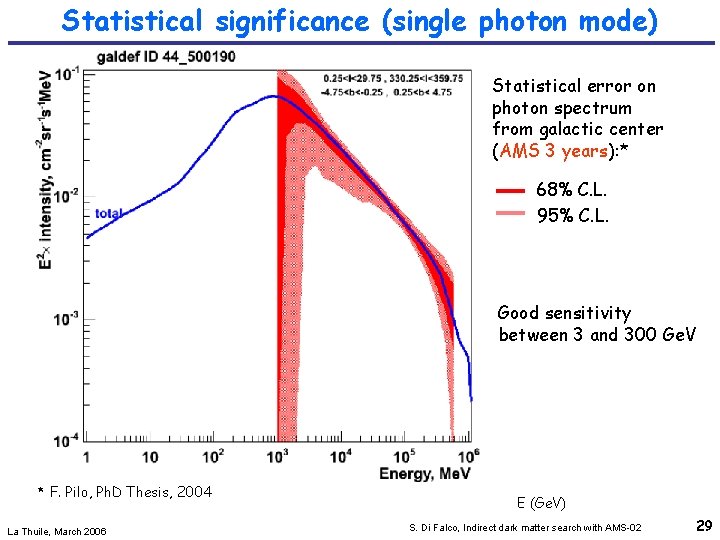
Statistical significance (single photon mode) Statistical error on photon spectrum from galactic center (AMS 3 years): * 68% C. L. 95% C. L. Good sensitivity between 3 and 300 Ge. V * F. Pilo, Ph. D Thesis, 2004 La Thuile, March 2006 E (Ge. V) S. Di Falco, Indirect dark matter search with AMS-02 29
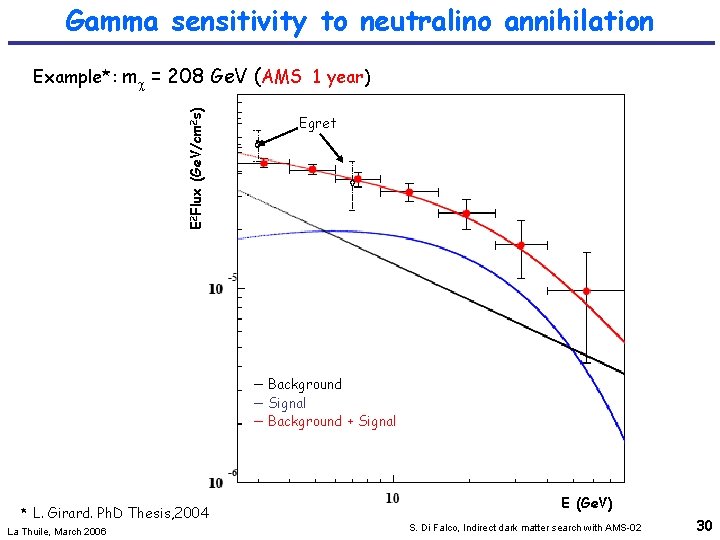
Gamma sensitivity to neutralino annihilation E 2 Flux (Ge. V/cm 2 s) Example*: m = 208 Ge. V (AMS 1 year) Egret — Background — Signal — Background + Signal * L. Girard. Ph. D Thesis, 2004 La Thuile, March 2006 E (Ge. V) S. Di Falco, Indirect dark matter search with AMS-02 30
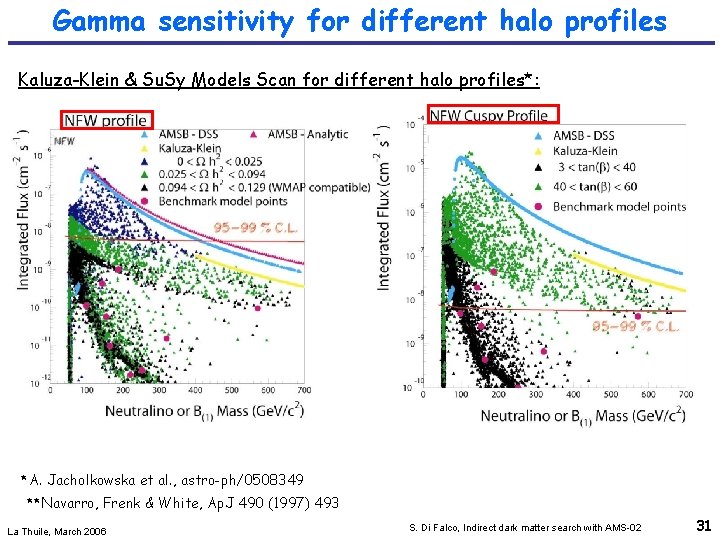
Gamma sensitivity for different halo profiles Kaluza-Klein & Su. Sy Models Scan for different halo profiles*: *A. Jacholkowska et al. , astro-ph/0508349 **Navarro, Frenk & White, Ap. J 490 (1997) 493 La Thuile, March 2006 S. Di Falco, Indirect dark matter search with AMS-02 31
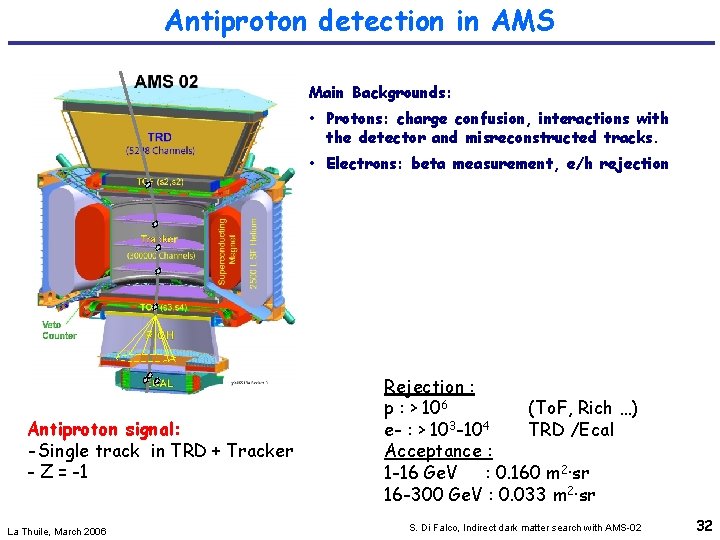
Antiproton detection in AMS Main Backgrounds: • Protons: charge confusion, interactions with the detector and misreconstructed tracks. • Electrons: beta measurement, e/h rejection Antiproton signal: -Single track in TRD + Tracker - Z = -1 La Thuile, March 2006 Rejection : p : > 106 (To. F, Rich …) e- : > 103 -104 TRD /Ecal Acceptance : 1 -16 Ge. V : 0. 160 m 2·sr 16 -300 Ge. V : 0. 033 m 2·sr S. Di Falco, Indirect dark matter search with AMS-02 32
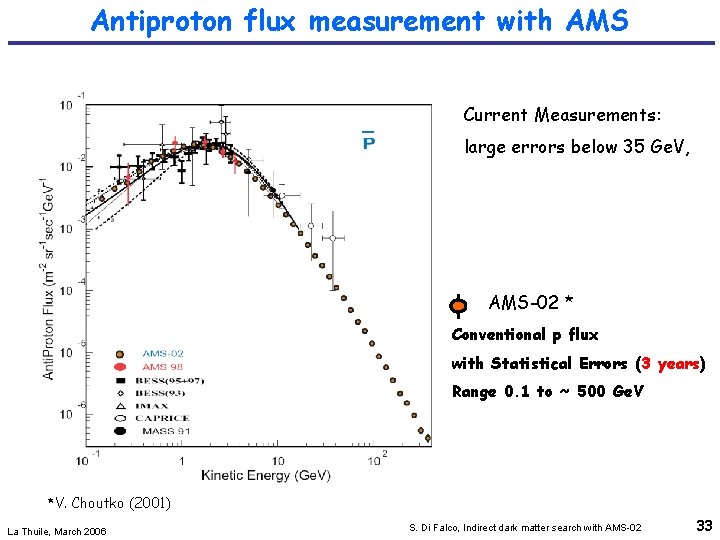
Antiproton flux measurement with AMS Current Measurements: large errors below 35 Ge. V, AMS-02 * Conventional p flux with Statistical Errors (3 years) Range 0. 1 to ~ 500 Ge. V *V. Choutko (2001) La Thuile, March 2006 S. Di Falco, Indirect dark matter search with AMS-02 33
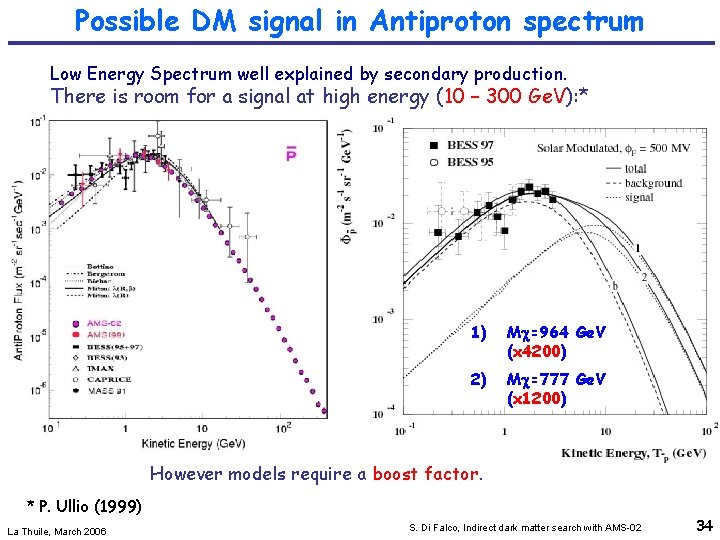
Possible DM signal in Antiproton spectrum Low Energy Spectrum well explained by secondary production. There is room for a signal at high energy (10 – 300 Ge. V): * 1) Mc=964 Ge. V (x 4200) 2) Mc=777 Ge. V (x 1200) However models require a boost factor. * P. Ullio (1999) La Thuile, March 2006 S. Di Falco, Indirect dark matter search with AMS-02 34
Conclusions The AMS experiment, during its 3 year mission, will be able to measure simultaneously and with unprecedented precision the rates and spectra of positrons, gammas and antiprotons in the Ge. V-Te. V range, looking for an excess of events that could hint for a dark matter annihilation signal. Several models for dark matter candidates can be constrained by the new AMS data. The AMS simultaneous measurements of other fundamental quantities (p and e spectra, B/C ratio, …) will help to refine the astrophysical predictions enhancing the compelling evidence for a dark matter signal. La Thuile, March 2006 S. Di Falco, Indirect dark matter search with AMS-02 35
Backup La Thuile, March 2006 S. Di Falco, Indirect dark matter search with AMS-02 36
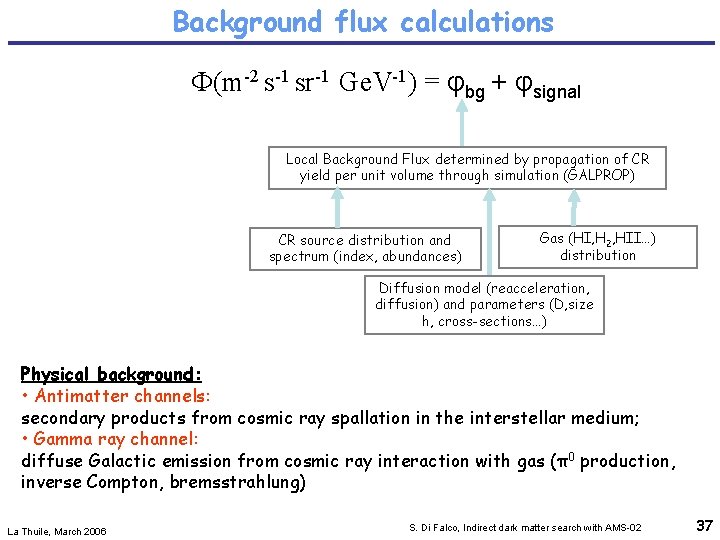
Background flux calculations F(m-2 s-1 sr-1 Ge. V-1) = φbg + φsignal Local Background Flux determined by propagation of CR yield per unit volume through simulation (GALPROP) CR source distribution and spectrum (index, abundances) Gas (HI, H 2, HII…) distribution Diffusion model (reacceleration, diffusion) and parameters (D, size h, cross-sections…) Physical background: • Antimatter channels: secondary products from cosmic ray spallation in the interstellar medium; • Gamma ray channel: diffuse Galactic emission from cosmic ray interaction with gas (π0 production, inverse Compton, bremsstrahlung) La Thuile, March 2006 S. Di Falco, Indirect dark matter search with AMS-02 37
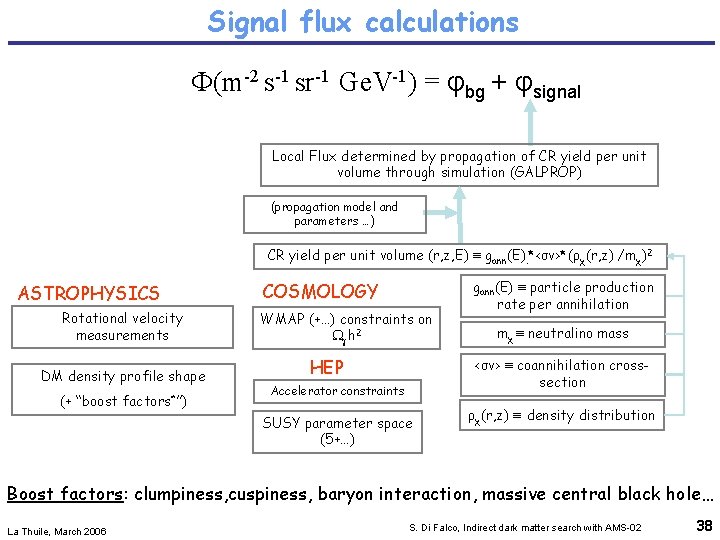
Signal flux calculations F(m-2 s-1 sr-1 Ge. V-1) = φbg + φsignal Local Flux determined by propagation of CR yield per unit volume through simulation (GALPROP) (propagation model and parameters …) CR yield per unit volume (r, z, E) ≡ gann(E). *<σv>*(ρχ(r, z) /mχ)2 ASTROPHYSICS Rotational velocity measurements DM density profile shape (+ “boost factors*”) COSMOLOGY WMAP (+…) constraints on h 2 HEP gann(E) ≡ particle production rate per annihilation mχ ≡ neutralino mass <σv> ≡ coannihilation crosssection Accelerator constraints SUSY parameter space (5+…) ρχ(r, z) ≡ density distribution Boost factors: clumpiness, cuspiness, baryon interaction, massive central black hole… La Thuile, March 2006 S. Di Falco, Indirect dark matter search with AMS-02 38
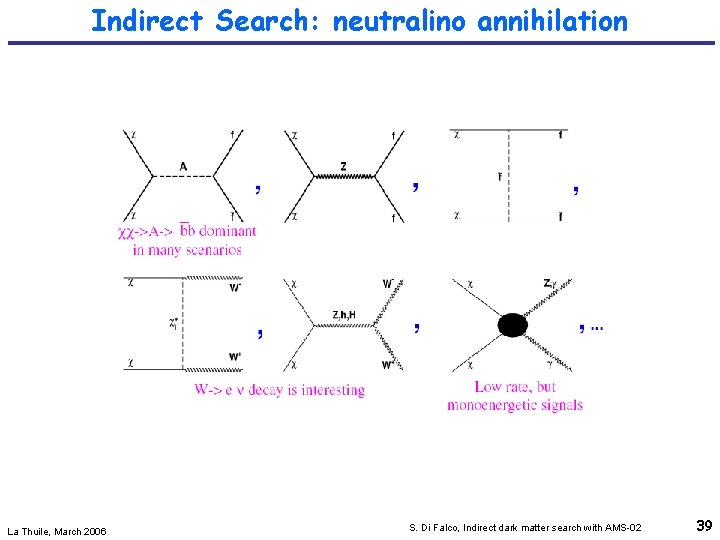
Indirect Search: neutralino annihilation La Thuile, March 2006 S. Di Falco, Indirect dark matter search with AMS-02 39
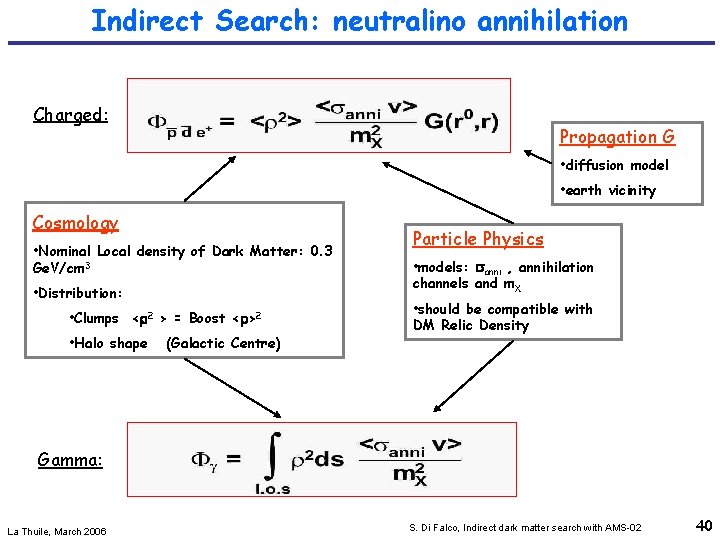
Indirect Search: neutralino annihilation Charged: Propagation G • diffusion model • earth vicinity Cosmology • Nominal Local density of Dark Matter: 0. 3 Ge. V/cm 3 • Distribution: • Clumps < 2 > = Boost < >2 • Halo shape (Galactic Centre) Particle Physics • models: anni , annihilation channels and m. X • should be compatible with DM Relic Density Gamma: La Thuile, March 2006 S. Di Falco, Indirect dark matter search with AMS-02 40
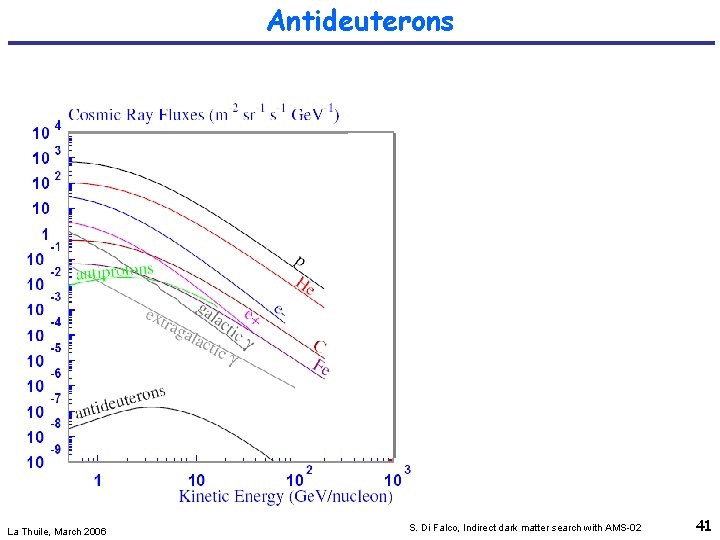
Antideuterons La Thuile, March 2006 S. Di Falco, Indirect dark matter search with AMS-02 41
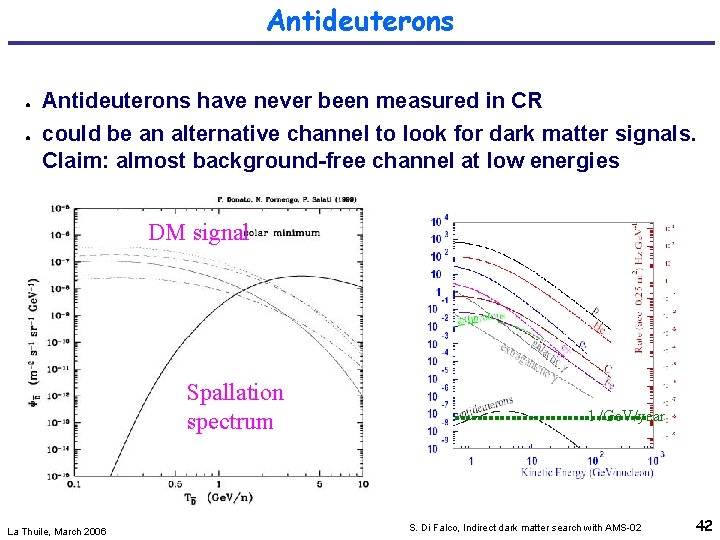
Antideuterons ● ● Antideuterons have never been measured in CR could be an alternative channel to look for dark matter signals. Claim: almost background-free channel at low energies DM signal Spallation spectrum La Thuile, March 2006 1 /Ge. V/year S. Di Falco, Indirect dark matter search with AMS-02 42
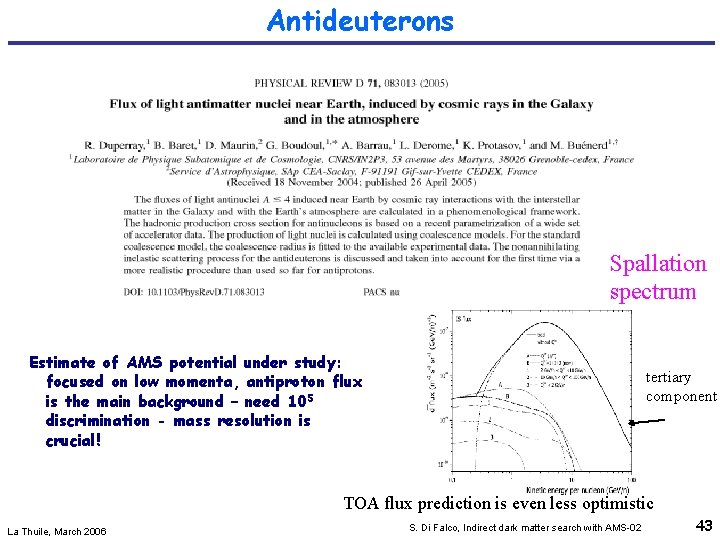
Antideuterons Spallation spectrum Estimate of AMS potential under study: focused on low momenta, antiproton flux is the main background – need 105 discrimination - mass resolution is crucial! tertiary component TOA flux prediction is even less optimistic La Thuile, March 2006 S. Di Falco, Indirect dark matter search with AMS-02 43
Some favourites Dark Matter candidates • Models of Supersymmetry : m. Sugra – 5 parameters: • m 0 : scalar mass • m 1/2 : gaugino mass • A 0 : sleptons and squarks coupling • tan : ratio of VED of the Higgs doublets • sign( ) : Higgs mass parameter – R-parity conservation • Ligthest Susy Particle stable : Neutralino • Extensions à la Kaluza-Klein: 2 working models with Extra Dimensions – Universal Extra Dimensions (UED) • all SM particles propagates in X-dimensions • Lightest First Excitation Level is stable : B(1) ( ~ (1) ) – Warped Grand Unified Theories • Z 3 symmetry to ensure proton stability • Lightest Z 3 charged particle is stable ( R(1) ) La Thuile, March 2006 S. Di Falco, Indirect dark matter search with AMS-02 44
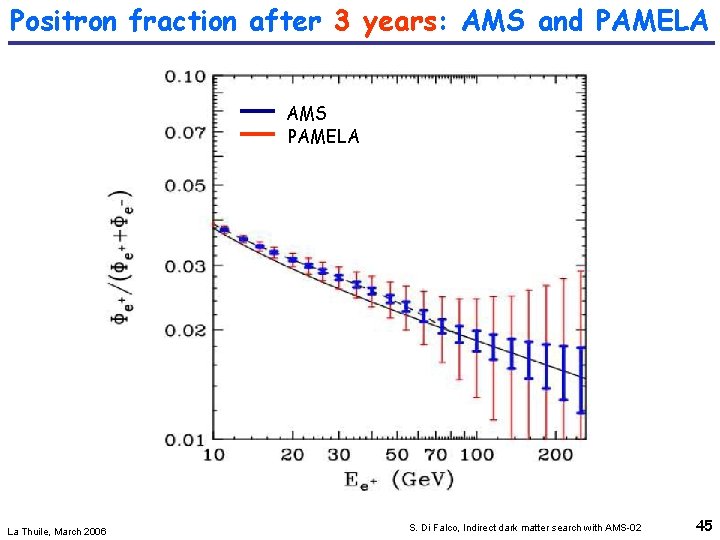
Positron fraction after 3 years: AMS and PAMELA AMS PAMELA La Thuile, March 2006 S. Di Falco, Indirect dark matter search with AMS-02 45
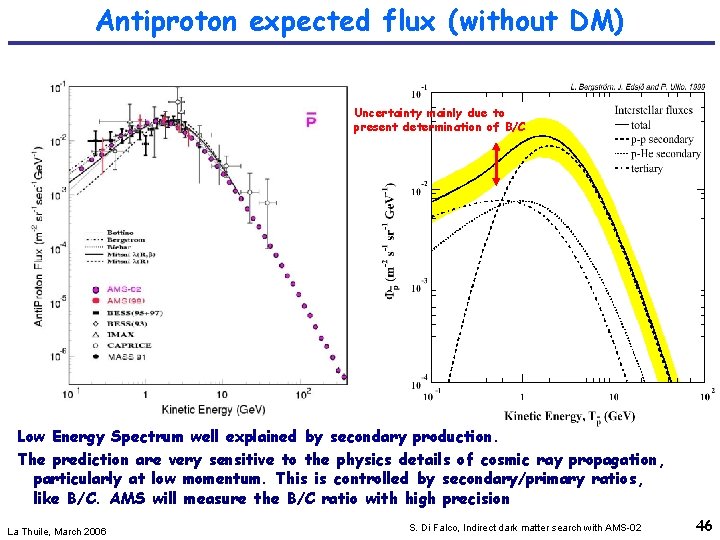
Antiproton expected flux (without DM) Uncertainty mainly due to present determination of B/C Low Energy Spectrum well explained by secondary production. The prediction are very sensitive to the physics details of cosmic ray propagation, particularly at low momentum. This is controlled by secondary/primary ratios, like B/C. AMS will measure the B/C ratio with high precision La Thuile, March 2006 S. Di Falco, Indirect dark matter search with AMS-02 46
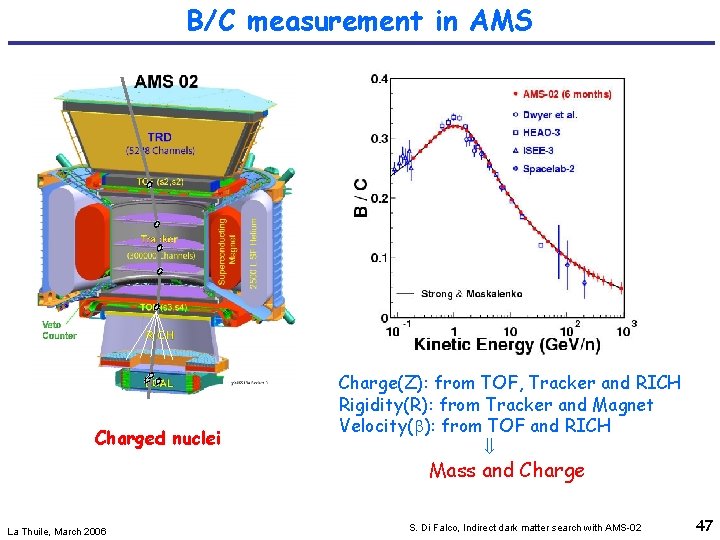
B/C measurement in AMS Charged nuclei Charge(Z): from TOF, Tracker and RICH Rigidity(R): from Tracker and Magnet Velocity( ): from TOF and RICH Mass and Charge La Thuile, March 2006 S. Di Falco, Indirect dark matter search with AMS-02 47
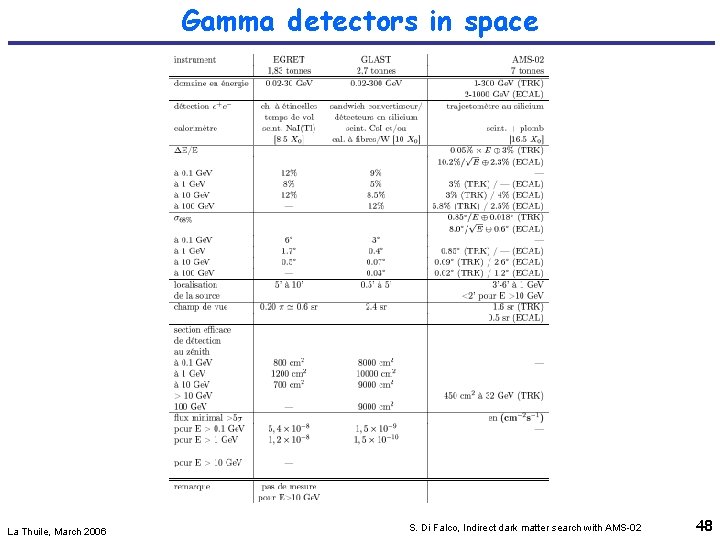
Gamma detectors in space La Thuile, March 2006 S. Di Falco, Indirect dark matter search with AMS-02 48
AMS response to positrons and protons E/P > 1 -( Tracker ECAL)/E X rays from transition radiation q~17° (41° at center), Dq~0. 2° Electromagnetic shower: • Charge determination: s. Tracker(E)/E = 0. 05%·E(Ge. V) 3% (E>50 Ge. V) • (4 prompt N ~7 at center) ++ p. e. Positive t~4 ns, Dt~160 ps curvature s. ECAL(E)/E = 12%/sqrt(E(Ge. V)) 2% reject e- and He • known longitudinal profile b (with ~ TOF): 1, |Z|=1, Z= +1 TOF • Reject p up to 10 Ge. V b. RICH ~ 1, |Z|=1, ~16 X 0 P r o t o n • recoverable leakage • Rigidity measurement • narrow (kinetic energy) (E/p • strongly matching): collimated • Reject upgoing particles • Reject He (|Z|=2) Resolution in Rigidity (%) P o s i t r o n ECAL+Tracker: ECAL E/p matching TRD TOF Tracker RICH signal • Reject p up to 1. 5 Ge. V (kinetic energy) Hadronic shower: No signal if <103 (E<300 Ge. V) Radiative tail • Reject He (|Z|=2) • not prompt • wrong longitudinal profile Positive curvature • unrecoverable leakage (with TOF): Z= +1 factor 102 -103 • Rejection wide up to 300 Ge. V • weakly collimated b. TOF ~ ~ 0. 996± 0. 001@10 Ge. V 0. 92± 0. 04@1. 5 Ge. V, , |Z|=1 RICH |Z|=1 Rigidity (GV) ~1 l. I La Thuile, March 2006 Rejection factor ~103 S. Di Falco, Indirect dark matter search with AMS-02 49
The AMS detector TRD (Transition Radiation Detector): 20 layers of Foam + Straw Drift Tubes (Xe/CO 2 ) 3 D tracks, e/h separation>102 rej. up to 300 Ge. V TOF (Time of Flight): 2+2 layers of scintillators, Dt =~160 ps Trigger, Z separation, with few % precision Superconducting Magnet: 1 m Nb-Ti coils in superfluid He(1. 8 K). Contained dipolar field: BL 2 = 0. 85 Tm 2 Tracker: 8 layers double sided silicon microstrip detector R(igidity)<2% for R<10 GV, R up to 2 -3 TV, Z separ. RICH (Ring Imaging CHerenkov): 2 Radiators: Na. F (center), Aerogel(elsewhere), with 0. 1% precision, Z and isotopes separation, (2% precision on mass below 10 Ge. V/n) ECAL (Electromagnetic Calorimeter): ~2 m La Thuile, March 2006 Sampling calorimeter: Lead+Scint. Fibers trigger, e , detection: E(nergy) <3% for E>10 Ge. V, 3 D imaging: e/h separation>103 rej S. Di Falco, Indirect dark matter search with AMS-02 50