
INDIGENOUS KNOWLEDGE SYSTEMS IN SOUTH AFRICA AN OVERVIEW



- Slides: 22
INDIGENOUS KNOWLEDGE SYSTEMS IN SOUTH AFRICA: AN OVERVIEW Mogege Mosimege Department of Science and Technology Pretoria mogege@dacst 5. pwv. gov. za
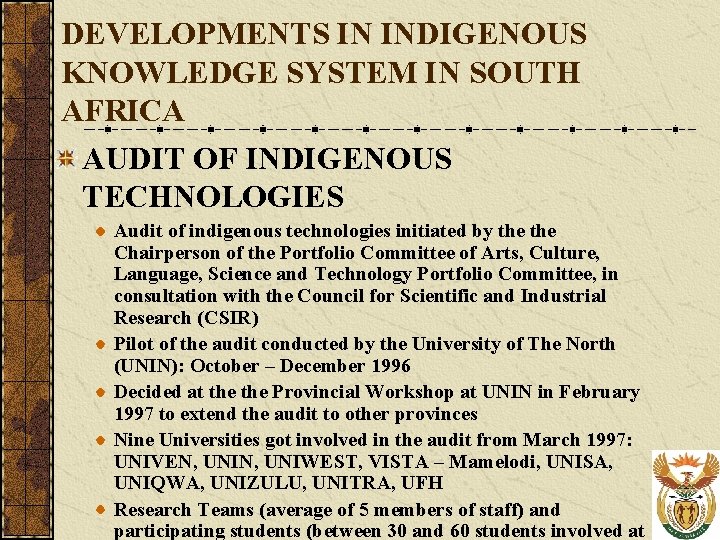
DEVELOPMENTS IN INDIGENOUS KNOWLEDGE SYSTEM IN SOUTH AFRICA AUDIT OF INDIGENOUS TECHNOLOGIES Audit of indigenous technologies initiated by the Chairperson of the Portfolio Committee of Arts, Culture, Language, Science and Technology Portfolio Committee, in consultation with the Council for Scientific and Industrial Research (CSIR) Pilot of the audit conducted by the University of The North (UNIN): October – December 1996 Decided at the Provincial Workshop at UNIN in February 1997 to extend the audit to other provinces Nine Universities got involved in the audit from March 1997: UNIVEN, UNIWEST, VISTA – Mamelodi, UNISA, UNIQWA, UNIZULU, UNITRA, UFH Research Teams (average of 5 members of staff) and participating students (between 30 and 60 students involved at
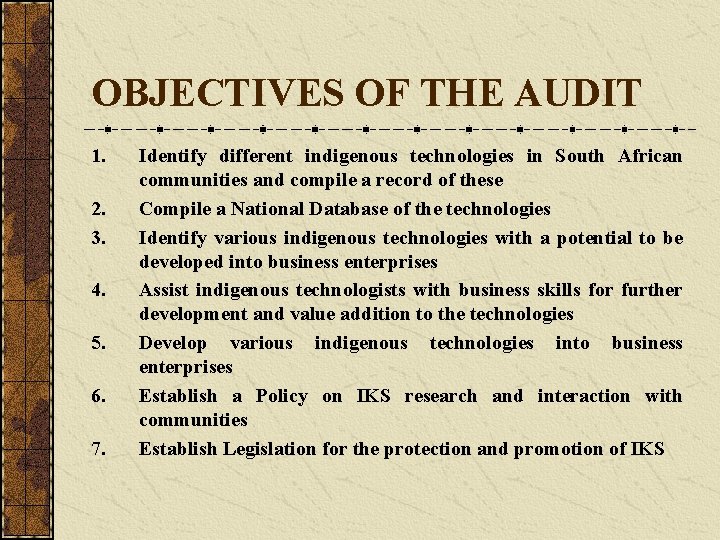
OBJECTIVES OF THE AUDIT 1. 2. 3. 4. 5. 6. 7. Identify different indigenous technologies in South African communities and compile a record of these Compile a National Database of the technologies Identify various indigenous technologies with a potential to be developed into business enterprises Assist indigenous technologists with business skills for further development and value addition to the technologies Develop various indigenous technologies into business enterprises Establish a Policy on IKS research and interaction with communities Establish Legislation for the protection and promotion of IKS
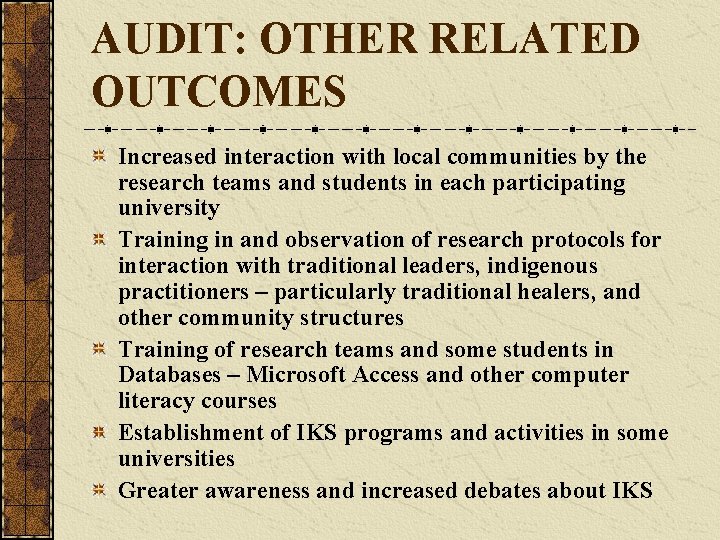
AUDIT: OTHER RELATED OUTCOMES Increased interaction with local communities by the research teams and students in each participating university Training in and observation of research protocols for interaction with traditional leaders, indigenous practitioners – particularly traditional healers, and other community structures Training of research teams and some students in Databases – Microsoft Access and other computer literacy courses Establishment of IKS programs and activities in some universities Greater awareness and increased debates about IKS
MILESTONES ATTAINED AS A RESULT OF WORK IN INDIGENOUS TECHNOLOGIES 1. 2. 3. 4. 5. 6. 7. 8. Transition from indigenous technologies to indigenous knowledge systems (IKS) Heightened awareness and increased debates on and about IKS Research Teams that involve a variety of disciplines and different institutions Greater involvement of indigenous practitioners and community members Establishment of bodies like the Science Councils IKS Champions Ring-fenced funding at NRF for research in IKS Programs and Centres at tertiary institutions IKS Directorate in the Department of Arts, Culture, Science and Technology
IKS PROGRAMS AND CENTRES AT TERTIARY INSTITUTIONS IKS Study Program at University of North West IKS Institute and Study Program at Technikon SA IKS Institute at University of Fort Hare IKS Centre at University of Pretoria (CINDEK) IKS Centre at University of Venda IKS Courses at following Universities: University of Natal – Pietermaritzburg University of The North – Qwaqwa Campus
From Indigenous Technologies to Indigenous Knowledge Systems: Some Definitions Indigenous Technologies: Technology is about skill or applied expertise whereas IKS is about social capital and knowledge Productions consisting of characteristic elements of the traditional artistic heritage developed and maintained by a community in the country or by individuals reflecting the traditional artistic expectations of such a community’ (Prolegomena to a Policy Framework on Indigenous Knowledge Systems in South Africa, 1998: 7)
INDIGENOUS KNOWLEDGE SYSTEMS: SOME DEFINITIONS The term ‘indigenous knowledge’ (IK) is used synonymously with ‘traditional’ and ‘local’ knowledge to differentiate the knowledge developed by a community from the international knowledge system sometimes also called ‘Western’ system, generated through universities, government research centres and private industry. IK refers to the knowledge of indigenous peoples as well as any other defined community’ (Warren, 1992) The unique, traditional, local knowledge existing within and developed around specific conditions of women and men indigenous to a particular area (Grenier, 1998)
IKS IN SOUTH AFRICA: NRF Defines IKS as a complex set of knowledge and technologies existing and developed around specific conditions of populations and communities indigenous to a particular geographic area (NRF, 2000) Has established an IKS Research Focus with 4 subfocus areas Administers a ring-fenced amount of R 10 m per annum which has been provided by the Department of Arts, Culture, Science and Technology (DACST) since 2000
IKS IN THE DEPARTMENT OF ARTS, CULTURE, SCIENCE AND TECHNOLOGY IKS activities since 1998 - First National Workshop - Provision of funding to NRF for IKS research since 2000 - Study visits to India and China: 2000 - Vlakplaas: December 2001 Commissioning of HSRC to redraft IKS Policy and Bill: January 2001 Establishment of IKS Directorate: 2001
IKS DIRECTORATE AT DEPARTMENT OF SCIENCE AND TECHNOLOGY MISSION: To protect, promote and develop IKS within the National System of Innovation (NSI) to contribute to economic and social transformation SUB-DIRECTORATES: A: Legislation, Policy and Strategy B: Research and NSI C: Auditing, Documenting and Preservation D: Human Resources and Institutional Capacity Building
OBJECTIVES OF DIRECTORATE 1. 2. 3. 4. 5. 6. 7. 8. Undertake and intra and extra departmental audit, as well as an audit of international IKS activities and processes Actively coordinate national IKS interventions and projects and link relevant ones to international efforts Develop and implement IKS Legislation, policy and Strategy Develop IKS human resource and institutional capacity through education and training Provide mechanisms and infra-structure for the codification, documentation and preservation of IKS knowledge and technologies Promote research, monitoring and evaluation of IKS Promote and develop IKS within the NSI Provide proactive support for IKS related activities within the Arts and Culture
COORDINATION AND LIAISON FUNCTIONS OF THE DIRECTORATE Ring-fenced funding for IKS research at the NRF since 2000 Inter-departmental Committee on IKS (DACST, DTI, DOH, DOE, DEAT, NDA, DWAF, DLA, DPLG) International Liaison: WIPO, CBD, FAO
MAJOR DIFFICULTIES AND CHALLENGES IN IKS Access Bio-piracy Bio-prospecting Benefit Sharing Term ‘Indigenous Knowledge’ IKS and Commercialisation Ownership: Individual, Communities Partnerships
World Intellectual Property Organization (WIPO) One of the specialized agencies of the United Nations, 179 member states. Responsible for administering 23 Treaties: - 16 Treaties on Industrial Property - 6 Treaties on Copyrights - Convention creating WIPO - Some examples of treaties: Paris Convention for the Protection of Industrial Property, Trademark Law Treaty; WIPO Copyright Treaty; Patent Law Treaty; Acknowledges difficulties related to debates on indigenous peoples, regards indigenous knowledge (IK) as part of traditional knowledge (TK). Intergovernmental Committee Meetings
WIPO: VIEW ON TRADITIONAL KNOWLEDGE WIPO currently uses the term traditional knowledge (TK) to refer to tradition-based literary, artistic or scientific works; performances; inventions; scientific discoveries; designs; marks, names and symbols; undisclosed information; and all other tradition-based innovations and creations resulting from intellectual activity in the industrial, scientific, literary or artistic fields. Tradition-based refers to knowledge systems, creations, innovations and cultural expressions which: (i) have generally been transmitted from generation to generation; (ii) are generally regarded as pertaining to a particular people or its territory; (iii) and are constantly evolving in response to a changing environment
MOTIVATION FOR IKS POLICY AND LEGISLATION - 1 One of the consequences of colonialism and apartheid: Erasure and marginalisation of cultural and intellectual contributions of non-western knowledge systems Piracy and bio-piracy of knowledge and related products, associated extractions without appropriate recompense, exploitation of knowledge holders Legitimation of IKS on its own terms by creating enabling environments for the internal development and articulation of all the domains of IKS (not just one dominant domain of medicinal plants) Establish IKS as a source of innovation and part of the National System of Innovation
MOTIVATION FOR IKS POLICY AND LEGISLATION - 2 Facilitation and engendering of mindset change in public institutions with regards to IKS and people-centered development Cultivation of trust and confidence of marginalized communities by investing in rural-based science and technology; strengthening community participation in information gathering and ownership of research processes and findings; developing mechanisms, protocols, and codes of conduct for value addition Protection, development and promotion of IKS will help improve livelihoods and economic well-being of local communities by ensuring appropriate benefit sharing for local communities in the utilization of the resources
IKS DRAFT BILL: PURPOSE AND OBJECTIVES 1. 2. 3. 4. Purpose: To recognize, promote, develop, protect, and affirm the hitherto undermined and marginalized IKS, to contribute to the reclamation and realization of indigenous knowledge of South Africa’s diverse communities and value systems connected therewith Objectives: To give legal recognition to IK, IKS and IKS practitioners To establish principles to guide and manage the recognition, promotion, development, innovation and protection of IK and IKS To regulate forms of ownership and benefit sharing of IK and IKS at all levels of value addition To provide for the development of code of ethics, conduct and good practice for owners, producers, managers and users of IK and IKS
IKS DRAFT POLICY: VISION AND GOALS - 1 Inspired by the universal principles of human rights and incorporates cardinal African values such as Ubuntu and Batho-pele Need to redress the paralysing legacies of apartheid colonialism in which the vast majority of Africans were marginalised National, Regional, Continental Context: Embrace the concepts, ideas, and spirit of African Renaissance, African Union, New Partnership for Africa’s development
IKS DRAFT POLICY: VISION AND GOALS - 2 IKS should be used for poverty eradication in South African communities through working in an integrated manner on food security, agriculture, environment, suitable development, education, health, culture and biological diversity IKS should be integrated into the National Qualifications Framework and the National Systems of Innovation There needs to be a development of a clearly articulated research agenda for IKS, based on the articulation of desired research priorities and outputs Recognition of all stakeholders for innovation and education in IKS Accreditation of IKS holders