
Indigenous children and child labour Towards a rightsbased
Indigenous children and child labour: Towards a rightsbased approach Indigenous and Tribal Peoples | www. ilo. org/indigenous | www. pro 169. org
• “Although indigenous children are disproportionately affected by specific challenges such as institutionalization, urbanization, drug and alcohol abuse, trafficking, armed conflict, sexual exploitation and child labour … [they] are not sufficiently taken into consideration in the development and implementation of policies and programmes for children. ” UN Committee on the Rights of the Child Indigenous and Tribal Peoples | www. ilo. org/indigenous | www. pro 169. org

Indigenous children: Special rights and special needs • Deprivation of fundamental human rights • Discrimination and non-recognition of their lifestyles, cultures, languages and traditional knowledge • Lack of recognition of collective rights to lands and natural resources • Gender-related discrimination of indigenous women and girls • Inadequacy of existing services - in particular education - for indigenous children Indigenous and Tribal Peoples | www. ilo. org/indigenous | www. pro 169. org
Indigenous child labour: The extent of the challenge • Still prevails in rural areas but also increasing in urban areas • Children of female-headed households and orphans most vulnerable • Occurs in formal and informal economies, but more widespread in the latter • Indigenous children increasingly represented among migrant workers • Affects boys and girls differently Indigenous and Tribal Peoples | www. ilo. org/indigenous | www. pro 169. org
What is child labour? We want to stop work that: • Is mentally, physically, socially or morally dangerous and harmful to children; and • Interferes with their schooling • In its most extreme forms, it involves children being enslaved together with, or separated from their families, exposed to serious dangers and illnesses at work, or dire forms of exploitation such as prostitution, or used in crimes – all of this often at a very early age. Indigenous and Tribal Peoples | www. ilo. org/indigenous | www. pro 169. org
Relevant international instruments Taken together, these Conventions provide a normative framework for addressing indigenous peoples’ rights, and for addressing the specific question of indigenous child labour: • ILO Convention No. 169 • ILO Convention on Minimum Age (No. 138) • ILO Convention on the Elimination of the Worst Forms of Child Labour (No. 182) • Convention on the Rights of the Child Indigenous and Tribal Peoples | www. ilo. org/indigenous | www. pro 169. org
Convention No. 169 Indigenous children: • • • Shall have the opportunity to acquire education on an equal footing Shall be taught to read and write in their own languages Shall have the opportunity to attain fluency in the national language(s) Education programmes and services: • • • Shall be developed and implemented in cooperation with indigenous peoples, and shall incorporate their histories, knowledge, technologies and value systems Shall impart general knowledge and skills that help indigenous children to participate fully and on an equal footing in their own and in the national community Shall contribute to eliminating prejudices against indigenous peoples Indigenous and Tribal Peoples | www. ilo. org/indigenous | www. pro 169. org
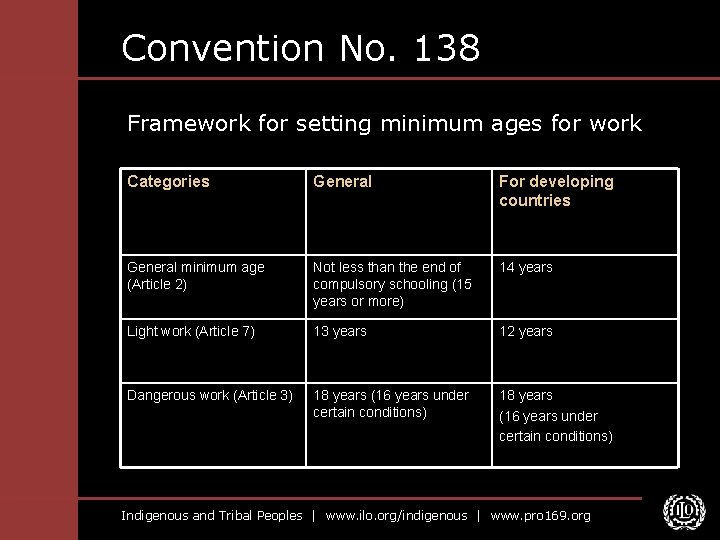
Convention No. 138 Framework for setting minimum ages for work Categories General For developing countries General minimum age (Article 2) Not less than the end of compulsory schooling (15 years or more) 14 years Light work (Article 7) 13 years 12 years Dangerous work (Article 3) 18 years (16 years under certain conditions) Indigenous and Tribal Peoples | www. ilo. org/indigenous | www. pro 169. org
Convention No. 182 The worst forms of child labour are: • Slavery and forced labour, including child trafficking and forced recruitment for armed conflict • Using a child in prostitution or pornography • Using a child in illicit activities like drug trafficking • Work likely to harm the health, safety or morals of children Convention No. 182 calls for "immediate and effective measures to secure the prohibition and elimination of the worst forms of child labour as a matter of urgency. ” Indigenous and Tribal Peoples | www. ilo. org/indigenous | www. pro 169. org
A rights-based approach to combating indigenous child labour Elements of a rights based approach could include: • Using indigenous children’s individual and collective rights as an overall framework for a situational analysis • Identifying violations and gaps in the provision of such rights and their causes • Strengthening dialogue between rights-holders and duty-bearers • Establishing mechanisms for ensuring adequate consultation and participation of indigenous peoples in defining strategies to combat indigenous child labour Indigenous and Tribal Peoples | www. ilo. org/indigenous | www. pro 169. org
- Slides: 10