
Indicators of Good Research How do I know
- Slides: 15
Indicators of Good Research How do I know that what I have done will be credible in the research world? O'Leary, Z. (2004) The Essential Guide to Doing Research. London: Sage Chapter Five 1
Understanding ‘Credibility’ Credibility: The quality, capability, or power to elicit belief O'Leary, Z. (2004) The Essential Guide to Doing Research. London: Sage Chapter Five 2
Working with Indicators Understanding appropriate credibility indicators is crucial to: n n critically reviewing relevant literature reflexively designing sound methodologies O'Leary, Z. (2004) The Essential Guide to Doing Research. London: Sage Chapter Five 3
Questions for Assessing Credibility n n n Have subjectivities been managed? Are methods approached with consistency? Has ‘true essence’ been captured? Are findings applicable outside the immediate frame of reference? Can the research be verified? O'Leary, Z. (2004) The Essential Guide to Doing Research. London: Sage Chapter Five 4
Managing Subjectivities n Objectivity - conclusions based on observable phenomena; not influenced by emotions, personal prejudices, or subjectivities O'Leary, Z. (2004) The Essential Guide to Doing Research. London: Sage Chapter Five 5
Managing Subjectivities n Neutrality - subjectivities recognised and negotiated in a manner that attempts to avoid biasing results / conclusions O'Leary, Z. (2004) The Essential Guide to Doing Research. London: Sage Chapter Five 6
Managing Subjectivities n Subjectivity with transparency acceptance and disclosure of subjective positioning and how it might impact the research process including conclusions drawn O'Leary, Z. (2004) The Essential Guide to Doing Research. London: Sage Chapter Five 7
Consistency in Methods n Reliability - concerned with internal consistency, that is whether data / results collected, measured, or generated are the same under repeated trials O'Leary, Z. (2004) The Essential Guide to Doing Research. London: Sage Chapter Five 8
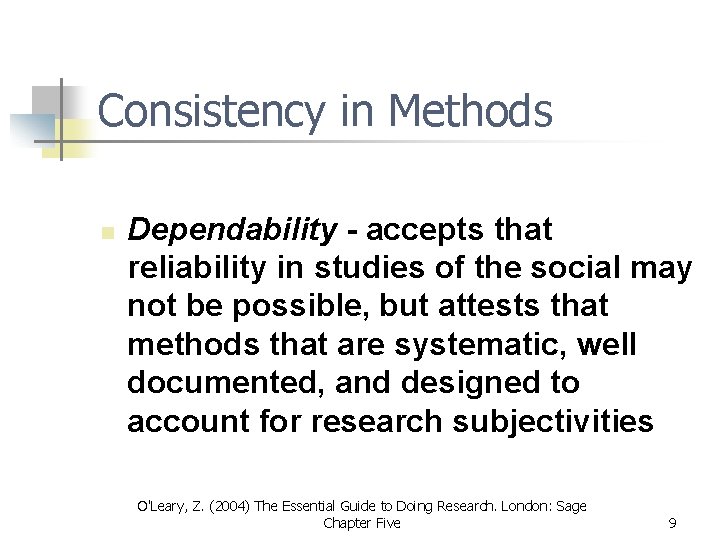
Consistency in Methods n Dependability - accepts that reliability in studies of the social may not be possible, but attests that methods that are systematic, well documented, and designed to account for research subjectivities O'Leary, Z. (2004) The Essential Guide to Doing Research. London: Sage Chapter Five 9
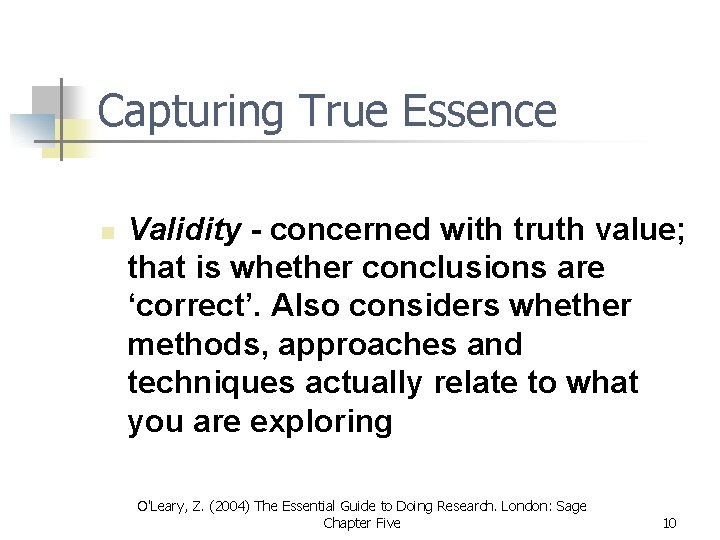
Capturing True Essence n Validity - concerned with truth value; that is whether conclusions are ‘correct’. Also considers whether methods, approaches and techniques actually relate to what you are exploring O'Leary, Z. (2004) The Essential Guide to Doing Research. London: Sage Chapter Five 10
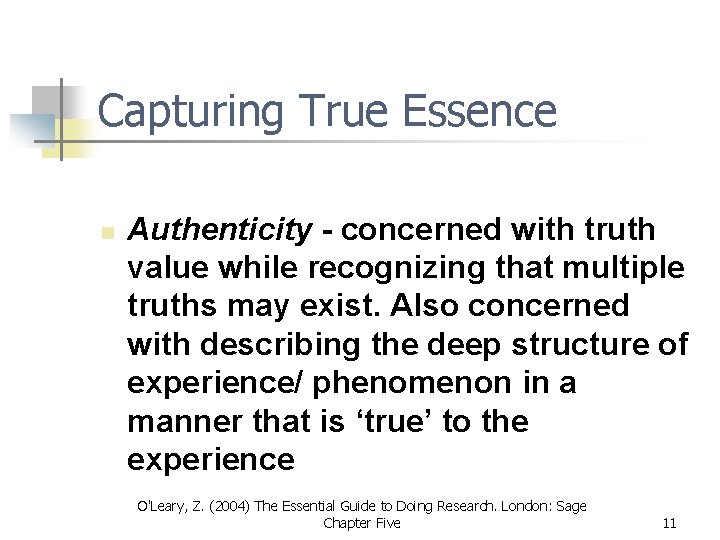
Capturing True Essence n Authenticity - concerned with truth value while recognizing that multiple truths may exist. Also concerned with describing the deep structure of experience/ phenomenon in a manner that is ‘true’ to the experience O'Leary, Z. (2004) The Essential Guide to Doing Research. London: Sage Chapter Five 11
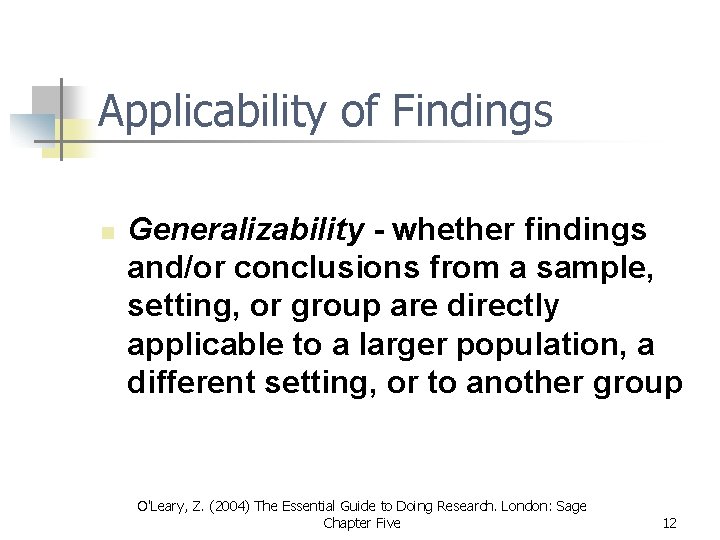
Applicability of Findings n Generalizability - whether findings and/or conclusions from a sample, setting, or group are directly applicable to a larger population, a different setting, or to another group O'Leary, Z. (2004) The Essential Guide to Doing Research. London: Sage Chapter Five 12
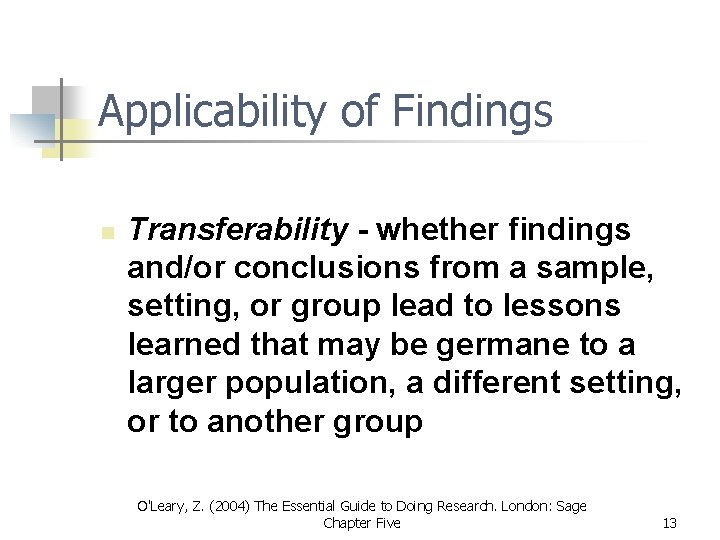
Applicability of Findings n Transferability - whether findings and/or conclusions from a sample, setting, or group lead to lessons learned that may be germane to a larger population, a different setting, or to another group O'Leary, Z. (2004) The Essential Guide to Doing Research. London: Sage Chapter Five 13
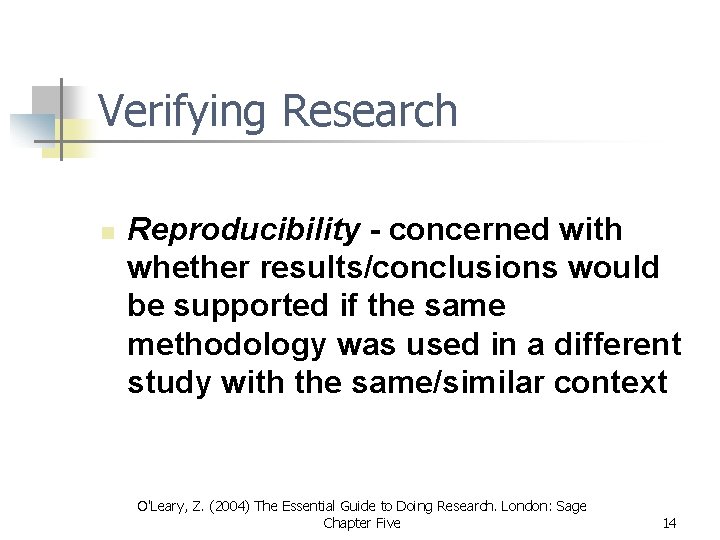
Verifying Research n Reproducibility - concerned with whether results/conclusions would be supported if the same methodology was used in a different study with the same/similar context O'Leary, Z. (2004) The Essential Guide to Doing Research. London: Sage Chapter Five 14
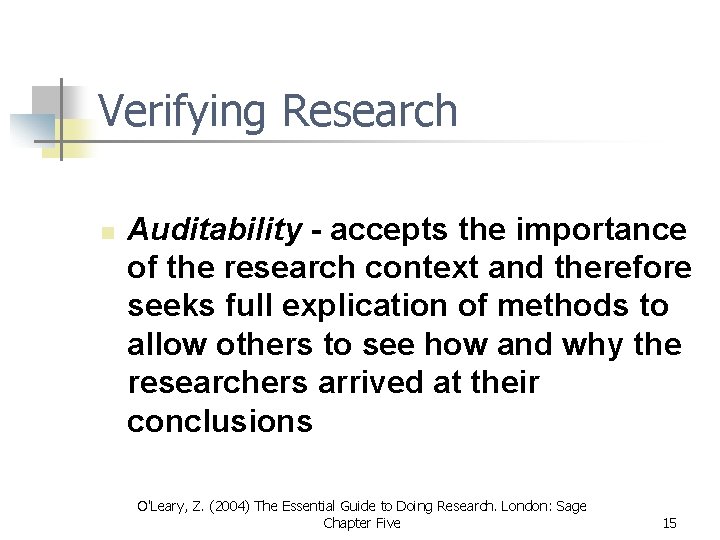
Verifying Research n Auditability - accepts the importance of the research context and therefore seeks full explication of methods to allow others to see how and why the researchers arrived at their conclusions O'Leary, Z. (2004) The Essential Guide to Doing Research. London: Sage Chapter Five 15