
Indicators for ecosystem based management Methods and applications
Indicators for ecosystem based management: Methods and applications Verena Trenkel, Anik Brind’Amour, Pascal Lorance, Stéphanie Mahevas, Marie-Joëlle Rochet Ecology and Models for Fisheries Science Ifremer, Nantes, France
Definition An indicator is a variable which quantifies how well a human activity is managed, in relation to specified objectives. A structured suite of indicators will reveal important system changes.
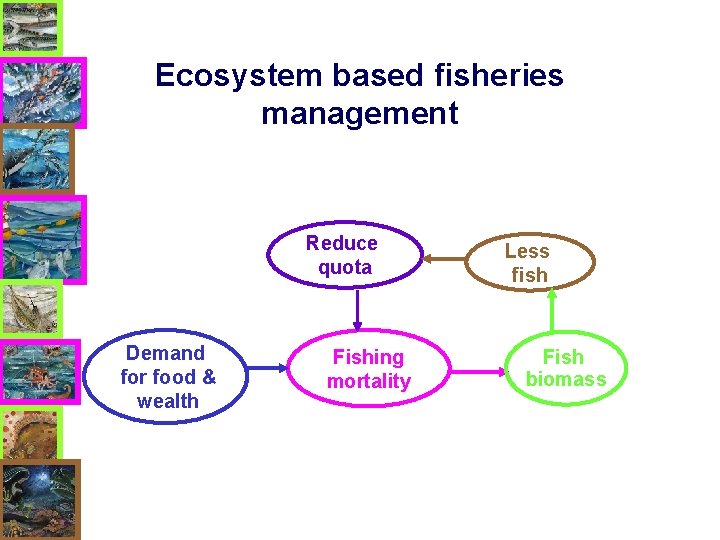
Ecosystem based fisheries management Reduce quota Demand for food & wealth Fishing mortality Less fish Fish biomass
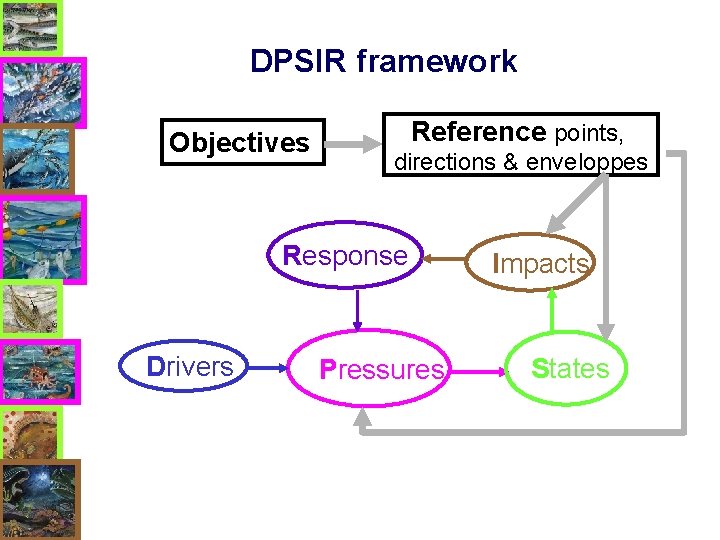
DPSIR framework Objectives Reference points, directions & enveloppes Response Drivers Pressures Impacts States
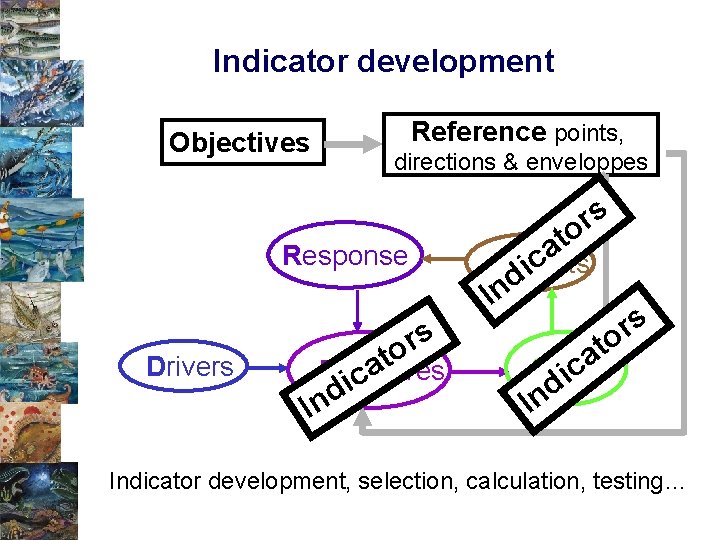
Indicator development Objectives Reference points, directions & enveloppes Response Drivers s r o t a Pressures c i d In s r to a c Impacts i d n I s r o t a States c i d n I Indicator development, selection, calculation, testing…
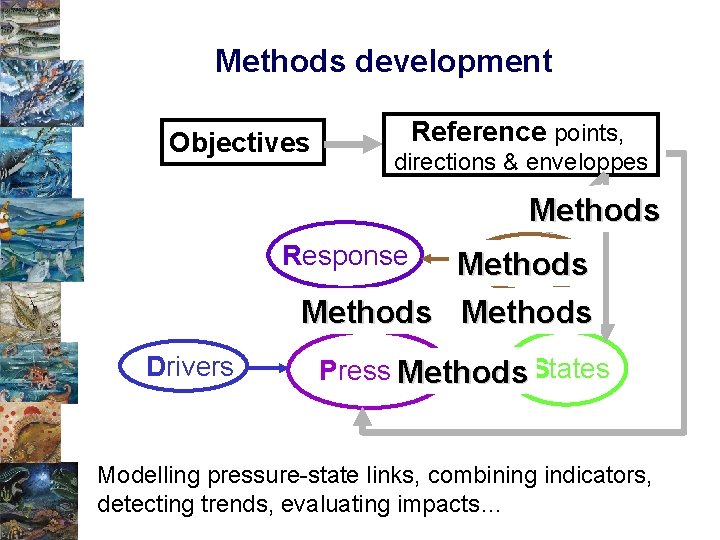
Methods development Objectives Reference points, directions & enveloppes Methods Response Impacts Methods Drivers Pressures Methods States Modelling pressure-state links, combining indicators, detecting trends, evaluating impacts…
Recent examples
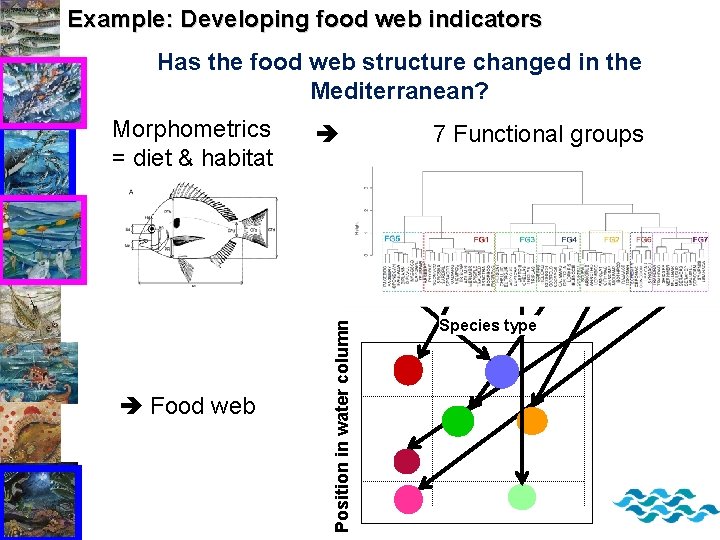
Example: Developing food web indicators Has the food web structure changed in the Mediterranean? Food web 7 Functional groups Position in water column Morphometrics = diet & habitat Species type 1
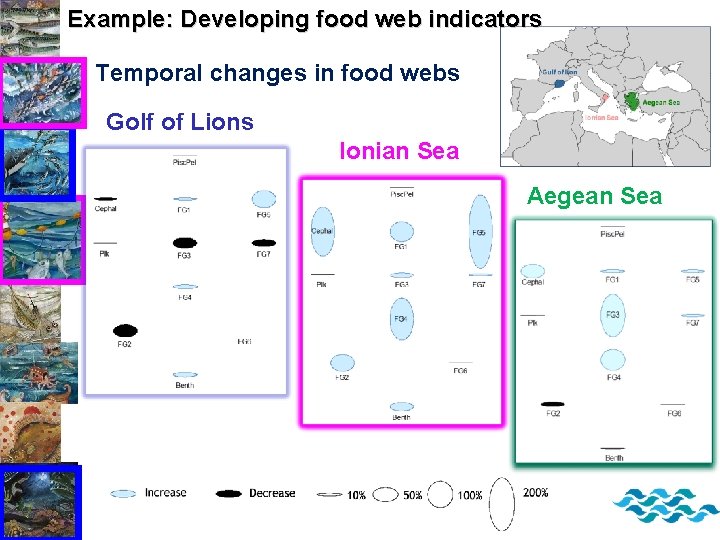
Example: Developing food web indicators Temporal changes in food webs Golf of Lions Ionian Sea Aegean Sea
Example: Selecting indicators for pelagic ecosystems Ecological objective: Maintain pelagic food supply for higher trophic levels Knowledge Few top predators & piscivores have strong pelagic prey dependance Operational objectives q Maintain herring and sprat in the Baltic Sea as prey for cod q Maintain total forage fish biomass in North Sea State & impact indicators q Prey biomass in critical area q Proxy: predator condition/growth/productivity Reference level q >x tons of prey species Pressure management q TAC, effort control, escapement rules 10

Example: Simulation testing population indicators Is occupancy a sensitive indicator for population abundance? 2 1 Demographic rates Spatial population dynamics 4 Observations Demographic rates Spatiotemporal catch & effort distribution r, K Spatiotemporal abundance distribution Depth Fishery dynamics Effort 3 Density 5 Indicator calculation Occupancy Depth Time In certain cases only: • occupancy can change much less than abundance • uncertainty in catches or effort can mask changes Trenkel et al In Press, Testing CPUE-derived spatial occupancy as an indicator for stock abundance: application to deep-sea stocks. Aquatic Living Resources DOI: 10. 1051/alr/2013060
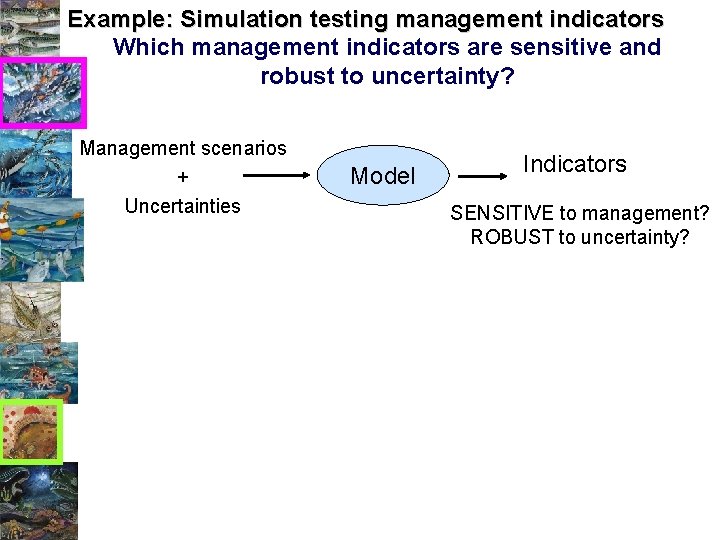
Example: Simulation testing management indicators Which management indicators are sensitive and robust to uncertainty? Management scenarios + Uncertainties Model Indicators SENSITIVE to management? ROBUST to uncertainty?
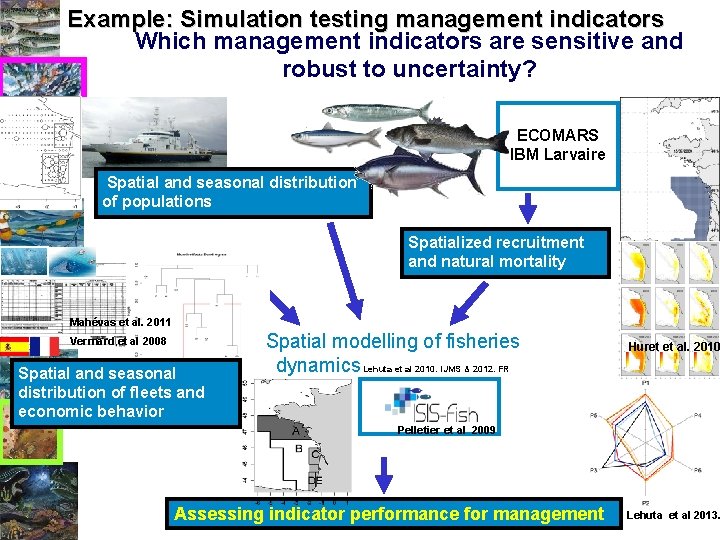
Example: Simulation testing management indicators Which management indicators are sensitive and robust to uncertainty? ECOMARS IBM Larvaire Spatial and seasonal distribution of populations Spatialized recruitment and natural mortality Mahévas et al. 2011 Vermard et al 2008 Spatial and seasonal distribution of fleets and economic behavior Spatial modelling of fisheries dynamics Lehuta et al 2010. IJMS & 2012. FR Huret et al. 2010 Pelletier et al 2009 Assessing indicator performance for management Lehuta et al 2013.
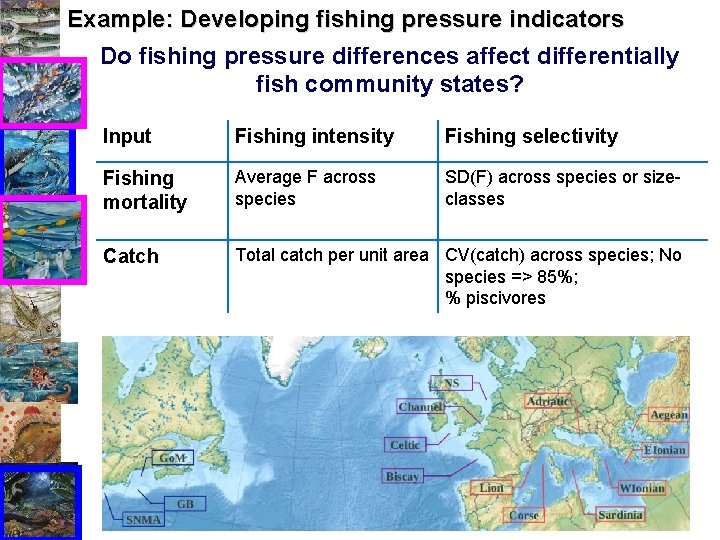
Example: Developing fishing pressure indicators Do fishing pressure differences affect differentially fish community states? Input Fishing intensity Fishing selectivity Fishing mortality Average F across species SD(F) across species or sizeclasses Catch Total catch per unit area CV(catch) across species; No species => 85%; % piscivores
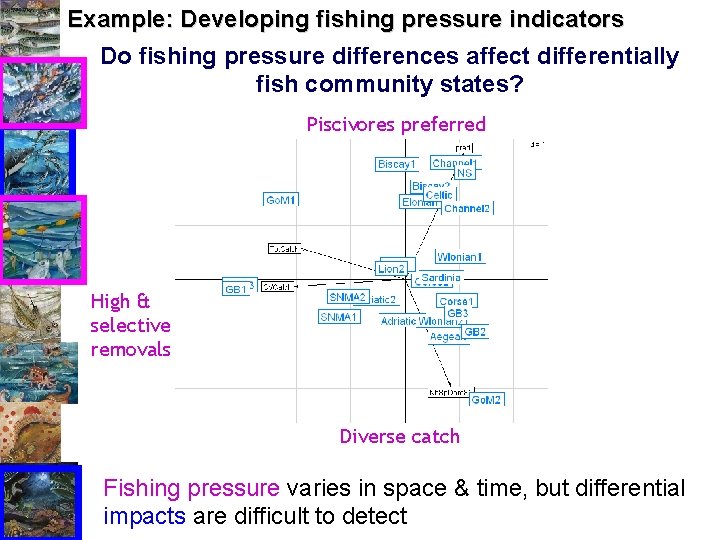
Example: Developing fishing pressure indicators Do fishing pressure differences affect differentially fish community states? Piscivores preferred High & selective removals Diverse catch Fishing pressure varies in space & time, but differential impacts are difficult to detect
For more information on our work on indicators q Come and see me q Read our publications http: //wwz. ifremer. fr/emh/Publications-EMH
- Slides: 16