
INDICATORS FOR CIRCULAR ECONOMY Arnau Gonzalez Junc Ph

- Slides: 11
INDICATORS FOR CIRCULAR ECONOMY Arnau Gonzalez Juncà Ph. D This project has received funding from the European Union's Horizon 2020 research and innovation programme under grant agreement N° 776708. The views expressed in this publication are the sole responsibility of the author/s and do not necessarily reflect the views of the European Commission.
Circular Economy: What is it about? According with renowned Ellen Mac. Arthur Foundation: “Underpinned by a transition to renewable energy sources, the circular model builds economic, natural, and social capital. It is based on three principles: • Design out waste and pollution • Keep products and materials in use • Regenerate natural systems” According with the European Parliament: “The circular economy is a model of production and consumption, which involves sharing, leasing, reusing, repairing, refurbishing and recycling existing materials and products as long as possible. In this way, the life cycle of products is extended. ”
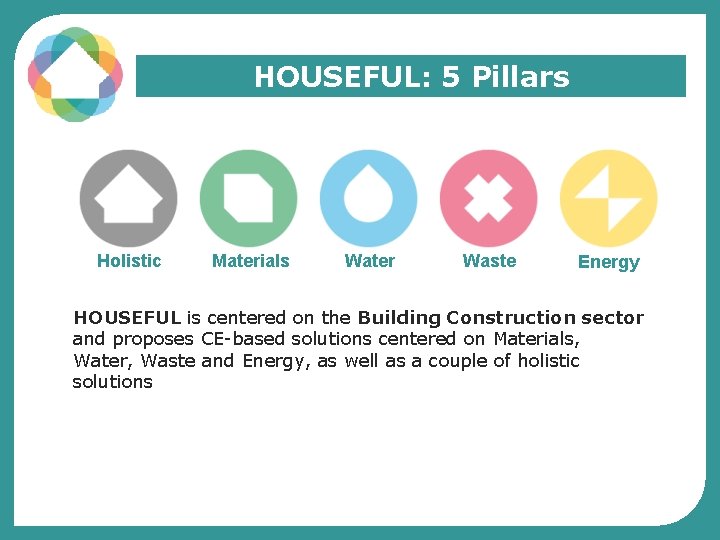
HOUSEFUL: 5 Pillars Holistic Materials Water Waste Energy HOUSEFUL is centered on the Building Construction sector and proposes CE-based solutions centered on Materials, Water, Waste and Energy, as well as a couple of holistic solutions
Circularity in the Built Environment Current approaches of Building Circularity assessment are mainly based only on materials assessment A building should be environmentally circular, socially sustainable and economically responsible HOUSEFUL’s Circularity Methodology proposes a holistic approach referring to: • Material resources • Energy • Water • Social issues • Environmental impact • Economic value HOUSEFUL’s methodology is aligned with Level(s) Framework of Sustainability Indicators for buildings
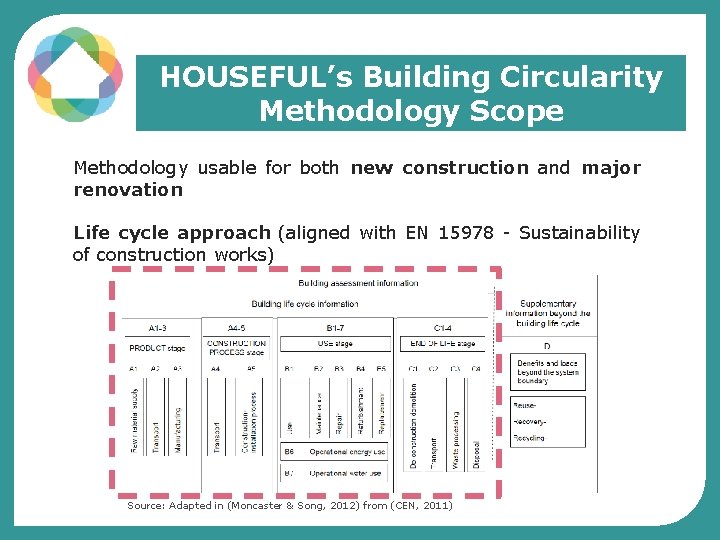
HOUSEFUL’s Building Circularity Methodology Scope Methodology usable for both new construction and major renovation Life cycle approach (aligned with EN 15978 - Sustainability of construction works) Source: Adapted in (Moncaster & Song, 2012) from (CEN, 2011)
Circularity Indicators Energy: Flow analysis • Embedded energy of products & materials, transportation & construction energy cost, operational energy use and dismantling and residues post-treatment embedded energy • “Circular” Energy: renewable energy produced on-site or nearby Materials: Flow analysis • Evaluation of circularity in terms of cycled materials use both upstream (products & materials) and downstream (C&DW) and incorporating products and parts service life and associated replacements • “Circular” Materials: see later
Circularity Indicators Water: Flow analysis • Evaluation of circularity in terms of: water footprint of products & materials, construction water use, operational water use and dismantling and C&DW post-treatment water footprint • “Circular” Water: on-site or nearby cycled water, i. e. recovered greywater, blackwater, rainwater… Social impact: checklist count • Evaluation of circularity in terms of social added value, also including relevant indicators – aside from Level(s) ones – to express and measure the positive social impact (i. e. Cradleto-Cradle, LEED, BREEAM…) • Social added value positively computing for Circularity includes Health and Comfort (use stage), Use of local workforce and pollution prevention (construction and deconstruction), social fairness (product stage)
Circularity Indicators Environmental impact: LCA/LCC • Evaluation of GWP reduction calculated by means of a Life Cycle Assessment (LCA). This is an overarching vector evaluating the environmental benefits of the entire project and therefore incorporating effects from pillars 1 to 4 • Environmental impact reduction positively computes for circularity of the building Economic value: LCA/LCC • Evaluation of Life Cycle Cost reduction calculated by means of a Life Cycle Costing (LCC) analysis. This is an overarching vector evaluating the economic value of the entire project incorporating positive and negative externalities and therefore incorporating effects from pillars 1 to 5 • Life Cycle Cost reduction positively computes for circularity of the building
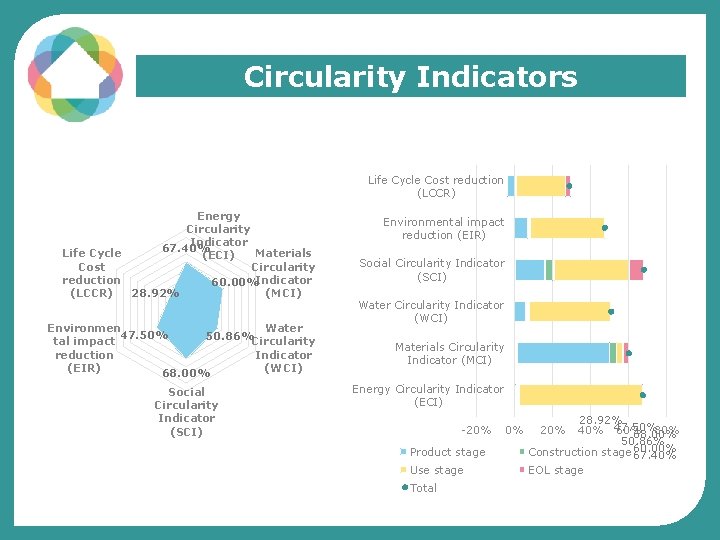
Circularity Indicators Life Cycle Cost reduction (LCCR) Energy Circularity Indicator 67. 40% Life Cycle Materials (ECI) Cost Circularity reduction 60. 00%Indicator (LCCR) (MCI) 28. 92% Environmen Water 47. 50% 50. 86% tal impact Circularity reduction Indicator (EIR) (WCI) 68. 00% Social Circularity Indicator (SCI) Environmental impact reduction (EIR) Social Circularity Indicator (SCI) Water Circularity Indicator (WCI) Materials Circularity Indicator (MCI) Energy Circularity Indicator (ECI) -20% Product stage Use stage Total 0% 28. 92% 40% 47. 50% 60% 80% 68. 00% 50. 86% Construction stage 60. 00% 67. 40% EOL stage 20%
Which pillar is more important? Depending on the location of the building assessed, one pillar or another might hold more importance than the others HOUSEFUL approach proposes the use of Eurostat indicators to tackle the different level of stress of the region in one or another aspect • Energy Dependency Rate, Share of RE in Gross Energy Consumption • Water Exploitation Index • Unemployment Rate, Energy Poverty • GHG emissions per capita, % reduction missing to reach 2030 target • GDP per capita, Gini coefficient or Inequality • … A “Building Circularity Score” is assigned as the weighted average of all pillar circularity scores
Thank you This project has received funding from the European Union's Horizon 2020 research and innovation programme under grant agreement N° 776708. The views expressed in this publication are the sole responsibility of the author/s and do not necessarily reflect the views of the European Commission.