
INDICATORS FOR AN INCLUSIVE GREEN ECONOMY INTRODUCTORY COURSE
- Slides: 29
INDICATORS FOR AN INCLUSIVE GREEN ECONOMY INTRODUCTORY COURSE
Why this course? § To introduce indicators for an Inclusive Green Economy (IGE) and discuss their role in policymaking § To describe various frameworks to structure a set of IGE indicators, particularly the framework of the Green Growth Knowledge Platform § To explore establishing an indicator framework and selecting indicators PAGE Indicators Introductory Course, Session 1 2 2
Overview of the course 1. Introduction to concepts 2. Choosing appropriate frameworks 3. Approaches to measurement 4. Selecting green economy indicators Group exercise PAGE Indicators Introductory Course, Session 1 3 3
UN Environment definition of Inclusive Green Economy “an economy that results in improved human well-being and social equity, while significantly reducing environmental risks and ecological scarcities” PAGE Indicators Introductory Course, Session 1 4 4
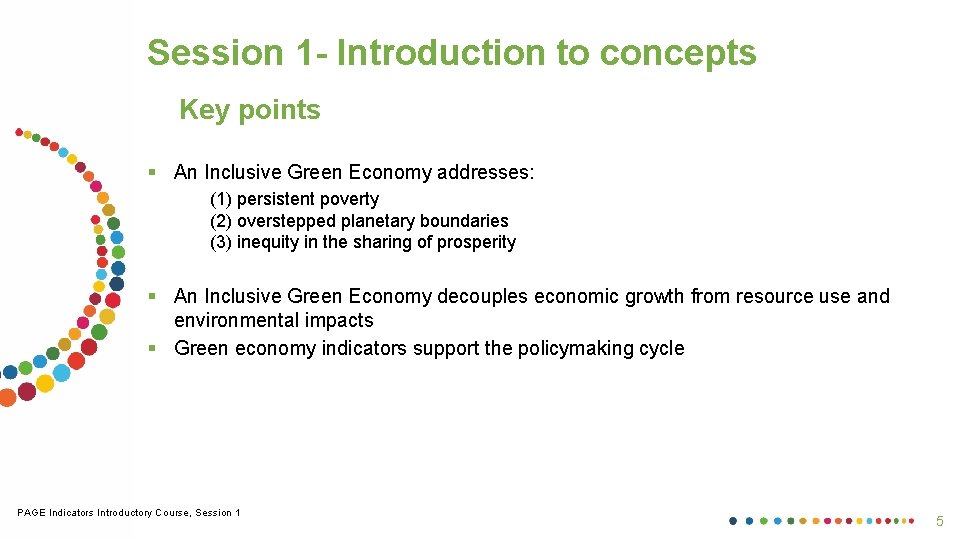
Session 1 - Introduction to concepts Key points § An Inclusive Green Economy addresses: (1) persistent poverty (2) overstepped planetary boundaries (3) inequity in the sharing of prosperity § An Inclusive Green Economy decouples economic growth from resource use and environmental impacts § Green economy indicators support the policymaking cycle PAGE Indicators Introductory Course, Session 1 5 5
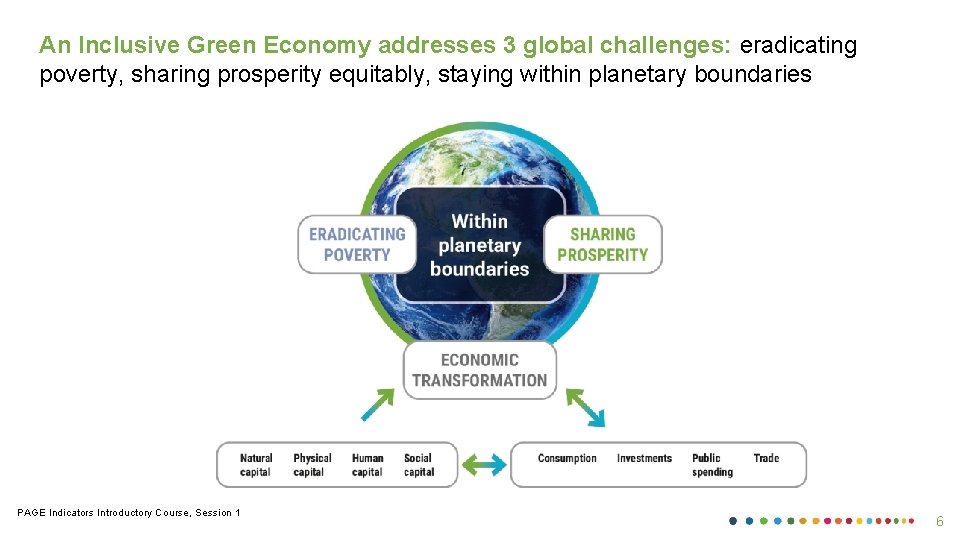
An Inclusive Green Economy addresses 3 global challenges: eradicating poverty, sharing prosperity equitably, staying within planetary boundaries PAGE Indicators Introductory Course, Session 1 6 6
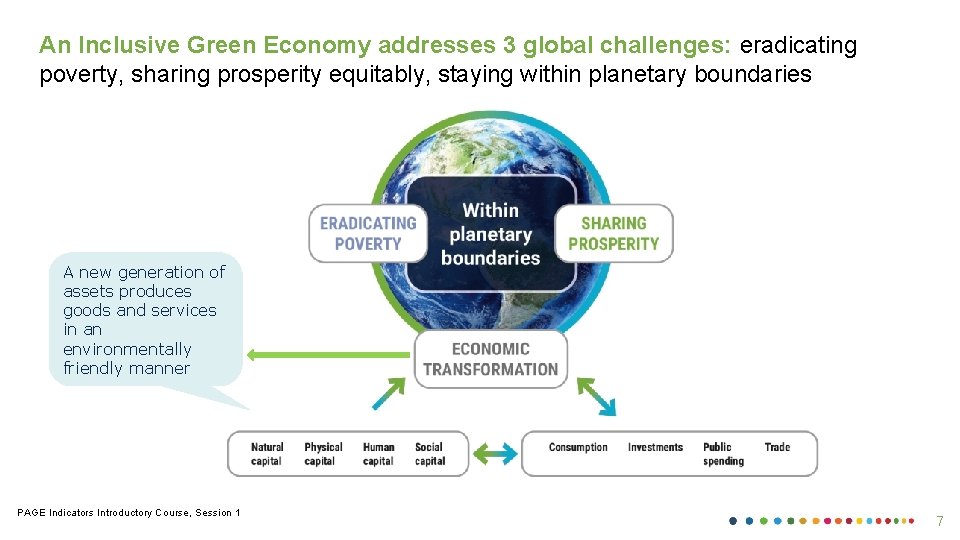
An Inclusive Green Economy addresses 3 global challenges: eradicating poverty, sharing prosperity equitably, staying within planetary boundaries A new generation of assets produces goods and services in an environmentally friendly manner PAGE Indicators Introductory Course, Session 1 7 7
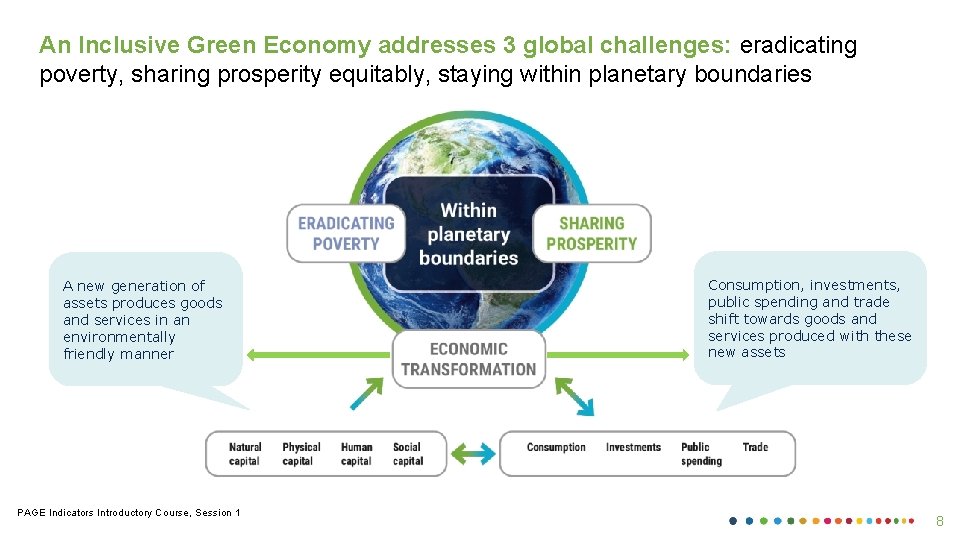
An Inclusive Green Economy addresses 3 global challenges: eradicating poverty, sharing prosperity equitably, staying within planetary boundaries A new generation of assets produces goods and services in an environmentally friendly manner PAGE Indicators Introductory Course, Session 1 Consumption, investments, public spending and trade shift towards goods and services produced with these new assets 8 8
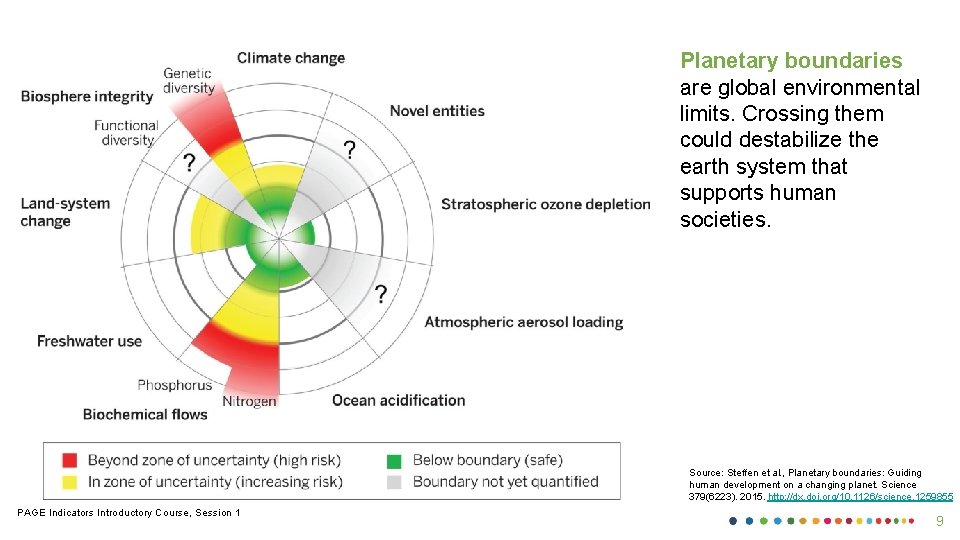
Planetary boundaries are global environmental limits. Crossing them could destabilize the earth system that supports human societies. Source: Steffen et al. , Planetary boundaries: Guiding human development on a changing planet. Science 379(6223). 2015. http: //dx. doi. org/10. 1126/science. 1259855 PAGE Indicators Introductory Course, Session 1 9 9
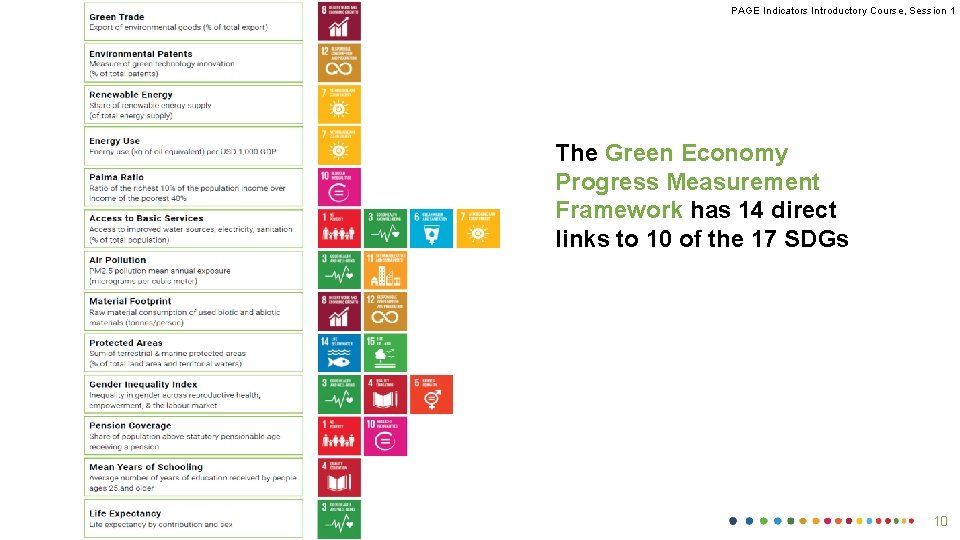
PAGE Indicators Introductory Course, Session 1 The Green Economy Progress Measurement Framework has 14 direct links to 10 of the 17 SDGs 10 10
What will it take to achieve an Inclusive Green Economy? • • private and public investment fiscal policies better market access for sustainable technologies green industrial policies generation of green jobs promotion of social inclusion use of trade opportunities from new markets and technological innovation PAGE Indicators Introductory Course, Session 1 11 11
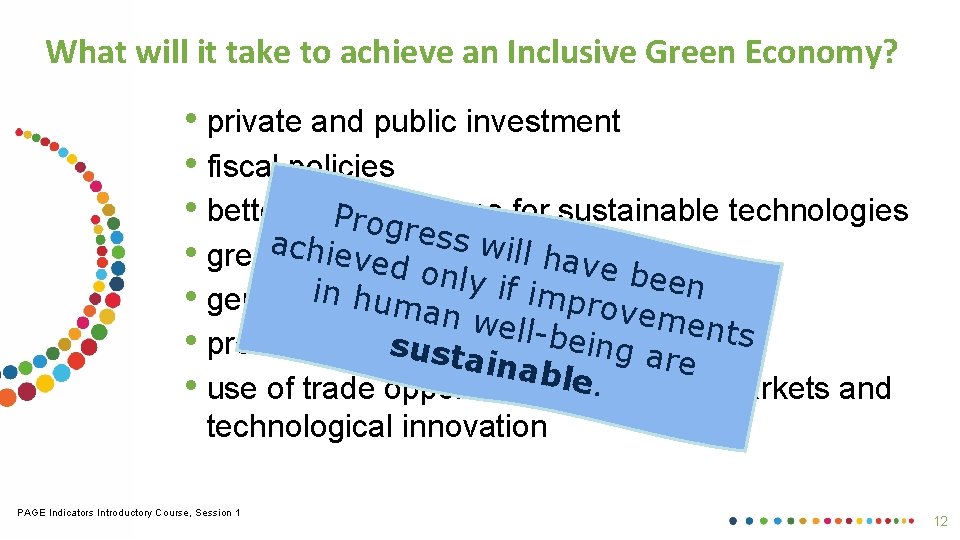
What will it take to achieve an Inclusive Green Economy? • private and public investment • fiscal policies • better market Prograccess for sustainable technologies e ss wil a c h l have ieved policies • green industrial only i b een f i n i mpro • generationhof green jobs um veme an we n l l t s b e • promotion of ssocial inclusion i ng ar ustai e nable. new markets and • use of trade opportunities from technological innovation PAGE Indicators Introductory Course, Session 1 12 12
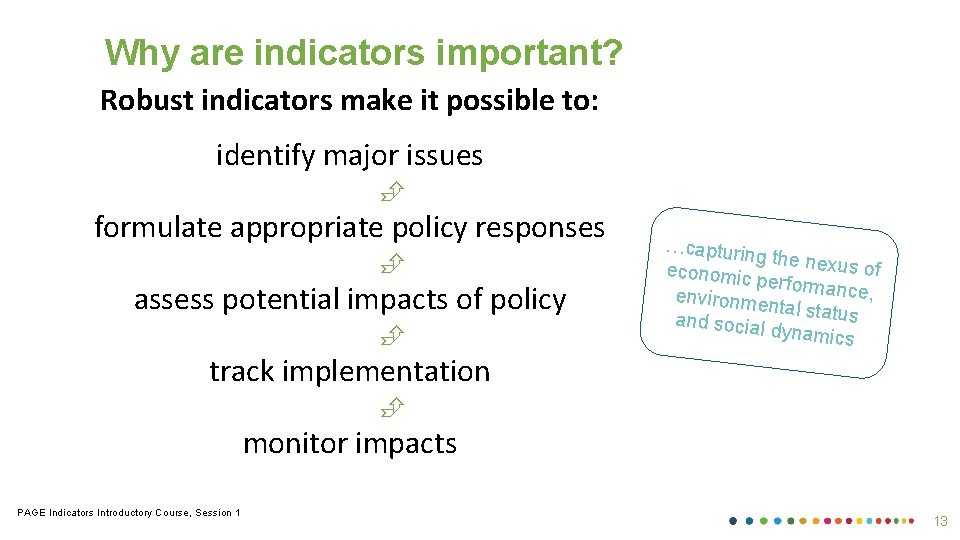
Why are indicators important? Robust indicators make it possible to: identify major issues formulate appropriate policy responses assess potential impacts of policy …capturin g the nexu s of economic performan ce, environme ntal status and social dynamics track implementation monitor impacts PAGE Indicators Introductory Course, Session 1 13 13
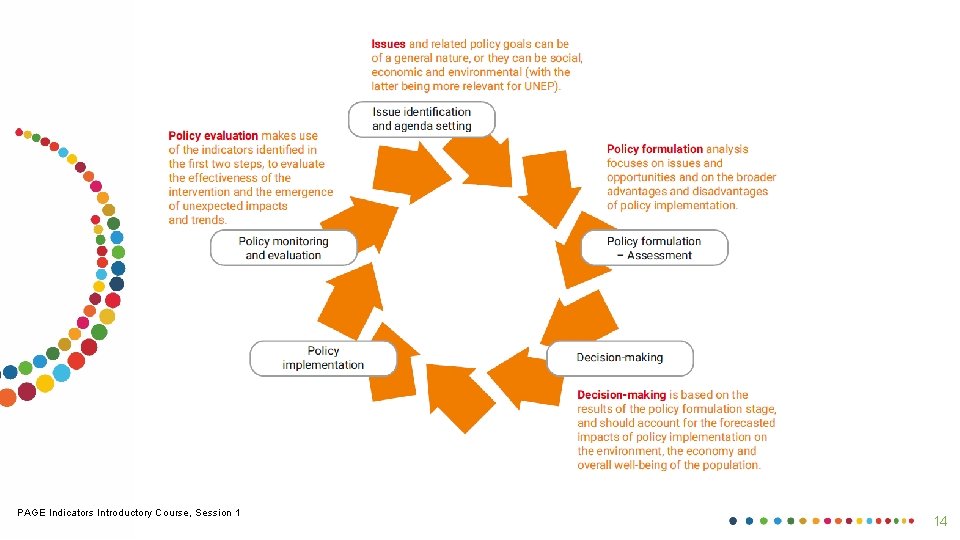
PAGE Indicators Introductory Course, Session 1 14 14
STAGE 1 Issues identification: “What is the problem? ” Identify and prioritize challenges and opportunities, and set an agenda PAGE Indicators Introductory Course, Session 1 15 15
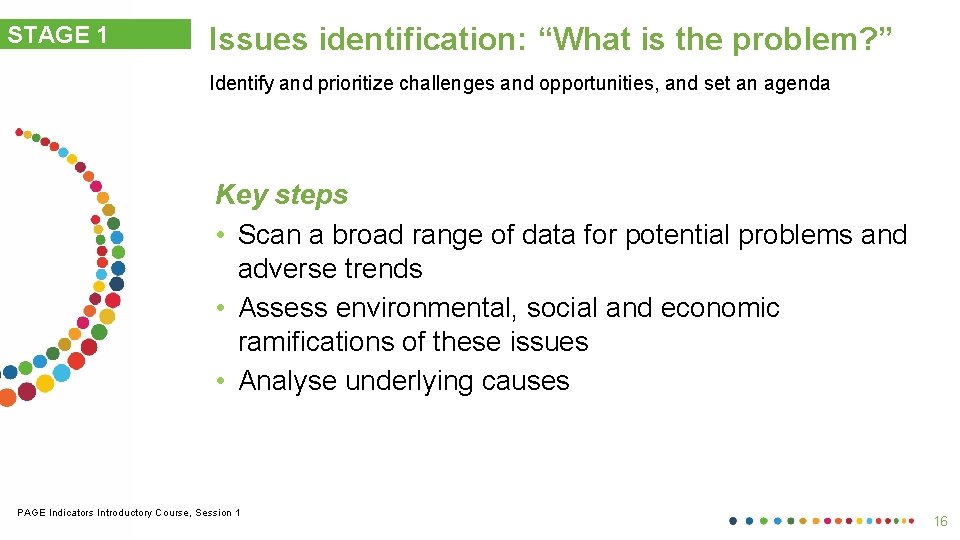
STAGE 1 Issues identification: “What is the problem? ” Identify and prioritize challenges and opportunities, and set an agenda Key steps • Scan a broad range of data for potential problems and adverse trends • Assess environmental, social and economic ramifications of these issues • Analyse underlying causes PAGE Indicators Introductory Course, Session 1 16 16
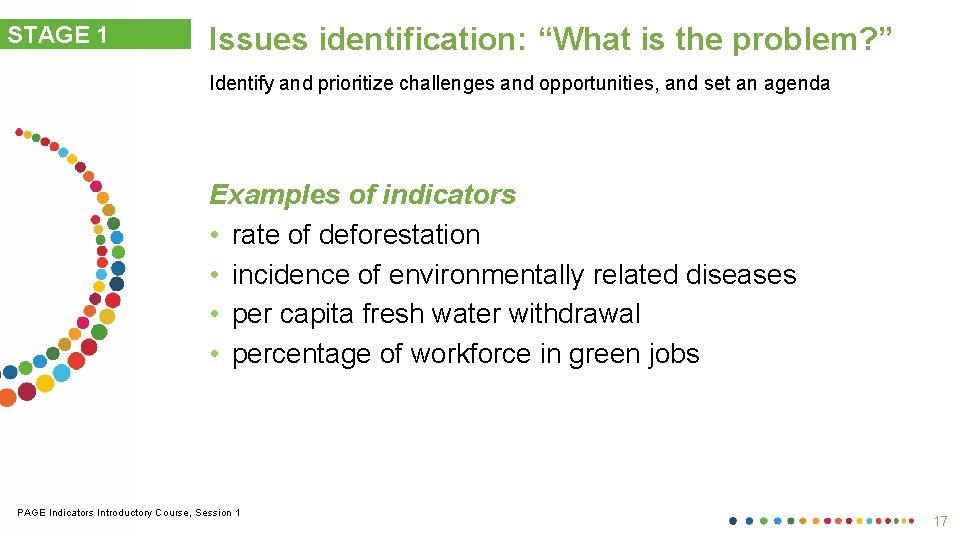
STAGE 1 Issues identification: “What is the problem? ” Identify and prioritize challenges and opportunities, and set an agenda Examples of indicators • rate of deforestation • incidence of environmentally related diseases • per capita fresh water withdrawal • percentage of workforce in green jobs PAGE Indicators Introductory Course, Session 1 17 17
STAGE 2 Policy formulation: «What should we do? » Design potential solutions by defining the investments needed PAGE Indicators Introductory Course, Session 1 18 18
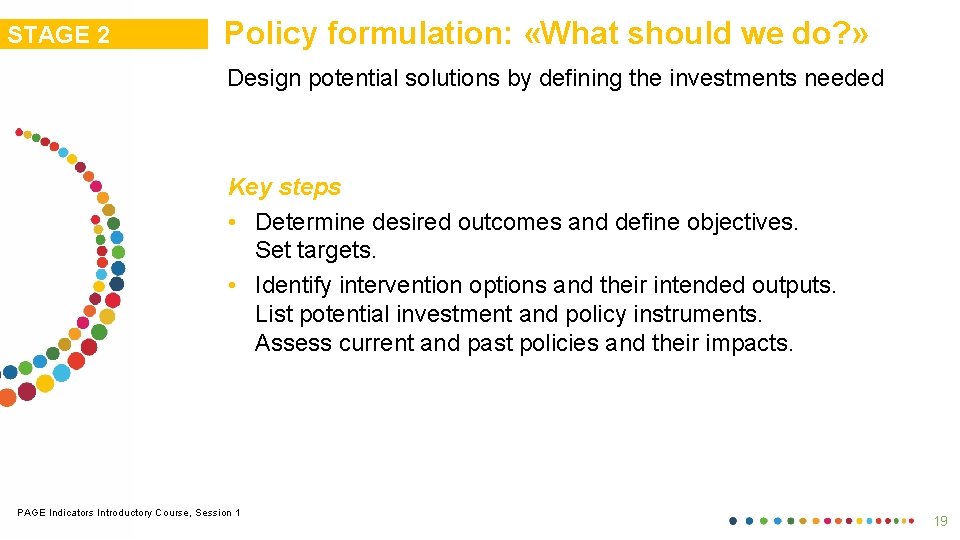
STAGE 2 Policy formulation: «What should we do? » Design potential solutions by defining the investments needed Key steps • Determine desired outcomes and define objectives. Set targets. • Identify intervention options and their intended outputs. List potential investment and policy instruments. Assess current and past policies and their impacts. PAGE Indicators Introductory Course, Session 1 19 19
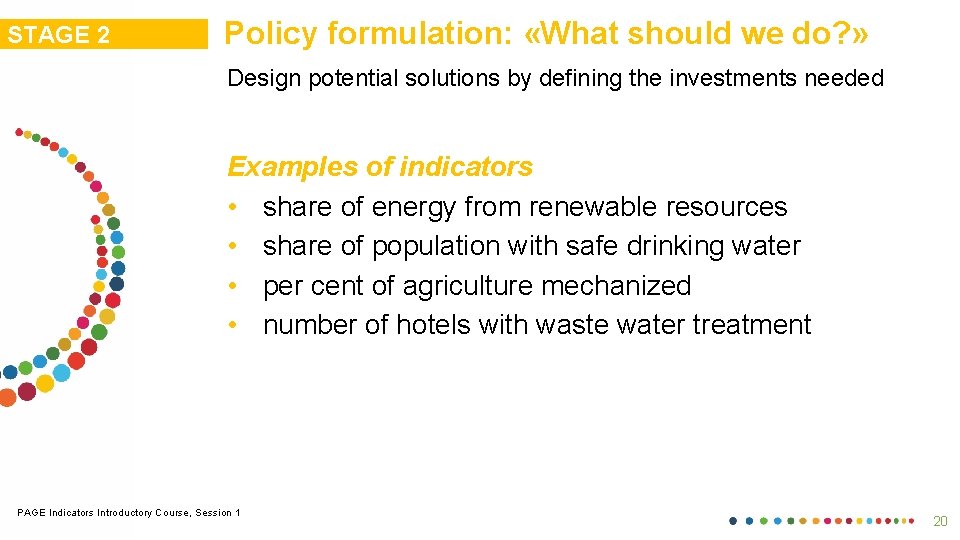
STAGE 2 Policy formulation: «What should we do? » Design potential solutions by defining the investments needed Examples of indicators • share of energy from renewable resources • share of population with safe drinking water • per cent of agriculture mechanized • number of hotels with waste water treatment PAGE Indicators Introductory Course, Session 1 20 20
STAGE 3 Policy assessment: «What will be the impacts? » Evaluate the effectiveness and effects of each option in social, economic and environmental dimensions PAGE Indicators Introductory Course, Session 1 21 21
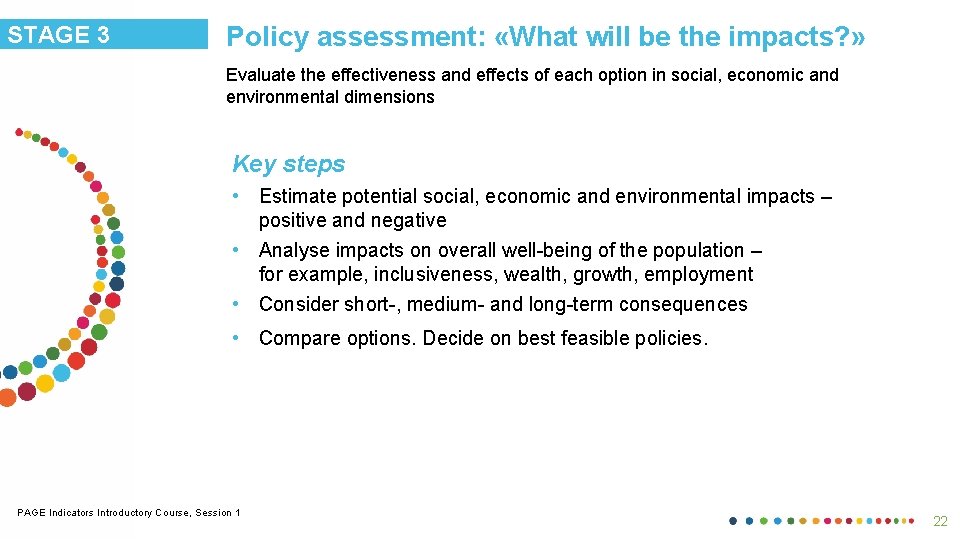
STAGE 3 Policy assessment: «What will be the impacts? » Evaluate the effectiveness and effects of each option in social, economic and environmental dimensions Key steps • Estimate potential social, economic and environmental impacts – positive and negative • Analyse impacts on overall well-being of the population – for example, inclusiveness, wealth, growth, employment • Consider short-, medium- and long-term consequences • Compare options. Decide on best feasible policies. PAGE Indicators Introductory Course, Session 1 22 22
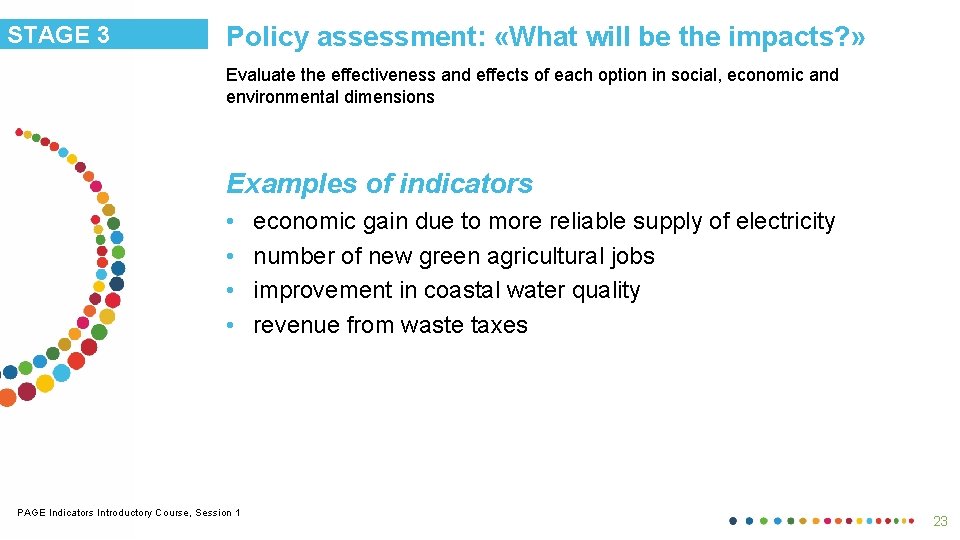
STAGE 3 Policy assessment: «What will be the impacts? » Evaluate the effectiveness and effects of each option in social, economic and environmental dimensions Examples of indicators • • PAGE Indicators Introductory Course, Session 1 economic gain due to more reliable supply of electricity number of new green agricultural jobs improvement in coastal water quality revenue from waste taxes 23 23
STAGE 4 Implementation: “Are we doing what we planned? ” Monitor whether the intervention is functioning as intended and generating expected outputs PAGE Indicators Introductory Course, Session 1 24 24
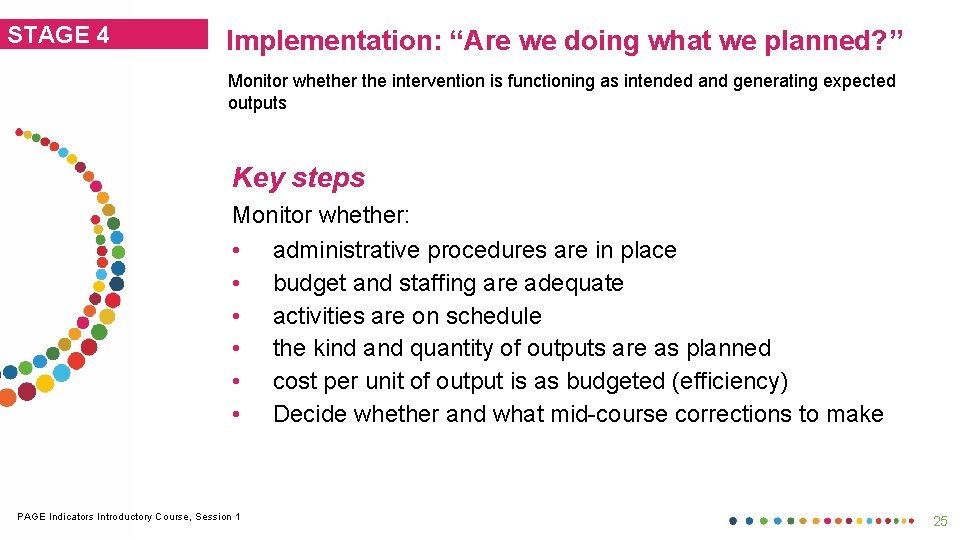
STAGE 4 Implementation: “Are we doing what we planned? ” Monitor whether the intervention is functioning as intended and generating expected outputs Key steps Monitor whether: • administrative procedures are in place • budget and staffing are adequate • activities are on schedule • the kind and quantity of outputs are as planned • cost per unit of output is as budgeted (efficiency) • Decide whether and what mid-course corrections to make PAGE Indicators Introductory Course, Session 1 25 25
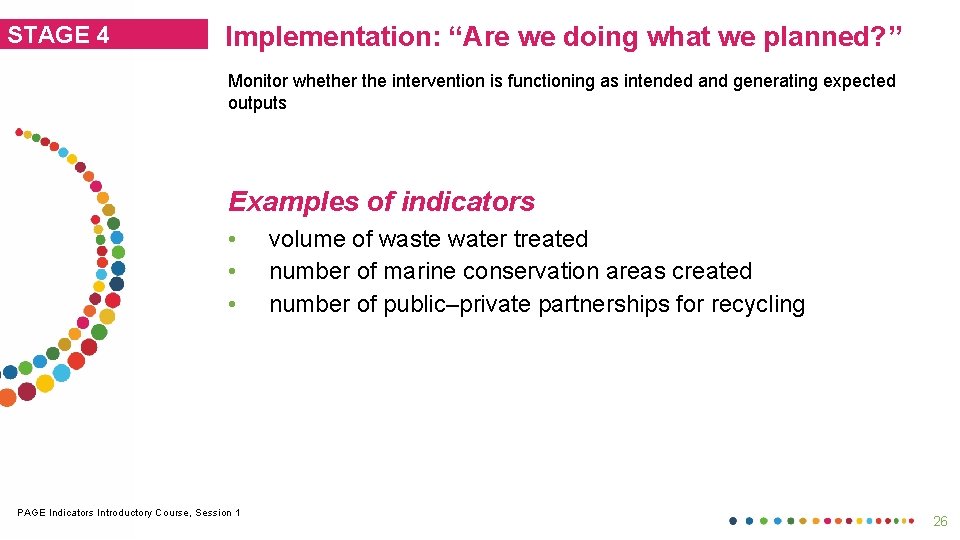
STAGE 4 Implementation: “Are we doing what we planned? ” Monitor whether the intervention is functioning as intended and generating expected outputs Examples of indicators • • • PAGE Indicators Introductory Course, Session 1 volume of waste water treated number of marine conservation areas created number of public–private partnerships for recycling 26 26
STAGE 5 M&E: “How are we performing? ” Assess the outcomes and impacts of the policy intervention PAGE Indicators Introductory Course, Session 1 27 27
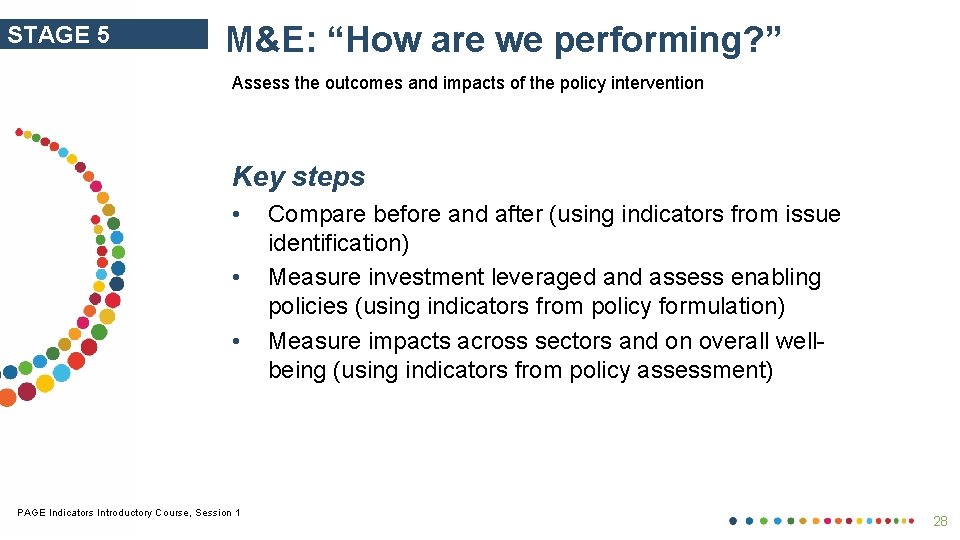
STAGE 5 M&E: “How are we performing? ” Assess the outcomes and impacts of the policy intervention Key steps • • • PAGE Indicators Introductory Course, Session 1 Compare before and after (using indicators from issue identification) Measure investment leveraged and assess enabling policies (using indicators from policy formulation) Measure impacts across sectors and on overall wellbeing (using indicators from policy assessment) 28 28
STAGE 5 M&E: “How are we performing? ” Assess the outcomes and impacts of the policy intervention Examples of indicators • • • PAGE Indicators Introductory Course, Session 1 CO 2 emissions incidence of water-borne diseases productivity of agricultural land 29 29