
Indian Wells Valley Groundwater Basin Brackish Water Future
Indian Wells Valley Groundwater Basin Brackish Water & Future Water Supply
Overview �What is a brackish groundwater project? �Where has brackish water been developed? �Globally, United States, California, Recent Grant Awards. �How can brackish water development help IWV? �Where is the brackish groundwater? �Basin Hydrogeology. �Brackish Groundwater Distribution. �What will a brackish water project look like? �Flow Chart. �Extraction & Conveyance. �Current status.
What Is A Brackish Groundwater Project? �Fresh Water < 1, 000 mg/L of total dissolved solids (TDS). �Brackish Water 1, 000 mg/L to 10, 000 mg/L (USGS, 2017). �Large-scale development of fresh groundwater has reduced amounts in storage and remaining volumes for future use. �Brackish groundwater is an alternative supply that can be used to augment existing “fresh” sources of water. �Basic process steps: �Extract with Wells – Treat with Reverse Osmosis (RO) – Deliver Fresh Water into System – Dispose RO Concentrate (salts).
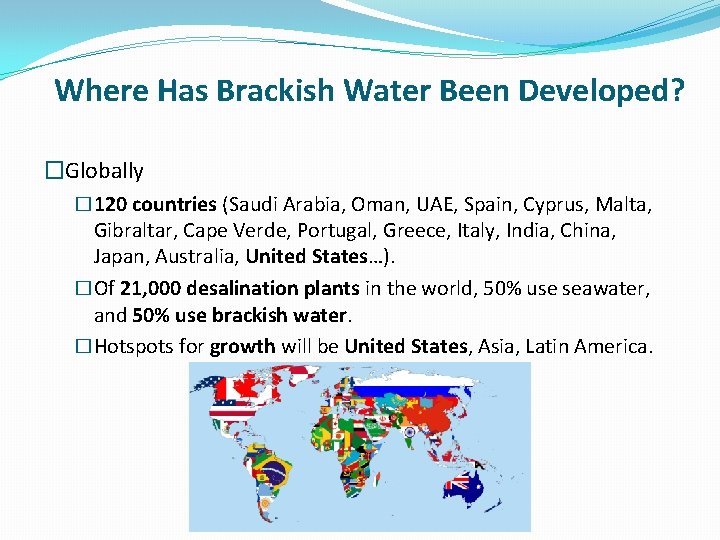
Where Has Brackish Water Been Developed? �Globally � 120 countries (Saudi Arabia, Oman, UAE, Spain, Cyprus, Malta, Gibraltar, Cape Verde, Portugal, Greece, Italy, India, China, Japan, Australia, United States…). �Of 21, 000 desalination plants in the world, 50% use seawater, and 50% use brackish water. �Hotspots for growth will be United States, Asia, Latin America.
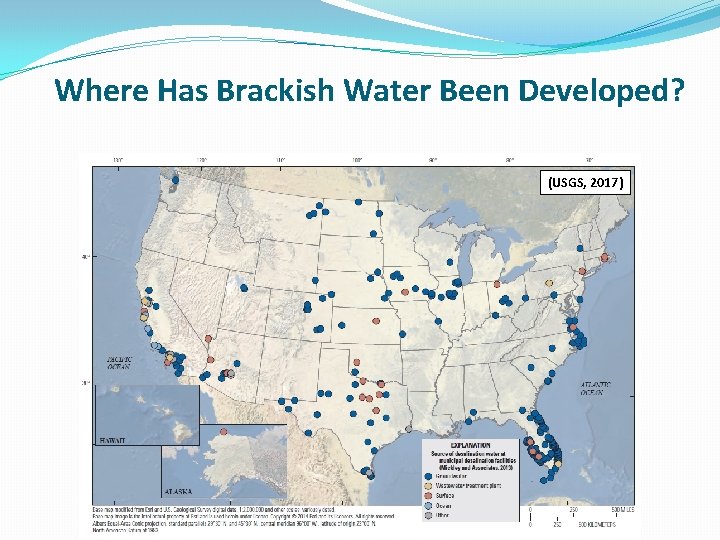
Where Has Brackish Water Been Developed? (USGS, 2017)
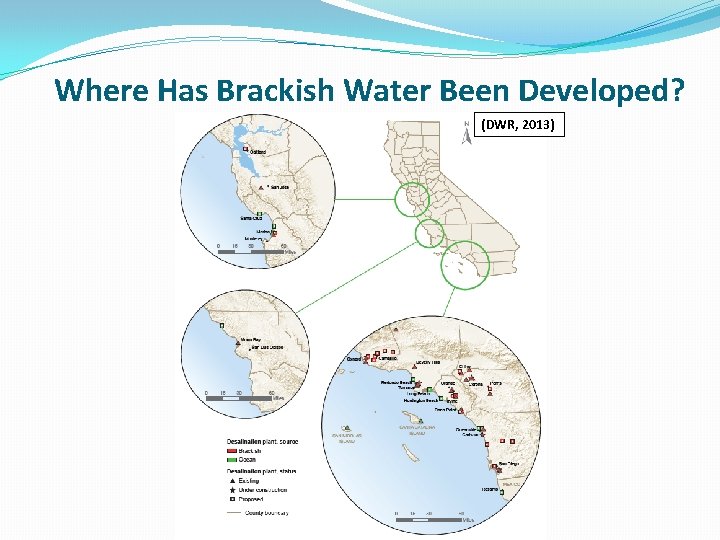
Where Has Brackish Water Been Developed? (DWR, 2013)
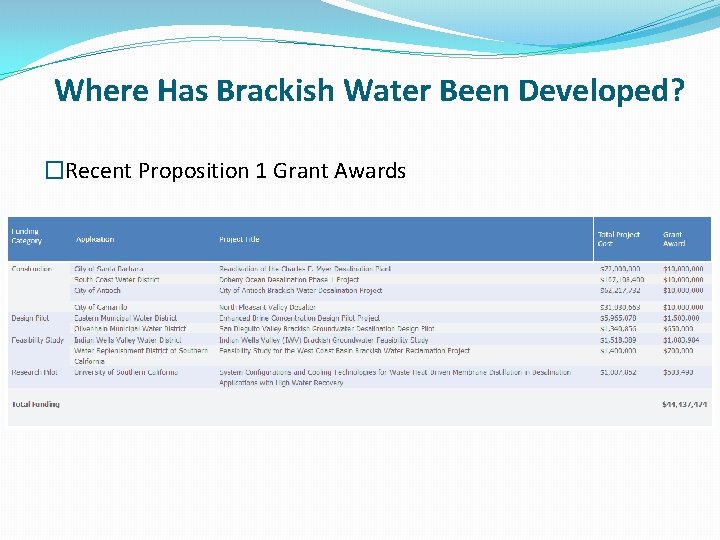
Where Has Brackish Water Been Developed? �Recent Proposition 1 Grant Awards
How Can Brackish Water Development Help Indian Wells Valley? � Expanding Local Supplies. � Fresh groundwater levels are declining (offset pumping in these areas). � Augment existing supply. � Improving Reliability. � Part of a portfolio of multiple sources of water. � � � Existing fresh groundwater. Imported water. Recycled water. Recharged and stored groundwater. Brackish groundwater. � Emergency Supplies. � Drought periods or other extraordinary events. � Buffer to Achieve SGMA Sustainability. � Brine (RO Concentrate) for Industrial Applications. � Coso Geothermal and Searles Valley Minerals.
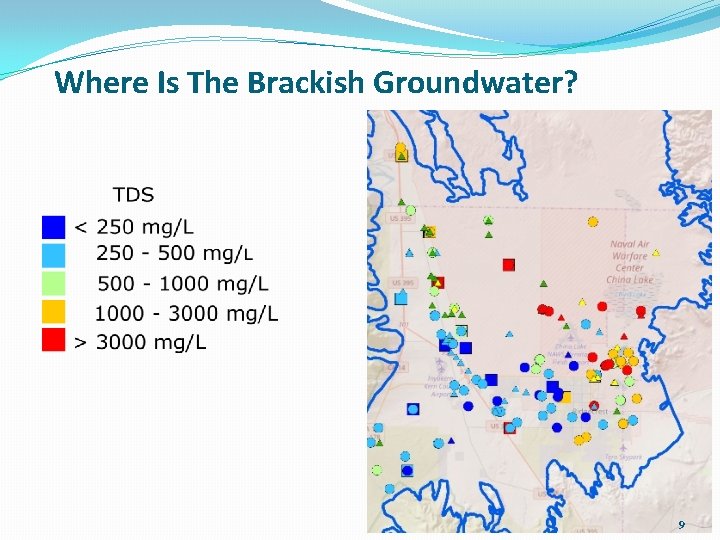
Where Is The Brackish Groundwater? 9
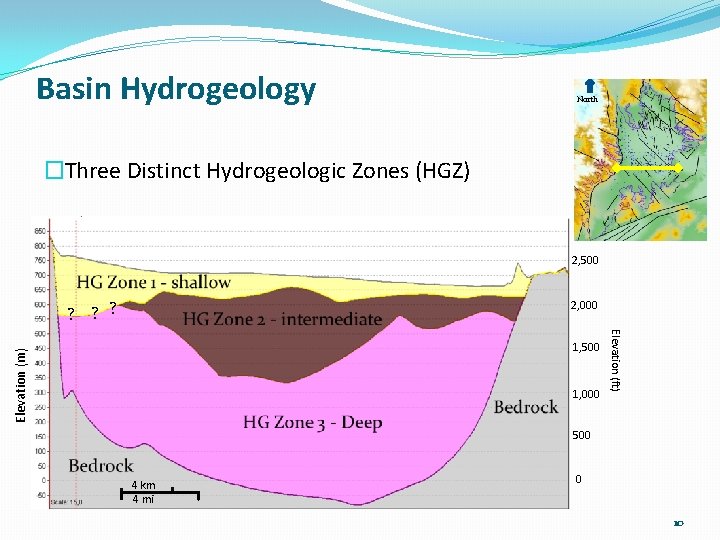
Basin Hydrogeology North �Three Distinct Hydrogeologic Zones (HGZ) 2, 500 ? ? ? 2, 000 Elevation (m) 1, 000 Elevation (ft) 1, 500 4 km 4 mi 0 10
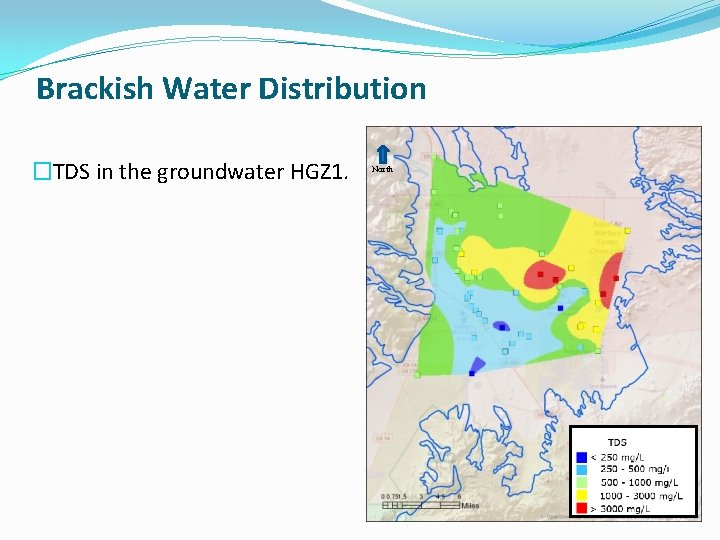
Brackish Water Distribution �TDS in the groundwater HGZ 1. North
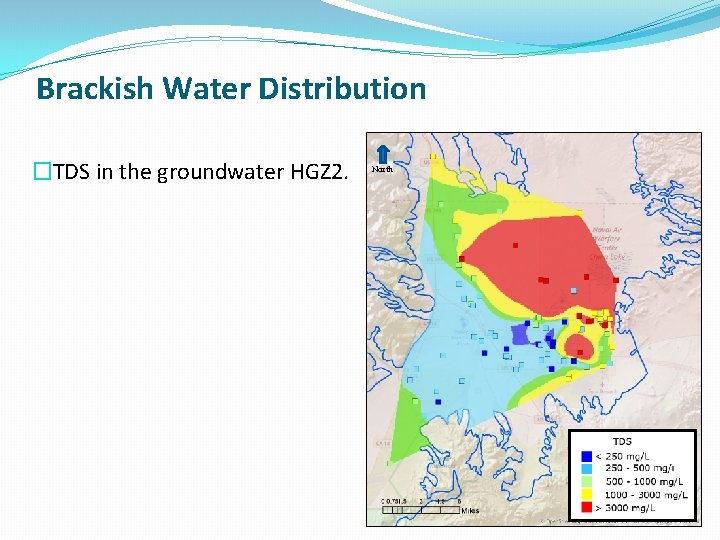
Brackish Water Distribution �TDS in the groundwater HGZ 2. North
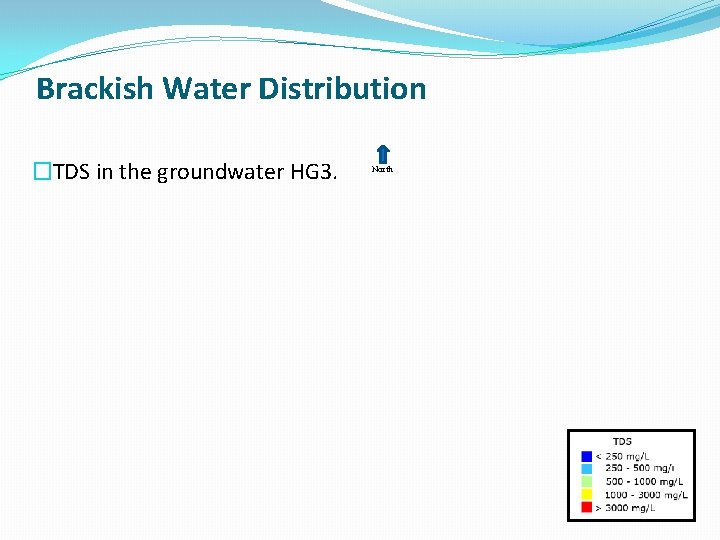
Brackish Water Distribution �TDS in the groundwater HG 3. North
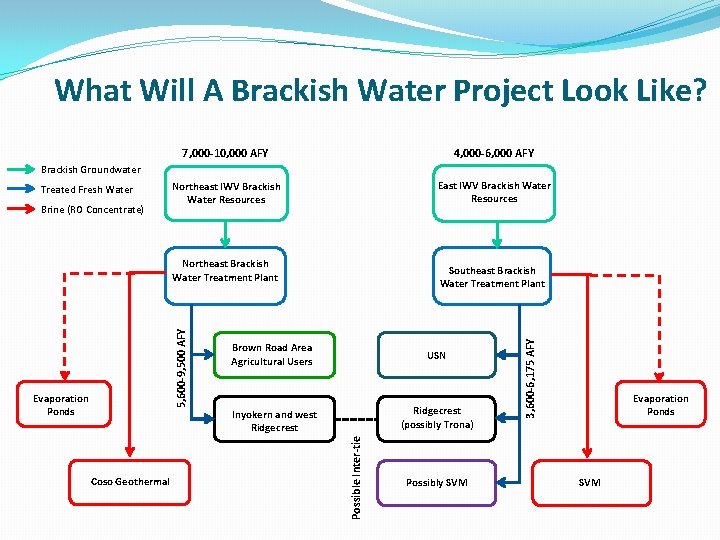
What Will A Brackish Water Project Look Like? 7, 000 -10, 000 AFY 4, 000 -6, 000 AFY Northeast IWV Brackish Water Resources East IWV Brackish Water Resources Brackish Groundwater Brine (RO Concentrate) Evaporation Ponds Coso Geothermal Southeast Brackish Water Treatment Plant Brown Road Area Agricultural Users USN Inyokern and west Ridgecrest (possibly Trona) Possible Inter-tie 5, 600 -9, 500 AFY Northeast Brackish Water Treatment Plant Possibly SVM 3, 600 -6, 175 AFY Treated Fresh Water Evaporation Ponds SVM
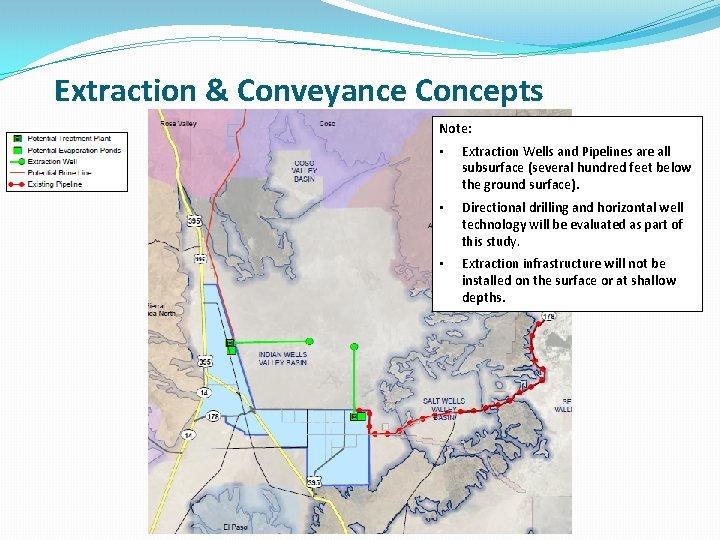
Extraction & Conveyance Concepts Note: • Extraction Wells and Pipelines are all subsurface (several hundred feet below the ground surface). • Directional drilling and horizontal well technology will be evaluated as part of this study. • Extraction infrastructure will not be installed on the surface or at shallow depths.
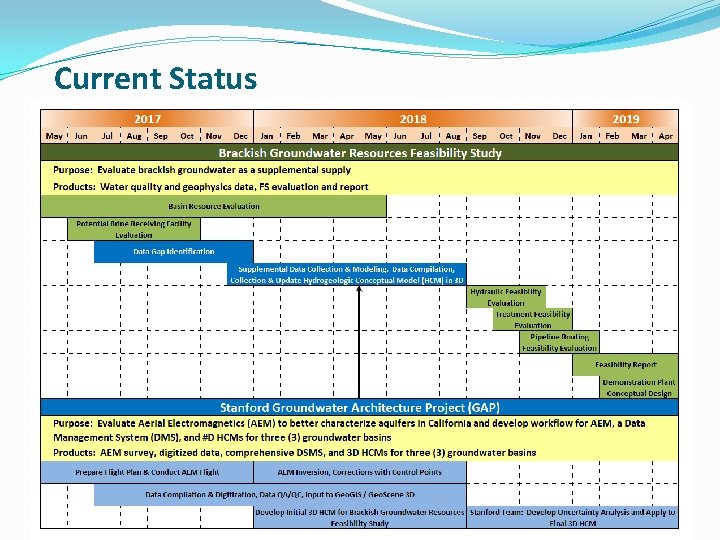
Current Status
Caveat �Numerical modeling of various brackish groundwater extraction scenarios is an essential component of the study. �We would look to have the Desert Research Institute (DRI) perform those modeling runs using their model, and provide us with the results. �Fate and transport (of salt and fresh water), and subsidence predictions are critical elements of the modeling runs to evaluate the potential for undesirable results.
Questions and Comments
- Slides: 18