
INDIAN BANKING SYSTEM UNIT I Manish Kumar Indian
INDIAN BANKING SYSTEM UNIT I Manish Kumar

Indian Banking System. Structure and Organization of Banks; RBI; APEX Banking Institutions ; Commercial Banks; RRB; Cooperative Banks; Development Banks 2
ORIGIN OF BANKING SYSTEM The modern banking system in India started with the establishment of General Bank of India in 1786. In the mid-nineteenth century East India Company established the Bank of Bengal in 1809, the Bank of Bombay in 1840 and the Bank of Madras in 1843. These were initially independent units and were referred to as the Presidency banks. Subsequently, these three banks were amalgamated and become known as Imperial Bank of India. After Independence the Imperial Bank of India was nationalized under the State Bank of India ACT of 1955 and Became know as the State Bank of India. In 1969 Indira Gandhi, the Prime Minister, continued the process of nationalization of Banks by Nationalizing 14 Banks 3
MEANING AND DEFINITION OF BANKING Bank is a German word which means ‘to collect’. The Main function of the banks is collection of funds as deposits. With time , banks have started performing other functions such as lending money etc. • According to R. S. Meyers, “ Banks are institutions whose debts are referred to as ‘Bank deposits’ and they are commonly accepted in final settlement of other people’s debts. • Section 5 (1) (b) of the Banking Regulation Act, 1949 defines banking as, “The accepting for the purpose of lending or investment, of deposits from the public, repayable on demand or otherwise and withdrawal by cheque, draft, order or otherwise”. • Section 5(1) (c) defines a banking company as , ” Any company which transacts the business of banking in India”. 4
FEATURES OF BANKING Banking Involves § The burrowing, raising or taking up money § The lending or advancing of money either with or without security § The drawing, making accepting, discounting, buying, selling, collecting and dealing in bills of exchange, hundis, provisionary notes, coupons, drafts, bills of lading, railway receipts, warrants, debentures, certificates, scripts and other instruments and securities whether transferable or negotiable or not. § The granting and issuing of letters of credit, traveler’s cheques and circular notes. § The buying and selling of foreign exchange including bank notes. § The acquiring holding, issuing on commission, underwriting and dealing in stocks, funds, shares, debentures, bonds, obligations, securities and investments of all kinds. § The purchasing and selling of bonds, scrips or other forms of securities on behalf of constituents or others, the negotiating of loans and advances. § The receiving of all kinds of bonds or valuables on deposit or for safe custody. 5
ORGANIZATION AND ADMINISTRATION OF BANKS A bank must have § A president, a cashier, and at least five directors. The directors must own at least ten shares of stock, except when the capital is not more than 25, 000, when five shares are required. § The directors are elected by, and represent, the stockholders, who are the owners of the bank. § They meet at least once a month and direct the policy of the bank. § The directors elect the officers, a president, vice president, cashier, and assistant cashier, who are the executive heads of the institutions and are charged with the duty of administering its affairs. § The number of Vice presidents and assistants cashiers depends upon the size of the banks. § The clerks divide naturally into two groups, tellers and book keepers. § The duty goes with the office rather than with the man. § The responsibility of the directors is the same in all cases. § In the very large banks, it is found that board organized into a discount committee, a finance committee, examination committee etc. , in order that the directors may be better keep in touch with the affairs of the bank and fulfil their moral and legal obligations to stockholders and depositors. 6
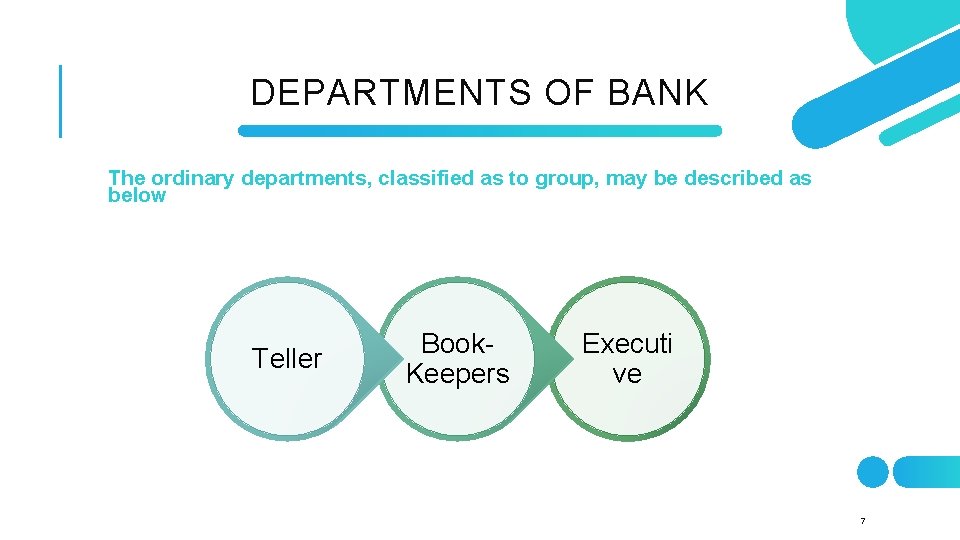
DEPARTMENTS OF BANK The ordinary departments, classified as to group, may be described as below Teller Book. Keepers Executi ve 7
TELLER Teller: The bank teller is the person most people associate with a bank, Teller Makes up 28% of the Bank employees, and conduct most of the banks routine transactions like cashing, checks, accepting deposits and loan payments and processing withdrawals. Paying Teller’s Department: This department pays or certifies checks. In charge of the signature book or cards bearing the authorized signatures of all depositors. In charge of he vault cash and reserves. Receiving Teller’s Department: This department receives deposits distributes checks to book-keepers and other departments. Prepares exchanges for clearing house. Turns cash over to the paying teller at end of the day. Note Teller’s Department: This department collects notes and drafts due at the bank or elsewhere in the city. Usually in charge of the runners or messengers department, this is a sub-division. Collection Department: This department collects notes, drafts, and other ‘time’ items when payable out of town. Credit accounts of depositors when collections are advised paid. Transit Department: This is a sub-division of the receiving teller’s department and may be known as other terms such as correspondence, foreign check miscellaneous check, or country check department. 8
EXECUTIVES These are the persons who take care of loans, make the analysis of the accounts of depositors. The executive department can be categorized. Loan or Discount Department: This department receives notes submitted for discount or making loans. Figures discount and interest. Has charge of collateral securing loans. Credit Department: This department secures and collects information relating to borrowers. Checks statements submitted by them. In charge of credit files which contains information as to the liability, business habits, and financial strength of borrowers. Analysis or statistical Department: This department usually found in city banks. Analyses the accounts o depositors to determine which are profitable and which are loose making accounts. Makes monthly reports to officers. In charge of statistics relating to the banks accounts. Auditor’s Department: This department is responsible for the settlement of the various departments. Reconciles the accounts with other banks. Certifies interest calculations. 9
BOOK-KEEPERS Book-Keepers prepare bank deposits by compiling data from cashiers, verifying and balancing receipts, and sending cash, checks or other forms of payment to the bank. This department can be categorized as follows: Individual ledger department: This department keeps the records of the balances of individual depositors. General Ledger department: this department keeps the general or control accounts of the bank. Makes-up the bank’s statement of condition. Country bank account department: This department confined to city banks. Keeps the accounts of other banks, usually consisting of reserve accounts 10

DEFECTS OF INDIAN BANKING • SYSTEM Low profitability • • • Growing Non-Performing Assets Low Capital Base Window Dressing Balance Sheets Favouritism in advancing loans Bad quality of loan portfolios Indulge in share speculation Irregularities in maintaining accounts Banks as sick units Social Banking inadequate Dual control 11
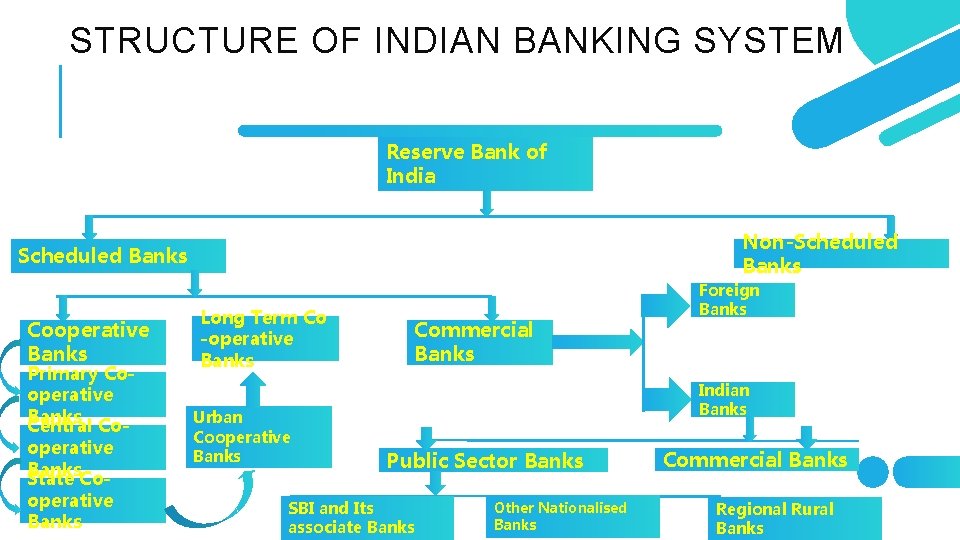
STRUCTURE OF INDIAN BANKING SYSTEM Reserve Bank of India Non-Scheduled Banks Cooperative Banks Primary Cooperative Banks Central Cooperative Banks State Cooperative Banks Long Term Co -operative Banks Urban Cooperative Banks Commercial Banks Foreign Banks Indian Banks Public Sector Banks SBI and Its associate Banks Other Nationalised Banks Commercial Banks Regional Rural Banks 12
SCHEDULED BANKS A scheduled bank is one which is registered in the second schedule of the Reserve Bank of India. The following condition must be fulfilled by a bank for inclusion in the schedule: • The banker must be in business of banking in India. • It is either a company defined in section 3 of the Indian companies act, 1956, or corporation or a company incorporated by or order any law in force in any place outside India or institution notified by Central Government of India. • It must have paid-up capital and reserve of an aggregate real or exchangeable value of not less than rupees five lacs. • It must satisfy RBI that its affairs are not conducted in a manner detrimental to the interests of its depositors. 13
SCHEDULED BANKS Scheduled Banks come under the preview of the various credit control measures of the Reserve bank of India. They are required to maintain a certain minimum balance on their accounts with the RBI Scheduled banks are further classified into: Scheduled Commercial Banks are those included in the second schedule of the Reserve Bank of India At, 1934. In terms of ownership, function, commercial banks can be classified into two categories. Public Sector Banks: Public sector banks are banks in which the government has a major holding. These can be classified into three groups: State Bank of India Nationalized Bank Regional Rural Banks (RRBs) Private Sector Bank: Private sector banks are banks in which majority of stake are hold by private individuals are not by government. Scheduled Co-operative Banks: Co-operative Banks came into existence with the enactment of the cooperative credit societies Act of 1904 which provided for the formation of Co-operative Credit societies. 14
NON- SCHEDULED BANKS Banks which are not included in the second schedule of the RBI, are known as non-scheduled banks § Non-scheduled banks are not entitled to all those facilities that the scheduled banks avail of from the Reserve Bank of India § Since the enactment of the Banking regulation Act in 1949, non-scheduled banks have also come under the ambit of the RBI control. It has become obligatory on the part of these banks to carry a portion of their deposits with the RBI or in vault with the bank itself, and prepare annual accounts and balance sheets in accordance with the requirements stipulated in section 29 of the Banking companies act. 15
SMALL INDUSTRIES DEVELOPMENT BANK OF INDIA The SIDBI was set up in October 1989 under the Act of Parliament as a wholly owned subsidiary of the IDBI. Its authorized capital is Rs. 250 Crore with an enabling provision to increase it to Rs. 1000 Crore Objectives of SIDBI Functions of SIDBI § To initiate steps for technological up gradation of existing units. • Administration of Small Industries Development Fund (SIDF) and National Equity Fund( NEF) for development and equity support to small and tiny industries • Providing working capital through single window scheme • Providing refinance support to bank/ development finance institutions. • Undertaking direct financing of SSI units. • Co-ordination of functions of various institutions engaged in finance to SSI § To expand channels for marketing of SSI sector products in India and abroad. § To promote employment oriented industries in Semi-urban areas and to check migration of population to big cities 16

APEX BANKING SYSTEM • An apex banking institution is a second tier or wholesale organisation that channels funding to multiple micro-finance institution. SIDBI NABAR D EXIM NHB Apex Banking institutio ns 17
SMALL INDUSTRIES DEVELOPMENT BANK OF INDIA The SIDBI was set up in October 1989 under the Act of Parliament as a wholly owned subsidiary of the IDBI. Its authorized capital is Rs. 250 Crore with an enabling provision to increase it to Rs. 1000 Crore Objectives of SIDBI Functions of SIDBI To initiate steps for technological up gradation of existing units. • Administration of Small Industries Development Fund (SIDF) and National Equity Fund( NEF) for development and equity support to small and tiny industries • Providing working capital through single window scheme • Providing refinance support to bank/ development finance institutions. • Undertaking direct financing of SSI units. • Co-ordination of functions of various institutions engaged in finance to SSI To expand channels for marketing of SSI sector products in India and abroad. To promote employment oriented industries in Semi-urban areas and to check migration of population to big cities 18

NATIONAL BANK FOR AGRICULTURE AND RURAL DEVELOPMENT In the light of the recommendations of the committee to review arrangements for institutional credit for agriculture and rural development (CRAFICARD), the government of India set up the National Bank for Agriculture and Rural Development (NABARD on July 12, 1982, to act as an agency for promoting integrated rural development and to provide all sorts of production and investment credit for agriculture and rural development Objectives of NABARD § To give undivided attention and purposeful direction to integrated rural development. § To act as a centre piece for the entire rural credit system at the national level. § To act as a provider of supplemental funding to rural credit institutions § To arrange for investment credit to small industries, village and cottage industries, handicrafts and other rural crafts, arcticians, and farmers. § To impose the credit distribution system institution building, rehabilitation pf credit institutions and raising and training of bank personnel. 19
EXPORT-IMPORT BANK OF INDIA EXIM bank of India is the premier export finance institutions of the country, set up in 1982 under the exportimport bank of India Act 1981. Government of India launched the institution with a mandate, not just to enhance exports from India, but to integrate the country’s foreign trade and investment with the overall economic growth. Objectives of EXIM bank EXIM Bank of India has been the prime mover in encouraging project exports from India. The Bank extends lines of credit to overseas financial institutions, foreign govt. and their agencies, enabling them to finance imports of goods and services from India. The Bank overseas Investment Finance programme offers a variety of facilities for Indian investments and acquisitions overseas. Under its Export Marketing Finance programme, EXIM Bank supports small and medium enterprises in Functions of EXIM Bank • Financing of exports and imports of goods and services, not only in India but also of the third world countries. • Financing of joint ventures in foreign countries • Providing loans to Indian parties to enable them to contribute ti the share capital of joint ventures in foreign countries. • To provide technical, administrative, and financial assistance to parties in connection with export and import. 20
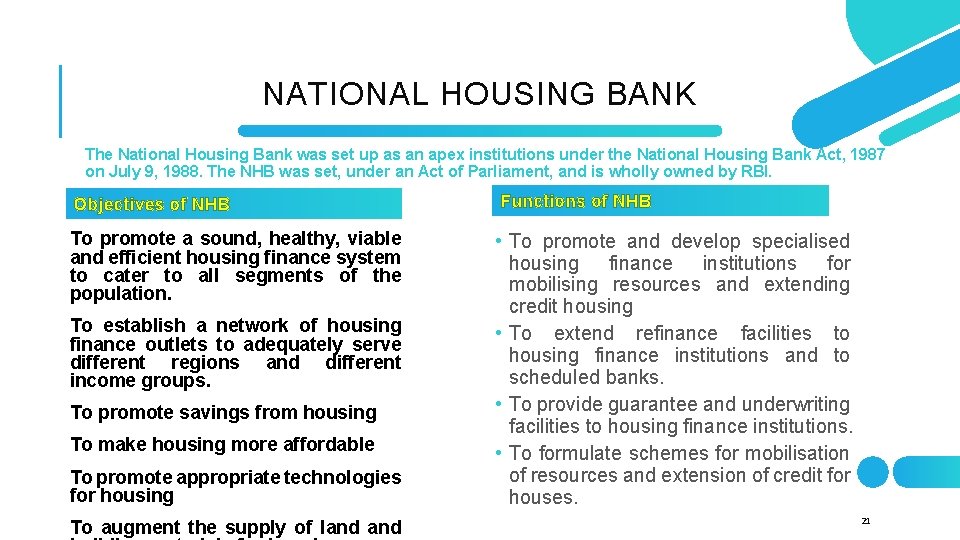
NATIONAL HOUSING BANK The National Housing Bank was set up as an apex institutions under the National Housing Bank Act, 1987 on July 9, 1988. The NHB was set, under an Act of Parliament, and is wholly owned by RBI. Objectives of NHB Functions of NHB To promote a sound, healthy, viable and efficient housing finance system to cater to all segments of the population. • To promote and develop specialised housing finance institutions for mobilising resources and extending credit housing • To extend refinance facilities to housing finance institutions and to scheduled banks. • To provide guarantee and underwriting facilities to housing finance institutions. • To formulate schemes for mobilisation of resources and extension of credit for houses. To establish a network of housing finance outlets to adequately serve different regions and different income groups. To promote savings from housing To make housing more affordable To promote appropriate technologies for housing To augment the supply of land 21

COMMERCIAL BANK Commercial Banks are those banks which perform all kinds of banking functions such as accepting deposits, advancing loans, credit creation and agency function. In India 20 major Commercial Banks have been nationalised, whereas in developed countries they are run like joint stock company. Indian Companies Act, 1949, has defined bank, “ The accepting for the purpose of lending or investment of deposits of money from the public repayable on demand or otherwise and withdrawable by cheque, draft and order or otherwise” According to Prof. Kinley, “A bank is an establishment which makes to individuals such advances of money as may be required and safely made, and to which individuals entrust money when not required by them for use. ” 22
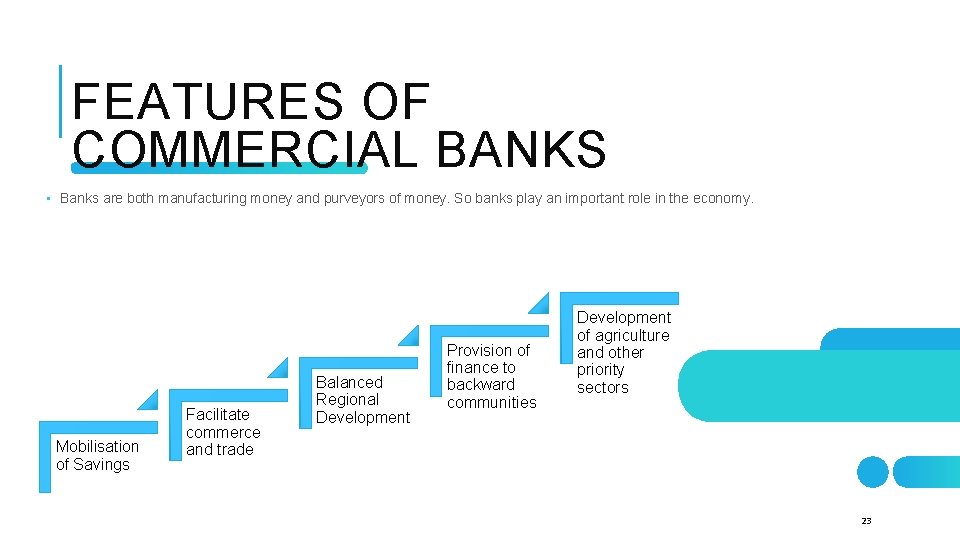
FEATURES OF COMMERCIAL BANKS • Banks are both manufacturing money and purveyors of money. So banks play an important role in the economy. Mobilisation of Savings Facilitate commerce and trade Balanced Regional Development Provision of finance to backward communities Development of agriculture and other priority sectors 23
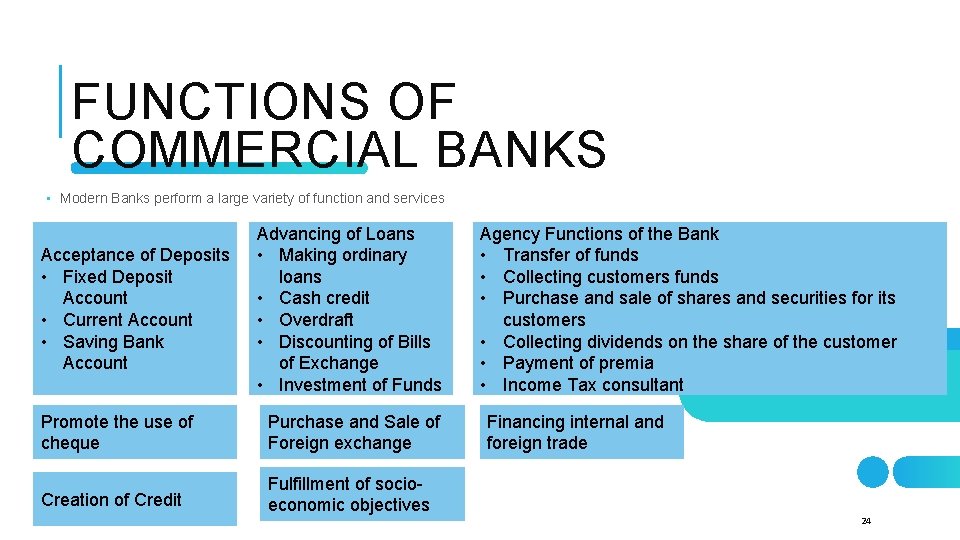
FUNCTIONS OF COMMERCIAL BANKS • Modern Banks perform a large variety of function and services Acceptance of Deposits • Fixed Deposit Account • Current Account • Saving Bank Account Advancing of Loans • Making ordinary loans • Cash credit • Overdraft • Discounting of Bills of Exchange • Investment of Funds Promote the use of cheque Purchase and Sale of Foreign exchange Creation of Credit Fulfillment of socioeconomic objectives Agency Functions of the Bank • Transfer of funds • Collecting customers funds • Purchase and sale of shares and securities for its customers • Collecting dividends on the share of the customer • Payment of premia • Income Tax consultant Financing internal and foreign trade 24
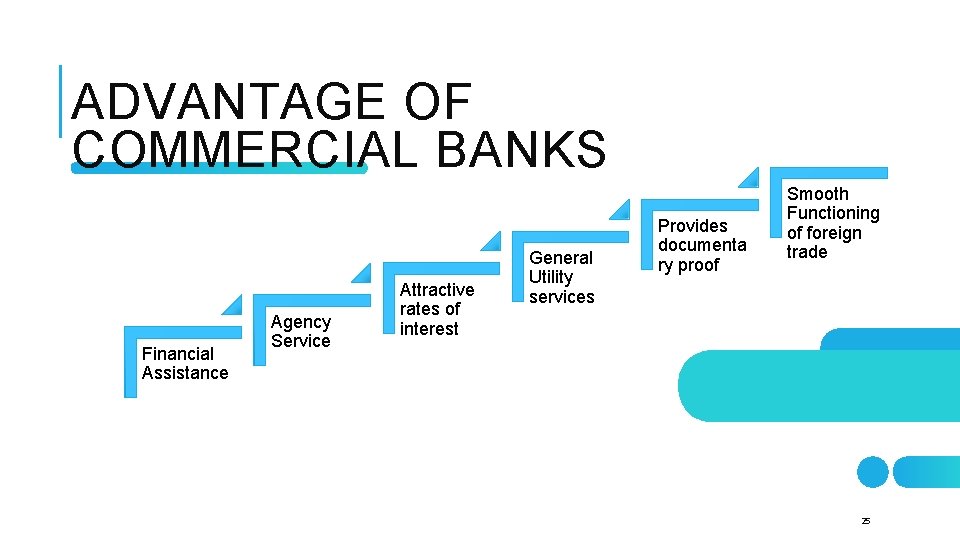
ADVANTAGE OF COMMERCIAL BANKS Financial Assistance Agency Service Attractive rates of interest General Utility services Provides documenta ry proof Smooth Functioning of foreign trade 25
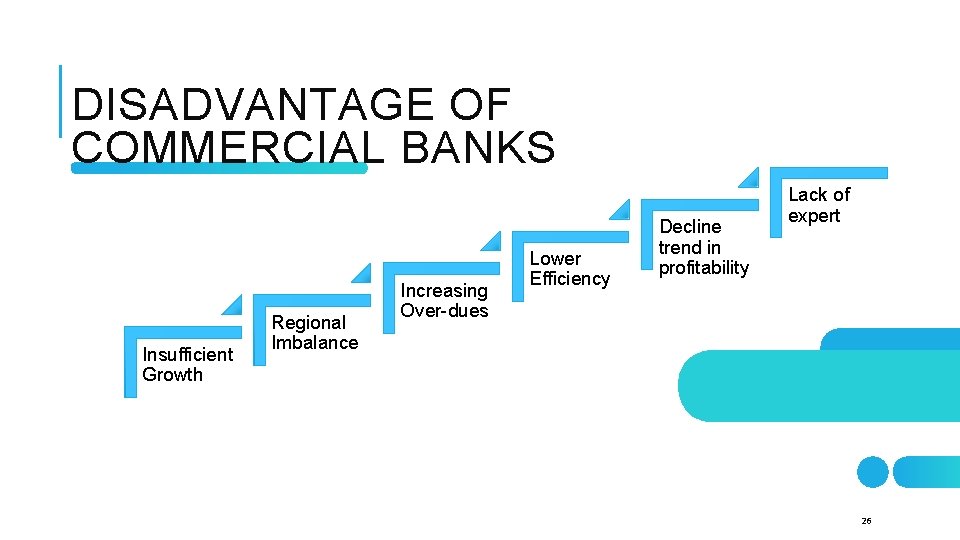
DISADVANTAGE OF COMMERCIAL BANKS Insufficient Growth Regional Imbalance Increasing Over-dues Lower Efficiency Decline trend in profitability Lack of expert 26
REGIONAL RURAL BANKS The idea of establishing Regional rural banks was mooted in the twenty point economic programme of July 1975 to cater the credit needs of rural people The government of India appointed the Narasimhan Committee in July 1975 to set up the new institutions in order: To provide employment to the rural educated youth. To ring down the cist of rural banks by recruiting their staff on the same scale of pay and allowances and for the employees of state Government/ Local bodies. It was on the recommendations that the fist five RRBs were set up on 2 October 1975 under an ordinance promulgated on 26 September 1975 which was replaced by the RRB act 1976. 27
CO-OPERATIVE BANKS Co-operative Banks came under the purview of the Banking Regulation Act only in 1966. Under Cooperative Banks are supervised by the Reserve Bank. A Cooperative bank is run for the benefits of a group of members o the cooperative body A cooperative bank distributes only a very small portion of its profit as divided. Retaining a major portion of it in business. 28
DEVELOPMENT BANKING INSTITUTIONS Specialized and hybrid financial institutions that are engaged in the provision of financial and other assistance for the purpose of undertaking long term developmental activities. Objectives of Development Banks To serve as an agent of development in various sectors, like, industry, agriculture and international trade. To accelerate the growth of economy To allocate resources to high priority area To foster rapid industrialisation, particularly in the prvate sector, so as tp provide employment opportunities as well as higher production To develop entrepreneurial skills To promote the development of rural areas. 29

FACTORS RESPONSIBLE FOR GROWTH OF DEVELOPMENT Many factors are responsible for the emergence and the growth of development banks athe world over and in India, in particular. They are Fostering industrial growth Long-term assistance Balanced development Promotional services Infrastructure building Economic policies Other factors. 30
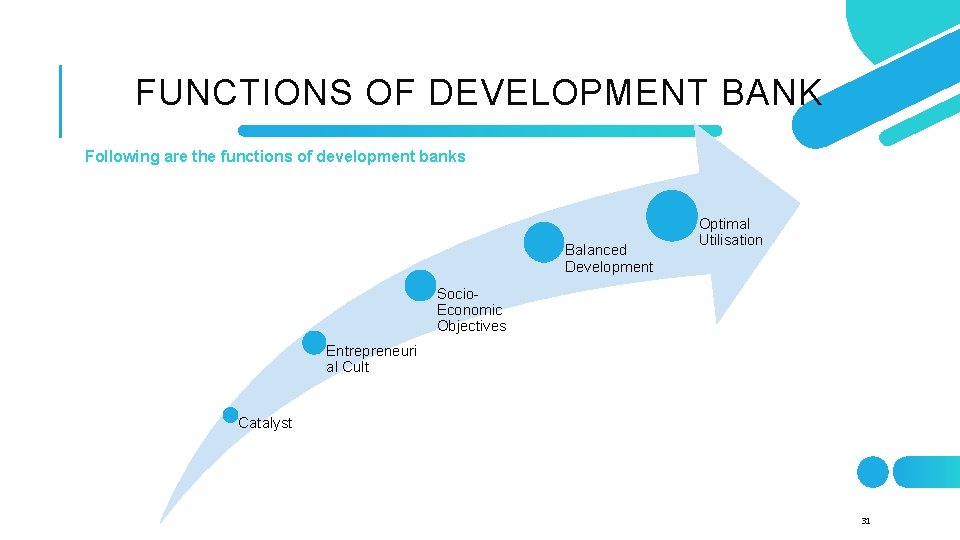
FUNCTIONS OF DEVELOPMENT BANK Following are the functions of development banks Balanced Development Optimal Utilisation Socio. Economic Objectives Entrepreneuri al Cult Catalyst 31
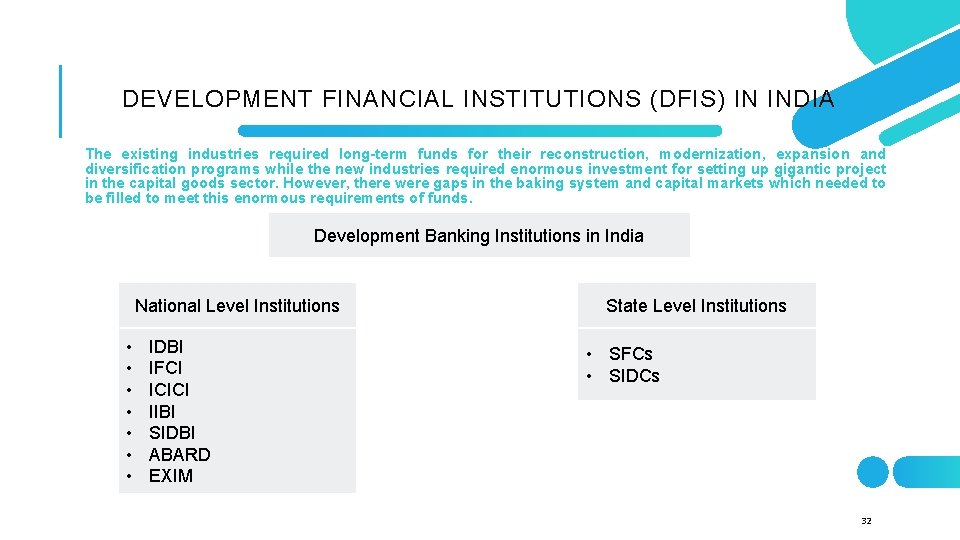
DEVELOPMENT FINANCIAL INSTITUTIONS (DFIS) IN INDIA The existing industries required long-term funds for their reconstruction, modernization, expansion and diversification programs while the new industries required enormous investment for setting up gigantic project in the capital goods sector. However, there were gaps in the baking system and capital markets which needed to be filled to meet this enormous requirements of funds. Development Banking Institutions in India National Level Institutions • • IDBI IFCI ICICI IIBI SIDBI ABARD EXIM State Level Institutions • SFCs • SIDCs 32
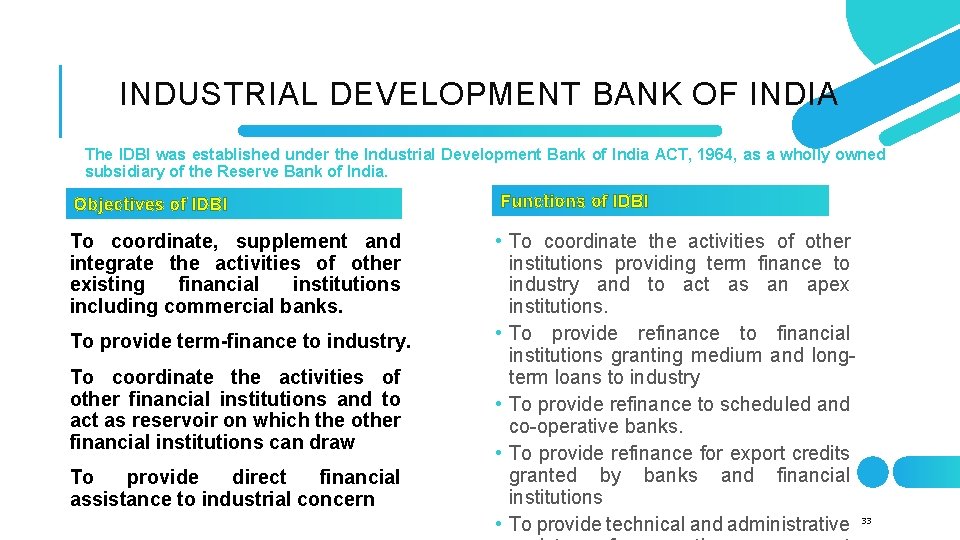
INDUSTRIAL DEVELOPMENT BANK OF INDIA The IDBI was established under the Industrial Development Bank of India ACT, 1964, as a wholly owned subsidiary of the Reserve Bank of India. Objectives of IDBI Functions of IDBI To coordinate, supplement and integrate the activities of other existing financial institutions including commercial banks. • To coordinate the activities of other institutions providing term finance to industry and to act as an apex institutions. • To provide refinance to financial institutions granting medium and longterm loans to industry • To provide refinance to scheduled and co-operative banks. • To provide refinance for export credits granted by banks and financial institutions • To provide technical and administrative 33 To provide term-finance to industry. To coordinate the activities of other financial institutions and to act as reservoir on which the other financial institutions can draw To provide direct financial assistance to industrial concern
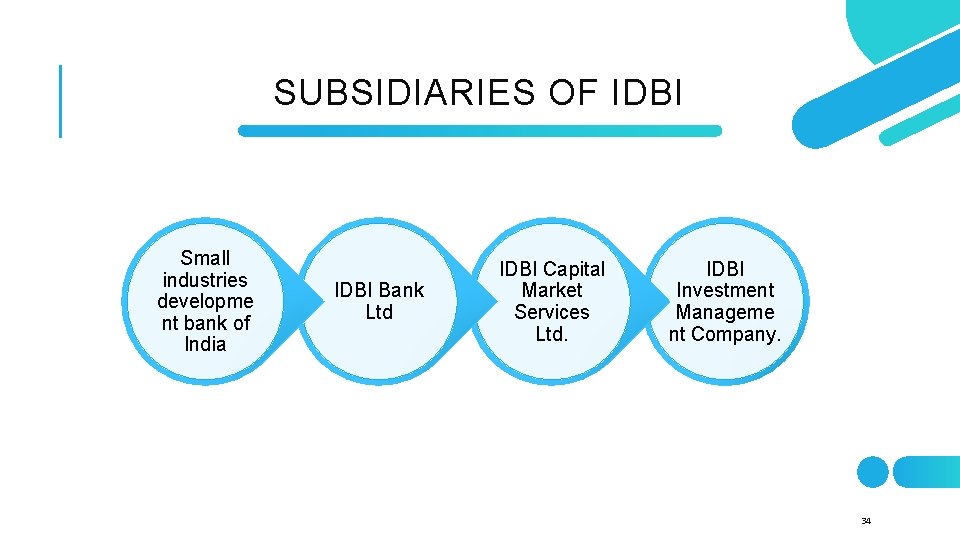
SUBSIDIARIES OF IDBI Small industries developme nt bank of India IDBI Bank Ltd IDBI Capital Market Services Ltd. IDBI Investment Manageme nt Company. 34
MODE OF ASSISTANCE The mode of assistance provided by the IDBI take the following forms: Financial Assistance Soft Loan Scheme Refinance assistance Assistance to small sector Technical development Fund Equipment finance scheme Change agent Regional Development Other activities 35
- Slides: 35