
India Hypertension Control Management Initiative Dr Prabhdeep Kaur
India Hypertension Control (Management) Initiative Dr Prabhdeep Kaur, Scientist E and Head of NCD Division, ICMR-NIE, Chennai On Behalf of the Project Partners – ICMR, WHO, NPCDCS program, State Governments and Vital Strategies- Resolve to Save lives, USA
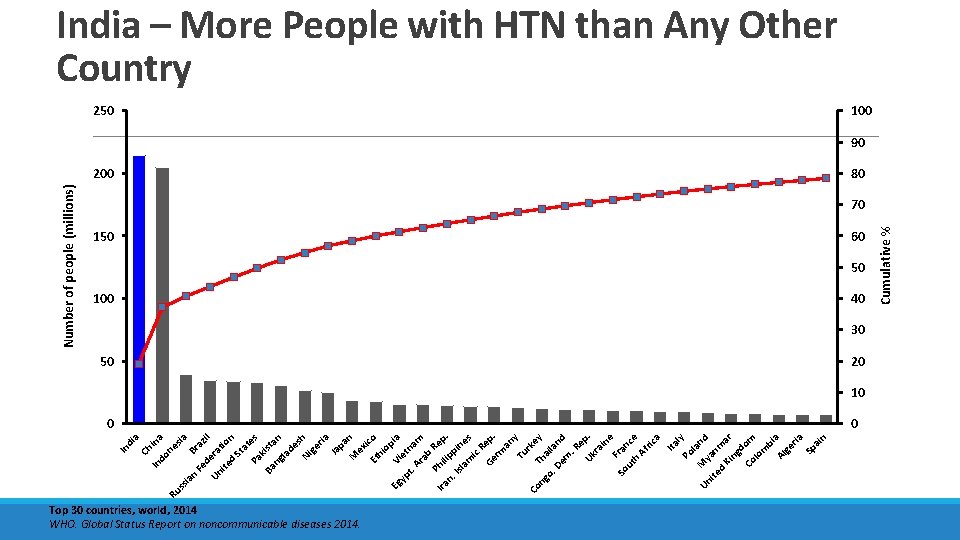
ra il az ite tio d n St at Pa es k Ba ista ng n la de s Ni h ge ria Ja pa M n ex i Et co hi op Eg Vi ia yp et t, na Ar m ab R Ira Phil ep n, ipp. Is la ine s m ic Re Ge p. rm an Tu y rk Co e ng Tha y o, D ilan em d. R e Uk p. ra in e F r So an ut c h e Af ric a Ita l Po y la Un My nd ite an d ma Ki ng r d Co om lo m bi Al a ge ria Sp ai n Un Br a sia ne in Ch do de Fe n ia ss Ru In di a In Number of people (millions) 250 200 150 60 50 100 40 30 50 20 10 0 0 Top 30 countries, world, 2014 WHO. Global Status Report on noncommunicable diseases 2014. Cumulative % India – More People with HTN than Any Other Country 100 90 80 70
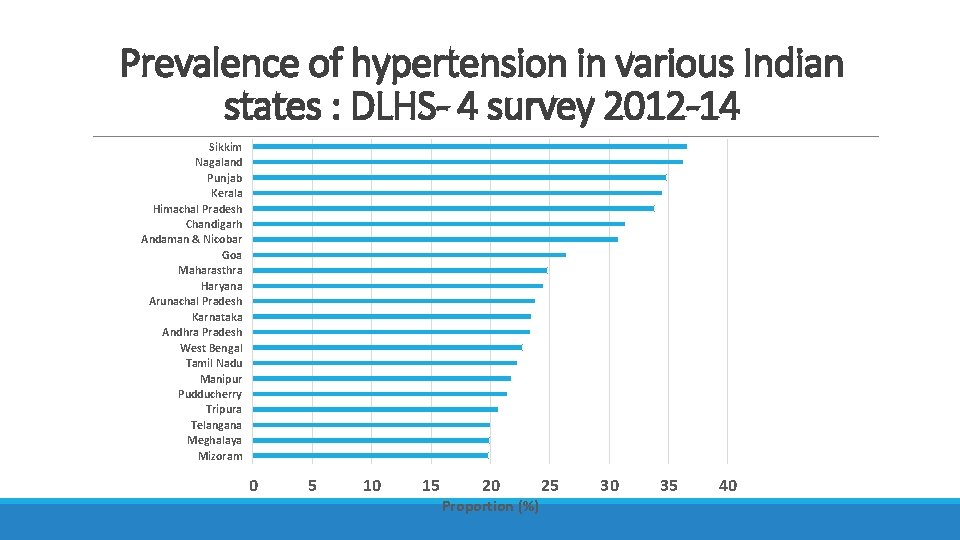
Prevalence of hypertension in various Indian states : DLHS- 4 survey 2012 -14 Sikkim Nagaland Punjab Kerala Himachal Pradesh Chandigarh Andaman & Nicobar Goa Maharasthra Haryana Arunachal Pradesh Karnataka Andhra Pradesh West Bengal Tamil Nadu Manipur Pudducherry Tripura Telangana Meghalaya Mizoram 0 5 10 15 20 Proportion (%) 25 30 35 40

India Hypertension Control (management) Initiative – Multi-partner project Aim: Increase the blood pressure control from 10% to 30% in the project districts in India by 2022 Hypertension patients : 200 million Treatment 50 million (25%) Blood pressure control - 20 million (10%) • Strengthen the hypertension treatment component of NPCDCS (national program) • Strategies to improve treatment coverage and blood pressure control ◦ ◦ ◦ Standard treatment algorithm Capacity building at all levels Availability of protocol drugs Patient cohort monitoring – robust M&E Decentralization for BP measurement and drug dispensing at sub center level • Partners : ICMR, WHO, Mo. HFW, State Governments, Vital Strategies - RSTL
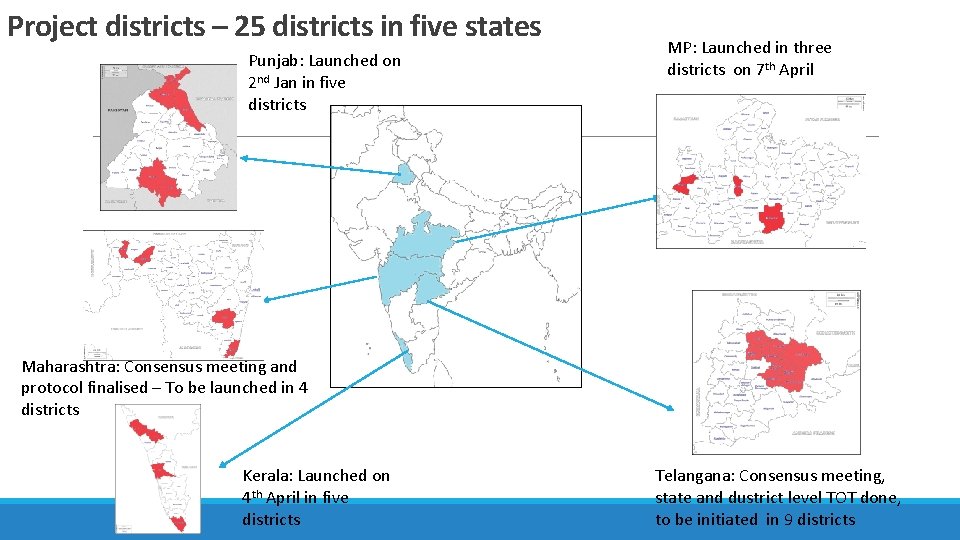
Project districts – 25 districts in five states Punjab: Launched on 2 nd Jan in five districts MP: Launched in three districts on 7 th April Maharashtra: Consensus meeting and protocol finalised – To be launched in 4 districts Kerala: Launched on 4 th April in five districts Telangana: Consensus meeting, state and dustrict level TOT done, to be initiated in 9 districts
Hypertension – Program and Status Target of GOI: 25% reduction in the increased BP by 2025 (4 crore patients) • NPCDCS has established basic infrastructure of staffing (NCD officer at State level, medical officers and nurses, equipment, drugs, screening, etc. ) • Focus on a select group of districts drawn from the 158 districts previously selected by GOI for population-based screening under NPCDCS • Follow-up of patients screened positive for HTN has been limited • Additional inputs required to increase the follow-up and control • Data available regarding number screened and detected ; monitoring and evaluation need to be strengthened to ensure quality and to capture the outcomes
Project -specific additional inputs • Additional manpower- in project districts to support training and monitoring • Cardiovascular Health Officers: One per district ± one at state level • Senior Treatment Supervisors: 1 -2 per district (depending on number of health facilities) • Consensus workshops at the state level to finalise protocol • Train trainers at state level and support training at the district level • Facilitate streamlining of drug logistics and BP monitor procurements • Strengthen patient monitoring to improve BP control and to reduce drop outs • Encourage task shifting for easy access to follow up treatment • Implementation science to document impact • Research to measure the change in blood pressure control in sample districts • Rigorous data quality monitoring, quarterly analysis and feedback to states • In depth data collection in a sample of health facilities

Sample protocol
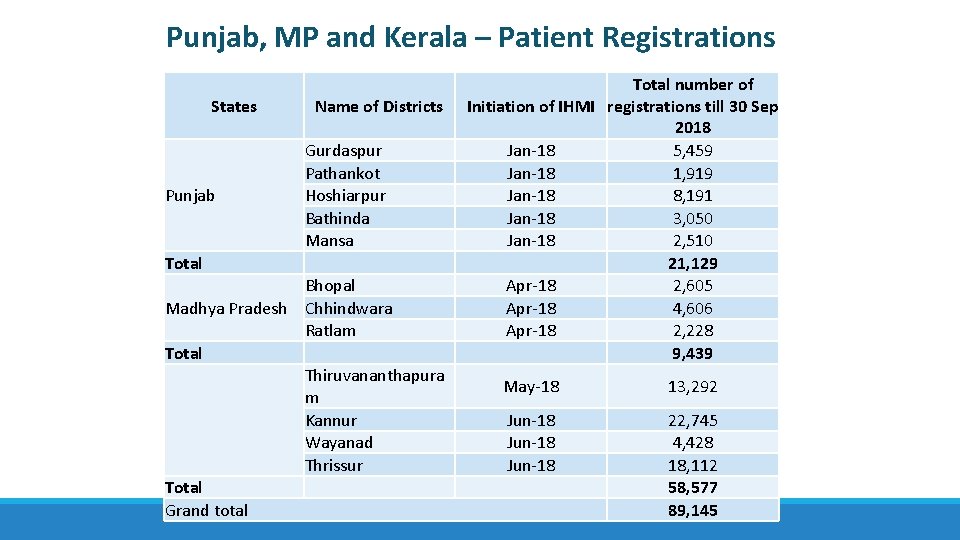
Punjab, MP and Kerala – Patient Registrations Total number of States Name of Districts Initiation of IHMI registrations till 30 Sep 2018 Gurdaspur Jan-18 5, 459 Pathankot Jan-18 1, 919 Punjab Hoshiarpur Jan-18 8, 191 Bathinda Jan-18 3, 050 Mansa Jan-18 2, 510 Total 21, 129 Bhopal Apr-18 2, 605 Madhya Pradesh Chhindwara Apr-18 4, 606 Ratlam Apr-18 2, 228 Total 9, 439 Thiruvananthapura May-18 13, 292 m Kannur Jun-18 22, 745 Wayanad Jun-18 4, 428 Thrissur Jun-18 18, 112 Total 58, 577 Grand total 89, 145
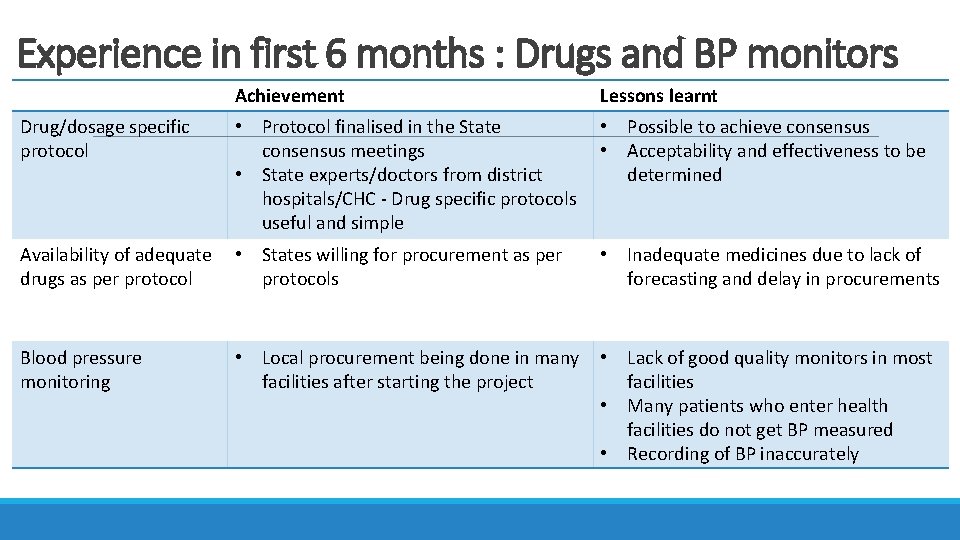
Experience in first 6 months : Drugs and BP monitors Achievement Drug/dosage specific protocol • Protocol finalised in the State • Possible to achieve consensus meetings • Acceptability and effectiveness to be • State experts/doctors from district determined hospitals/CHC - Drug specific protocols useful and simple Availability of adequate • States willing for procurement as per drugs as per protocols Blood pressure monitoring Lessons learnt • Inadequate medicines due to lack of forecasting and delay in procurements • Local procurement being done in many • Lack of good quality monitors in most facilities after starting the project facilities • Many patients who enter health facilities do not get BP measured • Recording of BP inaccurately
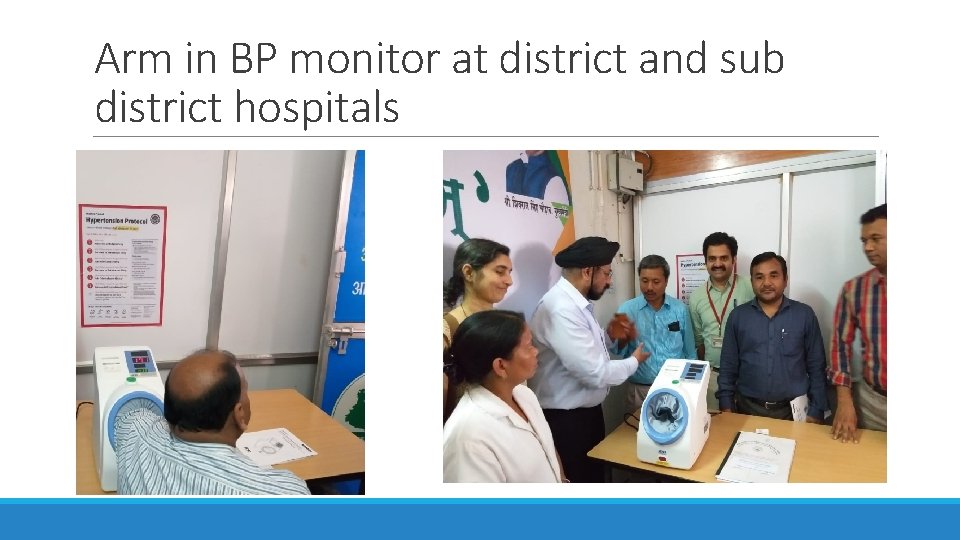
Arm in BP monitor at district and sub district hospitals
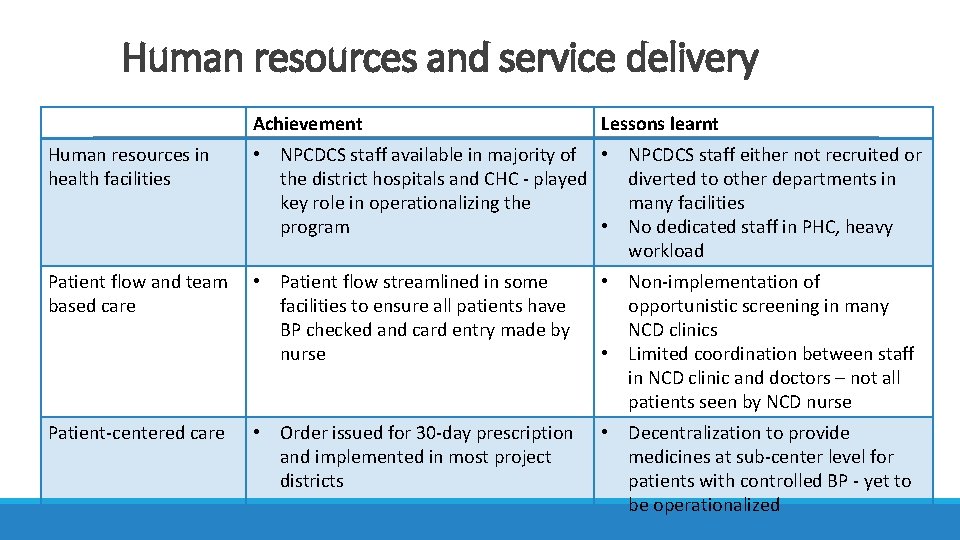
Human resources and service delivery Achievement Lessons learnt Human resources in health facilities • NPCDCS staff available in majority of • NPCDCS staff either not recruited or the district hospitals and CHC - played diverted to other departments in key role in operationalizing the many facilities program • No dedicated staff in PHC, heavy workload Patient flow and team based care • Patient flow streamlined in some facilities to ensure all patients have BP checked and card entry made by nurse • Non-implementation of opportunistic screening in many NCD clinics • Limited coordination between staff in NCD clinic and doctors – not all patients seen by NCD nurse Patient-centered care • Order issued for 30 -day prescription and implemented in most project districts • Decentralization to provide medicines at sub-center level for patients with controlled BP - yet to be operationalized
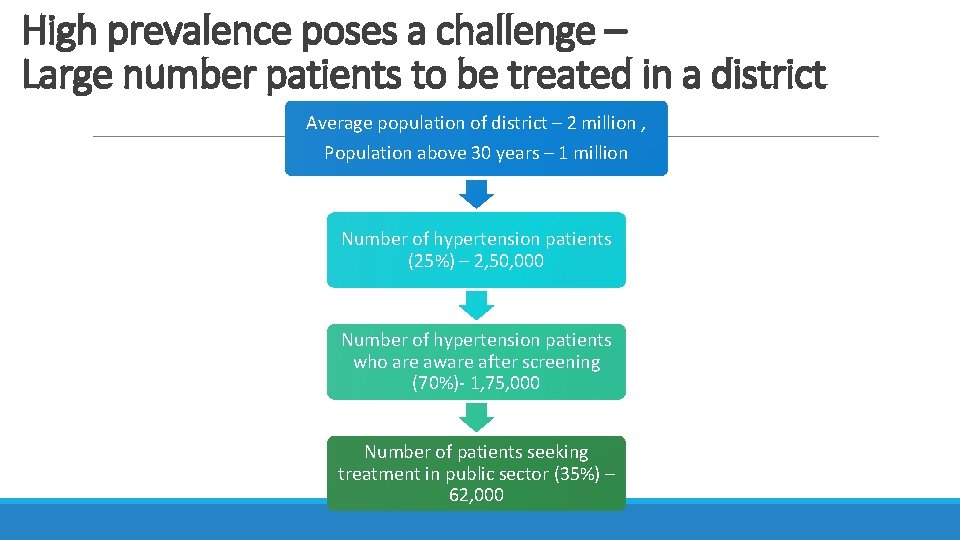
High prevalence poses a challenge – Large number patients to be treated in a district Average population of district – 2 million , Population above 30 years – 1 million Number of hypertension patients (25%) – 2, 50, 000 Number of hypertension patients who are aware after screening (70%)- 1, 75, 000 Number of patients seeking treatment in public sector (35%) – 62, 000
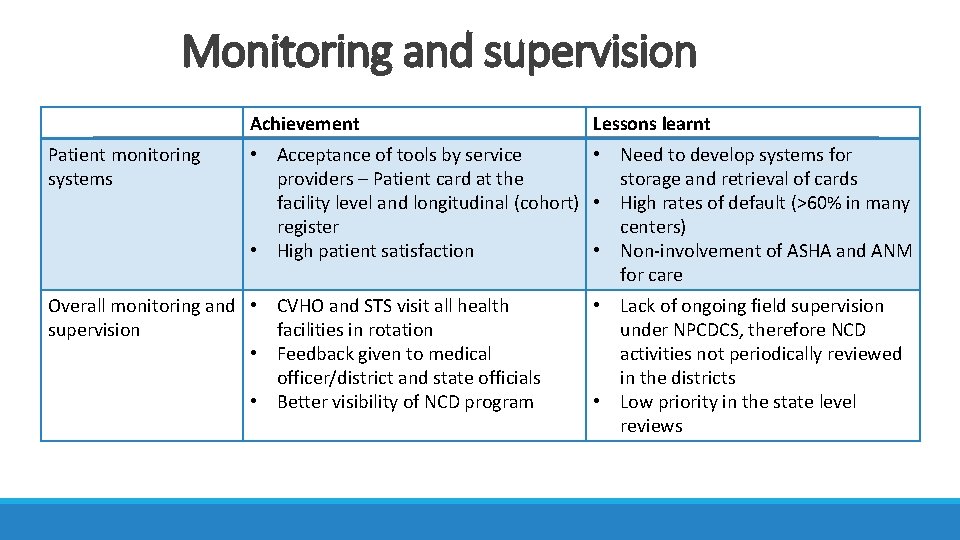
Monitoring and supervision Achievement Patient monitoring systems Lessons learnt • Acceptance of tools by service • Need to develop systems for providers – Patient card at the storage and retrieval of cards facility level and longitudinal (cohort) • High rates of default (>60% in many register centers) • High patient satisfaction • Non-involvement of ASHA and ANM for care Overall monitoring and • CVHO and STS visit all health supervision facilities in rotation • Feedback given to medical officer/district and state officials • Better visibility of NCD program • Lack of ongoing field supervision under NPCDCS, therefore NCD activities not periodically reviewed in the districts • Low priority in the state level reviews
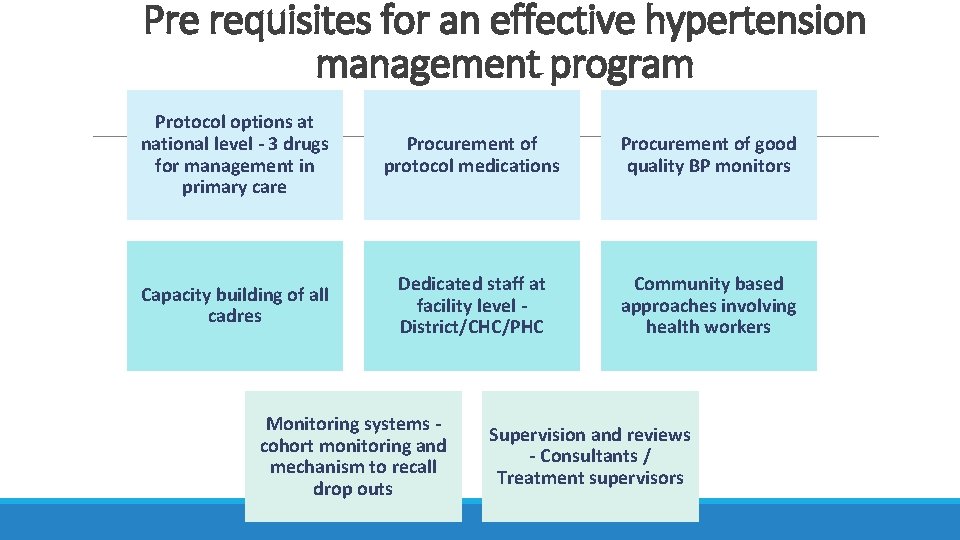
Pre requisites for an effective hypertension management program Protocol options at national level - 3 drugs for management in primary care Procurement of protocol medications Procurement of good quality BP monitors Capacity building of all cadres Dedicated staff at facility level - District/CHC/PHC Community based approaches involving health workers Monitoring systems - cohort monitoring and mechanism to recall drop outs Supervision and reviews - Consultants / Treatment supervisors
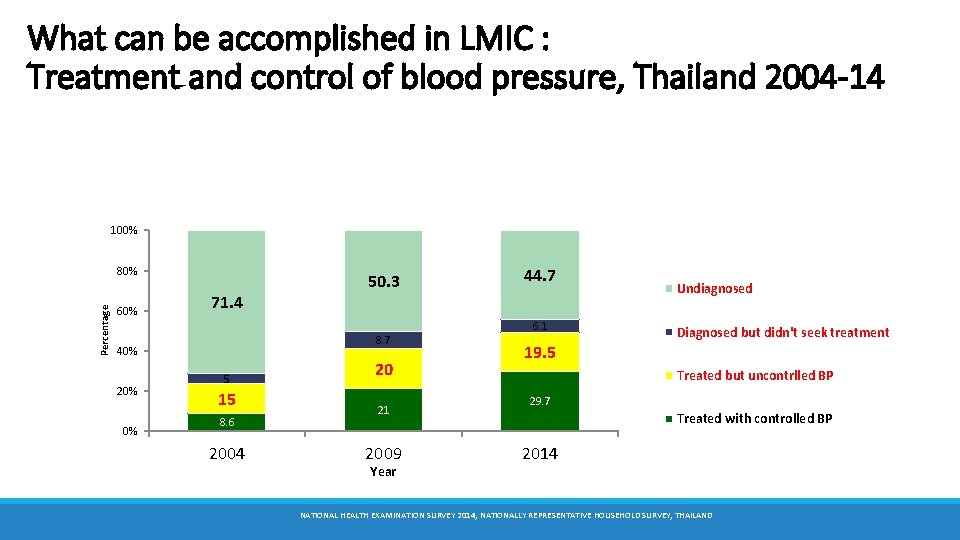
What can be accomplished in LMIC : Treatment and control of blood pressure, Thailand 2004 -14 100% Percentage 80% 60% 71. 4 8. 7 40% 20% 0% 50. 3 5 15 8. 6 2004 20 21 2009 Year 44. 7 6. 1 Undiagnosed Diagnosed but didn't seek treatment 19. 5 Treated but uncontrlled BP 29. 7 Treated with controlled BP 2014 NATIONAL HEALTH EXAMINATION SURVEY 2014, NATIONALLY REPRESENTATIVE HOUSEHOLD SURVEY, THAILAND
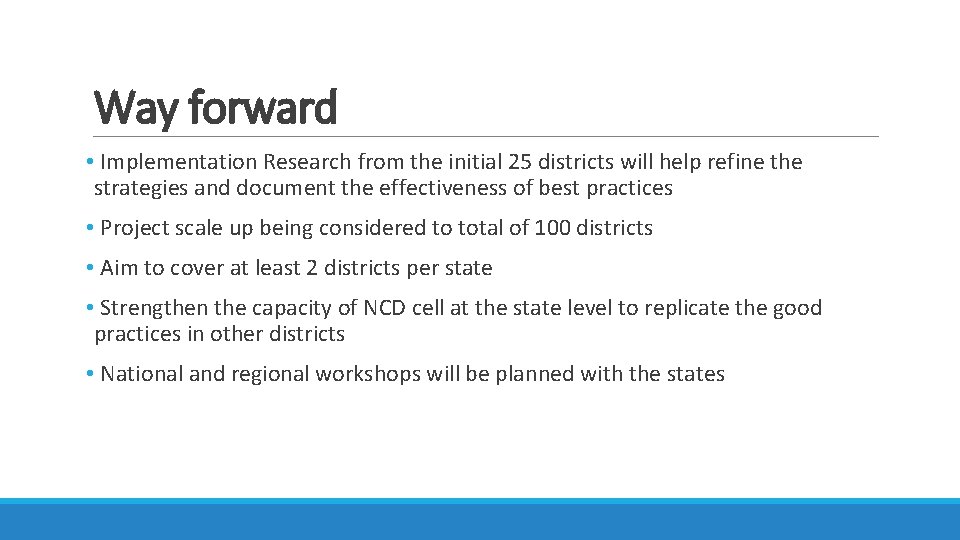
Way forward • Implementation Research from the initial 25 districts will help refine the strategies and document the effectiveness of best practices • Project scale up being considered to total of 100 districts • Aim to cover at least 2 districts per state • Strengthen the capacity of NCD cell at the state level to replicate the good practices in other districts • National and regional workshops will be planned with the states
- Slides: 18