
India 2000 B C E to current day
India 2000 B. C. E. to current day. Unique philosophies, religions, and societal ideas
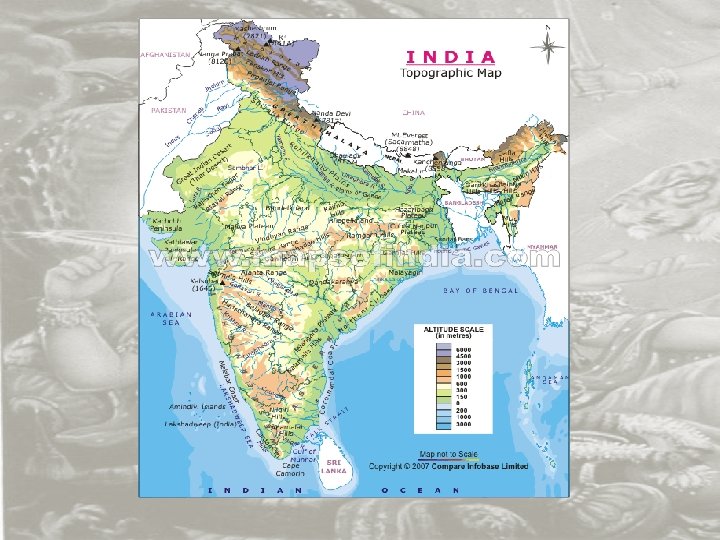
India Now • Very diverse culture • 18 different languages and hundreds of dialects. • Geography: mountains river valleys dry interior fertile coastal plains
Where does civilization develop? • River Valleys – example Mesopotamia, Egypt, and Indus River • In the Indus river valley over 1000 settlements have been found, but none lasted. • Why? • Earthquakes, climate changes, river flow, and new people arriving.
The First Settlers: Aryans • Not Hitler’s master race of blond hair and blue eyes. Although somewhat fair skinned. • Arrived in India around 2000 B. C. • Nomadic culture with superior iron weapons and horses. • By 1000 B. C. the Aryans partially controlled many areas in India.

Aryan social structure • Aryans believed in Varnas or social groups • 4 very different levels • You were born in, married in and died in your Varna. • You could not move up or down. • Your whole life depended on your Varna.
Varna Levels Brahmins - priests Kshatriyas - warriors Vaisyas – commoners (merchants and farmers) Sudras – peasants or servants Untouchables – lowest group sentenced to cleaning streets, laundry, and moving dead bodies • Varnas developed into the caste system. • A system of rigid social structure defined by occupation and family lineage. • • •
Caste system • Caste determined your job, whom you could marry, and what groups you socialize with. • It was very difficult to change caste because they are also based on religious purity. • The higher castes were people with greater religious purity, while the lower were impure. • The lowest level of Indian society are the Untouchables. • They are considered so impure they did not get a caste and were given tasks of collecting trash and handling dead bodies.
Hinduism • Aryan people that settled in India followed the Vedas. • Vedas are a collection hymns and religious ceremonies passed down by Aryan priests. • Hindus developed yoga (union) to leave earthly life and join Brahman in a dreamlike state.
Hinduism • Early Hindus believed in a single force in the universe. • The single force or ultimate reality in the universe is called Brahman. • It was the duty of the self to seek to know the ultimate reality. • Once achieved – the self would merge with Brahman after death.
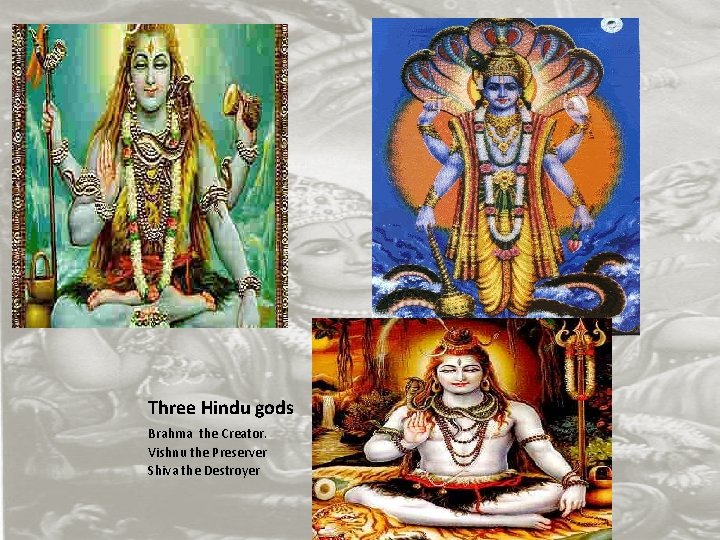
Three Hindu gods Brahma the Creator. Vishnu the Preserver Shiva the Destroyer
Reincarnation • By 6 th century B. C. E. reincarnation appeared in Hinduism. • Reincarnation is the belief that the soul is reborn in a different form after death. • Karma helps in determining the next life. • Karma is a force generated by a person’s actions. • Good Karma equals a better life (next time).

Reincarnation • The ideas of reincarnation and karma helped provide a rigid class system within the basis of religion. • Those with the most privileges have because they have achieved them through previous lives. • It also provided the poor with hope someday, if they are industrious, they will reach another level in another life.
Buddhism • Founded in Northern India in 6 th century B. C. E. by Siddhartha Gautama. • Known as the Buddha, or “Enlightened One”, Gautama claimed to see the world in a new way. • Buddhism believes the physical surroundings are simple illusions. • All human suffering is caused by attachment to material things.
Buddhism • Once people let go of their worldly cares and burdens, pain and suffering will be forgotten. • Bodhi (Buddha), or wisdom, is reached when people reach the level of self realization. • Wisdom is key in achieving nirvana, or ultimate reality. • Siddhartha taught all human beings could reach nirvana. Castes were not a part of Buddhism.
Early empires in India • Mauryan Empire ruled Northern India from 324 B. C. E. to 183 B. C. E. • Asoka ruled from 269 B. C. to 232 B. C. and was considered the greatest ruler in India's history. • When Ashoka converted to Buddhism he built hospitals for people and animals. • Asoka also prospered as India became important in trade routes.
Mauryan Empire • • • Mauryan Empire (322 BC -188 BC) � The Mauryans were better rulers and culturally rich. � They had a highly centralized and hierarchical government, well developed trade and commerce, welfare of foreigners, maintenance of public places including markets, and temples. � The most significant ruler of this period was Emperor Ashoka who converted to Buddhism and introduced Buddhism outside India � After the death of Ashoka, the Mauryan Empire disintegrated rapidly and all of South Asia fragmented into regional powers
Gupta Empire • When Ashoka died disunity came to India. • The Gupta Empire redeveloped India and made them a flourishing empire until they were taken over in the 400 s A. D. Gupta Period (320 AD – 480 AD) • � After the decline of Mauryans, Gupta rulers rose to • power • � The Gupta period in Indian history is known as the • Golden Age of India. • � Era of the most advanced civilization, flush with wealth, • higher education, trade with foreign countries, and an • overall happy life. • � Religious tolerance and freedom of worship • � Period of Hindu renaissance
Silk Road • The silk road developed between 200 B. C. and 100 A. D. and reached from China to Mesopotamia. • Caravans, led by camels, travelled 4000 + miles to bring silk and other luxury goods to the two cities.
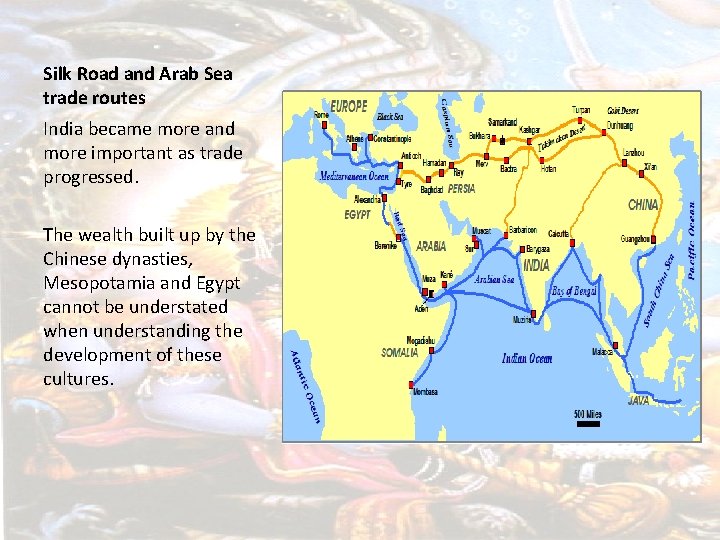
Silk Road and Arab Sea trade routes India became more and more important as trade progressed. The wealth built up by the Chinese dynasties, Mesopotamia and Egypt cannot be understated when understanding the development of these cultures.
Muslim Period • • • Muslim Period (1175 – 1800 AD) – The Mughals � Nomadic people of central Asia. The first invader wa Babur, related to Genghis Khan. � He defeated Rajputs and Afgans and ruled in India � Babar’s successors: Akbar and Shahjahan are the mos prominent in Indian history. � Akbar is known to be the first Muslim emperor to uni Hindus and Muslims, and marrying a Hindu woman. � Shahjahan is known in history for building the world famous monument Tajmahal.
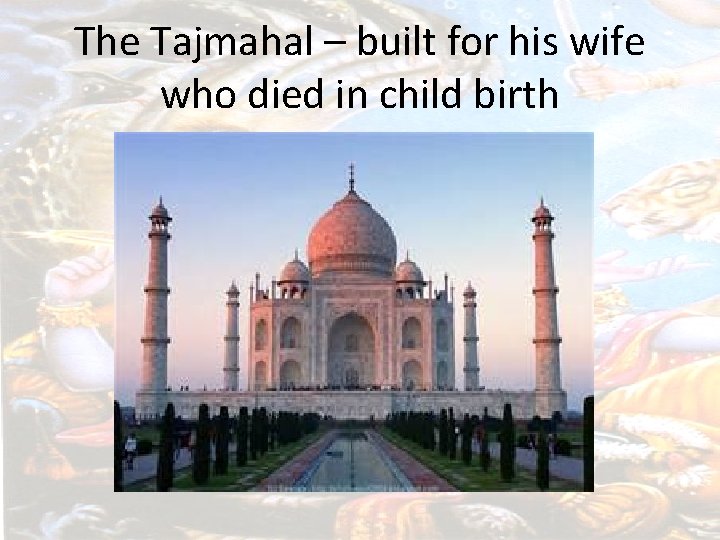
The Tajmahal – built for his wife who died in child birth
British Rule • • The British Rule � Lured by the Portuguese’s success in India, the Eng too wished to have their share of wealth and profits. � Despite the looting and plundering by Muslims and ea Europeans, India was still one of the most rich countries in the world. � In 1600 Queen Elizabeth granted a charter to a compa of merchants to trade freely with India
British Rule • British East India Company flourished and controlled the • whole country. • � India was ruled by British from 1858 to 1947 Mount • Batten was the last governor general to rule over India. • � The independence movement by Indians ended the • British rule on August 15, 1947
British Rule Impact of British Rule � The British influence inspired western education and thoughts: � Created a new educated class. � Created a common language – English � Inspired freedom and exchange of ideas � Built a railway system � The largest single employer in the world today, empl over a • million people. • � Created the largest English speaking nation in the w • •
Indian Independence • Independence of India • The main historical figures of the Indian independence • movement include Mahatma Gandhi, Jawaharlal Nehru, and Mohammad Ali Jinnah. • India and Pakistan become free and independent • countries on August 15, 1947 • Nehru became the first prime minister of newly formed • democratic country of India

Gandhi as young boy
Gandhi • When he returned to India, he organized poor farmers and others to fight against discrimination and taxation. • Leader of the Indian National Congress • Led campaigns to end poverty, liberation of women, brotherhood among religions • Wanted to end caste discrimination • Swaraj, the independence of India from foreign domination. • Salt March in 1930, a major peaceful protest to end British imperialism
Gandhi • In May 1883, at the age of 13, Gandhi was married through his parents' arrangements • They had five children, the first of whom died in infancy. • At the age of 18 on in 1888, Gandhi went to Britain to study law
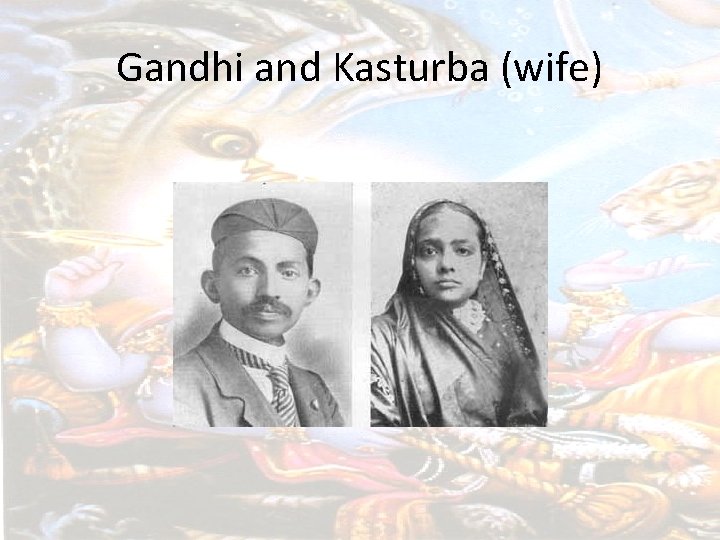
Gandhi and Kasturba (wife)
Gandhi • After graduating from law school, he moved to South Africa to practice law. • He encounters racism. • Indians were not considered full human beings. • Thrown out of a first-class railway compartment car, though he held a first-class ticket. • This event leads him to be leader of the Indian community.
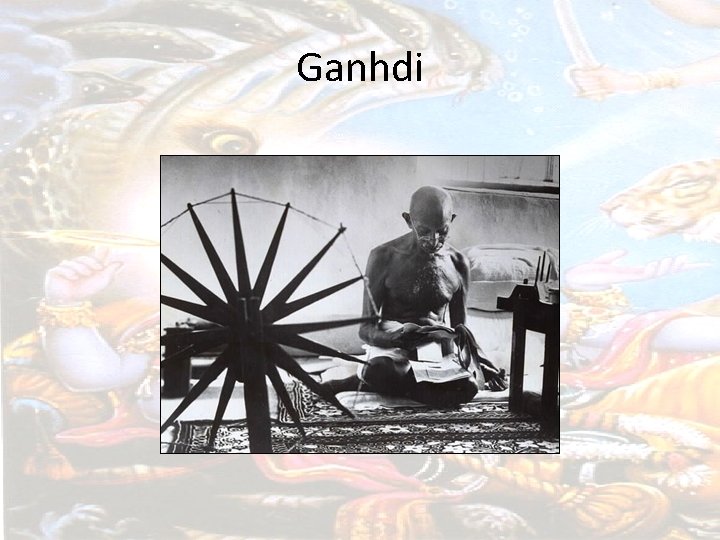
Gandhi • Truth could only be attained through ahimsa (non-violence, love) and brahmacharya (celibacy, striving towards God). He was imprisoned numerous times in both South Africa and India. • Gandhi practiced non-violence and truth, in all situations. • He lived simply, organizing an ashram that was self-sufficient in its needs. • Made his own clothes – dhoti and shawl woven • Vegetarian diet. • He underwent long fasts, for both self-purification and protest.
Ganhdi
Gahndi • Gandhi encouraged Indian’s to be self sufficient. • He believed the less dependent upon the British the more likely they were to gain their independence
Gandhi • Britain instituted a new tax on Salt. • Indians were outraged by this new tax. • March 12 to April 6 Gandhi and his followers launched a peaceful protest • The famous Salt March lasted for 248 miles from Ahmedabad to Dandi • Thousands of Indians joined him on this march to the sea. • This campaign was one of his most successful at upsetting British rule • Britain responded by imprisoning over 60, 000 people.
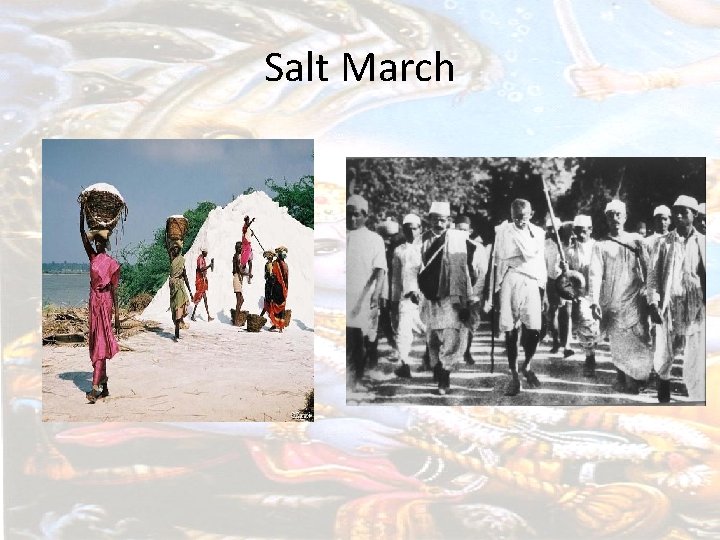
Salt March
Gahndi • On January 30, 1948, Gandhi was shot and killed while having his nightly public walk • The assassin, Nathuram Godse, was a radical Hindu • Godse held Gandi responsible for weakening India • Godse and his co-conspirator Naravan Apte were later tried, convicted; they were executed on November 15, 1949 • Gandhi’s last words were "Oh God".
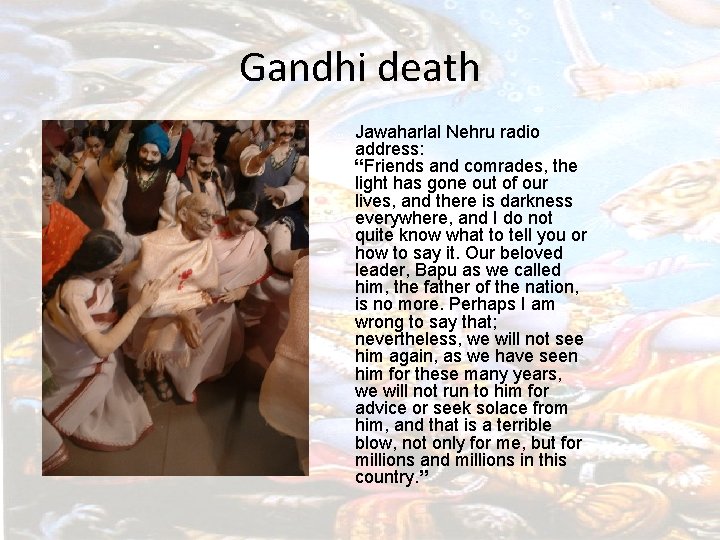
Gandhi death Jawaharlal Nehru radio address: “Friends and comrades, the light has gone out of our lives, and there is darkness everywhere, and I do not quite know what to tell you or how to say it. Our beloved leader, Bapu as we called him, the father of the nation, is no more. Perhaps I am wrong to say that; nevertheless, we will not see him again, as we have seen him for these many years, we will not run to him for advice or seek solace from him, and that is a terrible blow, not only for me, but for millions and millions in this country. ”
Gandhi Legacy • The legacy of Gandhi lives on. He has influenced such leaders as Martin Luther King, Jr. and Nelson Mandela. • Both of these leaders have used his principles of civil disobedience as a way to enact change.
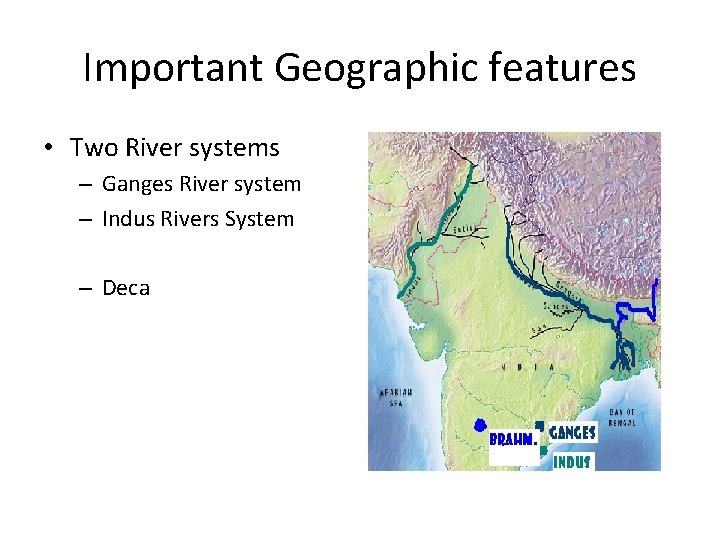
Important Geographic features • Two River systems – Ganges River system – Indus Rivers System – Deca
- Slides: 40