
Indexes WHERE key 22 Key Row pointer 22
- Slides: 12
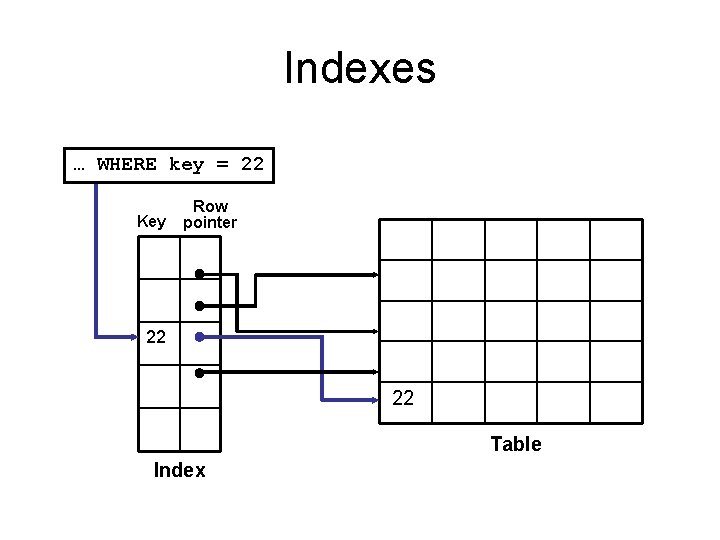
Indexes … WHERE key = 22 Key Row pointer 22 22 Table Index
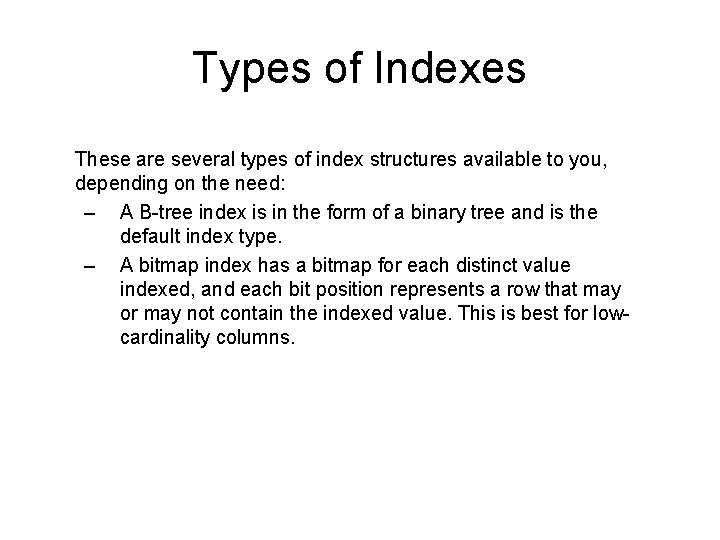
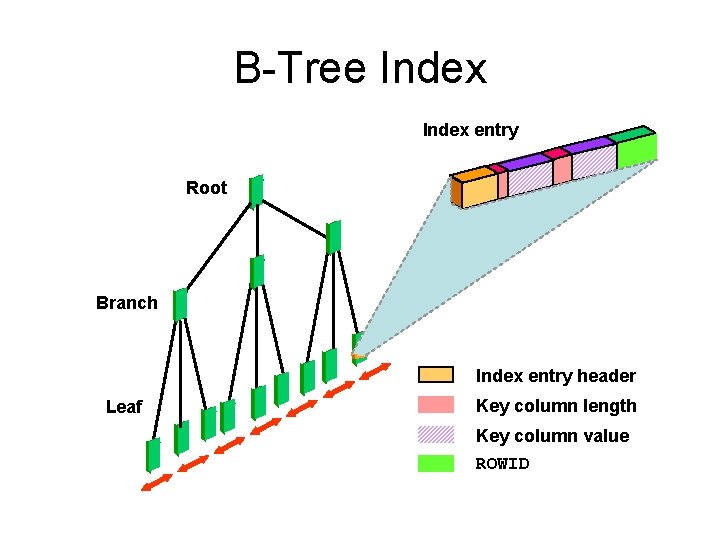
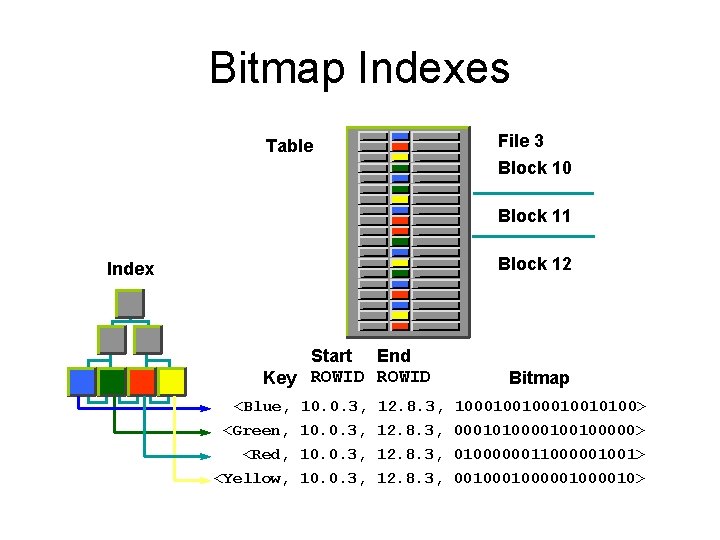
Types of Indexes These are several types of index structures available to you, depending on the need: – A B-tree index is in the form of a binary tree and is the default index type. – A bitmap index has a bitmap for each distinct value indexed, and each bit position represents a row that may or may not contain the indexed value. This is best for lowcardinality columns.
B-Tree Index entry Root Branch Index entry header Leaf Key column length Key column value ROWID
Bitmap Indexes Table File 3 Block 10 Block 11 Block 12 Index Start End Key ROWID Bitmap <Blue, 10. 0. 3, 12. 8. 3, 100010010100> <Green, 10. 0. 3, 12. 8. 3, 0001010000100100000> <Red, 10. 0. 3, 12. 8. 3, 0100000011000001001> <Yellow, 10. 0. 3, 12. 8. 3, 0010000010>
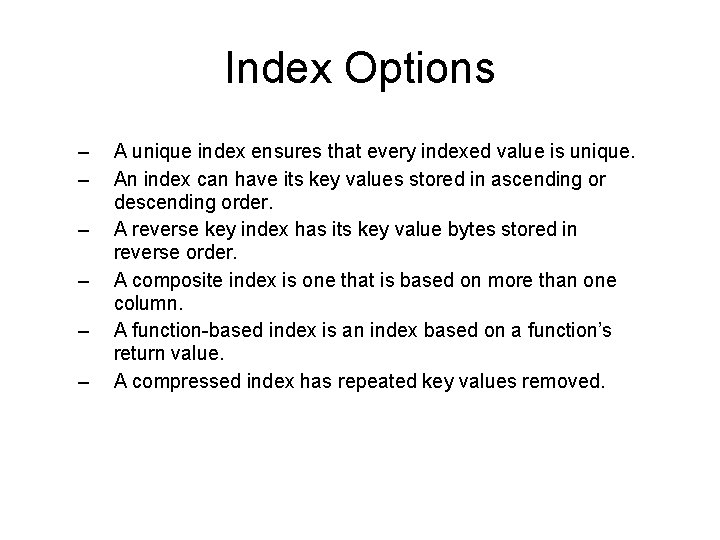
Index Options – – – A unique index ensures that every indexed value is unique. An index can have its key values stored in ascending or descending order. A reverse key index has its key value bytes stored in reverse order. A composite index is one that is based on more than one column. A function-based index is an index based on a function’s return value. A compressed index has repeated key values removed.
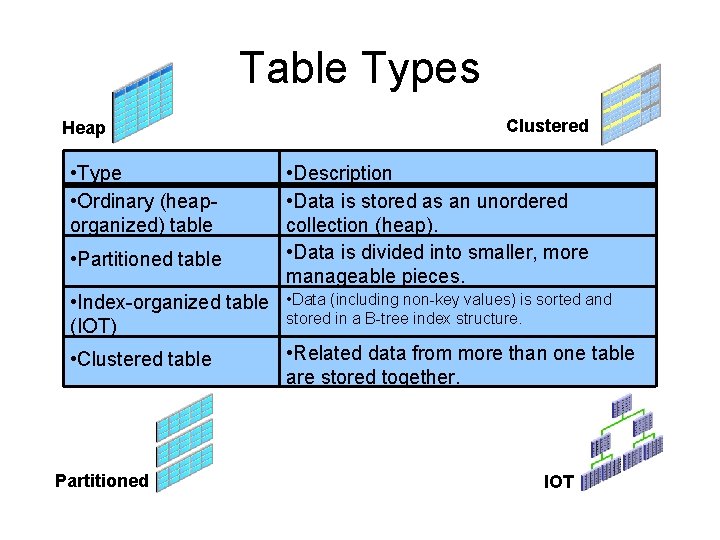
Table Types Heap • Type • Ordinary (heaporganized) table • Partitioned table Clustered • Description • Data is stored as an unordered collection (heap). • Data is divided into smaller, more manageable pieces. • Index-organized table • Data (including non-key values) is sorted and stored in a B-tree index structure. (IOT) • Related data from more than one table • Clustered table are stored together. Partitioned IOT
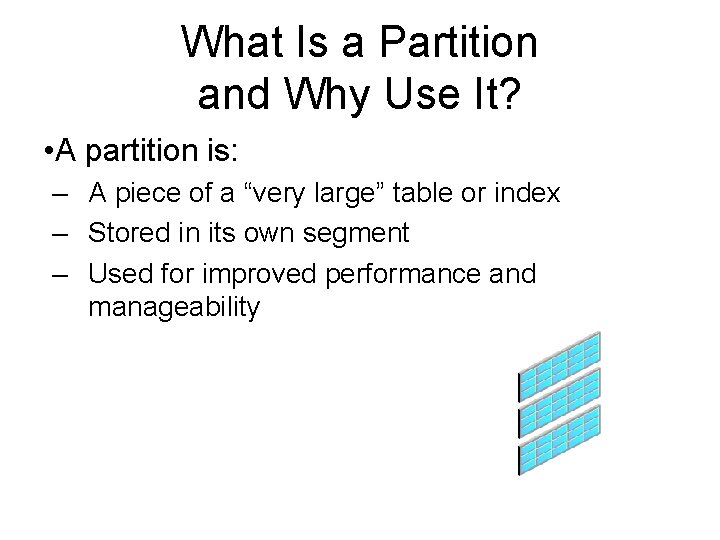
What Is a Partition and Why Use It? • A partition is: – A piece of a “very large” table or index – Stored in its own segment – Used for improved performance and manageability
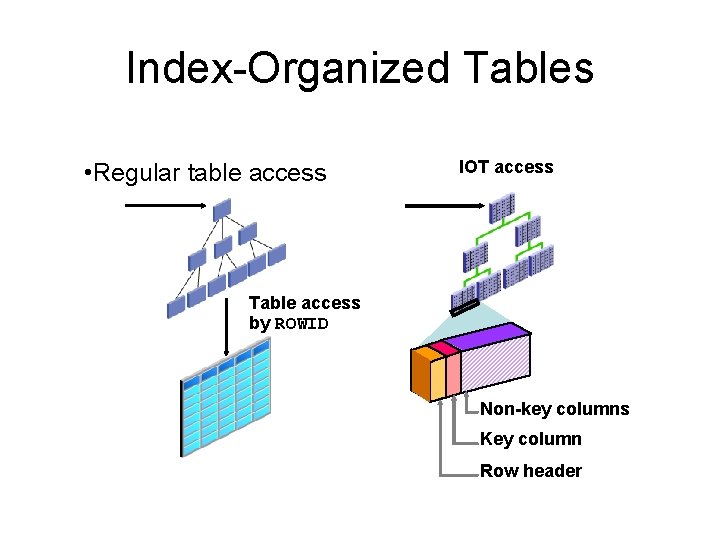
Index-Organized Tables • Regular table access IOT access Table access by ROWID Non-key columns Key column Row header
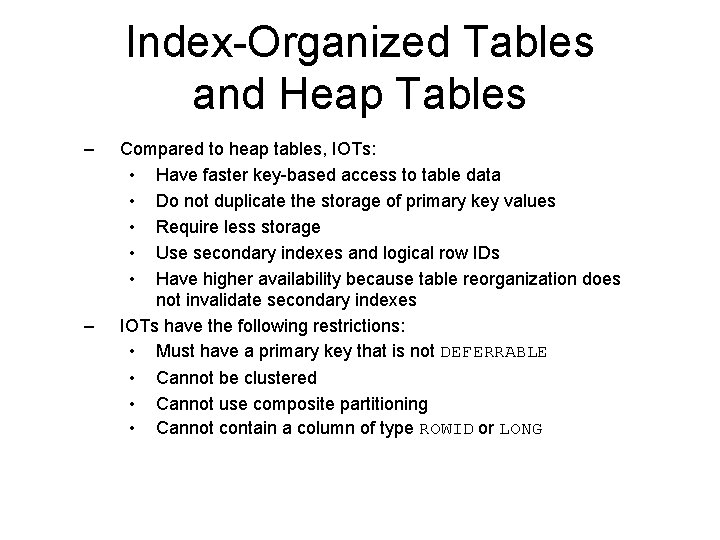
Index-Organized Tables and Heap Tables – – Compared to heap tables, IOTs: • Have faster key-based access to table data • Do not duplicate the storage of primary key values • Require less storage • Use secondary indexes and logical row IDs • Have higher availability because table reorganization does not invalidate secondary indexes IOTs have the following restrictions: • Must have a primary key that is not DEFERRABLE • • • Cannot be clustered Cannot use composite partitioning Cannot contain a column of type ROWID or LONG
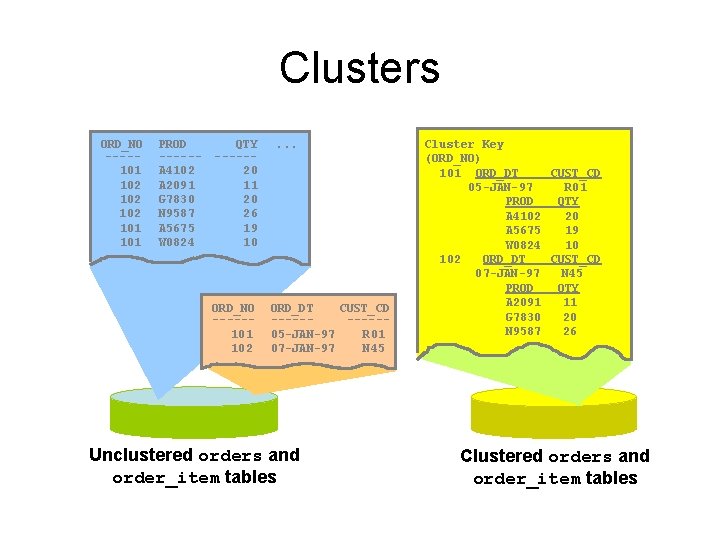
Clusters ORD_NO ----101 102 102 101 PROD -----A 4102 A 2091 G 7830 N 9587 A 5675 W 0824 QTY -----20 11 20 26 19 10 ORD_NO -----101 102 . . . ORD_DT CUST_CD -----05 -JAN-97 R 01 07 -JAN-97 N 45 Unclustered orders and order_item tables Cluster Key (ORD_NO) 101 ORD_DT CUST_CD 05 -JAN-97 R 01 PROD QTY A 4102 20 A 5675 19 W 0824 10 102 ORD_DT CUST_CD 07 -JAN-97 N 45 PROD QTY A 2091 11 G 7830 20 N 9587 26 Clustered orders and order_item tables
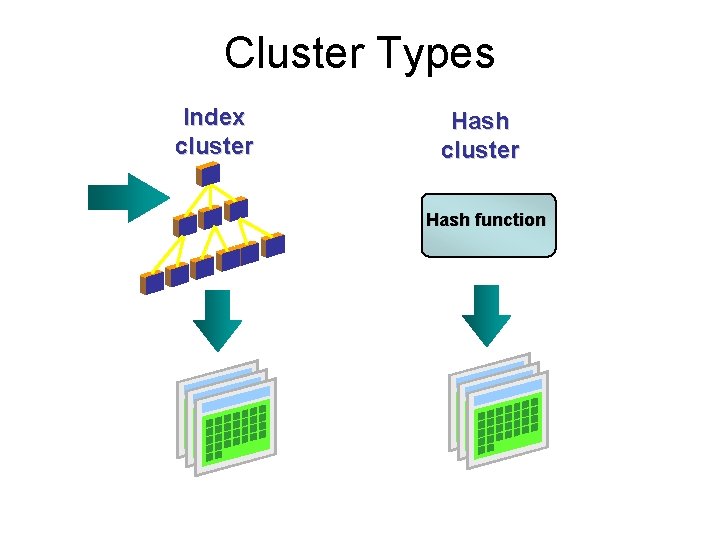
Cluster Types Index cluster Hash function
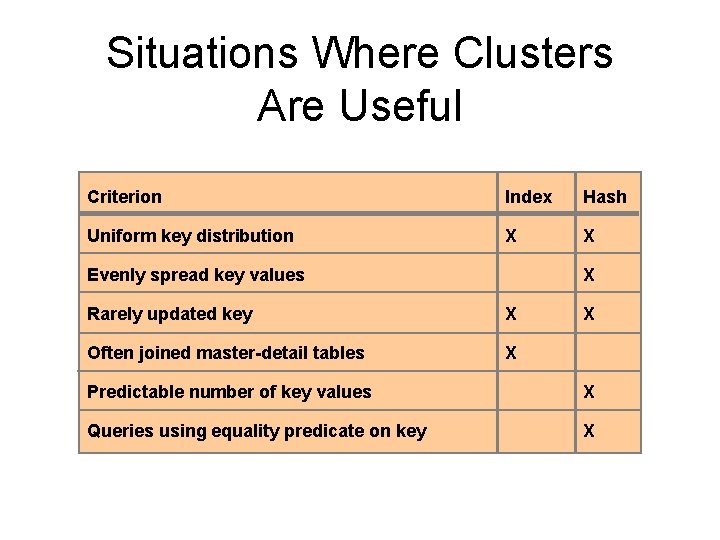
Situations Where Clusters Are Useful Criterion Index Hash Uniform key distribution X X Evenly spread key values X Rarely updated key X Often joined master-detail tables X X Predictable number of key values X Queries using equality predicate on key X