
Index of Refraction In general the speed of
- Slides: 17
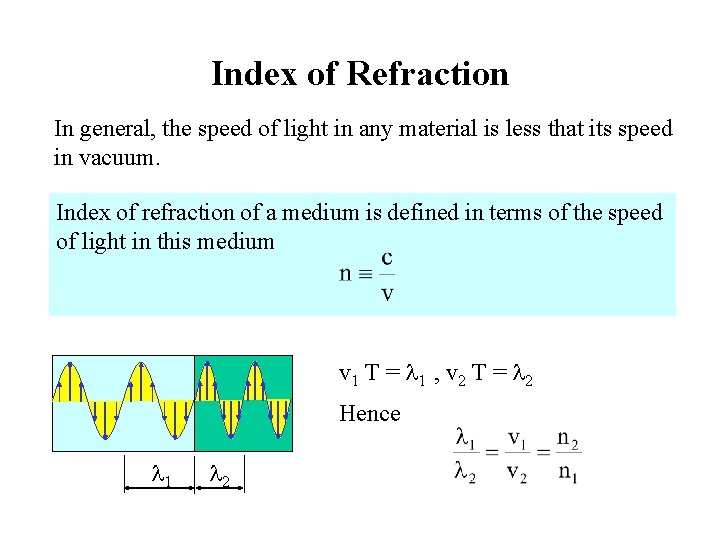
Index of Refraction In general, the speed of light in any material is less that its speed in vacuum. Index of refraction of a medium is defined in terms of the speed of light in this medium v 1 T = 1 , v 2 T = 2 Hence 1 2
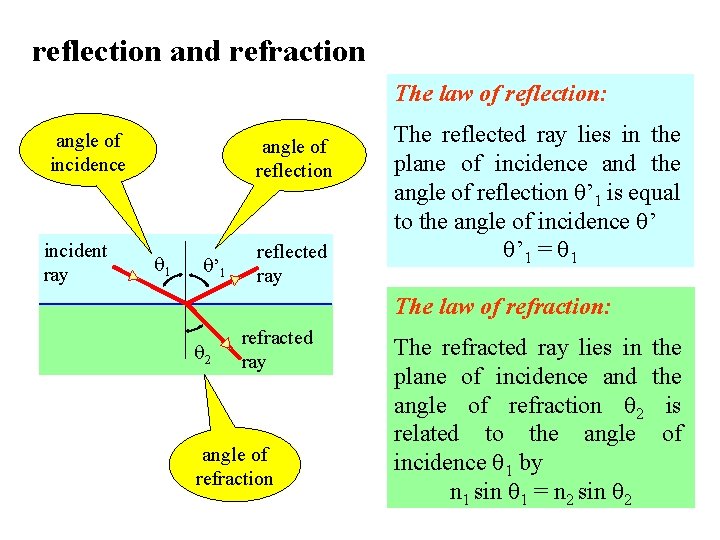
reflection and refraction The law of reflection: angle of incidence incident ray angle of reflection 1 ’ 1 reflected ray The reflected ray lies in the plane of incidence and the angle of reflection ’ 1 is equal to the angle of incidence ’ ’ 1 = 1 The law of refraction: 2 refracted ray angle of refraction The refracted ray lies in plane of incidence and angle of refraction 2 related to the angle incidence 1 by n 1 sin 1 = n 2 sin 2 the is of
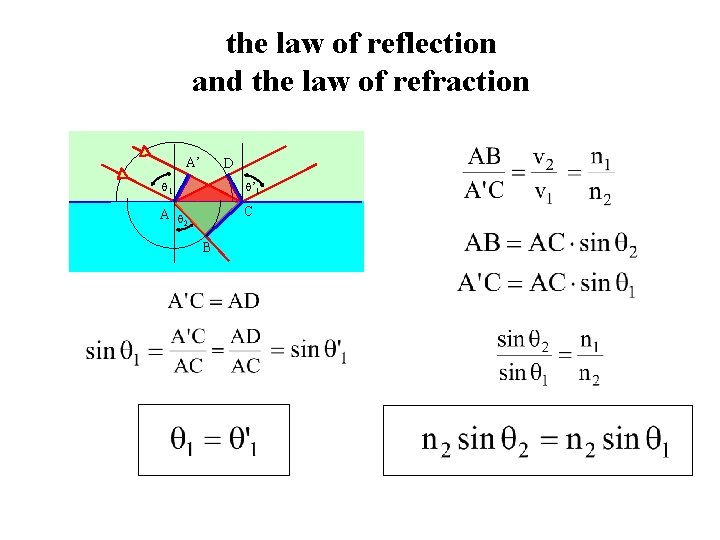
the law of reflection and the law of refraction A’ D 1 ’ 1 A 2 C B
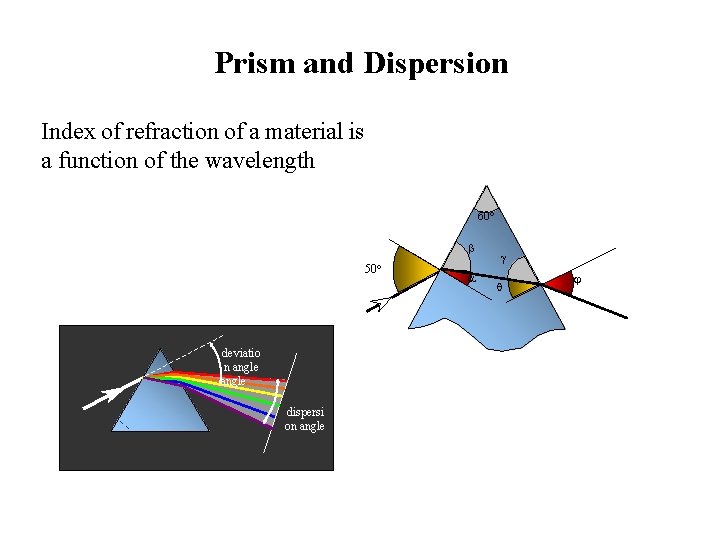
Prism and Dispersion Index of refraction of a material is a function of the wavelength 60 50 deviatio n angle dispersi on angle
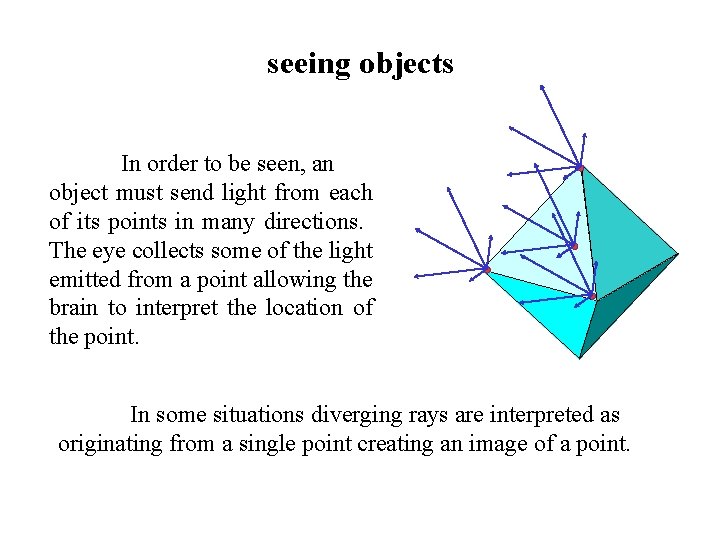
seeing objects In order to be seen, an object must send light from each of its points in many directions. The eye collects some of the light emitted from a point allowing the brain to interpret the location of the point. In some situations diverging rays are interpreted as originating from a single point creating an image of a point.
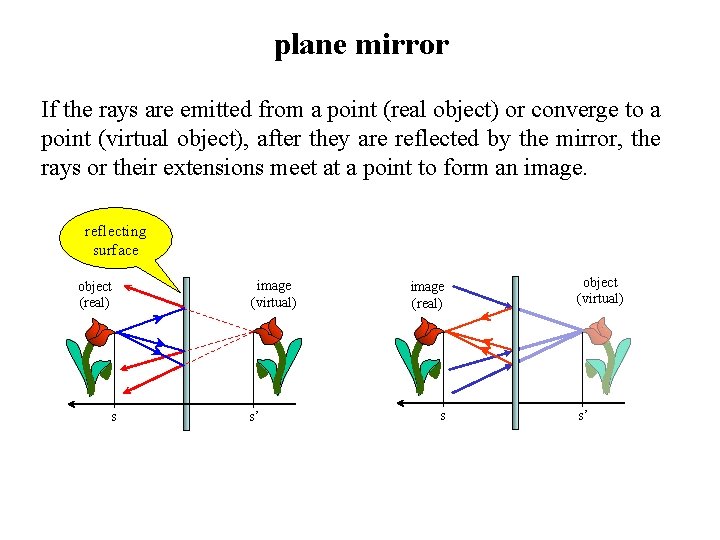
plane mirror If the rays are emitted from a point (real object) or converge to a point (virtual object), after they are reflected by the mirror, the rays or their extensions meet at a point to form an image. reflecting surface object (real) s image (virtual) s’ image (real) s object (virtual) s’
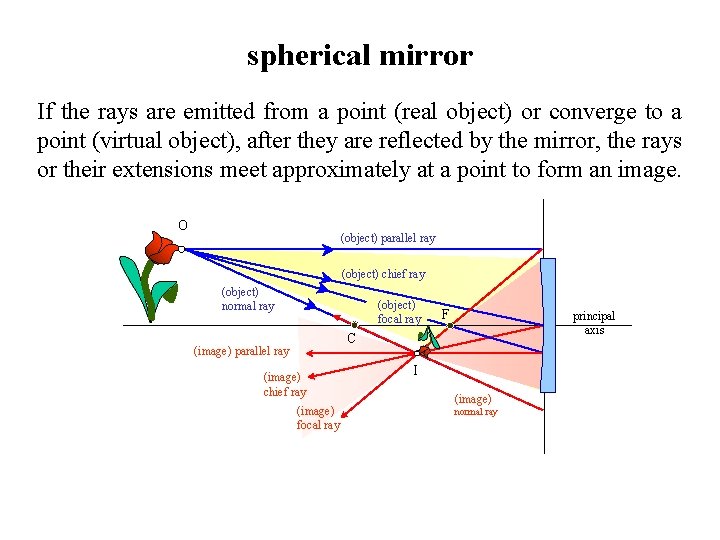
spherical mirror If the rays are emitted from a point (real object) or converge to a point (virtual object), after they are reflected by the mirror, the rays or their extensions meet approximately at a point to form an image. O (object) parallel ray (object) chief ray (object) normal ray (object) focal ray F principal axis C (image) parallel ray (image) chief ray (image) focal ray I (image) normal ray
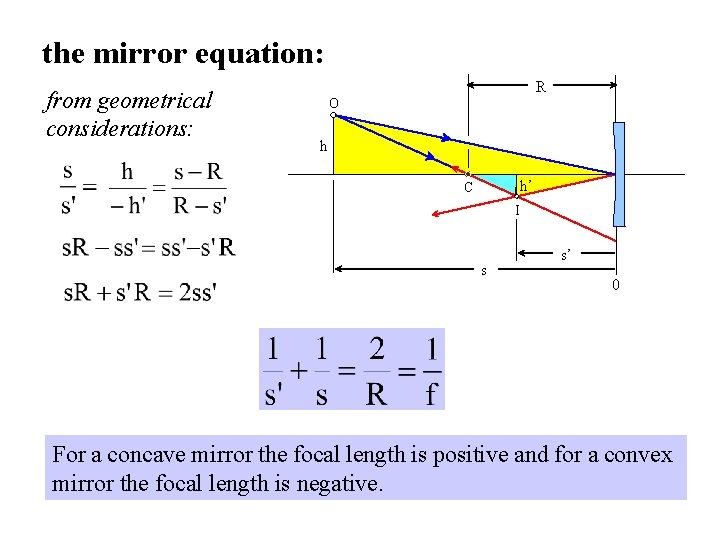
the mirror equation: from geometrical considerations: R O h h’ C I s s’ 0 For a concave mirror the focal length is positive and for a convex mirror the focal length is negative.
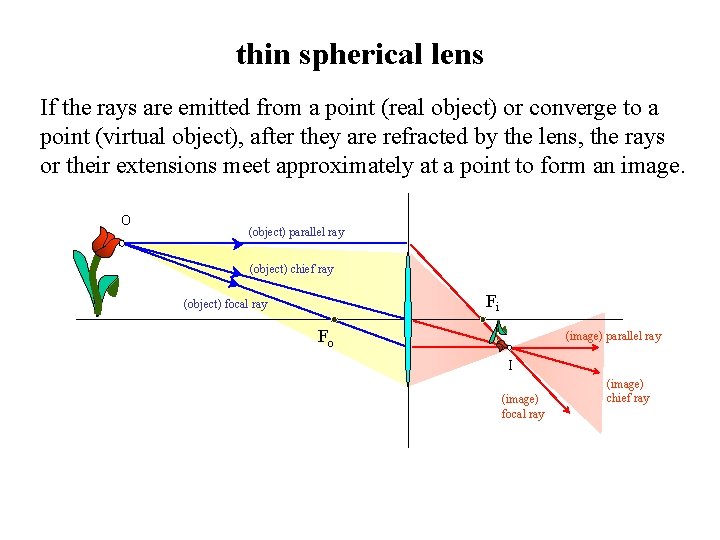
thin spherical lens If the rays are emitted from a point (real object) or converge to a point (virtual object), after they are refracted by the lens, the rays or their extensions meet approximately at a point to form an image. O (object) parallel ray (object) chief ray Fi (object) focal ray Fo (image) parallel ray I (image) focal ray (image) chief ray
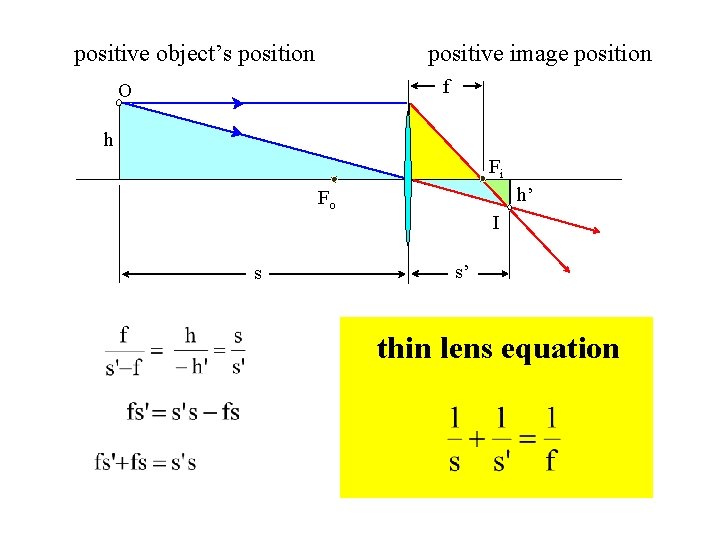
positive object’s position positive image position f O h Fi h’ Fo s I s’ thin lens equation
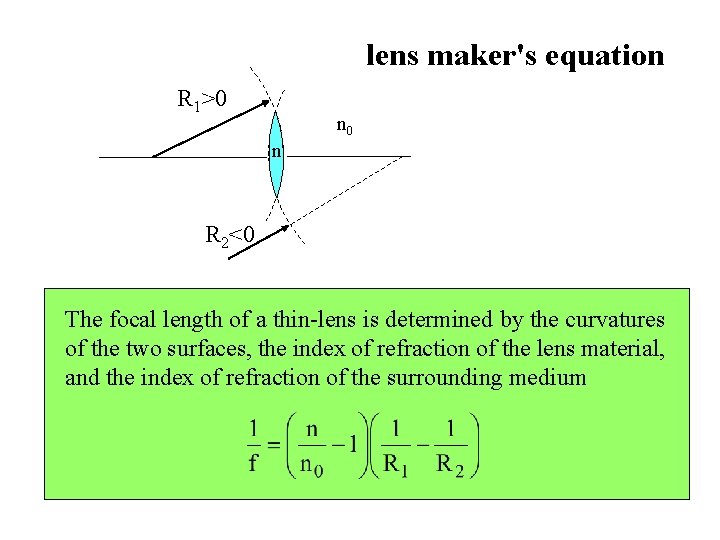
lens maker's equation R 1>0 n R 2<0 The focal length of a thin-lens is determined by the curvatures of the two surfaces, the index of refraction of the lens material, and the index of refraction of the surrounding medium
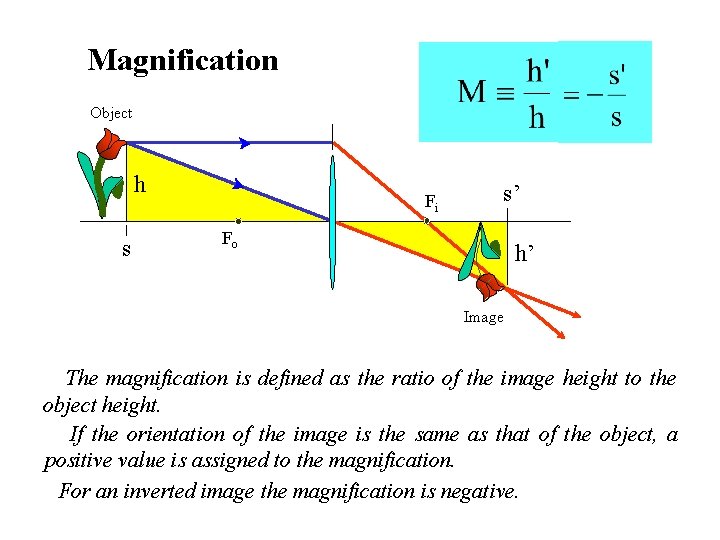
Magnification Object h s Fi s’ Fo h’ Image The magnification is defined as the ratio of the image height to the object height. If the orientation of the image is the same as that of the object, a positive value is assigned to the magnification. For an inverted image the magnification is negative.
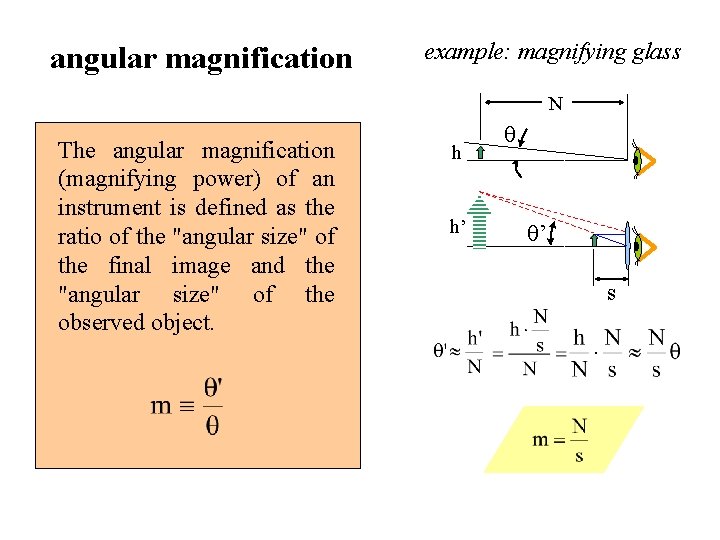
angular magnification example: magnifying glass N The angular magnification (magnifying power) of an instrument is defined as the ratio of the "angular size" of the final image and the "angular size" of the observed object. h h’ ’ s
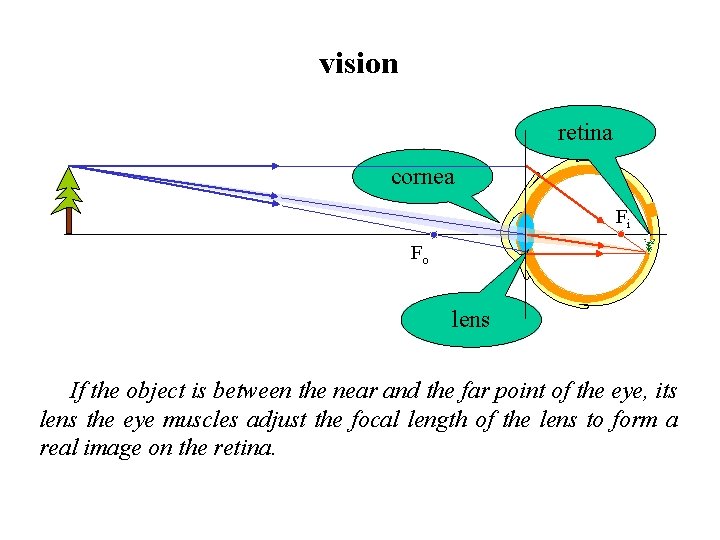
vision retina cornea Fi Fo lens If the object is between the near and the far point of the eye, its lens the eye muscles adjust the focal length of the lens to form a real image on the retina.
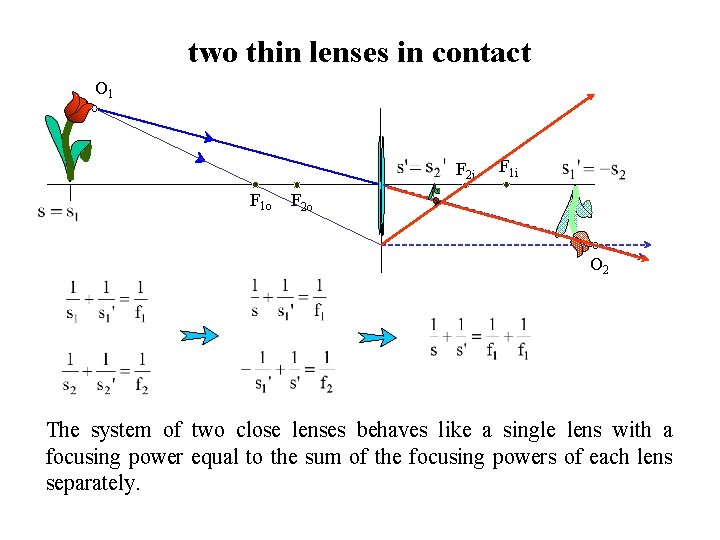
two thin lenses in contact O 1 F 2 i F 1 o F 1 i F 2 o O I 1 2 The system of two close lenses behaves like a single lens with a focusing power equal to the sum of the focusing powers of each lens separately.
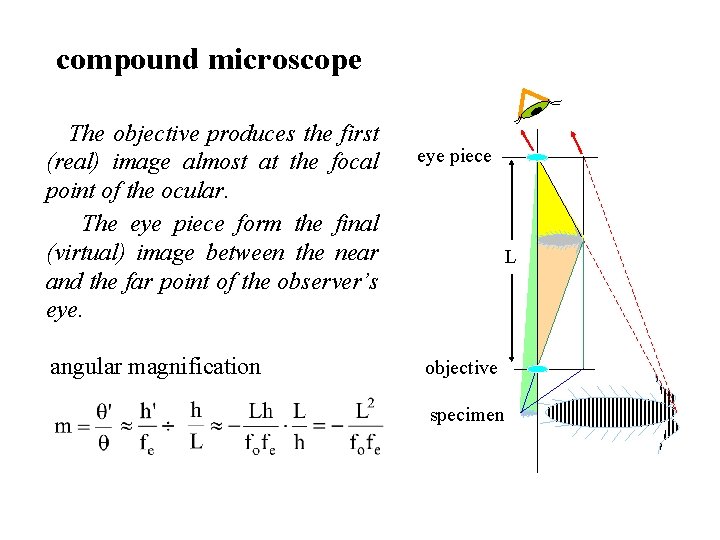
compound microscope The objective produces the first (real) image almost at the focal point of the ocular. The eye piece form the final (virtual) image between the near and the far point of the observer’s eye. angular magnification eye piece L objective specimen
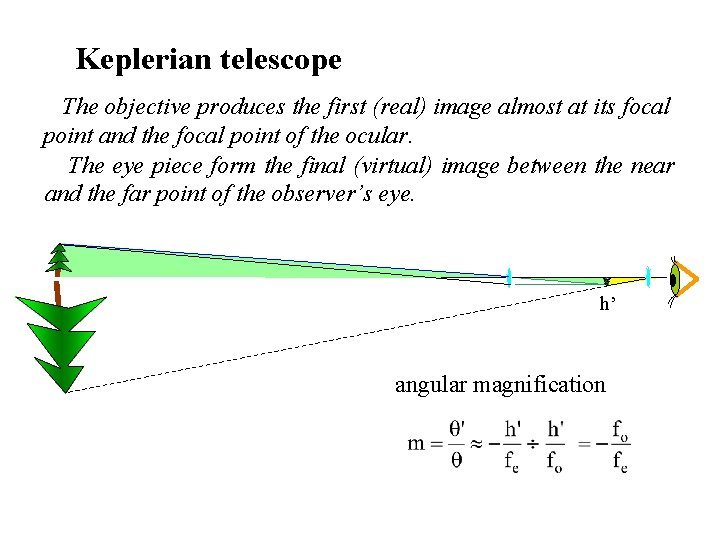
Keplerian telescope The objective produces the first (real) image almost at its focal point and the focal point of the ocular. The eye piece form the final (virtual) image between the near and the far point of the observer’s eye. h’ angular magnification