
INDEX Introduction Why Brain finger printing How it

INDEX Introduction. Why Brain finger printing? How it works Graphical representation Mermer methodology Phases of Brain finger printing Role of Brain finger printing in criminal proceeding Techniques Benefits Applications Limitations Conclusion References

INTRODUCTION Brain fingerprinting was invented by Lawrence Farwell which is used to detect the crimes based up on the brain wave responses. Brain Fingerprinting is a new computer-based technology to identify the person of a crime accurately. Brain Fingerprinting is based on the principle that the brain is central to all human acts.
Why Brain finger printing? The specific pattern EEG(electroencephalograph) used in this technique. Difference between a perpetrator and a falsely accused, innocent person. The Secrets Of Brain Fingerprinting Matching evidence at the crime scene with evidence in the brain.
How it works ? A suspect is tested by looking at three kinds of information represented by different colored lines. Ø Red: Information the suspect is expected to know. Ø Green: Information not known to suspect. Ø Blue: Information of the crime that only perpetrator would.

Graphical representation Not guilty : Guilty :
MERMER Methodology The procedure used is similar to the Guilty Knowledge Test; a series of words, sounds, or pictures are presented via computer to the subject for a fraction of a second each. This response does not elicit a MERMER, indicating that the information is absent from their mind.
Phases of Brain Fingerprinting 1. Brain Fingerprinting Crime Scene Evidence Collection. 2. Brain Fingerprinting Brain Evidence Collection. 3. Brain Fingerprinting Computer Evidence Analysis. 4. Brain Fingerprinting Scientific Result.
Role in criminal proceeding The application of Brain Fingerprinting testing in a criminal case involves four phases: 1. Invistigation 2. Interview 3. Scientific 4. Testing 5. Adjudication v The domain of science v The first phase is undertaken by a skilled invistigator v The fourth by a judge and jury v
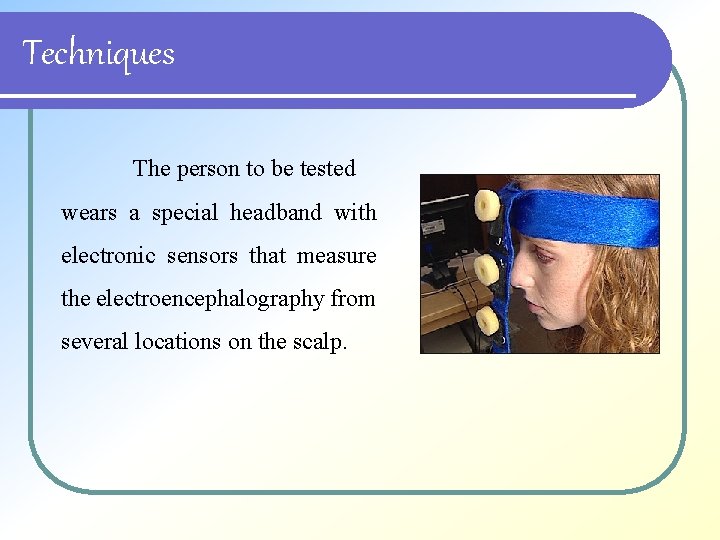
Techniques The person to be tested wears a special headband with electronic sensors that measure the electroencephalography from several locations on the scalp.
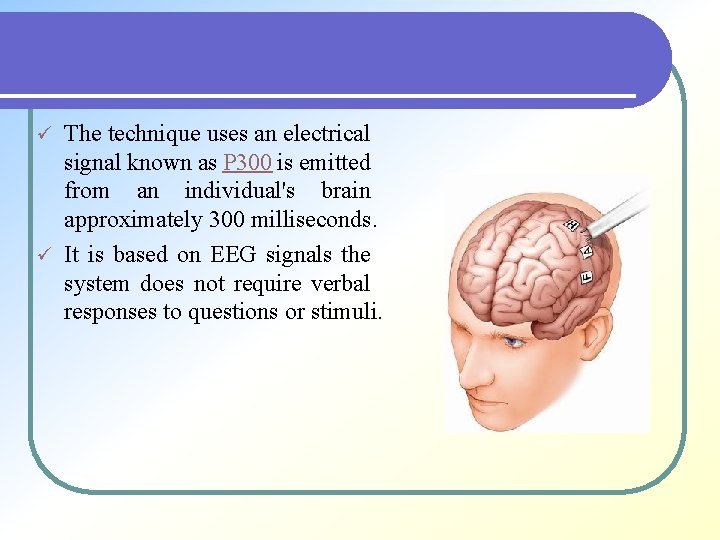
The technique uses an electrical signal known as P 300 is emitted from an individual's brain approximately 300 milliseconds. ü It is based on EEG signals the system does not require verbal responses to questions or stimuli. ü
BENEFITS l Identify crime perpetrators quickly and scientifically. l Record of 100% accuracy. l Confirm innocence, clear the falsely accused, and the falsely convicted. l Provide immediate Scientific Result: Information Present or Information Absent.
APPLICATIONS Ø Counter terrorism Ø Criminal justice Ø Medical Ø Additional Applications
Limitations l Brain fingerprinting detects information-processing brain responses that reveal what information is stored in the subject’s brain. l It is not applicable in a suspect and an alleged victim. l In a case where the suspect knows everything that the invistegations know.
CONCLUSION ØBrain Fingerprinting is a revolutionary new scientific technology for solving crimes, identifying perpetrators, ØExonerating innocent suspects, with a record of 100% accuracy in research with US government agencies, actual criminal cases, and other applications. ØThe technology fulfills an urgent need for governments, law enforcement agencies, corporations, investigators, crime victims, and falsely accused, innocent suspects.
REFERENCES http: //www. slideshare. net • www. brainwavescience. com • Farwell LA, Donchin E. The brain detector • Picton TW. Handbook of electroncephalography and clinical neurophysiology: human event-related potentials. •

Queries ?
- Slides: 17