
Independent Test Capability ITC ITC Synchronous Bus ITCSB
Independent Test Capability (ITC) ITC Synchronous Bus (ITCSB) 1553 and Space. Wire Interception ITC Team Members Justin Morris Steven Seeger Brandon Bailey Scott Zemerick Mark Pitts Jeff Joltes Justin Mc. Carty Dan Nawrocki Gary Carvell Peter Medley Contact Us: ivv-itc@lists. nasa. gov Internal Website: http: //itc. ivv. nasa. gov External Website: http: //www. nasa. gov/centers/ivv/JSTAR/ITC. html
Agenda • • ITCSB Description ITCSB Features ITCSB Interception Current Use – Demonstrations • Conclusion NASA IV&V Facility Independent Test Capability 2
ITCSB Description • Re-usable communication mechanism – Ensures consistent and correct data passing among distributed simulation components • Provides synchronization between distributed applications • Flexible and extensible design – Can be extended to incorporate any communication protocol NASA IV&V Facility Independent Test Capability 3
ITCSB Features • • Transport agnostic Cross platform C++ implementation Robust User API Specialized Layers: – MIL-STD-1553 B – ESA Space. Wire – Time Sync • Dynamic interception allows data manipulation – Without modification to software NASA IV&V Facility Independent Test Capability 4
ITCSB Interception • Dynamically added and removed • Priority-based • Block, pass, and modify data – Fault injection – Bus monitoring • Available utilities – 1553 Interceptor GUI – Space. Wire Interceptor GUI – Various command line utilities NASA IV&V Facility Independent Test Capability 5
Development & Interception • ITCSB used to create simulation components – Useful for easy integration into simulation environment – Common libraries guarantee communication correctness • Interception can come later – Development can occur without any consideration of interception – Dynamic nature of interception means it can be used later without modification to simulation component • Interception is future-proofing – Any work can be done later without modification to code – Code can be augmented by insertion of interceptions on the network • Development of interceptors separate from components NASA IV&V Facility Independent Test Capability 6
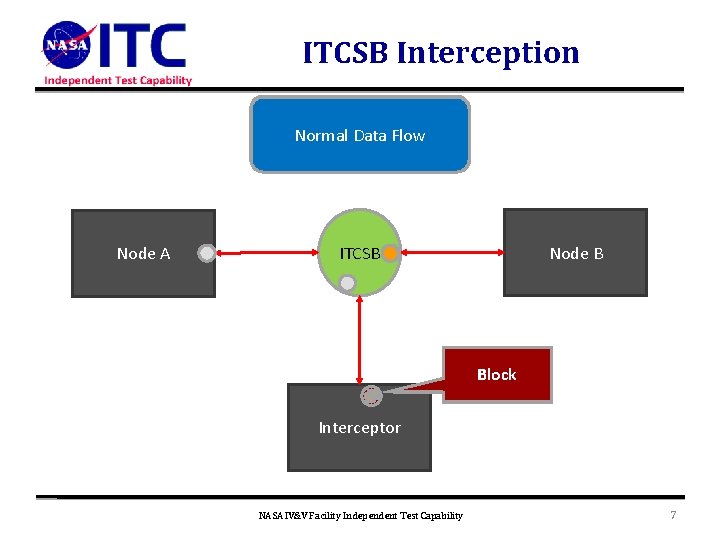
ITCSB Interception Interceptor Blocking Interceptor Modifying Data Flow With Normal Data Flow Data Interceptor Node A Node B ITCSB Block Modify Interceptor NASA IV&V Facility Independent Test Capability 7
Current Use • GPM Operational Simulator (GO-SIM) • JWST IV&V Simulation and Test (JIST) Environment ITCSB is the Main Communication Hub within GO-SIM and JIST NASA IV&V Facility Independent Test Capability 8
NASA IV&V Facility Independent Test Capability 9
NASA IV&V Facility Independent Test Capability 10
NASA IV&V Facility Independent Test Capability 11
Conclusion • ITCSB provides – Communications backbone for future simulation development – Synchronization for distributed simulation components • Mitigates timing concerns – Interceptors that allow the changing of data without modification to software under test • ITCSB interception is the most beneficial feature for the IV&V analysts – Provides mechanism for fault injection – Allows for testing scenarios that are often impossible with hardware NASA IV&V Facility Independent Test Capability 12
- Slides: 12