
Independent Sumerian CityStates The Emergence of Cities Vocabulary
Independent Sumerian City-States The Emergence of Cities
Vocabulary • Monarch – The king or queen of a people. • Polytheism – The belief in many gods or goddesses. • City-States – Cities and their surrounding countryside/farmland. • Cuneiform – An early writing system using wedge shapes to represent sounds. • Ziggurats – Large temple buildings constructed from mud bricks. • Chariots – Wheeled vehicles used during battles or for racing.
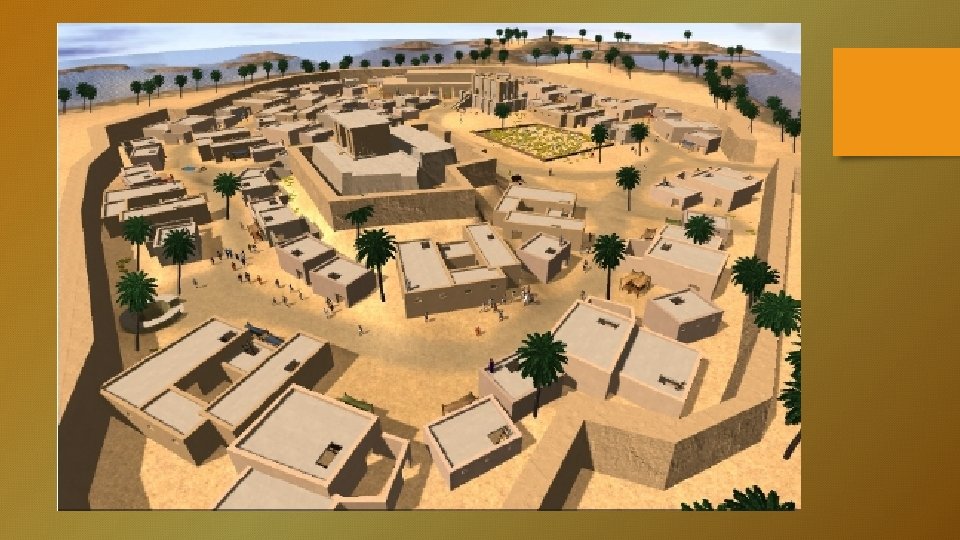
The Emergence of Cities: Overview • By 3, 000 B. C. , about 12 cities in Sumer had developed into the world’s first citystates which included a walled city and the land around it. • Each city-state had its own government and borders. (A state/nation that consisted of a city. ) • They contained several square miles and populations up to 5, 000 people. • Overtime they developed up to 60, 000 people or more. • Each Sumer city-state was independent, but shared a common culture: religion, language, and writing system. • They construct large buildings, and created arts and crafts. • They developed advanced technologies for irrigation.
Government & Religion • City-state governments were made up of a small group of leaders, and a chief leader chosen by the group. • They made laws, decided what work was to be done, and dealt with disputes over land water rights. (Either peacefully or with war. ) • Eventually a single leader emerged when city-states were faced with war and the group could not always agree what to do. • So was born, the world’s first monarchy. (Rule of a king, and queen) • When a king died, his son became the new king. • This was a more stable form of government than previously.
Government & Religion • The kings lived in walled palaces and had complete authority over religion, economy, and everyday life. • The king appointed officials to carry out his orders (often concerning surpluses and building projects) • Below the kings, priests also had authority. • Sumerians were polytheistic (belief in many gods) • Each natural event had its own god, each god protected a different city-state, each city-state built a temple for their main god. • Priests held ceremonies for the gods, especially those for agriculture.
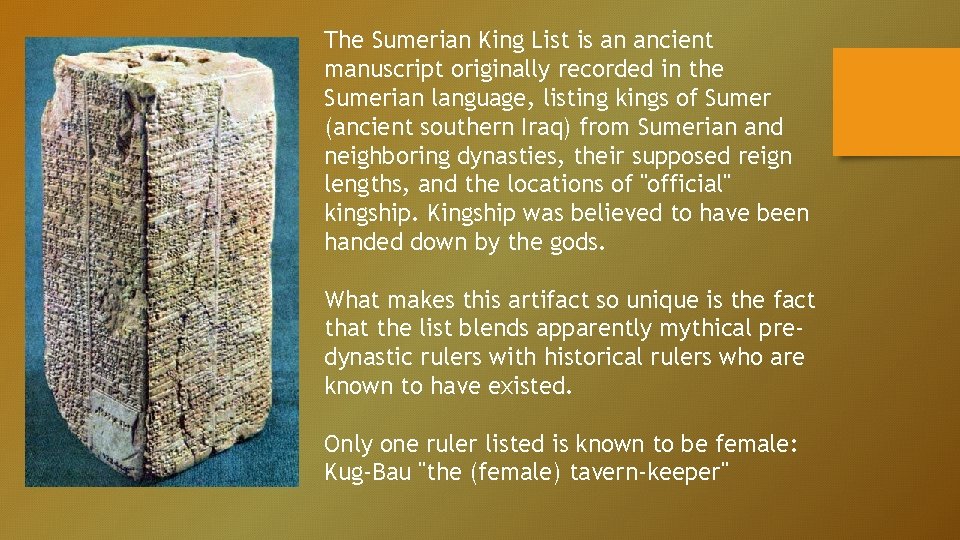
The Sumerian King List is an ancient manuscript originally recorded in the Sumerian language, listing kings of Sumer (ancient southern Iraq) from Sumerian and neighboring dynasties, their supposed reign lengths, and the locations of "official" kingship. Kingship was believed to have been handed down by the gods. What makes this artifact so unique is the fact that the list blends apparently mythical predynastic rulers with historical rulers who are known to have existed. Only one ruler listed is known to be female: Kug-Bau "the (female) tavern-keeper"
Sumerian Religion • • • Enlil – God of the air and storms. Was responsible for separating the heavens and the Earth. Utu – God of the sun and creator of law and justice. Nana – Goddess of the moon and fertility Enki – God of water and wisdom who gave people their talents and skills. Inanna – Goddess of love and war. Was present whenever a person was born or died. Ereshkigal – Goddess of darkness, gloom, and death. • Cities competed with each other to see who could build the largest and most beautiful temples to their gods. Some of the larger temples employed hundreds of people including priests, singers, dancers, and servants. • Unlike many other religions, the Sumerians did not have a clear vision of a heaven or hell. For them, life after death was simply a dull and shadowy version of life on Earth with little joy but also little sadness or pain. Spirits of dead people, called etemmu, could receive offerings from their living relatives. In turn the etemmu could help the living in small ways.
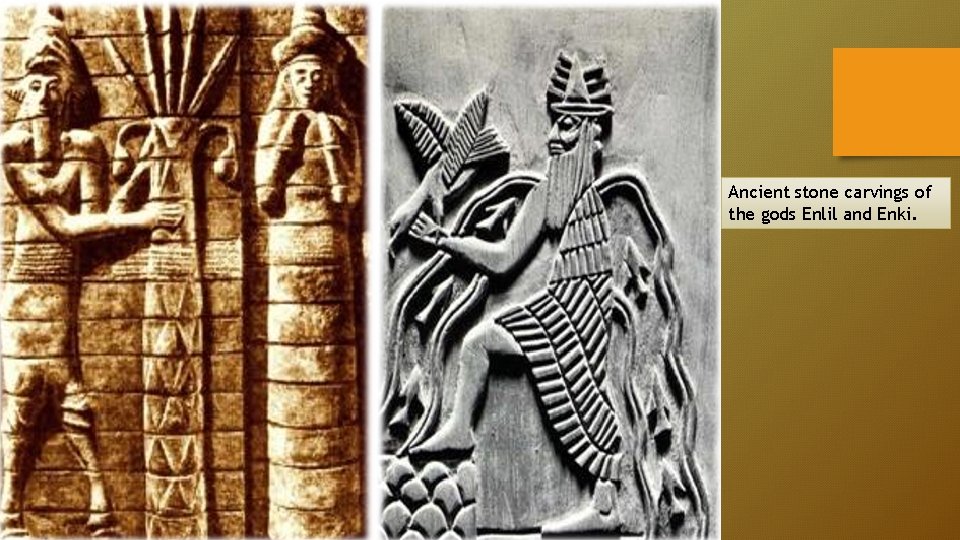
Ancient stone carvings of the gods Enlil and Enki.
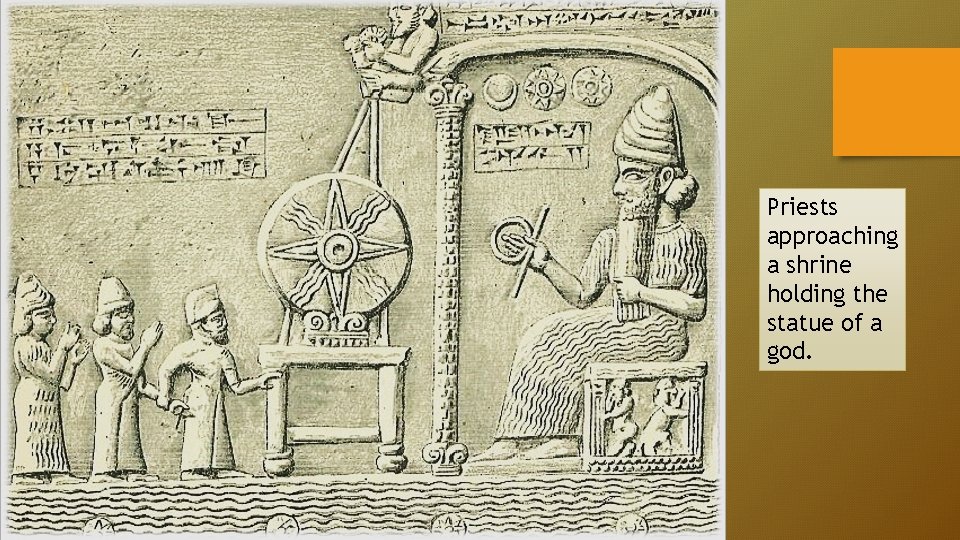
Priests approaching a shrine holding the statue of a god.
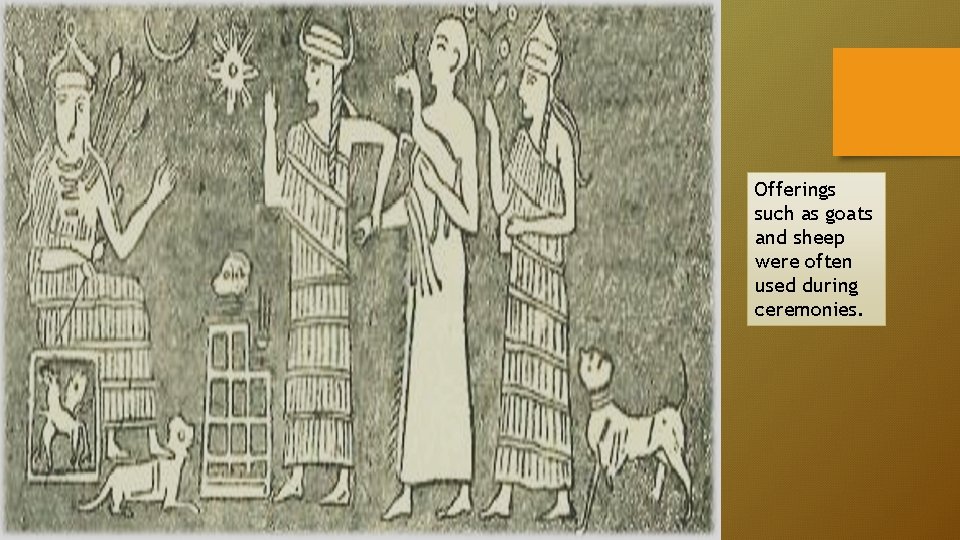
Offerings such as goats and sheep were often used during ceremonies.
A Commercial Society • • • Sumerian economy was based on surpluses. Surpluses led to new kinds of jobs, to production of new goods, and to more trade. New jobs included craftworkers, metalworkers, builders, and more. The land in Sumer did not have metals or trees. Sumerians exported (sent out) agricultural surpluses (grains and dates) in exchange for metals, woods, and other resources. Sumerians depended on long-distance trade. Groups of traders traveled on long journeys together. (caravans) Caravans carried trade goods by donkeys throughout the Fertile Crescent, and later by boats and ships. By 2, 300 B. C. trade expanded from Egypt and the eastern Mediterranean to perhaps as far as the Indus Valley. To keep track of trade they developed clay tokens, and recorded information on clay tablets
Excavations at Ur • Ur was a city-state in Sumer that last from 5, 000 – 2, 000 B. C. • The city of Ur was near the Euphrates River, the river has since changed its course and the land near Ur is now a desert. • Each layer of ground held artifacts from different periods of Ur. • In the deepest layer, they found remains of an Ubaid village, above that was eight feet of mud (evidence of a flood). • They found a cemetery, now called the Royal Cemetery of Ur, that held tombs from the 2, 500’s B. C. • Artifacts from the tombs showed the skill of Sumerian craftworkers and evidence of long distance trade.
Excavations at Ur • Tombs of royalty and high priests contain valuable items made of precious metals and stones. • Some had jewelry and weapons. • Archeologists also discovered a large temple that was dedicated to the moon god, Nana. • The temple’s architecture (building style) was similar to other city-states previous discovered. • The rest of the city consisted of small mud-brick houses built along narrow alleys. • The high layer of ground contained artifacts from the 2, 000’s B. C. , when the Euphrates changed its course and the city was abandoned.
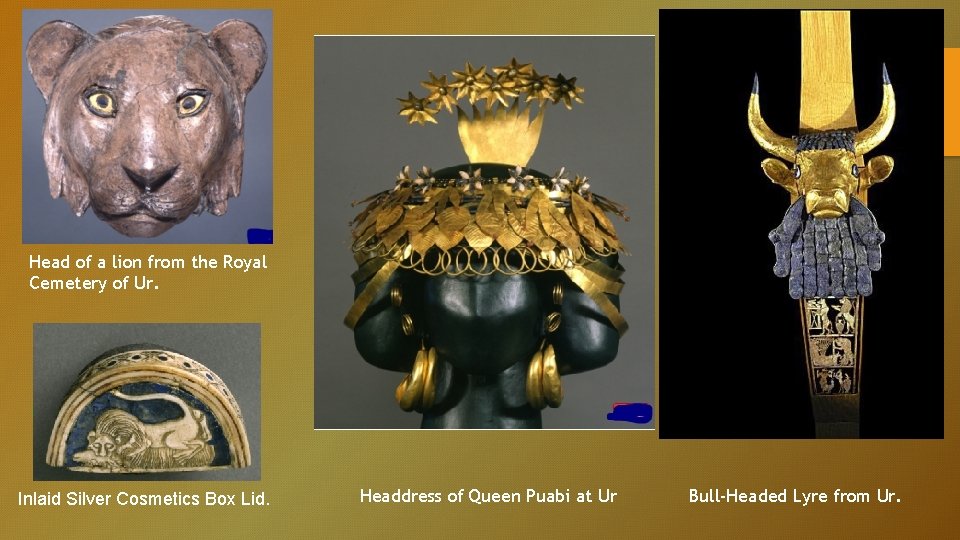
Head of a lion from the Royal Cemetery of Ur. Inlaid Silver Cosmetics Box Lid. Headdress of Queen Puabi at Ur Bull-Headed Lyre from Ur.
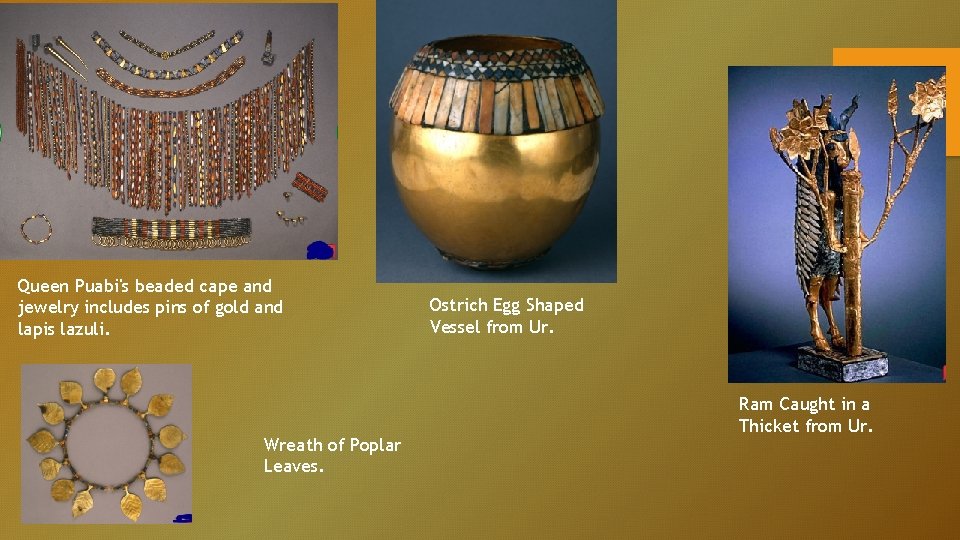
Queen Puabi's beaded cape and jewelry includes pins of gold and lapis lazuli. Wreath of Poplar Leaves. Ostrich Egg Shaped Vessel from Ur. Ram Caught in a Thicket from Ur.
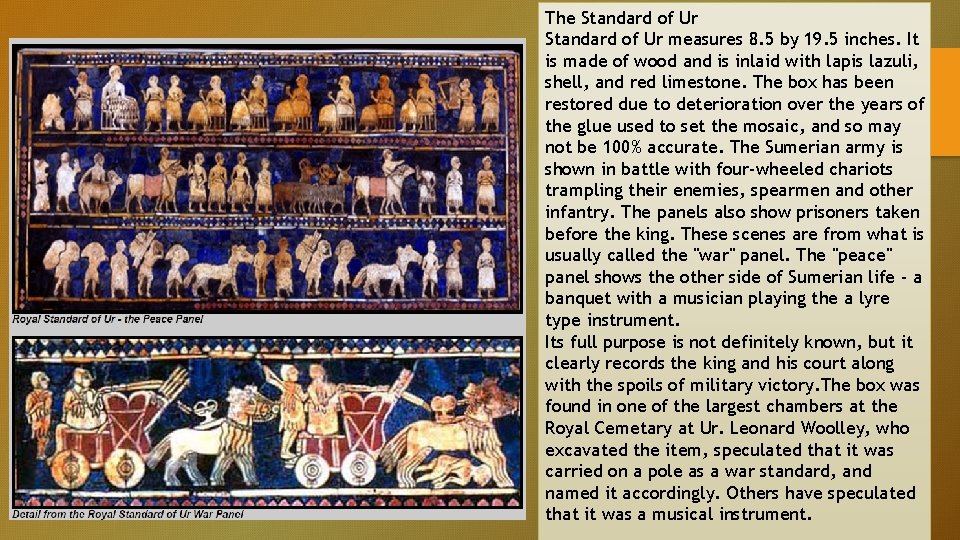
The Standard of Ur measures 8. 5 by 19. 5 inches. It is made of wood and is inlaid with lapis lazuli, shell, and red limestone. The box has been restored due to deterioration over the years of the glue used to set the mosaic, and so may not be 100% accurate. The Sumerian army is shown in battle with four-wheeled chariots trampling their enemies, spearmen and other infantry. The panels also show prisoners taken before the king. These scenes are from what is usually called the "war" panel. The "peace" panel shows the other side of Sumerian life - a banquet with a musician playing the a lyre type instrument. Its full purpose is not definitely known, but it clearly records the king and his court along with the spoils of military victory. The box was found in one of the largest chambers at the Royal Cemetary at Ur. Leonard Woolley, who excavated the item, speculated that it was carried on a pole as a war standard, and named it accordingly. Others have speculated that it was a musical instrument.
- Slides: 17