
Independent SplitPage Note Taking also called Cornell Notes

- Slides: 28
Independent Split-Page Note Taking (also called Cornell Notes) A Research-Based Strategy for Increasing Student Achievement
• Note taking stimulates critical thinking skills. • Note taking helps students remember what is said in class. • A good set of notes can help students work on assignments and prepare for tests outside of the classroom. • Note taking is required for this course.
• Good notes allow students to help each other problem solve. • Good Notes help students organize and process data and information. • Helps student recall by getting them to process their notes 3 times. • Writing is a great tool for learning!
What Does the Research Indicate about Note Taking? • Verbatim note taking is, perhaps, the least effective way to take notes. • Notes should be considered a work in progress. • Notes should be used as study guides for tests. • The more notes that are taken, the better.
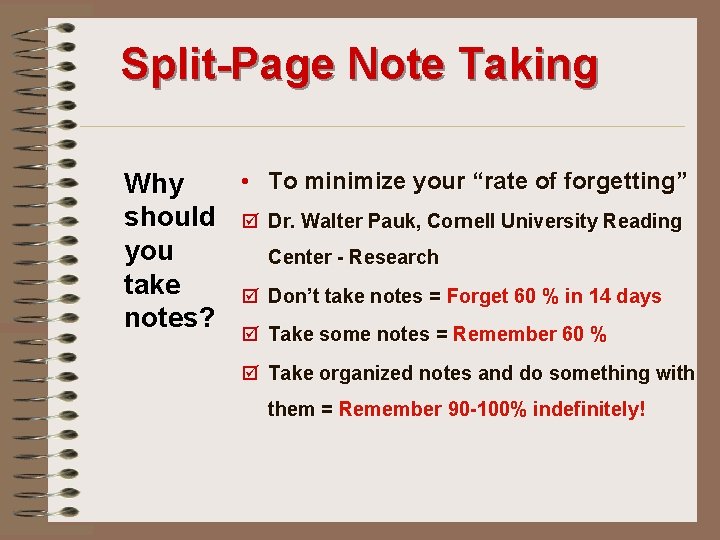
Split-Page Note Taking • To minimize your “rate of forgetting” Why should þ Dr. Walter Pauk, Cornell University Reading you Center - Research take þ Don’t take notes = Forget 60 % in 14 days notes? þ Take some notes = Remember 60 % þ Take organized notes and do something with them = Remember 90 -100% indefinitely!
WHAT ARE THE ADVANTAGES? • It is a method for mastering information --not just recording facts. • It is efficient. • Each step prepares the way for the next part of the learning process. • They count as 10% of your overall grade.
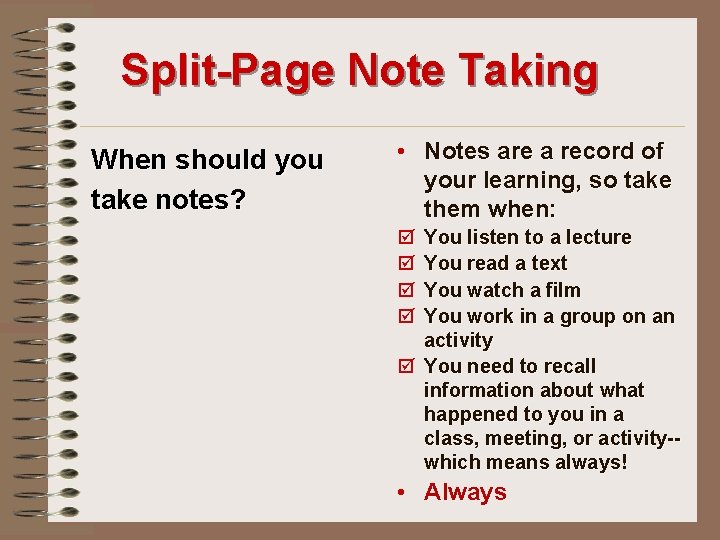
Split-Page Note Taking When should you take notes? • Notes are a record of your learning, so take them when: þ þ You listen to a lecture You read a text You watch a film You work in a group on an activity þ You need to recall information about what happened to you in a class, meeting, or activity-which means always! • Always
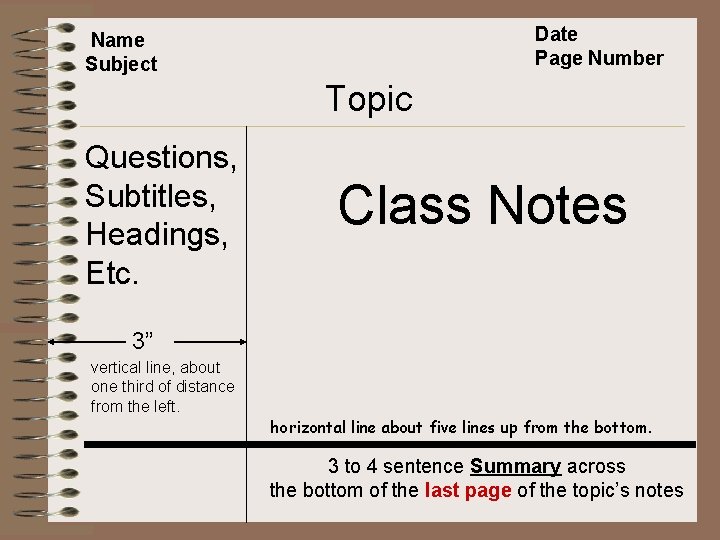
Format For Split-Page Note Taking
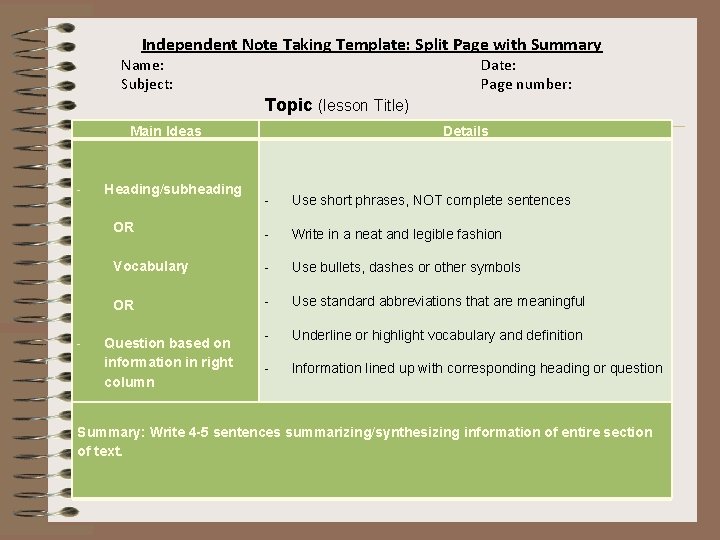
Independent Note Taking Template: Split Page with Summary Name: Subject: Date: Page number: Topic (lesson Title) Main Ideas - - Heading/subheading Details - Use short phrases, NOT complete sentences OR - Write in a neat and legible fashion Vocabulary - Use bullets, dashes or other symbols OR - Use standard abbreviations that are meaningful - Underline or highlight vocabulary and definition - Information lined up with corresponding heading or question Question based on information in right column Summary: Write 4 -5 sentences summarizing/synthesizing information of entire section of text.
Date Page Number Name Subject Topic Questions, Subtitles, Headings, Etc. Class Notes 3” vertical line, about one third of distance from the left. horizontal line about five lines up from the bottom. 3 to 4 sentence Summary across the bottom of the last page of the topic’s notes
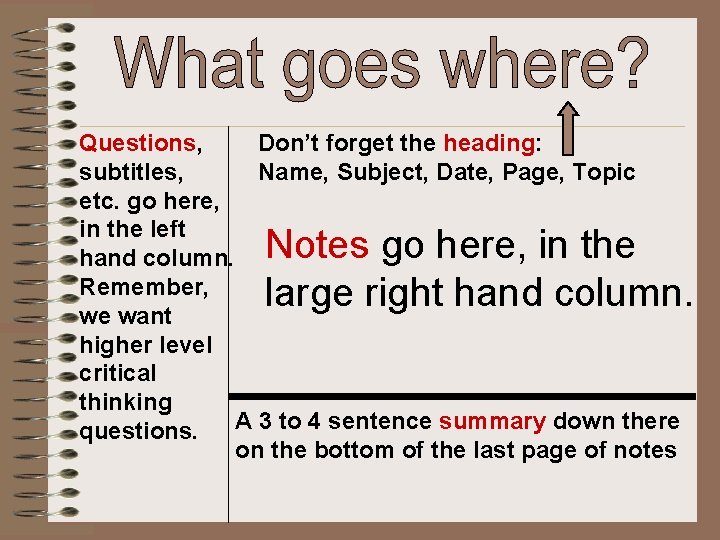
Don’t forget the heading: Questions, Name, Subject, Date, Page, Topic subtitles, etc. go here, in the left hand column. Remember, we want higher level critical thinking A 3 to 4 sentence summary down there questions. on the bottom of the last page of notes Notes go here, in the large right hand column.
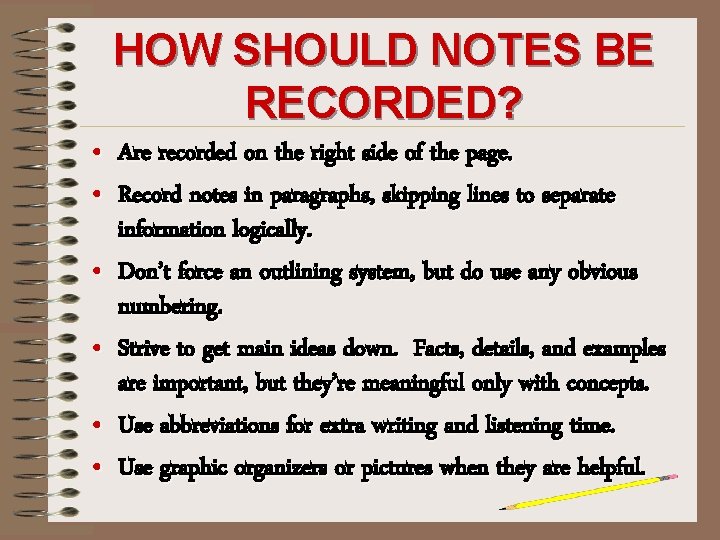
HOW SHOULD NOTES BE RECORDED? • Are recorded on the right side of the page. • Record notes in paragraphs, skipping lines to separate information logically. • Don’t force an outlining system, but do use any obvious numbering. • Strive to get main ideas down. Facts, details, and examples are important, but they’re meaningful only with concepts. • Use abbreviations for extra writing and listening time. • Use graphic organizers or pictures when they are helpful.
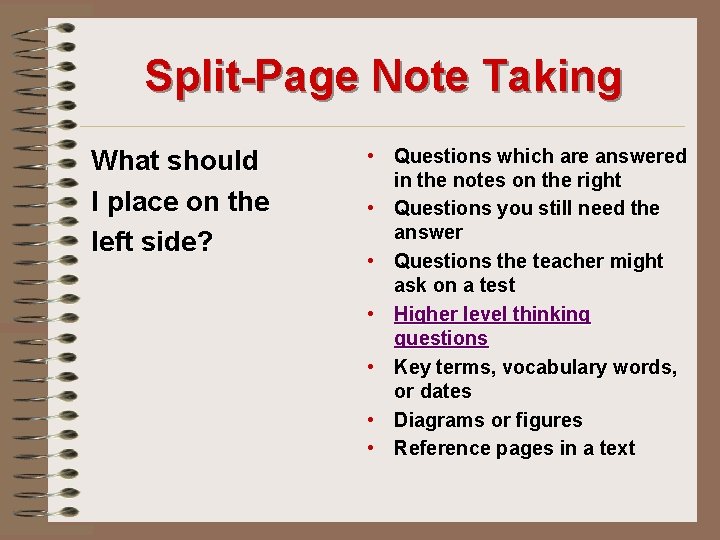
Split-Page Note Taking What should I place on the left side? • Questions which are answered in the notes on the right • Questions you still need the answer • Questions the teacher might ask on a test • Higher level thinking questions • Key terms, vocabulary words, or dates • Diagrams or figures • Reference pages in a text
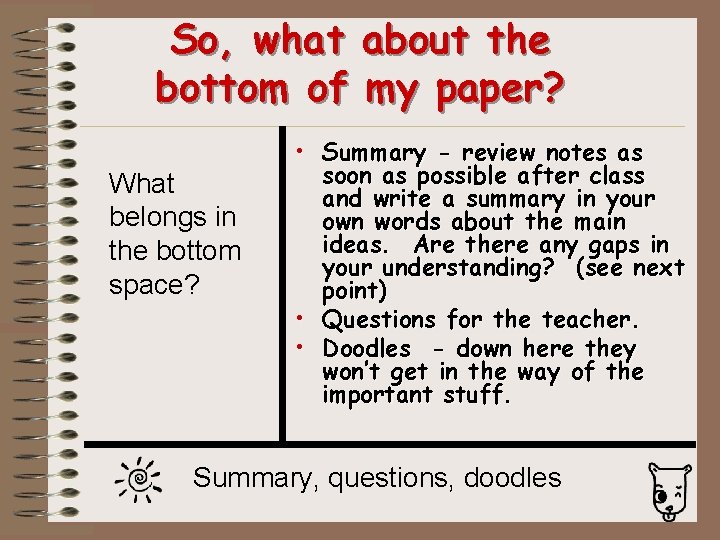
So, what about the bottom of my paper? What belongs in the bottom space? • Summary - review notes as soon as possible after class and write a summary in your own words about the main ideas. Are there any gaps in your understanding? (see next point) • Questions for the teacher. • Doodles - down here they won’t get in the way of the important stuff. Summary, questions, doodles
NOTETAKING TIPS
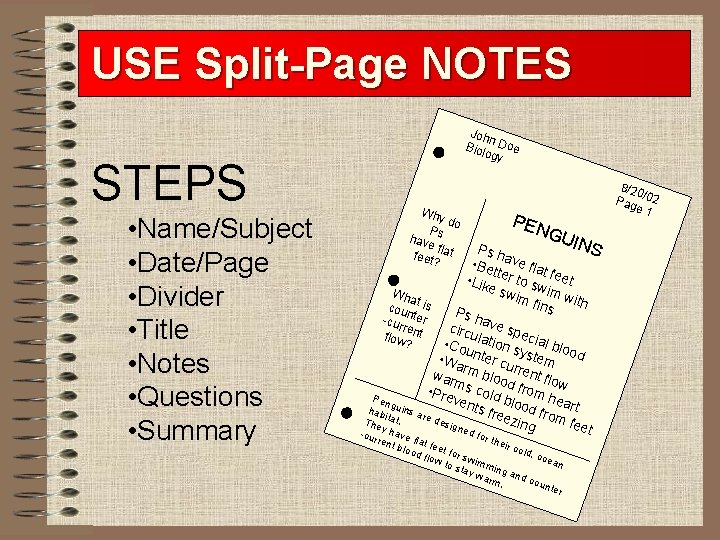
USE Split-Page NOTES Joh n Biol Doe ogy STEPS • Name/Subject • Date/Page • Divider • Title • Notes • Questions • Summary Why do Ps hav ef feet lat ? 8/20 Pag /02 e 1 PEN GUI NS Ps h a • Be ve flat t • Lik ter to sw feet e sw Wha im f im with t i s ins cou Ps h nter -cur re circ ave sp e u flow nt ? • Co lation s cial blo u od • Wa nter cu ystem r r war m bloo rent flo ms d cold from w • P r Pen eve g nts blood heart hab uins a free f re d it zing rom fee esig The at. yh ne t -cur rent d fo ave r the flat ir co bloo feet f ld, o o d flo r cea w to swimm n stay ing and war cou m. nter
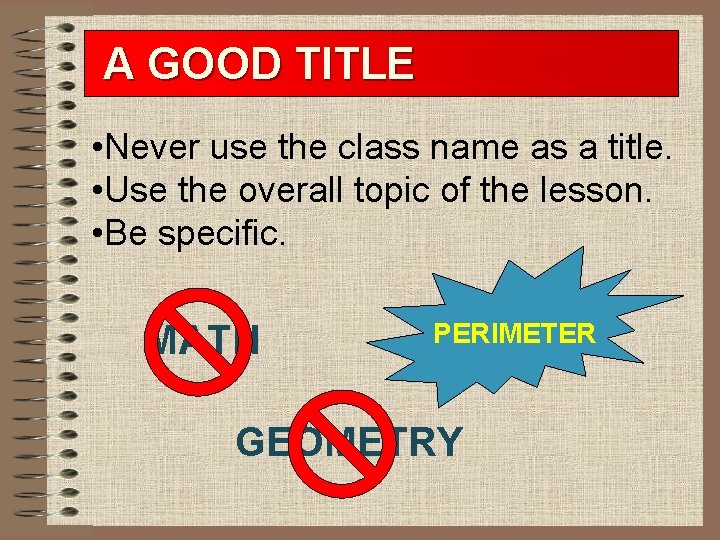
A GOOD TITLE • Never use the class name as a title. • Use the overall topic of the lesson. • Be specific. MATH PERIMETER GEOMETRY
IMPORTANT STUFF ONLY! • Keywords • Main Ideas • Important Concepts • New Vocabulary If you are writing every word the instructor is saying, you’re writing way too much!
BE QUICK • Use symbols and abbreviations. • Don’t worry about mechanics. • Write in phrases. • Leave space to add more detail later. If you fall behind the speaker, you’re writing too much.
QUESTION • Always be thinking of questions. • If you don’t understand, ask. • Write questions when you review. • Make them hard. The only stupid question is the one you don’t attempt to answer.
REVIEW • ASAP! • Check accuracy of notes. • Write Questions & Summary. • Underline/Highlight important stuff. Most forgetting happens in the first 24 hours.
SUMMARIZE • Tell what you learned. • Main ideas, not details. • Don’t give a class play-by-play. If you can’t explain what you learned, did you learn anything?
STUDY • Read over notes. • Recite aloud. • Self-Test. • Compare with other students. Waiting until the night before the test to study is a sure way to lower your grade.
Make use of the format • Cover the right side of your notes; review and answer study questions from the left using the right side as an answer key • Quiz yourself out loud • Cover the right side with blank paper; write out answers to the left column study questions
Write! • Write summaries of the most important material in the summary/reflection section • Write a quiz for others using notes; exchange and correct • Write anticipated test questions beyond those already in the left-hand column and write answers
Review • Look over notes frequently to keep information and questions still unanswered fresh in mind • Recite information from notes • Rework examples & problems
Study in a Group • Exchange notes with others to flesh out information and understanding • Use notes in study groups to provide a common ground of material for reference and review • Rewrite notes if necessary
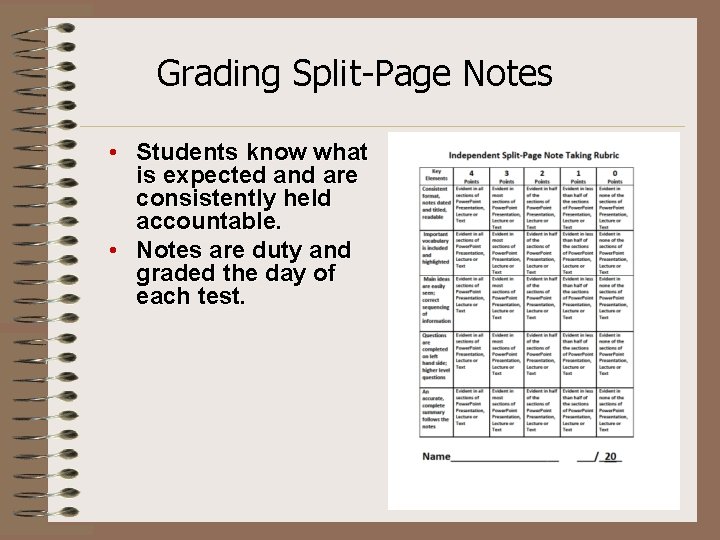
Grading Split-Page Notes • Students know what is expected and are consistently held accountable. • Notes are duty and graded the day of each test.