
INDEPENDENT REVIEW WORKING PAPERS CPD SEMINAR Legislative Requirements




- Slides: 68
INDEPENDENT REVIEW & WORKING PAPERS CPD SEMINAR
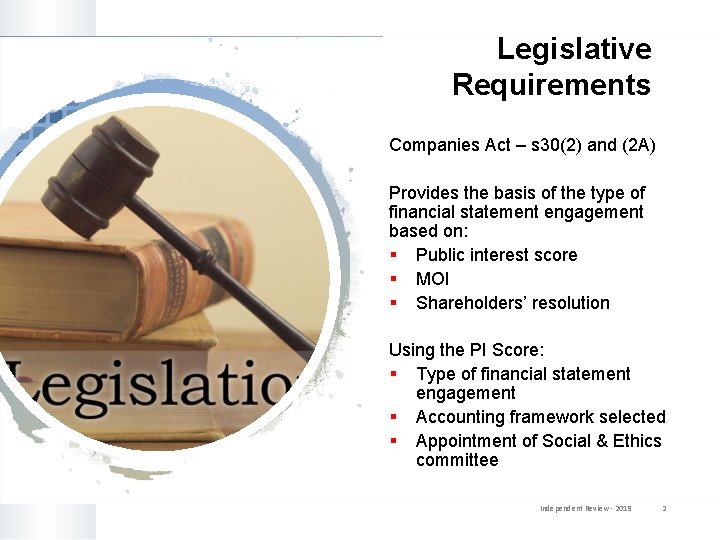
Legislative Requirements Companies Act – s 30(2) and (2 A) Provides the basis of the type of financial statement engagement based on: § Public interest score § MOI § Shareholders’ resolution Using the PI Score: § Type of financial statement engagement § Accounting framework selected § Appointment of Social & Ethics committee Independent Review - 2019 2
Calculation of PI Score Regulation 26(2) Provides the basis for the calculation of the PI score: § A number of points equal to the average number of employees of the company during the financial year § One point for every R 1 million (or portion thereof) in third party liability of the company at the financial year end § One point for every R 1 million (or portion thereof) in turnover during the financial year § One point for every individual who, at the end of the financial year, is known by the company to directly or indirectly have a beneficial interest in any of the company's issued securities Independent Review - 2019 3
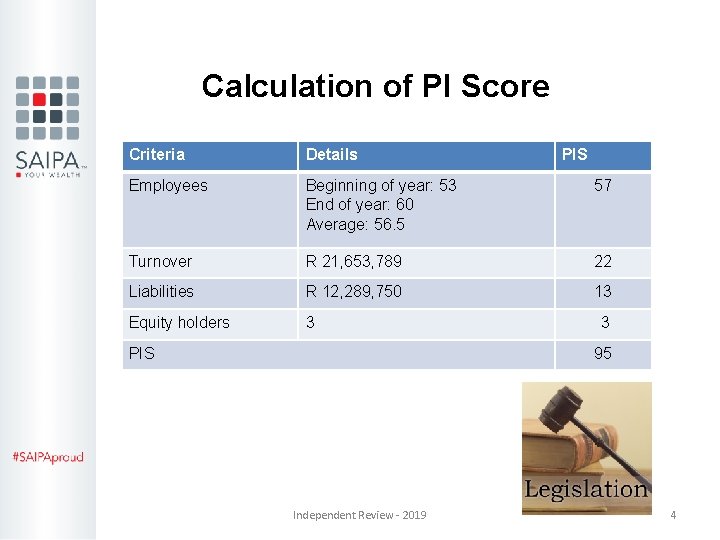
Calculation of PI Score Criteria Details Employees Beginning of year: 53 End of year: 60 Average: 56. 5 57 Turnover R 21, 653, 789 22 Liabilities R 12, 289, 750 13 Equity holders 3 PIS 3 95 Independent Review - 2019 4
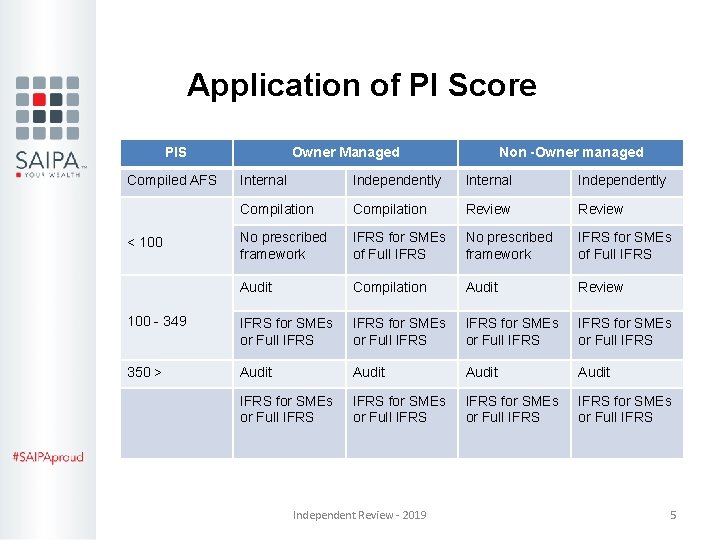
Application of PI Score PIS Compiled AFS Owner Managed Non -Owner managed Internal Independently Compilation Review No prescribed framework IFRS for SMEs of Full IFRS Audit Compilation Audit Review 100 - 349 IFRS for SMEs or Full IFRS 350 > Audit IFRS for SMEs or Full IFRS < 100 Independent Review - 2019 5
Independent Review - 2019 6
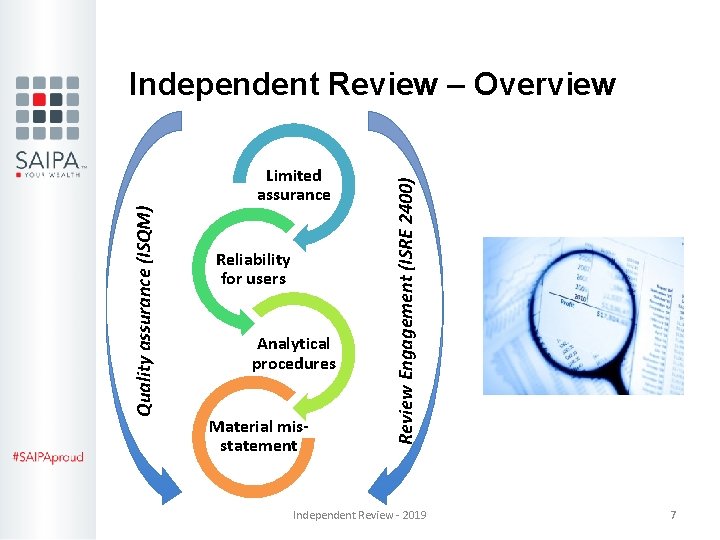
Quality assurance (ISQM) Limited assurance Reliability for users Analytical procedures Material misstatement Review Engagement (ISRE 2400) Independent Review – Overview Independent Review - 2019 7
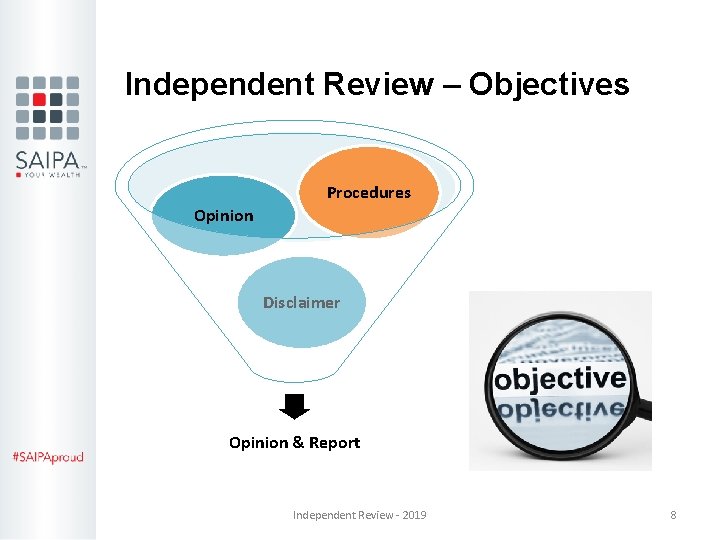
Independent Review – Objectives Procedures Opinion Disclaimer Opinion & Report Independent Review - 2019 8
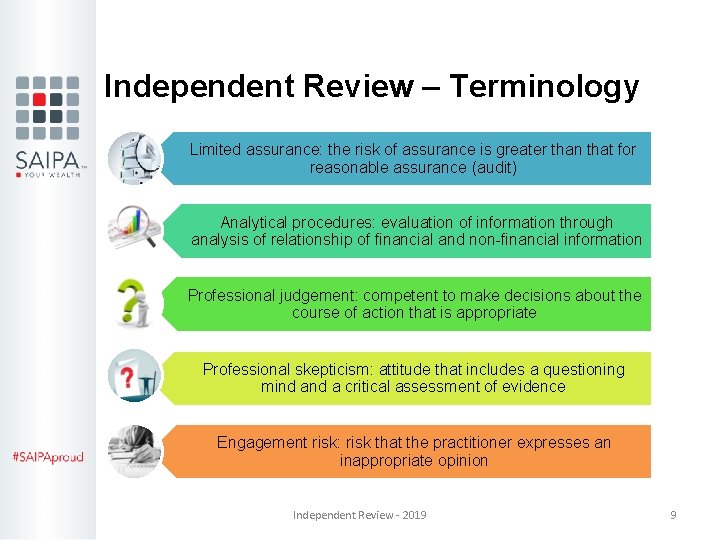
Independent Review – Terminology Limited assurance: the risk of assurance is greater than that for reasonable assurance (audit) Analytical procedures: evaluation of information through analysis of relationship of financial and non-financial information Professional judgement: competent to make decisions about the course of action that is appropriate Professional skepticism: attitude that includes a questioning mind a critical assessment of evidence Engagement risk: risk that the practitioner expresses an inappropriate opinion Independent Review - 2019 9
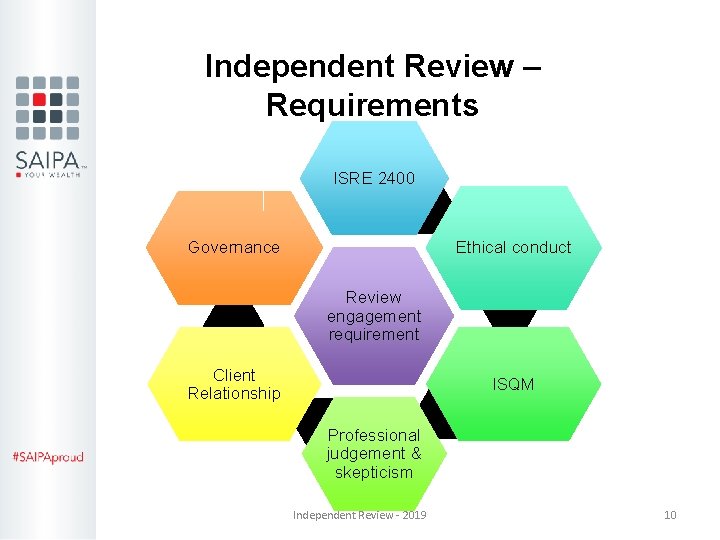
Independent Review – Requirements ISRE 2400 Governance Ethical conduct Review engagement requirement Client Relationship ISQM Professional judgement & skepticism Independent Review - 2019 10
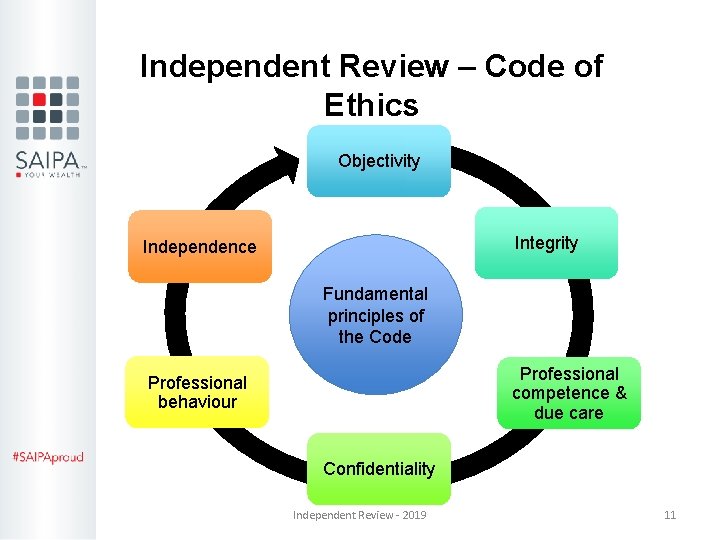
Independent Review – Code of Ethics Objectivity Integrity Independence Fundamental principles of the Code Professional competence & due care Professional behaviour Confidentiality Independent Review - 2019 11
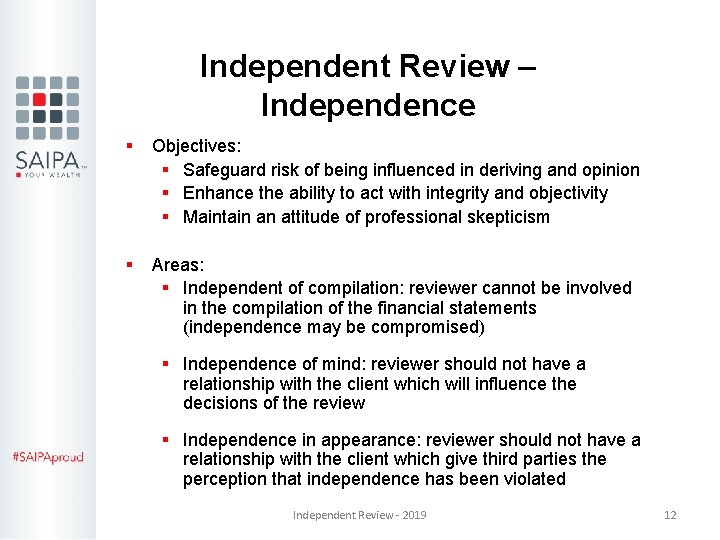
Independent Review – Independence § Objectives: § Safeguard risk of being influenced in deriving and opinion § Enhance the ability to act with integrity and objectivity § Maintain an attitude of professional skepticism § Areas: § Independent of compilation: reviewer cannot be involved in the compilation of the financial statements (independence may be compromised) § Independence of mind: reviewer should not have a relationship with the client which will influence the decisions of the review § Independence in appearance: reviewer should not have a relationship with the client which give third parties the perception that independence has been violated Independent Review - 2019 12
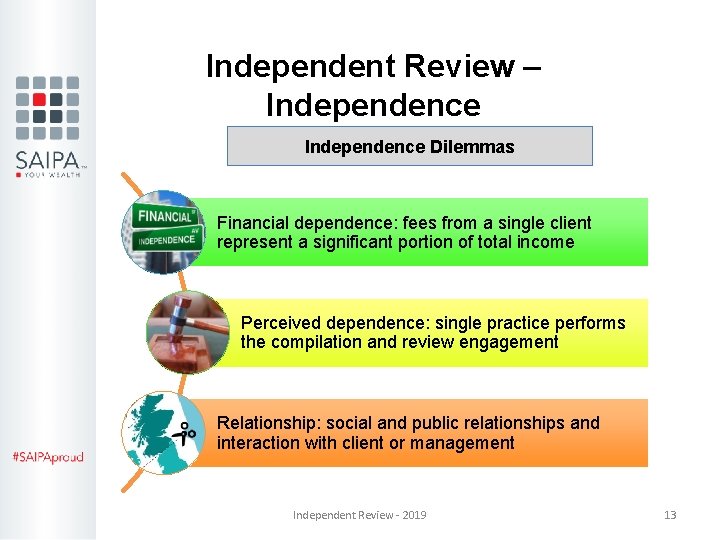
Independent Review – Independence Dilemmas Financial dependence: fees from a single client represent a significant portion of total income Perceived dependence: single practice performs the compilation and review engagement Relationship: social and public relationships and interaction with client or management Independent Review - 2019 13
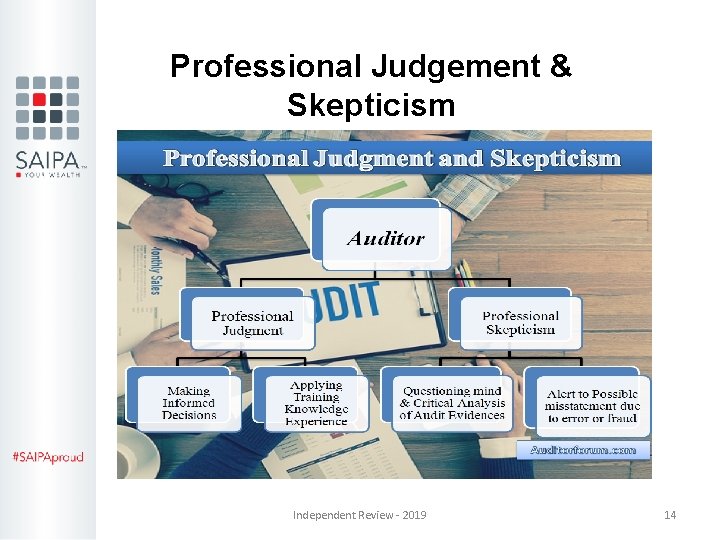
Professional Judgement & Skepticism Independent Review - 2019 14
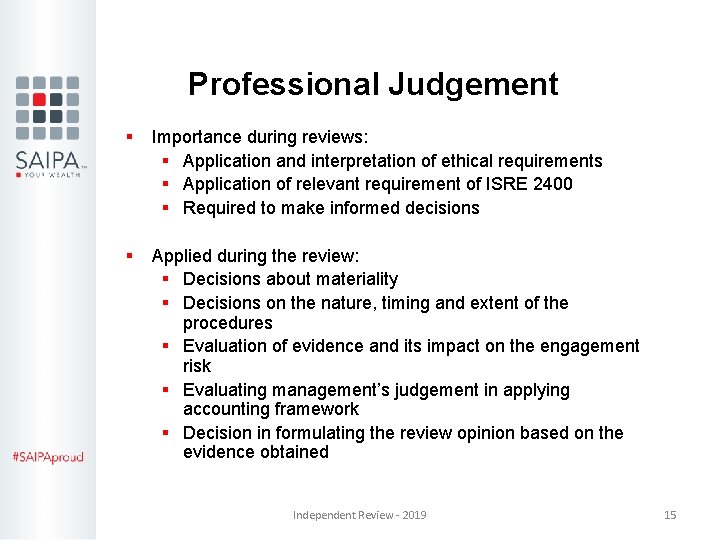
Professional Judgement § Importance during reviews: § Application and interpretation of ethical requirements § Application of relevant requirement of ISRE 2400 § Required to make informed decisions § Applied during the review: § Decisions about materiality § Decisions on the nature, timing and extent of the procedures § Evaluation of evidence and its impact on the engagement risk § Evaluating management’s judgement in applying accounting framework § Decision in formulating the review opinion based on the evidence obtained Independent Review - 2019 15
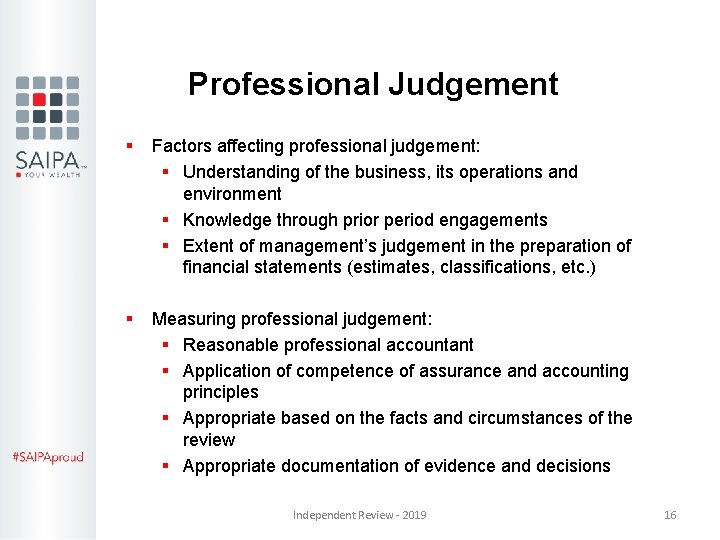
Professional Judgement § Factors affecting professional judgement: § Understanding of the business, its operations and environment § Knowledge through prior period engagements § Extent of management’s judgement in the preparation of financial statements (estimates, classifications, etc. ) § Measuring professional judgement: § Reasonable professional accountant § Application of competence of assurance and accounting principles § Appropriate based on the facts and circumstances of the review § Appropriate documentation of evidence and decisions Independent Review - 2019 16
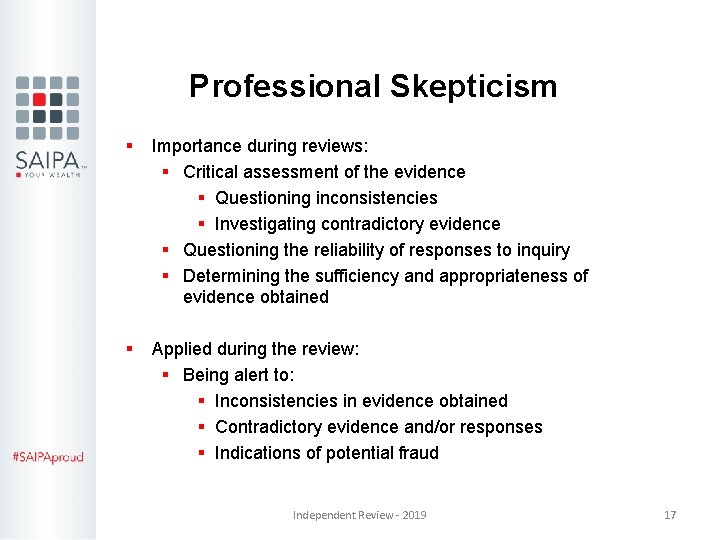
Professional Skepticism § Importance during reviews: § Critical assessment of the evidence § Questioning inconsistencies § Investigating contradictory evidence § Questioning the reliability of responses to inquiry § Determining the sufficiency and appropriateness of evidence obtained § Applied during the review: § Being alert to: § Inconsistencies in evidence obtained § Contradictory evidence and/or responses § Indications of potential fraud Independent Review - 2019 17
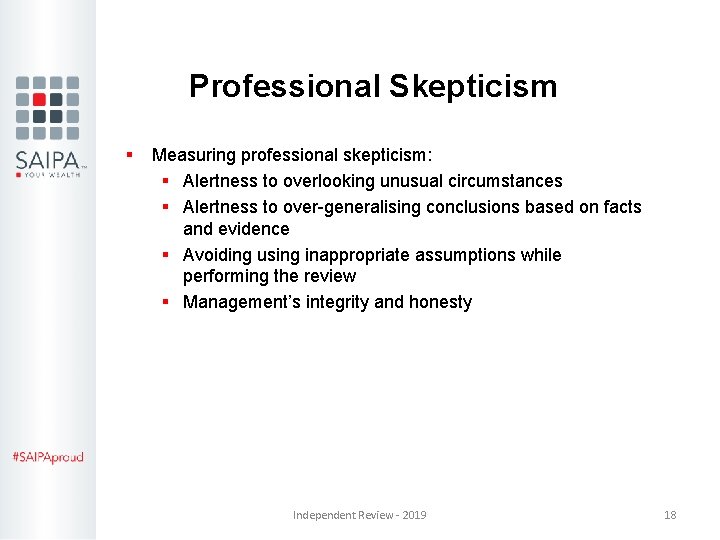
Professional Skepticism § Measuring professional skepticism: § Alertness to overlooking unusual circumstances § Alertness to over-generalising conclusions based on facts and evidence § Avoiding using inappropriate assumptions while performing the review § Management’s integrity and honesty Independent Review - 2019 18
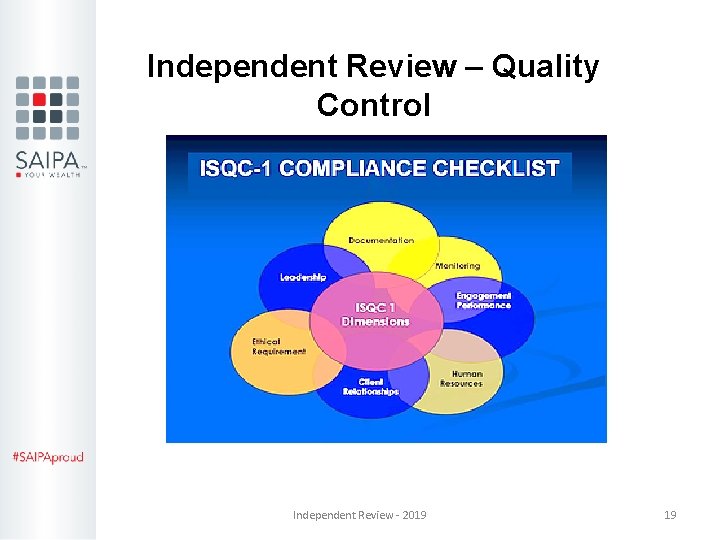
Independent Review – Quality Control Independent Review - 2019 19
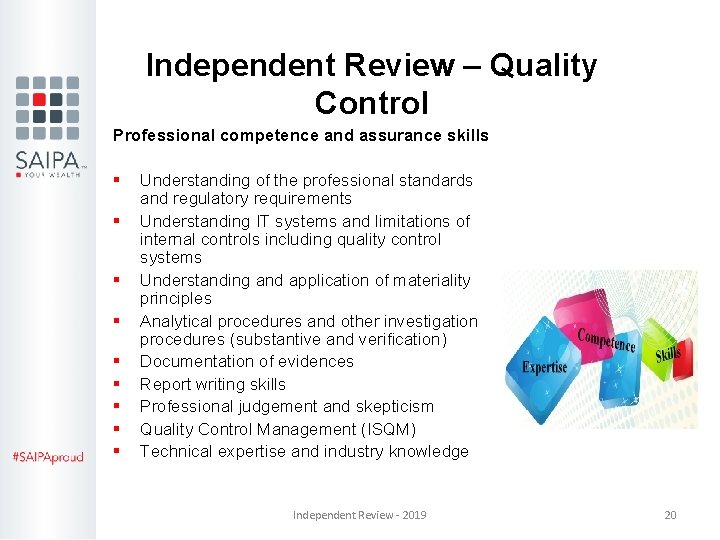
Independent Review – Quality Control Professional competence and assurance skills § § § § § Understanding of the professional standards and regulatory requirements Understanding IT systems and limitations of internal controls including quality control systems Understanding and application of materiality principles Analytical procedures and other investigation procedures (substantive and verification) Documentation of evidences Report writing skills Professional judgement and skepticism Quality Control Management (ISQM) Technical expertise and industry knowledge Independent Review - 2019 20
Independent Review – Acceptance Accepting the review engagement § Factors and consideration: § Rational purpose for the engagement § Using the practitioner’s name inappropriately § Limitation on scope of work § Ethical and independence requirements § Access and availability of evidence § Management’s integrity Independent Review - 2019 21
Independent Review – Acceptance Accepting the review engagement § Preconditions: § Management’s responsibility § Preparation of financial statements in compliance with accounting framework § Implement internal controls to ensure financial statements are free of material mis-statements § Allow the practitioner access to all information that is relevant to the preparation of the financial statements § Access to additional information relevant to the review engagement § Unrestricted access to staff to obtain evidence relevant to the review engagement Independent Review - 2019 22
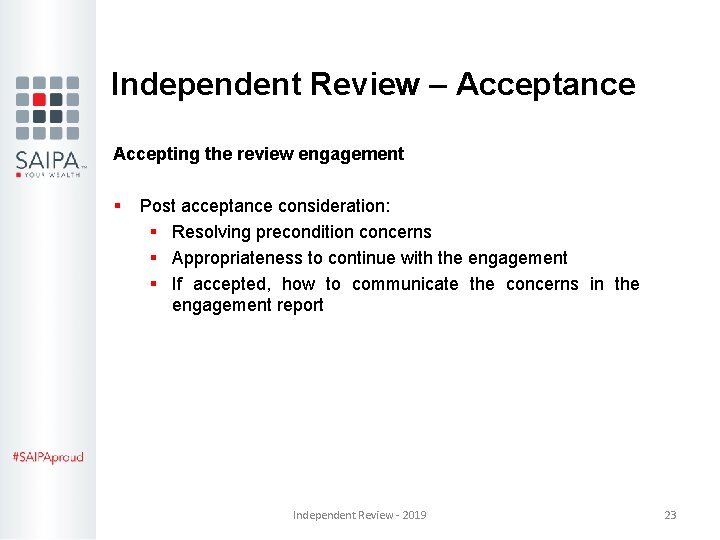
Independent Review – Acceptance Accepting the review engagement § Post acceptance consideration: § Resolving precondition concerns § Appropriateness to continue with the engagement § If accepted, how to communicate the concerns in the engagement report Independent Review - 2019 23
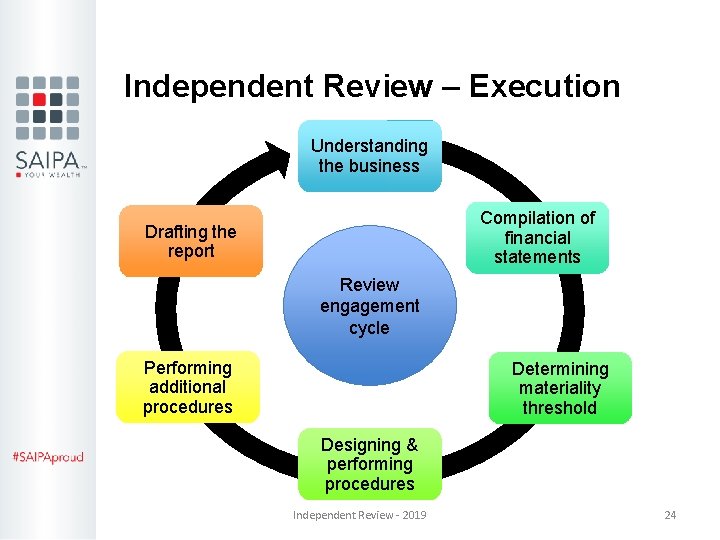
Independent Review – Execution Understanding the business Compilation of financial statements Drafting the report Review engagement cycle Performing additional procedures Determining materiality threshold Designing & performing procedures Independent Review - 2019 24
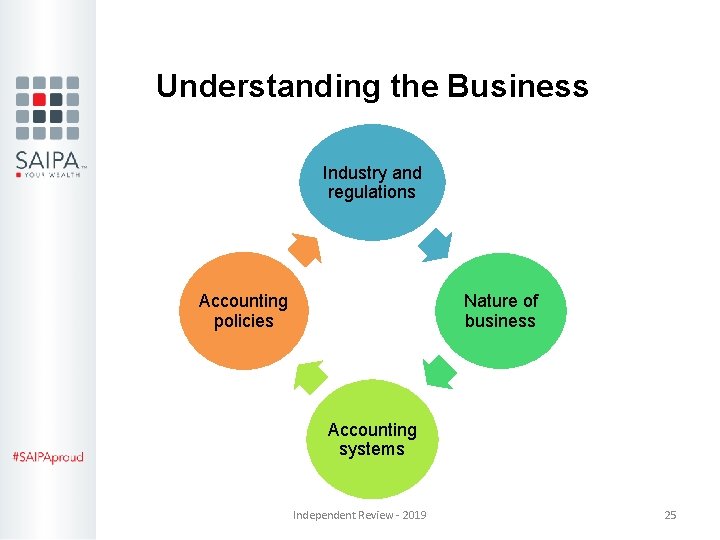
Understanding the Business Industry and regulations Nature of business Accounting policies Accounting systems Independent Review - 2019 25
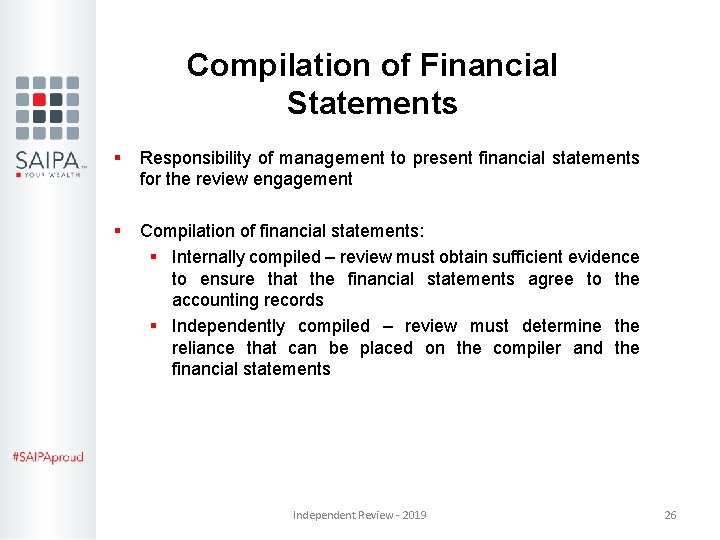
Compilation of Financial Statements § Responsibility of management to present financial statements for the review engagement § Compilation of financial statements: § Internally compiled – review must obtain sufficient evidence to ensure that the financial statements agree to the accounting records § Independently compiled – review must determine the reliance that can be placed on the compiler and the financial statements Independent Review - 2019 26
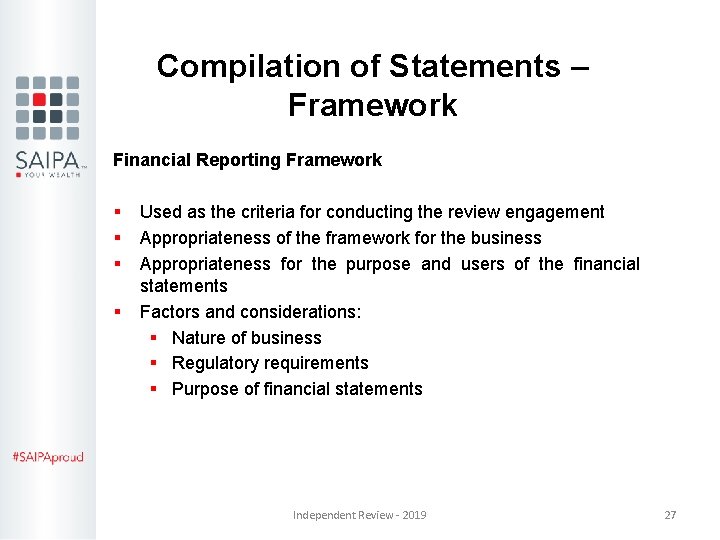
Compilation of Statements – Framework Financial Reporting Framework § § Used as the criteria for conducting the review engagement Appropriateness of the framework for the business Appropriateness for the purpose and users of the financial statements Factors and considerations: § Nature of business § Regulatory requirements § Purpose of financial statements Independent Review - 2019 27
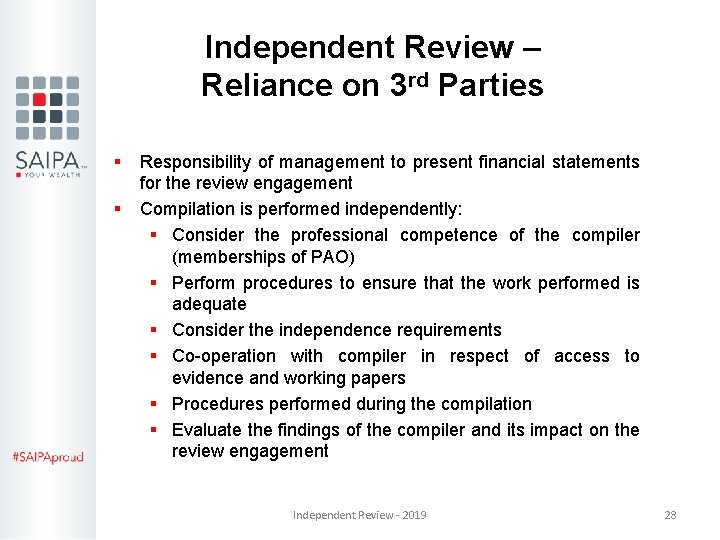
Independent Review – Reliance on 3 rd Parties § § Responsibility of management to present financial statements for the review engagement Compilation is performed independently: § Consider the professional competence of the compiler (memberships of PAO) § Perform procedures to ensure that the work performed is adequate § Consider the independence requirements § Co-operation with compiler in respect of access to evidence and working papers § Procedures performed during the compilation § Evaluate the findings of the compiler and its impact on the review engagement Independent Review - 2019 28
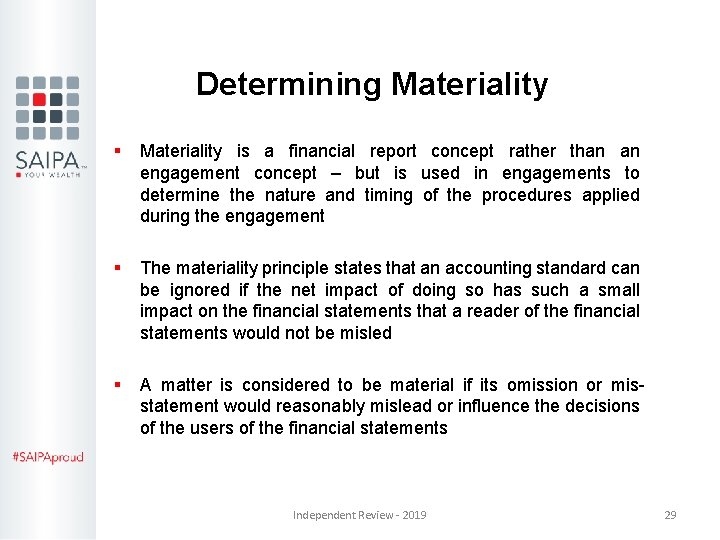
Determining Materiality § Materiality is a financial report concept rather than an engagement concept – but is used in engagements to determine the nature and timing of the procedures applied during the engagement § The materiality principle states that an accounting standard can be ignored if the net impact of doing so has such a small impact on the financial statements that a reader of the financial statements would not be misled § A matter is considered to be material if its omission or misstatement would reasonably mislead or influence the decisions of the users of the financial statements Independent Review - 2019 29
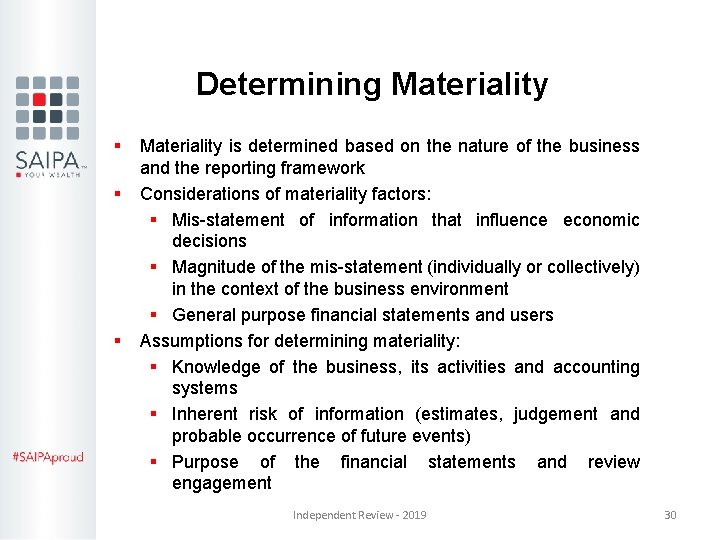
Determining Materiality § § § Materiality is determined based on the nature of the business and the reporting framework Considerations of materiality factors: § Mis-statement of information that influence economic decisions § Magnitude of the mis-statement (individually or collectively) in the context of the business environment § General purpose financial statements and users Assumptions for determining materiality: § Knowledge of the business, its activities and accounting systems § Inherent risk of information (estimates, judgement and probable occurrence of future events) § Purpose of the financial statements and review engagement Independent Review - 2019 30
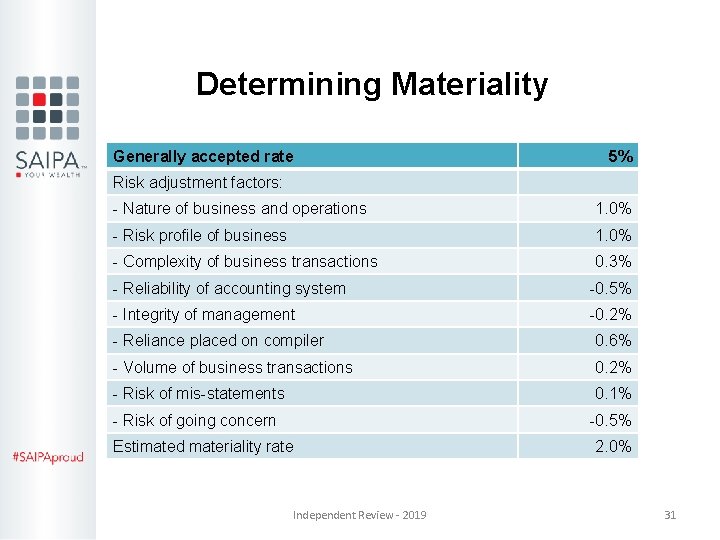
Determining Materiality Generally accepted rate 5% Risk adjustment factors: - Nature of business and operations 1. 0% - Risk profile of business 1. 0% - Complexity of business transactions 0. 3% - Reliability of accounting system -0. 5% - Integrity of management -0. 2% - Reliance placed on compiler 0. 6% - Volume of business transactions 0. 2% - Risk of mis-statements 0. 1% - Risk of going concern -0. 5% Estimated materiality rate Independent Review - 2019 2. 0% 31
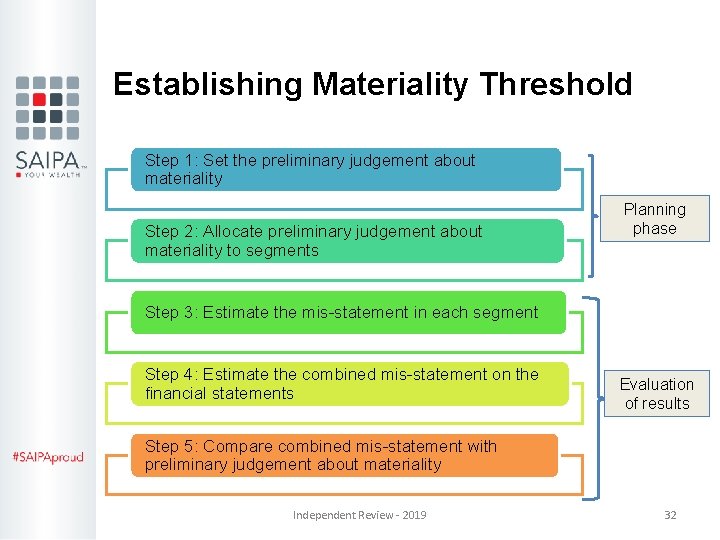
Establishing Materiality Threshold Step 1: Set the preliminary judgement about materiality Step 2: Allocate preliminary judgement about materiality to segments Planning phase Step 3: Estimate the mis-statement in each segment Step 4: Estimate the combined mis-statement on the financial statements Evaluation of results Step 5: Compare combined mis-statement with preliminary judgement about materiality Independent Review - 2019 32
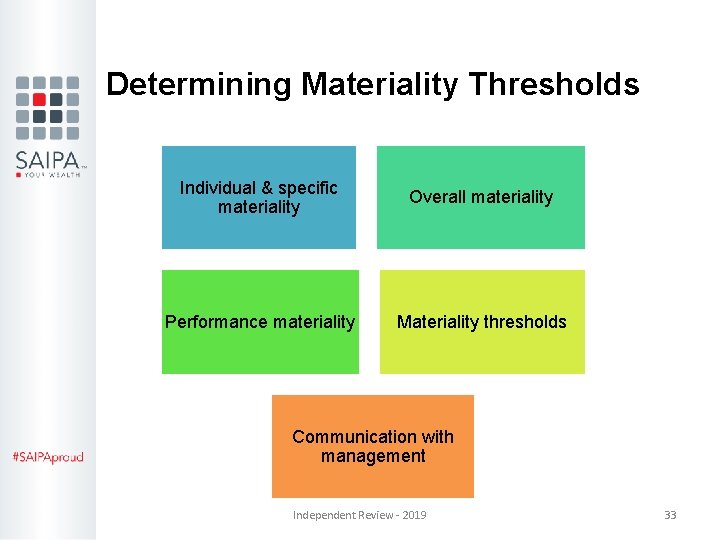
Determining Materiality Thresholds Individual & specific materiality Overall materiality Performance materiality Materiality thresholds Communication with management Independent Review - 2019 33
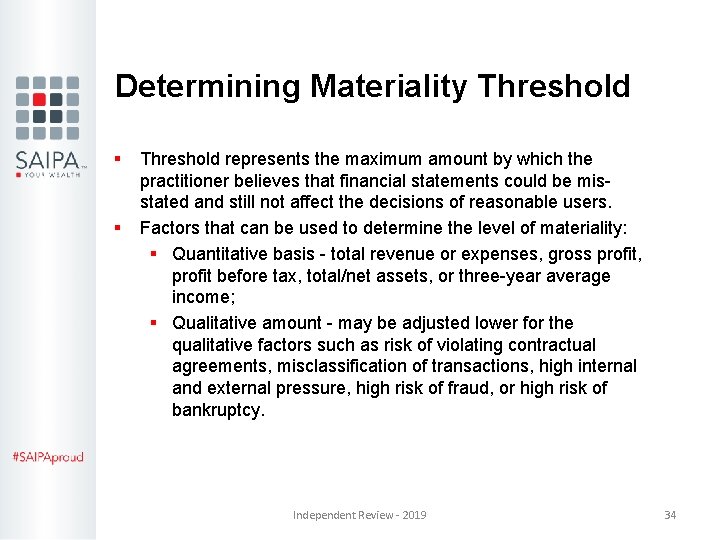
Determining Materiality Threshold § § Threshold represents the maximum amount by which the practitioner believes that financial statements could be misstated and still not affect the decisions of reasonable users. Factors that can be used to determine the level of materiality: § Quantitative basis - total revenue or expenses, gross profit, profit before tax, total/net assets, or three-year average income; § Qualitative amount - may be adjusted lower for the qualitative factors such as risk of violating contractual agreements, misclassification of transactions, high internal and external pressure, high risk of fraud, or high risk of bankruptcy. Independent Review - 2019 34
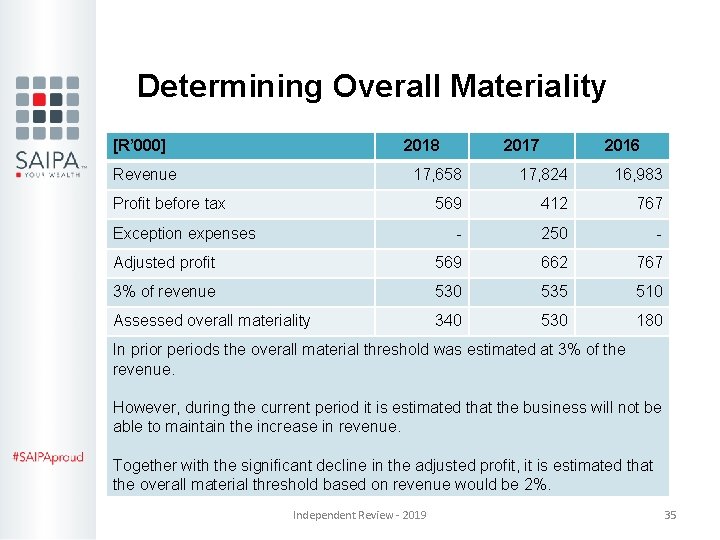
Determining Overall Materiality [R’ 000] 2018 Revenue 2017 2016 17, 658 17, 824 16, 983 569 412 767 - 250 - Adjusted profit 569 662 767 3% of revenue 530 535 510 Assessed overall materiality 340 530 180 Profit before tax Exception expenses In prior periods the overall material threshold was estimated at 3% of the revenue. However, during the current period it is estimated that the business will not be able to maintain the increase in revenue. Together with the significant decline in the adjusted profit, it is estimated that the overall material threshold based on revenue would be 2%. Independent Review - 2019 35
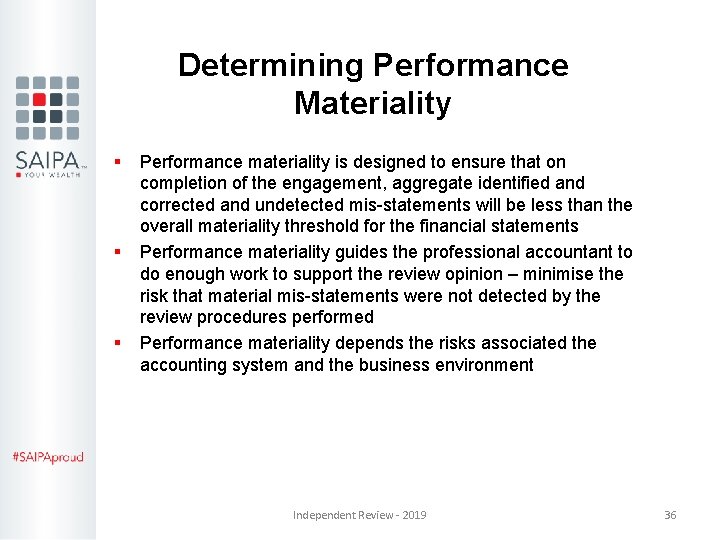
Determining Performance Materiality § § § Performance materiality is designed to ensure that on completion of the engagement, aggregate identified and corrected and undetected mis-statements will be less than the overall materiality threshold for the financial statements Performance materiality guides the professional accountant to do enough work to support the review opinion – minimise the risk that material mis-statements were not detected by the review procedures performed Performance materiality depends the risks associated the accounting system and the business environment Independent Review - 2019 36
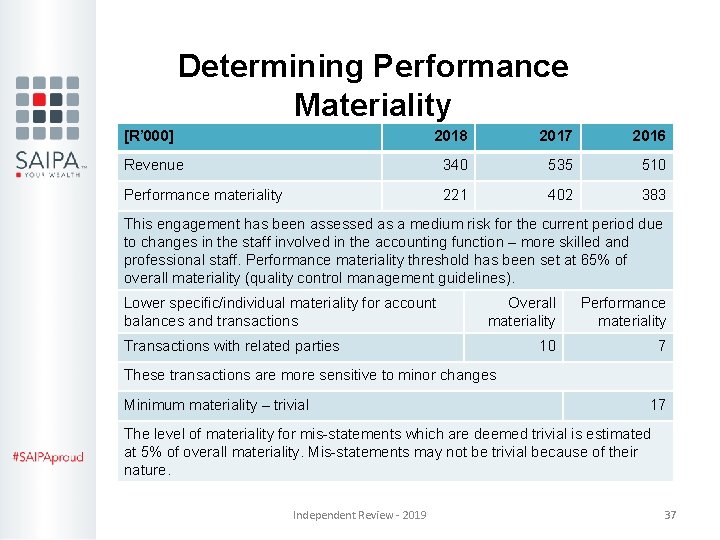
Determining Performance Materiality [R’ 000] 2018 2017 2016 Revenue 340 535 510 Performance materiality 221 402 383 This engagement has been assessed as a medium risk for the current period due to changes in the staff involved in the accounting function – more skilled and professional staff. Performance materiality threshold has been set at 65% of overall materiality (quality control management guidelines). Lower specific/individual materiality for account balances and transactions Overall materiality Performance materiality 10 7 Transactions with related parties These transactions are more sensitive to minor changes Minimum materiality – trivial 17 The level of materiality for mis-statements which are deemed trivial is estimated at 5% of overall materiality. Mis-statements may not be trivial because of their nature. Independent Review - 2019 37
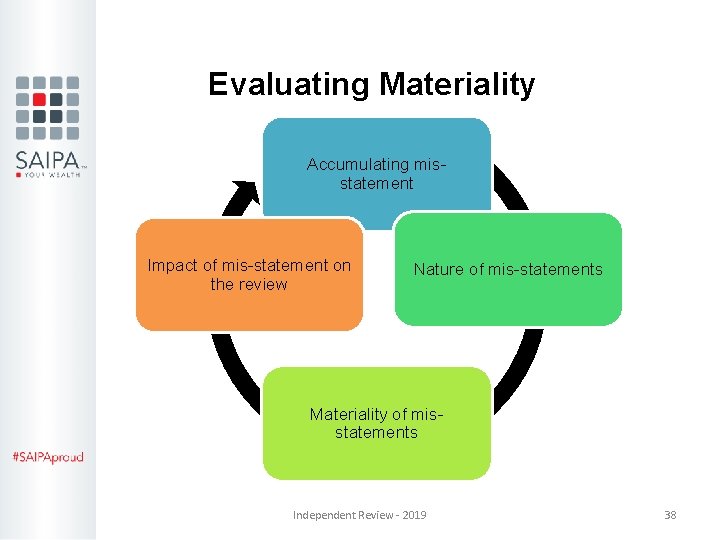
Evaluating Materiality Accumulating misstatement Impact of mis-statement on the review Nature of mis-statements Materiality of misstatements Independent Review - 2019 38
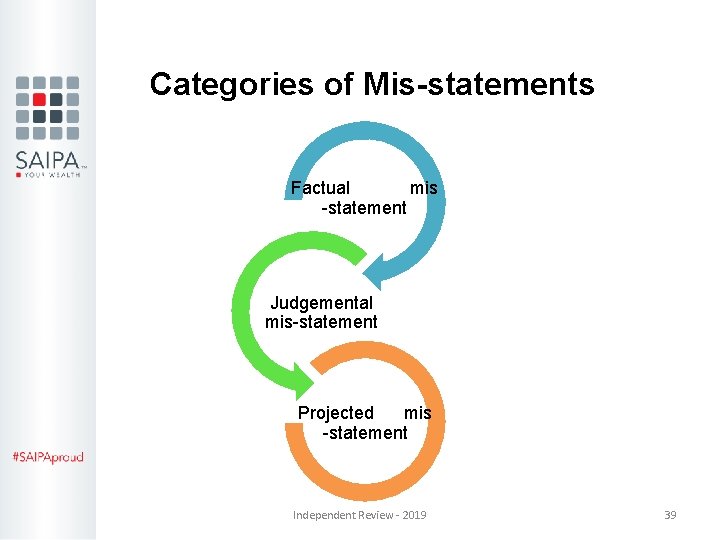
Categories of Mis-statements Factual mis -statement Judgemental mis-statement Projected mis -statement Independent Review - 2019 39
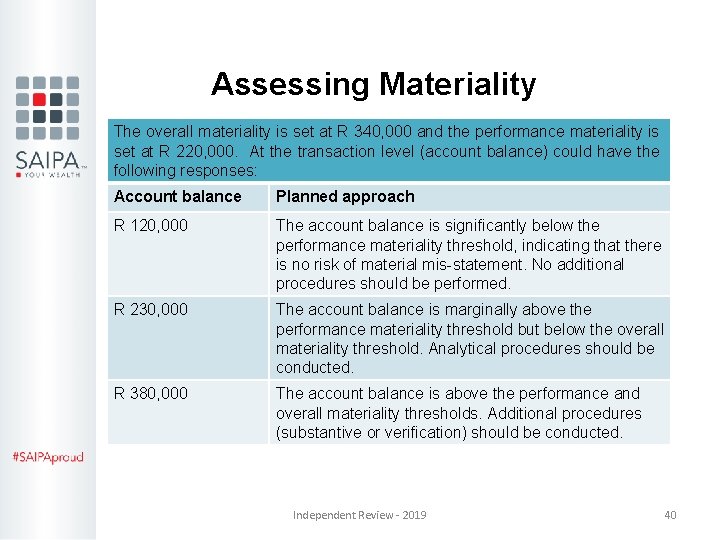
Assessing Materiality The overall materiality is set at R 340, 000 and the performance materiality is set at R 220, 000. At the transaction level (account balance) could have the following responses: Account balance Planned approach R 120, 000 The account balance is significantly below the performance materiality threshold, indicating that there is no risk of material mis-statement. No additional procedures should be performed. R 230, 000 The account balance is marginally above the performance materiality threshold but below the overall materiality threshold. Analytical procedures should be conducted. R 380, 000 The account balance is above the performance and overall materiality thresholds. Additional procedures (substantive or verification) should be conducted. Independent Review - 2019 40
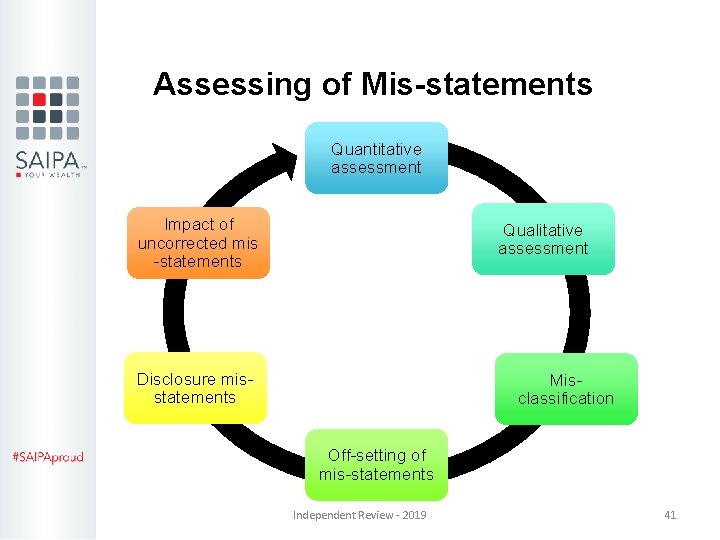
Assessing of Mis-statements Quantitative assessment Impact of uncorrected mis -statements Qualitative assessment Disclosure misstatements Misclassification Off-setting of mis-statements Independent Review - 2019 41
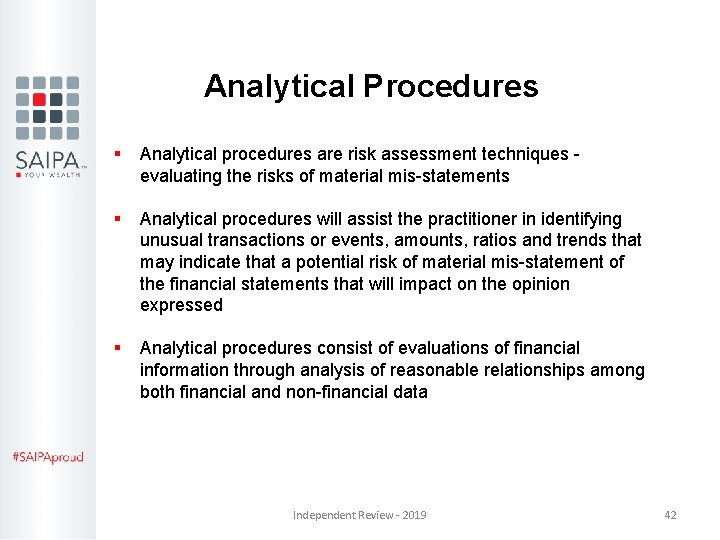
Analytical Procedures § Analytical procedures are risk assessment techniques evaluating the risks of material mis-statements § Analytical procedures will assist the practitioner in identifying unusual transactions or events, amounts, ratios and trends that may indicate that a potential risk of material mis-statement of the financial statements that will impact on the opinion expressed § Analytical procedures consist of evaluations of financial information through analysis of reasonable relationships among both financial and non-financial data Independent Review - 2019 42
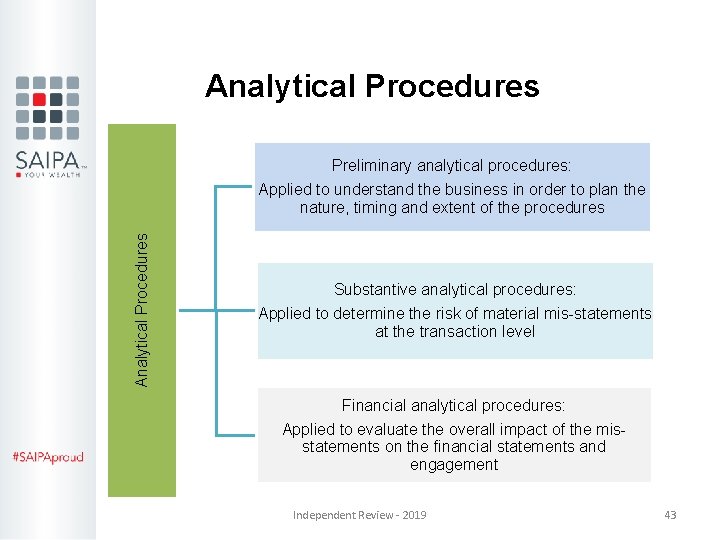
Analytical Procedures Preliminary analytical procedures: Analytical Procedures Applied to understand the business in order to plan the nature, timing and extent of the procedures Substantive analytical procedures: Applied to determine the risk of material mis-statements at the transaction level Financial analytical procedures: Applied to evaluate the overall impact of the misstatements on the financial statements and engagement Independent Review - 2019 43
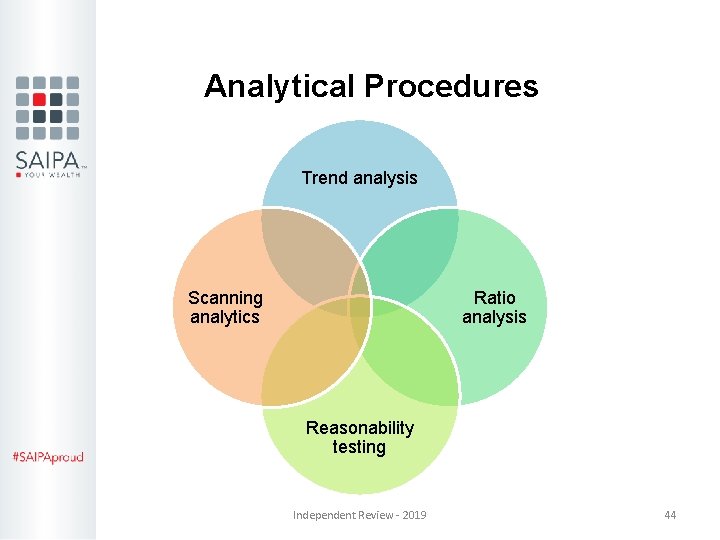
Analytical Procedures Trend analysis Scanning analytics Ratio analysis Reasonability testing Independent Review - 2019 44
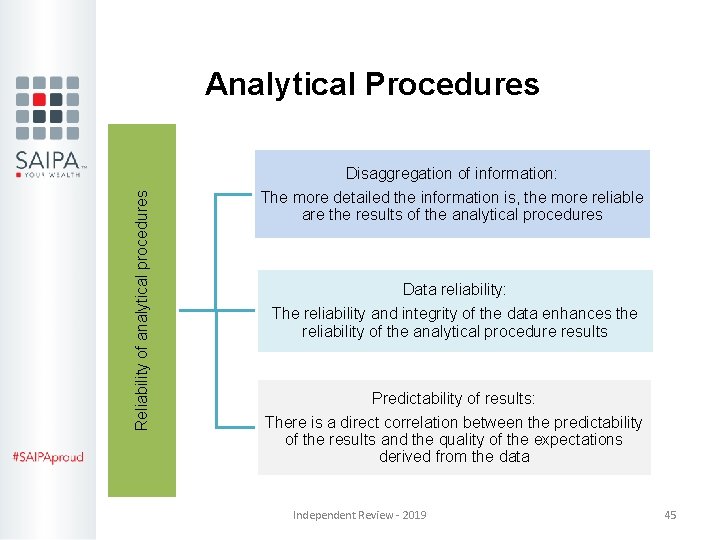
Analytical Procedures Reliability of analytical procedures Disaggregation of information: The more detailed the information is, the more reliable are the results of the analytical procedures Data reliability: The reliability and integrity of the data enhances the reliability of the analytical procedure results Predictability of results: There is a direct correlation between the predictability of the results and the quality of the expectations derived from the data Independent Review - 2019 45
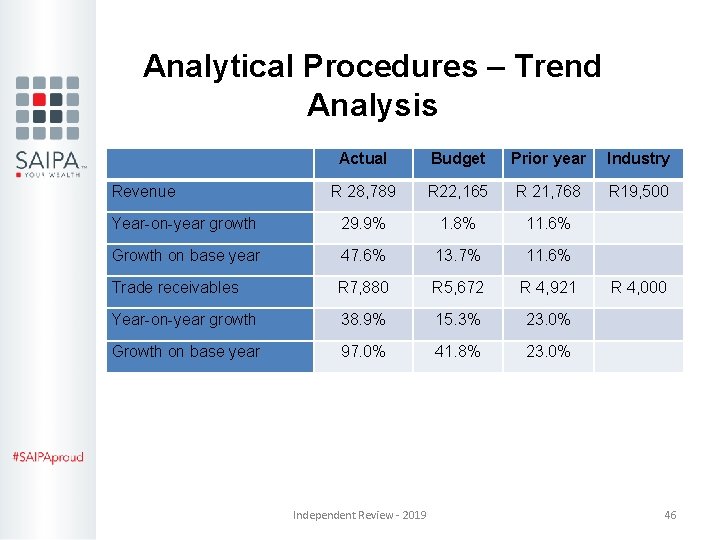
Analytical Procedures – Trend Analysis Actual Budget Prior year Industry R 28, 789 R 22, 165 R 21, 768 R 19, 500 Year-on-year growth 29. 9% 1. 8% 11. 6% Growth on base year 47. 6% 13. 7% 11. 6% Trade receivables R 7, 880 R 5, 672 R 4, 921 Year-on-year growth 38. 9% 15. 3% 23. 0% Growth on base year 97. 0% 41. 8% 23. 0% Revenue Independent Review - 2019 R 4, 000 46
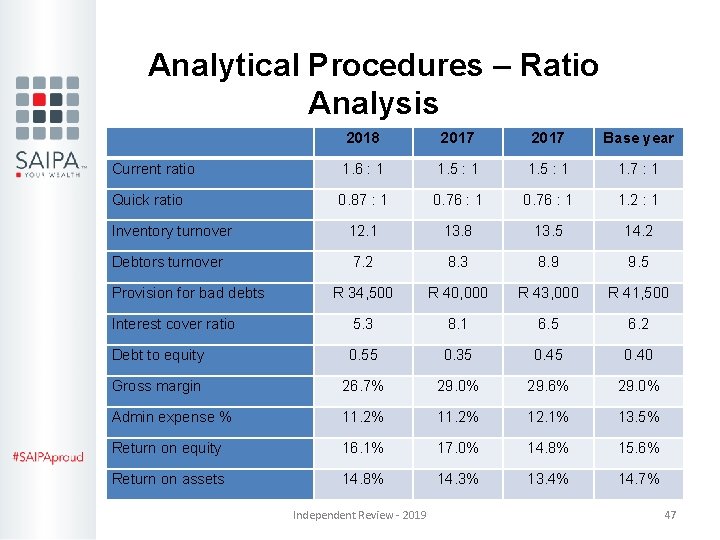
Analytical Procedures – Ratio Analysis 2018 2017 Base year Current ratio 1. 6 : 1 1. 5 : 1 1. 7 : 1 Quick ratio 0. 87 : 1 0. 76 : 1 1. 2 : 1 Inventory turnover 12. 1 13. 8 13. 5 14. 2 Debtors turnover 7. 2 8. 3 8. 9 9. 5 R 34, 500 R 40, 000 R 43, 000 R 41, 500 Interest cover ratio 5. 3 8. 1 6. 5 6. 2 Debt to equity 0. 55 0. 35 0. 40 Gross margin 26. 7% 29. 0% 29. 6% 29. 0% Admin expense % 11. 2% 12. 1% 13. 5% Return on equity 16. 1% 17. 0% 14. 8% 15. 6% Return on assets 14. 8% 14. 3% 13. 4% 14. 7% Provision for bad debts Independent Review - 2019 47
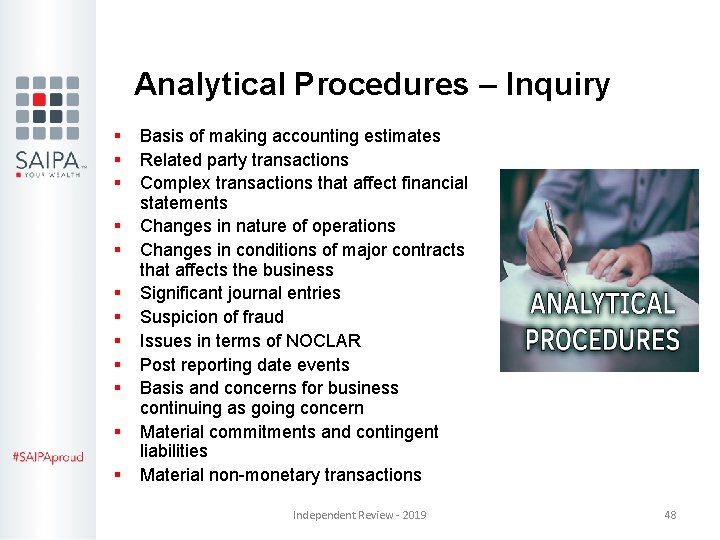
Analytical Procedures – Inquiry § § § Basis of making accounting estimates Related party transactions Complex transactions that affect financial statements Changes in nature of operations Changes in conditions of major contracts that affects the business Significant journal entries Suspicion of fraud Issues in terms of NOCLAR Post reporting date events Basis and concerns for business continuing as going concern Material commitments and contingent liabilities Material non-monetary transactions Independent Review - 2019 48
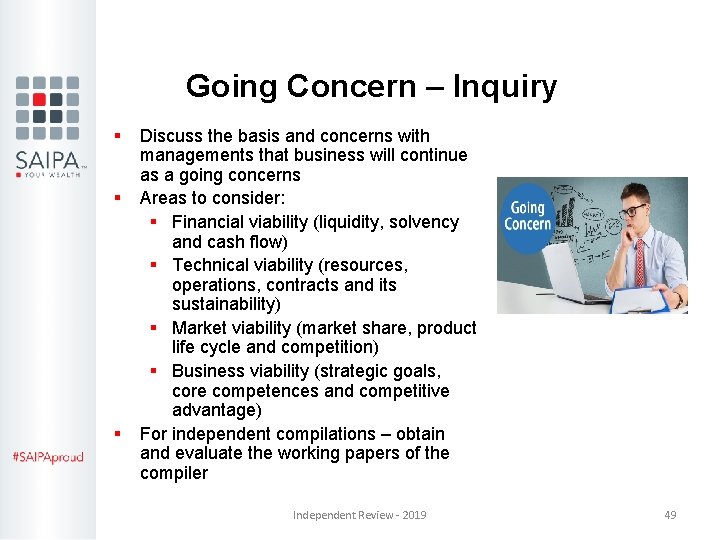
Going Concern – Inquiry § § § Discuss the basis and concerns with managements that business will continue as a going concerns Areas to consider: § Financial viability (liquidity, solvency and cash flow) § Technical viability (resources, operations, contracts and its sustainability) § Market viability (market share, product life cycle and competition) § Business viability (strategic goals, core competences and competitive advantage) For independent compilations – obtain and evaluate the working papers of the compiler Independent Review - 2019 49
Events after report date § § If the practitioner discovers any event occurring between the reporting date an the date the financial statements are signedoff: § Discuss the matter with management § Determine the impact on the financial statements – apply the accounting standards (amend financial statements or disclosed by way of a note) § Request management to amend the financial statements If management refuses to amend the financial statements: § Notify management not to issue financial statements to third parties § If issued, take appropriate action to prevent reliance being placed on the review report Independent Review - 2019 50
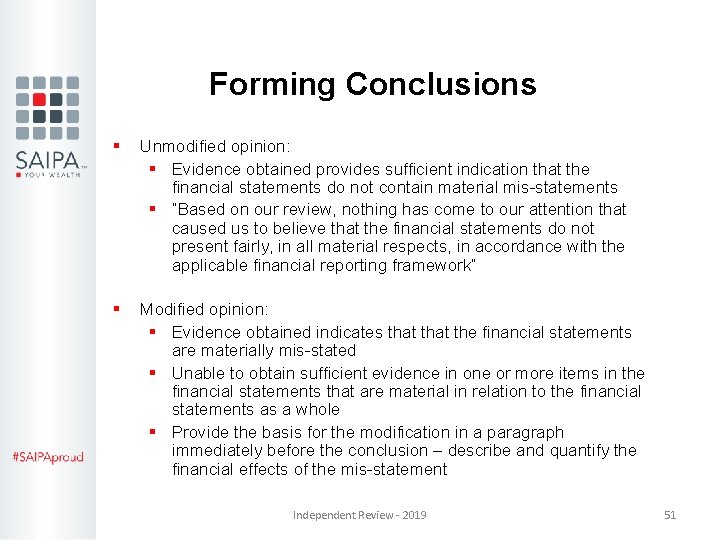
Forming Conclusions § Unmodified opinion: § Evidence obtained provides sufficient indication that the financial statements do not contain material mis-statements § “Based on our review, nothing has come to our attention that caused us to believe that the financial statements do not present fairly, in all material respects, in accordance with the applicable financial reporting framework” § Modified opinion: § Evidence obtained indicates that the financial statements are materially mis-stated § Unable to obtain sufficient evidence in one or more items in the financial statements that are material in relation to the financial statements as a whole § Provide the basis for the modification in a paragraph immediately before the conclusion – describe and quantify the financial effects of the mis-statement Independent Review - 2019 51
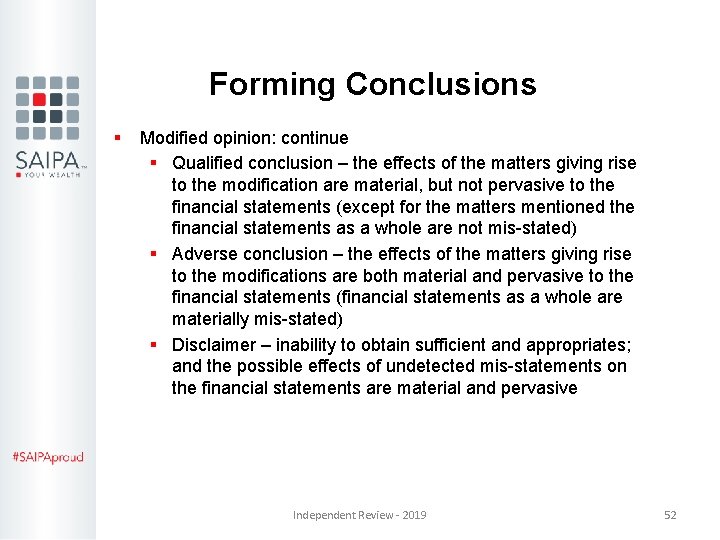
Forming Conclusions § Modified opinion: continue § Qualified conclusion – the effects of the matters giving rise to the modification are material, but not pervasive to the financial statements (except for the matters mentioned the financial statements as a whole are not mis-stated) § Adverse conclusion – the effects of the matters giving rise to the modifications are both material and pervasive to the financial statements (financial statements as a whole are materially mis-stated) § Disclaimer – inability to obtain sufficient and appropriates; and the possible effects of undetected mis-statements on the financial statements are material and pervasive Independent Review - 2019 52
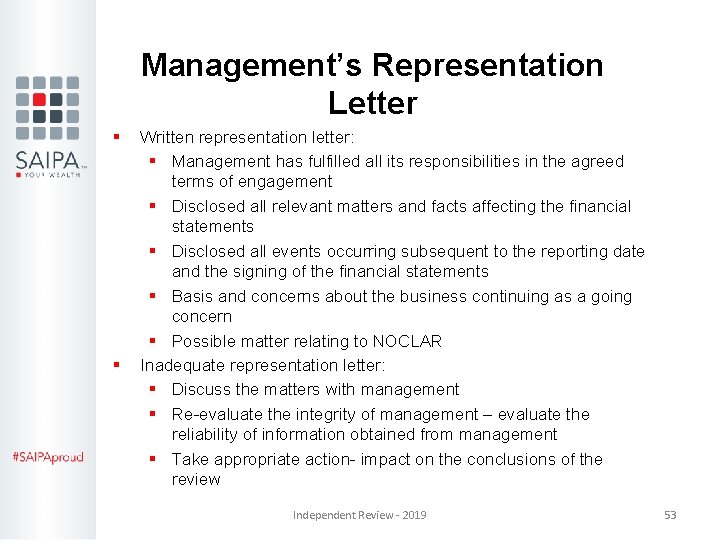
Management’s Representation Letter § § Written representation letter: § Management has fulfilled all its responsibilities in the agreed terms of engagement § Disclosed all relevant matters and facts affecting the financial statements § Disclosed all events occurring subsequent to the reporting date and the signing of the financial statements § Basis and concerns about the business continuing as a going concern § Possible matter relating to NOCLAR Inadequate representation letter: § Discuss the matters with management § Re-evaluate the integrity of management – evaluate the reliability of information obtained from management § Take appropriate action- impact on the conclusions of the review Independent Review - 2019 53
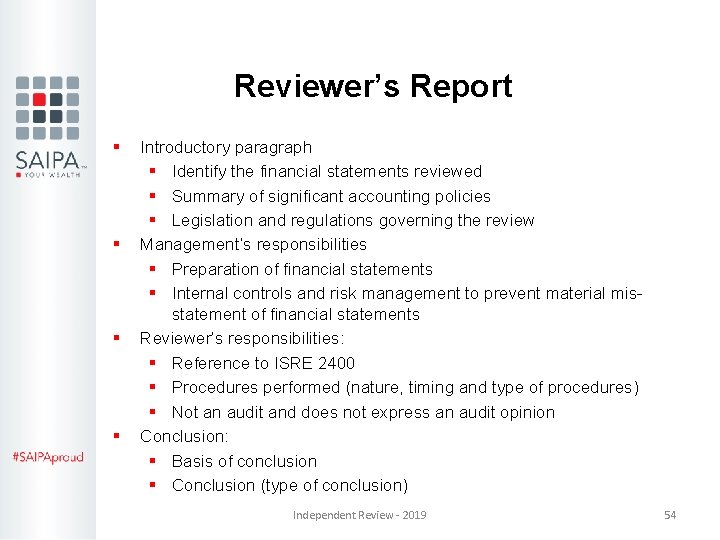
Reviewer’s Report § § Introductory paragraph § Identify the financial statements reviewed § Summary of significant accounting policies § Legislation and regulations governing the review Management’s responsibilities § Preparation of financial statements § Internal controls and risk management to prevent material misstatement of financial statements Reviewer’s responsibilities: § Reference to ISRE 2400 § Procedures performed (nature, timing and type of procedures) § Not an audit and does not express an audit opinion Conclusion: § Basis of conclusion § Conclusion (type of conclusion) Independent Review - 2019 54
Documentation § § Documentation maintained by the reviewer provides evidence that: § Review of the financial statements was performed in compliance with the IRSE 2400 § Sufficient and appropriate evidence was obtained to support the conclusions of the reviewer Information to be documented: § Nature, timing and extent of the procedures performed § Evidence and results of the procedures performed § Significant matters arising during the engagement § Discussions with management and other staff members § Significant inconsistencies identified during the engagement § Significant professional judgement made in reaching conclusions § Conclusions of the reviewer based on the evidence obtained Independent Review - 2019 55
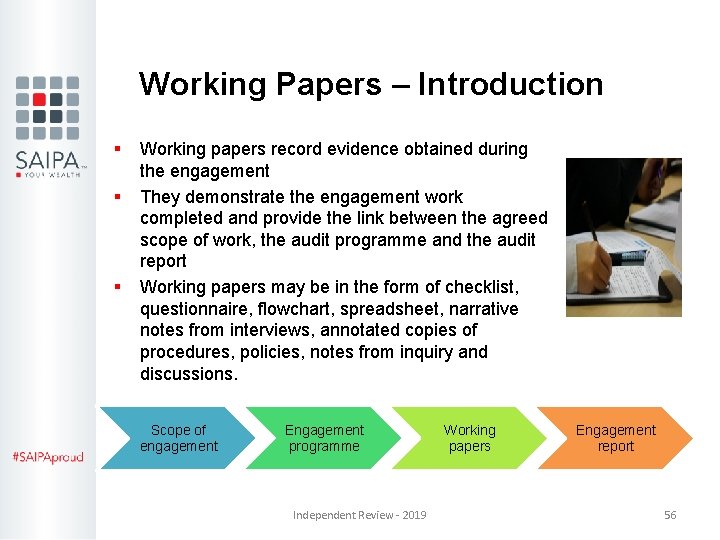
Working Papers – Introduction § § § Working papers record evidence obtained during the engagement They demonstrate the engagement work completed and provide the link between the agreed scope of work, the audit programme and the audit report Working papers may be in the form of checklist, questionnaire, flowchart, spreadsheet, narrative notes from interviews, annotated copies of procedures, policies, notes from inquiry and discussions. Scope of engagement Engagement programme Independent Review - 2019 Working papers Engagement report 56
Working Papers - Importance § § § Necessary for quality control purposes Provide assurance that the work delegated to staff has been properly completed Provide evidence that an effective engagement has been carried out Increase the economy, efficiency, and effectiveness of the engagement Contain sufficiently detailed and up-to-date facts which justify the reasonableness of the practitioner’s conclusions Retain a record of matters of continuing significance to future engagements Independent Review - 2019 57
Working Papers – Content § § § § Name of the client Period covered by the engagement Subject matter File reference (3) Initials (signature) of the member of staff who prepared the working paper, and the date on which it was prepared For audit papers prepared by client staff, the date the working papers were received, and the initials of the audit team member who carried out the audit work Initials of the member of staff who reviewed the working papers and the date on which the review was carried out Each engagement paper should meet the characteristics of a good working paper as per ISA 230 Independent Review - 2019 58
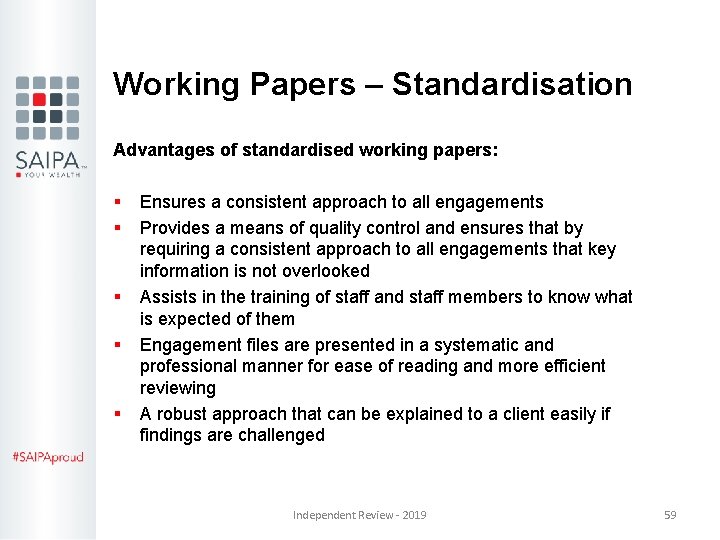
Working Papers – Standardisation Advantages of standardised working papers: § § § Ensures a consistent approach to all engagements Provides a means of quality control and ensures that by requiring a consistent approach to all engagements that key information is not overlooked Assists in the training of staff and staff members to know what is expected of them Engagement files are presented in a systematic and professional manner for ease of reading and more efficient reviewing A robust approach that can be explained to a client easily if findings are challenged Independent Review - 2019 59
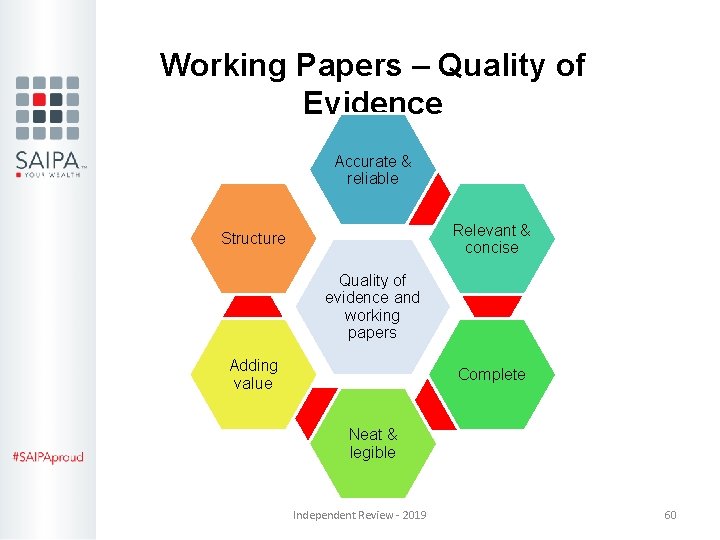
Working Papers – Quality of Evidence Accurate & reliable Relevant & concise Structure Quality of evidence and working papers Adding value Complete Neat & legible Independent Review - 2019 60
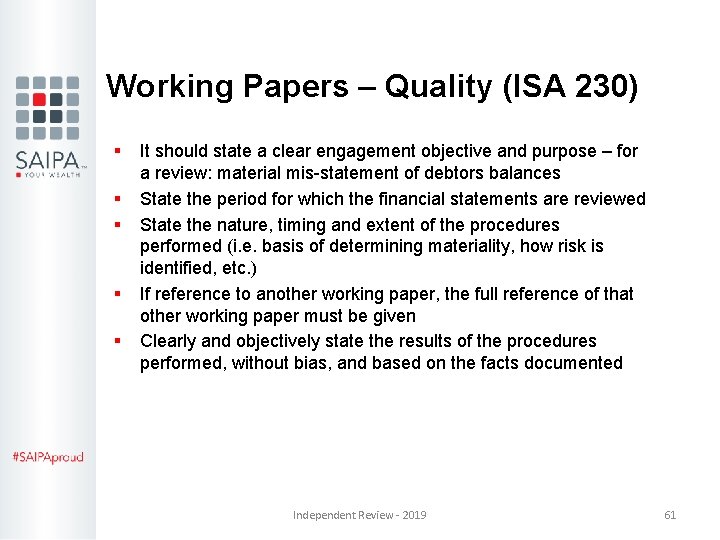
Working Papers – Quality (ISA 230) § § § It should state a clear engagement objective and purpose – for a review: material mis-statement of debtors balances State the period for which the financial statements are reviewed State the nature, timing and extent of the procedures performed (i. e. basis of determining materiality, how risk is identified, etc. ) If reference to another working paper, the full reference of that other working paper must be given Clearly and objectively state the results of the procedures performed, without bias, and based on the facts documented Independent Review - 2019 61
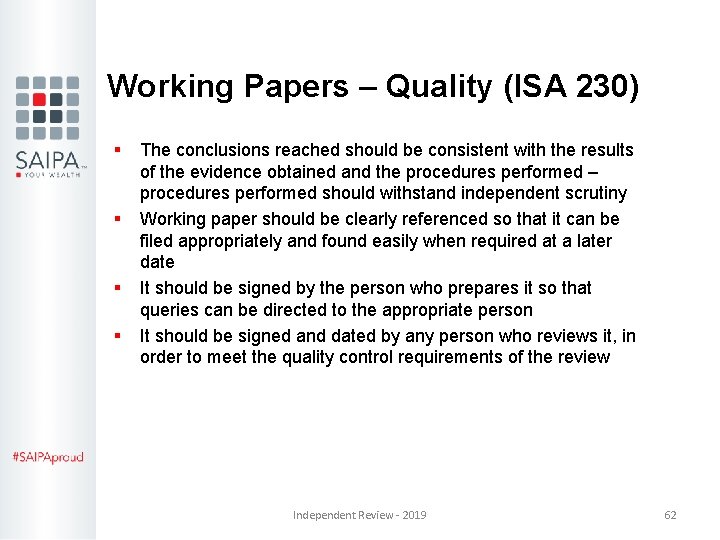
Working Papers – Quality (ISA 230) § § The conclusions reached should be consistent with the results of the evidence obtained and the procedures performed – procedures performed should withstand independent scrutiny Working paper should be clearly referenced so that it can be filed appropriately and found easily when required at a later date It should be signed by the person who prepares it so that queries can be directed to the appropriate person It should be signed and dated by any person who reviews it, in order to meet the quality control requirements of the review Independent Review - 2019 62
Working Papers – Property § § § Working papers prepared during an engagement (including those prepared by the client for the practitioner) are the property of the practitioner The only time a third-party has a legal right to examine the working papers is when they are subpoenaed by the courts as legal evidence Working papers can also be provided to a third-party i. e. newly appointed auditors/reviewers with the express permission of the client Independent Review - 2019 63
Working Papers – Retention § § § Auditing Professions Act, No 26 of 2005, implicitly requires that documents should be retained for three years ISQC 1 requires firms to establish policies and procedures for the retention of engagement documentation of which the retention period for engagements is no shorter than five years from the date of the engagement report The Companies Act 71 of 2008 expressly provides that records must be kept: a) in written form, or other form or manner that allows that information to be converted into written form within a reasonable time; and b) for a period of seven years, or any longer period of time specified in any other applicable public regulation Independent Review - 2019 64
Working Papers – General Can a practitioner meet their overall engagement objectives without documenting their work? § § No. Proper documentation is integral to the achievement of an practitioner’s overall objectives. If sufficient and appropriate evidence necessary to support the engagement opinion was not appropriately documented, then the engagement was not conducted in accordance with applicable standards, and the practitioner would not have a basis to render an opinion. Independent Review - 2019 65
Working Papers – General What level of documentation is required by the engagement standards? § The auditor should prepare audit documentation that is sufficient to enable an experienced auditor, having no previous connection with the audit, to understand: o the nature, timing, and extent of the procedures performed to comply with: i. IFRS/ISRE and applicable legal and regulatory requirements; ii. the results of the procedures performed, and the evidence obtained; iii. significant findings or issues identified, the conclusions reached thereon, and iv. significant professional judgments made in reaching those conclusions Independent Review - 2019 66
Independent Review - 2019 67
JOIN THE CONVERSATION AND BE #SAIPAproud @SAIPAcomms South African Institute of Professional Accountants SAIPA-South African Institute of Professional Accountants Independent Review - 2019 68