
Independent Component Analysis Blind Source Separation Ata Kaban
Independent Component Analysis & Blind Source Separation Ata Kaban The University of Birmingham
Overview • Today we learn about – The cocktail party problem -- called also ‘blind source separation’ (BSS) – Independent Component Analysis (ICA) for solving BSS – Other applications of ICA / BSS • At an intuitive & introductory & practical level
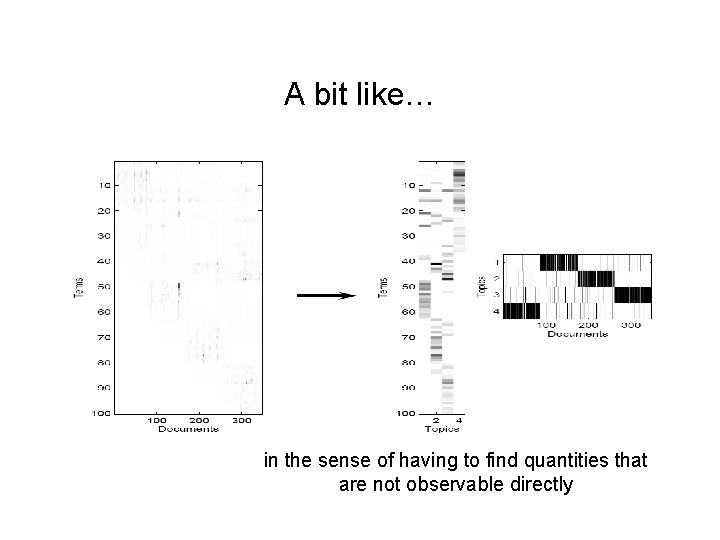
A bit like… in the sense of having to find quantities that are not observable directly
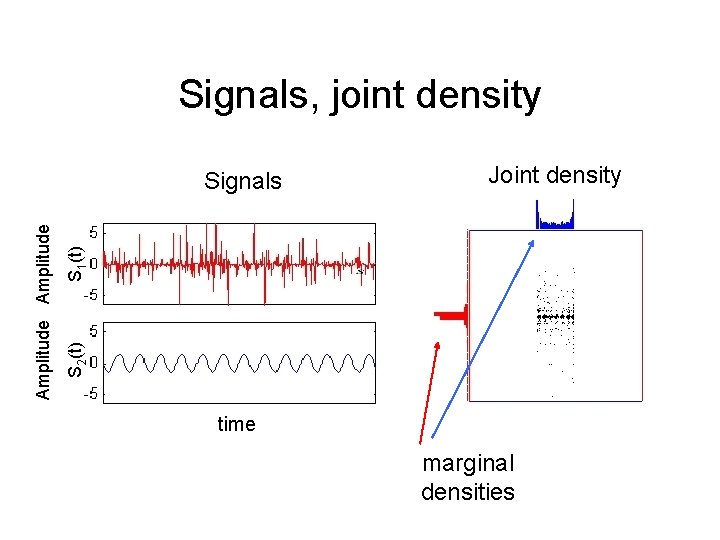
Signals, joint density S 1(t) Joint density S 2(t) Amplitude Signals time marginal densities
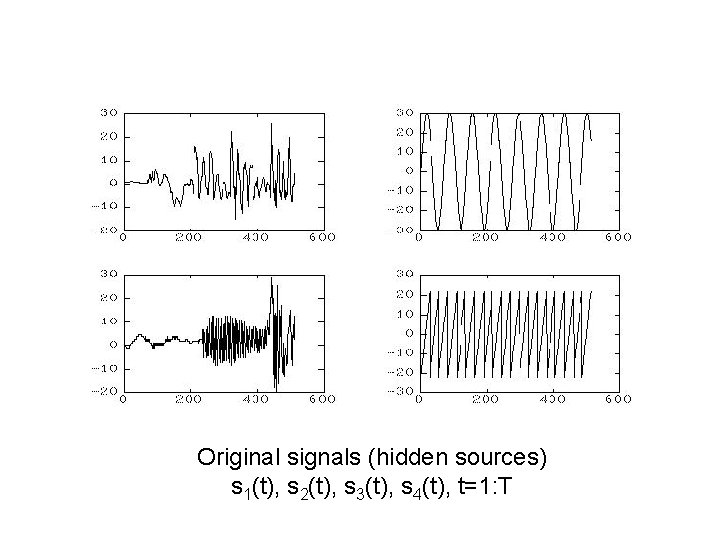
Original signals (hidden sources) s 1(t), s 2(t), s 3(t), s 4(t), t=1: T
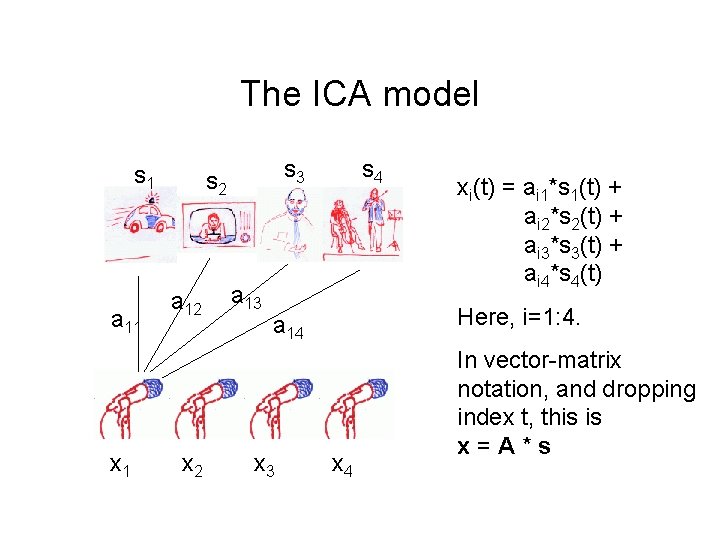
The ICA model s 1 a 11 x 1 s 3 s 2 a 12 x 2 a 13 s 4 Here, i=1: 4. a 14 x 3 xi(t) = ai 1*s 1(t) + ai 2*s 2(t) + ai 3*s 3(t) + ai 4*s 4(t) x 4 In vector-matrix notation, and dropping index t, this is x=A*s
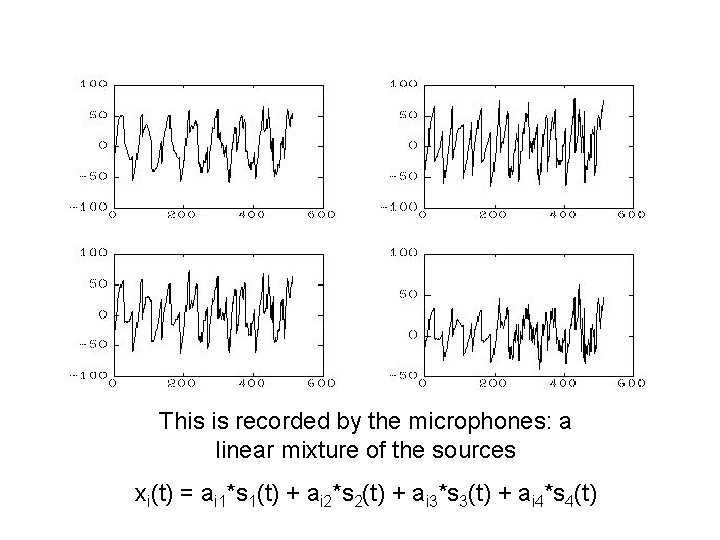
This is recorded by the microphones: a linear mixture of the sources xi(t) = ai 1*s 1(t) + ai 2*s 2(t) + ai 3*s 3(t) + ai 4*s 4(t)
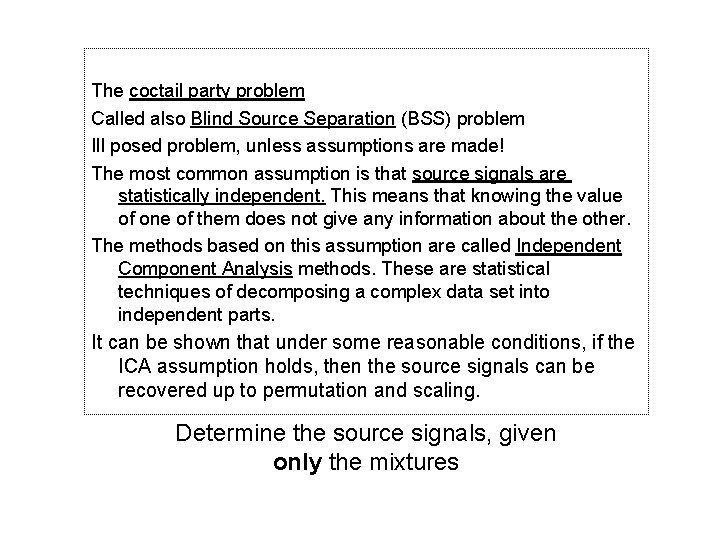
The coctail party problem Called also Blind Source Separation (BSS) problem Ill posed problem, unless assumptions are made! The most common assumption is that source signals are statistically independent. This means that knowing the value of one of them does not give any information about the other. The methods based on this assumption are called Independent Component Analysis methods. These are statistical techniques of decomposing a complex data set into independent parts. It can be shown that under some reasonable conditions, if the ICA assumption holds, then the source signals can be recovered up to permutation and scaling. Determine the source signals, given only the mixtures
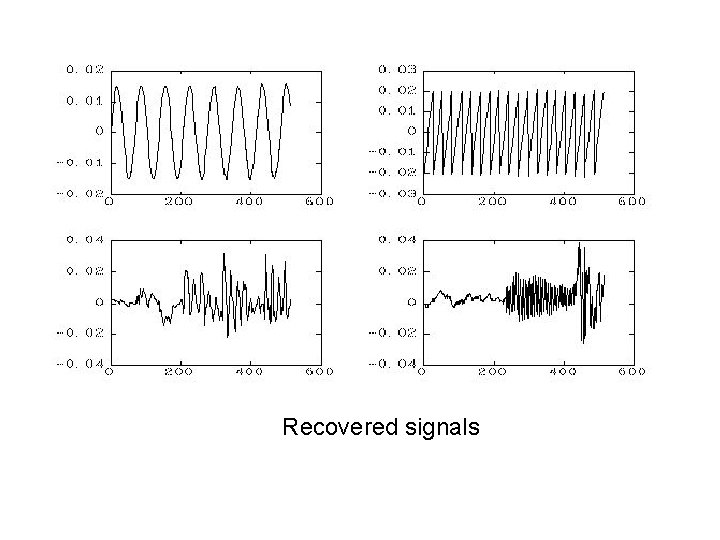
Recovered signals
Some further considerations • If we knew the mixing parameters aij then we would just need to solve a linear system of equations. • We know neither aij nor si. • ICA was initially developed to deal with problems closely related to the coctail party problem • Later it became evident that ICA has many other applications too. E. g. from electrical recordings of brain activity from different locations of the scalp (EEG signals) recover underlying components of brain activity
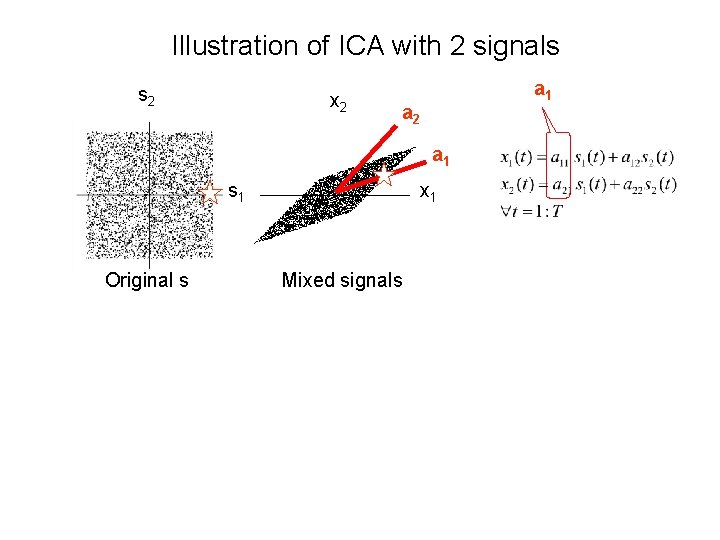
Illustration of ICA with 2 signals s 2 x 2 a 1 a 2 a 1 s 1 Original s x 1 Mixed signals
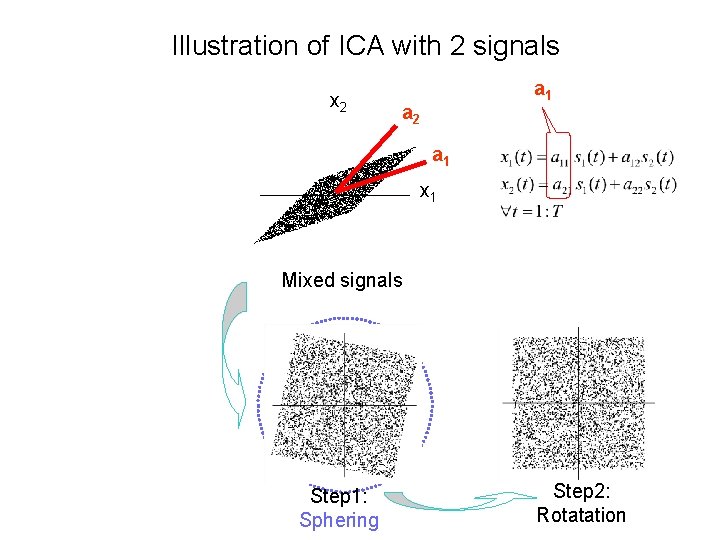
Illustration of ICA with 2 signals x 2 a 1 a 2 a 1 x 1 Mixed signals Step 1: Sphering Step 2: Rotatation
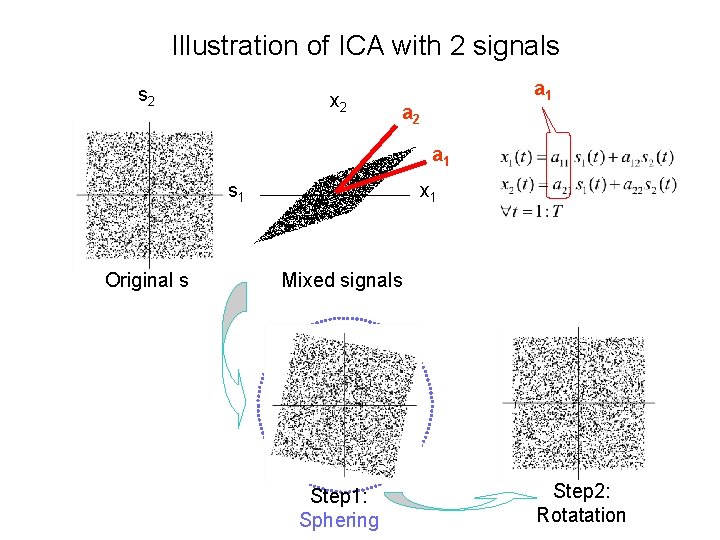
Illustration of ICA with 2 signals s 2 x 2 a 1 a 2 a 1 s 1 Original s x 1 Mixed signals Step 1: Sphering Step 2: Rotatation
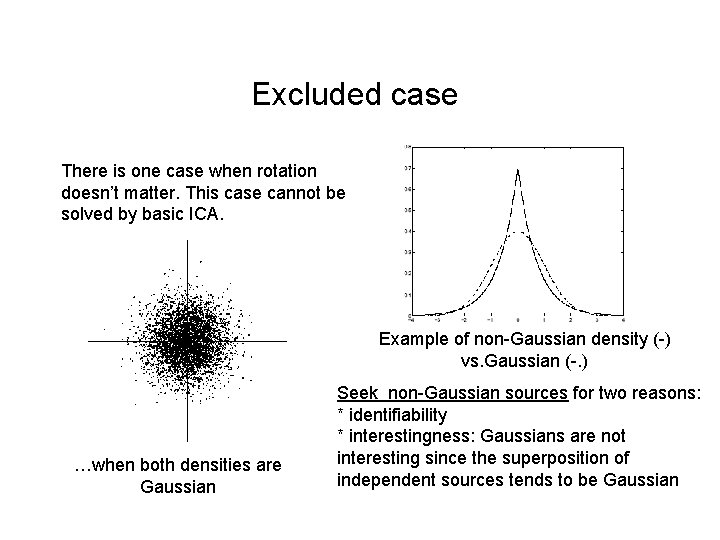
Excluded case There is one case when rotation doesn’t matter. This case cannot be solved by basic ICA. Example of non-Gaussian density (-) vs. Gaussian (-. ) …when both densities are Gaussian Seek non-Gaussian sources for two reasons: * identifiability * interestingness: Gaussians are not interesting since the superposition of independent sources tends to be Gaussian
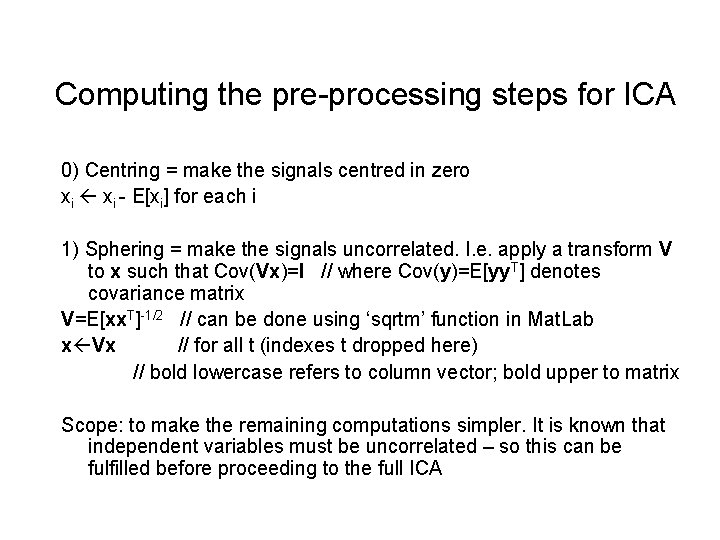
Computing the pre-processing steps for ICA 0) Centring = make the signals centred in zero xi - E[xi] for each i 1) Sphering = make the signals uncorrelated. I. e. apply a transform V to x such that Cov(Vx)=I // where Cov(y)=E[yy. T] denotes covariance matrix V=E[xx. T]-1/2 // can be done using ‘sqrtm’ function in Mat. Lab x Vx // for all t (indexes t dropped here) // bold lowercase refers to column vector; bold upper to matrix Scope: to make the remaining computations simpler. It is known that independent variables must be uncorrelated – so this can be fulfilled before proceeding to the full ICA
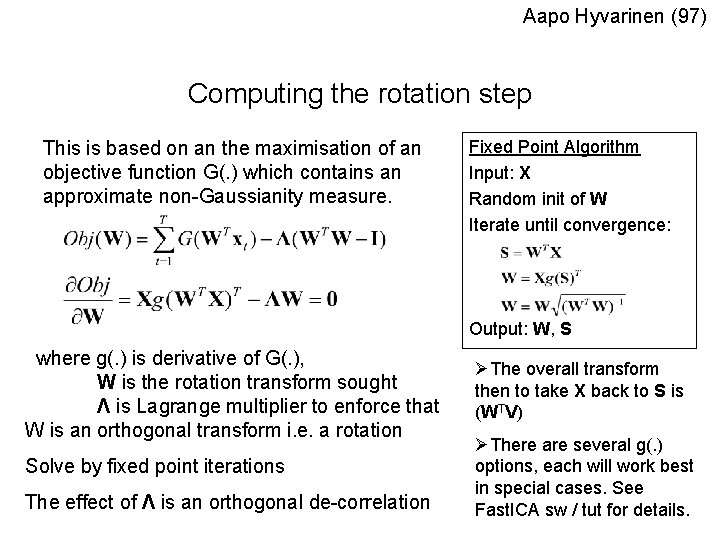
Aapo Hyvarinen (97) Computing the rotation step This is based on an the maximisation of an objective function G(. ) which contains an approximate non-Gaussianity measure. Fixed Point Algorithm Input: X Random init of W Iterate until convergence: Output: W, S where g(. ) is derivative of G(. ), W is the rotation transform sought Λ is Lagrange multiplier to enforce that W is an orthogonal transform i. e. a rotation Solve by fixed point iterations The effect of Λ is an orthogonal de-correlation ØThe overall transform then to take X back to S is (WTV) ØThere are several g(. ) options, each will work best in special cases. See Fast. ICA sw / tut for details.
Application domains of ICA • Blind source separation (Bell&Sejnowski, Te won Lee, Girolami, Hyvarinen, etc. ) • Image denoising (Hyvarinen) • Medical signal processing – f. MRI, ECG, EEG (Mackeig) • Modelling of the hippocampus and visual cortex (Lorincz, Hyvarinen) • Feature extraction, face recognition (Marni Bartlett) • Compression, redundancy reduction • Watermarking (D Lowe) • Clustering (Girolami, Kolenda) • Time series analysis (Back, Valpola) • Topic extraction (Kolenda, Bingham, Kaban) • Scientific Data Mining (Kaban, etc)
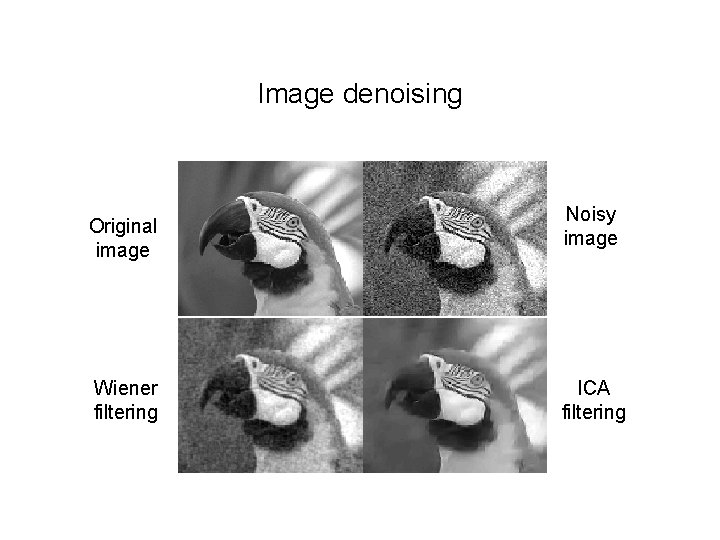
Image denoising Original image Wiener filtering Noisy image ICA filtering
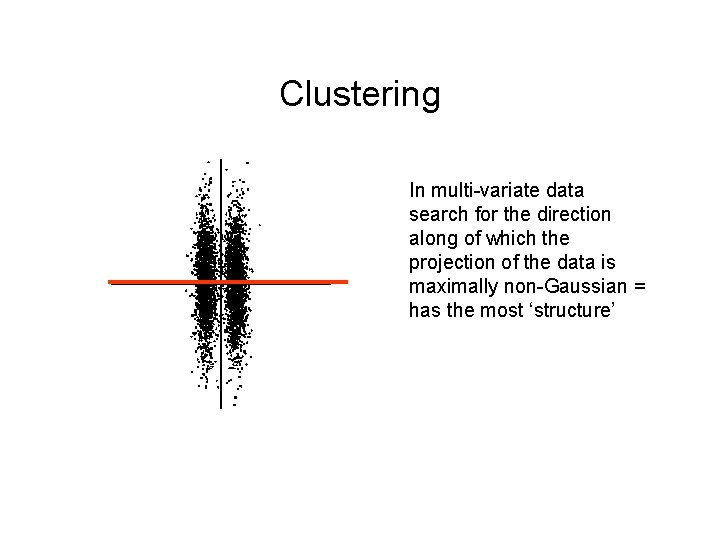
Clustering In multi-variate data search for the direction along of which the projection of the data is maximally non-Gaussian = has the most ‘structure’
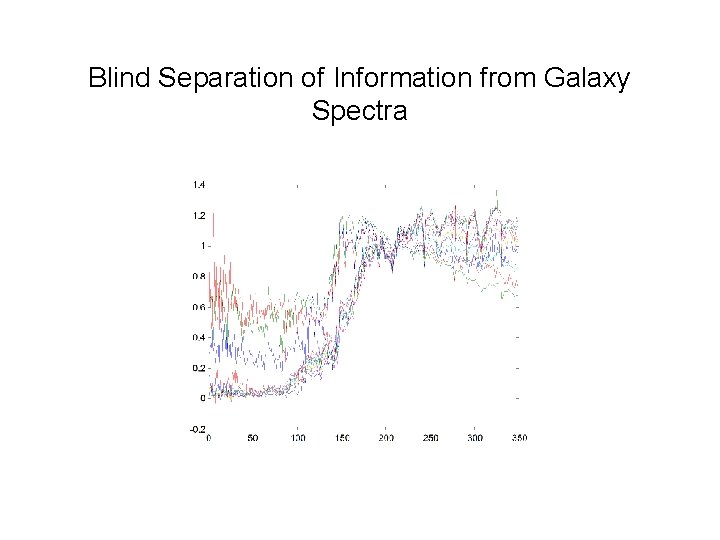
Blind Separation of Information from Galaxy Spectra
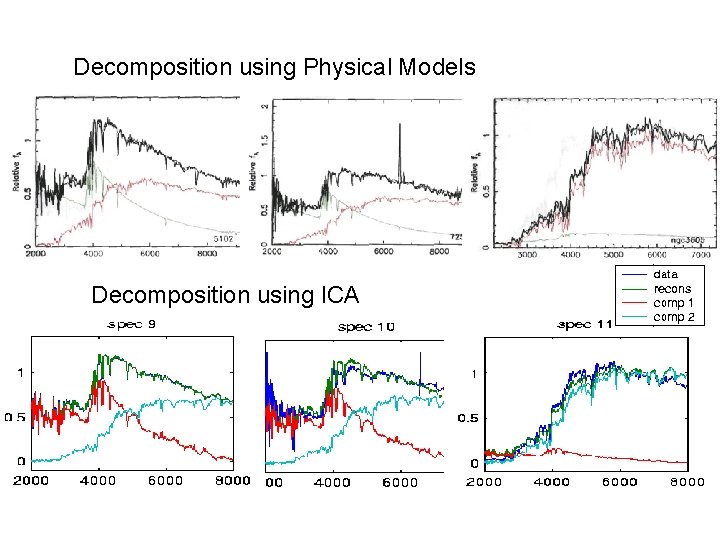
Decomposition using Physical Models Decomposition using ICA
Summing Up • Assumption that the data consists of unknown components – Individual signals in a mix – topics in a text corpus – basis-galaxies • Trying to solve the inverse problem: – Observing the superposition only – Recover components – Components often give simpler, clearer view of the data
Related resources § http: //www. cis. hut. fi/projects/ica/cocktail_en. cgi Demo and links to further info on ICA. § http: //www. cis. hut. fi/projects/ica/fastica/code/dlcode. shtml ICA software in Mat. Lab. § http: //www. cs. helsinki. fi/u/ahyvarin/papers/NN 00 new. pdf Comprehensive tutorial paper, slightly more technical.
- Slides: 23