
Independence Movements Upheaval in the Americas What is
- Slides: 11
Independence Movements Upheaval in the Americas
What is meant by the Americas? Two continents and islands isolated by two oceans Mountain ranges and major river systems limit travel Some countries dominated by indigenous population Others natives virtually wiped out Some democracies, others dictatorships Some right-wing, others Marxist/communist U. S. is regionally dominant American Revolution spawned others Some major players in region L’Ouverture, Porfirio Diaz, Castro, Perón Canada constitutionally independent but retains monarchy
Exploration and Colonization Various Euros established colonies in New World Conflicts in Europe spilled into colonies Sometimes opposite Over time – colonies more autonomous Constant oversight not possible – encouraged selfdefense to lower cost of protection Colonists’ motives varied as did social standing Also contract laborers and slaves Most were men
Influence of Geography Steep mountains, wild rivers presented obstacles to unification in Latin America Developed into separate nation states rather than a Spanish “United States” Spanish American colonies had relations with Crown, not each other. British North America had good river systems and modest-sized mountains that did not seriously hinder trade, travel, or communication among colonies
Differences between British and Spanish America 13 British colonies lasted 76 years under English control Latin American colonies spanned over 300 years Varied motives for colonization Spanish dealt with larger, organized native populations that had to be broken and controlled as a labor force British faced smaller, less developed groups that they forced from occupied land – but fostered resentment
Political Control Spanish colonies reflected absolutist regime at home Many laws, large bureaucracy and legal system Largely ignored beyond major cities of colonies Social hierarchy based on place of birth and racial mix Peninsulares/creoles – Mestizos, Mulattos, etc. Creoles excluded from control except in town councils (cabildos) Cabildos play significant role in wars of independence Portuguese control more relaxed and less-able to control Brazilian population
Political Control continued Government of British colonies represented extension of English Parliament English system based on common law and representative govt. English colonies had large degree of autonomy Each colony had some form of representative assembly voted in by popular support Democracy to a degree – white, wealthy men
Economic Systems All used mercantilism – colonies contribute to wealth of empires Colonies provide raw materials and serve as a market for mother country’s finished goods Trade with rivals restricted and taxed British Navigation Acts (1650 – 1673) established rules for trade in entire empire – not just North America Smuggling, especially in New England, widespread Lax enforcement – Salutary Neglect Spanish mercantilism tightly enforced Monopoly ports, annual convoy system Concentrated on precious metals more than raw materials Spain more dependant upon foreign trade for finished goods Intra-colonial trade developed where possible
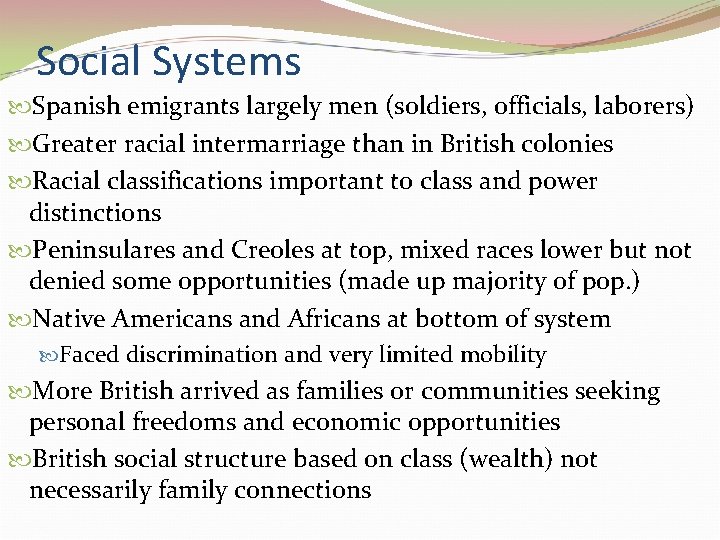
Social Systems Spanish emigrants largely men (soldiers, officials, laborers) Greater racial intermarriage than in British colonies Racial classifications important to class and power distinctions Peninsulares and Creoles at top, mixed races lower but not denied some opportunities (made up majority of pop. ) Native Americans and Africans at bottom of system Faced discrimination and very limited mobility More British arrived as families or communities seeking personal freedoms and economic opportunities British social structure based on class (wealth) not necessarily family connections
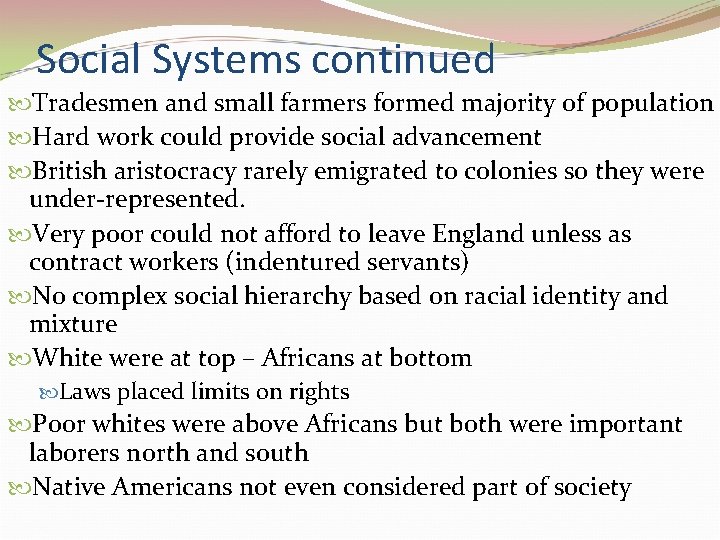
Social Systems continued Tradesmen and small farmers formed majority of population Hard work could provide social advancement British aristocracy rarely emigrated to colonies so they were under-represented. Very poor could not afford to leave England unless as contract workers (indentured servants) No complex social hierarchy based on racial identity and mixture White were at top – Africans at bottom Laws placed limits on rights Poor whites were above Africans but both were important laborers north and south Native Americans not even considered part of society
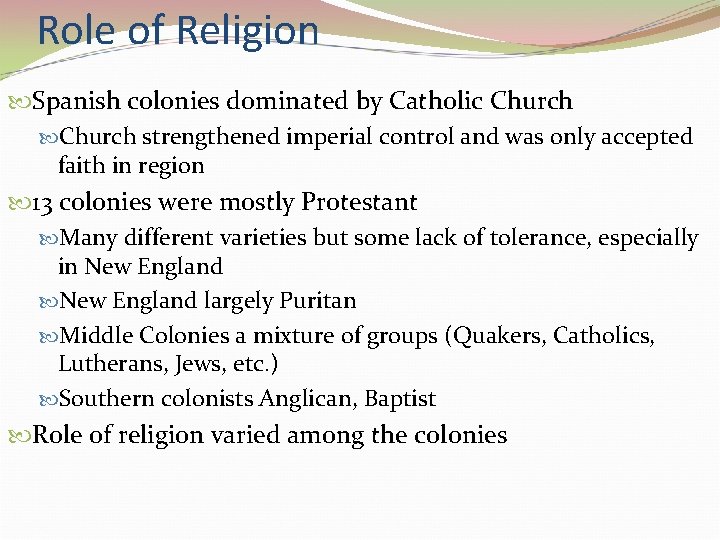
Role of Religion Spanish colonies dominated by Catholic Church strengthened imperial control and was only accepted faith in region 13 colonies were mostly Protestant Many different varieties but some lack of tolerance, especially in New England largely Puritan Middle Colonies a mixture of groups (Quakers, Catholics, Lutherans, Jews, etc. ) Southern colonists Anglican, Baptist Role of religion varied among the colonies