
Ind AS 11 Construction Contracts and Ind AS


- Slides: 125
> Ind AS 11 Construction Contracts and Ind AS 18 Revenue > IND AS 101: - First Time Adoption of Indian Accounting Standards Awareness programme on IND AS Jaipur, Saturday Oct 1, 2016 CA Nitish Kirtikar
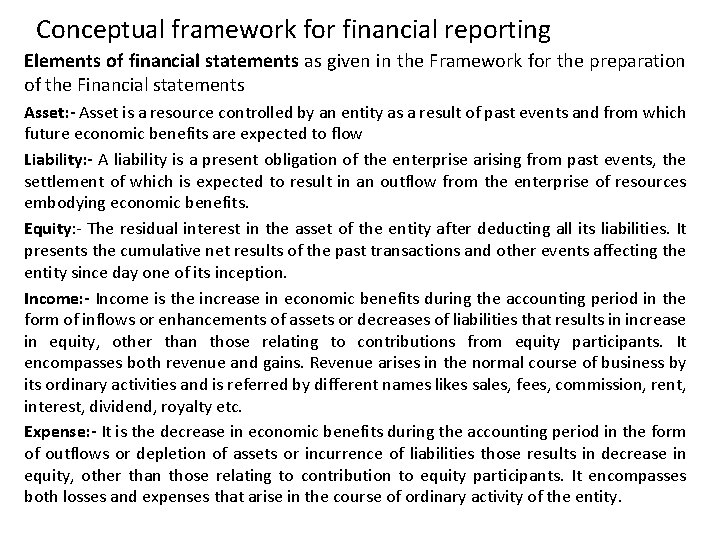
Conceptual framework for financial reporting Elements of financial statements as given in the Framework for the preparation of the Financial statements Asset: - Asset is a resource controlled by an entity as a result of past events and from which future economic benefits are expected to flow Liability: - A liability is a present obligation of the enterprise arising from past events, the settlement of which is expected to result in an outflow from the enterprise of resources embodying economic benefits. Equity: ‐ The residual interest in the asset of the entity after deducting all its liabilities. It presents the cumulative net results of the past transactions and other events affecting the entity since day one of its inception. Income: - Income is the increase in economic benefits during the accounting period in the form of inflows or enhancements of assets or decreases of liabilities that results in increase in equity, other than those relating to contributions from equity participants. It encompasses both revenue and gains. Revenue arises in the normal course of business by its ordinary activities and is referred by different names likes sales, fees, commission, rent, interest, dividend, royalty etc. Expense: - It is the decrease in economic benefits during the accounting period in the form of outflows or depletion of assets or incurrence of liabilities those results in decrease in equity, other than those relating to contribution to equity participants. It encompasses both losses and expenses that arise in the course of ordinary activity of the entity.
Ind AS 11 Construction Contracts and Ind AS 18 Revenue
Ind AS 11 Construction Contracts
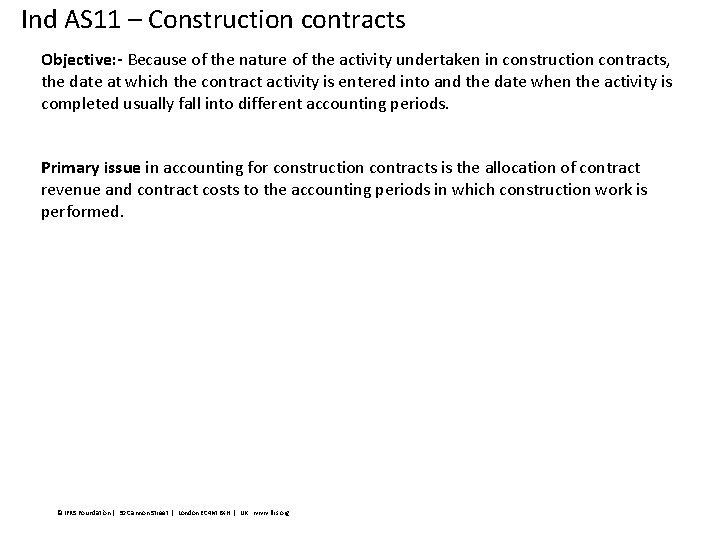
Ind AS 11 – Construction contracts Objective: - Because of the nature of the activity undertaken in construction contracts, the date at which the contract activity is entered into and the date when the activity is completed usually fall into different accounting periods. Primary issue in accounting for construction contracts is the allocation of contract revenue and contract costs to the accounting periods in which construction work is performed. © IFRS Foundation | 30 Cannon Street | London EC 4 M 6 XH | UK. www. ifrs. org 5
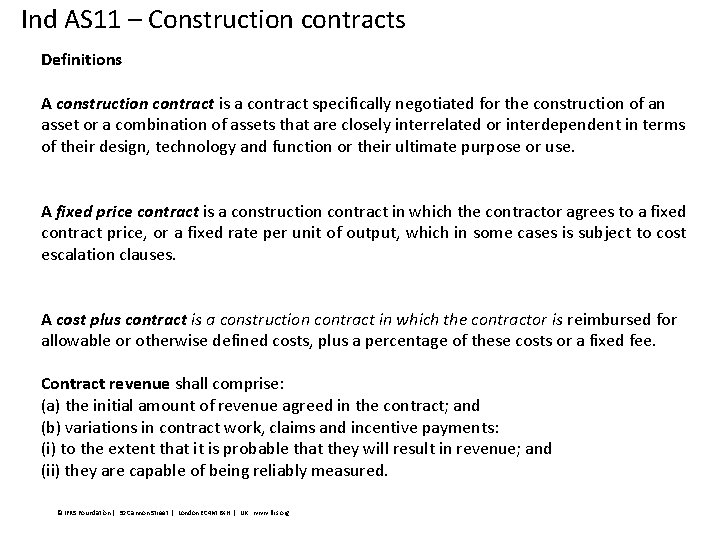
Ind AS 11 – Construction contracts Definitions A construction contract is a contract specifically negotiated for the construction of an asset or a combination of assets that are closely interrelated or interdependent in terms of their design, technology and function or their ultimate purpose or use. A fixed price contract is a construction contract in which the contractor agrees to a fixed contract price, or a fixed rate per unit of output, which in some cases is subject to cost escalation clauses. A cost plus contract is a construction contract in which the contractor is reimbursed for allowable or otherwise defined costs, plus a percentage of these costs or a fixed fee. Contract revenue shall comprise: (a) the initial amount of revenue agreed in the contract; and (b) variations in contract work, claims and incentive payments: (i) to the extent that it is probable that they will result in revenue; and (ii) they are capable of being reliably measured. © IFRS Foundation | 30 Cannon Street | London EC 4 M 6 XH | UK. www. ifrs. org 6
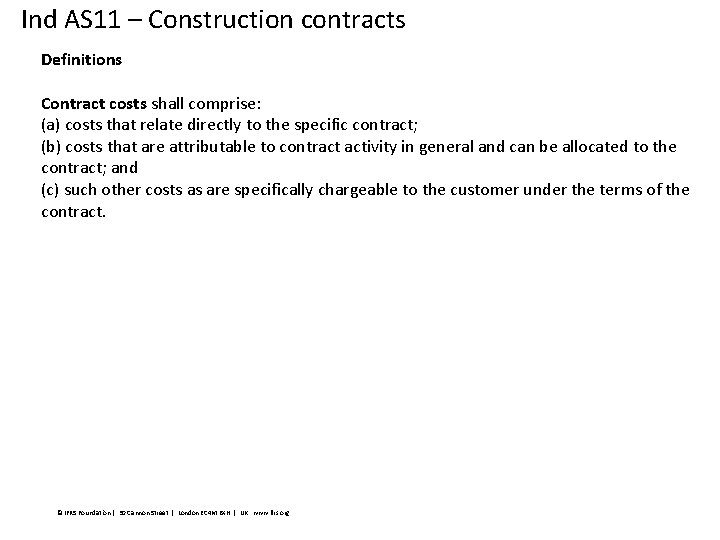
Ind AS 11 – Construction contracts Definitions Contract costs shall comprise: (a) costs that relate directly to the specific contract; (b) costs that are attributable to contract activity in general and can be allocated to the contract; and (c) such other costs as are specifically chargeable to the customer under the terms of the contract. © IFRS Foundation | 30 Cannon Street | London EC 4 M 6 XH | UK. www. ifrs. org 7
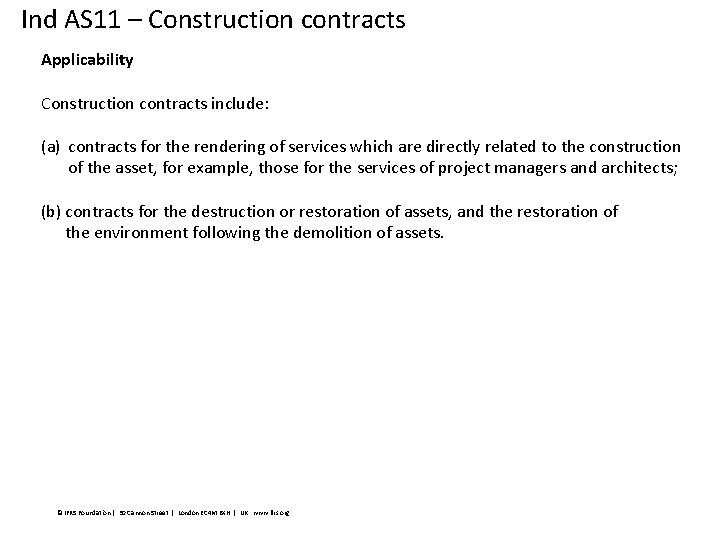
Ind AS 11 – Construction contracts Applicability Construction contracts include: (a) contracts for the rendering of services which are directly related to the construction of the asset, for example, those for the services of project managers and architects; (b) contracts for the destruction or restoration of assets, and the restoration of the environment following the demolition of assets. © IFRS Foundation | 30 Cannon Street | London EC 4 M 6 XH | UK. www. ifrs. org 8
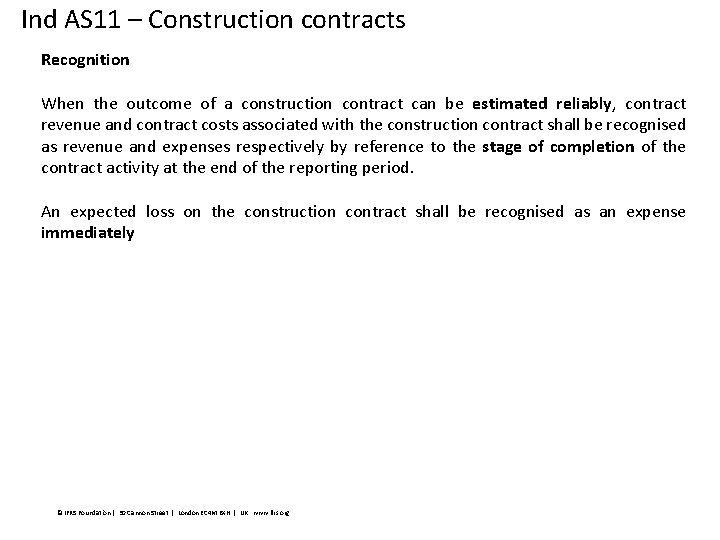
Ind AS 11 – Construction contracts Recognition When the outcome of a construction contract can be estimated reliably, contract revenue and contract costs associated with the construction contract shall be recognised as revenue and expenses respectively by reference to the stage of completion of the contract activity at the end of the reporting period. An expected loss on the construction contract shall be recognised as an expense immediately © IFRS Foundation | 30 Cannon Street | London EC 4 M 6 XH | UK. www. ifrs. org 9
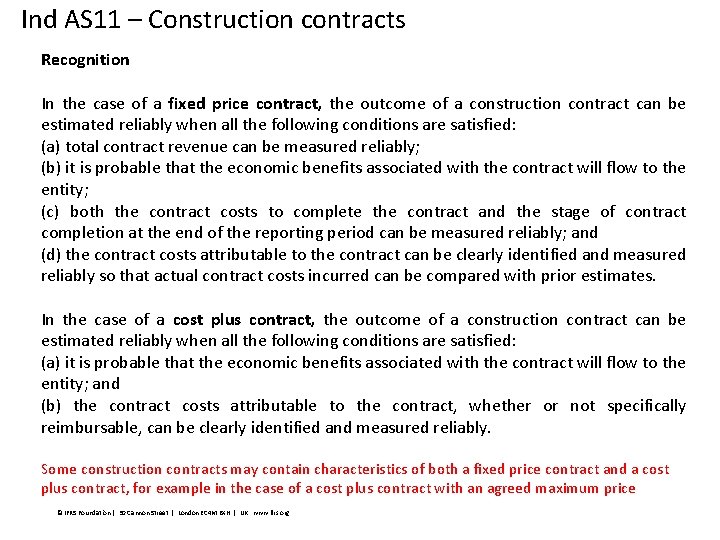
Ind AS 11 – Construction contracts Recognition In the case of a fixed price contract, the outcome of a construction contract can be estimated reliably when all the following conditions are satisfied: (a) total contract revenue can be measured reliably; (b) it is probable that the economic benefits associated with the contract will flow to the entity; (c) both the contract costs to complete the contract and the stage of contract completion at the end of the reporting period can be measured reliably; and (d) the contract costs attributable to the contract can be clearly identified and measured reliably so that actual contract costs incurred can be compared with prior estimates. In the case of a cost plus contract, the outcome of a construction contract can be estimated reliably when all the following conditions are satisfied: (a) it is probable that the economic benefits associated with the contract will flow to the entity; and (b) the contract costs attributable to the contract, whether or not specifically reimbursable, can be clearly identified and measured reliably. Some construction contracts may contain characteristics of both a fixed price contract and a cost plus contract, for example in the case of a cost plus contract with an agreed maximum price © IFRS Foundation | 30 Cannon Street | London EC 4 M 6 XH | UK. www. ifrs. org 10
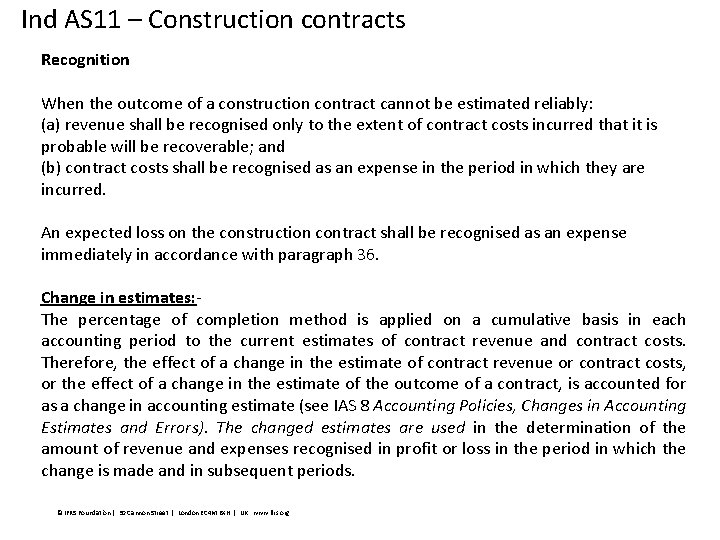
Ind AS 11 – Construction contracts Recognition When the outcome of a construction contract cannot be estimated reliably: (a) revenue shall be recognised only to the extent of contract costs incurred that it is probable will be recoverable; and (b) contract costs shall be recognised as an expense in the period in which they are incurred. An expected loss on the construction contract shall be recognised as an expense immediately in accordance with paragraph 36. Change in estimates: ‐ The percentage of completion method is applied on a cumulative basis in each accounting period to the current estimates of contract revenue and contract costs. Therefore, the effect of a change in the estimate of contract revenue or contract costs, or the effect of a change in the estimate of the outcome of a contract, is accounted for as a change in accounting estimate (see IAS 8 Accounting Policies, Changes in Accounting Estimates and Errors). The changed estimates are used in the determination of the amount of revenue and expenses recognised in profit or loss in the period in which the change is made and in subsequent periods. © IFRS Foundation | 30 Cannon Street | London EC 4 M 6 XH | UK. www. ifrs. org 11
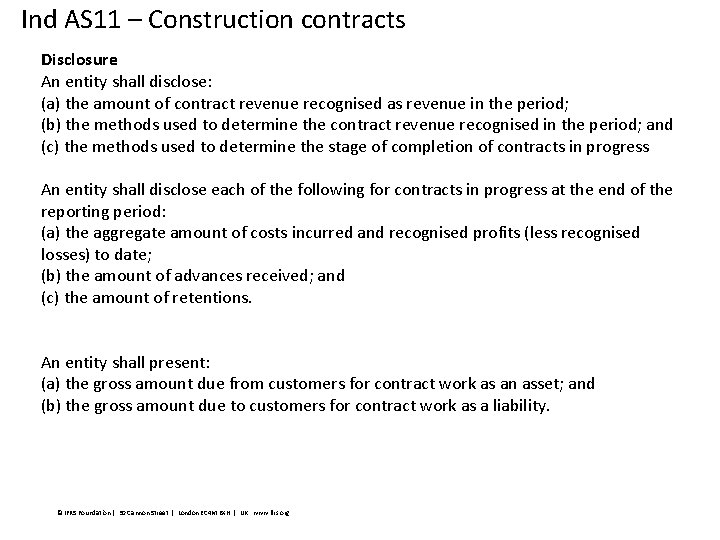
Ind AS 11 – Construction contracts Disclosure An entity shall disclose: (a) the amount of contract revenue recognised as revenue in the period; (b) the methods used to determine the contract revenue recognised in the period; and (c) the methods used to determine the stage of completion of contracts in progress An entity shall disclose each of the following for contracts in progress at the end of the reporting period: (a) the aggregate amount of costs incurred and recognised profits (less recognised losses) to date; (b) the amount of advances received; and (c) the amount of retentions. An entity shall present: (a) the gross amount due from customers for contract work as an asset; and (b) the gross amount due to customers for contract work as a liability. © IFRS Foundation | 30 Cannon Street | London EC 4 M 6 XH | UK. www. ifrs. org 12
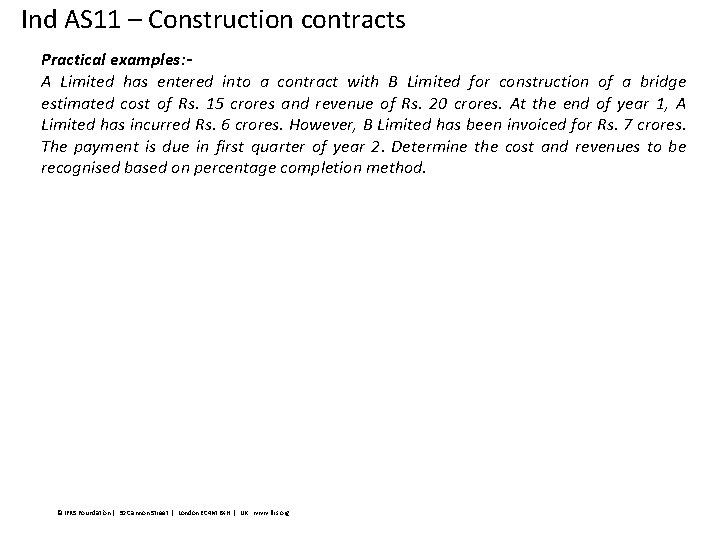
Ind AS 11 – Construction contracts Practical examples: A Limited has entered into a contract with B Limited for construction of a bridge estimated cost of Rs. 15 crores and revenue of Rs. 20 crores. At the end of year 1, A Limited has incurred Rs. 6 crores. However, B Limited has been invoiced for Rs. 7 crores. The payment is due in first quarter of year 2. Determine the cost and revenues to be recognised based on percentage completion method. © IFRS Foundation | 30 Cannon Street | London EC 4 M 6 XH | UK. www. ifrs. org 13
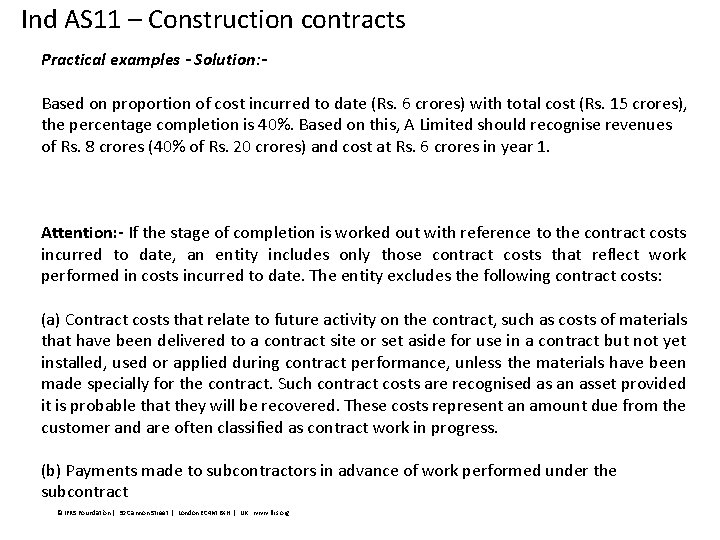
Ind AS 11 – Construction contracts Practical examples - Solution: Based on proportion of cost incurred to date (Rs. 6 crores) with total cost (Rs. 15 crores), the percentage completion is 40%. Based on this, A Limited should recognise revenues of Rs. 8 crores (40% of Rs. 20 crores) and cost at Rs. 6 crores in year 1. Attention: - If the stage of completion is worked out with reference to the contract costs incurred to date, an entity includes only those contract costs that reflect work performed in costs incurred to date. The entity excludes the following contract costs: (a) Contract costs that relate to future activity on the contract, such as costs of materials that have been delivered to a contract site or set aside for use in a contract but not yet installed, used or applied during contract performance, unless the materials have been made specially for the contract. Such contract costs are recognised as an asset provided it is probable that they will be recovered. These costs represent an amount due from the customer and are often classified as contract work in progress. (b) Payments made to subcontractors in advance of work performed under the subcontract © IFRS Foundation | 30 Cannon Street | London EC 4 M 6 XH | UK. www. ifrs. org 14
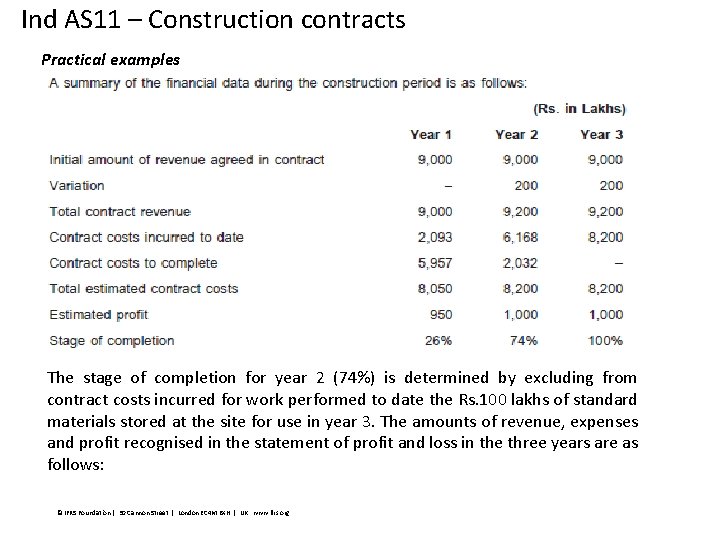
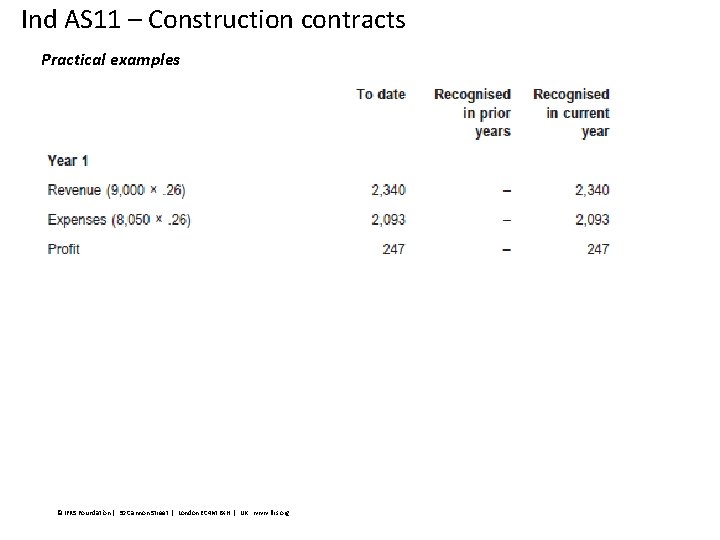
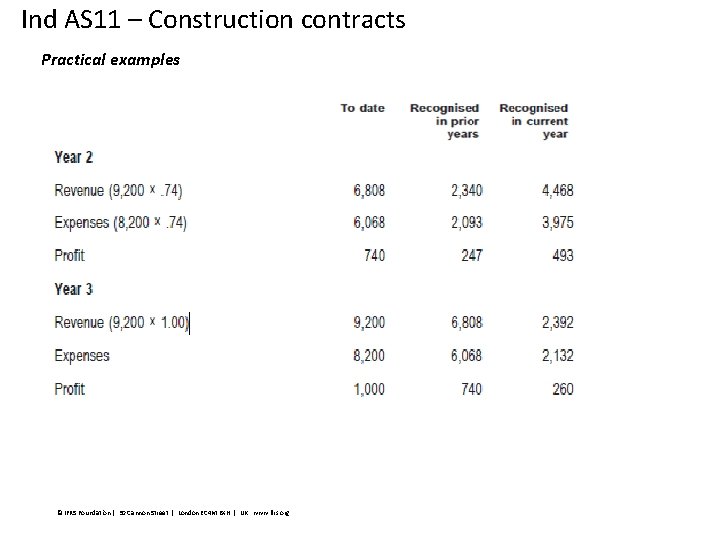
Ind AS 11 – Construction contracts Practical examples The stage of completion for year 2 (74%) is determined by excluding from contract costs incurred for work performed to date the Rs. 100 lakhs of standard materials stored at the site for use in year 3. The amounts of revenue, expenses and profit recognised in the statement of profit and loss in the three years are as follows: © IFRS Foundation | 30 Cannon Street | London EC 4 M 6 XH | UK. www. ifrs. org 15
Ind AS 11 – Construction contracts Practical examples © IFRS Foundation | 30 Cannon Street | London EC 4 M 6 XH | UK. www. ifrs. org 16
Ind AS 11 – Construction contracts Practical examples © IFRS Foundation | 30 Cannon Street | London EC 4 M 6 XH | UK. www. ifrs. org 17
Appendix A – Service concession arrangements Infrastructure for public services—such as roads, bridges, tunnels, prisons, hospitals, airports, water distribution facilities, energy supply and telecommunication networks Private sector participation in the development, financing, operation and maintenance of such infrastructure. The arrangement is governed by a contract that sets out performance standards, mechanisms for adjusting prices, and arrangements for arbitrating disputes. This Interpretation gives guidance on the accounting by operators for public‐to‐private service concession arrangements. © IFRS Foundation | 30 Cannon Street | London EC 4 M 6 XH | UK. www. ifrs. org 18
Appendix A – Service concession arrangements This Interpretation sets out general principles on recognising and measuring the obligations and related rights in service concession arrangements. The issues addressed in this Interpretation are: (a) treatment of the operator’s rights over the infrastructure; (b) recognition and measurement of arrangement consideration; (c) construction or upgrade services; (d) operation services; (e) borrowing costs; (f) subsequent accounting treatment of a financial asset and an intangible asset; and (g) items provided to the operator by the grantor. © IFRS Foundation | 30 Cannon Street | London EC 4 M 6 XH | UK. www. ifrs. org 19
Appendix A – Service concession arrangements Consensus : Infrastructure shall not be recognised as property, plant and equipment of the operator because the contractual service arrangement does not convey the right to control the use of the public service infrastructure to the operator. The grantor may also provide other items (other than PPE) to the operator that the operator can keep or deal with as it wishes. The operator shall recognise such assets at fair value on initial recognition. The operator shall recognise a liability in respect of unfulfilled obligations it has assumed in exchange for the assets. The operator shall recognise and measure revenue in accordance with IASs 11 and 18 for the services it performs. If the operator performs more than one service (ie construction or upgrade services and operation services) under a single contract or arrangement, consideration received or receivable shall be allocated by reference to the relative fair values of the services delivered, when the amounts are separately identifiable. The operator shall account for revenue and costs relating to construction or upgrade services in accordance with IAS 11. © IFRS Foundation | 30 Cannon Street | London EC 4 M 6 XH | UK. www. ifrs. org 20
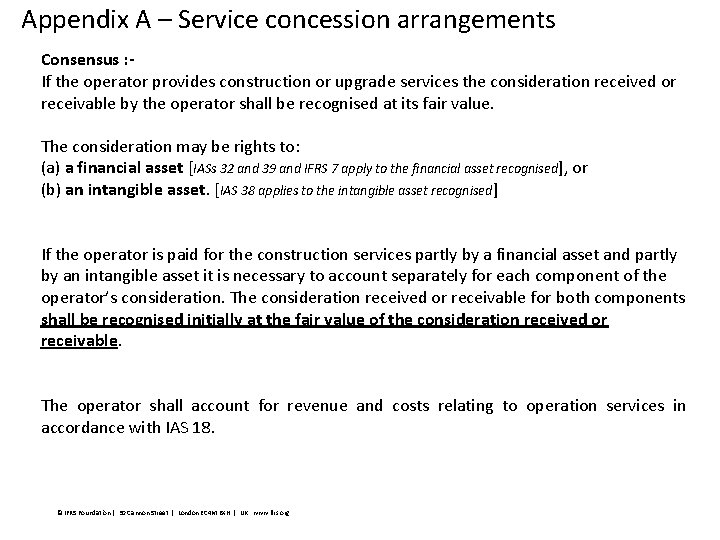
Appendix A – Service concession arrangements Consensus : If the operator provides construction or upgrade services the consideration received or receivable by the operator shall be recognised at its fair value. The consideration may be rights to: (a) a financial asset [IASs 32 and 39 and IFRS 7 apply to the financial asset recognised], or (b) an intangible asset. [IAS 38 applies to the intangible asset recognised] If the operator is paid for the construction services partly by a financial asset and partly by an intangible asset it is necessary to account separately for each component of the operator’s consideration. The consideration received or receivable for both components shall be recognised initially at the fair value of the consideration received or receivable. The operator shall account for revenue and costs relating to operation services in accordance with IAS 18. © IFRS Foundation | 30 Cannon Street | London EC 4 M 6 XH | UK. www. ifrs. org 21
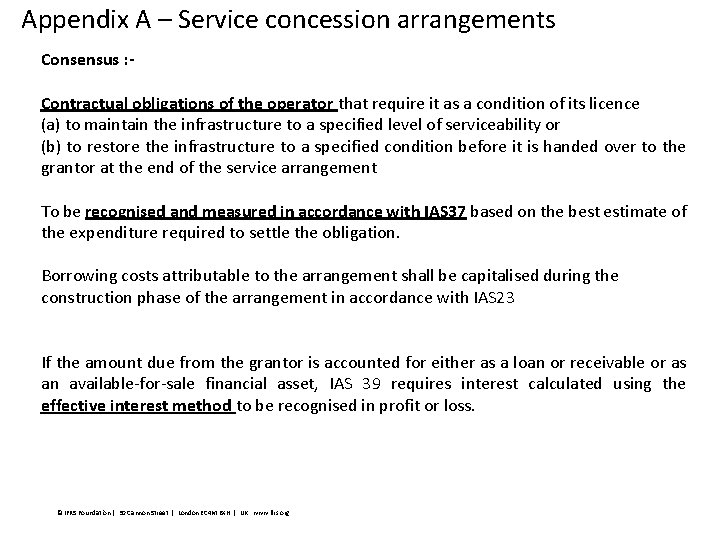
Appendix A – Service concession arrangements Consensus : Contractual obligations of the operator that require it as a condition of its licence (a) to maintain the infrastructure to a specified level of serviceability or (b) to restore the infrastructure to a specified condition before it is handed over to the grantor at the end of the service arrangement To be recognised and measured in accordance with IAS 37 based on the best estimate of the expenditure required to settle the obligation. Borrowing costs attributable to the arrangement shall be capitalised during the construction phase of the arrangement in accordance with IAS 23 If the amount due from the grantor is accounted for either as a loan or receivable or as an available‐for‐sale financial asset, IAS 39 requires interest calculated using the effective interest method to be recognised in profit or loss. © IFRS Foundation | 30 Cannon Street | London EC 4 M 6 XH | UK. www. ifrs. org 22
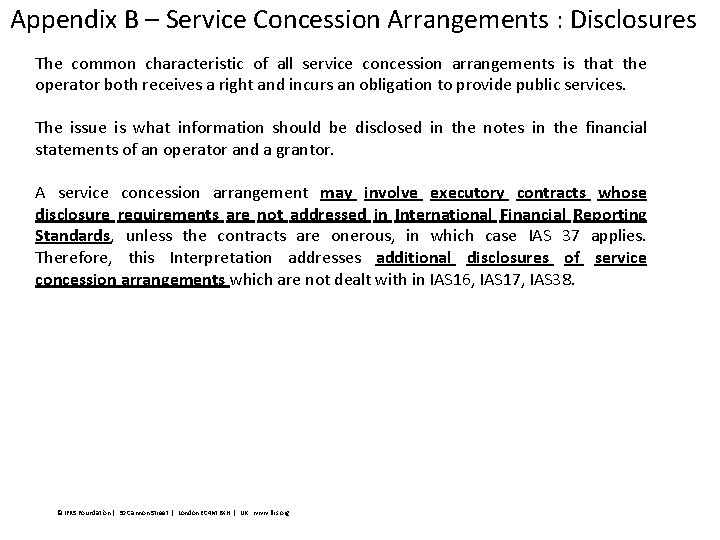
Appendix B – Service Concession Arrangements : Disclosures The common characteristic of all service concession arrangements is that the operator both receives a right and incurs an obligation to provide public services. The issue is what information should be disclosed in the notes in the financial statements of an operator and a grantor. A service concession arrangement may involve executory contracts whose disclosure requirements are not addressed in International Financial Reporting Standards, unless the contracts are onerous, in which case IAS 37 applies. Therefore, this Interpretation addresses additional disclosures of service concession arrangements which are not dealt with in IAS 16, IAS 17, IAS 38. © IFRS Foundation | 30 Cannon Street | London EC 4 M 6 XH | UK. www. ifrs. org 23
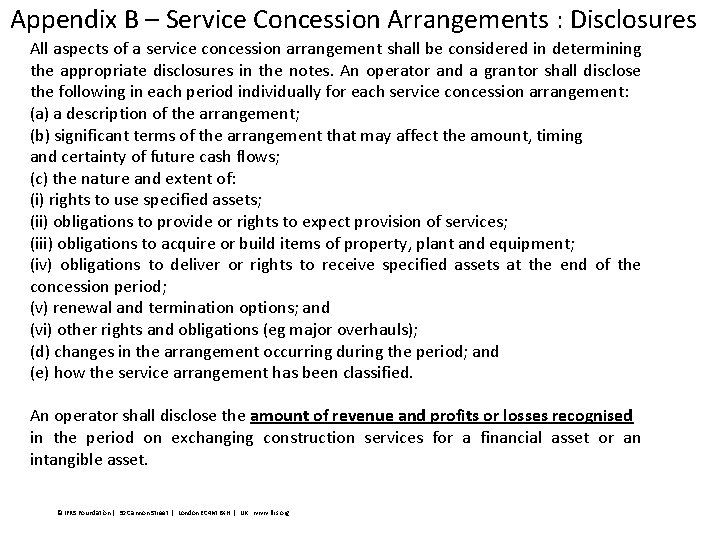
Appendix B – Service Concession Arrangements : Disclosures All aspects of a service concession arrangement shall be considered in determining the appropriate disclosures in the notes. An operator and a grantor shall disclose the following in each period individually for each service concession arrangement: (a) a description of the arrangement; (b) significant terms of the arrangement that may affect the amount, timing and certainty of future cash flows; (c) the nature and extent of: (i) rights to use specified assets; (ii) obligations to provide or rights to expect provision of services; (iii) obligations to acquire or build items of property, plant and equipment; (iv) obligations to deliver or rights to receive specified assets at the end of the concession period; (v) renewal and termination options; and (vi) other rights and obligations (eg major overhauls); (d) changes in the arrangement occurring during the period; and (e) how the service arrangement has been classified. An operator shall disclose the amount of revenue and profits or losses recognised in the period on exchanging construction services for a financial asset or an intangible asset. © IFRS Foundation | 30 Cannon Street | London EC 4 M 6 XH | UK. www. ifrs. org 24
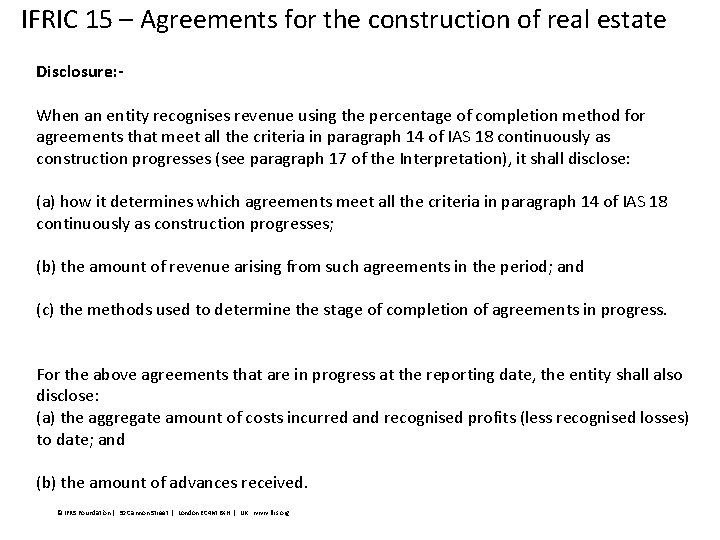
IFRIC 15 – Agreements for the construction of real estate Disclosure: When an entity recognises revenue using the percentage of completion method for agreements that meet all the criteria in paragraph 14 of IAS 18 continuously as construction progresses (see paragraph 17 of the Interpretation), it shall disclose: (a) how it determines which agreements meet all the criteria in paragraph 14 of IAS 18 continuously as construction progresses; (b) the amount of revenue arising from such agreements in the period; and (c) the methods used to determine the stage of completion of agreements in progress. For the above agreements that are in progress at the reporting date, the entity shall also disclose: (a) the aggregate amount of costs incurred and recognised profits (less recognised losses) to date; and (b) the amount of advances received. © IFRS Foundation | 30 Cannon Street | London EC 4 M 6 XH | UK. www. ifrs. org 25
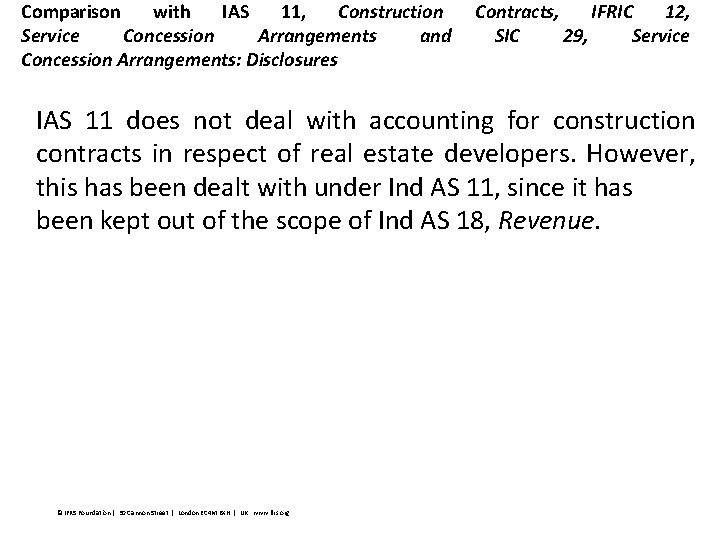
Comparison with IAS 11, Construction Service Concession Arrangements and Concession Arrangements: Disclosures Contracts, IFRIC 12, SIC 29, Service IAS 11 does not deal with accounting for construction contracts in respect of real estate developers. However, this has been dealt with under Ind AS 11, since it has been kept out of the scope of Ind AS 18, Revenue. © IFRS Foundation | 30 Cannon Street | London EC 4 M 6 XH | UK. www. ifrs. org 26
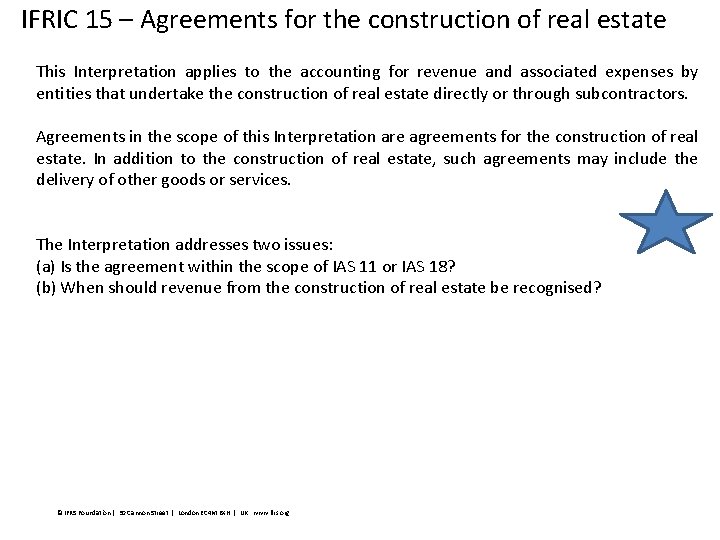
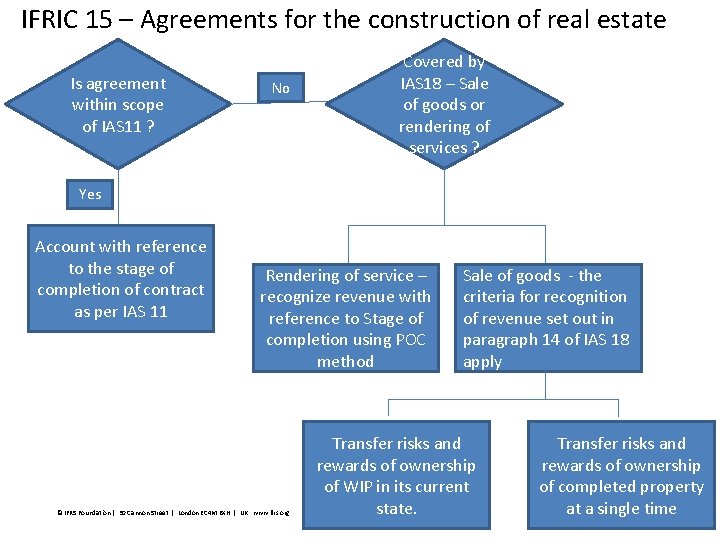
IFRIC 15 – Agreements for the construction of real estate This Interpretation applies to the accounting for revenue and associated expenses by entities that undertake the construction of real estate directly or through subcontractors. Agreements in the scope of this Interpretation are agreements for the construction of real estate. In addition to the construction of real estate, such agreements may include the delivery of other goods or services. The Interpretation addresses two issues: (a) Is the agreement within the scope of IAS 11 or IAS 18? (b) When should revenue from the construction of real estate be recognised? © IFRS Foundation | 30 Cannon Street | London EC 4 M 6 XH | UK. www. ifrs. org 27
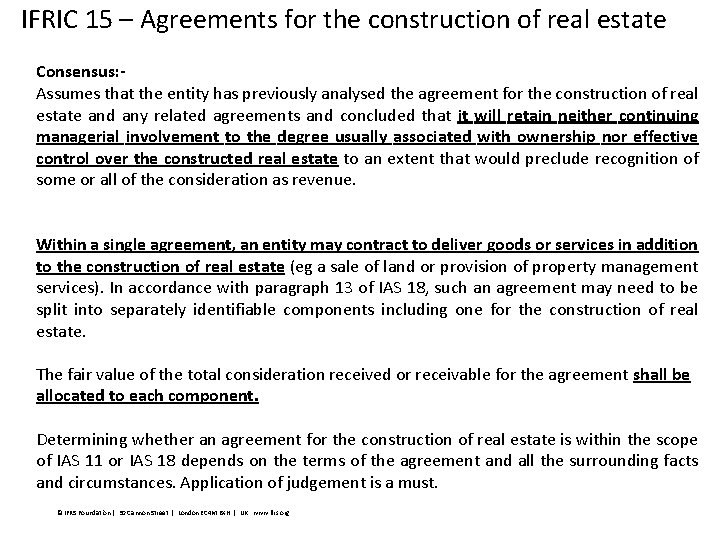
IFRIC 15 – Agreements for the construction of real estate Consensus: Assumes that the entity has previously analysed the agreement for the construction of real estate and any related agreements and concluded that it will retain neither continuing managerial involvement to the degree usually associated with ownership nor effective control over the constructed real estate to an extent that would preclude recognition of some or all of the consideration as revenue. Within a single agreement, an entity may contract to deliver goods or services in addition to the construction of real estate (eg a sale of land or provision of property management services). In accordance with paragraph 13 of IAS 18, such an agreement may need to be split into separately identifiable components including one for the construction of real estate. The fair value of the total consideration received or receivable for the agreement shall be allocated to each component. Determining whether an agreement for the construction of real estate is within the scope of IAS 11 or IAS 18 depends on the terms of the agreement and all the surrounding facts and circumstances. Application of judgement is a must. © IFRS Foundation | 30 Cannon Street | London EC 4 M 6 XH | UK. www. ifrs. org 28
IFRIC 15 – Agreements for the construction of real estate Consensus: IAS 11 applies when the agreement meets the definition of a construction contract set out in paragraph 3 of IAS 11 An agreement for the construction of real estate meets the definition of a construction contract when the buyer is able to specify the major structural elements of the design of the real estate before construction begins and/or specify major structural changes once construction is in progress (whether or not it exercises that ability). When IAS 11 applies, the construction contract also includes any contracts or components for the rendering of services that are directly related to the construction of the real estate in accordance with paragraph 5(a) of IAS 11 and paragraph 4 of IAS 18. In contrast, an agreement for the construction of real estate in which buyers have only limited ability to influence the design of the real estate, eg to select a design from a range of options specified by the entity, or to specify only minor variations to the basic design, is an agreement for the sale of goods within the scope of IAS 18. © IFRS Foundation | 30 Cannon Street | London EC 4 M 6 XH | UK. www. ifrs. org 29
IFRIC 15 – Agreements for the construction of real estate Is agreement within scope of IAS 11 ? No Covered by IAS 18 – Sale of goods or rendering of services ? Yes Account with reference to the stage of completion of contract as per IAS 11 Rendering of service – recognize revenue with reference to Stage of completion using POC method © IFRS Foundation | 30 Cannon Street | London EC 4 M 6 XH | UK. www. ifrs. org Sale of goods ‐ the criteria for recognition of revenue set out in paragraph 14 of IAS 18 apply Transfer risks and rewards of ownership of WIP in its current 30 state. Transfer risks and rewards of ownership of completed property at a single time
Ind AS 18 Revenue
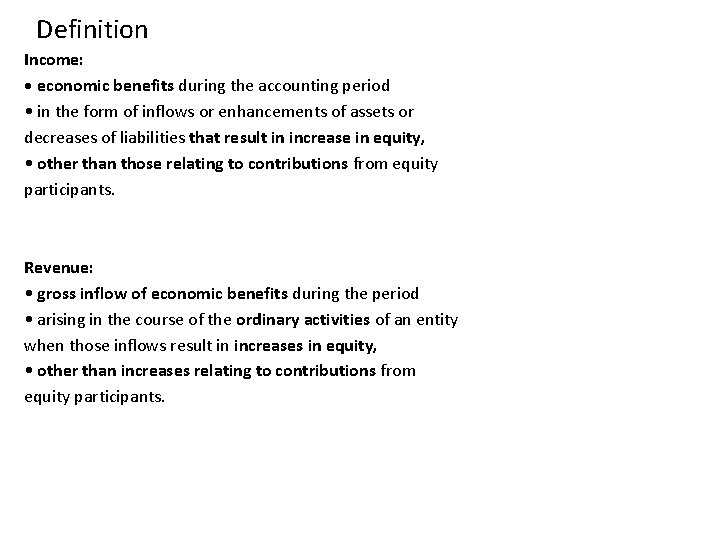
Definition Income: • economic benefits during the accounting period • in the form of inflows or enhancements of assets or decreases of liabilities that result in increase in equity, • other than those relating to contributions from equity participants. Revenue: • gross inflow of economic benefits during the period • arising in the course of the ordinary activities of an entity when those inflows result in increases in equity, • other than increases relating to contributions from equity participants.
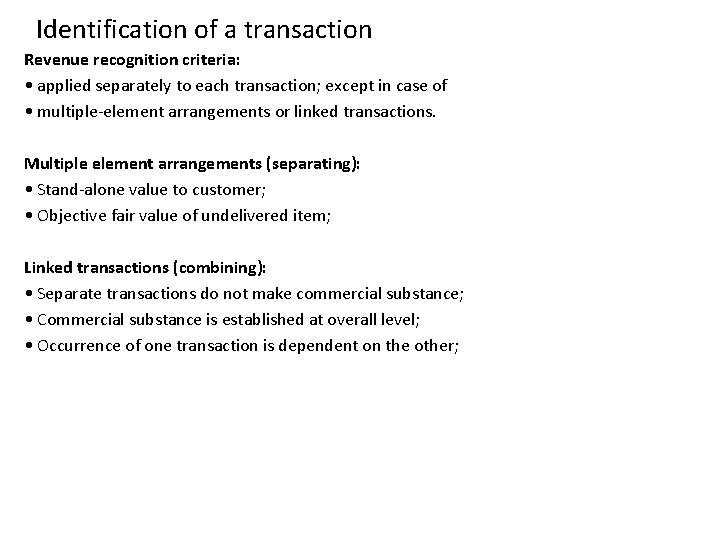
Identification of a transaction Revenue recognition criteria: • applied separately to each transaction; except in case of • multiple‐element arrangements or linked transactions. Multiple element arrangements (separating): • Stand‐alone value to customer; • Objective fair value of undelivered item; Linked transactions (combining): • Separate transactions do not make commercial substance; • Commercial substance is established at overall level; • Occurrence of one transaction is dependent on the other;
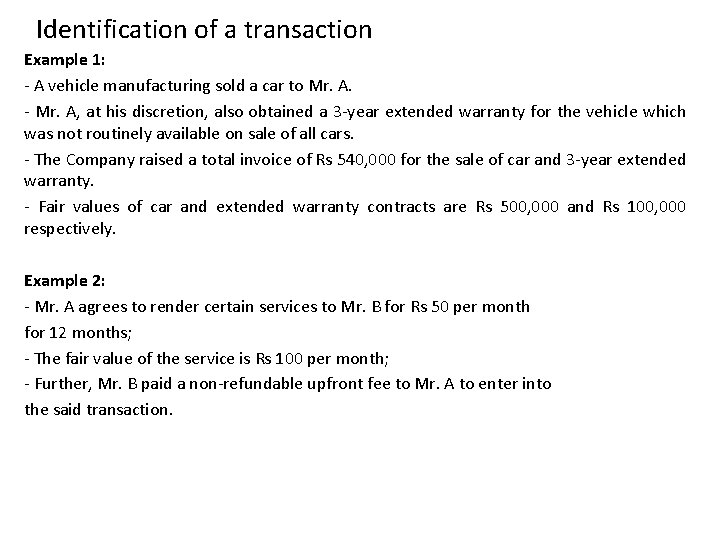
Identification of a transaction Example 1: ‐ A vehicle manufacturing sold a car to Mr. A. ‐ Mr. A, at his discretion, also obtained a 3‐year extended warranty for the vehicle which was not routinely available on sale of all cars. ‐ The Company raised a total invoice of Rs 540, 000 for the sale of car and 3‐year extended warranty. ‐ Fair values of car and extended warranty contracts are Rs 500, 000 and Rs 100, 000 respectively. Example 2: ‐ Mr. A agrees to render certain services to Mr. B for Rs 50 per month for 12 months; ‐ The fair value of the service is Rs 100 per month; ‐ Further, Mr. B paid a non‐refundable upfront fee to Mr. A to enter into the said transaction.
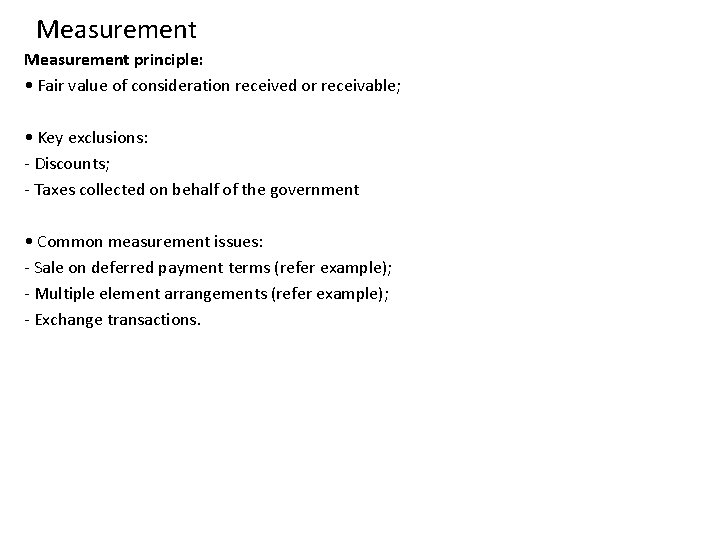
Measurement principle: • Fair value of consideration received or receivable; • Key exclusions: ‐ Discounts; ‐ Taxes collected on behalf of the government • Common measurement issues: ‐ Sale on deferred payment terms (refer example); ‐ Multiple element arrangements (refer example); ‐ Exchange transactions.
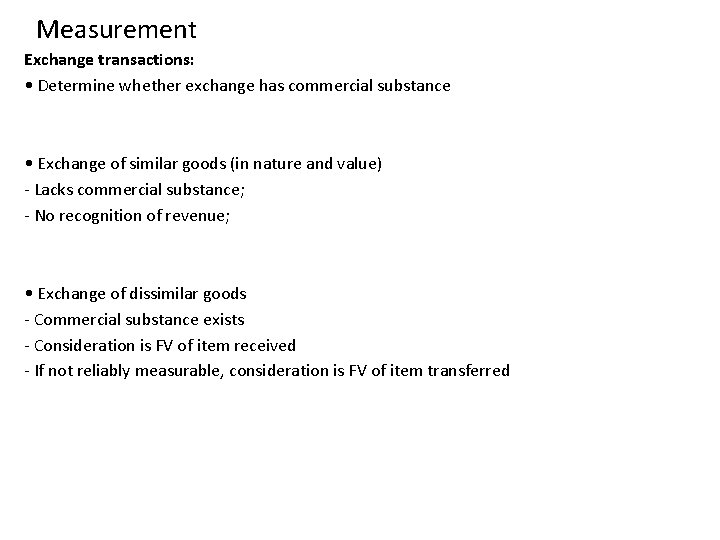
Measurement Exchange transactions: • Determine whether exchange has commercial substance • Exchange of similar goods (in nature and value) ‐ Lacks commercial substance; ‐ No recognition of revenue; • Exchange of dissimilar goods ‐ Commercial substance exists ‐ Consideration is FV of item received ‐ If not reliably measurable, consideration is FV of item transferred
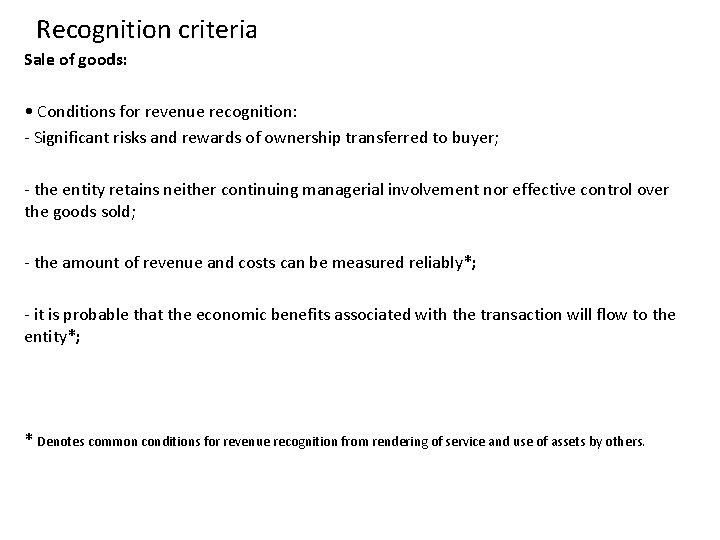
Recognition criteria Sale of goods: • Conditions for revenue recognition: ‐ Significant risks and rewards of ownership transferred to buyer; ‐ the entity retains neither continuing managerial involvement nor effective control over the goods sold; ‐ the amount of revenue and costs can be measured reliably*; ‐ it is probable that the economic benefits associated with the transaction will flow to the entity*; * Denotes common conditions for revenue recognition from rendering of service and use of assets by others.
Recognition criteria Transfer of significant risks and rewards: • Usually transferred with transfer of title to goods; • Insignificant risks and rewards may be retained. Examples: significant risks and rewards are retained: • Obligation for unsatisfactory performance not covered by normal warranty provisions; • Sale contingent on the buyer making an onward sale; • Shipping of goods subject to a significant installation process, which is to be delivered. Examples when insignificant risks and rewards are retained: • Transfer of legal title only on collection; • Buyer’s right to return goods.
Recognition criteria Continuing managerial involvement and control: Bill and hold sales: • delivery of goods is probable; • the item is on hand, identified and ready for delivery; • buyer acknowledges the deferred delivery instructions; and • the usual payment terms apply. Revenue is recognised when the buyer takes title to goods.
Recognition criteria Rendering of services: • Conditions for revenue recognition: ‐the stage of completion of the transaction at the end of the reporting period can be measured reliably; ‐ the amount of revenue and costs can be measured reliably*; ‐ it is probable that the economic benefits associated with the transaction will flow to the entity*; * Denotes common conditions for revenue recognition from rendering of service and use of assets by others. • Revenue recognition based on the stage of completion (percentage of completion (POC) method)
Recognition criteria Reliable measurement of stage of completion: • Methods include: ‐ Work surveys ‐ Services to date to total services ‐ Costs incurred to total costs • Measurement of stage of completion: >Reliable: recognise revenue as services rendered (POC method) > Not reliable: recognise revenue to the extent of recoverable costs incurred
Recognition criteria Examples: ‐ • Installation fees: Over the period of installation based on stage of completion • Subscription: Straight‐line basis • Training fees: when training is provided
Recognition criteria Interest, royalties and dividend: • Conditions: ‐ Flow of economic benefits to the entity is probable ‐ Reliable measurement • Basis for revenue recognition: ‐ Interest based on effective interest rate (EIR) ‐ Royalty on accrual basis based on substance of arrangement ‐ Dividend based on holder’s right to receive is established
Disclosure Consensus: • Accounting policies • Methods to determine the stage of completion • Revenue by category ‐ Sale of goods ‐ Rendering of services ‐ Interest ‐ Royalties ‐ Dividends
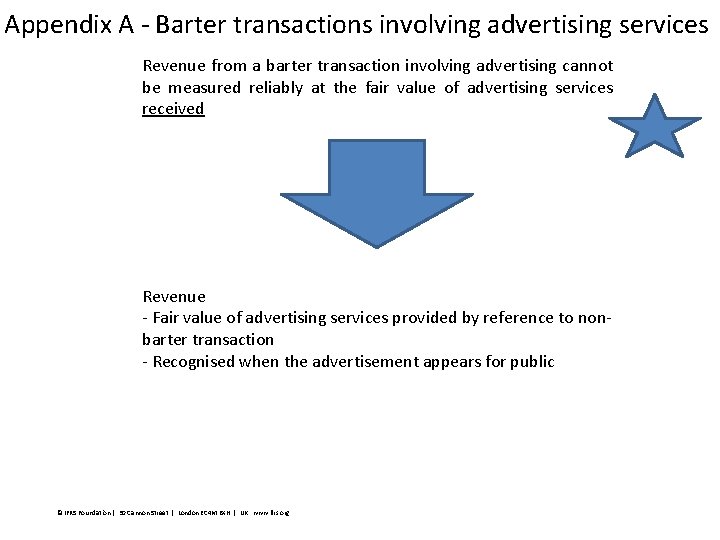
Appendix A ‐ Barter transactions involving advertising services Revenue from a barter transaction involving advertising cannot be measured reliably at the fair value of advertising services received Revenue ‐ Fair value of advertising services provided by reference to non‐ barter transaction ‐ Recognised when the advertisement appears for public © IFRS Foundation | 30 Cannon Street | London EC 4 M 6 XH | UK. www. ifrs. org 45
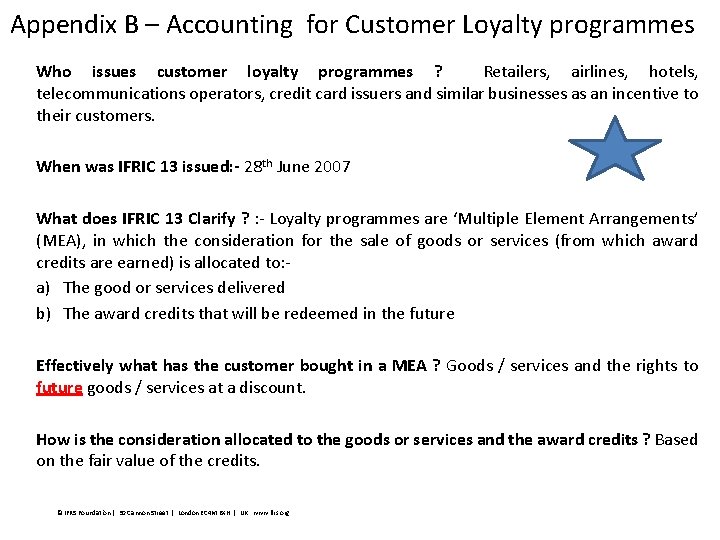
Appendix B – Accounting for Customer Loyalty programmes Who issues customer loyalty programmes ? Retailers, airlines, hotels, telecommunications operators, credit card issuers and similar businesses as an incentive to their customers. When was IFRIC 13 issued: - 28 th June 2007 What does IFRIC 13 Clarify ? : ‐ Loyalty programmes are ‘Multiple Element Arrangements’ (MEA), in which the consideration for the sale of goods or services (from which award credits are earned) is allocated to: ‐ a) The good or services delivered b) The award credits that will be redeemed in the future Effectively what has the customer bought in a MEA ? Goods / services and the rights to future goods / services at a discount. How is the consideration allocated to the goods or services and the award credits ? Based on the fair value of the credits. © IFRS Foundation | 30 Cannon Street | London EC 4 M 6 XH | UK. www. ifrs. org 46
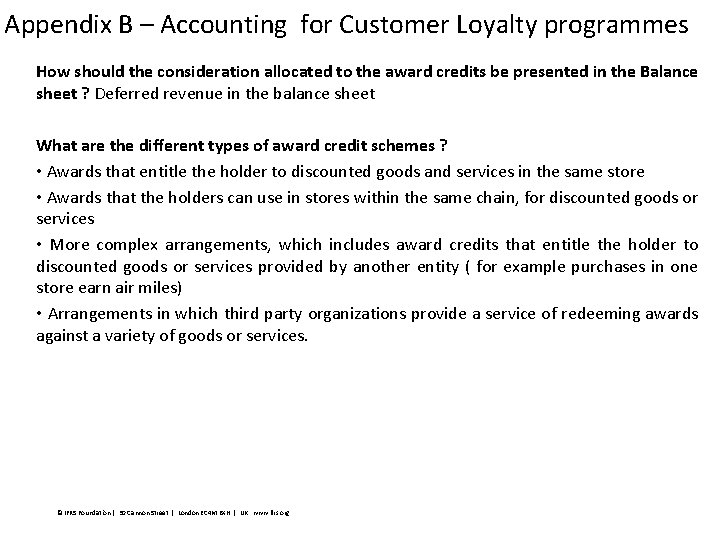
Appendix B – Accounting for Customer Loyalty programmes How should the consideration allocated to the award credits be presented in the Balance sheet ? Deferred revenue in the balance sheet What are the different types of award credit schemes ? • Awards that entitle the holder to discounted goods and services in the same store • Awards that the holders can use in stores within the same chain, for discounted goods or services • More complex arrangements, which includes award credits that entitle the holder to discounted goods or services provided by another entity ( for example purchases in one store earn air miles) • Arrangements in which third party organizations provide a service of redeeming awards against a variety of goods or services. © IFRS Foundation | 30 Cannon Street | London EC 4 M 6 XH | UK. www. ifrs. org 47
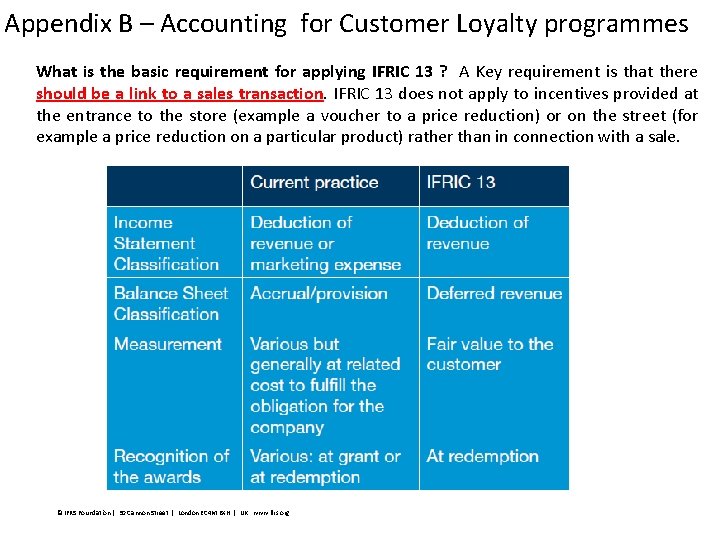
Appendix B – Accounting for Customer Loyalty programmes What is the basic requirement for applying IFRIC 13 ? A Key requirement is that there should be a link to a sales transaction. IFRIC 13 does not apply to incentives provided at the entrance to the store (example a voucher to a price reduction) or on the street (for example a price reduction on a particular product) rather than in connection with a sale. © IFRS Foundation | 30 Cannon Street | London EC 4 M 6 XH | UK. www. ifrs. org 48
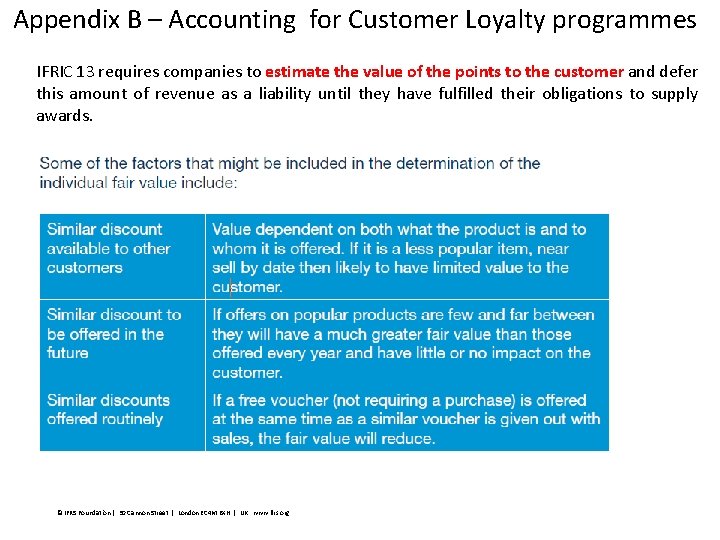
Appendix B – Accounting for Customer Loyalty programmes IFRIC 13 requires companies to estimate the value of the points to the customer and defer this amount of revenue as a liability until they have fulfilled their obligations to supply awards. © IFRS Foundation | 30 Cannon Street | London EC 4 M 6 XH | UK. www. ifrs. org 49
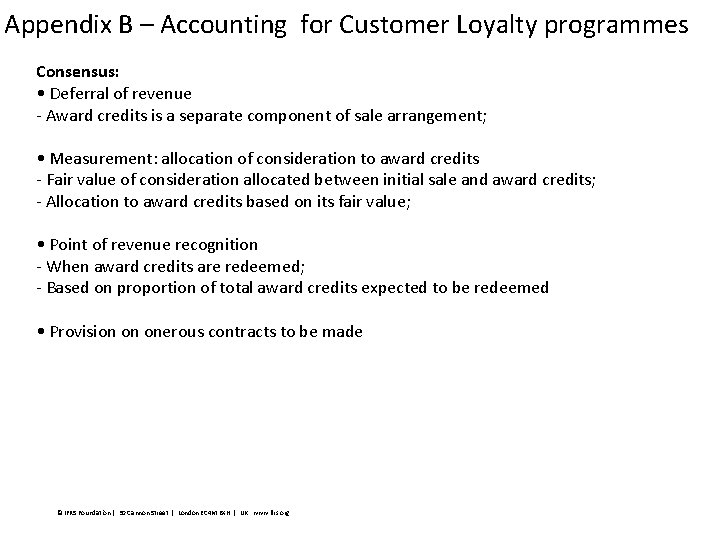
Appendix B – Accounting for Customer Loyalty programmes Consensus: • Deferral of revenue ‐ Award credits is a separate component of sale arrangement; • Measurement: allocation of consideration to award credits ‐ Fair value of consideration allocated between initial sale and award credits; ‐ Allocation to award credits based on its fair value; • Point of revenue recognition ‐ When award credits are redeemed; ‐ Based on proportion of total award credits expected to be redeemed • Provision on onerous contracts to be made © IFRS Foundation | 30 Cannon Street | London EC 4 M 6 XH | UK. www. ifrs. org 50
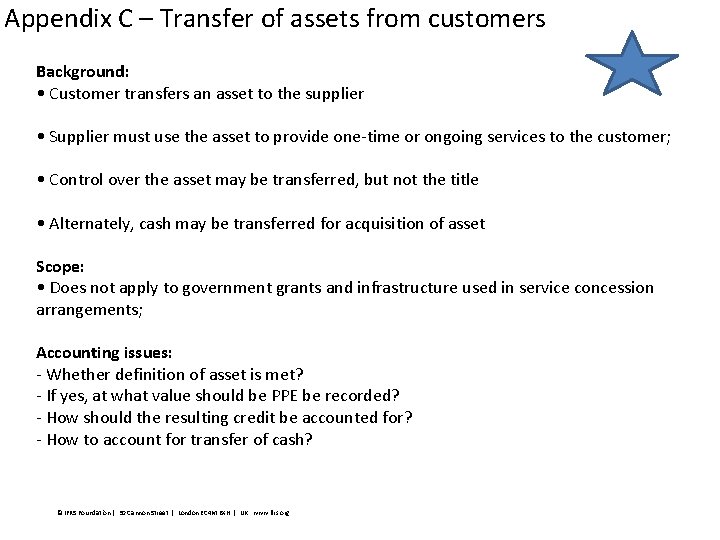
Appendix C – Transfer of assets from customers Background: • Customer transfers an asset to the supplier • Supplier must use the asset to provide one‐time or ongoing services to the customer; • Control over the asset may be transferred, but not the title • Alternately, cash may be transferred for acquisition of asset Scope: • Does not apply to government grants and infrastructure used in service concession arrangements; Accounting issues: ‐ Whether definition of asset is met? ‐ If yes, at what value should be PPE be recorded? ‐ How should the resulting credit be accounted for? ‐ How to account for transfer of cash? © IFRS Foundation | 30 Cannon Street | London EC 4 M 6 XH | UK. www. ifrs. org 51
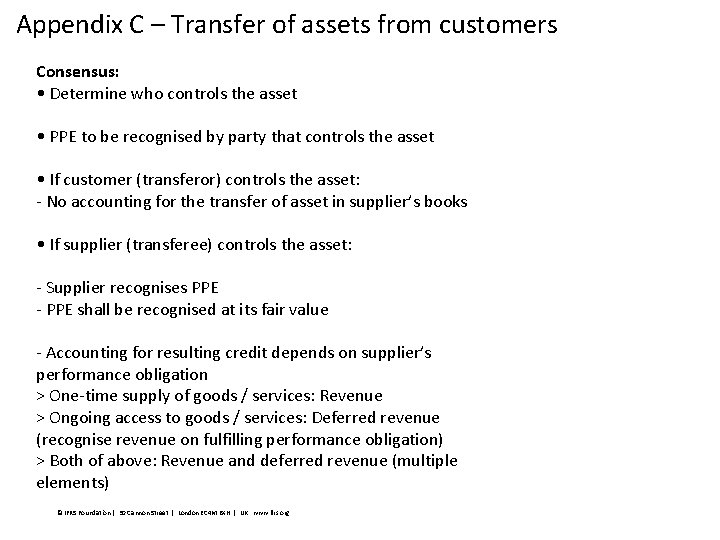
Appendix C – Transfer of assets from customers Consensus: • Determine who controls the asset • PPE to be recognised by party that controls the asset • If customer (transferor) controls the asset: ‐ No accounting for the transfer of asset in supplier’s books • If supplier (transferee) controls the asset: ‐ Supplier recognises PPE ‐ PPE shall be recognised at its fair value ‐ Accounting for resulting credit depends on supplier’s performance obligation > One‐time supply of goods / services: Revenue > Ongoing access to goods / services: Deferred revenue (recognise revenue on fulfilling performance obligation) > Both of above: Revenue and deferred revenue (multiple elements) © IFRS Foundation | 30 Cannon Street | London EC 4 M 6 XH | UK. www. ifrs. org 52
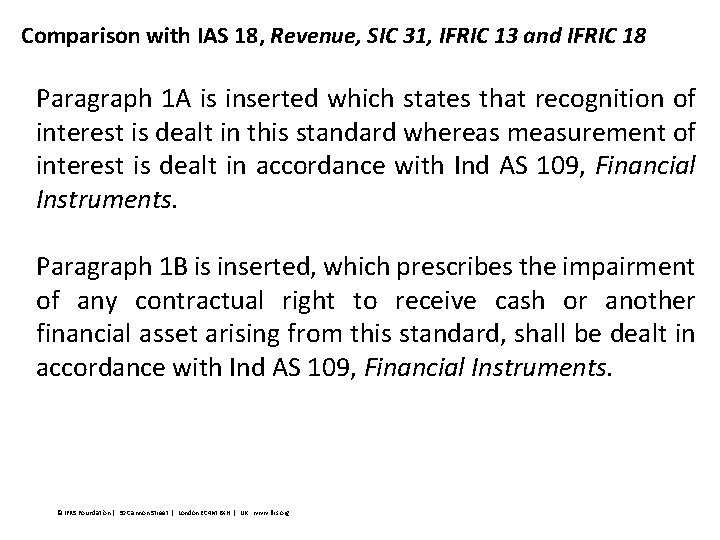
Comparison with IAS 18, Revenue, SIC 31, IFRIC 13 and IFRIC 18 Paragraph 1 A is inserted which states that recognition of interest is dealt in this standard whereas measurement of interest is dealt in accordance with Ind AS 109, Financial Instruments. Paragraph 1 B is inserted, which prescribes the impairment of any contractual right to receive cash or another financial asset arising from this standard, shall be dealt in accordance with Ind AS 109, Financial Instruments. © IFRS Foundation | 30 Cannon Street | London EC 4 M 6 XH | UK. www. ifrs. org 53
IND AS 101: - First Time Adoption of Indian Accounting Standards
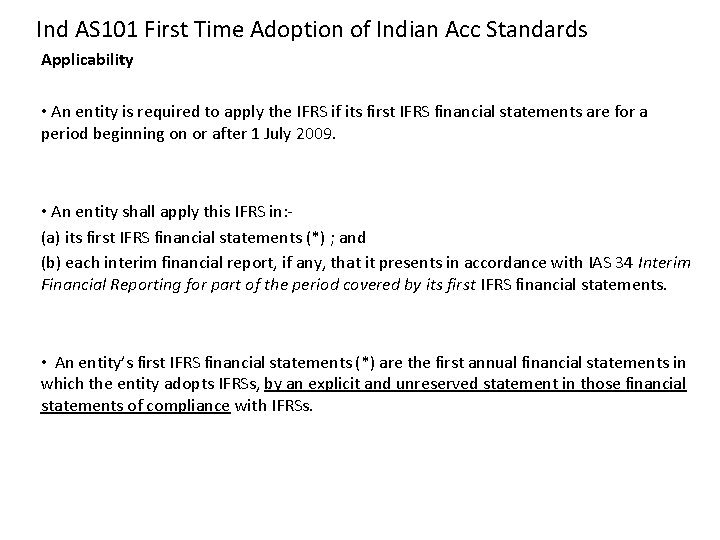
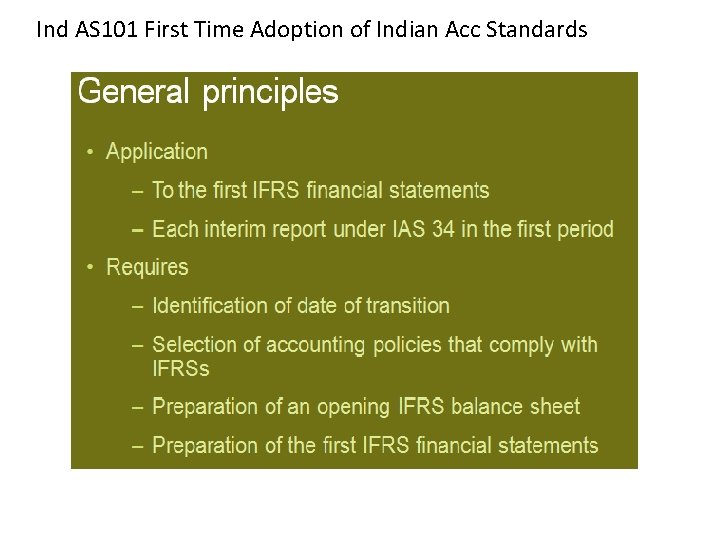
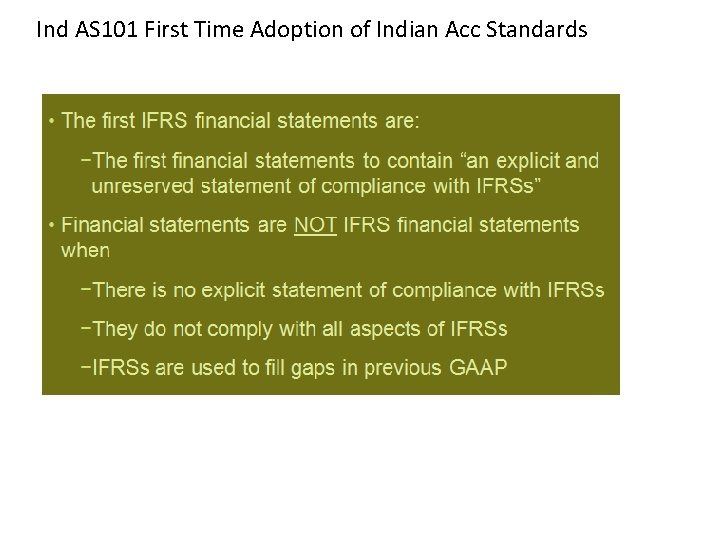
Ind AS 101 First Time Adoption of Indian Acc Standards Applicability • An entity is required to apply the IFRS if its first IFRS financial statements are for a period beginning on or after 1 July 2009. • An entity shall apply this IFRS in: ‐ (a) its first IFRS financial statements (*) ; and (b) each interim financial report, if any, that it presents in accordance with IAS 34 Interim Financial Reporting for part of the period covered by its first IFRS financial statements. • An entity’s first IFRS financial statements (*) are the first annual financial statements in which the entity adopts IFRSs, by an explicit and unreserved statement in those financial statements of compliance with IFRSs.
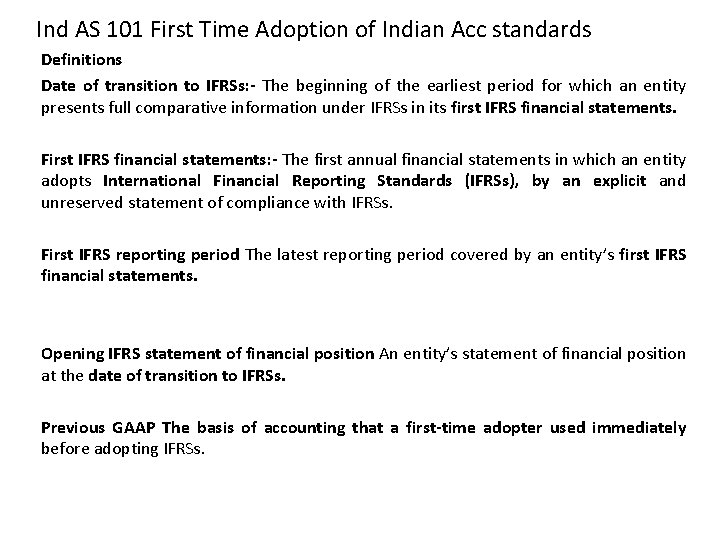
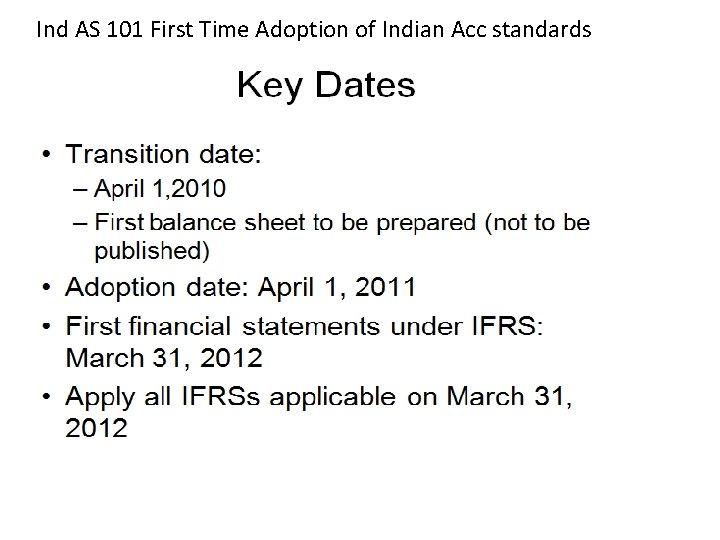
Ind AS 101 First Time Adoption of Indian Acc standards Definitions Date of transition to IFRSs: - The beginning of the earliest period for which an entity presents full comparative information under IFRSs in its first IFRS financial statements. First IFRS financial statements: - The first annual financial statements in which an entity adopts International Financial Reporting Standards (IFRSs), by an explicit and unreserved statement of compliance with IFRSs. First IFRS reporting period The latest reporting period covered by an entity’s first IFRS financial statements. Opening IFRS statement of financial position An entity’s statement of financial position at the date of transition to IFRSs. Previous GAAP The basis of accounting that a first-time adopter used immediately before adopting IFRSs.
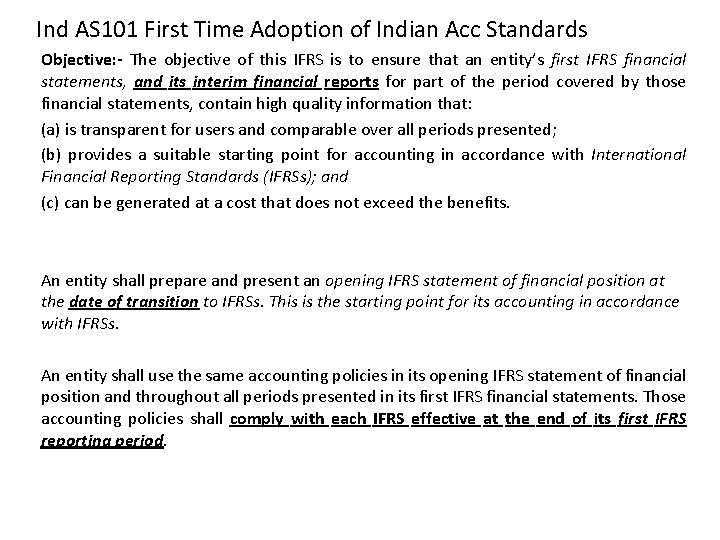
Ind AS 101 First Time Adoption of Indian Acc Standards Objective: - The objective of this IFRS is to ensure that an entity’s first IFRS financial statements, and its interim financial reports for part of the period covered by those financial statements, contain high quality information that: (a) is transparent for users and comparable over all periods presented; (b) provides a suitable starting point for accounting in accordance with International Financial Reporting Standards (IFRSs); and (c) can be generated at a cost that does not exceed the benefits. An entity shall prepare and present an opening IFRS statement of financial position at the date of transition to IFRSs. This is the starting point for its accounting in accordance with IFRSs. An entity shall use the same accounting policies in its opening IFRS statement of financial position and throughout all periods presented in its first IFRS financial statements. Those accounting policies shall comply with each IFRS effective at the end of its first IFRS reporting period.
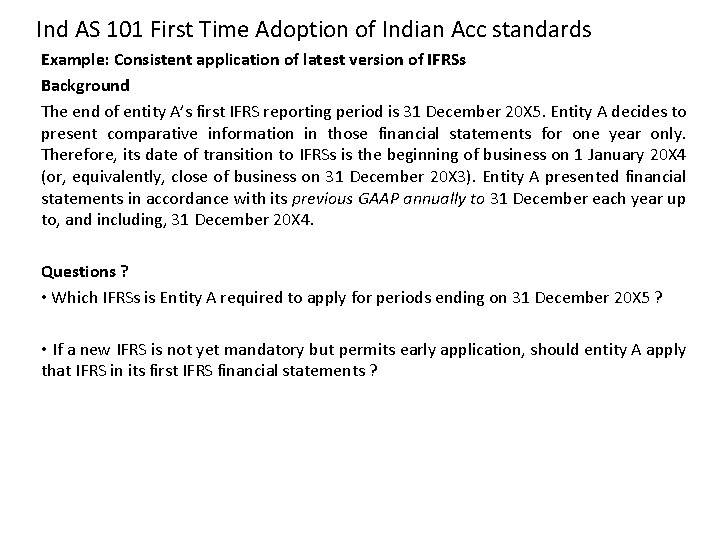
Ind AS 101 First Time Adoption of Indian Acc standards Example: Consistent application of latest version of IFRSs Background The end of entity A’s first IFRS reporting period is 31 December 20 X 5. Entity A decides to present comparative information in those financial statements for one year only. Therefore, its date of transition to IFRSs is the beginning of business on 1 January 20 X 4 (or, equivalently, close of business on 31 December 20 X 3). Entity A presented financial statements in accordance with its previous GAAP annually to 31 December each year up to, and including, 31 December 20 X 4. Questions ? • Which IFRSs is Entity A required to apply for periods ending on 31 December 20 X 5 ? • If a new IFRS is not yet mandatory but permits early application, should entity A apply that IFRS in its first IFRS financial statements ?
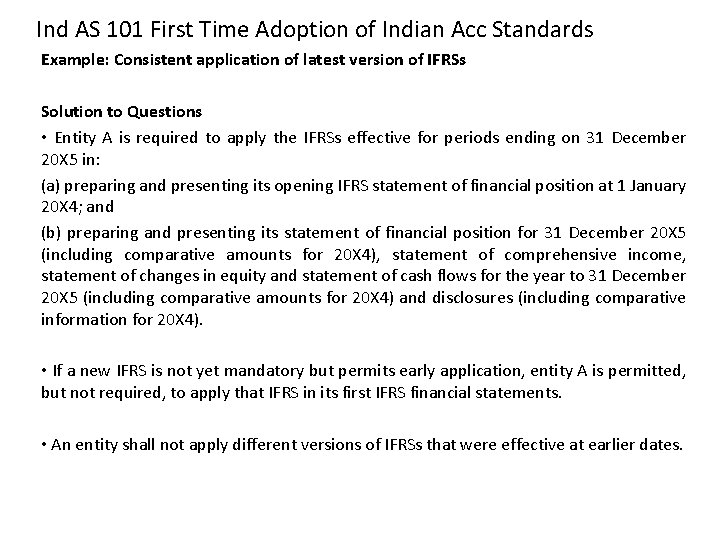
Ind AS 101 First Time Adoption of Indian Acc Standards Example: Consistent application of latest version of IFRSs Solution to Questions • Entity A is required to apply the IFRSs effective for periods ending on 31 December 20 X 5 in: (a) preparing and presenting its opening IFRS statement of financial position at 1 January 20 X 4; and (b) preparing and presenting its statement of financial position for 31 December 20 X 5 (including comparative amounts for 20 X 4), statement of comprehensive income, statement of changes in equity and statement of cash flows for the year to 31 December 20 X 5 (including comparative amounts for 20 X 4) and disclosures (including comparative information for 20 X 4). • If a new IFRS is not yet mandatory but permits early application, entity A is permitted, but not required, to apply that IFRS in its first IFRS financial statements. • An entity shall not apply different versions of IFRSs that were effective at earlier dates.
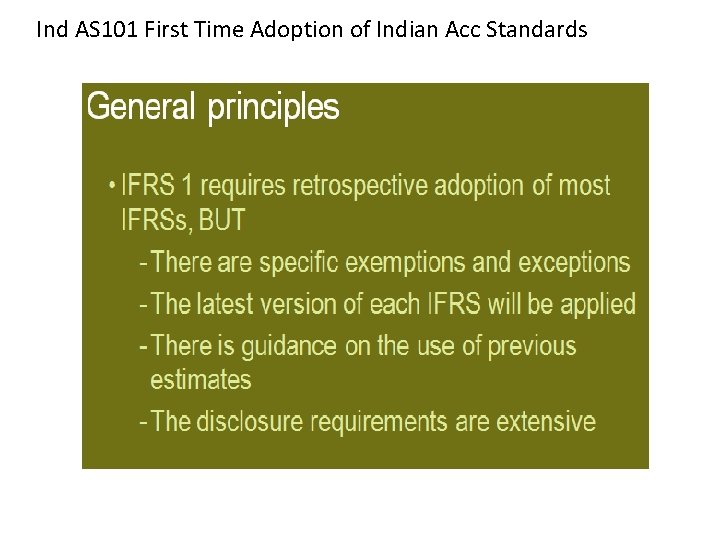
Ind AS 101 First Time Adoption of Indian Acc standards
Ind AS 101 First Time Adoption of Indian Acc Standards
Ind AS 101 First Time Adoption of Indian Acc Standards
Ind AS 101 First Time Adoption of Indian Acc Standards
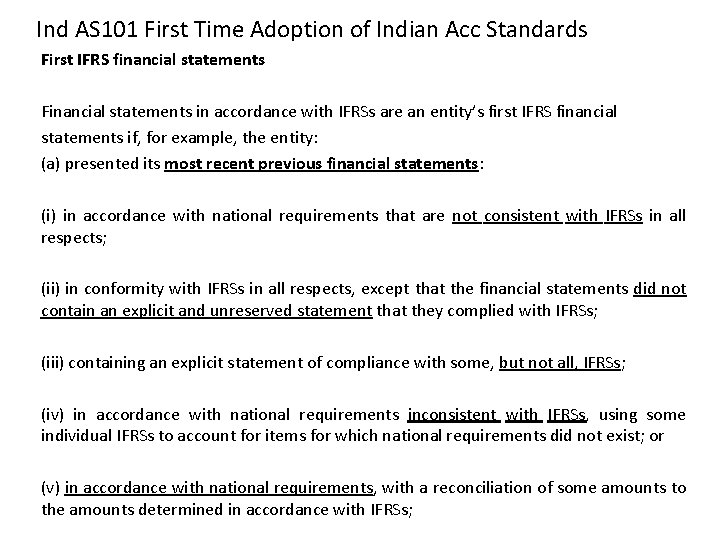
Ind AS 101 First Time Adoption of Indian Acc Standards First IFRS financial statements Financial statements in accordance with IFRSs are an entity’s first IFRS financial statements if, for example, the entity: (a) presented its most recent previous financial statements: (i) in accordance with national requirements that are not consistent with IFRSs in all respects; (ii) in conformity with IFRSs in all respects, except that the financial statements did not contain an explicit and unreserved statement that they complied with IFRSs; (iii) containing an explicit statement of compliance with some, but not all, IFRSs; (iv) in accordance with national requirements inconsistent with IFRSs, using some individual IFRSs to account for items for which national requirements did not exist; or (v) in accordance with national requirements, with a reconciliation of some amounts to the amounts determined in accordance with IFRSs;
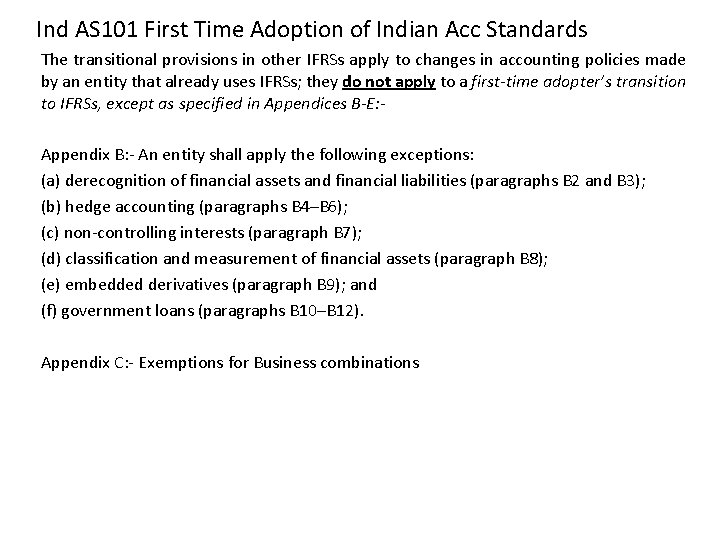
Ind AS 101 First Time Adoption of Indian Acc Standards The transitional provisions in other IFRSs apply to changes in accounting policies made by an entity that already uses IFRSs; they do not apply to a first-time adopter’s transition to IFRSs, except as specified in Appendices B-E: Appendix B: ‐ An entity shall apply the following exceptions: (a) derecognition of financial assets and financial liabilities (paragraphs B 2 and B 3); (b) hedge accounting (paragraphs B 4–B 6); (c) non‐controlling interests (paragraph B 7); (d) classification and measurement of financial assets (paragraph B 8); (e) embedded derivatives (paragraph B 9); and (f) government loans (paragraphs B 10–B 12). Appendix C: ‐ Exemptions for Business combinations
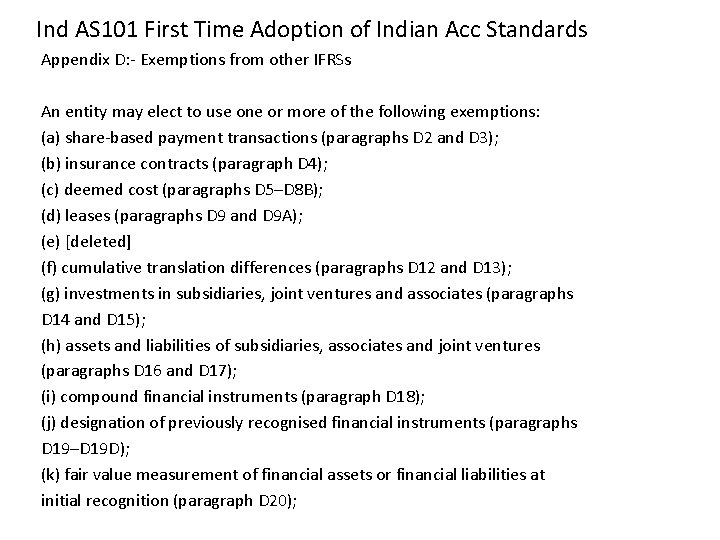
Ind AS 101 First Time Adoption of Indian Acc Standards Appendix D: ‐ Exemptions from other IFRSs An entity may elect to use one or more of the following exemptions: (a) share‐based payment transactions (paragraphs D 2 and D 3); (b) insurance contracts (paragraph D 4); (c) deemed cost (paragraphs D 5–D 8 B); (d) leases (paragraphs D 9 and D 9 A); (e) [deleted] (f) cumulative translation differences (paragraphs D 12 and D 13); (g) investments in subsidiaries, joint ventures and associates (paragraphs D 14 and D 15); (h) assets and liabilities of subsidiaries, associates and joint ventures (paragraphs D 16 and D 17); (i) compound financial instruments (paragraph D 18); (j) designation of previously recognised financial instruments (paragraphs D 19–D 19 D); (k) fair value measurement of financial assets or financial liabilities at initial recognition (paragraph D 20);
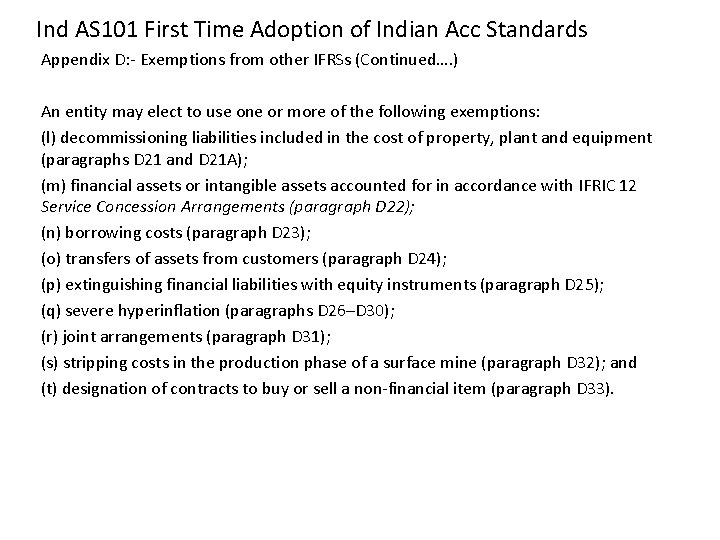
Ind AS 101 First Time Adoption of Indian Acc Standards Appendix D: ‐ Exemptions from other IFRSs (Continued…. ) An entity may elect to use one or more of the following exemptions: (l) decommissioning liabilities included in the cost of property, plant and equipment (paragraphs D 21 and D 21 A); (m) financial assets or intangible assets accounted for in accordance with IFRIC 12 Service Concession Arrangements (paragraph D 22); (n) borrowing costs (paragraph D 23); (o) transfers of assets from customers (paragraph D 24); (p) extinguishing financial liabilities with equity instruments (paragraph D 25); (q) severe hyperinflation (paragraphs D 26–D 30); (r) joint arrangements (paragraph D 31); (s) stripping costs in the production phase of a surface mine (paragraph D 32); and (t) designation of contracts to buy or sell a non‐financial item (paragraph D 33).
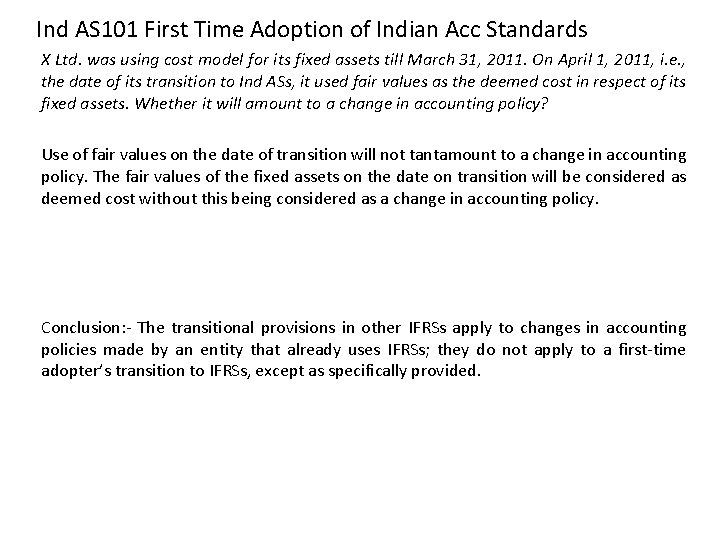
Ind AS 101 First Time Adoption of Indian Acc Standards X Ltd. was using cost model for its fixed assets till March 31, 2011. On April 1, 2011, i. e. , the date of its transition to Ind ASs, it used fair values as the deemed cost in respect of its fixed assets. Whether it will amount to a change in accounting policy? Use of fair values on the date of transition will not tantamount to a change in accounting policy. The fair values of the fixed assets on the date on transition will be considered as deemed cost without this being considered as a change in accounting policy. Conclusion: ‐ The transitional provisions in other IFRSs apply to changes in accounting policies made by an entity that already uses IFRSs; they do not apply to a first‐time adopter’s transition to IFRSs, except as specifically provided.
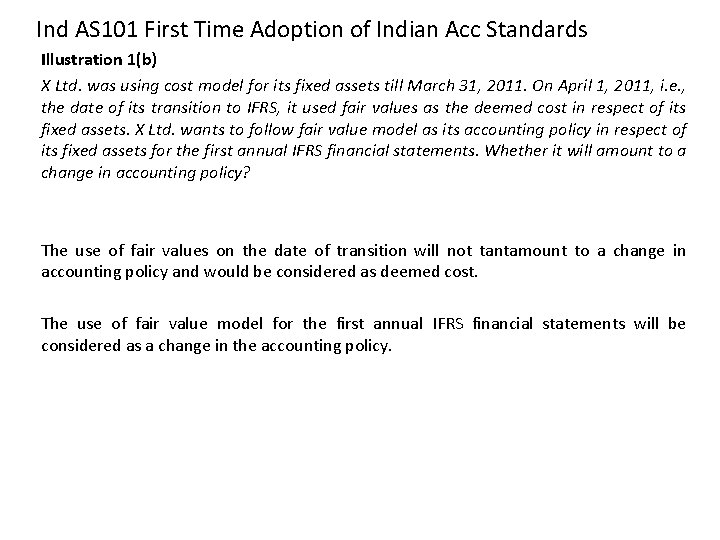
Ind AS 101 First Time Adoption of Indian Acc Standards Illustration 1(b) X Ltd. was using cost model for its fixed assets till March 31, 2011. On April 1, 2011, i. e. , the date of its transition to IFRS, it used fair values as the deemed cost in respect of its fixed assets. X Ltd. wants to follow fair value model as its accounting policy in respect of its fixed assets for the first annual IFRS financial statements. Whether it will amount to a change in accounting policy? The use of fair values on the date of transition will not tantamount to a change in accounting policy and would be considered as deemed cost. The use of fair value model for the first annual IFRS financial statements will be considered as a change in the accounting policy.
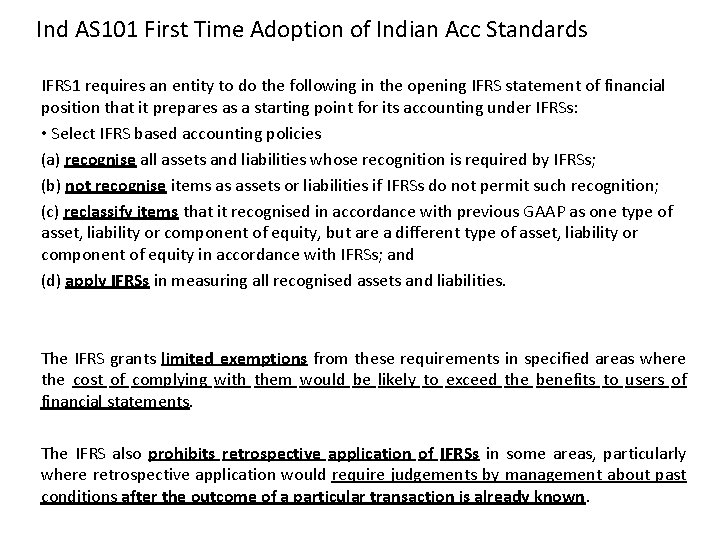
Ind AS 101 First Time Adoption of Indian Acc Standards IFRS 1 requires an entity to do the following in the opening IFRS statement of financial position that it prepares as a starting point for its accounting under IFRSs: • Select IFRS based accounting policies (a) recognise all assets and liabilities whose recognition is required by IFRSs; (b) not recognise items as assets or liabilities if IFRSs do not permit such recognition; (c) reclassify items that it recognised in accordance with previous GAAP as one type of asset, liability or component of equity, but are a different type of asset, liability or component of equity in accordance with IFRSs; and (d) apply IFRSs in measuring all recognised assets and liabilities. The IFRS grants limited exemptions from these requirements in specified areas where the cost of complying with them would be likely to exceed the benefits to users of financial statements. The IFRS also prohibits retrospective application of IFRSs in some areas, particularly where retrospective application would require judgements by management about past conditions after the outcome of a particular transaction is already known.
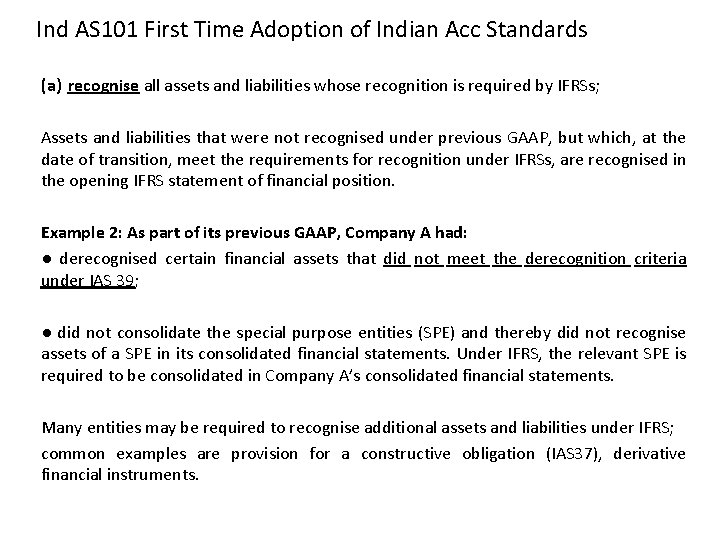
Ind AS 101 First Time Adoption of Indian Acc Standards (a) recognise all assets and liabilities whose recognition is required by IFRSs; Assets and liabilities that were not recognised under previous GAAP, but which, at the date of transition, meet the requirements for recognition under IFRSs, are recognised in the opening IFRS statement of financial position. Example 2: As part of its previous GAAP, Company A had: ● derecognised certain financial assets that did not meet the derecognition criteria under IAS 39; ● did not consolidate the special purpose entities (SPE) and thereby did not recognise assets of a SPE in its consolidated financial statements. Under IFRS, the relevant SPE is required to be consolidated in Company A’s consolidated financial statements. Many entities may be required to recognise additional assets and liabilities under IFRS; common examples are provision for a constructive obligation (IAS 37), derivative financial instruments.
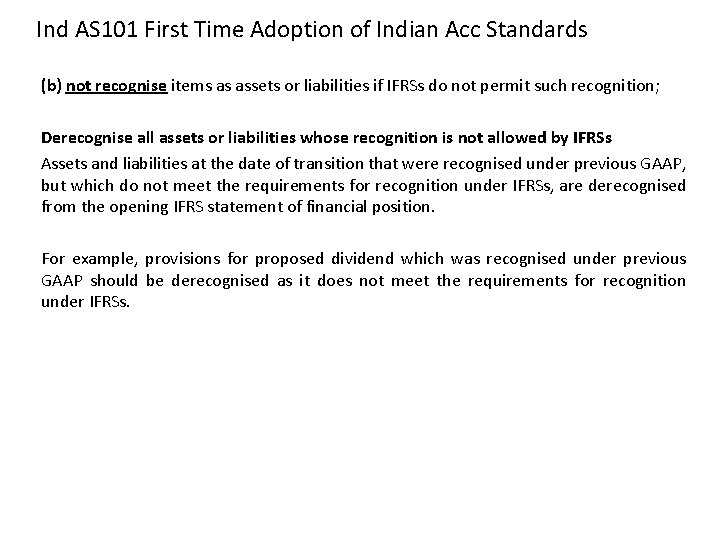
Ind AS 101 First Time Adoption of Indian Acc Standards (b) not recognise items as assets or liabilities if IFRSs do not permit such recognition; Derecognise all assets or liabilities whose recognition is not allowed by IFRSs Assets and liabilities at the date of transition that were recognised under previous GAAP, but which do not meet the requirements for recognition under IFRSs, are derecognised from the opening IFRS statement of financial position. For example, provisions for proposed dividend which was recognised under previous GAAP should be derecognised as it does not meet the requirements for recognition under IFRSs.
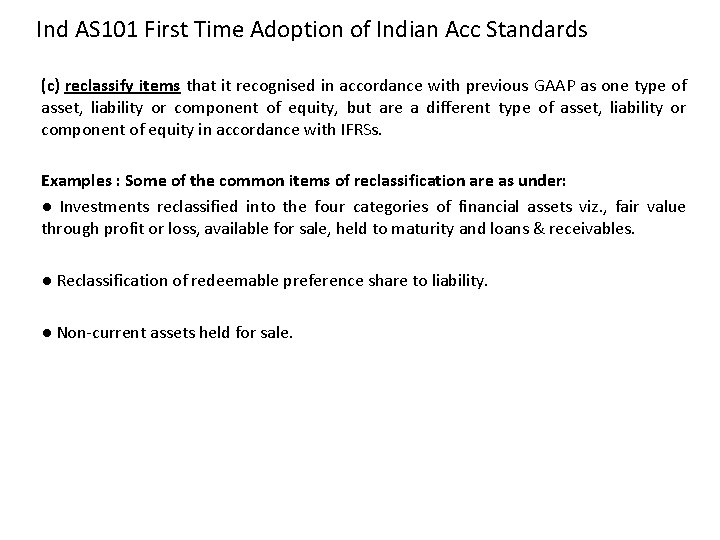
Ind AS 101 First Time Adoption of Indian Acc Standards (c) reclassify items that it recognised in accordance with previous GAAP as one type of asset, liability or component of equity, but are a different type of asset, liability or component of equity in accordance with IFRSs. Examples : Some of the common items of reclassification are as under: ● Investments reclassified into the four categories of financial assets viz. , fair value through profit or loss, available for sale, held to maturity and loans & receivables. ● Reclassification of redeemable preference share to liability. ● Non‐current assets held for sale.
Ind AS 101 First Time Adoption of Indian Acc Standards (d) apply IFRSs in measuring all recognised assets and liabilities. Assets and liabilities in the opening IFRS statement of financial position are measured in accordance with relevant IFRSs, which will require remeasurement if the measurement basis under previous GAAP is not compliant with IFRSs. Example 4: Some of the common items of remeasurement are as under: ● Measurement of provisions on a discounted basis ‐ an entity that might have recognised under previous GAAP a provision that is expected to be paid out in 10 years’ time at a nominal amount of 500, would be required under IAS 37, Provisions, Contingent Liabilities and Contingent Assets, to discount the provision back to the present value of, say 400 in the opening IFRS balance sheet; ● Measurement of available for sale securities at fair value (which were measured at cost under previous GAAP)
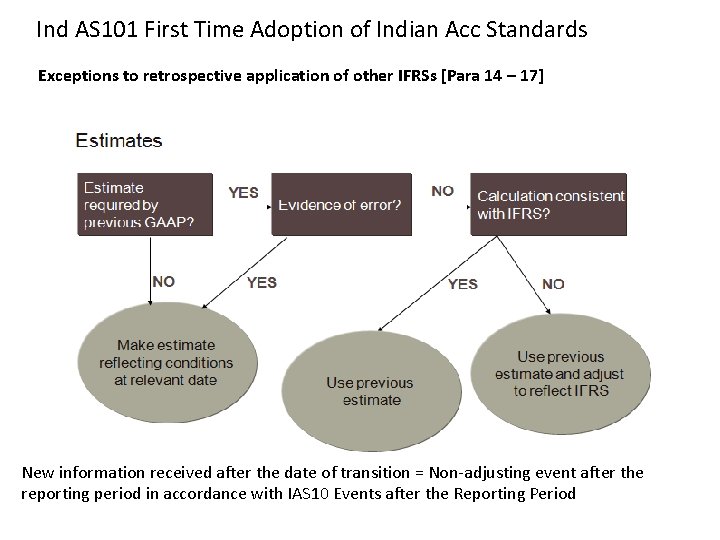
Ind AS 101 First Time Adoption of Indian Acc Standards Exceptions to retrospective application of other IFRSs [Para 14 – 17] New information received after the date of transition = Non‐adjusting event after the reporting period in accordance with IAS 10 Events after the Reporting Period
Ind AS 101 First Time Adoption of Indian Acc Standards Exceptions to retrospective application of other IFRSs [Para 14 – 17] The guidance considers two scenarios: (1) IFRS requires an estimate to be made and previous GAAP required the same or similar estimate: ‐ should be consistent with that under the previous GAAP, unless such estimates made under the previous GAAP were erroneous or the estimate and related information under previous GAAP no longer are relevant because the entity elects a different accounting policy on transition to IFRS. (2) IFRS requires an estimate to be made but there was no such requirement under previous GAAP: ‐ to achieve consistency with IAS 10, the estimate must reflect conditions that existed at the date of transition. These estimates cannot reflect conditions that arose after the relevant reporting date, including changes in market prices, interest rates or foreign exchange rates.
Ind AS 101 First Time Adoption of Indian Acc Standards Exceptions to retrospective application of other IFRSs [Para 14 – 17] Example on Estimates: At March 31, 2013, Company A held an investment (a security) that was classified as long‐ term investment under previous GAAP. The security was not traded on an active market and it was measured at cost under previous GAAP. A adopts IFRS with a date of transition of April 1, 2013. The security will be classified as available for sale financial asset under IFRS and will be measured at fair value. Apply IFRS 1 provisions in respect of the above ?
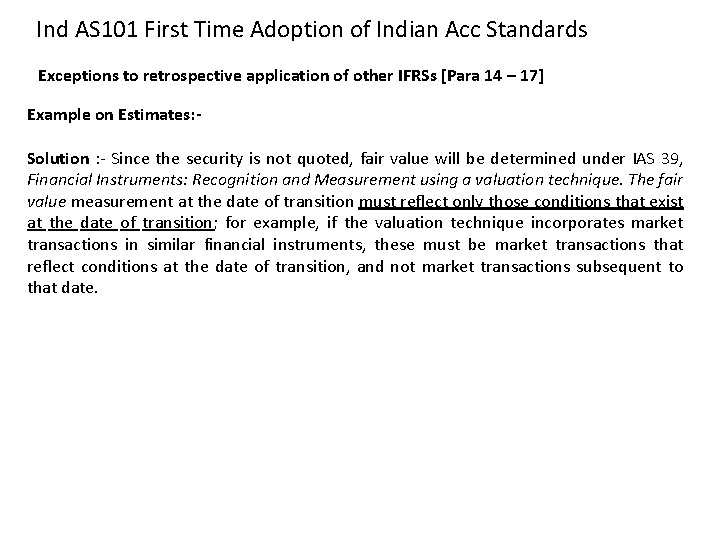
Ind AS 101 First Time Adoption of Indian Acc Standards Exceptions to retrospective application of other IFRSs [Para 14 – 17] Example on Estimates: Solution : ‐ Since the security is not quoted, fair value will be determined under IAS 39, Financial Instruments: Recognition and Measurement using a valuation technique. The fair value measurement at the date of transition must reflect only those conditions that exist at the date of transition; for example, if the valuation technique incorporates market transactions in similar financial instruments, these must be market transactions that reflect conditions at the date of transition, and not market transactions subsequent to that date.
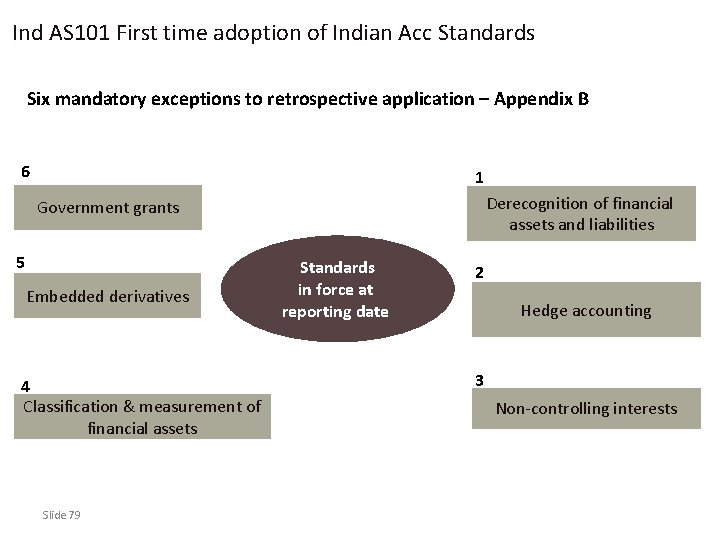
Ind AS 101 First time adoption of Indian Acc Standards Six mandatory exceptions to retrospective application – Appendix B 6 1 Derecognition of financial assets and liabilities Government grants 5 Embedded derivatives 4 Classification & measurement of financial assets Slide 79 Standards in force at reporting date 2 Hedge accounting 3 Non‐controlling interests
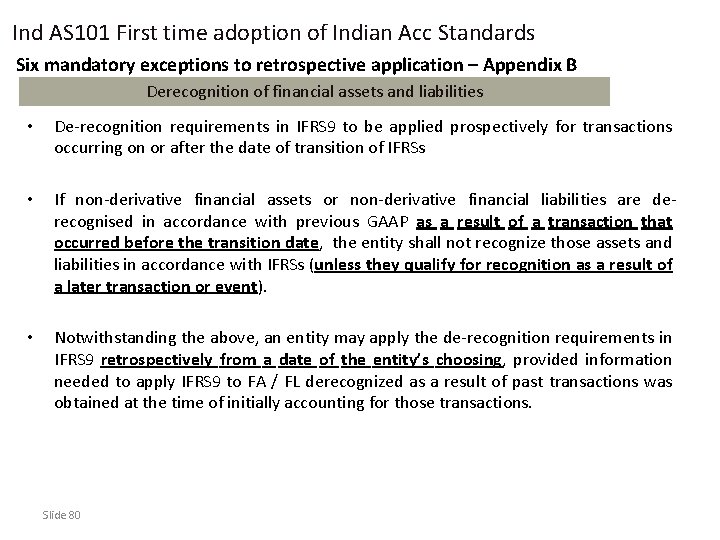
Ind AS 101 First time adoption of Indian Acc Standards Six mandatory exceptions to retrospective application – Appendix B Derecognition of financial assets and liabilities • De‐recognition requirements in IFRS 9 to be applied prospectively for transactions occurring on or after the date of transition of IFRSs • If non‐derivative financial assets or non‐derivative financial liabilities are de‐ recognised in accordance with previous GAAP as a result of a transaction that occurred before the transition date, the entity shall not recognize those assets and liabilities in accordance with IFRSs (unless they qualify for recognition as a result of a later transaction or event). • Notwithstanding the above, an entity may apply the de‐recognition requirements in IFRS 9 retrospectively from a date of the entity’s choosing, provided information needed to apply IFRS 9 to FA / FL derecognized as a result of past transactions was obtained at the time of initially accounting for those transactions. Slide 80
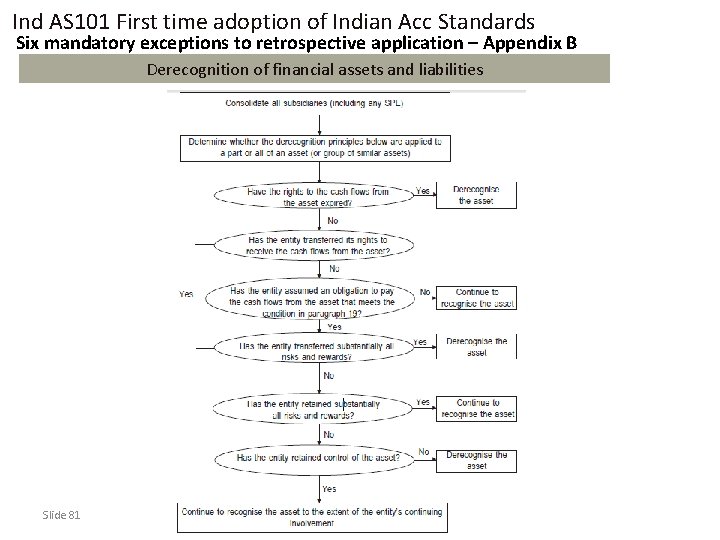
Ind AS 101 First time adoption of Indian Acc Standards Six mandatory exceptions to retrospective application – Appendix B Derecognition of financial assets and liabilities Slide 81
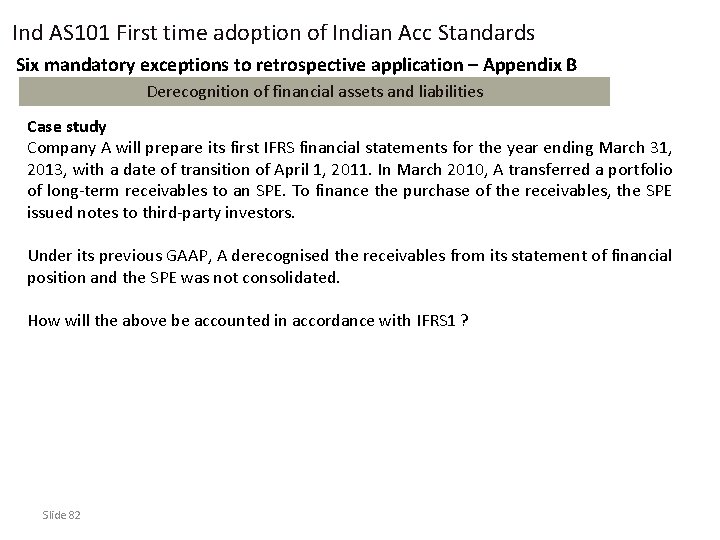
Ind AS 101 First time adoption of Indian Acc Standards Six mandatory exceptions to retrospective application – Appendix B Derecognition of financial assets and liabilities Case study Company A will prepare its first IFRS financial statements for the year ending March 31, 2013, with a date of transition of April 1, 2011. In March 2010, A transferred a portfolio of long‐term receivables to an SPE. To finance the purchase of the receivables, the SPE issued notes to third‐party investors. Under its previous GAAP, A derecognised the receivables from its statement of financial position and the SPE was not consolidated. How will the above be accounted in accordance with IFRS 1 ? Slide 82
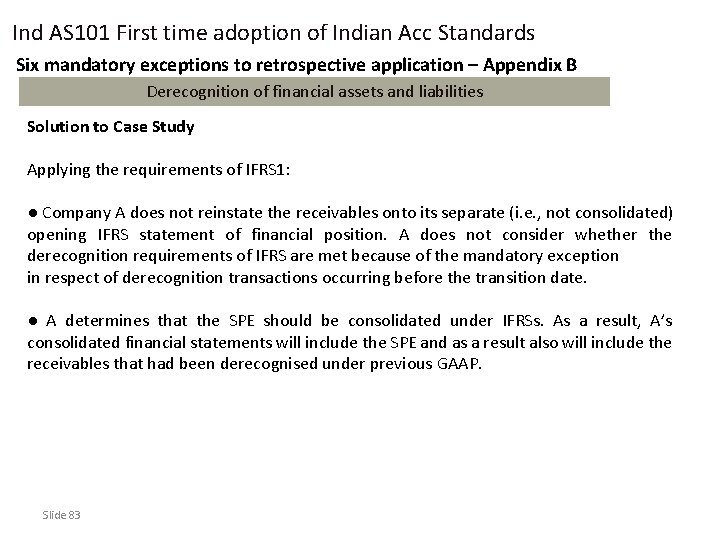
Ind AS 101 First time adoption of Indian Acc Standards Six mandatory exceptions to retrospective application – Appendix B Derecognition of financial assets and liabilities Solution to Case Study Applying the requirements of IFRS 1: ● Company A does not reinstate the receivables onto its separate (i. e. , not consolidated) opening IFRS statement of financial position. A does not consider whether the derecognition requirements of IFRS are met because of the mandatory exception in respect of derecognition transactions occurring before the transition date. ● A determines that the SPE should be consolidated under IFRSs. As a result, A’s consolidated financial statements will include the SPE and as a result also will include the receivables that had been derecognised under previous GAAP. Slide 83
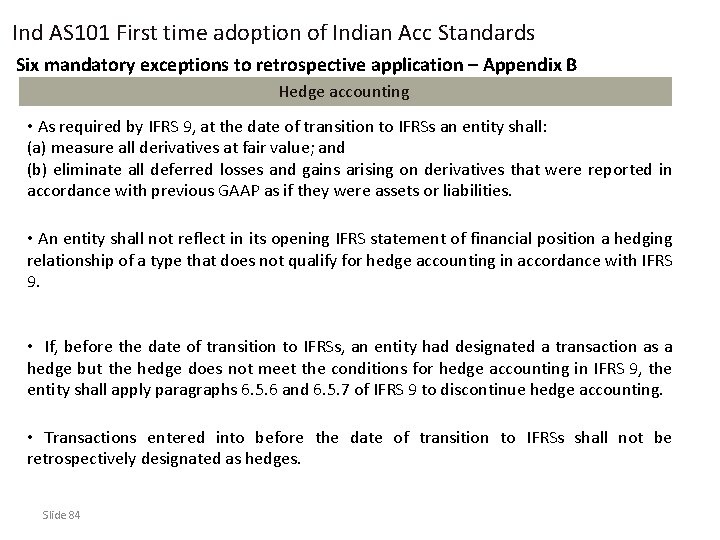
Ind AS 101 First time adoption of Indian Acc Standards Six mandatory exceptions to retrospective application – Appendix B Hedge accounting • As required by IFRS 9, at the date of transition to IFRSs an entity shall: (a) measure all derivatives at fair value; and (b) eliminate all deferred losses and gains arising on derivatives that were reported in accordance with previous GAAP as if they were assets or liabilities. • An entity shall not reflect in its opening IFRS statement of financial position a hedging relationship of a type that does not qualify for hedge accounting in accordance with IFRS 9. • If, before the date of transition to IFRSs, an entity had designated a transaction as a hedge but the hedge does not meet the conditions for hedge accounting in IFRS 9, the entity shall apply paragraphs 6. 5. 6 and 6. 5. 7 of IFRS 9 to discontinue hedge accounting. • Transactions entered into before the date of transition to IFRSs shall not be retrospectively designated as hedges. Slide 84
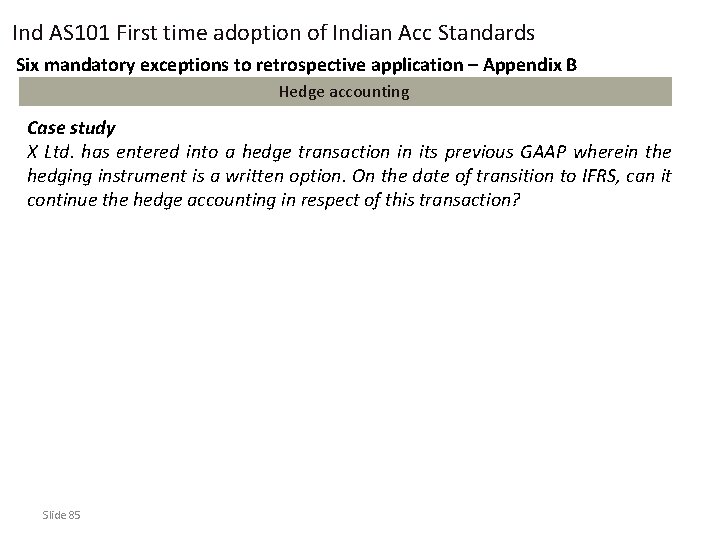
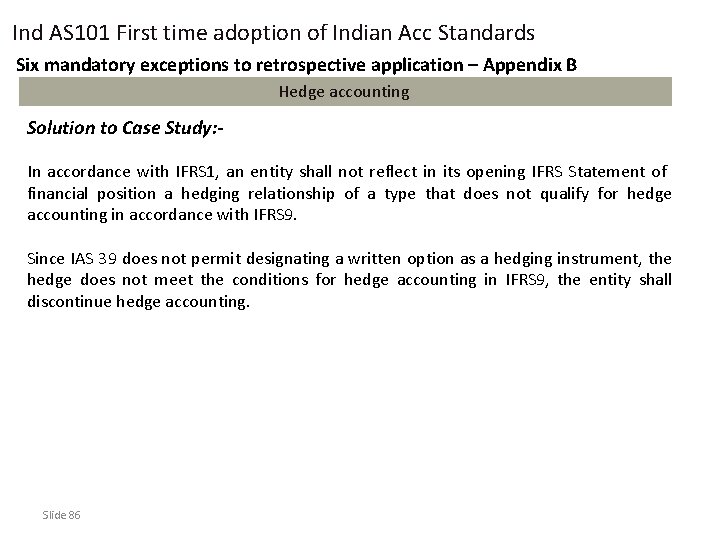
Ind AS 101 First time adoption of Indian Acc Standards Six mandatory exceptions to retrospective application – Appendix B Hedge accounting Case study X Ltd. has entered into a hedge transaction in its previous GAAP wherein the hedging instrument is a written option. On the date of transition to IFRS, can it continue the hedge accounting in respect of this transaction? Slide 85
Ind AS 101 First time adoption of Indian Acc Standards Six mandatory exceptions to retrospective application – Appendix B Hedge accounting Solution to Case Study: In accordance with IFRS 1, an entity shall not reflect in its opening IFRS Statement of financial position a hedging relationship of a type that does not qualify for hedge accounting in accordance with IFRS 9. Since IAS 39 does not permit designating a written option as a hedging instrument, the hedge does not meet the conditions for hedge accounting in IFRS 9, the entity shall discontinue hedge accounting. Slide 86
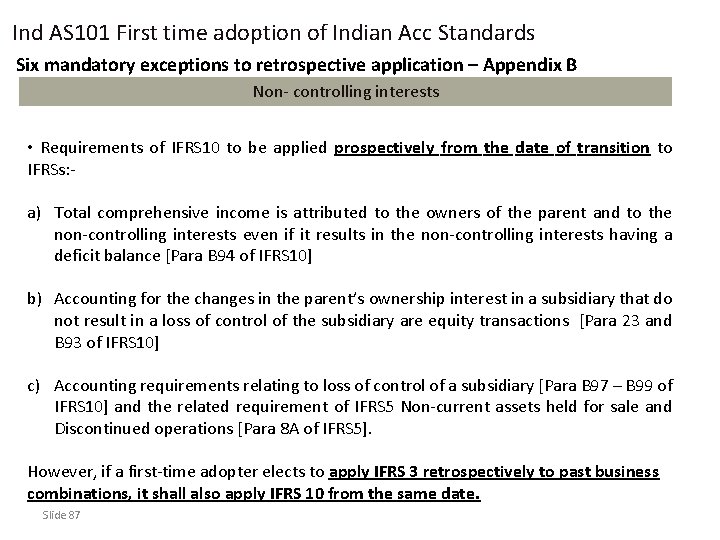
Ind AS 101 First time adoption of Indian Acc Standards Six mandatory exceptions to retrospective application – Appendix B Non‐ controlling interests • Requirements of IFRS 10 to be applied prospectively from the date of transition to IFRSs: ‐ a) Total comprehensive income is attributed to the owners of the parent and to the non‐controlling interests even if it results in the non‐controlling interests having a deficit balance [Para B 94 of IFRS 10] b) Accounting for the changes in the parent’s ownership interest in a subsidiary that do not result in a loss of control of the subsidiary are equity transactions [Para 23 and B 93 of IFRS 10] c) Accounting requirements relating to loss of control of a subsidiary [Para B 97 – B 99 of IFRS 10] and the related requirement of IFRS 5 Non‐current assets held for sale and Discontinued operations [Para 8 A of IFRS 5]. However, if a first‐time adopter elects to apply IFRS 3 retrospectively to past business combinations, it shall also apply IFRS 10 from the same date. Slide 87
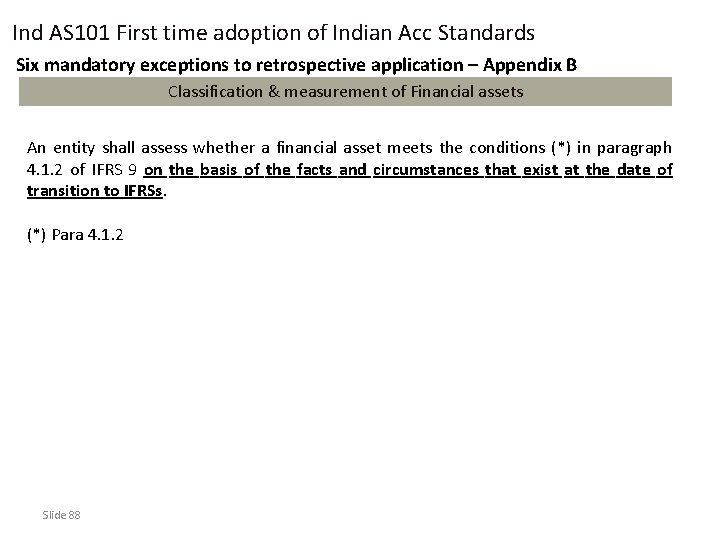
Ind AS 101 First time adoption of Indian Acc Standards Six mandatory exceptions to retrospective application – Appendix B Classification & measurement of Financial assets An entity shall assess whether a financial asset meets the conditions (*) in paragraph 4. 1. 2 of IFRS 9 on the basis of the facts and circumstances that exist at the date of transition to IFRSs. (*) Para 4. 1. 2 Slide 88
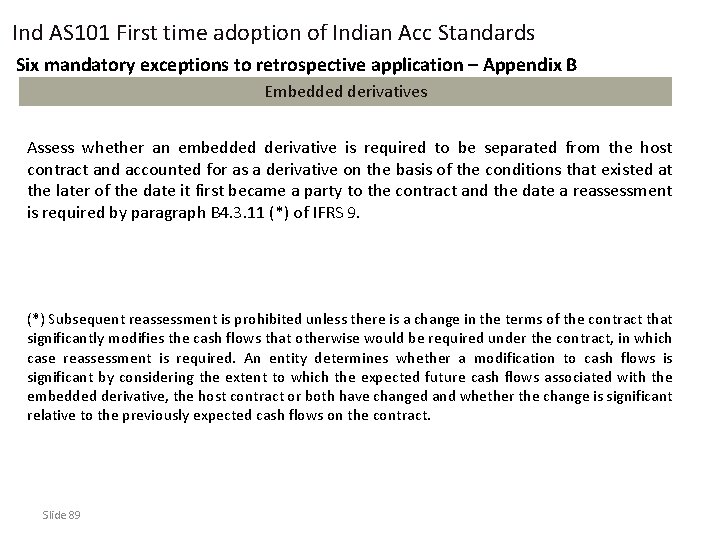
Ind AS 101 First time adoption of Indian Acc Standards Six mandatory exceptions to retrospective application – Appendix B Embedded derivatives Assess whether an embedded derivative is required to be separated from the host contract and accounted for as a derivative on the basis of the conditions that existed at the later of the date it first became a party to the contract and the date a reassessment is required by paragraph B 4. 3. 11 (*) of IFRS 9. (*) Subsequent reassessment is prohibited unless there is a change in the terms of the contract that significantly modifies the cash flows that otherwise would be required under the contract, in which case reassessment is required. An entity determines whether a modification to cash flows is significant by considering the extent to which the expected future cash flows associated with the embedded derivative, the host contract or both have changed and whether the change is significant relative to the previously expected cash flows on the contract. Slide 89
Ind AS 101 First time adoption of Indian Acc Standards Six mandatory exceptions to retrospective application – Appendix B Government loans Classify all government loans received as a financial liability or an equity instrument in accordance with IAS 32 Financial Instruments: Presentation. Apply (*) the requirements in IFRS 9 Financial Instruments and IAS 20 Accounting for Government Grants and Disclosure of Government Assistance prospectively to government loans existing at the date of transition to IFRSs and shall not recognise the corresponding benefit of the government loan at a below‐market rate of interest as a government grant. (*) Notwithstanding the above, an entity may apply the requirements in IFRS 9 and IAS 20 retrospectively to any government loan originated before the date of transition to IFRSs, provided that the information needed to do so had been obtained at the time of initially accounting for that loan. Slide 90
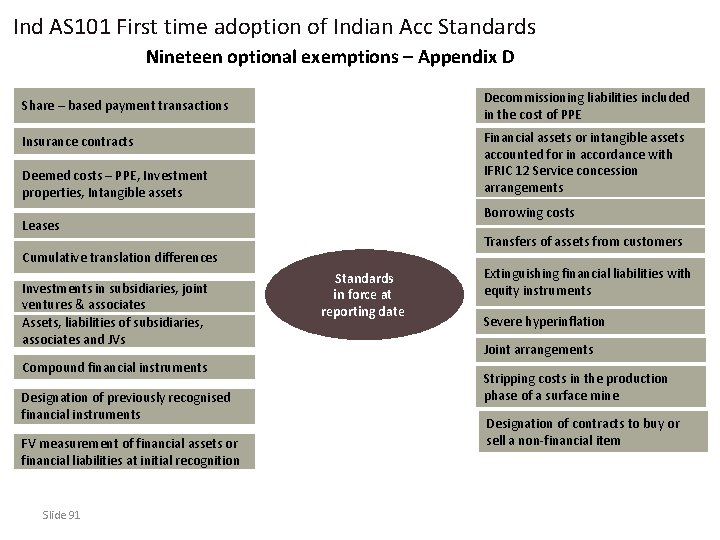
Ind AS 101 First time adoption of Indian Acc Standards Nineteen optional exemptions – Appendix D Decommissioning liabilities included in the cost of PPE Share – based payment transactions Financial assets or intangible assets accounted for in accordance with IFRIC 12 Service concession arrangements Insurance contracts Deemed costs – PPE, Investment properties, Intangible assets Borrowing costs Leases Transfers of assets from customers Cumulative translation differences Investments in subsidiaries, joint ventures & associates Assets, liabilities of subsidiaries, associates and JVs Compound financial instruments Designation of previously recognised financial instruments FV measurement of financial assets or financial liabilities at initial recognition Slide 91 Standards in force at reporting date Extinguishing financial liabilities with equity instruments Severe hyperinflation Joint arrangements Stripping costs in the production phase of a surface mine Designation of contracts to buy or sell a non‐financial item
Ind AS 101 First time adoption of Indian Acc Standards Nineteen optional exemptions – Appendix D Share based payments • A FTA is encouraged, but not required, to apply IFRS 2 to equity instruments that were granted after 7 November 2002 and vested before the later of (a) the date of transition to IFRSs and (b) 1 January 2005. • If an FTA elects to apply IFRS 2 to such equity instruments, it may do so only if the entity has disclosed publicly the fair value of those equity instruments, determined at the measurement date, as defined in IFRS 2 • A FTA is encouraged, but not required, to apply IFRS 2 to liabilities arising from share‐ based payment transactions that were settled before the date of transition to IFRSs or which were settled before 1 st January 2005. • For liabilities to which IFRS 2 is applied, a FTA is not required to restate comparative information to the extent that the information relates to a period or date that is earlier than 7 November 2002. Slide 92
Ind AS 101 First time adoption of Indian Acc Standards Nineteen optional exemptions – Appendix D Insurance contracts • A FTA may apply the transitional provisions in IFRS 4 Insurance Contracts. [An entity shall apply this IFRS for annual periods beginning on or after 1 January 2005. Earlier application is encouraged. If an entity applies this IFRS for an earlier period, it shall disclose that fact] • IFRS 4 restricts changes in accounting policies for insurance contracts, including changes made by a first‐time adopter. Slide 93
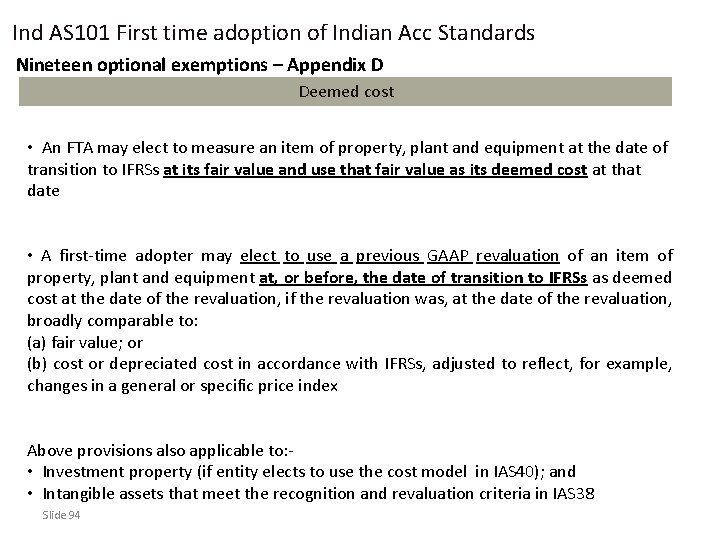
Ind AS 101 First time adoption of Indian Acc Standards Nineteen optional exemptions – Appendix D Deemed cost • An FTA may elect to measure an item of property, plant and equipment at the date of transition to IFRSs at its fair value and use that fair value as its deemed cost at that date • A first‐time adopter may elect to use a previous GAAP revaluation of an item of property, plant and equipment at, or before, the date of transition to IFRSs as deemed cost at the date of the revaluation, if the revaluation was, at the date of the revaluation, broadly comparable to: (a) fair value; or (b) cost or depreciated cost in accordance with IFRSs, adjusted to reflect, for example, changes in a general or specific price index Above provisions also applicable to: ‐ • Investment property (if entity elects to use the cost model in IAS 40); and • Intangible assets that meet the recognition and revaluation criteria in IAS 38 Slide 94
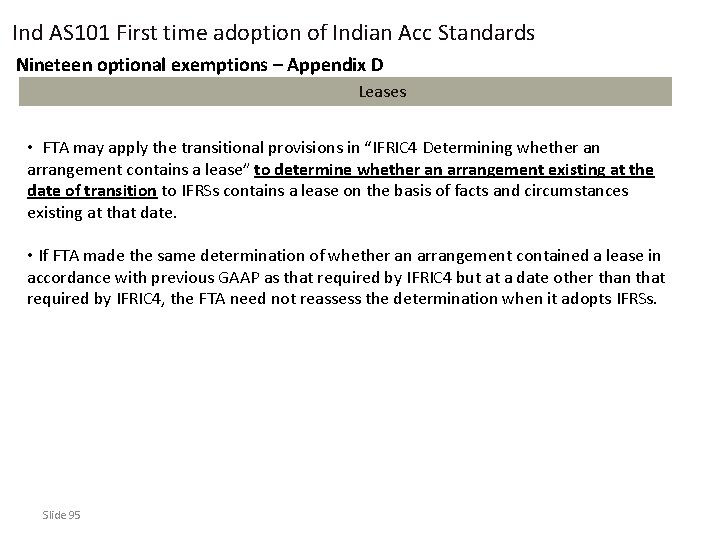
Ind AS 101 First time adoption of Indian Acc Standards Nineteen optional exemptions – Appendix D Leases • FTA may apply the transitional provisions in “IFRIC 4 Determining whether an arrangement contains a lease” to determine whether an arrangement existing at the date of transition to IFRSs contains a lease on the basis of facts and circumstances existing at that date. • If FTA made the same determination of whether an arrangement contained a lease in accordance with previous GAAP as that required by IFRIC 4 but at a date other than that required by IFRIC 4, the FTA need not reassess the determination when it adopts IFRSs. Slide 95
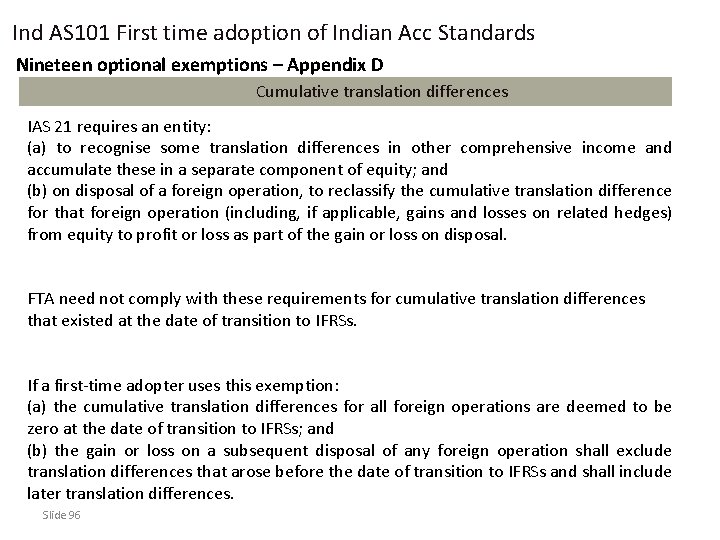
Ind AS 101 First time adoption of Indian Acc Standards Nineteen optional exemptions – Appendix D Cumulative translation differences IAS 21 requires an entity: (a) to recognise some translation differences in other comprehensive income and accumulate these in a separate component of equity; and (b) on disposal of a foreign operation, to reclassify the cumulative translation difference for that foreign operation (including, if applicable, gains and losses on related hedges) from equity to profit or loss as part of the gain or loss on disposal. FTA need not comply with these requirements for cumulative translation differences that existed at the date of transition to IFRSs. If a first‐time adopter uses this exemption: (a) the cumulative translation differences for all foreign operations are deemed to be zero at the date of transition to IFRSs; and (b) the gain or loss on a subsequent disposal of any foreign operation shall exclude translation differences that arose before the date of transition to IFRSs and shall include later translation differences. Slide 96
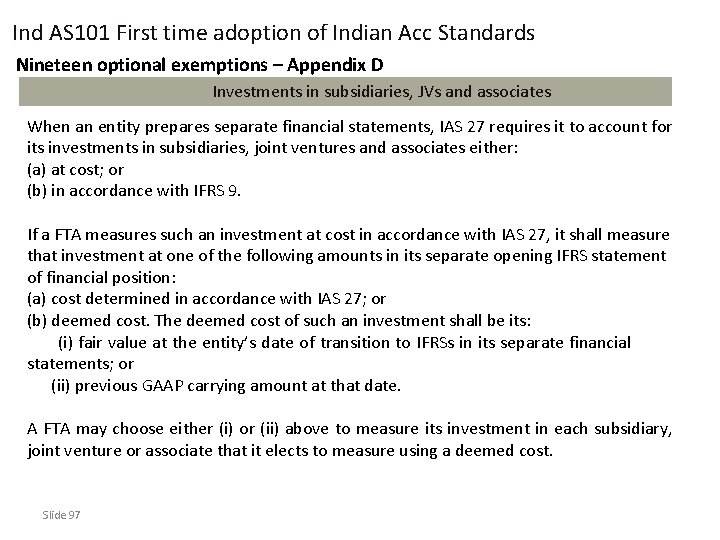
Ind AS 101 First time adoption of Indian Acc Standards Nineteen optional exemptions – Appendix D Investments in subsidiaries, JVs and associates When an entity prepares separate financial statements, IAS 27 requires it to account for its investments in subsidiaries, joint ventures and associates either: (a) at cost; or (b) in accordance with IFRS 9. If a FTA measures such an investment at cost in accordance with IAS 27, it shall measure that investment at one of the following amounts in its separate opening IFRS statement of financial position: (a) cost determined in accordance with IAS 27; or (b) deemed cost. The deemed cost of such an investment shall be its: (i) fair value at the entity’s date of transition to IFRSs in its separate financial statements; or (ii) previous GAAP carrying amount at that date. A FTA may choose either (i) or (ii) above to measure its investment in each subsidiary, joint venture or associate that it elects to measure using a deemed cost. Slide 97
Ind AS 101 First time adoption of Indian Acc Standards Nineteen optional exemptions – Appendix D Assets and liabilities of subsidiaries, associates and joint ventures If a subsidiary becomes a FTA later than its parent, the subsidiary shall, in its financial statements, measure its assets and liabilities at either: (a) the carrying amounts that would be included in the parent’s consolidated financial statements, based on the parent’s date of transition to IFRSs, if no adjustments were made for consolidation procedures and for the effects of the business combination in which the parent acquired the subsidiary (this election is not available to a subsidiary of an investment entity, as defined in IFRS 10, that is required to be measured at fair value through profit or loss); or (b) the carrying amounts required by the rest of this IFRS, based on the subsidiary’s date of transition to IFRSs. These carrying amounts could differ from those described in (a): A similar election is available to an associate or JV that becomes a FTA later than an entity that has significant influence or joint control over it. Slide 98
Ind AS 101 First time adoption of Indian Acc Standards Nineteen optional exemptions – Appendix D Assets and liabilities of subsidiaries, associates and joint ventures If an entity becomes a FTA later than its subsidiary (or associate or JV), the entity shall in its consolidated financial statements, measure the assets and liabilities of the subsidiary (or associate or joint venture) at the same carrying amounts as in the financial statements of the subsidiary (or associate or joint venture), after adjusting for consolidation and equity accounting adjustments and for the effects of the business combination in which the entity acquired the subsidiary. Slide 99
Ind AS 101 First time adoption of Indian Acc Standards Nineteen optional exemptions – Appendix D Compound Financial instruments • IAS 32 Financial Instruments: Presentation requires an entity to split a compound financial instrument at inception into separate liability and equity components. • If the liability component is no longer outstanding, retrospective application of IAS 32 involves separating two portions of equity. The first portion is in retained earnings and represents the cumulative interest accreted on the liability component. The other portion represents the original equity component. • However, in accordance with this IFRS, a FTA need not separate these two portions if the liability component is no longer outstanding at the date of transition to IFRSs Slide 100
Ind AS 101 First time adoption of Indian Acc Standards Nineteen optional exemptions – Appendix D Designation of previously recognised financial instruments IAS 39 permits a financial asset to be designated on initial recognition as available for sale or a financial instrument (provided it meets certain criteria) to be designated as a financial asset or financial liability at fair value through profit or loss. Despite this requirement exceptions apply in the following circumstances: (a) an entity is permitted to make an available‐for‐sale designation at the date of transition to IFRSs. (b) an entity is permitted to designate, at the date of transition to IFRSs, any financial asset or financial liability as at fair value through profit or loss provided the asset or liability meets the criteria in paragraph 9(b)(i), 9(b)(ii) or 11 A of IAS 39 at that date. Slide 101
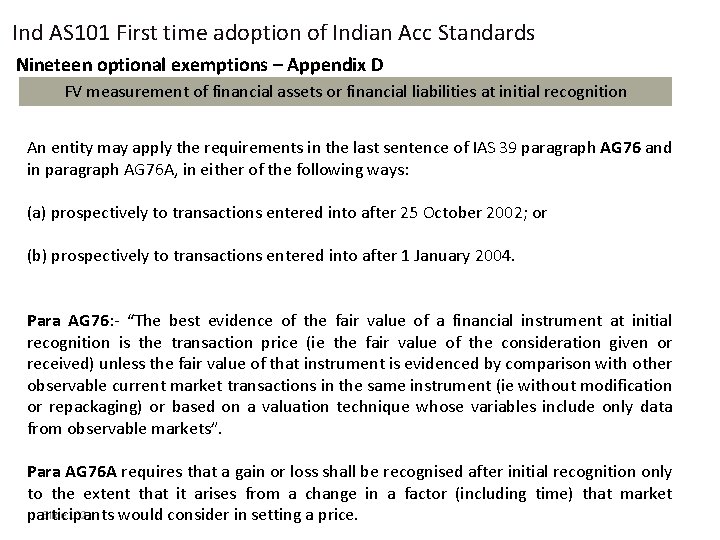
Ind AS 101 First time adoption of Indian Acc Standards Nineteen optional exemptions – Appendix D FV measurement of financial assets or financial liabilities at initial recognition An entity may apply the requirements in the last sentence of IAS 39 paragraph AG 76 and in paragraph AG 76 A, in either of the following ways: (a) prospectively to transactions entered into after 25 October 2002; or (b) prospectively to transactions entered into after 1 January 2004. Para AG 76: ‐ “The best evidence of the fair value of a financial instrument at initial recognition is the transaction price (ie the fair value of the consideration given or received) unless the fair value of that instrument is evidenced by comparison with other observable current market transactions in the same instrument (ie without modification or repackaging) or based on a valuation technique whose variables include only data from observable markets”. Para AG 76 A requires that a gain or loss shall be recognised after initial recognition only to the extent that it arises from a change in a factor (including time) that market Slide 102 participants would consider in setting a price.
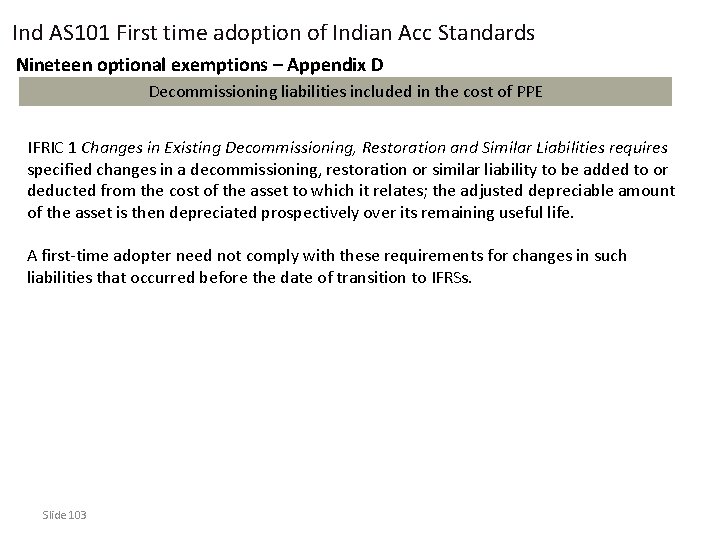
Ind AS 101 First time adoption of Indian Acc Standards Nineteen optional exemptions – Appendix D Decommissioning liabilities included in the cost of PPE IFRIC 1 Changes in Existing Decommissioning, Restoration and Similar Liabilities requires specified changes in a decommissioning, restoration or similar liability to be added to or deducted from the cost of the asset to which it relates; the adjusted depreciable amount of the asset is then depreciated prospectively over its remaining useful life. A first‐time adopter need not comply with these requirements for changes in such liabilities that occurred before the date of transition to IFRSs. Slide 103
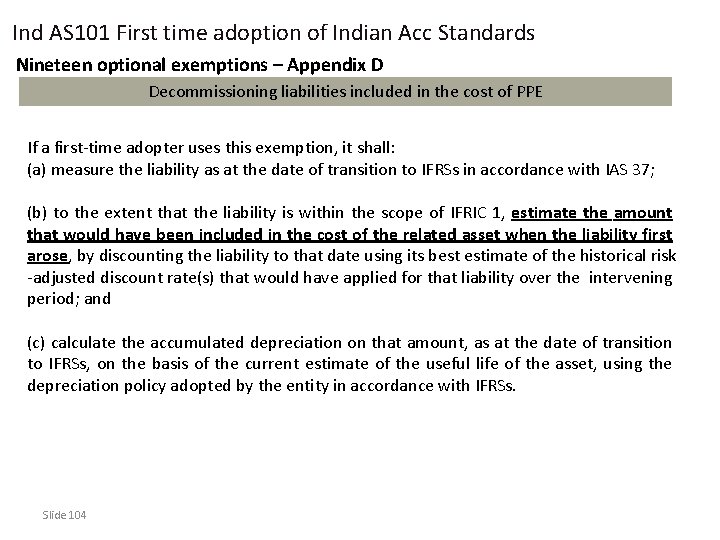
Ind AS 101 First time adoption of Indian Acc Standards Nineteen optional exemptions – Appendix D Decommissioning liabilities included in the cost of PPE If a first‐time adopter uses this exemption, it shall: (a) measure the liability as at the date of transition to IFRSs in accordance with IAS 37; (b) to the extent that the liability is within the scope of IFRIC 1, estimate the amount that would have been included in the cost of the related asset when the liability first arose, by discounting the liability to that date using its best estimate of the historical risk ‐adjusted discount rate(s) that would have applied for that liability over the intervening period; and (c) calculate the accumulated depreciation on that amount, as at the date of transition to IFRSs, on the basis of the current estimate of the useful life of the asset, using the depreciation policy adopted by the entity in accordance with IFRSs. Slide 104
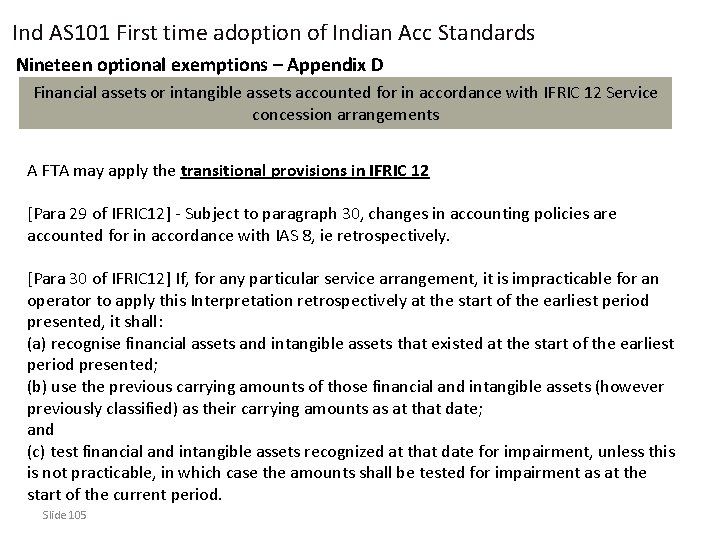
Ind AS 101 First time adoption of Indian Acc Standards Nineteen optional exemptions – Appendix D Financial assets or intangible assets accounted for in accordance with IFRIC 12 Service concession arrangements A FTA may apply the transitional provisions in IFRIC 12 [Para 29 of IFRIC 12] ‐ Subject to paragraph 30, changes in accounting policies are accounted for in accordance with IAS 8, ie retrospectively. [Para 30 of IFRIC 12] If, for any particular service arrangement, it is impracticable for an operator to apply this Interpretation retrospectively at the start of the earliest period presented, it shall: (a) recognise financial assets and intangible assets that existed at the start of the earliest period presented; (b) use the previous carrying amounts of those financial and intangible assets (however previously classified) as their carrying amounts as at that date; and (c) test financial and intangible assets recognized at that date for impairment, unless this is not practicable, in which case the amounts shall be tested for impairment as at the start of the current period. Slide 105
Ind AS 101 First time adoption of Indian Acc Standards Nineteen optional exemptions – Appendix D Borrowing costs A first‐time adopter may apply the transitional provisions set out in paragraphs 27 and 28 of IAS 23. Para 27 : “When application of this Standard constitutes a change in accounting policy, an entity shall apply the Standard to borrowing costs relating to qualifying assets for which the commencement date (@) for capitalization is on or after the effective date (*)”. Para 28 : “However, an entity may designate any date before the effective date (*) and apply the Standard to borrowing costs relating to all qualifying assets for which the commencement date (@) for capitalization is on or after that date”. (*) references to the effective date shall be interpreted as 1 July 2009 or the date of transition to IFRSs, whichever is later. Slide 106
Ind AS 101 First time adoption of Indian Acc Standards Nineteen optional exemptions – Appendix D Borrowing costs @ The commencement date for capitalization is the date when the entity first meets all of the following conditions: (a) it incurs expenditures for the asset; (b) it incurs borrowing costs; and (c) it undertakes activities that are necessary to prepare the asset for its intended use or sale. Slide 107
Ind AS 101 First time adoption of Indian Acc Standards Nineteen optional exemptions – Appendix D Transfer of assets from customers • A FTA may apply the transitional provisions set out in paragraph 22 of IFRIC 18 “Transfer of Assets from Customers”. • Para 22 “An entity shall apply this interpretation prospectively to transfers of assets from customers received on or after 1 July 2009. Earlier application is permitted provided the valuations and other information needed to apply the interpretation to past transfers were obtained at the time those transfers occurred. An entity shall disclose the date from which the interpretation was applied” • Alternatively, the FTA may designate any date before the date of transition to IFRSs and apply IFRIC 18 to all transfers of assets from customers received on or after that date. (*) references to the effective date shall be interpreted as 1 July 2009 or the date of transition to IFRSs, whichever is later. Slide 108
Ind AS 101 First time adoption of Indian Acc Standards Nineteen optional exemptions – Appendix D Extinguishing financial liabilities with equity instruments A FTA may apply the transitional provisions in IFRIC 19 “Extinguishing financial liabilities with equity instruments” Transitional provisions ‐> “An entity shall apply this interpretation for annual periods beginning on or after 1 July 2010. Earlier application is permitted. If an entity applies this interpretation for a period beginning before 1 July 2010, it shall disclose that fact”. Slide 109
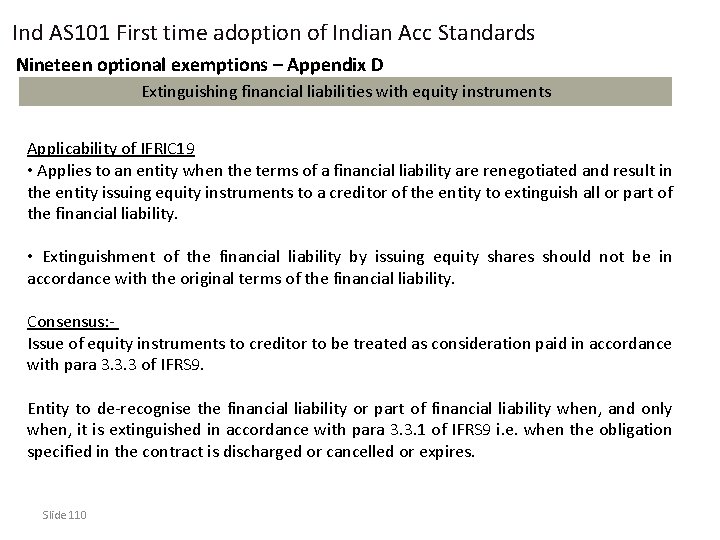
Ind AS 101 First time adoption of Indian Acc Standards Nineteen optional exemptions – Appendix D Extinguishing financial liabilities with equity instruments Applicability of IFRIC 19 • Applies to an entity when the terms of a financial liability are renegotiated and result in the entity issuing equity instruments to a creditor of the entity to extinguish all or part of the financial liability. • Extinguishment of the financial liability by issuing equity shares should not be in accordance with the original terms of the financial liability. Consensus: ‐ Issue of equity instruments to creditor to be treated as consideration paid in accordance with para 3. 3. 3 of IFRS 9. Entity to de‐recognise the financial liability or part of financial liability when, and only when, it is extinguished in accordance with para 3. 3. 1 of IFRS 9 i. e. when the obligation specified in the contract is discharged or cancelled or expires. Slide 110
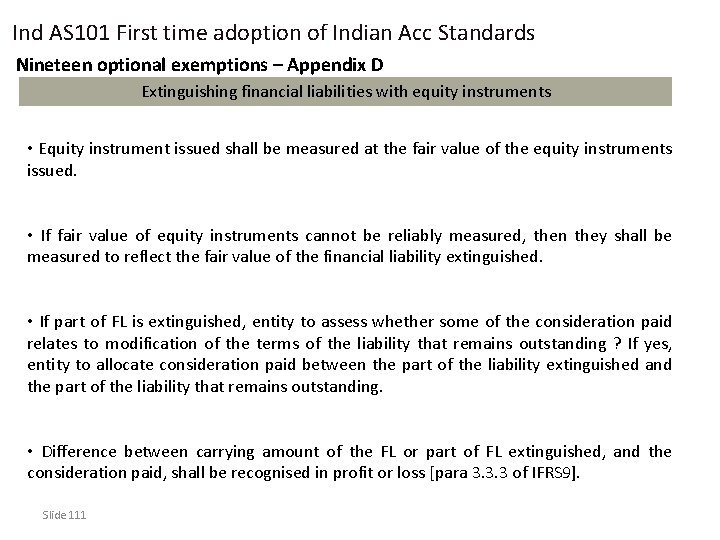
Ind AS 101 First time adoption of Indian Acc Standards Nineteen optional exemptions – Appendix D Extinguishing financial liabilities with equity instruments • Equity instrument issued shall be measured at the fair value of the equity instruments issued. • If fair value of equity instruments cannot be reliably measured, then they shall be measured to reflect the fair value of the financial liability extinguished. • If part of FL is extinguished, entity to assess whether some of the consideration paid relates to modification of the terms of the liability that remains outstanding ? If yes, entity to allocate consideration paid between the part of the liability extinguished and the part of the liability that remains outstanding. • Difference between carrying amount of the FL or part of FL extinguished, and the consideration paid, shall be recognised in profit or loss [para 3. 3. 3 of IFRS 9]. Slide 111
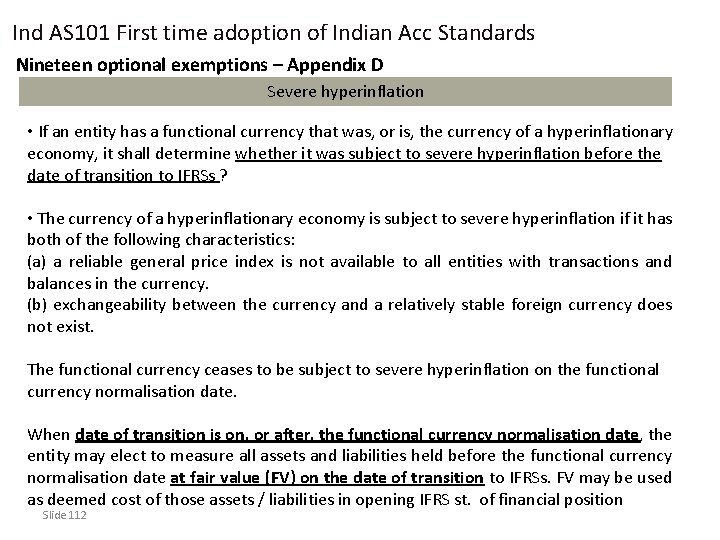
Ind AS 101 First time adoption of Indian Acc Standards Nineteen optional exemptions – Appendix D Severe hyperinflation • If an entity has a functional currency that was, or is, the currency of a hyperinflationary economy, it shall determine whether it was subject to severe hyperinflation before the date of transition to IFRSs ? • The currency of a hyperinflationary economy is subject to severe hyperinflation if it has both of the following characteristics: (a) a reliable general price index is not available to all entities with transactions and balances in the currency. (b) exchangeability between the currency and a relatively stable foreign currency does not exist. The functional currency ceases to be subject to severe hyperinflation on the functional currency normalisation date. When date of transition is on, or after, the functional currency normalisation date, the entity may elect to measure all assets and liabilities held before the functional currency normalisation date at fair value (FV) on the date of transition to IFRSs. FV may be used as deemed cost of those assets / liabilities in opening IFRS st. of financial position Slide 112
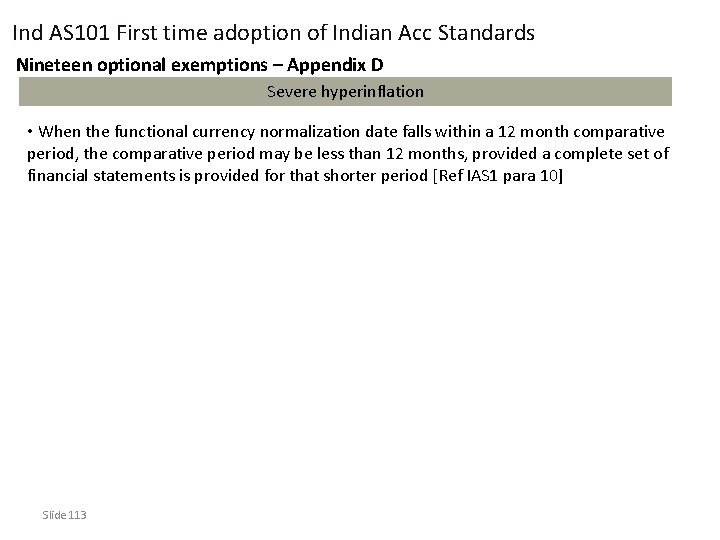
Ind AS 101 First time adoption of Indian Acc Standards Nineteen optional exemptions – Appendix D Severe hyperinflation • When the functional currency normalization date falls within a 12 month comparative period, the comparative period may be less than 12 months, provided a complete set of financial statements is provided for that shorter period [Ref IAS 1 para 10] Slide 113
Ind AS 101 First time adoption of Indian Acc Standards Nineteen optional exemptions – Appendix D Joint arrangements A FTA may apply the transition provisions in IFRS 11 with the following exceptions: (a) When applying the transition provisions in IFRS 11, a FTA shall apply these provisions at the date of transition to IFRS. (b) When changing from proportionate consolidation to the equity method, a FTA shall test for impairment the investment in accordance with IAS 36 as at the date of transition to IFRS, regardless of whethere is any indication that the investment may be impaired. Any resulting impairment shall be recognised as an adjustment to retained earnings at the date of transition to IFRS. Slide 114
Ind AS 101 First time adoption of Indian Acc Standards Nineteen optional exemptions – Appendix D Stripping costs in the production phase of a surface mine A first‐time adopter may apply the transitional provisions set out in “IFRIC 20 Stripping Costs in the Production Phase of a Surface Mine” Effective date shall be interpreted as 1 January 2013 or the beginning of the first IFRS reporting period, whichever is later. An entity to apply this IFRIC to annual periods beginning on or after 01. 2013 and to production stripping costs incurred on or after the beginning of the earliest period presented. At the transition date, any previously recognised asset balance that resulted from stripping activity during the production phase (predecessor stripping asset) shall be reclassified as a part of an existing asset to which the stripping activity related, to the extent there remains an identifiable component of the ore body with which the predecessor stripping asset can be associated. Else recognise in opening retained earnings at the beginning of he earliest period presented. Such balance shall be depreciated or amortised over the remaining useful life of the identified component of the ore body to which each predecessor stripping asset balance Slide 115 relates.
Ind AS 101 First time adoption of Indian Acc Standards Nineteen optional exemptions – Appendix D Stripping costs in the production phase of a surface mine Applicability: ‐ Stripping activity = removal of mine waste materials (overburden). Mining entity may continue to incur stripping costs during the production phase of the mine. Stripping costs are usually capitalized during the development phase of the mine (before production begins). Slide 116
Ind AS 101 First time adoption of Indian Acc Standards Nineteen optional exemptions – Appendix D Stripping costs in the production phase of a surface mine Background: ‐ Ratio of ore and waste can range from uneconomic low grade to profitable high grade. Removal of material with low ratio of ore to waste may produce some inventory + provide access to deeper levels of material with higher ratios of ore to waste. Consensus: ‐ • Recognition of production stripping costs as an asset: ‐ Current (inventory produced) & Non‐current asset (improved access to ore). • Initial measurement of the stripping activity asset: ‐ at cost i. e. accumulation of costs directly incurred to perform the stripping activity + directly attributable overhead costs. If costs attributable to inventory and improved access to ore cannot be separately determined, the entity shall allocate the production stripping cost based on relevant production measure. • subsequent measurement of the stripping activity asset: ‐ At Cost or its revalued amount less depreciation / amortisation less impairment losses. Slide 117
Ind AS 101 First time adoption of Indian Acc Standards Nineteen optional exemptions – Appendix D Stripping costs in the production phase of a surface mine • Stripping activity asset to be depreciated or amortised on a systematic basis, over the expected useful life of the identified component of the ore body that becomes more accessable as a result of the stripping activity. Slide 118
Ind AS 101 First time adoption of Indian Acc Standards Nineteen optional exemptions – Appendix D Designation of contracts to buy or sell a non‐financial item IAS 39 permits some contracts to buy or sell a non‐financial item to be designated at inception as measured at fair value through profit or loss (Para 5 A of IAS 39). Despite this requirement an entity is permitted to designate, at the date of transition to IFRSs, contracts that already exist on that date as measured at fair value through profit or loss but only if they meet the requirements of paragraph 5 A of IAS 39 at that date and the entity designates all similar contracts. Slide 119
Ind AS 101 First time adoption of Indian Acc Standards Exemptions for Business combinations – Appendix C IFRS 3 need not be applied to combinations before date of transition (April 1, 2010) • BUT, if one combination is restated, all subsequent combinations are restated and also apply IFRS 10 from that date. When the exemption is used • No change in classification as in previous GAAP financials • Post combination carrying amount is deemed cost for assets and liabilities measured at cost • Assets and liabilities measured at fair value restated at date of transition – adjust retained earnings Slide 120
First‐time Adoption of Indian Acc Standards ‐ Business combinations exemption ‐ (Contd. . ) Assets and liabilities not recognised at the time of a business combination under previous GAAP are: • Recognized as if subsidiary adopted IFRSs at the same date Subsidiaries not consolidated under previous GAAP are: • Consolidated as if subsidiary adopted IFRSs at the same date • Goodwill is the difference between cost of investment and net assets recognised at date of transition Slide 121
First‐time Adoption of Ind AS 101 ‐ Business combinations exemption – (Contd. . ) Goodwill is recognised at the carrying amount under previous GAAP and adjusted for • Intangibles that are not recognised under IFRS • Intangibles that must be recognised under IFRS • Contingent consideration not recognised; and • Tested for impairment Goodwill deducted from equity remains in equity Slide 122
Ind AS 101 First Time Adoption of Indian Acc Standards Disclosures: The IFRS requires disclosures that explain how the transition from previous GAAP to IFRSs affected the entity’s reported financial position, financial performance and cash flows.
Ind AS 101 First time Adoption of Indian Acc Standards ‐ Reconciliations Equity 01. 04. 20 X 0 Transition date Slide 124 Equity and net income 30. 09. 20 X 0 31. 03. 20 X 1 Interim – comparative Year end – comparative 30. 09. 20 X 1 Interim date 31. 03. 20 X 2 Reporting date
THANK YOU Contact details: ‐ nitishkirtikar@gmail. com Bcom, ACA, ACMA(India), ACMA CGMA (UK), CS Inter +91 9820754798