
IND 3102 Project Management Lecture 3 Organizational Influences
![IND 3102 Project Management (Lecture 3) Organizational Influences and Project Selection References: [1] Jeffrey](https://slidetodoc.com/presentation_image_h2/2cb53559b5e95ff6d8c696084190bd63/image-1.jpg "IND 3102 Project Management (Lecture 3) Organizational Influences and Project Selection References: [1] Jeffrey")
![Organizational Structures[3] • Projects are a part of a larger organization most of the](https://slidetodoc.com/presentation_image_h2/2cb53559b5e95ff6d8c696084190bd63/image-3.jpg "Organizational Structures[3] • Projects are a part of a larger organization most of the")
![Organizational Structures[3] • Functional organization [3] (Black boxes are the staff assigned to a](https://slidetodoc.com/presentation_image_h2/2cb53559b5e95ff6d8c696084190bd63/image-4.jpg "Organizational Structures[3] • Functional organization [3] (Black boxes are the staff assigned to a")
![Organizational Structures[3] • Project-based organization [3] ((Black boxes are the staff assigned to the](https://slidetodoc.com/presentation_image_h2/2cb53559b5e95ff6d8c696084190bd63/image-5.jpg "Organizational Structures[3] • Project-based organization [3] ((Black boxes are the staff assigned to the")
![Organizational Structures[3, 4] • Within a matrix organization, there is both a functional organization](https://slidetodoc.com/presentation_image_h2/2cb53559b5e95ff6d8c696084190bd63/image-6.jpg "Organizational Structures[3, 4] • Within a matrix organization, there is both a functional organization")
![Organizational Structures[3] • Weak matrix organization [3, 4] Project Coordination Source: [6] PMBOK Guide,](https://slidetodoc.com/presentation_image_h2/2cb53559b5e95ff6d8c696084190bd63/image-7.jpg "Organizational Structures[3] • Weak matrix organization [3, 4] Project Coordination Source: [6] PMBOK Guide,")
![Organizational Structures[3] • Balanced matrix organization [3, 4] Çalışanlar Project Manager Source: [6] PMBOK](https://slidetodoc.com/presentation_image_h2/2cb53559b5e95ff6d8c696084190bd63/image-8.jpg "Organizational Structures[3] • Balanced matrix organization [3, 4] Çalışanlar Project Manager Source: [6] PMBOK")
![Organizational Structures[3] • Strong matrix organization [3, 4] Manager of project managers Project manager](https://slidetodoc.com/presentation_image_h2/2cb53559b5e95ff6d8c696084190bd63/image-9.jpg "Organizational Structures[3] • Strong matrix organization [3, 4] Manager of project managers Project manager")
![Organizational Structures[3] • Composite Organization [3] Manager of project managers Project Coordination of Project](https://slidetodoc.com/presentation_image_h2/2cb53559b5e95ff6d8c696084190bd63/image-10.jpg "Organizational Structures[3] • Composite Organization [3] Manager of project managers Project Coordination of Project")
![Effect of Organizational Structure to the Project[6] Organizational Structure /Project Characteristics Authorization of Project](https://slidetodoc.com/presentation_image_h2/2cb53559b5e95ff6d8c696084190bd63/image-11.jpg "Effect of Organizational Structure to the Project[6] Organizational Structure /Project Characteristics Authorization of Project")
![Project Selection[1] • Project selection criteria (decision support systems consider) [1]: – Realism –](https://slidetodoc.com/presentation_image_h2/2cb53559b5e95ff6d8c696084190bd63/image-14.jpg "Project Selection[1] • Project selection criteria (decision support systems consider) [1]: – Realism –")
![Factors in Project Screening and Selection [1] 1. Risk factor a) b) c) d)](https://slidetodoc.com/presentation_image_h2/2cb53559b5e95ff6d8c696084190bd63/image-15.jpg "Factors in Project Screening and Selection [1] 1. Risk factor a) b) c) d)")
![Factors in Project Screening and Selection[1] 3. Internal operating issues a) b) c) d)](https://slidetodoc.com/presentation_image_h2/2cb53559b5e95ff6d8c696084190bd63/image-16.jpg "Factors in Project Screening and Selection[1] 3. Internal operating issues a) b) c) d)")
![Project Selection Models [1] • Non-numerical models • Numerical models: uses numerical values as](https://slidetodoc.com/presentation_image_h2/2cb53559b5e95ff6d8c696084190bd63/image-17.jpg "Project Selection Models [1] • Non-numerical models • Numerical models: uses numerical values as")
![Project Selection–Non-numerical Models [1] • Direct recommendation of top level management • Operational necessity](https://slidetodoc.com/presentation_image_h2/2cb53559b5e95ff6d8c696084190bd63/image-18.jpg "Project Selection–Non-numerical Models [1] • Direct recommendation of top level management • Operational necessity")
![Checklist Model Source: [1] Jeffrey K. Pinto. Project Management: Achieving Competitive Advantage, Second Edition,](https://slidetodoc.com/presentation_image_h2/2cb53559b5e95ff6d8c696084190bd63/image-19.jpg "Checklist Model Source: [1] Jeffrey K. Pinto. Project Management: Achieving Competitive Advantage, Second Edition,")
![Checklist Model Kaynak: [1] Jeffrey K. Pinto. Project Management: Achieving Competitive Advantage, Second Edition,](https://slidetodoc.com/presentation_image_h2/2cb53559b5e95ff6d8c696084190bd63/image-20.jpg "Checklist Model Kaynak: [1] Jeffrey K. Pinto. Project Management: Achieving Competitive Advantage, Second Edition,")
![Disadvantages of Checklist Model [1] • Subjective measuring (high, medium, low) • Shortcomings in](https://slidetodoc.com/presentation_image_h2/2cb53559b5e95ff6d8c696084190bd63/image-21.jpg "Disadvantages of Checklist Model [1] • Subjective measuring (high, medium, low) • Shortcomings in")
![Simple Scoring Model [1] • A weight is assigned to each criterion according to](https://slidetodoc.com/presentation_image_h2/2cb53559b5e95ff6d8c696084190bd63/image-22.jpg "Simple Scoring Model [1] • A weight is assigned to each criterion according to")
![Simple Scoring Model Source: [1] Jeffrey K. Pinto. Project Management: Achieving Competitive Advantage, Second](https://slidetodoc.com/presentation_image_h2/2cb53559b5e95ff6d8c696084190bd63/image-23.jpg "Simple Scoring Model Source: [1] Jeffrey K. Pinto. Project Management: Achieving Competitive Advantage, Second")
![Simple Scoring Model[1] Source: [1] Jeffrey K. Pinto. Project Management: Achieving Competitive Advantage, Second](https://slidetodoc.com/presentation_image_h2/2cb53559b5e95ff6d8c696084190bd63/image-24.jpg "Simple Scoring Model[1] Source: [1] Jeffrey K. Pinto. Project Management: Achieving Competitive Advantage, Second")
![Disadvantages of Simple Scoring Model [1] • Doing evaluation in the given scale may](https://slidetodoc.com/presentation_image_h2/2cb53559b5e95ff6d8c696084190bd63/image-25.jpg "Disadvantages of Simple Scoring Model [1] • Doing evaluation in the given scale may")
![IND 3102 Project Management Organizational Structures and Project Selection References: [1] Jeffrey K. Pinto.](https://slidetodoc.com/presentation_image_h2/2cb53559b5e95ff6d8c696084190bd63/image-26.jpg "IND 3102 Project Management Organizational Structures and Project Selection References: [1] Jeffrey K. Pinto.")
- Slides: 26
IND 3102 Project Management (Lecture 3) Organizational Influences and Project Selection References: [1] Jeffrey K. Pinto. Project Management: Achieving Competitive Advantage, Second Edition, Chapter 3, Published by Prentice Hall. Copyright © 2010 by Pearson Education, Inc. [2] Shtub, A. , Bard, J. F. , & Globerson, S. (2005). Project management: Processes, methodologies, and economics. Pearson Prentice Hall. [3] PMP Proje Yönetimi Bilgi Birikimi Kılavuzu (PMBOK Kılavuzu), PMI, 5. Baskı, İstanbul, 2013. [4] http: //www. gokremtekir. com/index. php/2009/02/03/pmia-gore-matrisorganizasyonlar/ [5] http: //www. deu. edu. tr/userweb/k. yaralioglu/dosyalar/Analitik_Hiyerarsi_Proses. doc. [6] PMI. "A guide to the project management body of knowledge (PMBOK guide). " Project Management Institute, 2000.
Contents • Organizational Influences – Functional organizations – Project-based organizations – Matrix organizations • Project Initiation – Project Selection Methods
Organizational Structures[3] • Projects are a part of a larger organization most of the time. – Firms, government organizations, health organizations etc. • Structures within these organizations affects projects. • Organizational systems are classified into two groups: – Project based organizations – Non-project based organizations
Organizational Structures[3] • Functional organization [3] (Black boxes are the staff assigned to a specific project. ) Source: [6] PMBOK Guide, 2000
Organizational Structures[3] • Project-based organization [3] ((Black boxes are the staff assigned to the project. . ) Source: [6] PMBOK Guide, 2000
Organizational Structures[3, 4] • Within a matrix organization, there is both a functional organization and another team devoted for the management of projects. [4] • A matrix organization is a mix of functional and project-based organizational structures. [3] – Weak matrix organization – Balanced matrix organization – Strong matrix organization
Organizational Structures[3] • Weak matrix organization [3, 4] Project Coordination Source: [6] PMBOK Guide, 2000
Organizational Structures[3] • Balanced matrix organization [3, 4] Çalışanlar Project Manager Source: [6] PMBOK Guide, 2000
Organizational Structures[3] • Strong matrix organization [3, 4] Manager of project managers Project manager Project Coordination Source: [6] PMBOK Guide, 2000
Organizational Structures[3] • Composite Organization [3] Manager of project managers Project Coordination of Project B Project manager Project Coordination of Project A Source: PMBOK [6] PMBOK Source: Guide, 2000 Project manager
Effect of Organizational Structure to the Project[6] Organizational Structure /Project Characteristics Authorization of Project manager % of personnel assigned fulltime to the project Role of Project manager Title of Project manager Administrative staff of the project Functional Weak Matrix Little /None Limited Low. Moderate. High None % 0 -25 % 15 -60 % 50 -95 % 85 -100 Part time Full time Project coord. / Leader Project Manager/ Leader Part time Full time Source: [6] PMBOK Guide, 2000 Balanced Matrix Strong Matrix Projectbased High. Almost total Project Manager/ Leader Full time
Project Selection • Top level management selects the project. – Defines financial and qualitative factors for all projects. – Collects data for all projects. – Estimates use of time and resources for all projects. – Analyzes the alternative projects and determines the projects to be executed. (Use of decision support systems) – Applies pre-project plans.
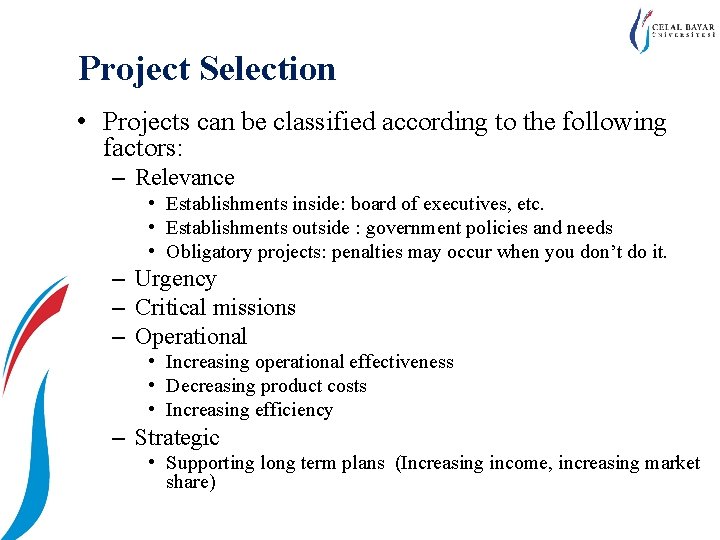
Project Selection • Projects can be classified according to the following factors: – Relevance • Establishments inside: board of executives, etc. • Establishments outside : government policies and needs • Obligatory projects: penalties may occur when you don’t do it. – Urgency – Critical missions – Operational • Increasing operational effectiveness • Decreasing product costs • Increasing efficiency – Strategic • Supporting long term plans (Increasing income, increasing market share)
Project Selection[1] • Project selection criteria (decision support systems consider) [1]: – Realism – Capability – Flexibility – Ease of use – Cost – Comparability
Factors in Project Screening and Selection [1] 1. Risk factor a) b) c) d) e) Technical risks Financial risks Safety risks Quality risks Legal risks 2. Commercial factors a) b) c) d) e) f) Expected return of investment Payback period Potential market share Long term market dominance Initial cash outlay Ability to generate new markets
Factors in Project Screening and Selection[1] 3. Internal operating issues a) b) c) d) Need for employee training/progress Changes in work force size or composition. Changes in the physical environment Change in manufacturing or service operations resulting from project. 4. Additional factors a) Patent protection b) Impact on company’s image c) Strategic fit
Project Selection Models [1] • Non-numerical models • Numerical models: uses numerical values as inputs.
Project Selection–Non-numerical Models [1] • Direct recommendation of top level management • Operational necessity – In order to keep up the ongoing system, the project is inevitable • Competitive advantage requirement – To keep your competitive advantage in the current market. • To extend product life cycle. • Comparative benefit model
Checklist Model Source: [1] Jeffrey K. Pinto. Project Management: Achieving Competitive Advantage, Second Edition, Published by Prentice Hall. Copyright © 2010 by Pearson Education, Inc. (Chapter 3). Performance on Criteria Project Alpha Project Criteria Cost Profit potential Time to market Development risks Beta Project Cost Profit potential Time to market Development risks Gamma Project Cost Profit potential Time to market Development risks Delta Project Cost Profit potential Time to market Development risks High x Medium Low x x x x
Checklist Model Kaynak: [1] Jeffrey K. Pinto. Project Management: Achieving Competitive Advantage, Second Edition, Published by Prentice Hall. Copyright © 2010 by Pearson Education, Inc. (Chapter 3). Performance on Criteria Project Alpha Project Criteria Cost Profit potential Time to market Development risks Beta Project Cost Profit potential Time to market Development risks Gamma Project Cost Profit potential Time to market Development risks Delta Project Cost Profit potential Time to market Development risks High x Medium Low x x x x
Disadvantages of Checklist Model [1] • Subjective measuring (high, medium, low) • Shortcomings in comparison of criteria: – If our criteria are differentially weighted? For example, if ‘time to market’ is much more important than the others? – How will we change our final decision? • Models which also consider importance of different criteria are necessary. . .
Simple Scoring Model [1] • A weight is assigned to each criterion according to its importance. • For all alternatives, a relative score value is assigned according to each criterion. • In each alternative, in order to find the weighted score values, – score values are multiplied by weights. • In order to obtain the final score of the project, the sum of weighted scores are calculated.
Simple Scoring Model Source: [1] Jeffrey K. Pinto. Project Management: Achieving Competitive Advantage, Second Edition, Published by Prentice Hall. Copyright © 2010 by Pearson Education, Inc. (Chapter 3). Project Alpha Project Criterion Cost Profit potential Time to market Development risks (A) (B) (A) X (B) Importance Weight Score Weighted Score 1 2 3 1 2 1 3 2 6 2 2 2 3 2 13 2 4 9 4 19 Total Score Beta Project Cost Profit potential Time to market Development risks Total Score 1 2 3 2
Simple Scoring Model[1] Source: [1] Jeffrey K. Pinto. Project Management: Achieving Competitive Advantage, Second Edition, Published by Prentice Hall. Copyright © 2010 by Pearson Education, Inc. (Chapter 3). Project Criterion Gamma Project Cost Profit potential Time to market Development risks (A) (B) (A)X (B) Importance Weight Score Weighted Score 1 2 3 3 1 2 3 2 1 1 3 2 3 6 18 1 2 9 4 16 Total Score Delta Project Cost Profit potential Time to market Development risks Total Score
Disadvantages of Simple Scoring Model [1] • Doing evaluation in the given scale may be wrong mathematically. – For 3 (High) and 2 (Medium), we know that 3 is better than 2 but how much? – Can we assume that the difference between 3 and 2 is same as the difference between 2 and 1. • We cannot say that there is a meaningful relation between the given weights and score values.
IND 3102 Project Management Organizational Structures and Project Selection References: [1] Jeffrey K. Pinto. Project Management: Achieving Competitive Advantage, Second Edition, Chapter 3, Published by Prentice Hall. Copyright © 2010 by Pearson Education, Inc. [2] Shtub, A. , Bard, J. F. , & Globerson, S. (2005). Project management: Processes, methodologies, and economics. Pearson Prentice Hall. [3] PMP Proje Yönetimi Bilgi Birikimi Kılavuzu (PMBOK Kılavuzu), PMI, 5. Baskı, İstanbul, 2013. [4] http: //www. gokremtekir. com/index. php/2009/02/03/pmia-gore-matrisorganizasyonlar/ [5] http: //www. deu. edu. tr/userweb/k. yaralioglu/dosyalar/Analitik_Hiyerarsi_Proses. doc. [6] PMI. "A guide to the project management body of knowledge (PMBOK guide). " Project Management Institute, 2000.