
Incremental Threat Modelling Never try to boil an

Incremental Threat Modelling Never try to boil an ocean
Who am I Security consultant at NCC Group • Coming from software development and architecture • 20 years as software engineer, architect, technical lead • Variety of consulting and testing work • From large financial organisations to start-ups • Favourite engagement type – threat modelling 2

Agenda STRIDE – quick recap Introducing our example Incremental modelling walk-through Sting in the tail Conclusions Q&A 3
Threat modelling Reminder • Decompose architecture using DFDs • Search for threats using STRIDE • Rank or quantify – out of scope for today 4
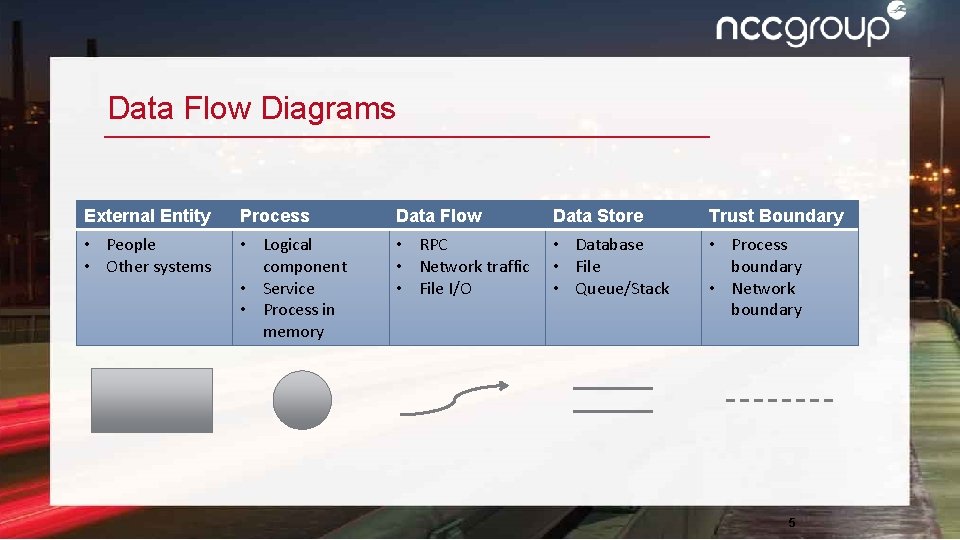
Data Flow Diagrams External Entity Process Data Flow Data Store Trust Boundary • People • Other systems • Logical component • Service • Process in memory • RPC • Network traffic • File I/O • Database • File • Queue/Stack • Process boundary • Network boundary 5
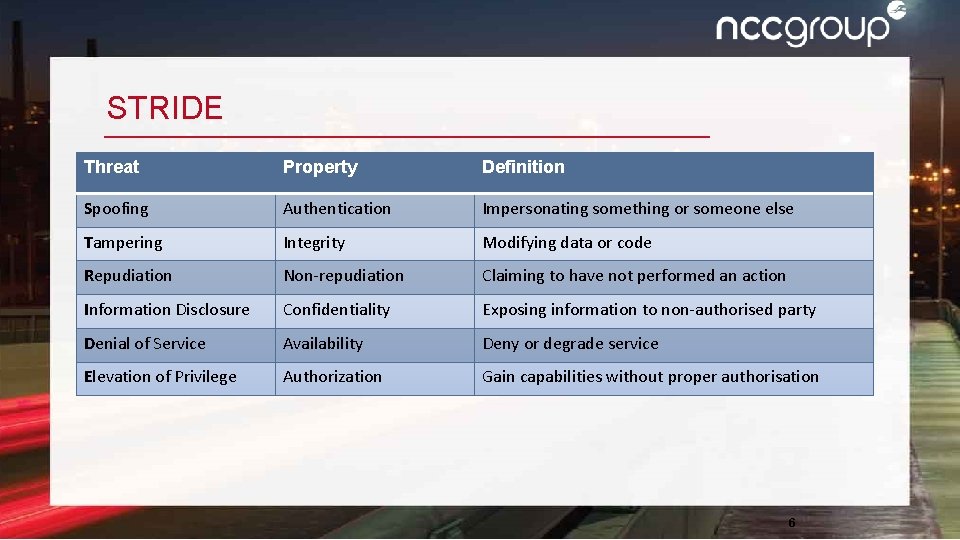
STRIDE Threat Property Definition Spoofing Authentication Impersonating something or someone else Tampering Integrity Modifying data or code Repudiation Non-repudiation Claiming to have not performed an action Information Disclosure Confidentiality Exposing information to non-authorised party Denial of Service Availability Deny or degrade service Elevation of Privilege Authorization Gain capabilities without proper authorisation 6
Introducing our example • Explain the existing architecture and the feature we are planning to add • Pretend that threat model for the existing part does not exist • Model new feature 7
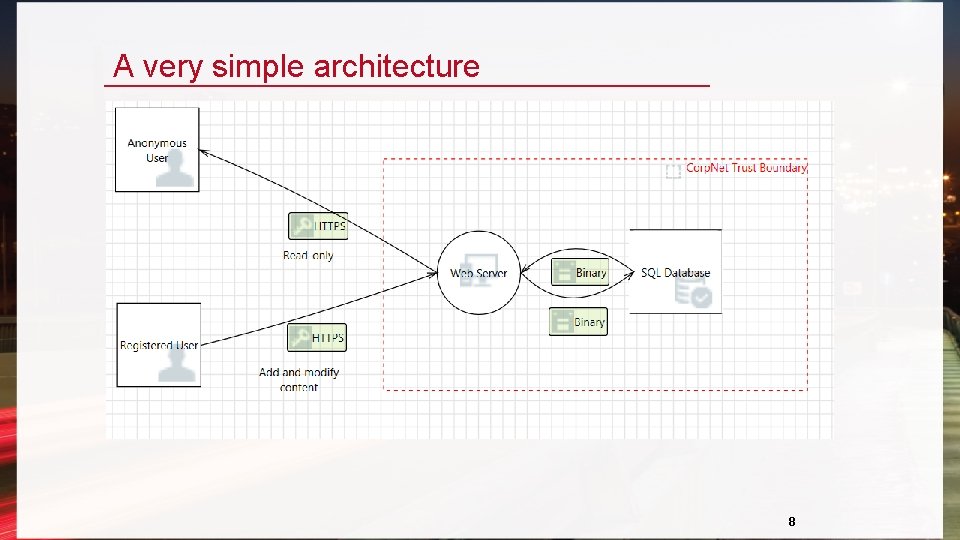
A very simple architecture 8
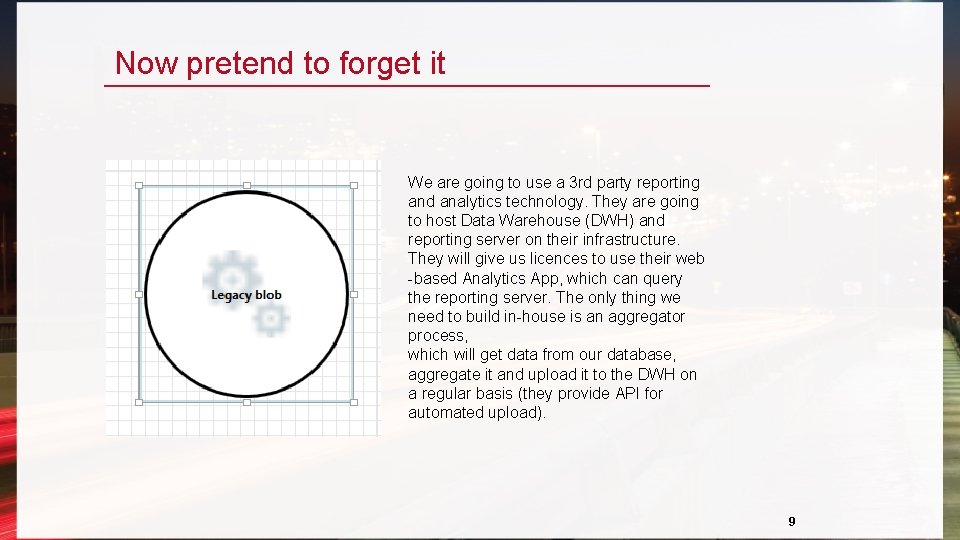
Now pretend to forget it We are going to use a 3 rd party reporting and analytics technology. They are going to host Data Warehouse (DWH) and reporting server on their infrastructure. They will give us licences to use their web -based Analytics App, which can query the reporting server. The only thing we need to build in-house is an aggregator process, which will get data from our database, aggregate it and upload it to the DWH on a regular basis (they provide API for automated upload). 9
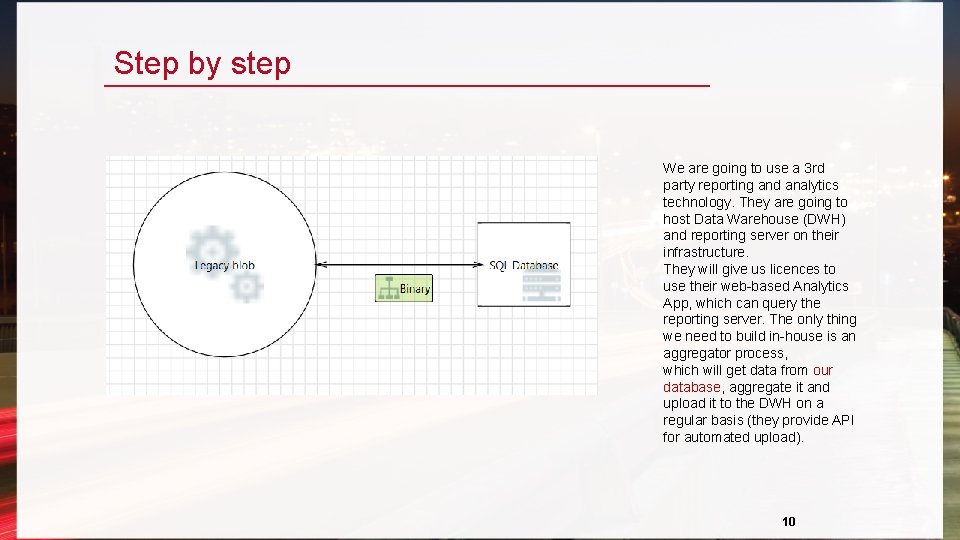
Step by step We are going to use a 3 rd party reporting and analytics technology. They are going to host Data Warehouse (DWH) and reporting server on their infrastructure. They will give us licences to use their web-based Analytics App, which can query the reporting server. The only thing we need to build in-house is an aggregator process, which will get data from our database, aggregate it and upload it to the DWH on a regular basis (they provide API for automated upload). 10
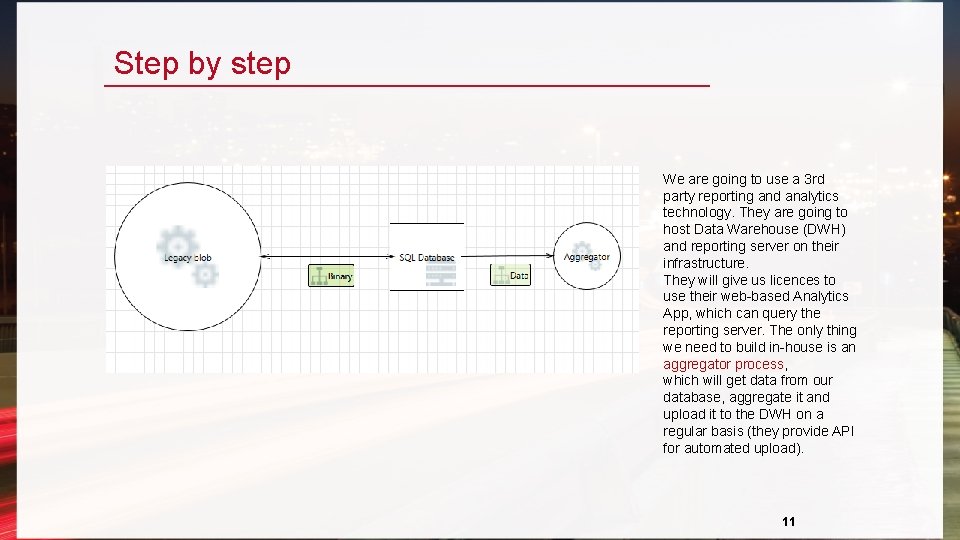
Step by step We are going to use a 3 rd party reporting and analytics technology. They are going to host Data Warehouse (DWH) and reporting server on their infrastructure. They will give us licences to use their web-based Analytics App, which can query the reporting server. The only thing we need to build in-house is an aggregator process, which will get data from our database, aggregate it and upload it to the DWH on a regular basis (they provide API for automated upload). 11
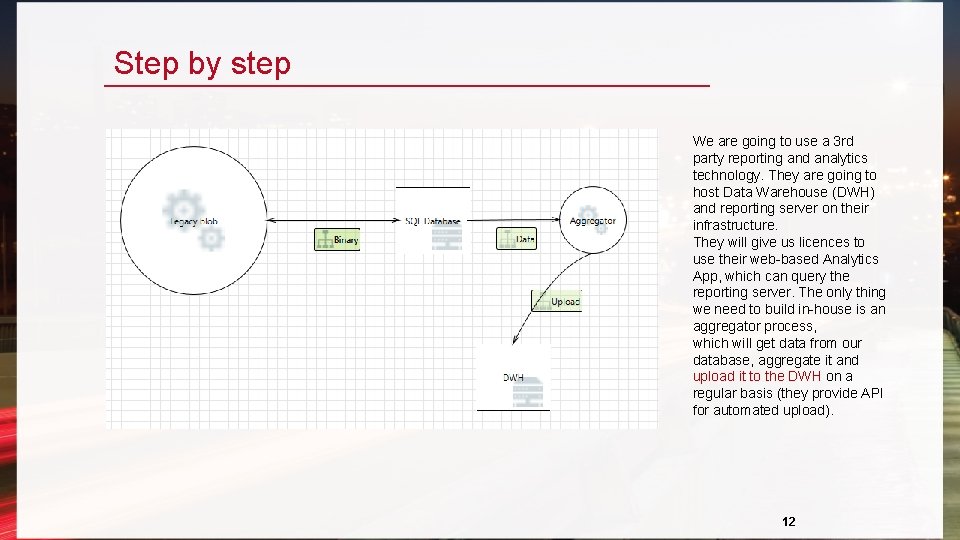
Step by step We are going to use a 3 rd party reporting and analytics technology. They are going to host Data Warehouse (DWH) and reporting server on their infrastructure. They will give us licences to use their web-based Analytics App, which can query the reporting server. The only thing we need to build in-house is an aggregator process, which will get data from our database, aggregate it and upload it to the DWH on a regular basis (they provide API for automated upload). 12
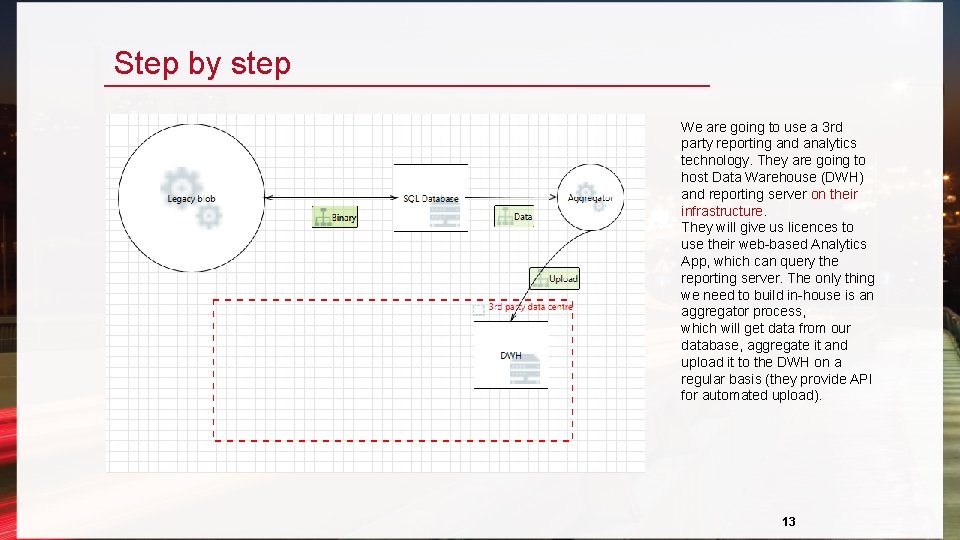
Step by step We are going to use a 3 rd party reporting and analytics technology. They are going to host Data Warehouse (DWH) and reporting server on their infrastructure. They will give us licences to use their web-based Analytics App, which can query the reporting server. The only thing we need to build in-house is an aggregator process, which will get data from our database, aggregate it and upload it to the DWH on a regular basis (they provide API for automated upload). 13
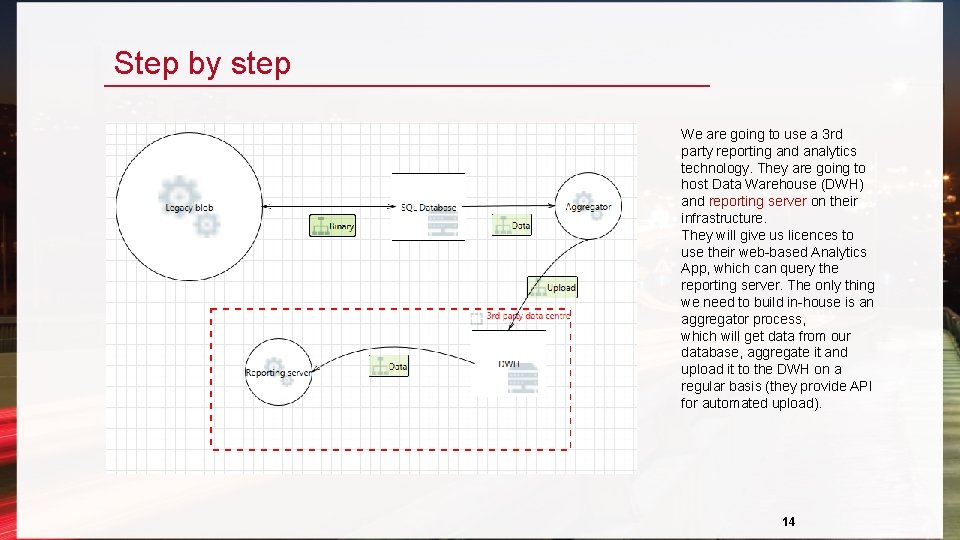
Step by step We are going to use a 3 rd party reporting and analytics technology. They are going to host Data Warehouse (DWH) and reporting server on their infrastructure. They will give us licences to use their web-based Analytics App, which can query the reporting server. The only thing we need to build in-house is an aggregator process, which will get data from our database, aggregate it and upload it to the DWH on a regular basis (they provide API for automated upload). 14
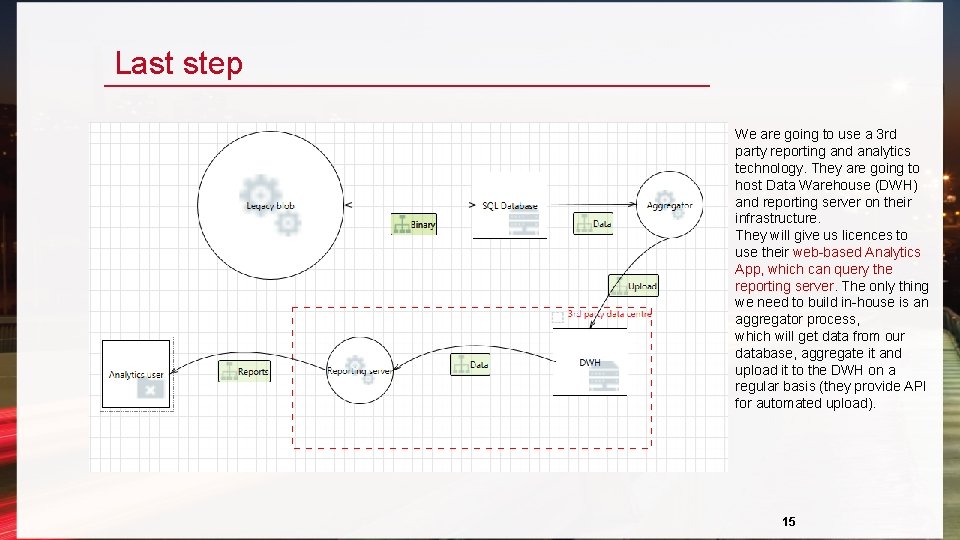
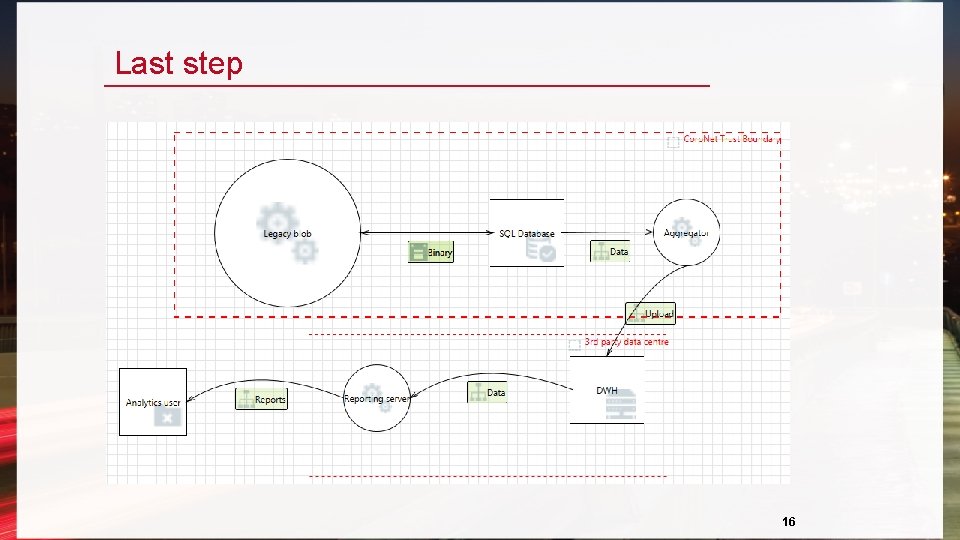
Last step We are going to use a 3 rd party reporting and analytics technology. They are going to host Data Warehouse (DWH) and reporting server on their infrastructure. They will give us licences to use their web-based Analytics App, which can query the reporting server. The only thing we need to build in-house is an aggregator process, which will get data from our database, aggregate it and upload it to the DWH on a regular basis (they provide API for automated upload). 15
Last step 16
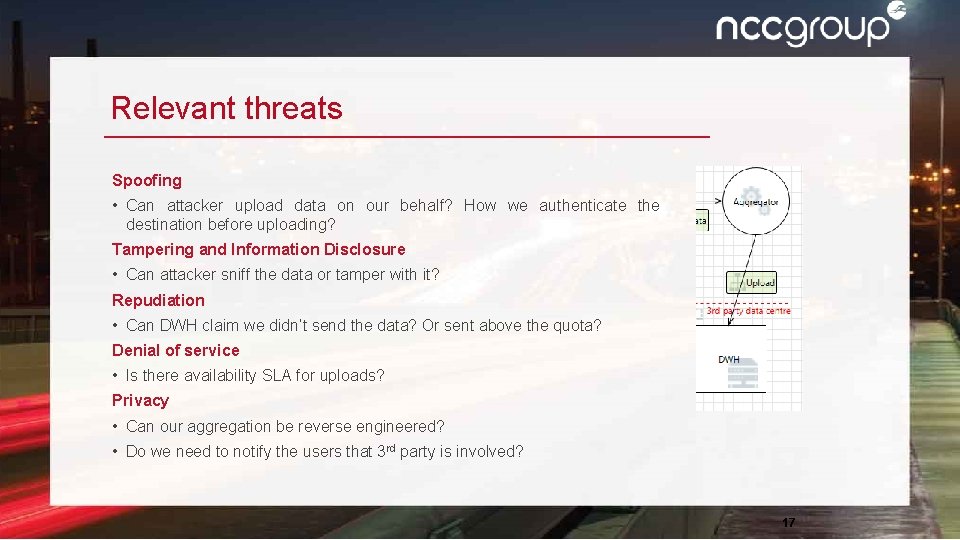
Relevant threats Spoofing • Can attacker upload data on our behalf? How we authenticate the destination before uploading? Tampering and Information Disclosure • Can attacker sniff the data or tamper with it? Repudiation • Can DWH claim we didn’t send the data? Or sent above the quota? Denial of service • Is there availability SLA for uploads? Privacy • Can our aggregation be reverse engineered? • Do we need to notify the users that 3 rd party is involved? 17
Irrelevant threats 18
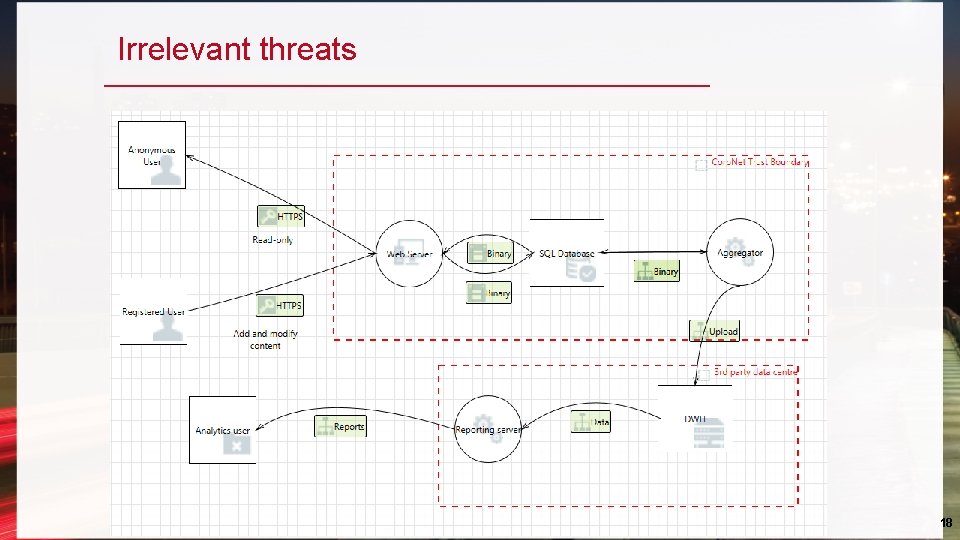
Irrelevant threats – how to make them go away • Can registered user inject malicious content? • We are not making it worse • Can anonymous user bypass access controls and modify something? • We are not making it worse • Is our datacentre infrastructure secure? • We are not making it worse (careful here!) • Can analytics user abuse licencing? • Not our problem, 3 rd party problem 19
Caveats Not our problem • If the team’s task is not just to implement with a chosen provider, but to evaluate several providers. We are not making it worse • If you come across something so catastrophic in the “Legacy blob”, that it’s an immediately obvious critical flaw. 20
What if implementation deviates from design? • Aggregator is implemented as two processes: one to read and aggregate the data, the other for actual upload • Time pressure and we MUST have analytics in the release. Let’s create a user for this 3 rd party so they pull data directly from our DB. 21
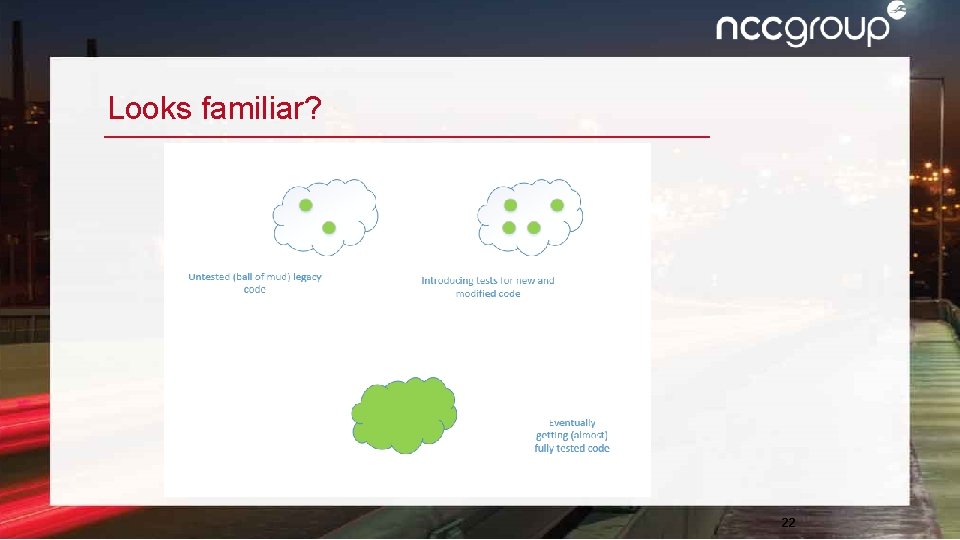
Looks familiar? 22
This thinking does not work in security! Examples: • NTVDM bug – found in 2010, introduced in 1993 • Shellshock – found in 2014, introduced in 1989 • Heartbleed – found in 2014, introduced in 2011 • POODLE – found in 2014, existed since 1996 • JASBUG – found in 2015, introduced in 2000 • DROWN, Badlock, gotofail, etc. 23

Eventually we need to see the whole picture Reasons: • What we don’t know can harm us • The system is greater than the sum of its parts 24
Why eventually is better than upfront • People have developed the necessary skills • Many subsystems will be already analysed • Easier to achieve management buy-in 25
Conclusion • Incremental threat modelling can fit any time-box, without disturbing the regular development cadence. • You can build a model of the whole system in parallel, starting from day 1, or waiting for several cycles, whatever suits your situation. • As a shortcut, you can bring external resources to help with the initial model. • But for the best results in agile environment you have to involve the whole team. 26
Points of contact Irene Michlin Principal Security Consultant M: +44 (0) 7972 333 148 E: irene. michlin@nccgroup. trust T: @Irene. Michlin 27
Locations North America Europe Australia Atlanta Austin Chicago Kitchener New York San Francisco Seattle Sunnyvale Manchester - Head Office Amsterdam Basingstoke Cambridge Copenhagen Cheltenham Delft Edinburgh Glasgow Leatherhead Leeds London Luxembourg Madrid Malmö Milton Keynes Munich Vilnius Zurich Sydney 28
- Slides: 28