
Incremental Frequent Route Based Trajectory Prediction Anja Bachmann

Incremental Frequent Route Based Trajectory Prediction Anja Bachmann Christian Borgelt Gyözö Gidofalvi Karlsruhe Institute of Technology European Centre for Soft Computing KTH – Royal Institute of Technology
Outline § Introduction § Related work § Inc. CCFR § § Trajectory representation Stream processing model Incremental mining of Closed Contiguous Frequent Routes (CCFR) CCFR-based trajectory prediction § Empirical evaluations 2013 -11 -05 IWCTS 2013, Orlando, FL 2
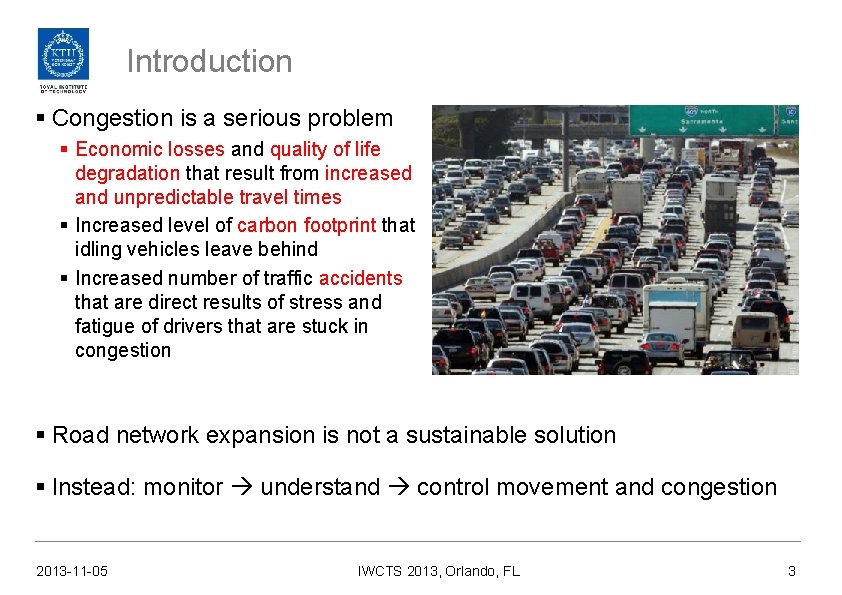
Introduction § Congestion is a serious problem § Economic losses and quality of life degradation that result from increased and unpredictable travel times § Increased level of carbon footprint that idling vehicles leave behind § Increased number of traffic accidents that are direct results of stress and fatigue of drivers that are stuck in congestion § Road network expansion is not a sustainable solution § Instead: monitor understand control movement and congestion 2013 -11 -05 IWCTS 2013, Orlando, FL 3
Modern Traffic Prediction and Managemnt System (TPMS) § Motivated by: § Widespread adoption of online GPS-based on-board navigation systems and location-aware mobile devices § Movement of an individual contains a high degree of regularity § Use vehicle movement data as follows: § Vehicles periodically send their location (and speed) to TPMS § TPMS extracts traffic / mobility patterns from the submitted information § TPMS uses traffic / mobility patterns + current / recent historical locations (and speeds) of the vehicles for: § Short-term traffic prediction and management: § Predict near-future locations of vehicles and near-future traffic conditions § Inform the relevant vehicles in case of an (actual / predicted) event § Suggest how and which vehicles to re-route in case of an event § Long-term traffic and transport planning 2013 -11 -05 IWCTS 2013, Orlando, FL 4
Remaining Challenges § Sequential pattern based trajectory prediction is difficult to adopt to capture the temporal and periodic variations § Trajectory prediction systems model and provide knowledge about the movement of the objects at a fixed level of detail, while different applications (real-time management vs. long-term planning) need different levels of detail. § Predictions tend to be based on either historical or current information while both types of information are relevant. § No end-to-end system for management, incremental mining and accurate prediction of continuously evolving trajectories of moving objects. 2013 -11 -05 IWCTS 2013, Orlando, FL 5
Outline § Introduction § Related work § Inc. CCFR § § Trajectory representation Stream processing model Incremental mining of Closed Contiguous Frequent Routes (CCFR) CCFR-based trajectory prediction § Empirical evaluations 2013 -11 -05 IWCTS 2013, Orlando, FL 6
Related Work: Frequent Pattern Mining § 20 years of research § Frequent pattern types: itemsets sequences graphs § Exponential search space is pruned based on the anti-monotonicity of the pattern support measure given a minimum support threshold min_sup § Pattern constraints: § Maximal (lossy): Pattern X is a maximal if X is frequent and there does not exist another pattern Y that is a proper superset of X that is frequent. lossy § Closed (lossless): Pattern X is closed if X is frequent and there does not exist another pattern Y that is a proper superset of X that has the same support as X. § Processing models: batch online / stream incremental 2013 -11 -05 IWCTS 2013, Orlando, FL 7
Related Work: Trajectory Prediction § Prediction model § Markov model § Sequential rule / trajectory pattern § Model basis / generality § General model for all objects § Type-base model for similar (type of) objects § Specific model for each individual object § Definition of Regions Of Interest (ROI) for prediction § Application specific ROIs (road segments, network cells, sensors, etc. ) § Density-based ROIs § Grid-based ROIs § Prediction provision § Sequential spatial prediction (loc. of next ROI) § Spatio-temporal prediction § Additional movement assumptions or models: YES / NO 2013 -11 -05 IWCTS 2013, Orlando, FL 8
Outline § Introduction § Related work § Inc. CCFR § § Trajectory representation Stream processing model Incremental mining of Closed Contiguous Frequent Routes (CCFR) CCFR-based trajectory prediction § Empirical evaluations 2013 -11 -05 IWCTS 2013, Orlando, FL 9
Trajectory Representation § Grid G with side length glen uniformly partitions the 2 D space § Representation is without limitations, easily scalable to different level of details § Grid based trajectory: § start time § temporally annotated sequence: sequence of traversed grid cells and associated traversal times § Modeling the stopping of objects: append a pseudo grid cell (‘stop’) after the last (real) grid cell of each completed trip trajectory 2013 -11 -05 IWCTS 2013, Orlando, FL 10
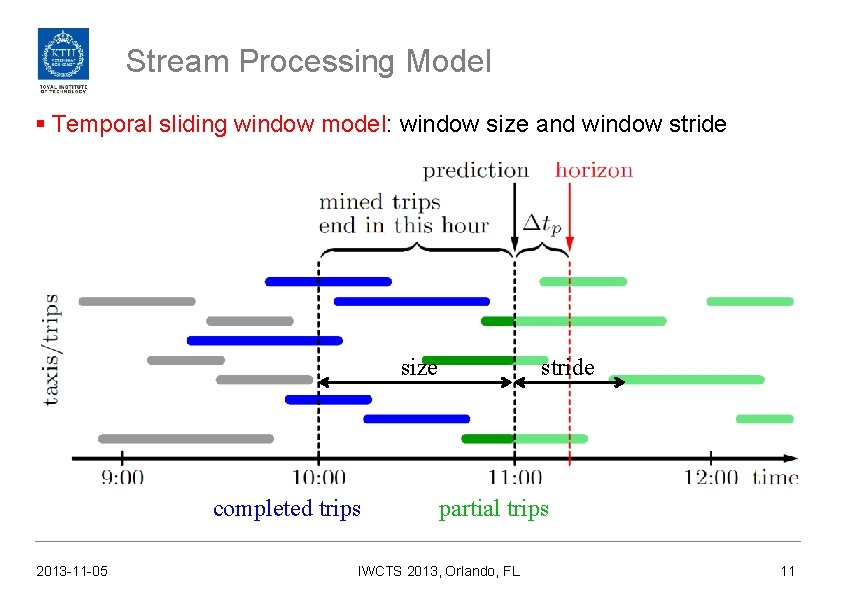
Stream Processing Model § Temporal sliding window model: window size and window stride size completed trips 2013 -11 -05 stride partial trips IWCTS 2013, Orlando, FL 11
Mining of Closed Contiguous Frequent Routes § Grow CCFRs (or patterns) in a depth-first fashion § Start with single grid cells § Recursively extend by adding one grid cell in each recursion § Data structure: § Simple flat array representation of the trajectories is used § References are kept to the current ends of the pattern occurrences in order to be able to quickly find and group possible extensions. § Simple and fast closedness checking of contiguous patterns: direct check of possible superpatterns and their support by generating and testing all possible extensions of a given pattern § Without limitations, annotate CCFRs with global traversal times of grid cells 2013 -11 -05 IWCTS 2013, Orlando, FL 12
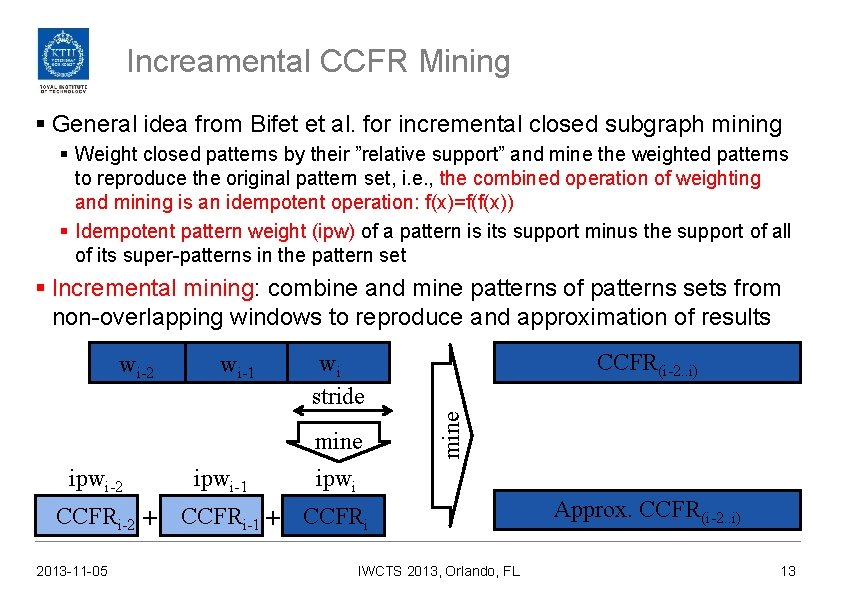
Increamental CCFR Mining § General idea from Bifet et al. for incremental closed subgraph mining § Weight closed patterns by their ”relative support” and mine the weighted patterns to reproduce the original pattern set, i. e. , the combined operation of weighting and mining is an idempotent operation: f(x)=f(f(x)) § Idempotent pattern weight (ipw) of a pattern is its support minus the support of all of its super-patterns in the pattern set § Incremental mining: combine and mine patterns of patterns sets from non-overlapping windows to reproduce and approximation of results wi-1 mine ipwi-2 ipwi-1 CCFR(i-2. . i) wi stride mine wi-2 ipwi CCFRi-2 + CCFRi-1 + CCFRi 2013 -11 -05 IWCTS 2013, Orlando, FL Approx. CCFR(i-2. . i) 13
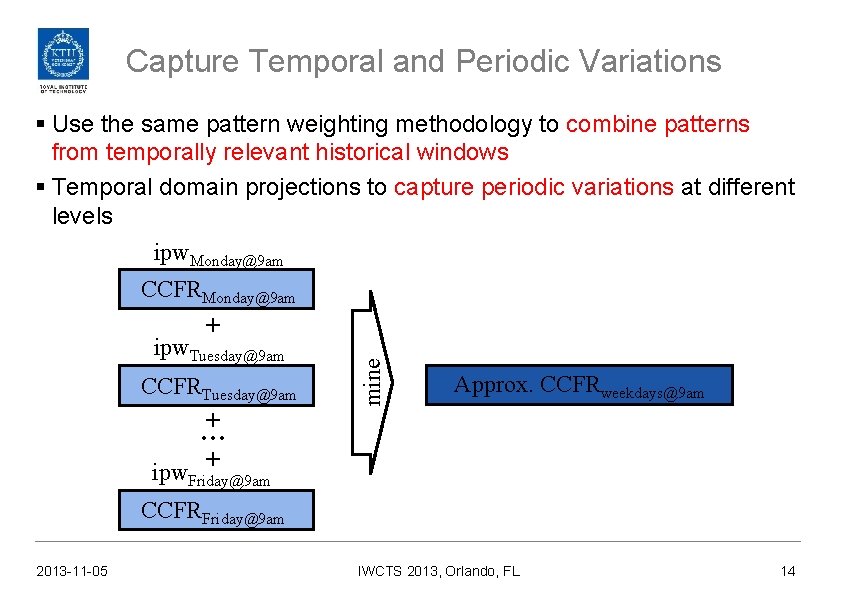
Capture Temporal and Periodic Variations § Use the same pattern weighting methodology to combine patterns from temporally relevant historical windows § Temporal domain projections to capture periodic variations at different levels ipw. Monday@9 am CCFRMonday@9 am ipw. Tuesday@9 am CCFRTuesday@9 am + … + ipw. Friday@9 am mine + Approx. CCFRweekdays@9 am CCFRFriday@9 am 2013 -11 -05 IWCTS 2013, Orlando, FL 14
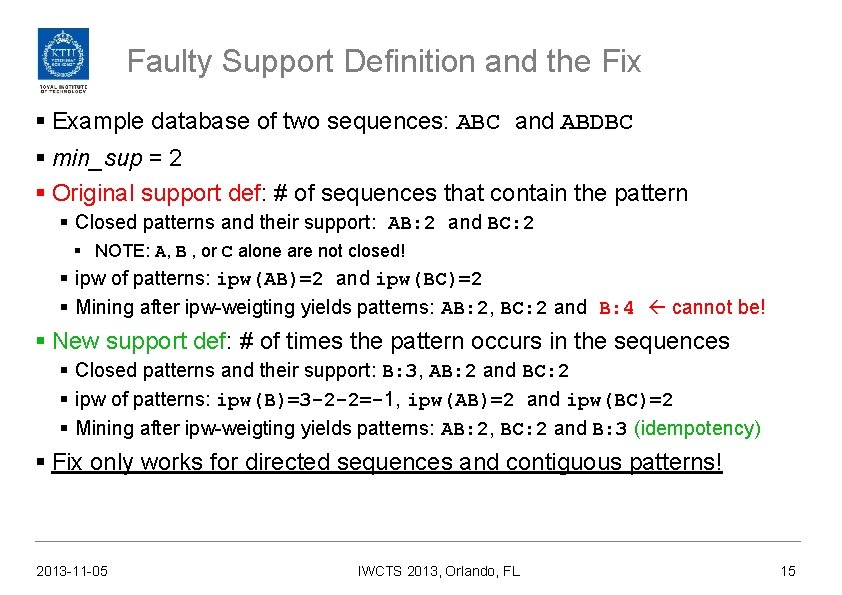
Faulty Support Definition and the Fix § Example database of two sequences: ABC and ABDBC § min_sup = 2 § Original support def: # of sequences that contain the pattern § Closed patterns and their support: AB: 2 and BC: 2 § NOTE: A, B , or C alone are not closed! § ipw of patterns: ipw(AB)=2 and ipw(BC)=2 § Mining after ipw-weigting yields patterns: AB: 2, BC: 2 and B: 4 cannot be! § New support def: # of times the pattern occurs in the sequences § Closed patterns and their support: B: 3, AB: 2 and BC: 2 § ipw of patterns: ipw(B)=3 -2 -2=-1, ipw(AB)=2 and ipw(BC)=2 § Mining after ipw-weigting yields patterns: AB: 2, BC: 2 and B: 3 (idempotency) § Fix only works for directed sequences and contiguous patterns! 2013 -11 -05 IWCTS 2013, Orlando, FL 15
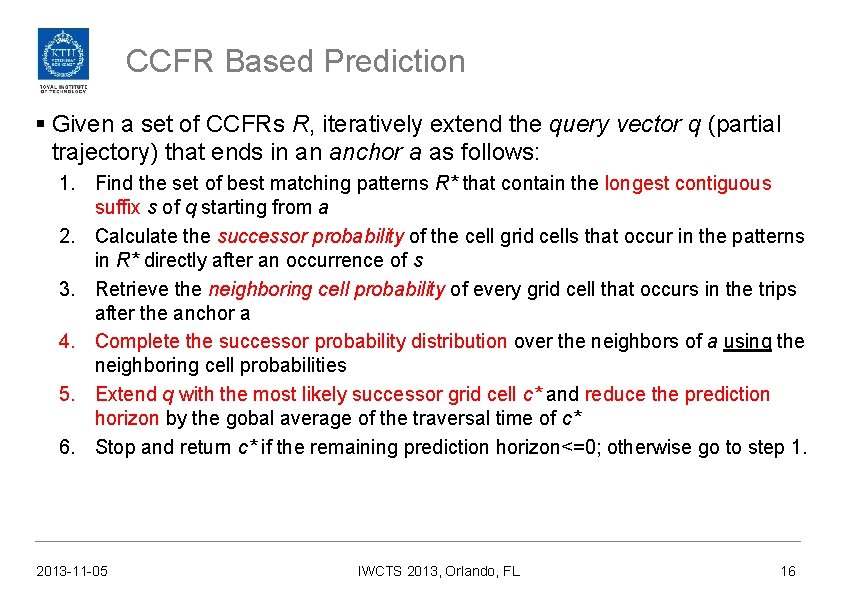
CCFR Based Prediction § Given a set of CCFRs R, iteratively extend the query vector q (partial trajectory) that ends in an anchor a as follows: 1. Find the set of best matching patterns R* that contain the longest contiguous suffix s of q starting from a 2. Calculate the successor probability of the cell grid cells that occur in the patterns in R* directly after an occurrence of s 3. Retrieve the neighboring cell probability of every grid cell that occurs in the trips after the anchor a 4. Complete the successor probability distribution over the neighbors of a using the neighboring cell probabilities 5. Extend q with the most likely successor grid cell c* and reduce the prediction horizon by the gobal average of the traversal time of c* 6. Stop and return c* if the remaining prediction horizon<=0; otherwise go to step 1. 2013 -11 -05 IWCTS 2013, Orlando, FL 16
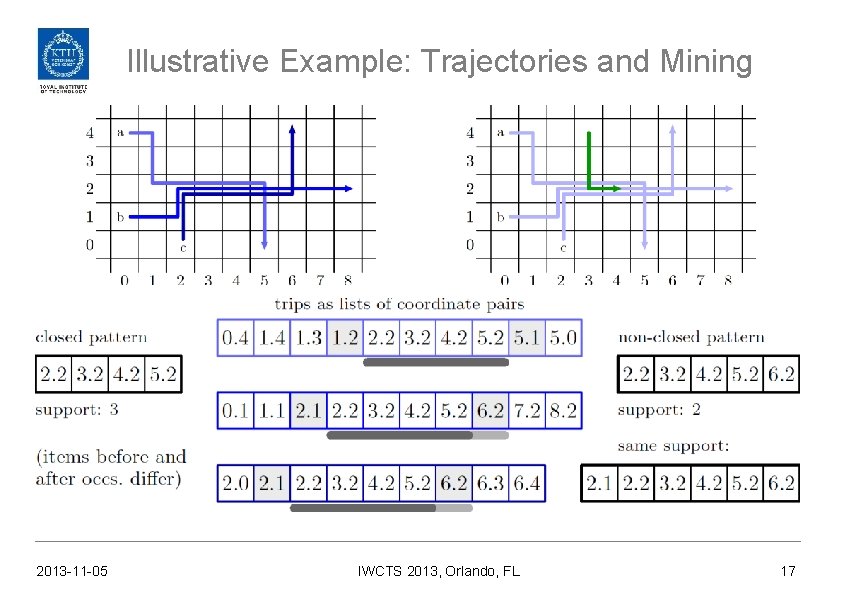
Illustrative Example: Trajectories and Mining 2013 -11 -05 IWCTS 2013, Orlando, FL 17
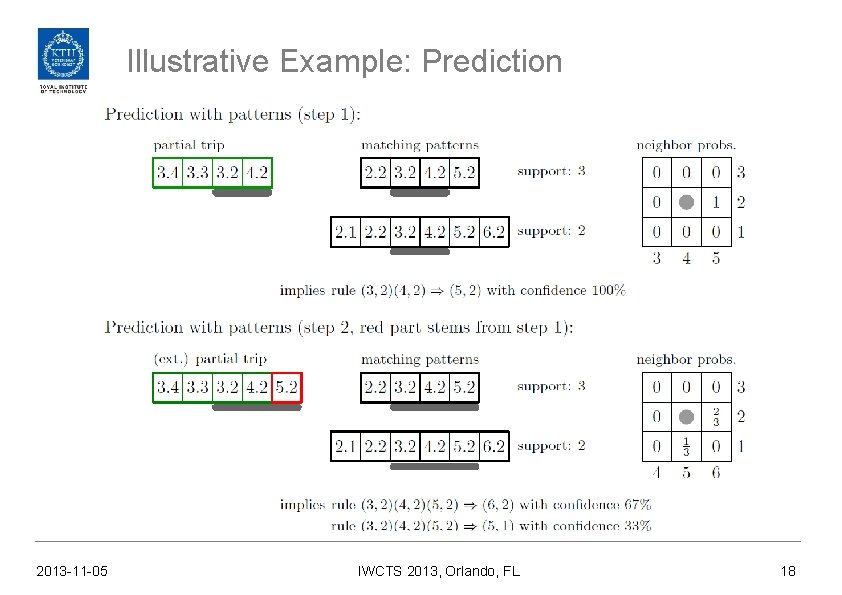
Illustrative Example: Prediction 2013 -11 -05 IWCTS 2013, Orlando, FL 18
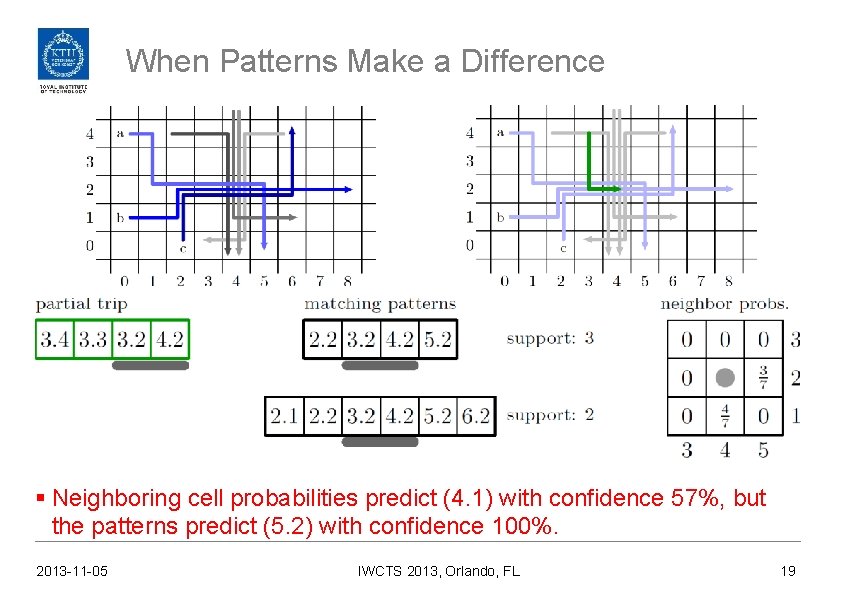
When Patterns Make a Difference § Neighboring cell probabilities predict (4. 1) with confidence 57%, but the patterns predict (5. 2) with confidence 100%. 2013 -11 -05 IWCTS 2013, Orlando, FL 19
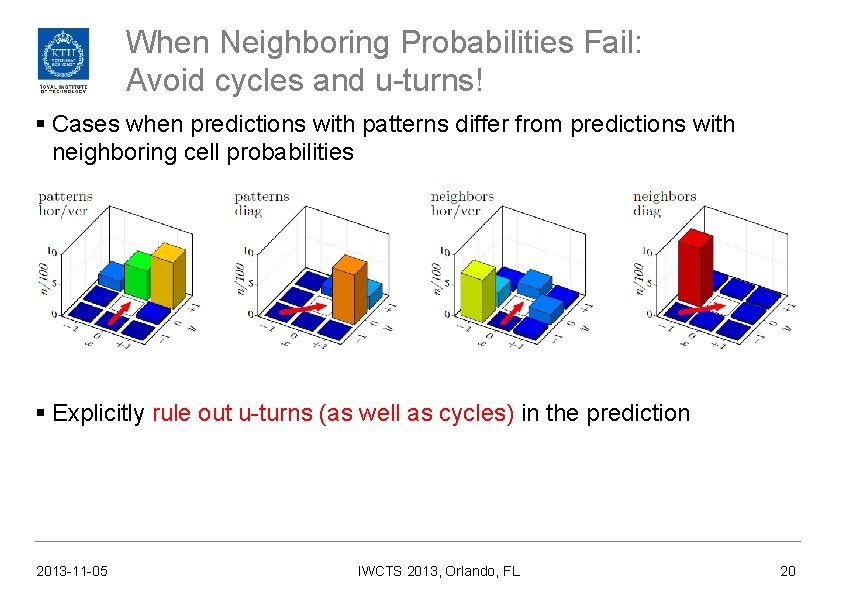
When Neighboring Probabilities Fail: Avoid cycles and u-turns! § Cases when predictions with patterns differ from predictions with neighboring cell probabilities § Explicitly rule out u-turns (as well as cycles) in the prediction 2013 -11 -05 IWCTS 2013, Orlando, FL 20
Outline § Introduction § Related work § Inc. CCFR § § Trajectory representation Stream processing model Incremental mining of Closed Contiguous Frequent Routes (CCFR) CCFR-based trajectory prediction § Empirical evaluations 2013 -11 -05 IWCTS 2013, Orlando, FL 21
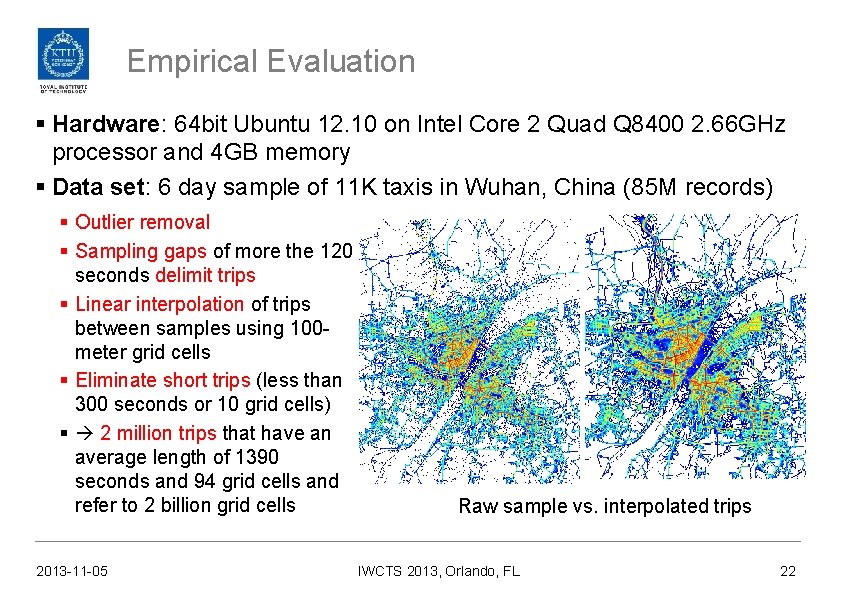
Empirical Evaluation § Hardware: 64 bit Ubuntu 12. 10 on Intel Core 2 Quad Q 8400 2. 66 GHz processor and 4 GB memory § Data set: 6 day sample of 11 K taxis in Wuhan, China (85 M records) § Outlier removal § Sampling gaps of more the 120 seconds delimit trips § Linear interpolation of trips between samples using 100 meter grid cells § Eliminate short trips (less than 300 seconds or 10 grid cells) § 2 million trips that have an average length of 1390 seconds and 94 grid cells and refer to 2 billion grid cells 2013 -11 -05 Raw sample vs. interpolated trips IWCTS 2013, Orlando, FL 22
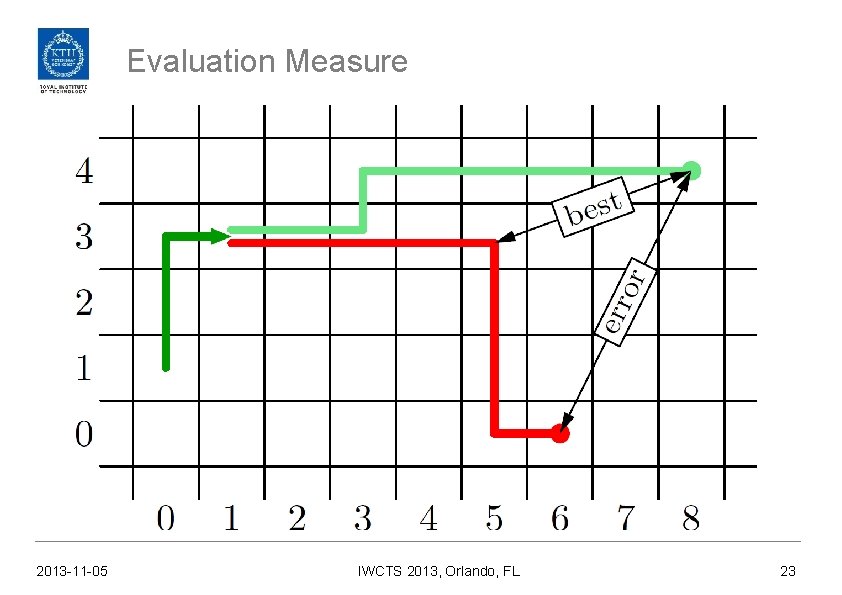
Evaluation Measure 2013 -11 -05 IWCTS 2013, Orlando, FL 23
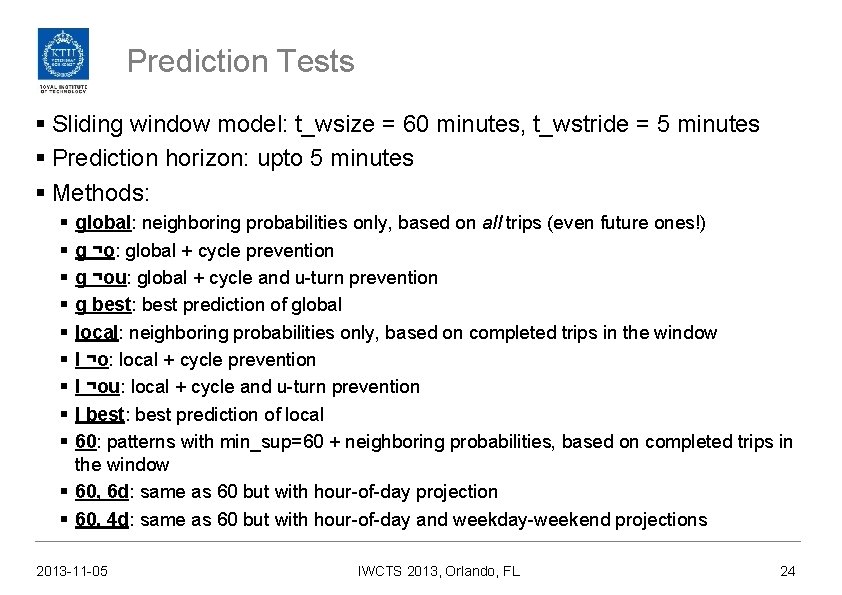
Prediction Tests § Sliding window model: t_wsize = 60 minutes, t_wstride = 5 minutes § Prediction horizon: upto 5 minutes § Methods: § § § § § global: neighboring probabilities only, based on all trips (even future ones!) g ¬o: global + cycle prevention g ¬ou: global + cycle and u-turn prevention g best: best prediction of global local: neighboring probabilities only, based on completed trips in the window l ¬o: local + cycle prevention l ¬ou: local + cycle and u-turn prevention l best: best prediction of local 60: patterns with min_sup=60 + neighboring probabilities, based on completed trips in the window § 60, 6 d: same as 60 but with hour-of-day projection § 60, 4 d: same as 60 but with hour-of-day and weekday-weekend projections 2013 -11 -05 IWCTS 2013, Orlando, FL 24
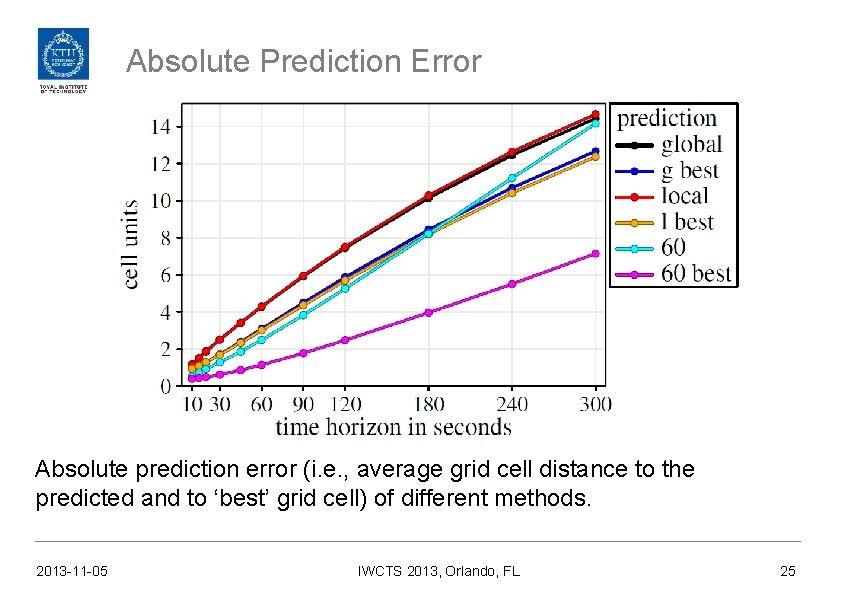
Absolute Prediction Error Absolute prediction error (i. e. , average grid cell distance to the predicted and to ‘best’ grid cell) of different methods. 2013 -11 -05 IWCTS 2013, Orlando, FL 25
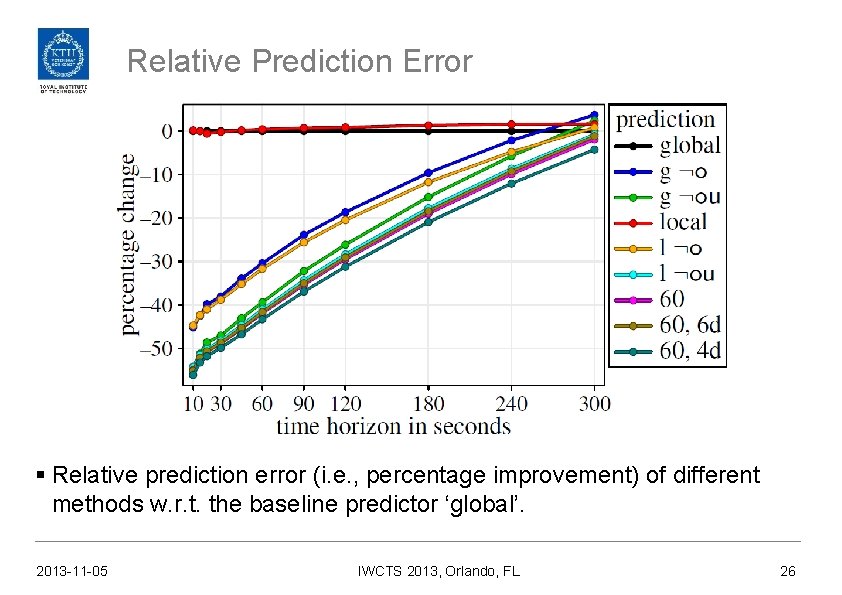
Relative Prediction Error § Relative prediction error (i. e. , percentage improvement) of different methods w. r. t. the baseline predictor ‘global’. 2013 -11 -05 IWCTS 2013, Orlando, FL 26
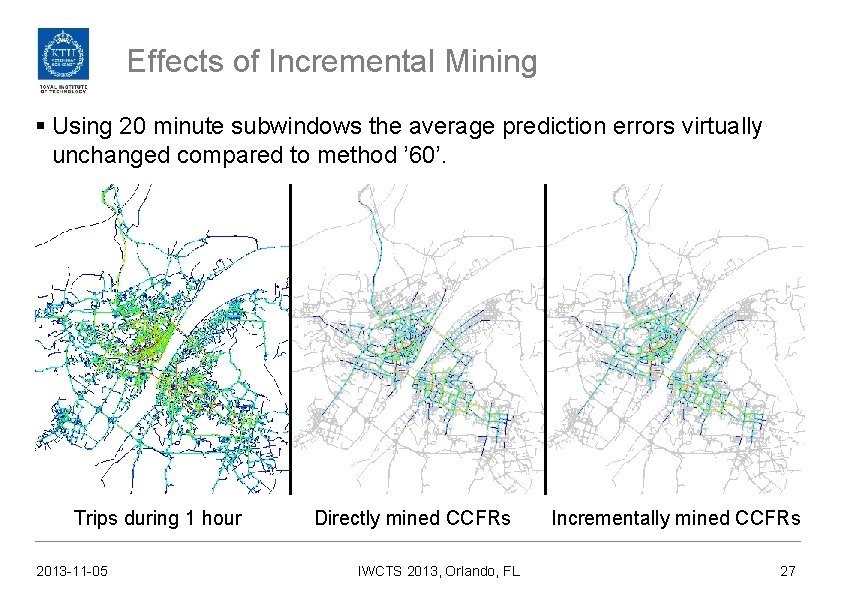
Effects of Incremental Mining § Using 20 minute subwindows the average prediction errors virtually unchanged compared to method ’ 60’. Trips during 1 hour 2013 -11 -05 Directly mined CCFRs IWCTS 2013, Orlando, FL Incrementally mined CCFRs 27
Conclusions and Future Work § Inc. CCFR: a novel, incremental approach for managing, mining, and predicting the incrementally evolving trajectories of moving object § Essentially a varying order, deterministic Markov model that is based on closed contiguous frequent routes and neighboring cell probabilities § Advantages: § Reduced mining and storage costs § Ability to combine multiple temporally relevant mining results from the past to capture temporal and periodic regularities in movement § Future work: § Use pattern combination approach to parallelize mining § Use current speed + historical CCFRs to be able to react to rare, unpredictable, sudden changes 2013 -11 -05 IWCTS 2013, Orlando, FL 28

Thank you for your attention! Q/A? 2013 -11 -05 IWCTS 2013, Orlando, FL 29
- Slides: 29