
Increasing Speaking Listening Reading and Writing Vocabularies and
Increasing Speaking, Listening, Reading, and Writing Vocabularies and Word Recognition Chapter 5
How students decode and develop vocabularies b. Parallel distributed processing ( how brain associates words with their meaning) The brain detects patterns in sounds and symbols it sees bcan acquire vocabulary through experiences in literature in an integrated program b. The major difference between poor and better readers is that better readers read more than poorer ones and better readers recognize the meanings of most words instantly and automatically.
How can teachers help? b. Read aloud to students b. Give more chances to talk, read, and speak b. By third or fourth grade, children’s ability to continuously expand their oral vocabularies will significantly affect their level of lifelong reading success. b. Varied heterogeneous reading groups buse of multiple decoding strategies for learning new words.
How can we help build vocabulary ? b. Teach students to think of how words relate to each other bidentify new vocabulary as you read banticipate new words they may encounter bwrite the new words as you are saying them
Semantic mapping or webbing b. The visual organization in which thoughts and ideas are diagramed to demonstrate their relationship to each other. b. Library of Graphic Organizers
Decoding and Encoding b. Decoding changes written word or spoken word into meaning. b. Student must use certain strategies and check decoding against their understandings about life, and what makes sense in the story b. Encoding translates the word into letters or sounds that will communicate to others
Teaching sight word strategies b. Content -specific sight words bteach in context of subject matter bword imagery b. Basic sight words bconfiguration(shape) bteach most used words first
b. Signal sight words b. Shows relationship, order, summations, or changes in thoughts and ideas, more of same or different coming buse same word in different sentences bteach directly
Phonics b. Science of matching speech sounds to printed letters while reading and spelling bcontroversy b. Use fourteen generalizations to decode 80% of the phonetically regular English words
Phonetic generalizations b. Use when a word looks similar to one they already know b. Model how to select the proper generalization bstop at difficult word bthink about words around it btell how you selected generalization blet students do a think aloud b. Learn to use fourteen generalizations rapidly and independently blearn letter names and phonemes blearn reoccurring spelling patterns blearn most common sequence of letters within words
b. Decode by analogy (comparisons) b. Use rhyme b. Use words in language experience b. Blending b. Say medial vowel sound first b. Blend beginning sound with b. Add ending sound b. Change words that begin with a single consonant to ones with blends
Structural Analysis b. Analyze sections of the multisyllable word to determine meaning and build vocabulary broot words, suffixes, prefixes b. Spelling patterns
Semantic and Syntactic context clues b. Use position word holds in a sentence b. Use meanings of words around it in the sentence bcontextual wedges
Using Dictionaries and thesauruses b. Teach dictionary usage b. Dictionary sword drills bdefinitions general to specialized bidentify meaning used in reading buse first letter to open to most efficient place balphabetical order to third letter bguide words bdiacritical markings and accents
b. Locate the parts of speech bhow to skim a page to locate word quickly bsyllabication markings bhow to know the preferred spelling bhow to use preface and appendices bhow to find synonyms and antonyms in word definitions
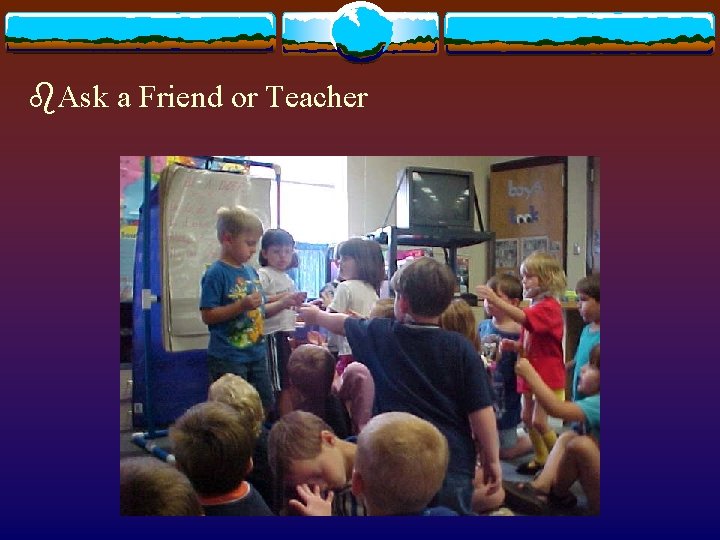
b. Ask a Friend or Teacher
What to do when you don’t know a word ? b. Must know basic sight words banalyze words with familiar spelling patterns buse structural analysis if it is a long word buse other words in the sentence bask a friend or teacher blook in dictionary
Reader selected miscues b. Have students mark word that they have difficulty with b. Teacher looks to see if there are common difficulties
What’s in my head b. Put 25 words on board in groups of five b. Number paper from one to five b. Give five clues for each grouping to help find the specific word b. Write the word on the paper
Decoding differences between languages b. Meet with students individually to decode words b. Know the conflicts between the first and second language to help with problems b. Find cognates in languages ( pairs of words formed from the same root)
Technology support b. Electronic books b. Multimedia that is interactive -videodiscs b. Mapping b. Graphing b. Researching
Other things of interest b. Reading aloud is one of the best methods of advancing student’s communication and thinking abilities b. Think pads b. Holiday books
- Slides: 22