
Increasing Rigor Through Questioning and Depth of Knowledge


- Slides: 50
Increasing Rigor Through Questioning and Depth of Knowledge Strategies Blanche Kapushion Ph. D. , & Tonia Heffley, M. Ed. Jefferson County Public Schools Blanche Kapushion Ph. D. , Tonia Heffley MA. Ed. Golden, CO
Learning Target and Success Criteria We will use explore tools and resources that enable implementing depth and complexity through questioning strategies and techniques. Blanche Kapushion Ph. D. , Tonia Heffley MA. Ed.
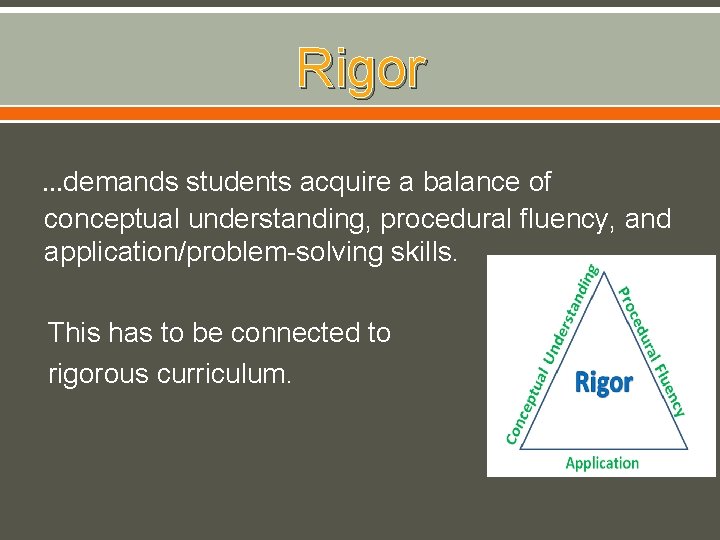
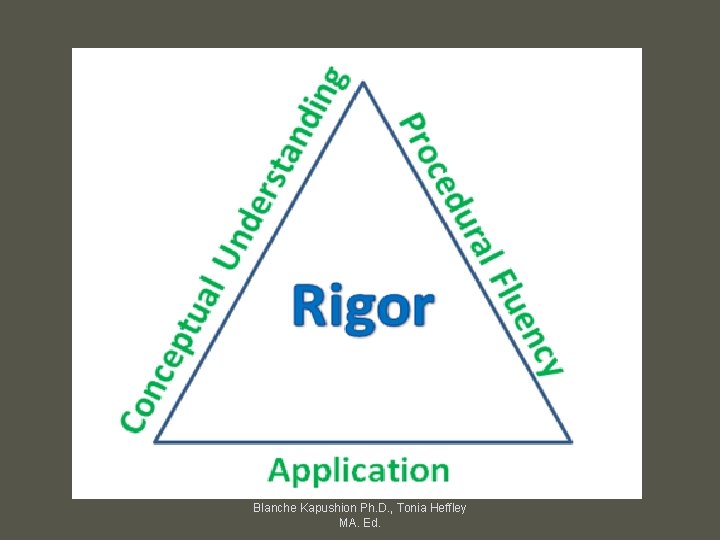
Rigor. . . demands students acquire a balance of conceptual understanding, procedural fluency, and application/problem-solving skills. This has to be connected to rigorous curriculum.
Blanche Kapushion Ph. D. , Tonia Heffley MA. Ed.
Planning If we want to all prepare students to explain their thinking about why learning the content is important, relevant and engaging, then we must plan differently and intentionally for this outcome.
SO…. . What are we really talking about here? Blanche Kapushion Ph. D. , Tonia Heffley MA. Ed.
Quick Chat 1. Challenging vs. Difficult (3 minutes) a. What does this mean for you? b. What might this look like for students? 2. Turn to a partner a. Person A goes first and answers the question. b. Person B listens, paraphrases what they heard. c. Person A confirms and/or adds to their final thoughts. d. Person B answers the question. e. Person A listens & paraphrases. f. Person B confirms and/or adds to their final thoughts. Blanche Kapushion Ph. D. , Tonia Heffley MA. Ed.
Cognitive Complexity vs. Difficulty What is the difference between Cognitive Complexity and Difficulty Level? ● Difficulty refers to how many students answered the question correctly. ● Higher Order Thinking (Cognitive Complexity) refers to how many steps it takes to answer the question.
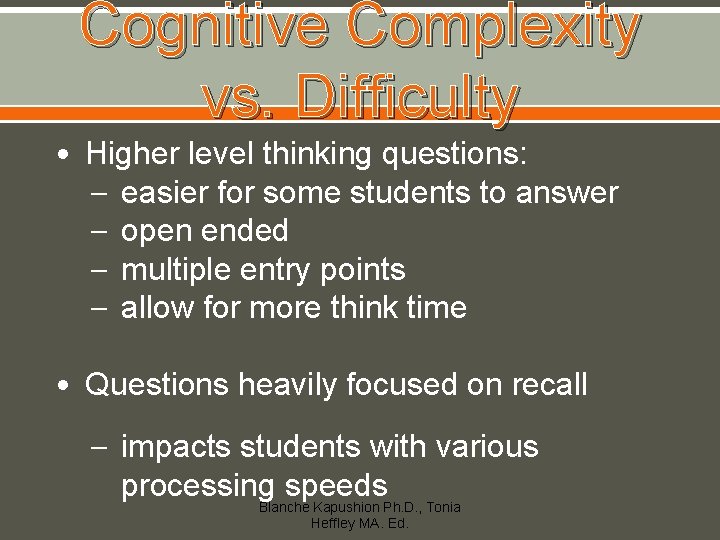
Cognitive Complexity vs. Difficulty • Higher level thinking questions: – easier for some students to answer – open ended – multiple entry points – allow for more think time • Questions heavily focused on recall – impacts students with various processing speeds Blanche Kapushion Ph. D. , Tonia Heffley MA. Ed.
Let’s get down to business! What are some things we ask students to do to demonstrate their understanding?
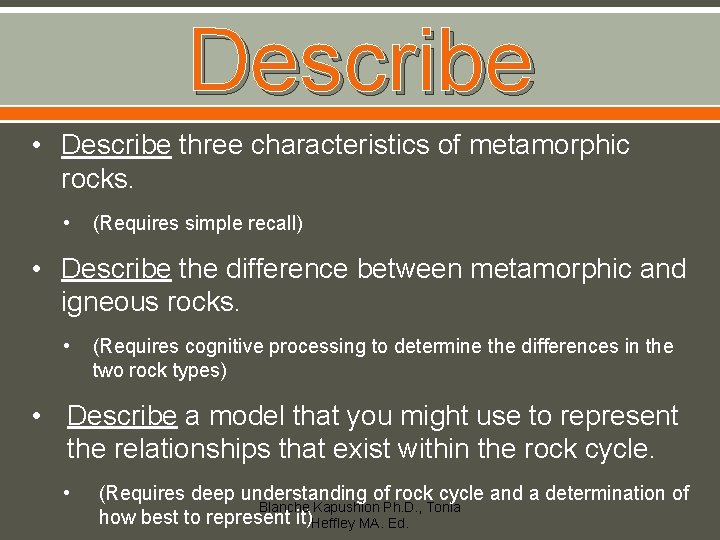
Describe • Describe three characteristics of metamorphic rocks. • (Requires simple recall) • Describe the difference between metamorphic and igneous rocks. • (Requires cognitive processing to determine the differences in the two rock types) • Describe a model that you might use to represent the relationships that exist within the rock cycle. • (Requires deep understanding of rock cycle and a determination of Blanche Kapushion Ph. D. , Tonia how best to represent it)Heffley MA. Ed.
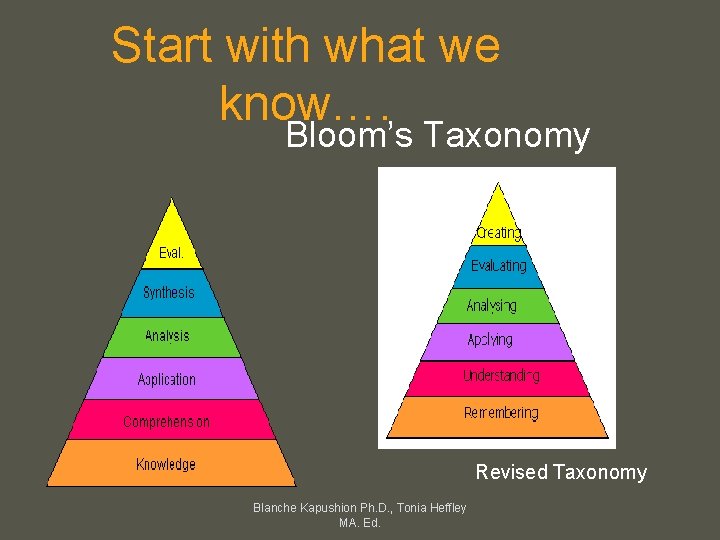
Start with what we know…. Bloom’s Taxonomy Revised Taxonomy Blanche Kapushion Ph. D. , Tonia Heffley MA. Ed.
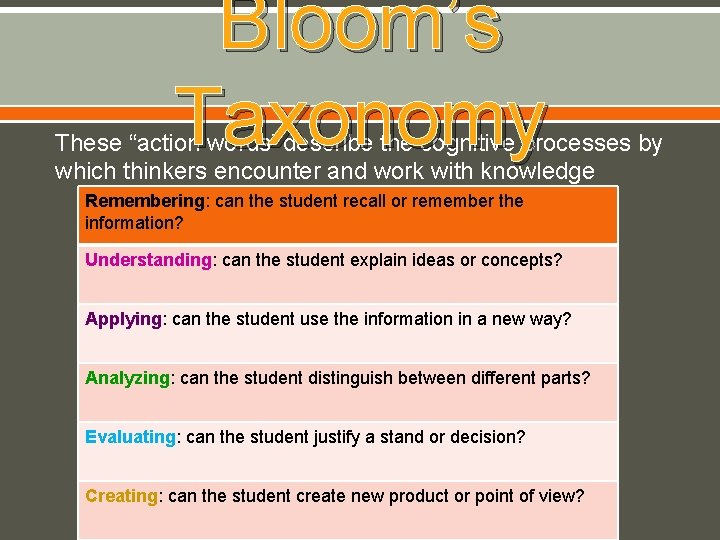
Bloom’s Taxonomy These “action words’ describe the cognitive processes by which thinkers encounter and work with knowledge Remembering: can the student recall or remember the information? Understanding: can the student explain ideas or concepts? Applying: can the student use the information in a new way? Analyzing: can the student distinguish between different parts? Evaluating: can the student justify a stand or decision? Creating: can the student create new product or point of view?
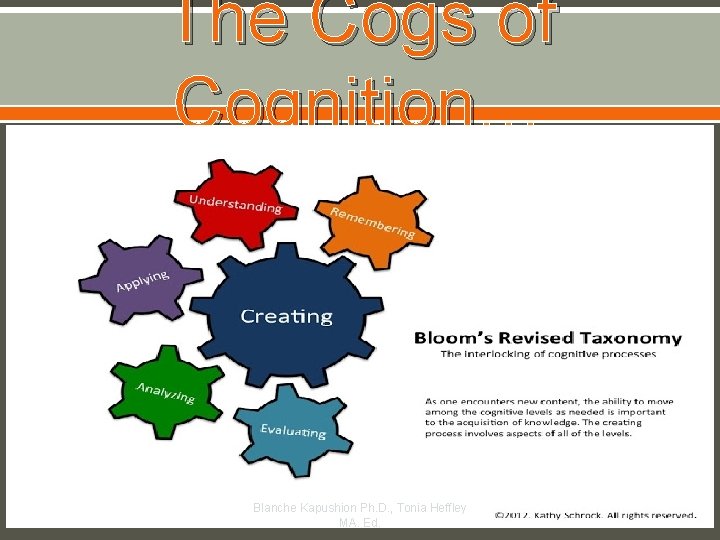
The Cogs of Cognition… Blanche Kapushion Ph. D. , Tonia Heffley MA. Ed.
Blanche Kapushion Ph. D. , Tonia Heffley MA. Ed.
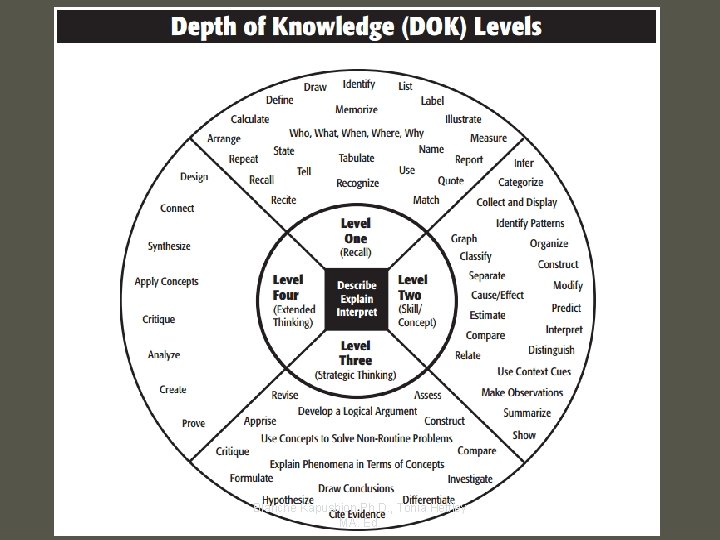
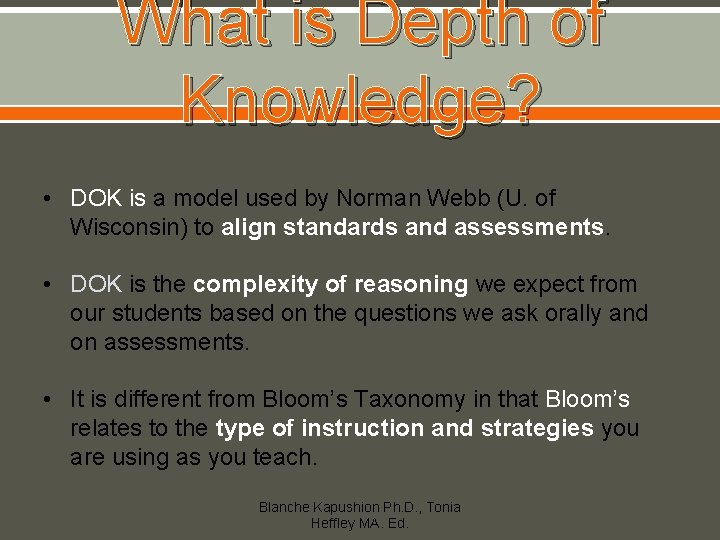
What is Depth of Knowledge? • DOK is a model used by Norman Webb (U. of Wisconsin) to align standards and assessments. • DOK is the complexity of reasoning we expect from our students based on the questions we ask orally and on assessments. • It is different from Bloom’s Taxonomy in that Bloom’s relates to the type of instruction and strategies you are using as you teach. Blanche Kapushion Ph. D. , Tonia Heffley MA. Ed.
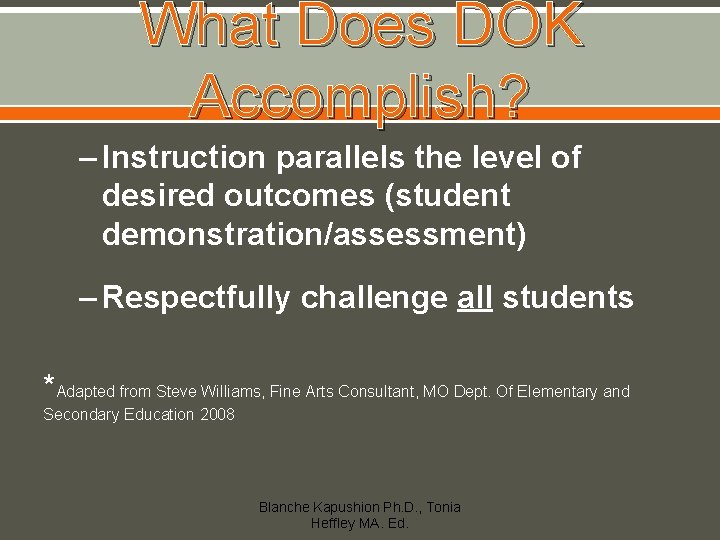
What Does DOK Accomplish? – Instruction parallels the level of desired outcomes (student demonstration/assessment) – Respectfully challenge all students *Adapted from Steve Williams, Fine Arts Consultant, MO Dept. Of Elementary and Secondary Education 2008 Blanche Kapushion Ph. D. , Tonia Heffley MA. Ed.
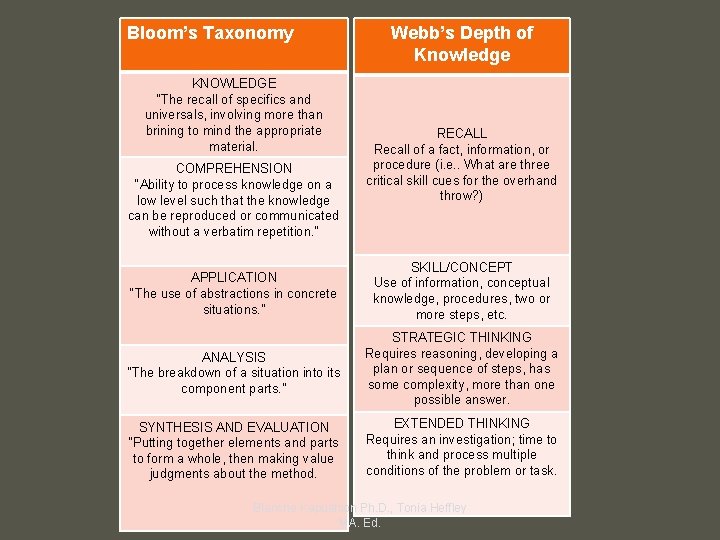
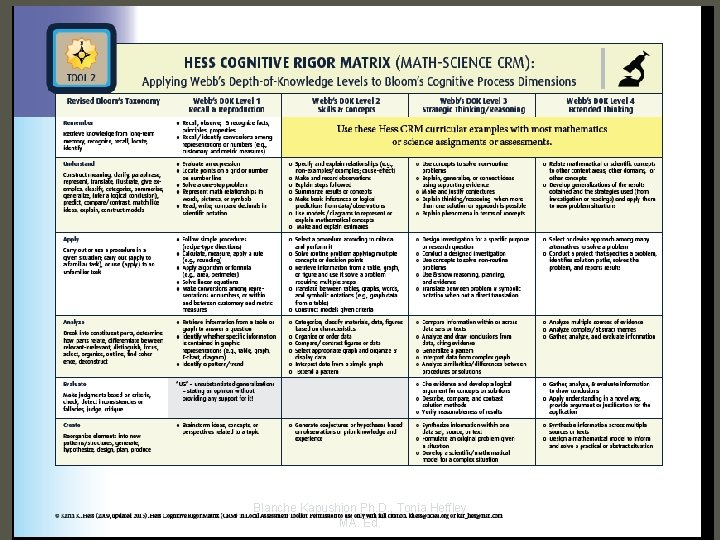
Bloom’s Taxonomy KNOWLEDGE “The recall of specifics and universals, involving more than brining to mind the appropriate material. COMPREHENSION “Ability to process knowledge on a low level such that the knowledge can be reproduced or communicated without a verbatim repetition. ” Webb’s Depth of Knowledge RECALL Recall of a fact, information, or procedure (i. e. . What are three critical skill cues for the overhand throw? ) APPLICATION “The use of abstractions in concrete situations. ” SKILL/CONCEPT Use of information, conceptual knowledge, procedures, two or more steps, etc. ANALYSIS “The breakdown of a situation into its component parts. ” STRATEGIC THINKING Requires reasoning, developing a plan or sequence of steps, has some complexity, more than one possible answer. SYNTHESIS AND EVALUATION “Putting together elements and parts to form a whole, then making value judgments about the method. EXTENDED THINKING Requires an investigation; time to think and process multiple conditions of the problem or task. Blanche Kapushion Ph. D. , Tonia Heffley MA. Ed.
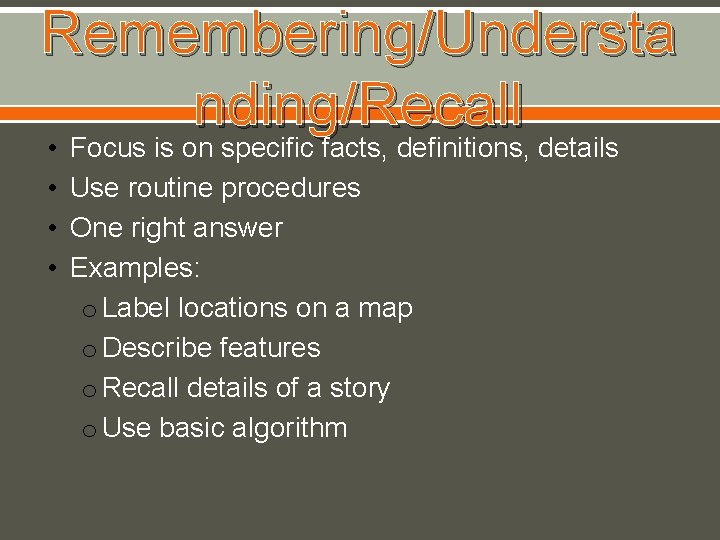
Remembering/Understa nding/Recall • Focus is on specific facts, definitions, details • Use routine procedures • One right answer • Examples: o Label locations on a map o Describe features o Recall details of a story o Use basic algorithm
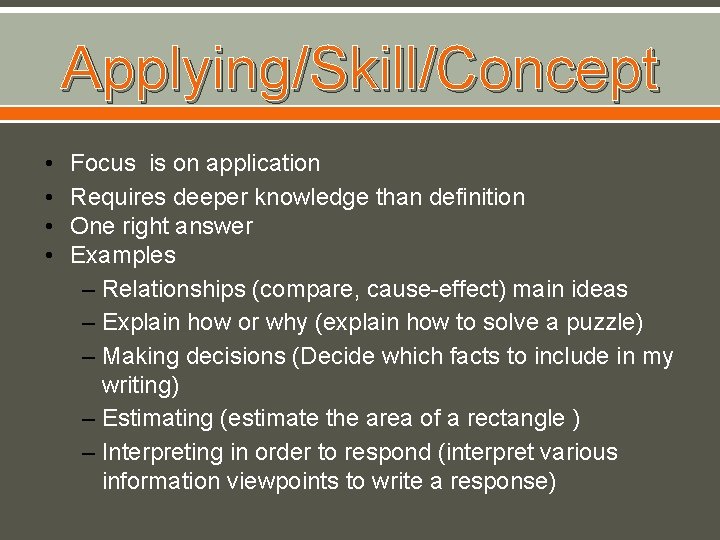
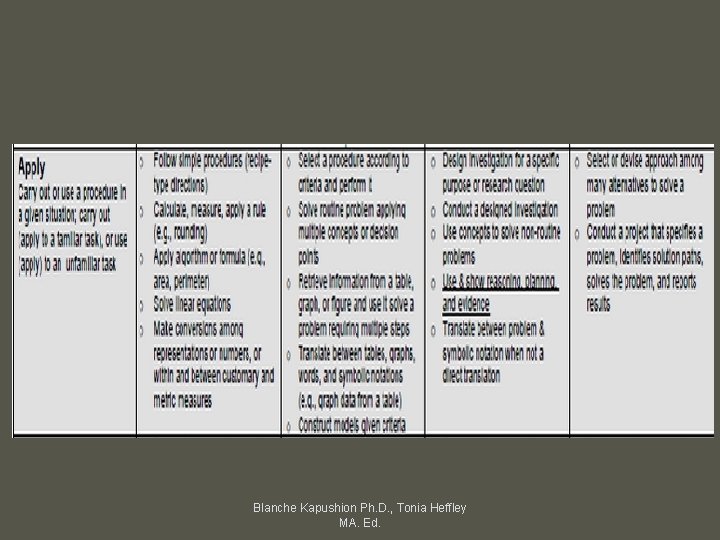
Applying/Skill/Concept • • Focus is on application Requires deeper knowledge than definition One right answer Examples – Relationships (compare, cause-effect) main ideas – Explain how or why (explain how to solve a puzzle) – Making decisions (Decide which facts to include in my writing) – Estimating (estimate the area of a rectangle ) – Interpreting in order to respond (interpret various information viewpoints to write a response)
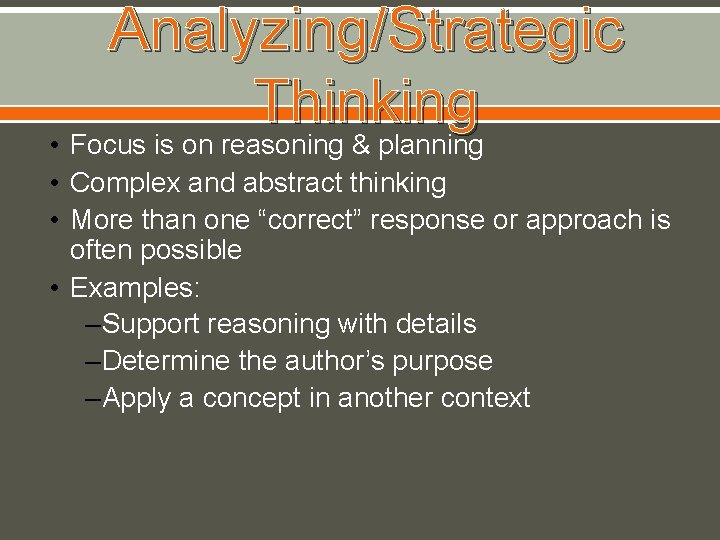
Analyzing/Strategic Thinking • Focus is on reasoning & planning • Complex and abstract thinking • More than one “correct” response or approach is often possible • Examples: –Support reasoning with details –Determine the author’s purpose –Apply a concept in another context
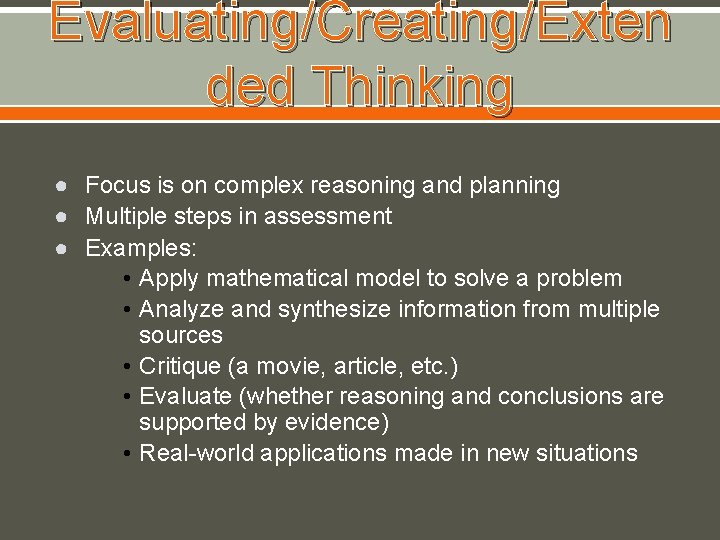
Evaluating/Creating/Exten ded Thinking ● Focus is on complex reasoning and planning ● Multiple steps in assessment ● Examples: • Apply mathematical model to solve a problem • Analyze and synthesize information from multiple sources • Critique (a movie, article, etc. ) • Evaluate (whether reasoning and conclusions are supported by evidence) • Real-world applications made in new situations
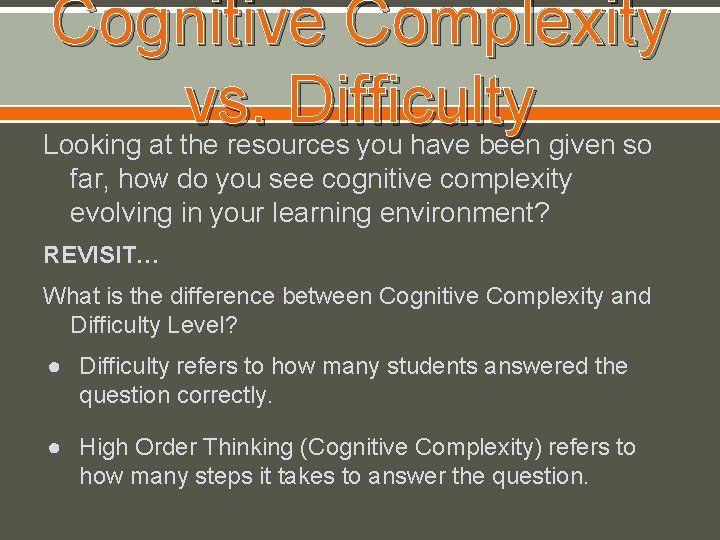
Cognitive Complexity vs. Difficulty Looking at the resources you have been given so far, how do you see cognitive complexity evolving in your learning environment? REVISIT… What is the difference between Cognitive Complexity and Difficulty Level? ● Difficulty refers to how many students answered the question correctly. ● High Order Thinking (Cognitive Complexity) refers to how many steps it takes to answer the question.
Livebinder http: //www. livebinders. com/play/ play? id=1564350
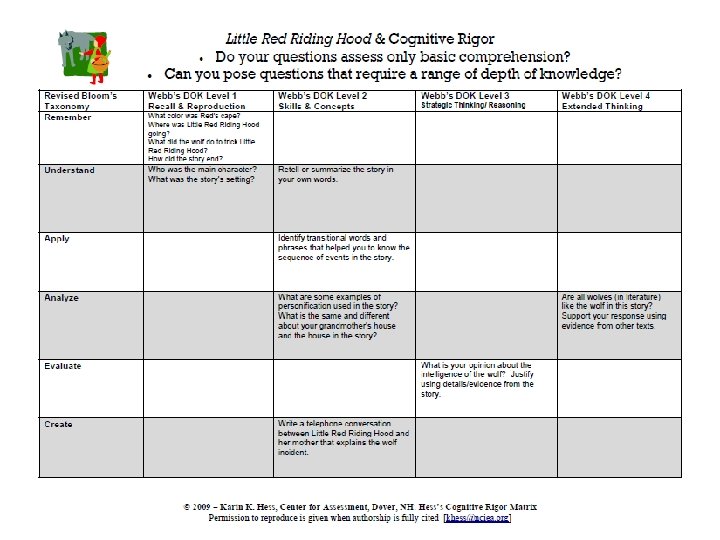
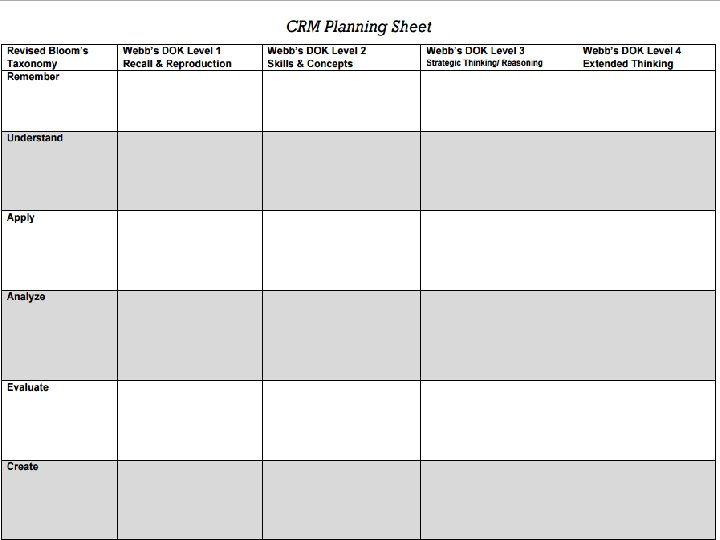
Cognitive Rigor Matrices Blanche Kapushion Ph. D. , Tonia Heffley MA. Ed.
Blanche Kapushion Ph. D. , Tonia Heffley MA. Ed.
Blanche Kapushion Ph. D. , Tonia Heffley MA. Ed.
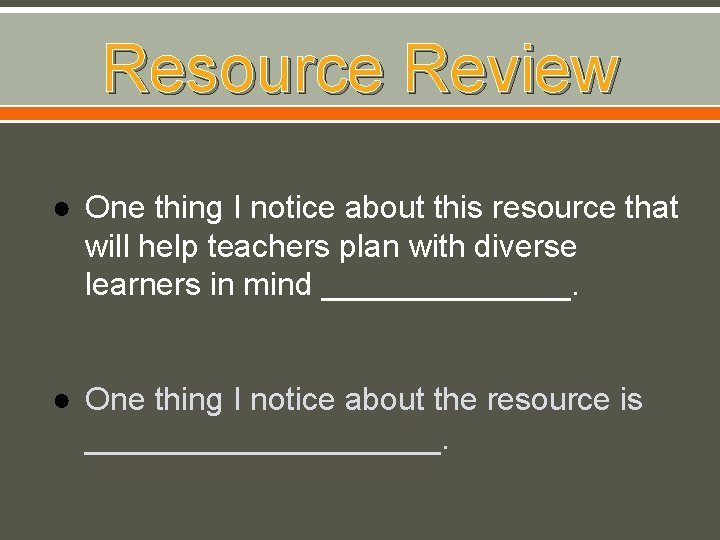
Resource Review ● One thing I notice about this resource that will help teachers plan with diverse learners in mind _______. ● One thing I notice about the resource is __________.
Blanche Kapushion Ph. D. , Tonia Heffley MA. Ed.
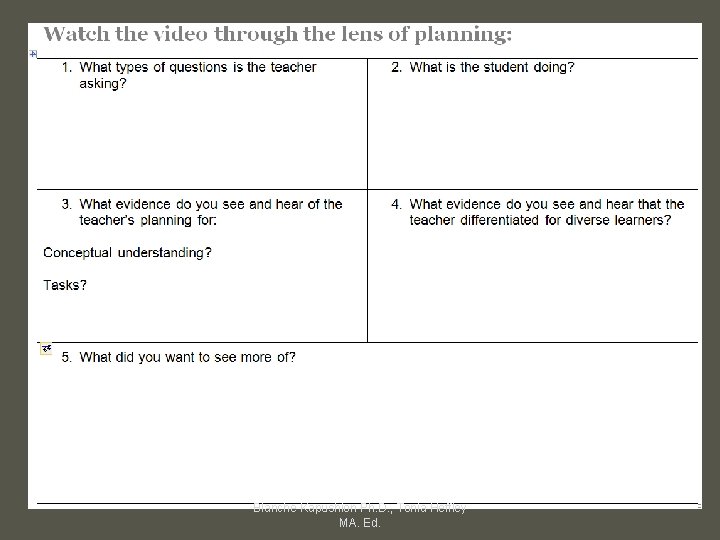
https: //www. teachingchannel. org/videos/conjecture-lesson-plan Application, Evaluate & Analyze Blanche Kapushion Ph. D. , Tonia Heffley MA. Ed.
Resource Exploration. .
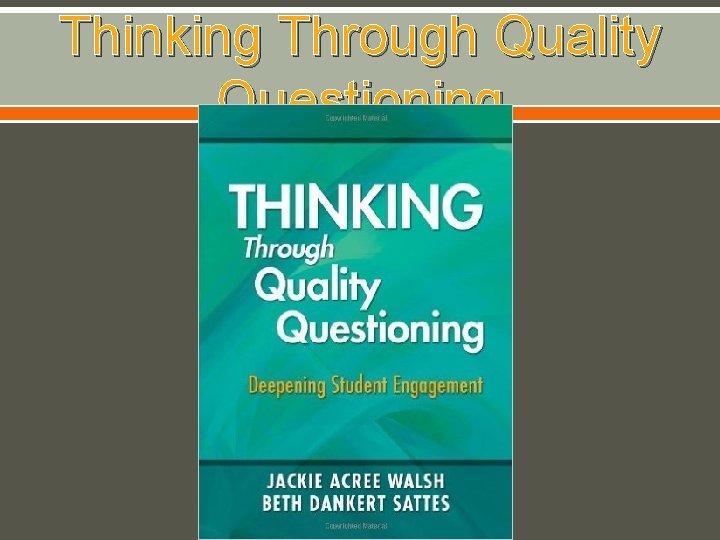
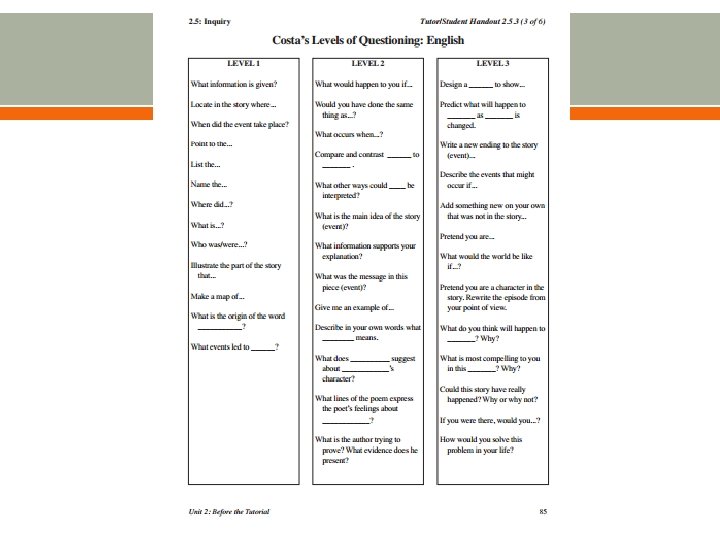
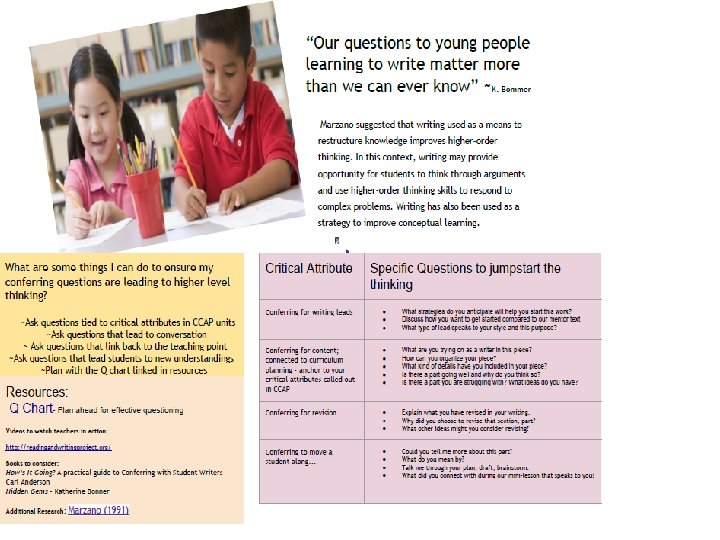
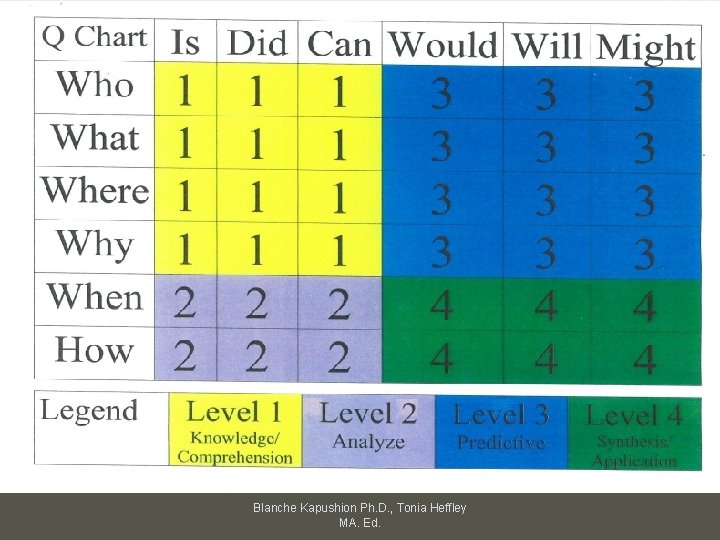
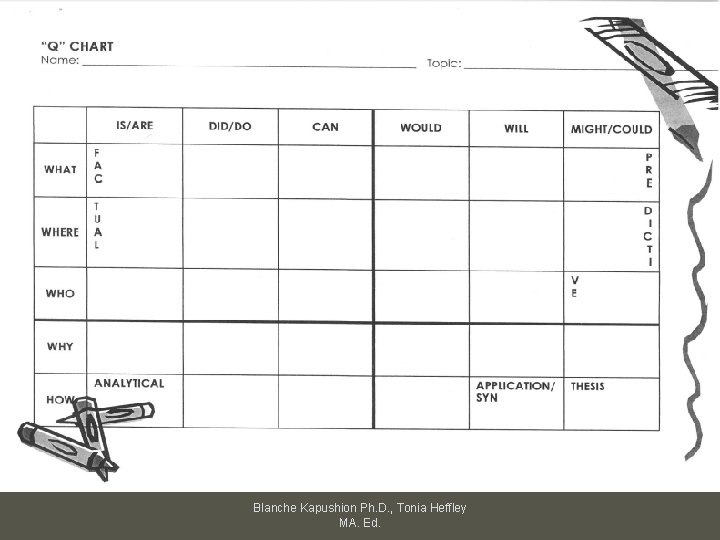
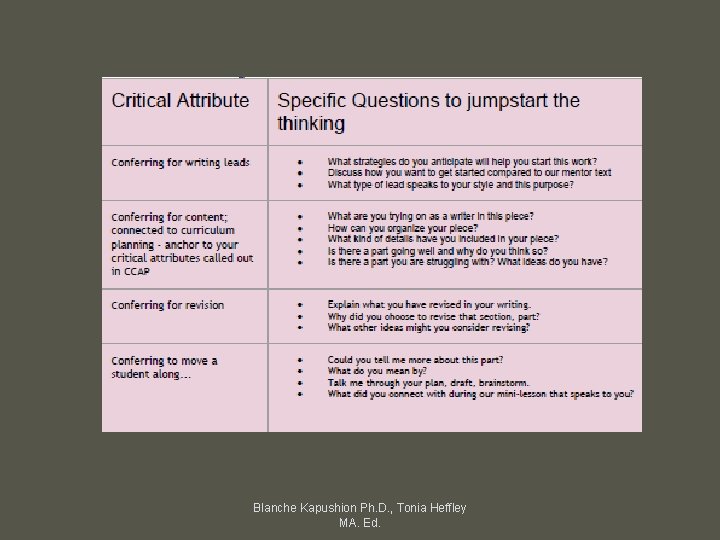
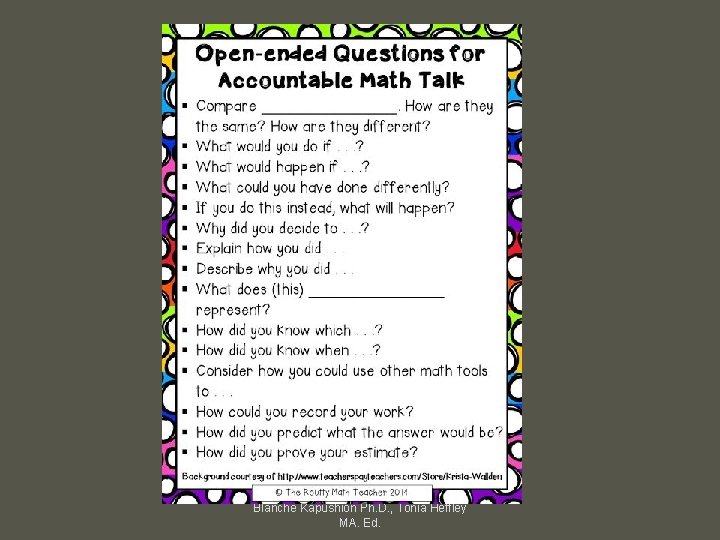
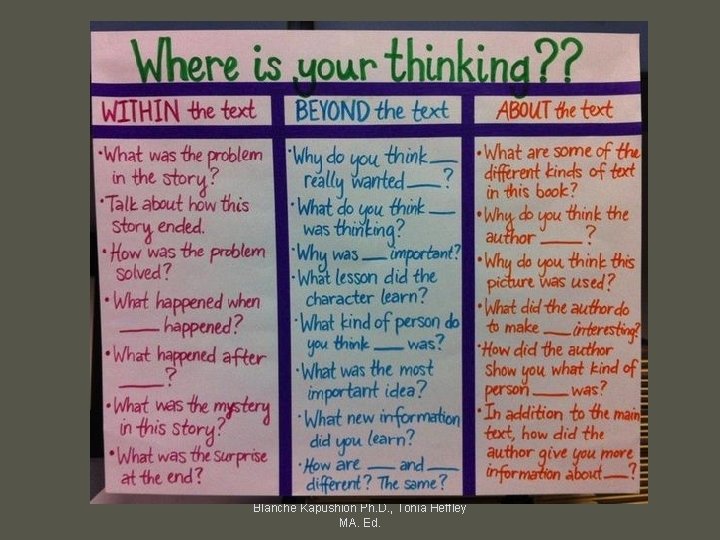
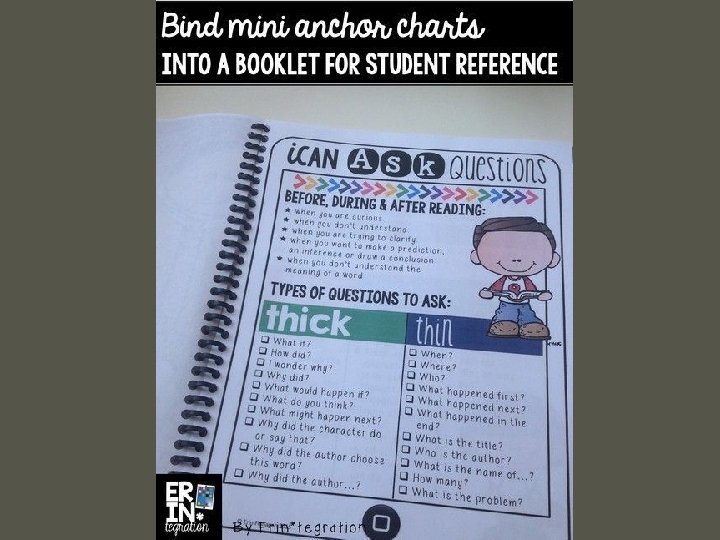
Thinking Through Quality Questioning
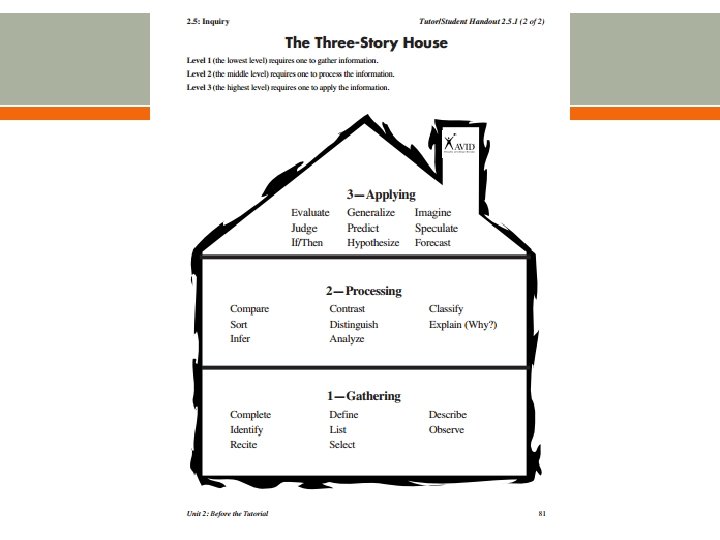
Blanche Kapushion Ph. D. , Tonia Heffley MA. Ed.
Blanche Kapushion Ph. D. , Tonia Heffley MA. Ed.
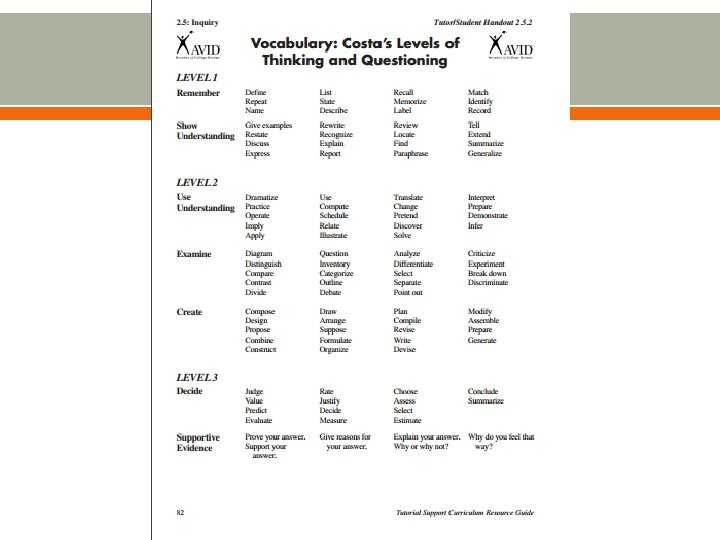
Blanche Kapushion Ph. D. , Tonia Heffley MA. Ed.
Blanche Kapushion Ph. D. , Tonia Heffley MA. Ed.
Blanche Kapushion Ph. D. , Tonia Heffley MA. Ed.
Blanche Kapushion Ph. D. , Tonia Heffley MA. Ed.
Questions Contact information: o Dr. Blanche Kapushion: bmkapush@comcast. net o Tonia Heffley: theffley@jeffco. k 12. co. us
Learning Target and Success Criteria We will use explore tools and resources that enable implementing depth and complexity through questioning strategies and techniques. Blanche Kapushion Ph. D. , Tonia Heffley MA. Ed.
Feedback ● What is one thing you will take back to your school/classroom? ● What is one resource you can use during planning?
Thank you Blanche Kapushion, Ph. D. , Tonia Heffley MA. Ed. Blanche Kapushion Ph. D. , Tonia Heffley MA. Ed.