
Increasing Physical Activity for Academic Success The brain

Increasing Physical Activity for Academic Success
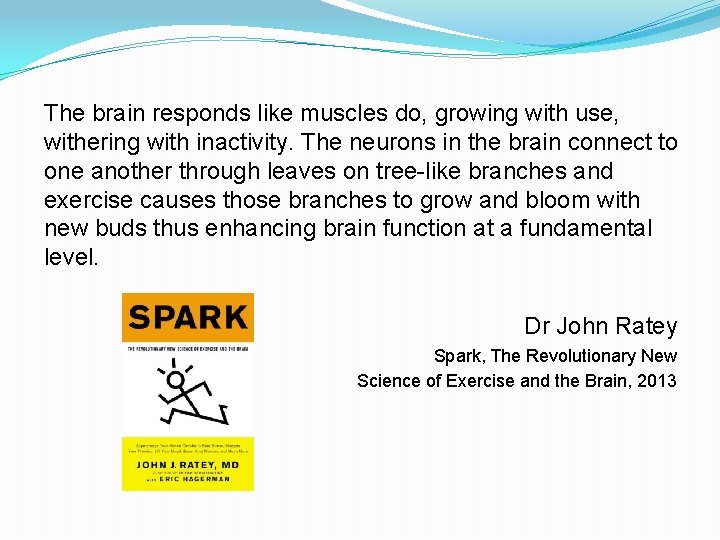
The brain responds like muscles do, growing with use, withering with inactivity. The neurons in the brain connect to one another through leaves on tree-like branches and exercise causes those branches to grow and bloom with new buds thus enhancing brain function at a fundamental level. Dr John Ratey Spark, The Revolutionary New Science of Exercise and the Brain, 2013

Physical Activity and Academic Achievement �Physical activity increases heart rate which boosts oxygen intake necessary for quicker brain function. �Motor skill development is linked to neuron development and more synaptic connections in the brain. �Physical activity reduces stress, improves mood and promotes a calming effect. �Physical activity improves concentration and attention to tasks. �Physical activity improves behavior in children diagnosed with ADHD. Source: Telljohann, Symons, Pateman & Seabert, 2013. Health Education: Elementary and Middle School Application.
Strategies to Engage Students in Physical Activity �Change the posture of students during classroom instruction e. g. sitting, standing. �Get students moving e. g. having students show prepositions of place by moving around their seats, or standing in front of their classmate. �Encourage students to use their bodies to learn e. g. demonstrate rhythms, emotions. �Incorporate more student-centered activity like role play and gallery walks. �Take 2 -minute activity breaks between every 20 minutes of classroom instruction. Source: Telljohann, Symons, Pateman & Seabert, 2013. Health Education: Elementary and Middle School Application.
Alternatives to Taking Away Physical Activity �Self-reflection on misbehavior to be done as homework and submitted the next day. �Behavior contract listing out consequences to misbehavior e. g. detention after school or litter-picking.
- Slides: 5