
Increasing Information per Bit Information in a source
Increasing Information per Bit • Information in a source – – Mathematical Models of Sources Information Measures • Compressing information – Huffman encoding • Optimal Compression for DMS? – Lempel-Ziv-Welch Algorithm • For Stationary Sources? • Practical Compression • Quantization of analog data – – Scalar Quantization Vector Quantization Model Based Coding Practical Quantization • • • m-law encoding Delta Modulation Linear Predictor Coding (LPC)
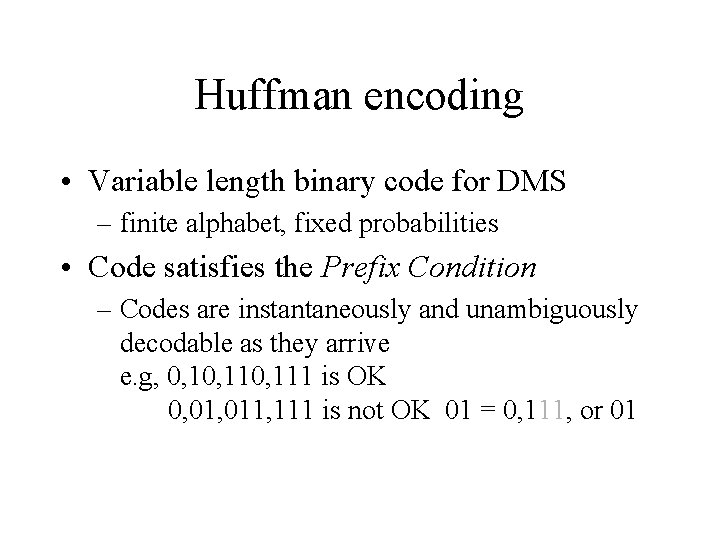
Huffman encoding • Variable length binary code for DMS – finite alphabet, fixed probabilities • Code satisfies the Prefix Condition – Codes are instantaneously and unambiguously decodable as they arrive e. g, 0, 110, 111 is OK 0, 011, 111 is not OK 01 = 0, 111, or 01
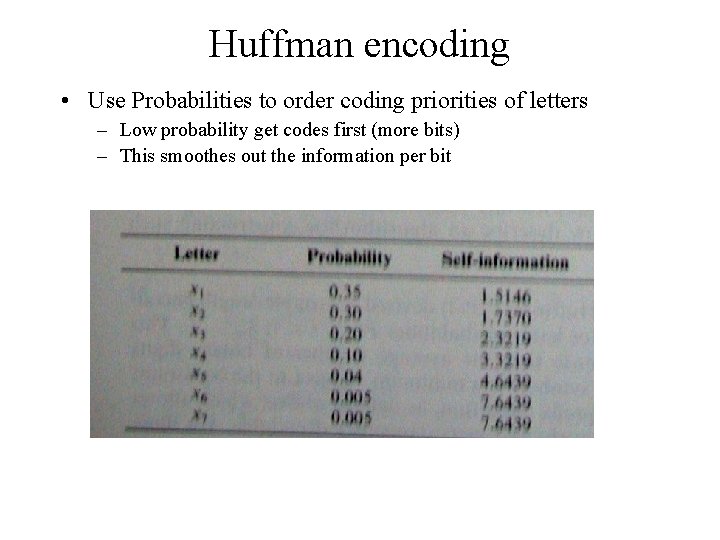
Huffman encoding • Use Probabilities to order coding priorities of letters – Low probability get codes first (more bits) – This smoothes out the information per bit
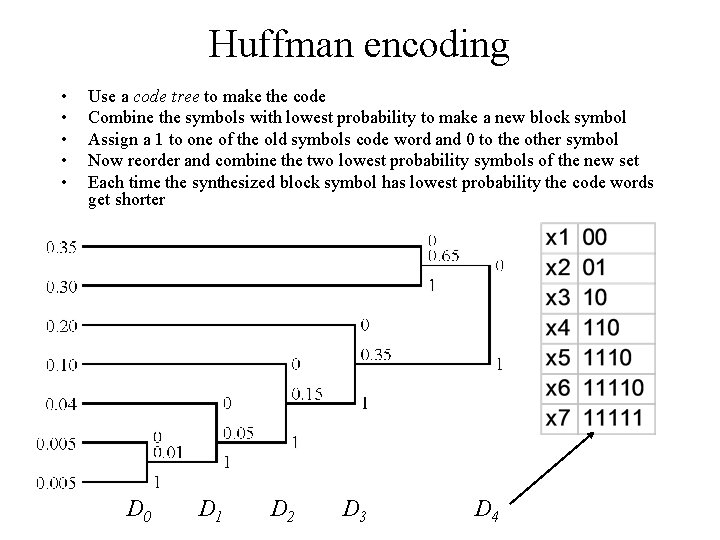
Huffman encoding • • • Use a code tree to make the code Combine the symbols with lowest probability to make a new block symbol Assign a 1 to one of the old symbols code word and 0 to the other symbol Now reorder and combine the two lowest probability symbols of the new set Each time the synthesized block symbol has lowest probability the code words get shorter D 0 D 1 D 2 D 3 D 4
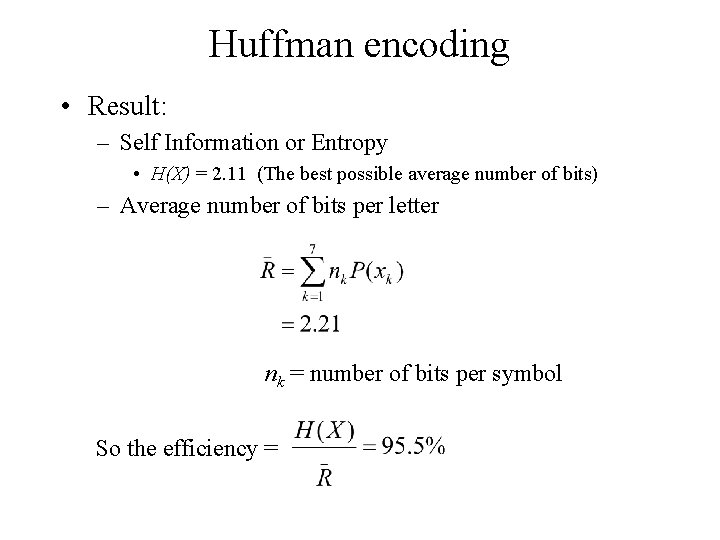
Huffman encoding • Result: – Self Information or Entropy • H(X) = 2. 11 (The best possible average number of bits) – Average number of bits per letter nk = number of bits per symbol So the efficiency =

Huffman encoding • Lets compare to simple 3 bit code
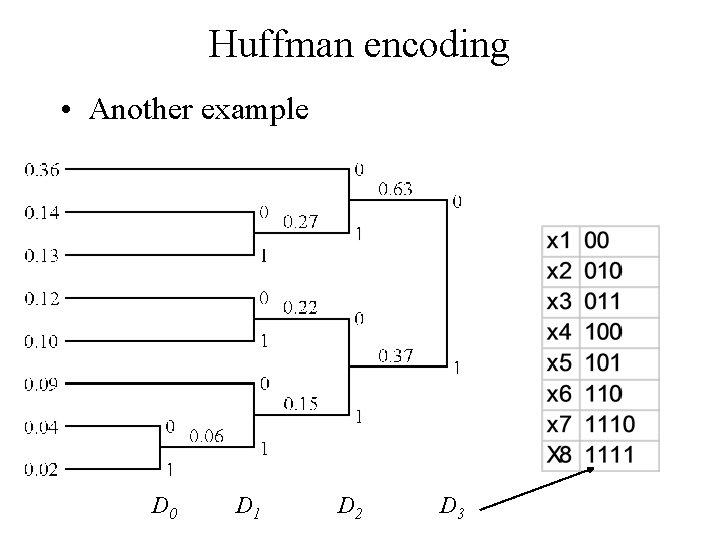
Huffman encoding • Another example D 0 D 1 D 2 D 3
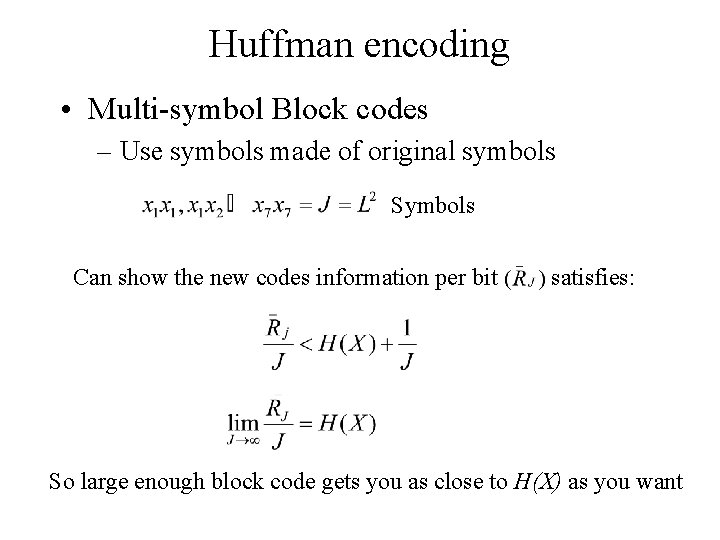
Huffman encoding • Multi-symbol Block codes – Use symbols made of original symbols Symbols Can show the new codes information per bit satisfies: So large enough block code gets you as close to H(X) as you want
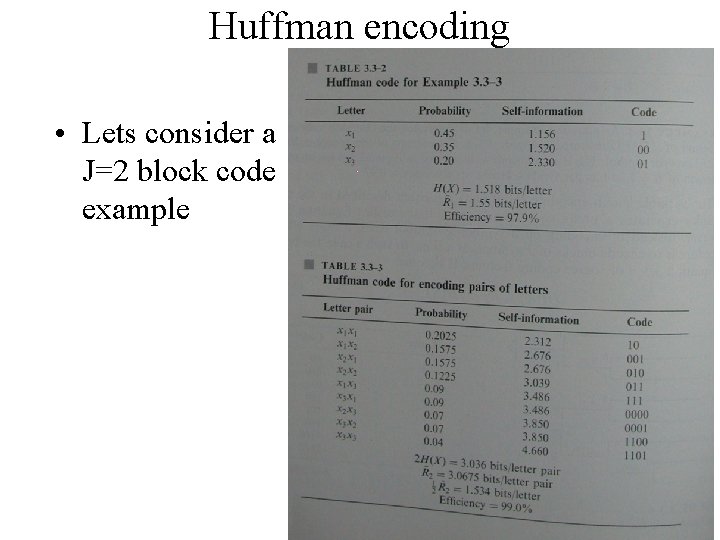
Huffman encoding • Lets consider a J=2 block code example
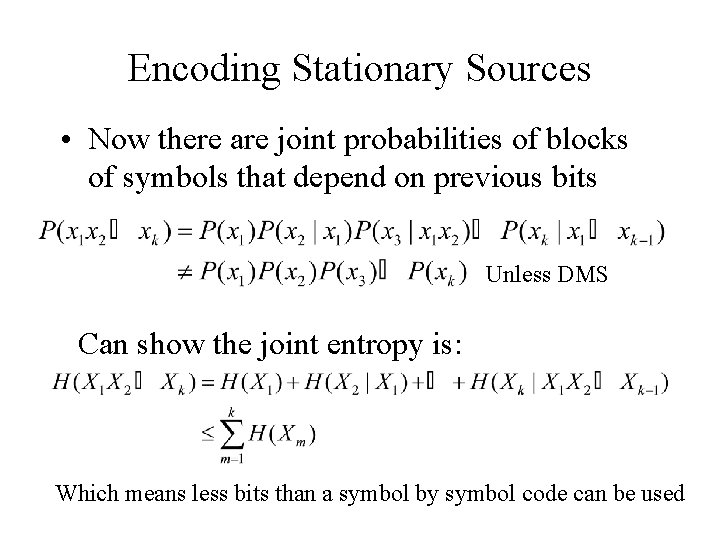
Encoding Stationary Sources • Now there are joint probabilities of blocks of symbols that depend on previous bits Unless DMS Can show the joint entropy is: Which means less bits than a symbol by symbol code can be used
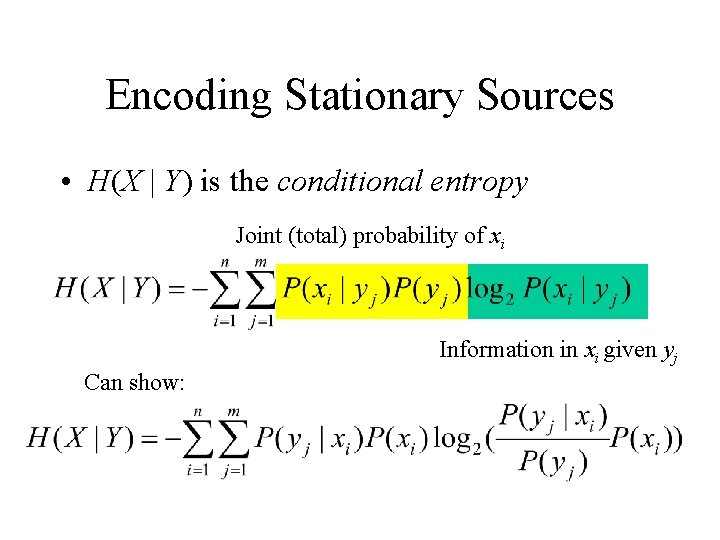
Encoding Stationary Sources • H(X | Y) is the conditional entropy Joint (total) probability of xi Information in xi given yj Can show:
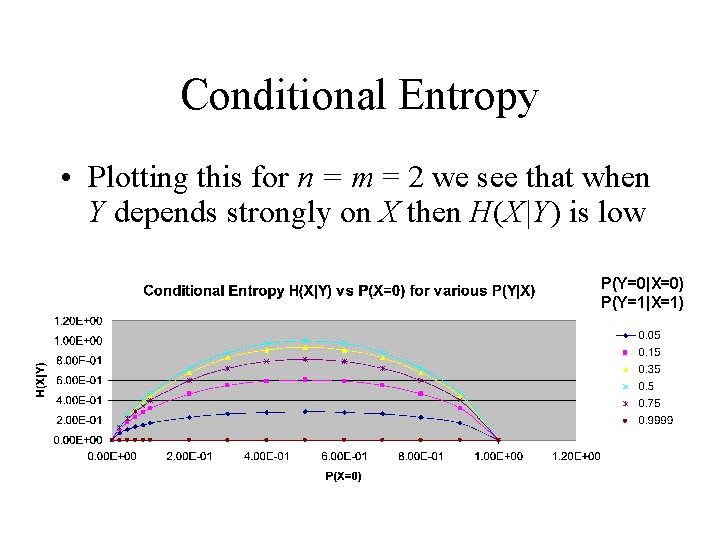
Conditional Entropy • Plotting this for n = m = 2 we see that when Y depends strongly on X then H(X|Y) is low P(Y=0|X=0) P(Y=1|X=1)
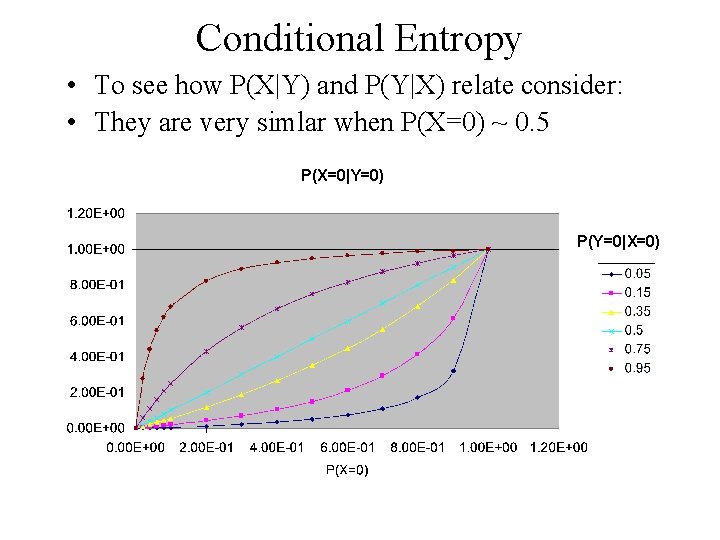
Conditional Entropy • To see how P(X|Y) and P(Y|X) relate consider: • They are very simlar when P(X=0) ~ 0. 5 P(X=0|Y=0) P(Y=0|X=0)
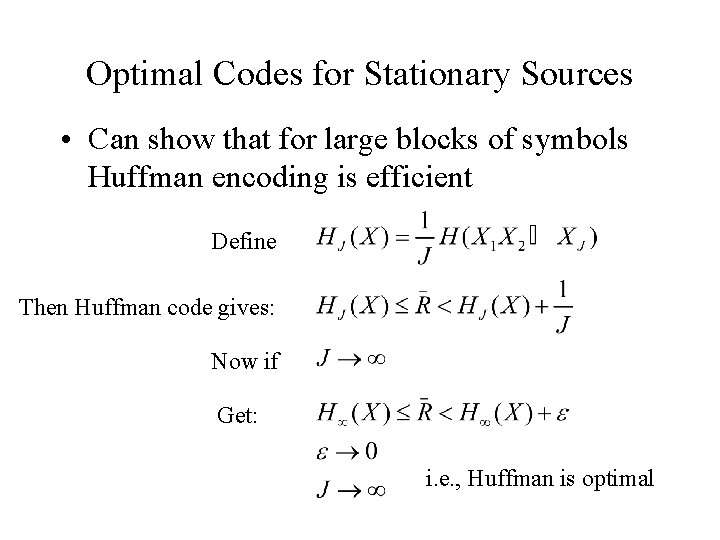
Optimal Codes for Stationary Sources • Can show that for large blocks of symbols Huffman encoding is efficient Define Then Huffman code gives: Now if Get: i. e. , Huffman is optimal
Lempel-Ziv-Welch Code • Huffman encoding is efficient but need to know joint probabilities of large blocks of symbols • Finding joint probabilities is hard • LZW is independent of source statistics • Is a universal source code algorithm • Is not optimal
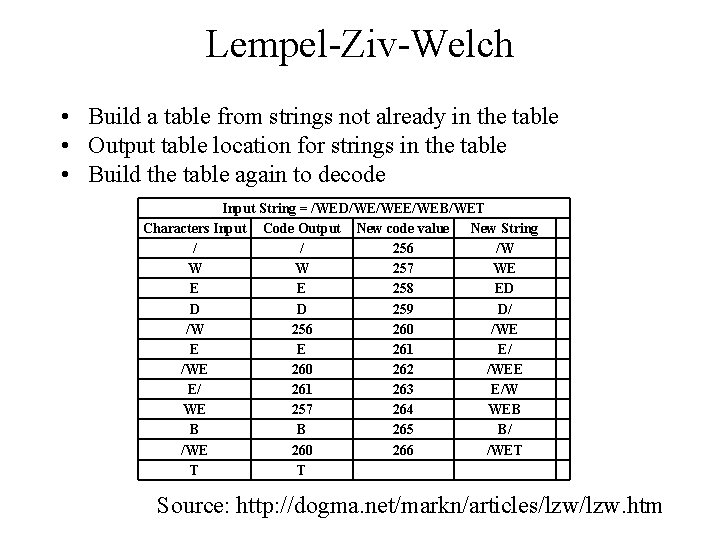
Lempel-Ziv-Welch • Build a table from strings not already in the table • Output table location for strings in the table • Build the table again to decode Input String = /WED/WE/WEB/WET Characters Input Code Output New code value New String / / 256 /W W W 257 WE E E 258 ED D D 259 D/ /W 256 260 /WE E E 261 E/ /WE 260 262 /WEE E/ 261 263 E/W WE 257 264 WEB B B 265 B/ /WE 260 266 /WET T T Source: http: //dogma. net/markn/articles/lzw. htm
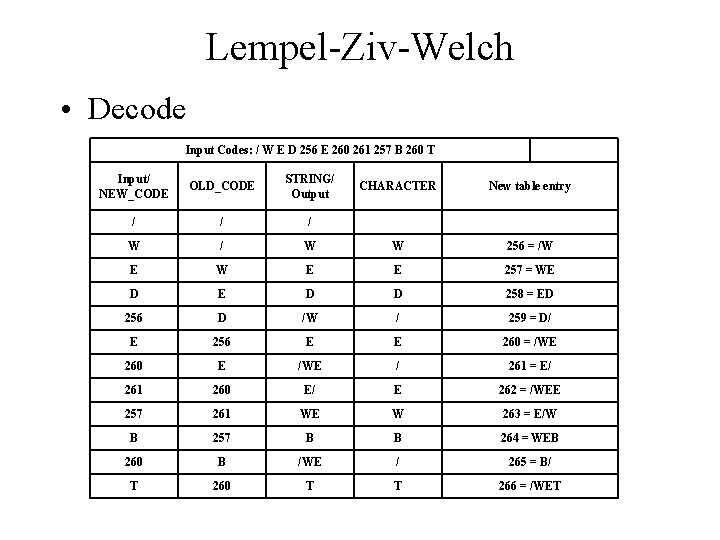
Lempel-Ziv-Welch • Decode Input Codes: / W E D 256 E 260 261 257 B 260 T Input/ NEW_CODE OLD_CODE STRING/ Output / / / W / E CHARACTER New table entry W W 256 = /W W E E 257 = WE D D 258 = ED 256 D /W / 259 = D/ E 256 E E 260 = /WE 260 E /WE / 261 = E/ 261 260 E/ E 262 = /WEE 257 261 WE W 263 = E/W B 257 B B 264 = WEB 260 B /WE / 265 = B/ T 260 T T 266 = /WET
Lempel-Ziv-Welch • Typically takes hundreds of entries to table before compression occurs • Some nasty patents make licensing an issue
- Slides: 18