
INCREASING IMPACT DEFLECTION FROM PRECISELY MEASURED MECHANICAL PROPERTIES
- Slides: 16
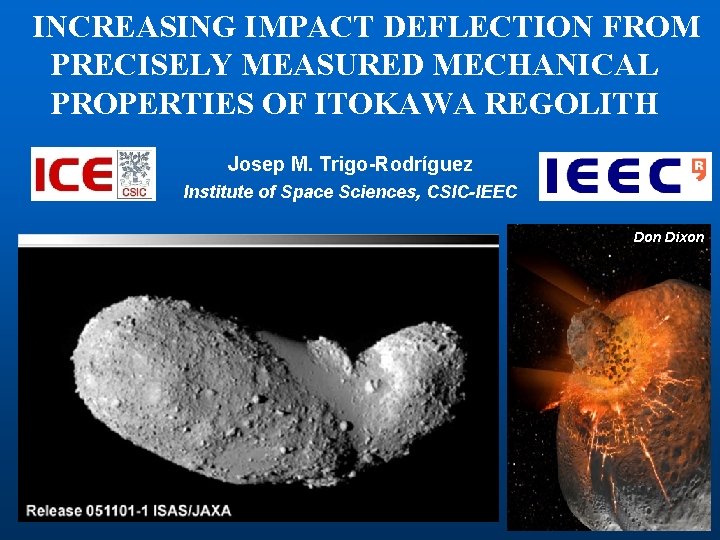
INCREASING IMPACT DEFLECTION FROM PRECISELY MEASURED MECHANICAL PROPERTIES OF ITOKAWA REGOLITH Josep M. Trigo-Rodríguez Institute of Space Sciences, CSIC-IEEC Don Dixon
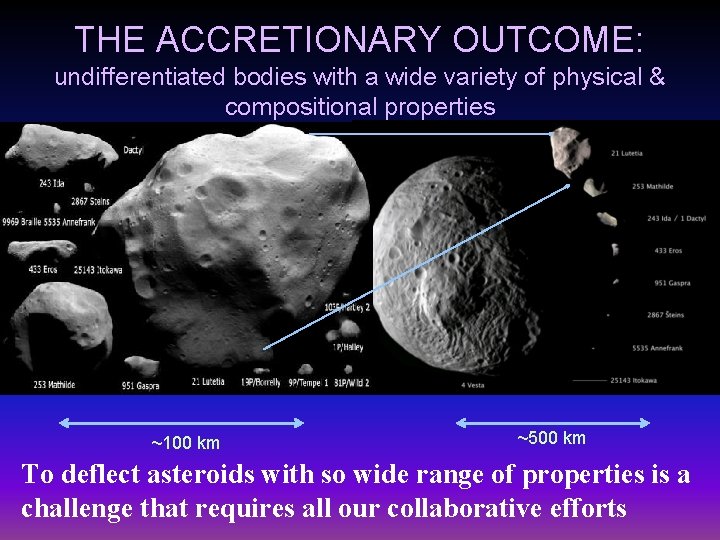
THE ACCRETIONARY OUTCOME: undifferentiated bodies with a wide variety of physical & compositional properties ~100 km ~500 km To deflect asteroids with so wide range of properties is a challenge that requires all our collaborative efforts
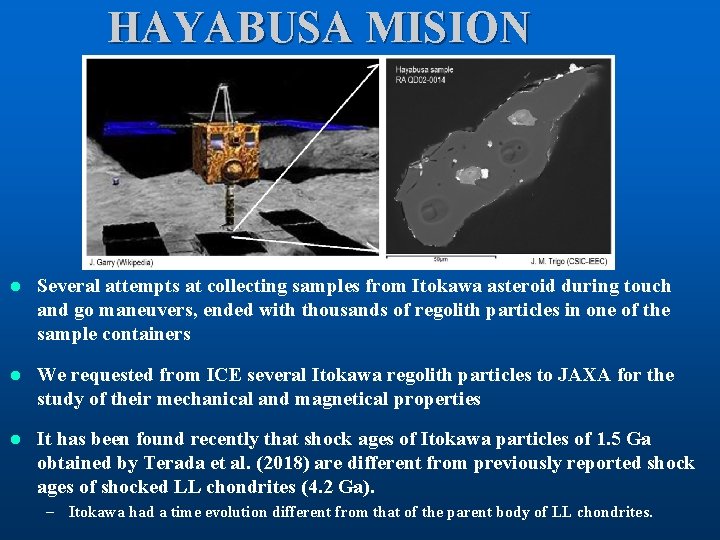
HAYABUSA MISION l Several attempts at collecting samples from Itokawa asteroid during touch and go maneuvers, ended with thousands of regolith particles in one of the sample containers l We requested from ICE several Itokawa regolith particles to JAXA for the study of their mechanical and magnetical properties l It has been found recently that shock ages of Itokawa particles of 1. 5 Ga obtained by Terada et al. (2018) are different from previously reported shock ages of shocked LL chondrites (4. 2 Ga). – Itokawa had a time evolution different from that of the parent body of LL chondrites.
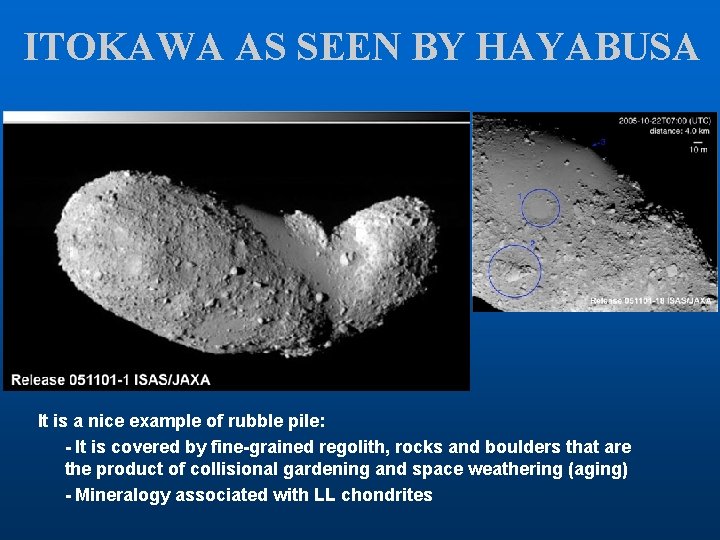
ITOKAWA AS SEEN BY HAYABUSA It is a nice example of rubble pile: - It is covered by fine-grained regolith, rocks and boulders that are the product of collisional gardening and space weathering (aging) - Mineralogy associated with LL chondrites
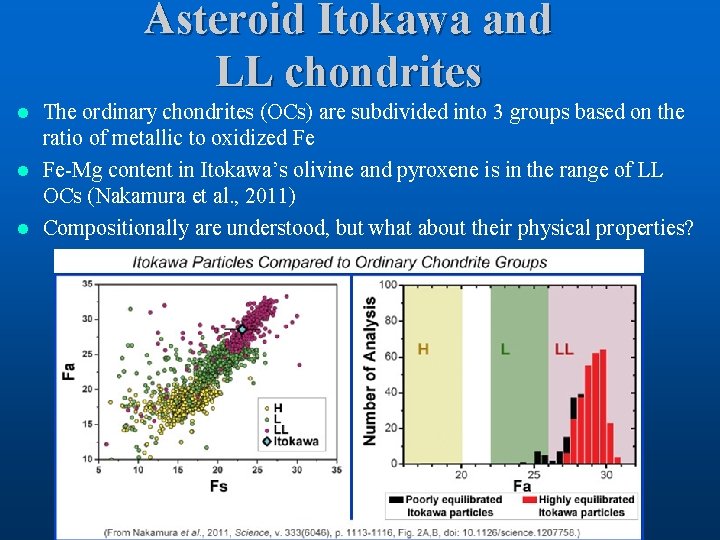
Asteroid Itokawa and LL chondrites The ordinary chondrites (OCs) are subdivided into 3 groups based on the ratio of metallic to oxidized Fe l Fe-Mg content in Itokawa’s olivine and pyroxene is in the range of LL OCs (Nakamura et al. , 2011) l Compositionally are understood, but what about their physical properties? l
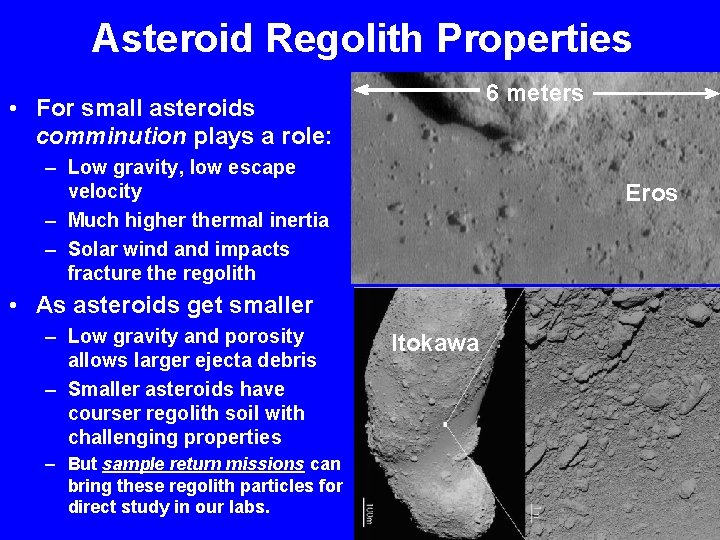
Asteroid Regolith Properties 6 meters • For small asteroids comminution plays a role: – Low gravity, low escape velocity – Much higher thermal inertia – Solar wind and impacts fracture the regolith Eros • As asteroids get smaller – Low gravity and porosity allows larger ejecta debris – Smaller asteroids have courser regolith soil with challenging properties – But sample return missions can bring these regolith particles for direct study in our labs. Itokawa
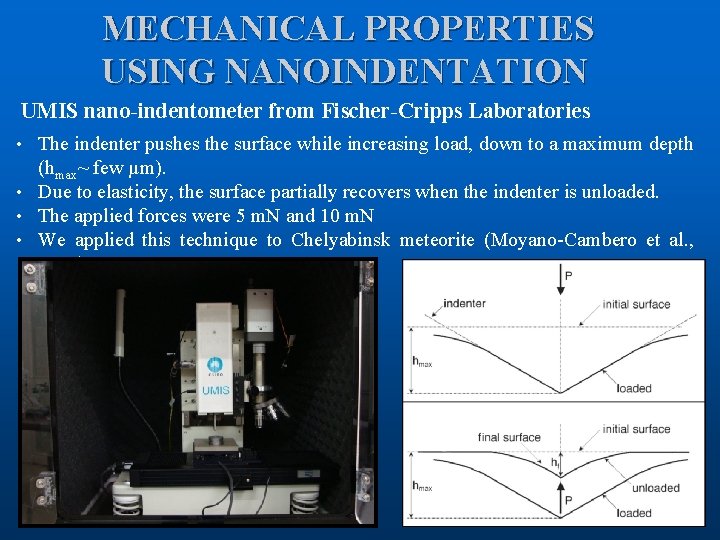
MECHANICAL PROPERTIES USING NANOINDENTATION UMIS nano-indentometer from Fischer-Cripps Laboratories The indenter pushes the surface while increasing load, down to a maximum depth (hmax~ few µm). • Due to elasticity, the surface partially recovers when the indenter is unloaded. • The applied forces were 5 m. N and 10 m. N • We applied this technique to Chelyabinsk meteorite (Moyano-Cambero et al. , 2017) •
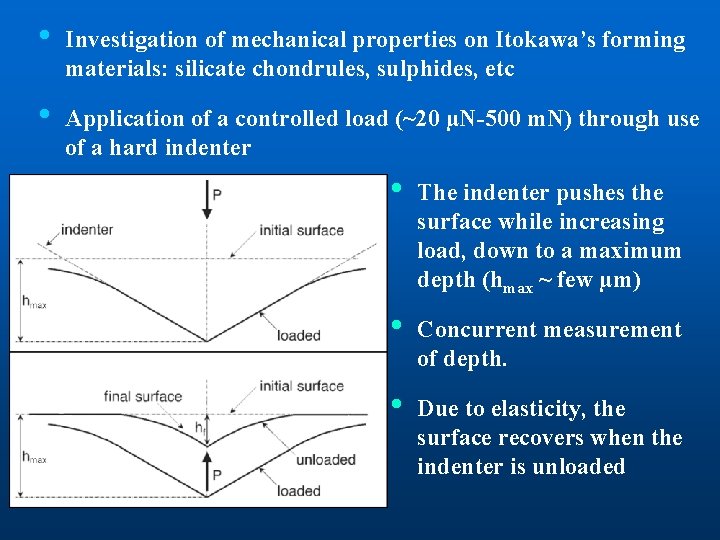
• Investigation of mechanical properties on Itokawa’s forming materials: silicate chondrules, sulphides, etc • Application of a controlled load (~20 µN-500 m. N) through use of a hard indenter • The indenter pushes the surface while increasing load, down to a maximum depth (hmax ~ few µm) • Concurrent measurement of depth. • Due to elasticity, the surface recovers when the indenter is unloaded
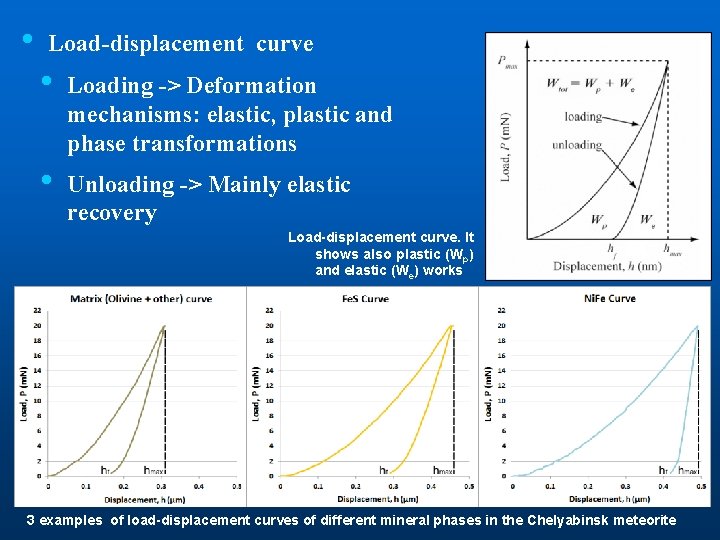
• Load-displacement curve • Loading -> Deformation mechanisms: elastic, plastic and phase transformations • Unloading -> Mainly elastic recovery Load-displacement curve. It shows also plastic (Wp) and elastic (We) works 3 examples of load-displacement curves of different mineral phases in the Chelyabinsk meteorite
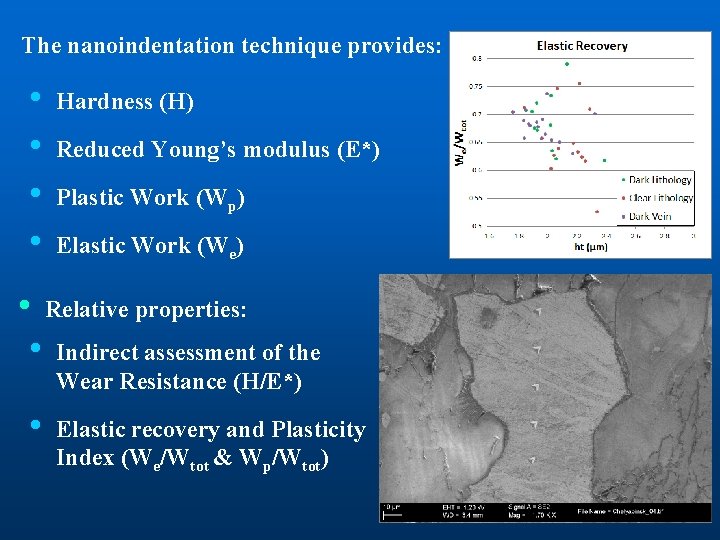
The nanoindentation technique provides: • • Hardness (H) Reduced Young’s modulus (E*) Plastic Work (Wp) Elastic Work (We) • Relative properties: • Indirect assessment of the Wear Resistance (H/E*) • Elastic recovery and Plasticity Index (We/Wtot & Wp/Wtot)
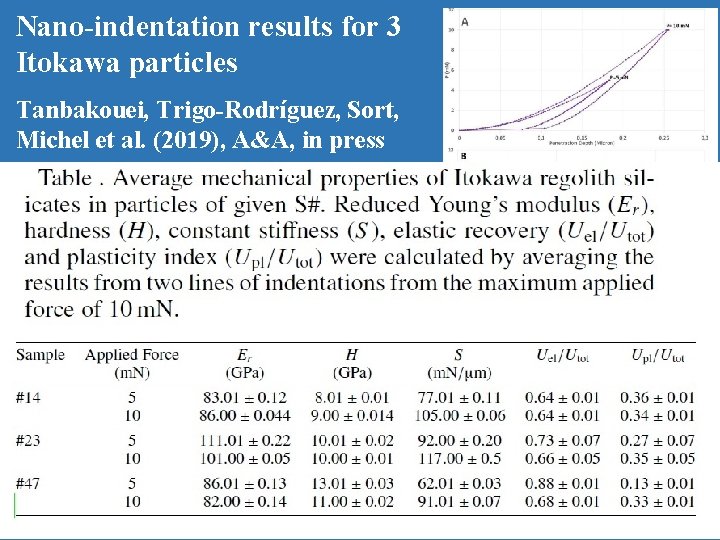
Nano-indentation results for 3 Itokawa particles Tanbakouei, Trigo-Rodríguez, Sort, Michel et al. (2019), A&A, in press
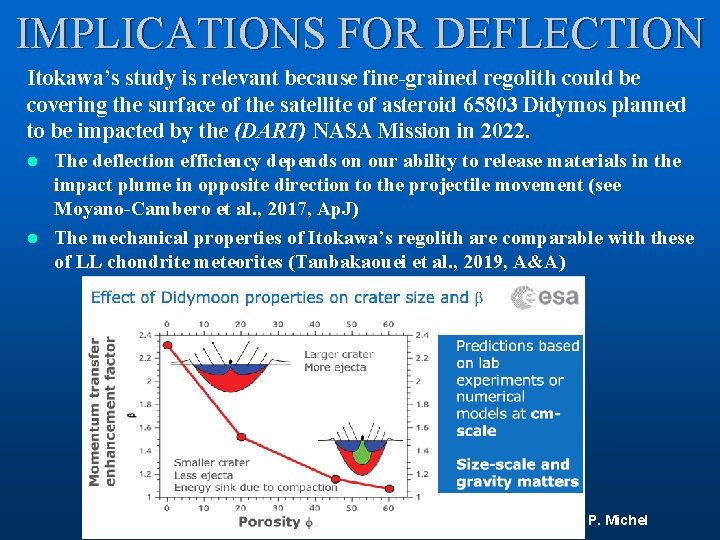
IMPLICATIONS FOR DEFLECTION Itokawa’s study is relevant because fine-grained regolith could be covering the surface of the satellite of asteroid 65803 Didymos planned to be impacted by the (DART) NASA Mission in 2022. The deflection efficiency depends on our ability to release materials in the impact plume in opposite direction to the projectile movement (see Moyano-Cambero et al. , 2017, Ap. J) l The mechanical properties of Itokawa’s regolith are comparable with these of LL chondrite meteorites (Tanbakaouei et al. , 2019, A&A) l P. Michel
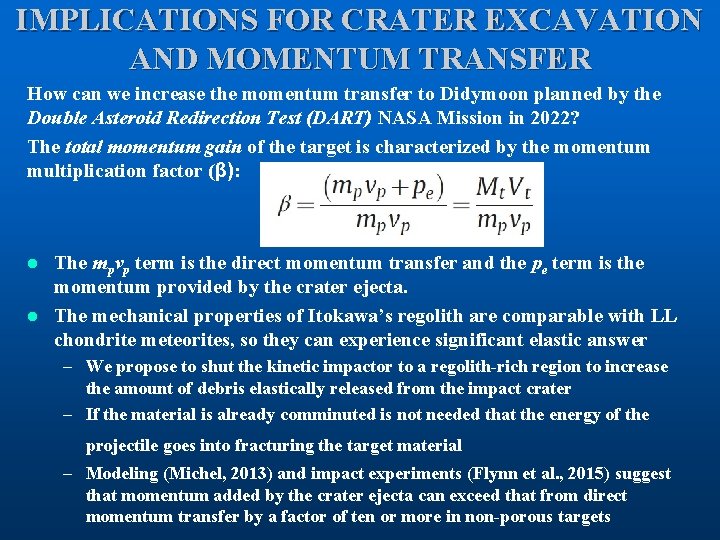
IMPLICATIONS FOR CRATER EXCAVATION AND MOMENTUM TRANSFER How can we increase the momentum transfer to Didymoon planned by the Double Asteroid Redirection Test (DART) NASA Mission in 2022? The total momentum gain of the target is characterized by the momentum multiplication factor (β): The mpvp term is the direct momentum transfer and the pe term is the momentum provided by the crater ejecta. l The mechanical properties of Itokawa’s regolith are comparable with LL chondrite meteorites, so they can experience significant elastic answer l – We propose to shut the kinetic impactor to a regolith-rich region to increase the amount of debris elastically released from the impact crater – If the material is already comminuted is not needed that the energy of the projectile goes into fracturing the target material – Modeling (Michel, 2013) and impact experiments (Flynn et al. , 2015) suggest that momentum added by the crater ejecta can exceed that from direct momentum transfer by a factor of ten or more in non-porous targets
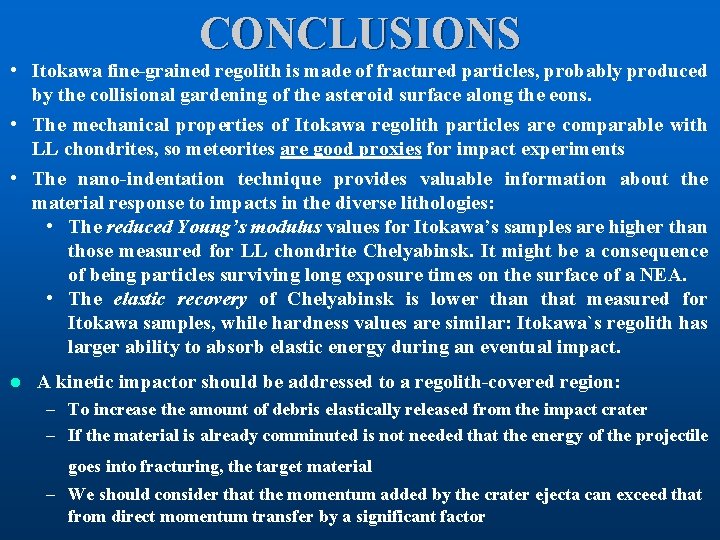
CONCLUSIONS • Itokawa fine-grained regolith is made of fractured particles, probably produced by the collisional gardening of the asteroid surface along the eons. • The mechanical properties of Itokawa regolith particles are comparable with LL chondrites, so meteorites are good proxies for impact experiments • The nano-indentation technique provides valuable information about the material response to impacts in the diverse lithologies: • The reduced Young’s modulus values for Itokawa’s samples are higher than those measured for LL chondrite Chelyabinsk. It might be a consequence of being particles surviving long exposure times on the surface of a NEA. • The elastic recovery of Chelyabinsk is lower than that measured for Itokawa samples, while hardness values are similar: Itokawa`s regolith has larger ability to absorb elastic energy during an eventual impact. l A kinetic impactor should be addressed to a regolith-covered region: – To increase the amount of debris elastically released from the impact crater – If the material is already comminuted is not needed that the energy of the projectile goes into fracturing, the target material – We should consider that the momentum added by the crater ejecta can exceed that from direct momentum transfer by a significant factor
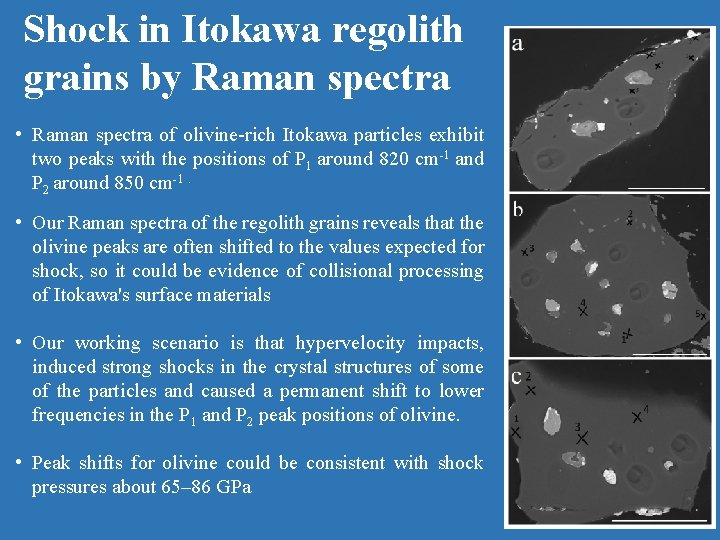
Shock in Itokawa regolith grains by Raman spectra • Raman spectra of olivine-rich Itokawa particles exhibit two peaks with the positions of P 1 around 820 cm-1 and P 2 around 850 cm-1. • Our Raman spectra of the regolith grains reveals that the olivine peaks are often shifted to the values expected for shock, so it could be evidence of collisional processing of Itokawa's surface materials • Our working scenario is that hypervelocity impacts, induced strong shocks in the crystal structures of some of the particles and caused a permanent shift to lower frequencies in the P 1 and P 2 peak positions of olivine. • Peak shifts for olivine could be consistent with shock pressures about 65– 86 GPa
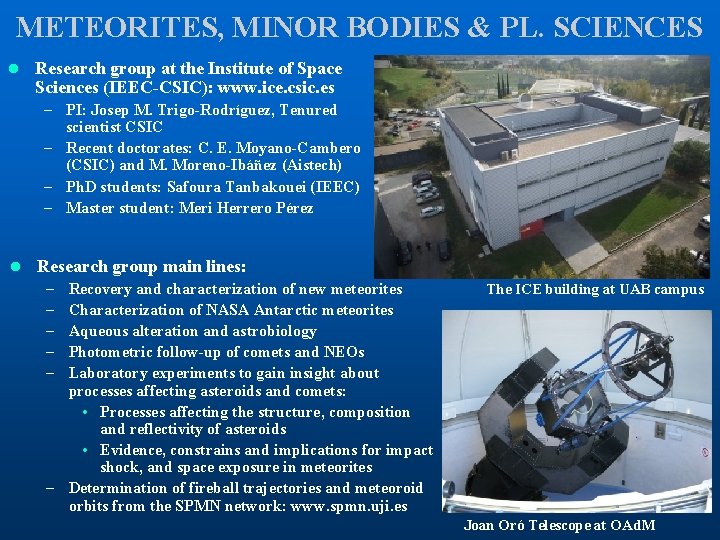
METEORITES, MINOR BODIES & PL. SCIENCES l Research group at the Institute of Space Sciences (IEEC-CSIC): www. ice. csic. es – PI: Josep M. Trigo-Rodríguez, Tenured scientist CSIC – Recent doctorates: C. E. Moyano-Cambero (CSIC) and M. Moreno-Ibáñez (Aistech) – Ph. D students: Safoura Tanbakouei (IEEC) – Master student: Meri Herrero Pérez l Research group main lines: – – – Recovery and characterization of new meteorites Characterization of NASA Antarctic meteorites Aqueous alteration and astrobiology Photometric follow-up of comets and NEOs Laboratory experiments to gain insight about processes affecting asteroids and comets: • Processes affecting the structure, composition and reflectivity of asteroids • Evidence, constrains and implications for impact shock, and space exposure in meteorites – Determination of fireball trajectories and meteoroid orbits from the SPMN network: www. spmn. uji. es The ICE building at UAB campus Joan Oró Telescope at OAd. M