
Increasing Computer Science Training to Support Future Technology
- Slides: 1
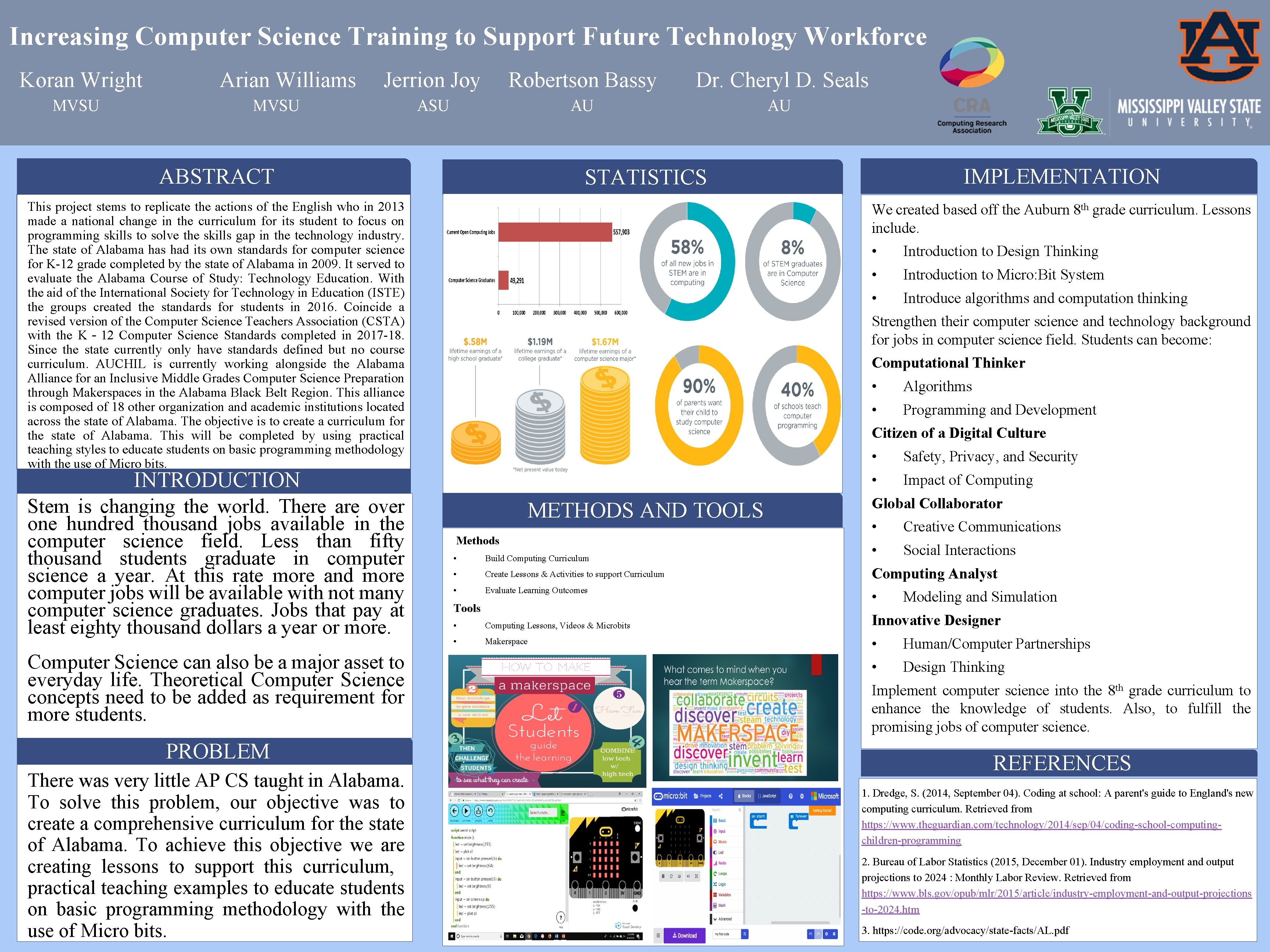
Increasing Computer Science Training to Support Future Technology Workforce Koran Wright MVSU Arian Williams Jerrion Joy Robertson Bassy Dr. Cheryl D. Seals ASU AU AU MVSU ABSTRACT This project stems to replicate the actions of the English who in 2013 made a national change in the curriculum for its student to focus on programming skills to solve the skills gap in the technology industry. The state of Alabama has had its own standards for computer science for K-12 grade completed by the state of Alabama in 2009. It served to evaluate the Alabama Course of Study: Technology Education. With the aid of the International Society for Technology in Education (ISTE) the groups created the standards for students in 2016. Coincide a revised version of the Computer Science Teachers Association (CSTA) with the K‐ 12 Computer Science Standards completed in 2017 -18. Since the state currently only have standards defined but no course curriculum. AUCHIL is currently working alongside the Alabama Alliance for an Inclusive Middle Grades Computer Science Preparation through Makerspaces in the Alabama Black Belt Region. This alliance is composed of 18 other organization and academic institutions located across the state of Alabama. The objective is to create a curriculum for the state of Alabama. This will be completed by using practical teaching styles to educate students on basic programming methodology with the use of Micro bits. We created based off the Auburn 8 th grade curriculum. Lessons include. Computer Science can also be a major asset to everyday life. Theoretical Computer Science concepts need to be added as requirement for more students. PROBLEM There was very little AP CS taught in Alabama. To solve this problem, our objective was to create a comprehensive curriculum for the state of Alabama. To achieve this objective we are creating lessons to support this curriculum, practical teaching examples to educate students on basic programming methodology with the use of Micro bits. • Introduction to Design Thinking • Introduction to Micro: Bit System • Introduce algorithms and computation thinking Strengthen their computer science and technology background for jobs in computer science field. Students can become: Computational Thinker • Algorithms • Programming and Development Citizen of a Digital Culture INTRODUCTION Stem is changing the world. There are over one hundred thousand jobs available in the computer science field. Less than fifty thousand students graduate in computer science a year. At this rate more and more computer jobs will be available with not many computer science graduates. Jobs that pay at least eighty thousand dollars a year or more. IMPLEMENTATION STATISTICS METHODS AND TOOLS Methods • Safety, Privacy, and Security • Impact of Computing Global Collaborator • Creative Communications • Social Interactions • Build Computing Curriculum • Create Lessons & Activities to support Curriculum Computing Analyst • Evaluate Learning Outcomes • Tools • Computing Lessons, Videos & Microbits • Makerspace Modeling and Simulation Innovative Designer • Human/Computer Partnerships • Design Thinking Implement computer science into the 8 th grade curriculum to enhance the knowledge of students. Also, to fulfill the promising jobs of computer science. REFERENCES 1. Dredge, S. (2014, September 04). Coding at school: A parent's guide to England's new computing curriculum. Retrieved from https: //www. theguardian. com/technology/2014/sep/04/coding-school-computingchildren-programming 2. Bureau of Labor Statistics (2015, December 01). Industry employment and output projections to 2024 : Monthly Labor Review. Retrieved from https: //www. bls. gov/opub/mlr/2015/article/industry-employment-and-output-projections -to-2024. htm 3. https: //code. org/advocacy/state-facts/AL. pdf